AI Handoff to Human Agent: The Complete Guide to Seamless Support Transitions
The AI handoff to human agent is the critical transition point where automated chatbots recognize their limitations and seamlessly transfer conversations to live support staff. When executed properly, customers receive empathetic, context-aware assistance for complex issues like billing disputes that require human judgment, while poorly designed handoffs force customers into frustrating loops or require them to repeat information, undermining your entire automation strategy.
 Grant CooperFounder14 min read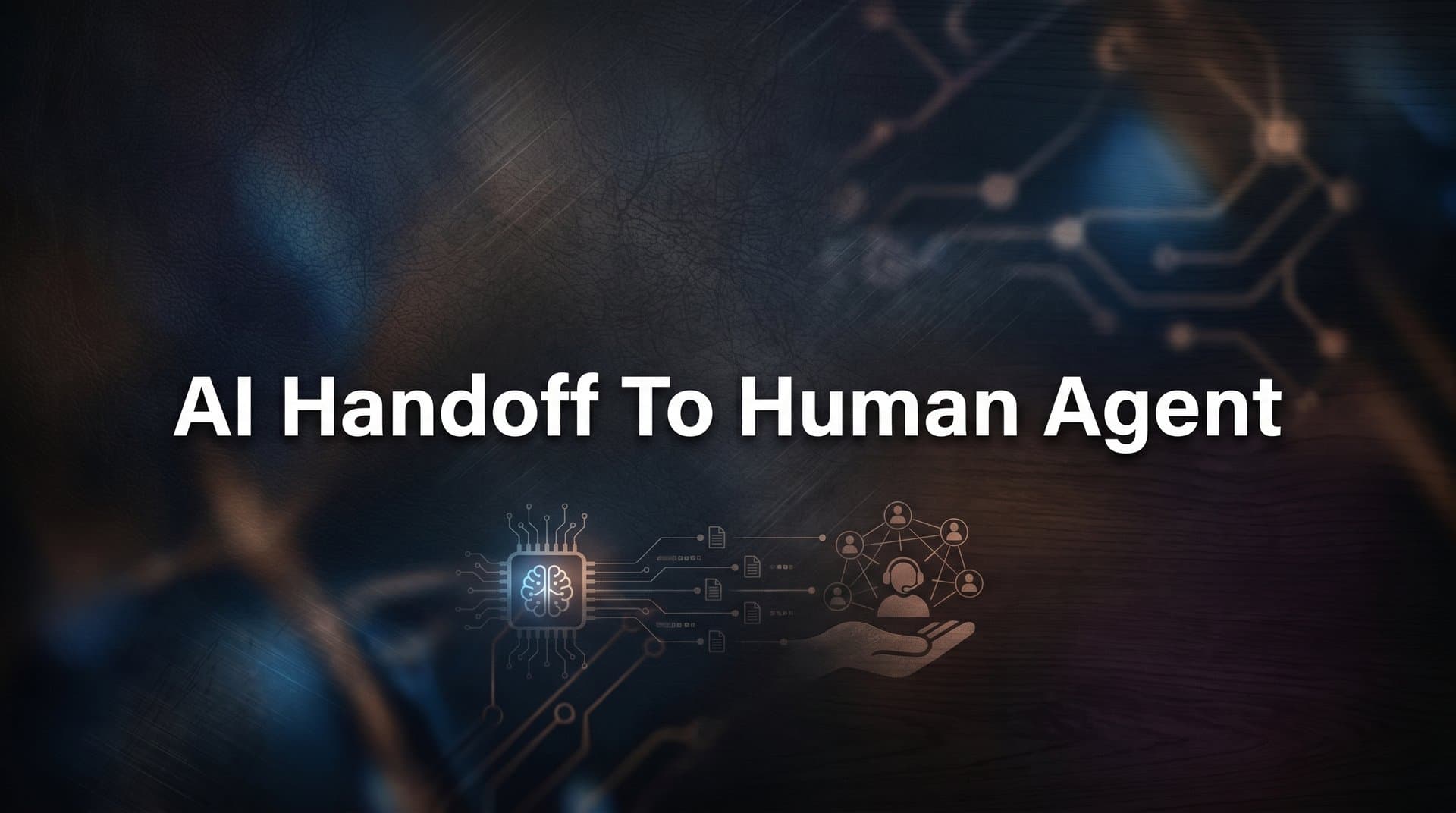
Picture this: A customer is three messages deep with your AI chatbot, trying to resolve a billing discrepancy on their account. The AI has pulled up their invoice history and explained your standard refund policy, but the customer keeps pushing back—they have a legitimate case involving a service outage that affected their billing cycle. This isn't a FAQ scenario. This is where judgment calls happen, where empathy matters, where a human needs to step in.
The AI handoff to human agent is that critical moment when automation recognizes its limits and gracefully transfers the conversation to a live person. Get it right, and your customer feels heard and supported. Get it wrong, and they're stuck in an endless loop of "I'm sorry, I didn't understand that" or forced to repeat their entire story to an agent who has zero context.
For B2B teams running customer support operations, this handoff moment is where your automation strategy either proves its intelligence or reveals its gaps. This guide breaks down exactly how to build AI support that knows when to step back, how to transition seamlessly, and why the best AI systems aren't the ones that never escalate—they're the ones that escalate at exactly the right time.
The Anatomy of an Intelligent Handoff
Let's start with what AI handoff to human agent actually means in practice. At its core, it's the transfer of a customer conversation from an automated system to a live support agent—but that simple definition hides enormous complexity. The difference between a good handoff and a terrible one comes down to what information travels with that transfer.
Think of it like a relay race. In a poorly designed system, the AI drops the baton and walks away, leaving the human agent to start from scratch. The customer has to repeat their issue, re-explain what they've already tried, and sit through the same diagnostic questions they just answered. This is what the industry calls a "cold transfer," and it's one of the fastest ways to destroy customer trust.
An intelligent handoff has three essential components working together. First is trigger detection—the system's ability to recognize when escalation is needed. This isn't just about looking for the phrase "speak to a human." Modern systems analyze conversation patterns, detect rising frustration in language, identify issue types that require human judgment, and recognize when the AI has reached the limits of what it can confidently resolve.
The second component is context preservation. When the handoff happens, the human agent should receive everything: the complete conversation transcript, what the customer has already tried, relevant account details, the AI's assessment of the issue, and even sentiment indicators that signal how frustrated or urgent the customer feels. This context transforms the agent's experience from "What can I help you with?" to "I can see you've been working on a billing issue related to last month's service outage—let me take a closer look at your account."
The third piece is routing logic—determining which human should receive this escalated conversation. Not every agent has the same expertise, availability, or authority level. A billing dispute needs someone who can process refunds. A technical integration question needs an agent familiar with APIs and developer tools. A cancellation threat from a high-value customer might need to go straight to an account manager.
When these three components work together, the customer experience is seamless. They never feel like they're being bounced between systems. The conversation flows naturally from AI assistance to human expertise, with no information lost in translation. The agent jumps in already briefed, ready to solve the problem rather than gather background information.
Compare this to the alternative many customers still experience: reaching the limits of what an AI can help with, asking for a human, being told to call a phone number or submit a form, and then starting over with an agent who knows nothing about the conversation that just happened. That's not a handoff. That's abandonment with extra steps.
Recognizing the Right Moment to Escalate
The hardest part of AI handoff to human agent isn't the technical transfer—it's knowing when to make that call. Escalate too often, and you've built an expensive routing system that defeats the efficiency purpose of automation. Escalate too rarely, and you trap frustrated customers in conversations that can't resolve their issues.
Emotional escalation signals are often the clearest indicators. When customers explicitly ask for a human—"I need to speak to a real person," "This isn't working, connect me to someone"—the AI should comply immediately. But explicit requests aren't the only signals. Language patterns reveal rising frustration: repeated questions, increasingly short responses, profanity or aggressive language, or the customer saying variations of "I already told you that."
Sentiment analysis helps here, but it needs to be calibrated carefully. A single frustrated message doesn't always warrant escalation—sometimes customers are venting about their situation, not the support experience. Look for sustained negative sentiment across multiple messages, or sudden spikes in frustration after the AI provides an answer. These patterns suggest the conversation isn't moving toward resolution.
Certain topics inherently require human judgment. Cancellation requests, complaints about service quality, legal or compliance questions, requests for exceptions to standard policies—these aren't scenarios where you want AI making decisions. Even if the AI could technically process a cancellation, the business value of having a human attempt to retain that customer far outweighs any efficiency gain from automation. Understanding the handoff between AI and human support for these sensitive topics is essential.
Complexity thresholds matter too. When a customer's issue involves multiple interconnected problems, unusual edge cases, or situations the AI hasn't been trained on, escalation becomes necessary. If the AI finds itself asking clarifying questions beyond a certain depth without reaching resolution, that's a signal. If the customer's account shows unusual patterns that don't match standard scenarios, that's a signal. If the proposed solution requires multiple manual steps or coordination across systems, that's a signal.
Business-critical moments demand human attention regardless of whether AI could theoretically handle them. High-value customers—those with large contracts, long tenure, or significant revenue potential—should often have lower escalation thresholds. The cost of mishandling their issue is too high. Revenue-impacting decisions like pricing negotiations, contract renewals, or upgrade discussions benefit from human relationship-building that AI can't replicate.
Here's the thing about escalation triggers: they should evolve based on your AI's capabilities. Early in deployment, you might escalate conservatively, transferring any issue that feels borderline. As the AI learns and proves itself on more issue types, you can raise those thresholds. Every successful AI resolution is evidence that similar future issues might not need escalation. Every escalation that reveals a gap is training data for expanding what the AI can handle.
Preserving Context Through the Transition
The moment of handoff is where most AI support systems fail. The customer has invested time explaining their situation, the AI has gathered information and attempted solutions, and then—poof—all that context evaporates when a human agent joins the conversation. The customer hears "Hi, how can I help you today?" and realizes with sinking dread that they're starting over.
Context preservation starts with the complete conversation transcript. The human agent needs to see every message exchanged, in order, exactly as the customer experienced it. But raw transcripts aren't enough—they can be overwhelming, especially for lengthy conversations. The best systems provide both the full transcript and an AI-generated summary that highlights key points: the customer's core issue, what's been tried, relevant account details, and the reason for escalation.
Think about what information actually matters to the receiving agent. They need to know the customer's identity and account status—are they a new trial user or a long-term enterprise customer? They need the issue classification—is this billing, technical support, a feature request, a complaint? They need sentiment context—is the customer frustrated, confused, or just seeking information? They need the AI's assessment—what solutions were attempted, what information was gathered, why the AI determined it couldn't resolve this independently. This is why support agents need product context to be effective.
The technical implementation of context transfer varies by platform architecture. Real-time sync means the agent sees messages as they arrive during the conversation, allowing them to monitor the interaction and jump in at the optimal moment. This works well for chat-based support where agents can see incoming conversations in a queue. Batch transfer happens at the point of escalation, packaging all context and delivering it when the agent accepts the ticket. This suits asynchronous support channels where immediate response isn't expected.
Maintaining conversation continuity through the handoff requires careful UX design. The customer shouldn't experience a jarring interface change or be forced to switch channels. If they started in a chat widget, the human agent should appear in that same widget. The conversation history should remain visible, creating a sense that the human is joining an ongoing discussion rather than starting a new one. Implementing live chat to support agent handoff properly makes this seamless.
Here's what this looks like from the agent's perspective: A ticket appears in their queue marked as an AI escalation. They click to open it and immediately see a briefing panel: "Customer: Sarah Chen, Enterprise Plan, Account in good standing. Issue: Unable to integrate with Salesforce API, getting authentication errors. AI attempted: Verified API credentials format, checked endpoint URLs, confirmed account permissions. Escalation reason: Customer reports following all troubleshooting steps with no resolution, issue may require backend investigation. Sentiment: Moderately frustrated, time-sensitive (mentioned deadline)."
Armed with this context, the agent can jump straight into problem-solving: "Hi Sarah, I can see you've been working on the Salesforce integration issue and tried the standard authentication troubleshooting. Let me check the backend logs to see if there's something else going on with your API connection." The customer doesn't repeat anything. The agent doesn't ask redundant questions. The conversation picks up exactly where it needs to.
Matching Issues to the Right Expertise
Not every human agent should receive every escalation. The whole point of intelligent routing is ensuring that when AI hands off a conversation, it lands with someone who can actually resolve it. Poor routing creates a second handoff—the agent realizes they can't help and transfers to someone else—which defeats the purpose of the first escalation.
Skill-based routing starts with issue classification. Billing questions go to agents who understand your pricing model, can process refunds, and have authority to make account adjustments. Technical support questions go to agents with product expertise who can troubleshoot integration issues, debug implementation problems, and escalate to engineering when needed. Account management questions—renewals, upgrades, contract negotiations—go to agents focused on customer success and revenue retention. Deploying AI agents for technical support can help with initial triage before routing to specialists.
The AI's role in routing is providing accurate issue classification before the handoff happens. This is where conversation analysis during the AI interaction pays off. By the time escalation is triggered, the system should have enough information to categorize the issue type, estimate complexity, and determine required expertise. A customer asking about API rate limits needs a different agent than one questioning their invoice charges.
Availability and workload balancing prevent escalated customers from sitting in queues while agents are overwhelmed or idle. Real-time routing considers which agents are currently online, how many active conversations each is handling, and what their average resolution times look like. If your billing specialist is managing five complex cases, routing a sixth to them creates a bottleneck. Routing to an available generalist who can handle basic billing questions keeps the customer moving toward resolution.
Escalation tiers add another layer of intelligence. Not every issue needs your most senior agents, but some absolutely do. A standard billing question can go to any billing-trained agent. A request for a custom enterprise pricing exception needs someone with authority to negotiate. A threat to cancel a six-figure contract needs your most experienced account manager or a team lead. The routing logic should recognize these differences and adjust accordingly. The right live agent handoff software makes this tiered routing automatic.
Here's where business context becomes critical. Your high-value customers shouldn't wait in the same queue as trial users. That's not about treating customers unfairly—it's about recognizing business impact. When a customer representing significant recurring revenue has an issue, getting them to the right expert quickly is a business priority. The routing system should factor in customer tier, contract value, and relationship history when determining priority and agent assignment.
Tracking What Handoffs Reveal
Every AI handoff to human agent is a data point that tells you something about your support operation. Measuring handoff success isn't just about tracking numbers—it's about understanding patterns that reveal where your AI is working, where it's struggling, and where your overall support strategy needs adjustment.
The handoff rate is your starting metric: what percentage of AI conversations end in escalation? But context matters enormously here. A 20% handoff rate might be excellent if your AI is handling complex product support, or concerning if it's meant to answer simple FAQs. The rate itself is less important than the trend and the reasons behind it. Is the rate decreasing as your AI learns? Are certain issue types escalating more than others? Are specific customer segments more likely to need human help? Implementing AI support agent performance tracking helps you answer these questions systematically.
Resolution time post-handoff reveals how effective your context transfer is. If agents are resolving escalated issues quickly, your handoffs are working—the agent received good context and the routing was accurate. If resolution times are long, investigate why. Are agents spending time gathering information that should have transferred? Are issues being routed to the wrong expertise? Are escalations happening too late, after customers are already frustrated and harder to help?
Customer satisfaction scores for escalated tickets are your ultimate measure. You can optimize every technical aspect of handoffs, but if customers who needed human help end up dissatisfied, something's broken. Compare satisfaction scores for escalated tickets against AI-only resolutions. In healthy systems, escalated tickets should have equal or higher satisfaction—these customers got exactly what they needed (human expertise) at the right time.
Here's where handoff data becomes training data: every escalation is a signal about what your AI should learn to handle better. If you're seeing consistent escalations around a specific product feature, that's a gap in your AI's training. If customers frequently ask for humans when dealing with a particular workflow, your AI needs better content for that scenario. If certain edge cases keep triggering escalations, you need to decide whether to train the AI on those cases or accept that they'll always need human judgment.
The goal isn't zero handoffs. That's a critical point many teams miss when optimizing for automation. Some issues should always go to humans—high-stakes decisions, emotional situations, complex negotiations, relationship-building moments. The goal is right-time handoffs: escalating when human expertise adds value, automating when AI can confidently resolve the issue. Understanding the balance between support automation vs live agents is key to this optimization.
Track escalation patterns by customer journey stage too. New customers might need more hand-holding and escalate more frequently while learning your product. Long-term customers might escalate mainly for advanced use cases or account changes. Understanding these patterns helps you calibrate AI training and staffing levels appropriately.
Use handoff data to identify training priorities for both AI and human agents. If your AI is escalating questions about a newly launched feature, create better training content. If human agents struggle with certain types of escalated issues, they need additional training or resources. The handoff point is where automation and human expertise meet—optimize both sides of that equation.
Designing Handoffs as a Feature, Not a Failure
The smartest AI support systems aren't the ones that never escalate to humans. They're the ones that know exactly when to escalate and do it so smoothly that customers never feel like they're being bounced between systems. AI handoff to human agent isn't a failure of your automation strategy—it's proof that your automation is intelligent enough to recognize its limits.
Think about your current handoff experience from the customer's perspective. Are they repeating information they already provided? Are they waiting in queues after the AI promises immediate help? Are they being asked to switch channels or start over in a different system? Each of these friction points is an opportunity to improve. The best handoffs feel like a natural conversation flow: "Let me connect you with someone who can help with this specific situation" followed by a human who's already up to speed.
Evaluate your handoff triggers honestly. Are you escalating too conservatively, routing issues to humans that AI could handle with better training? Or are you pushing automation too aggressively, trapping customers in loops when they need expertise? The right balance comes from continuous monitoring and adjustment based on real customer outcomes, not just efficiency metrics.
Context preservation is where most systems have room to improve. Your human agents should never start a conversation with "How can I help you?" when the customer just spent ten minutes explaining their issue to an AI. Every piece of information gathered during the AI interaction should flow to the agent, formatted in a way that's immediately useful rather than overwhelming.
Here's the forward-looking perspective: every handoff makes both your AI and your human agents more effective over time. The AI learns from patterns in escalated issues, expanding what it can confidently handle. Human agents develop expertise in the complex, nuanced issues that require their judgment. The feedback loop between automation and human expertise creates a support operation that gets smarter with every interaction.
Your support team shouldn't scale linearly with your customer base. Let AI agents handle routine tickets, guide users through your product, and surface business intelligence while your team focuses on complex issues that need a human touch. See Halo in action and discover how continuous learning transforms every interaction into smarter, faster support—with intelligent handoffs that ensure customers always get the right help at the right time.