Customer Support Sentiment Analysis: How AI Reads Between the Lines to Transform Service Quality
Customer support sentiment analysis uses AI to detect emotional cues hidden in support conversations that human teams miss at scale—like the frustrated undertone in "Fine, I guess that works." By analyzing these subtle signals across thousands of tickets, companies can identify at-risk customers before they churn, spot emerging product issues early, and shift from reactive problem-solving to proactive service that improves retention and customer satisfaction.
 Grant CooperFounder15 min read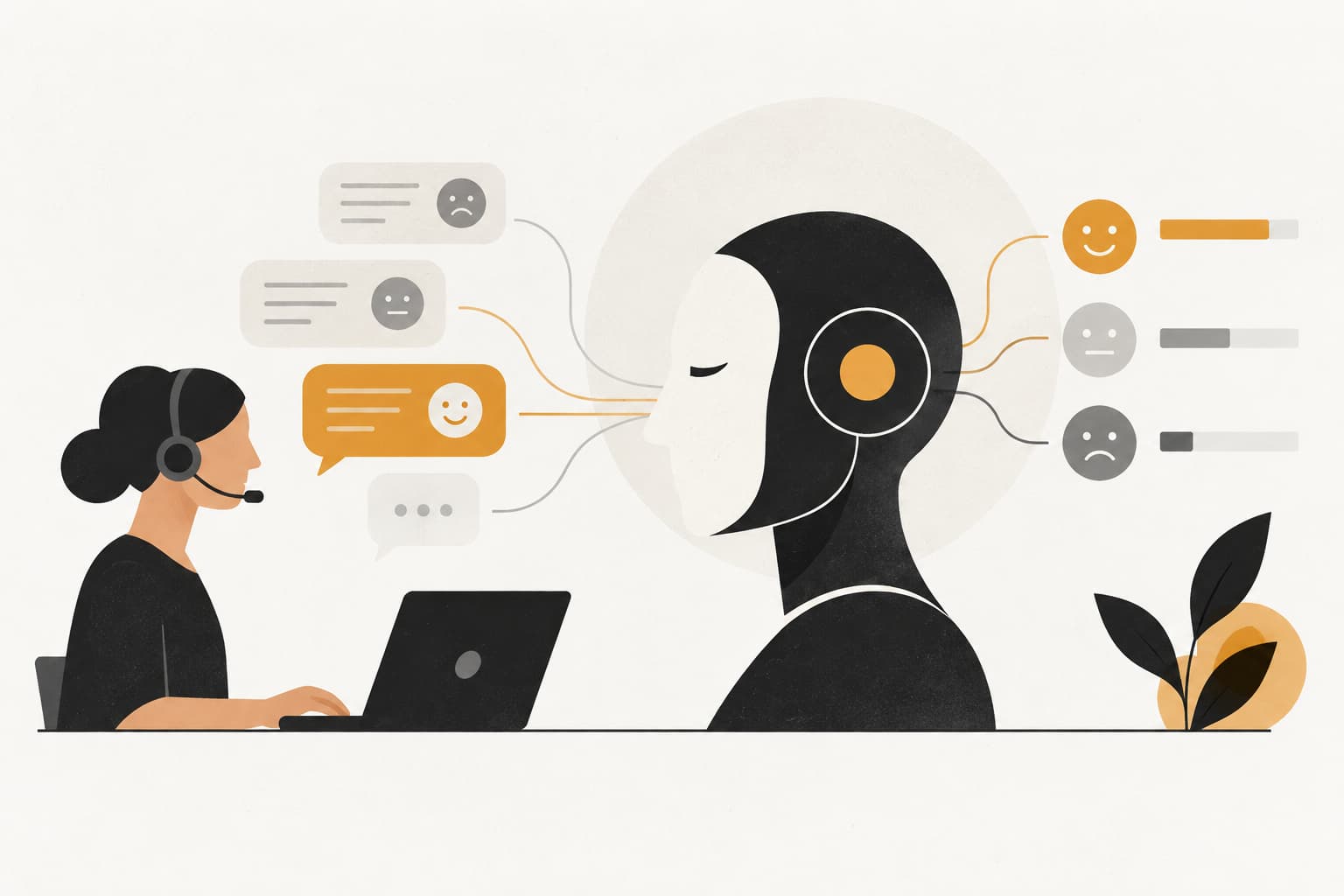
Picture this: A customer types "Fine, I guess that works" in response to your support agent's solution. Your team marks it resolved. The ticket closes. But three weeks later, that same customer churns to a competitor. What happened? The words said one thing, but the emotion behind them told a completely different story.
This is the challenge that customer support sentiment analysis solves. While humans excel at reading emotional cues in face-to-face conversations, we struggle to decode the subtle signals hidden in thousands of support tickets flowing through our systems daily. That frustrated "Fine" carries the same emotional weight as an explicit complaint, but at scale, these nuanced signals slip through the cracks.
The stakes couldn't be higher. Companies that understand the emotional undercurrents in customer communications can intervene before frustration becomes churn, identify product issues before they explode, and transform reactive support into proactive relationship management. Customer support sentiment analysis uses artificial intelligence to read between the lines, detecting emotional patterns that would be impossible for human teams to spot across every interaction.
In this guide, we'll explore how sentiment analysis technology actually works, what makes it different from simple keyword matching, and how forward-thinking support teams are using it to deliver emotionally intelligent service at scale. You'll learn the practical applications that move business metrics, the implementation strategies that work, and the common pitfalls to avoid. By the end, you'll understand why sentiment intelligence is rapidly becoming essential infrastructure for companies serious about customer retention.
The Science Behind Emotional Intelligence in Support
At its core, customer support sentiment analysis relies on natural language processing (NLP) to evaluate the emotional tone of customer communications. But this isn't your grandfather's keyword matching system. Modern sentiment analysis powered by transformer-based language models understands context and nuance in ways that would have seemed like science fiction just a few years ago.
Here's how it works. The AI examines multiple layers of language simultaneously. Word choice matters, obviously—"frustrated" signals something different than "confused." But the technology goes deeper. Punctuation patterns reveal intensity: "This doesn't work!!!" carries more urgency than "This doesn't work." Sentence structure provides clues too. Short, clipped sentences often indicate frustration, while longer explanatory messages might suggest confusion or a willingness to engage.
The real breakthrough comes in distinguishing explicit sentiment from implicit sentiment. Explicit sentiment is straightforward—when a customer writes "I'm extremely frustrated with this experience," the emotion is stated directly. Implicit sentiment requires reading between the lines. Consider "This is the third time I've contacted you about this issue." Those words don't contain emotional descriptors, yet they clearly communicate mounting frustration and eroding patience.
Modern automated support sentiment analysis systems excel at detecting these implicit signals. They recognize patterns like repeated contact attempts, escalating language intensity, and subtle shifts in communication tone. The AI might notice that a customer who started their first message with "Hi there! I'm having a small issue" has progressed to "I need this fixed immediately" by their third interaction—even if they never explicitly state their frustration.
The technology also understands context in ways earlier systems couldn't. It recognizes that "This is sick!" means something completely different in a gaming support context versus a healthcare application. It catches sarcasm—"Oh great, another update that breaks everything"—where keyword-based systems would incorrectly flag "great" as positive sentiment.
There's an important distinction between real-time sentiment analysis and aggregate sentiment analysis, and knowing when each matters changes how you deploy the technology. Real-time analysis evaluates individual messages as they arrive, enabling dynamic responses during active conversations. This is crucial for identifying when a customer interaction is heading south and needs immediate escalation or intervention.
Aggregate sentiment analysis, on the other hand, looks at patterns across many interactions over time. This reveals systemic issues that individual tickets might not expose. When sentiment scores consistently drop whenever customers mention a specific product feature, you've identified a problem that needs product team attention, not just better support responses.
From Raw Data to Actionable Emotion Scores
Understanding that sentiment analysis detects emotional signals is one thing. Knowing what to do with those signals is another. This is where the technology transforms from interesting to invaluable—by converting raw emotional data into actionable intelligence that drives better decisions.
The simplest sentiment systems categorize messages as positive, negative, or neutral. That's a start, but it's like describing a symphony as "loud" or "quiet"—you're missing most of the story. Advanced sentiment analysis goes far deeper, identifying specific emotional states that require different responses.
Urgency: A customer who writes "I have a presentation in two hours and the export feature isn't working" expresses a time-sensitive crisis that demands immediate attention, regardless of when the ticket arrived in your queue.
Confusion: Messages filled with questions and uncertain language—"I'm not sure if I'm doing this right" or "Maybe I'm missing something?"—signal customers who need educational guidance rather than technical troubleshooting.
Satisfaction levels: The difference between "This works perfectly, thank you!" and "Yeah, that's fine" represents a meaningful gap in customer experience quality, even though both are technically positive.
Context becomes critical when analyzing sentiment shifts within a single conversation. Imagine a support interaction that starts with negative sentiment, improves to neutral as the agent engages, then drops back to negative when the proposed solution doesn't work. That emotional journey tells a story about failed expectations and growing frustration that a simple "ticket resolved" status completely misses.
The AI tracks these sentiment arcs in real-time, recognizing when an interaction is improving or deteriorating. This enables support systems to automatically escalate conversations that show declining sentiment, even if the customer never explicitly asks to speak with a manager. The technology sees what's happening before the situation becomes irreparable.
Industry-specific language learning represents another crucial capability. A generic sentiment model might misinterpret technical jargon or domain-specific terminology. When a developer writes "This API is throwing errors left and right," they're reporting a technical issue, not expressing emotional distress about directional problems. AI systems that learn from your actual customer communications develop nuanced understanding of how your specific audience expresses emotions.
This learning happens continuously. Every resolved ticket, every customer interaction, every piece of feedback trains the model to better understand your customers' communication patterns. The system learns that when your enterprise clients use formal language, it doesn't indicate emotional distance—it's just their communication style. It discovers that your startup customers tend to use casual language even when seriously frustrated, so tone alone isn't a reliable sentiment indicator.
The output of all this analysis typically comes in the form of emotion scores—quantified measurements of different emotional states detected in the communication. These scores enable systematic decision-making at scale, and understanding customer support trend analysis helps you interpret these patterns over time. You can route tickets, prioritize queues, trigger automations, and measure trends based on emotional intelligence rather than just keywords or timestamps.
Practical Applications That Move the Needle
Sentiment analysis technology is fascinating, but the real question is: what can you actually do with it? The answer transforms how support operations function, shifting from reactive firefighting to proactive relationship management.
The most immediate application is intelligent ticket prioritization. Traditional support queues operate on first-in-first-out logic or simple priority tags. Sentiment-based prioritization adds a crucial dimension: emotional urgency. A ticket that arrived ten minutes ago from a highly frustrated customer who's already contacted you twice might need attention before a three-hour-old inquiry from a curious prospect asking about features.
This isn't about ignoring the prospect—it's about recognizing that the frustrated customer represents immediate churn risk while the prospect is still in exploration mode. Support teams using sentiment prioritization often find they can prevent escalations simply by responding to emotional urgency before it boils over into public complaints or cancellations.
Proactive outreach represents another powerful application. When sentiment analysis detects a customer's emotional state dropping below certain thresholds—particularly when it's declining across multiple interactions—the system can trigger automatic alerts or even proactive communication. Think of it as an early warning system for customer relationships in trouble.
This might look like a senior support specialist receiving a notification when a high-value customer's sentiment score drops significantly, enabling them to reach out personally before the customer even considers leaving. Or it could mean automatically offering a call with a product specialist when a customer shows sustained confusion across several support interactions, rather than letting them struggle through endless back-and-forth messages. This is where proactive customer support software delivers exceptional value.
The aggregate view reveals systemic issues that individual tickets can't expose. When you analyze sentiment patterns across hundreds or thousands of interactions, themes emerge. You might discover that sentiment consistently drops whenever customers mention a specific product feature, indicating a usability problem that needs product team attention. Or you might find that sentiment improves dramatically when certain support agents handle tickets, revealing coaching opportunities for the rest of the team.
These patterns often surface problems before they become widespread complaints. A gradual decline in average sentiment around a particular workflow might indicate that a recent product update introduced friction that customers haven't yet explicitly complained about—but they're feeling it. This gives product and support teams the chance to investigate and fix issues proactively rather than reactively.
Sentiment data also informs resource allocation decisions. By tracking which types of issues generate the most negative sentiment, support leaders can make data-driven decisions about where to invest in better documentation, product improvements, or additional training. If password reset requests consistently generate frustrated sentiment, maybe the reset flow needs UX work rather than just faster support responses.
The technology enables dynamic conversation routing too. When an AI agent detects rising frustration or confusion during an interaction, it can seamlessly hand off to a human specialist who's better equipped to handle complex emotional situations. This creates a natural division of labor: AI handles routine inquiries efficiently, while humans focus on the interactions that need empathy and creative problem-solving.
Building Your Sentiment Analysis Strategy
Understanding what sentiment analysis can do is step one. Actually implementing it effectively requires strategic thinking about tools, metrics, and team dynamics. Let's break down how to build a sentiment analysis strategy that delivers real business value.
The first decision point: standalone sentiment analysis tools versus integrated AI support platforms. Standalone tools typically offer deep sentiment analysis capabilities that you can layer onto your existing helpdesk system through APIs. They excel at providing detailed emotional insights but require integration work and may create workflow friction when your team needs to jump between systems.
Integrated platforms like Halo embed sentiment analysis directly into the support workflow, where AI agents use emotional intelligence to inform every interaction automatically. The advantage is seamless operation—sentiment insights drive ticket routing, response prioritization, and escalation decisions without requiring manual interpretation or system-switching. The trade-off is that you're adopting a more comprehensive platform rather than adding a point solution.
Your choice depends on your current infrastructure and transformation appetite. Companies deeply invested in existing helpdesk systems might start with standalone sentiment tools to prove value before considering broader platform changes. Organizations building support operations from scratch or ready for significant upgrades often find intelligent customer support software delivers faster time-to-value.
Regardless of which path you choose, tracking the right metrics determines whether you're actually improving or just collecting interesting data. Start with these core measurements:
Sentiment trend analysis: Track average sentiment scores over time, segmented by product area, customer segment, and support channel. Are you improving? Where are the persistent problem areas?
Resolution correlation: Compare sentiment scores at ticket opening versus closing. Successful support interactions should show sentiment improvement. If sentiment stays flat or declines even when tickets are "resolved," you're solving problems without satisfying customers.
Escalation rates: Monitor how often negative sentiment leads to escalations, manager involvement, or customer churn. This helps you calibrate your intervention thresholds—are you catching problems early enough?
Response time by sentiment: Measure whether high-urgency, negative-sentiment tickets actually receive faster responses. This validates that your prioritization strategy is working in practice, not just in theory. Implementing strategies to reduce customer support response time becomes even more critical when sentiment data reveals urgent situations.
The human element remains critical even with sophisticated AI. Your team needs training not just on how the technology works, but on how to act on sentiment insights without over-automating human judgment. A low sentiment score provides valuable context, but it shouldn't replace critical thinking about what the customer actually needs.
Train your team to use sentiment data as one input among many. A frustrated customer might need a fast solution, or they might need someone to genuinely listen to their concerns before offering any solution at all. The AI can flag the frustration; the human determines the right response. This balanced approach prevents the robotic feeling that comes from overly automated interactions while still leveraging the scale and pattern recognition that AI provides.
Common Pitfalls and How to Avoid Them
Even the most sophisticated sentiment analysis technology can fail to deliver value if you fall into common implementation traps. Understanding these pitfalls helps you avoid them from the start.
The biggest mistake is over-relying on sentiment scores without human context review. A customer who writes "This is absolutely unbelievable" might be expressing amazement at how well something works, not frustration. Sarcasm, cultural communication styles, and individual quirks can all confuse sentiment analysis systems. Treating sentiment scores as absolute truth rather than valuable signals leads to misrouted tickets, inappropriate responses, and frustrated customers who feel misunderstood.
The fix is building human oversight into your workflow, especially during early implementation. Have experienced team members review sentiment classifications regularly, particularly for edge cases. Use these reviews to refine your system's understanding and identify patterns where it consistently misinterprets certain types of messages. Over time, the AI learns from these corrections, but you need human judgment to guide that learning. Understanding the balance between AI customer support vs human agents helps you design these oversight processes effectively.
Cultural and linguistic variations in emotional expression represent another significant challenge. Different cultures express frustration, satisfaction, and urgency in vastly different ways. What reads as neutral in one cultural context might signal serious dissatisfaction in another. Direct communication styles common in some regions might be interpreted as aggressive, while indirect communication from other cultures might mask urgent problems.
If you serve a global customer base, your sentiment analysis needs to account for these variations. This might mean training separate models for different regions or languages, or at minimum, being aware that sentiment scores require cultural context for accurate interpretation. A one-size-fits-all approach to sentiment analysis often misses the mark with international customers.
Perhaps the most strategic mistake is failing to close the feedback loop between sentiment data and product improvements. Sentiment analysis reveals what customers feel about your product and service, but if those insights never reach the teams who can address root causes, you're just documenting problems without fixing them.
Create formal processes for sharing sentiment insights with product, engineering, and UX teams. When aggregate sentiment consistently flags a particular feature or workflow, that's not just a support problem—it's a product problem. The companies that get the most value from sentiment analysis use it to drive continuous improvement across the entire customer experience, not just to optimize support responses.
Another pitfall is implementing sentiment analysis without clear success criteria. What are you actually trying to improve? Customer retention? Support efficiency? Product quality? Without defined goals, you can't measure whether the technology is working. Set specific targets: reduce negative sentiment tickets by a certain percentage, improve sentiment trend scores for specific product areas, or decrease escalation rates for high-value customers. Measuring customer support ROI helps you validate that your sentiment analysis investment is paying off.
Putting Sentiment Intelligence to Work
You understand the technology, the applications, and the pitfalls. Now let's talk about actually implementing sentiment analysis in your support operations. Here's a practical roadmap to get started.
Start with a quick-start checklist for integrating sentiment analysis into existing workflows. First, audit your current support data to understand what you're working with. Do you have enough historical ticket data to train models effectively? What communication channels need sentiment analysis—email, chat, social media? Identifying your data landscape helps you choose the right tools and set realistic expectations.
Next, define your priority use cases. Don't try to implement everything at once. Pick one high-impact application—maybe ticket prioritization or proactive escalation—and prove value there before expanding. This focused approach lets you learn, refine, and demonstrate ROI before making bigger commitments. If you're new to this space, learning how to get started with AI customer support provides a solid foundation.
Integrate sentiment scoring into your team's daily workflow gradually. Start by displaying sentiment scores alongside tickets so agents can use them as context, but don't change routing or prioritization yet. Let your team build trust in the data before making it drive automated decisions. Once they see that the scores align with their intuitive sense of customer emotions, you can confidently use sentiment to drive more automation.
The power of continuous learning AI cannot be overstated. Every resolved ticket, every customer interaction, every piece of feedback makes the system smarter. Early in implementation, you might see sentiment accuracy around 70-80%. That's useful, but not transformative. After months of learning from your specific customer communications, accuracy typically improves significantly as the AI understands your customers' unique communication patterns, industry jargon, and emotional expression styles.
This continuous improvement happens automatically with modern AI systems, but you can accelerate it by actively providing feedback. When agents notice sentiment misclassifications, capture those examples. When customers provide explicit feedback that contradicts sentiment scores, use that data to refine the model. The AI learns fastest when it receives clear signals about where it's getting things right and wrong.
The competitive advantage of emotionally intelligent support becomes clear when you consider the customer experience. Every company can respond to tickets. Most companies can resolve technical issues. But companies that understand and respond to the emotional dimension of customer interactions create fundamentally different relationships.
When a customer feels heard, understood, and valued—not just helped—they become advocates rather than just satisfied users. Sentiment analysis at scale enables you to deliver that emotionally intelligent experience to every customer, not just the ones who happen to interact with your most empathetic support agents. It democratizes emotional intelligence across your entire support operation.
The Future of Support Is Emotionally Intelligent
Customer support sentiment analysis represents more than just another analytics tool. It transforms support from reactive problem-solving into proactive relationship management. When you understand not just what customers say but how they feel, you can intervene before frustration becomes churn, identify systemic issues before they explode, and deliver experiences that build loyalty rather than just resolve tickets.
The technology is most powerful when it augments human empathy rather than replacing it. AI excels at pattern recognition, scale, and consistency—detecting emotional signals across thousands of interactions that no human team could monitor. Humans excel at nuanced interpretation, creative problem-solving, and genuine connection. The winning combination uses AI to surface the insights and humans to act on them with judgment and care.
As we move further into 2026, sentiment intelligence is rapidly becoming table stakes for companies serious about customer retention. The ability to read between the lines, understand emotional undercurrents, and respond with appropriate empathy at scale isn't a nice-to-have anymore—it's essential infrastructure for building lasting customer relationships in an increasingly competitive landscape.
The question isn't whether to implement sentiment analysis, but how quickly you can integrate it into your support operations and start using emotional intelligence as a competitive advantage. The companies that master this capability now will build the customer relationships that sustain their growth for years to come.
Your support team shouldn't scale linearly with your customer base. Let AI agents handle routine tickets, guide users through your product, and surface business intelligence while your team focuses on complex issues that need a human touch. See Halo in action and discover how continuous learning transforms every interaction into smarter, faster support.
How Halo helps
Halo turns support conversations into business intelligence: Ask AI answers questions across your tickets, calls, CRM, and billing data in plain English, so revenue and product teams can act on what customers are actually saying. Learn more about Halo's voice-of-customer analysis.