9 Best Affordable AI Customer Service Software Tools in 2026
Growing support volumes don't have to mean growing headhead costs — today's affordable AI customer service software can handle routine inquiries autonomously at a fraction of legacy helpdesk prices. This guide evaluates 9 top platforms on automation depth, integration ecosystems, ease of setup, and transparent pricing, so teams of any size can find the right fit in 2026.
 Matt PattoliFounder13 min read
Growing support ticket volumes don't have to mean growing headcount costs. A new generation of AI customer service platforms can handle a significant share of routine inquiries autonomously, and many of them are priced to work for lean teams as well as scaling enterprises.
But "affordable" means different things depending on your situation. For a 10-person SaaS startup, it might mean a generous free tier or per-resolution pricing. For a mid-market company, it might mean replacing a bloated helpdesk suite with something purpose-built that actually costs less at scale.
This list focuses on tools that deliver genuine AI capability, not just keyword-matching chatbots, without requiring enterprise-level budgets. We evaluated each platform on automation depth, integration ecosystem, ease of setup, and transparent pricing. Whether you're migrating off a legacy helpdesk or building your support stack from scratch, there's an option here that fits. Let's get into it.
1. Halo AI
Best for: B2B SaaS and product teams wanting AI-first support that learns and scales autonomously.
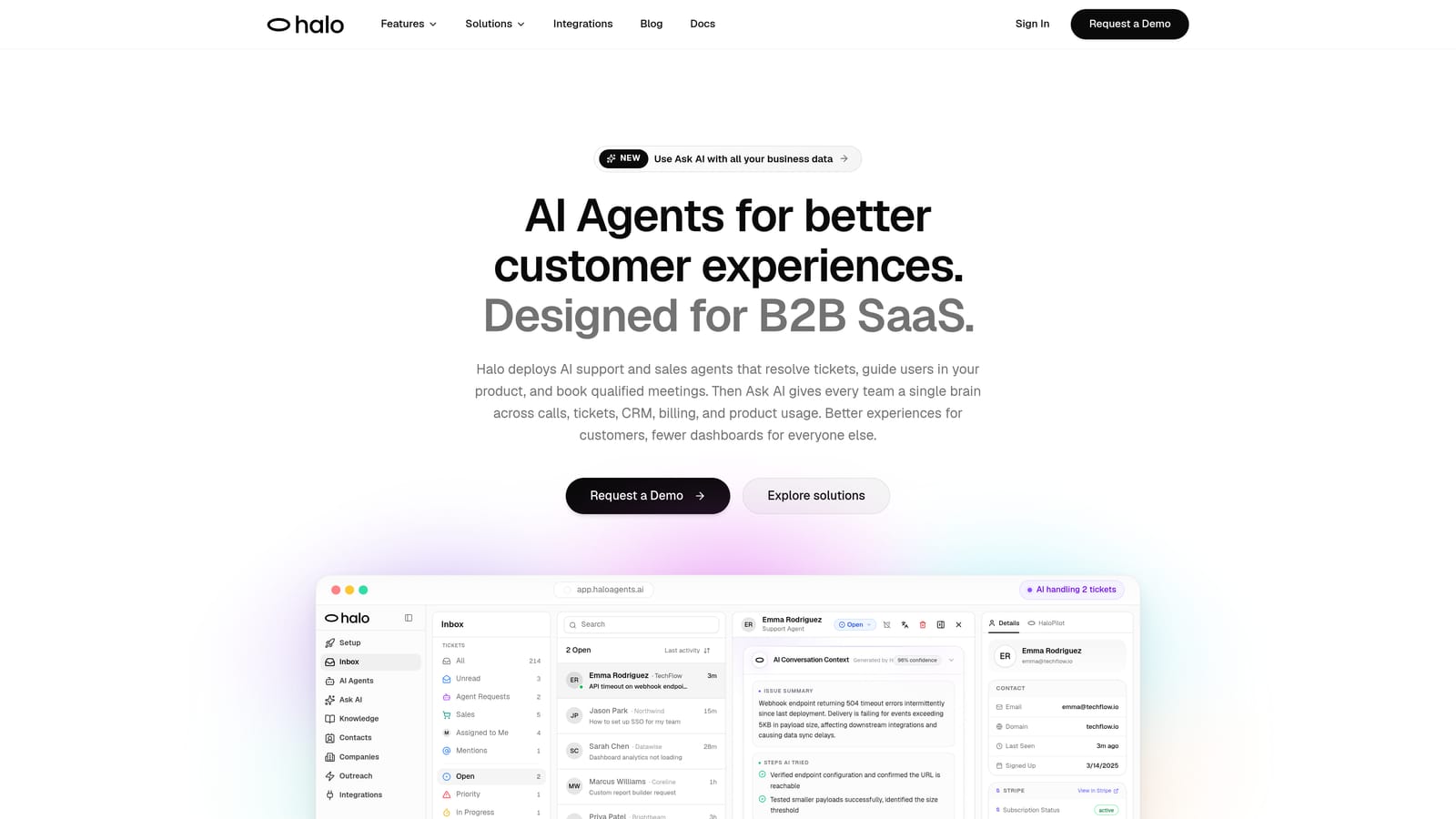
Halo AI is an AI-first customer support platform that deploys intelligent agents to resolve tickets, guide users through your product, and create bug reports, all while learning from every interaction.
Where This Tool Shines
Most AI customer service tools are bolt-ons: a chatbot layer added to an existing helpdesk. Halo is built differently, with AI at the core of every workflow. The result is a platform that doesn't just deflect tickets but actually understands context, improves over time, and surfaces intelligence your team can act on.
The page-aware chat widget is a standout capability. It sees exactly what the user sees in your product, enabling contextual guidance that's far more precise than a generic chatbot response. Combined with continuous learning from every resolved interaction, the system gets measurably smarter the more it's used.
Key Features
Page-Aware Chat Widget: Understands the user's current product context to deliver precise, in-the-moment guidance rather than generic answers.
Continuous Learning: Every resolved ticket feeds back into the model, improving future response accuracy without manual retraining.
Smart Inbox with Business Intelligence: Goes beyond support metrics to surface customer health signals, anomaly detection, and revenue intelligence from your conversation data.
Auto Bug Ticket Creation: Automatically generates and routes bug reports to Linear or your engineering stack when users report issues.
Live Agent Handoff: Escalates complex conversations to human agents with full context transfer, so nothing gets lost in the handoff.
Broad Integration Ecosystem: Connects with HubSpot, Slack, Intercom, Stripe, Zoom, PandaDoc, Fathom, and Linear out of the box.
Best For
B2B SaaS companies and product teams that want AI support agents capable of autonomous resolution, not just assisted drafting. Particularly strong for teams that need their support platform to connect with their broader business stack and deliver intelligence beyond ticket counts.
Pricing
Pricing is customized based on your team's needs. Book a demo at haloagents.ai to get a tailored overview and see the platform in action.
2. Tidio
Best for: Small businesses and e-commerce teams wanting live chat plus AI automation on a budget.
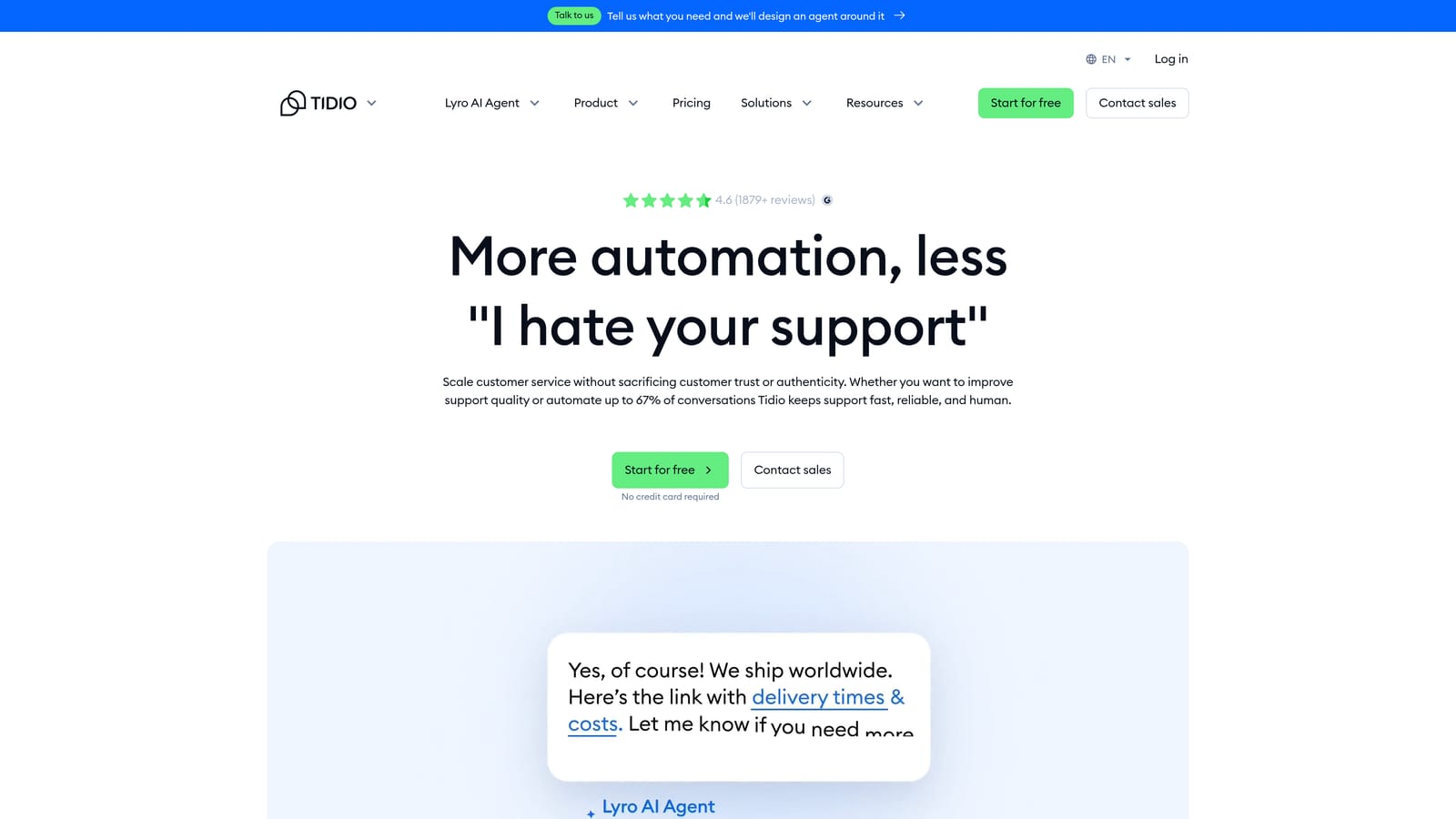
Tidio is a live chat and AI chatbot platform popular with SMBs and e-commerce teams, featuring the Lyro AI agent for automated query resolution.
Where This Tool Shines
Tidio has built a strong reputation among early-stage teams because it's genuinely easy to set up and comes with a meaningful free tier. The Lyro AI agent handles common support queries by drawing on your existing help content, reducing the volume of conversations that need a live agent.
For e-commerce teams in particular, the Shopify and WooCommerce integrations mean Tidio can slot into an existing stack with minimal friction. It's not the deepest AI on this list, but for teams prioritizing speed-to-value and low cost, it delivers well.
Key Features
Lyro AI Chatbot: Handles FAQ-style support queries autonomously using your help content as the knowledge source.
Live Chat with Visitor Tracking: Proactive messaging triggers based on user behavior, helping teams reach customers at the right moment.
E-Commerce Integrations: Native connections to Shopify, WordPress, and WooCommerce for seamless deployment.
Multi-Channel Support: Covers email and Facebook Messenger alongside live chat.
Free Plan: Available for small teams with core live chat features included at no cost.
Best For
Early-stage startups, e-commerce brands, and bootstrapped teams that want a simple, affordable entry point into AI-assisted support without complex setup or high monthly commitments.
Pricing
Free plan available for small teams. Lyro AI plans start at accessible price points. Visit tidio.com/pricing for current rates, as pricing updates frequently.
3. Freshdesk
Best for: Teams wanting a full-featured helpdesk with built-in AI and a free starting tier.
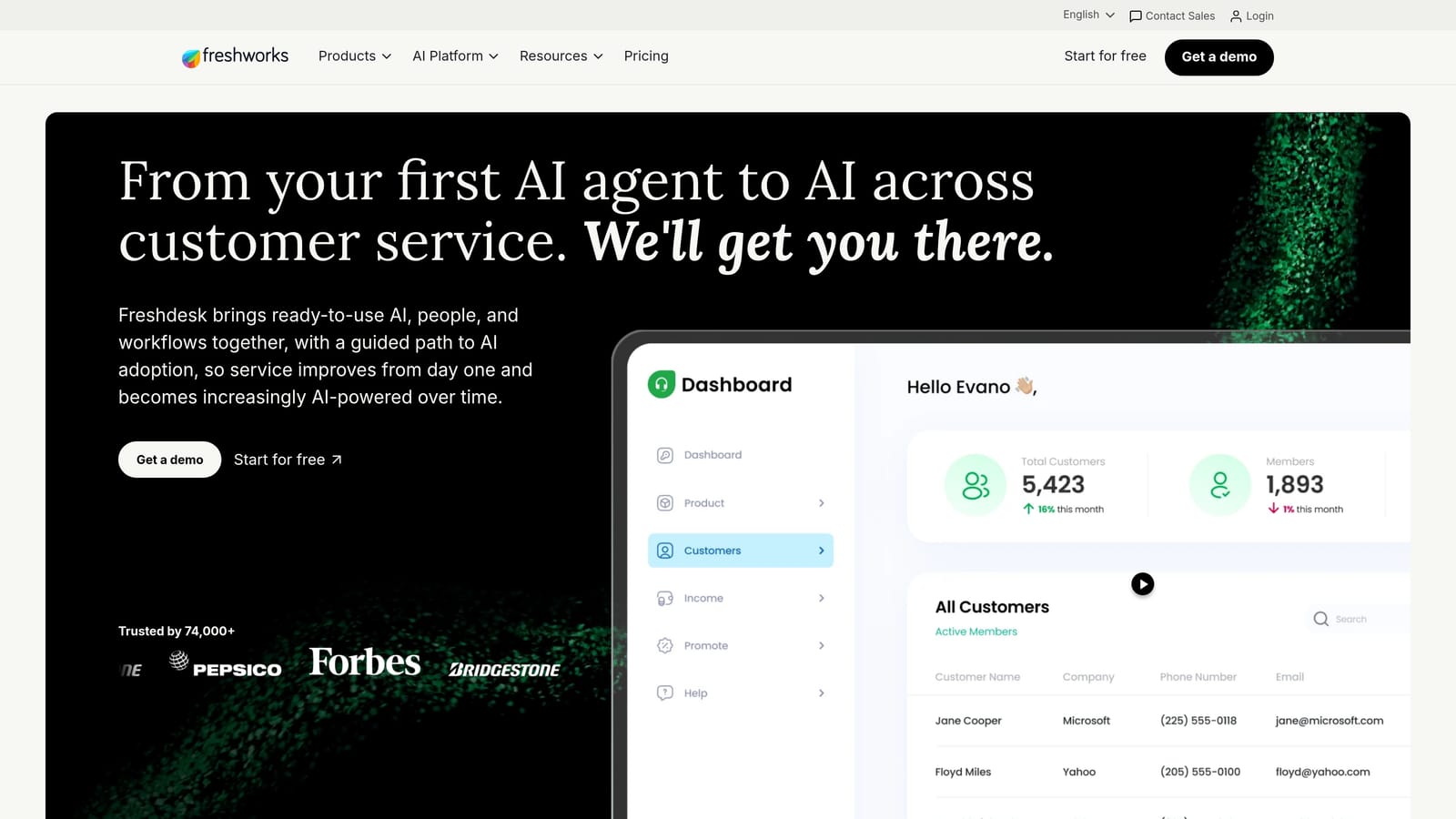
Freshdesk is a full-featured helpdesk platform by Freshworks with Freddy AI built in, offering ticketing, automation, and a knowledge base at competitive pricing.
Where This Tool Shines
Freshdesk occupies a sweet spot: it's mature enough to handle complex support operations, yet accessible enough for teams just getting started. The free plan for unlimited agents is genuinely useful, not a stripped-down teaser, making it a strong option for growing teams watching their budget.
Freddy AI adds meaningful automation across the platform, from suggesting responses to summarizing tickets, without requiring a separate AI add-on purchase on most tiers. The breadth of channel support (email, chat, phone, social) also makes it a good fit for teams managing support across multiple touchpoints.
Key Features
Freddy AI: Handles ticket summarization, suggested responses, and agent assist features across plans.
Free Plan for Unlimited Agents: Core ticketing features available at no cost, with no agent seat cap.
Multi-Channel Support: Covers email, live chat, phone, and social media in one platform.
Automation Rules and SLA Management: Configurable workflows and service level agreement tracking to keep response times on target.
Knowledge Base and Self-Service Portal: Built-in tools for creating help content that powers both agent assistance and customer self-service.
Best For
Growing teams that need a reliable, multi-channel helpdesk with AI assistance built in. Especially well-suited to teams that want to start free and upgrade as their needs evolve.
Pricing
Free plan available. Paid plans start at competitive per-agent monthly rates. See freshdesk.com/pricing for current details.
4. Intercom
Best for: SaaS companies needing polished in-product messaging with high-capability autonomous AI resolution.
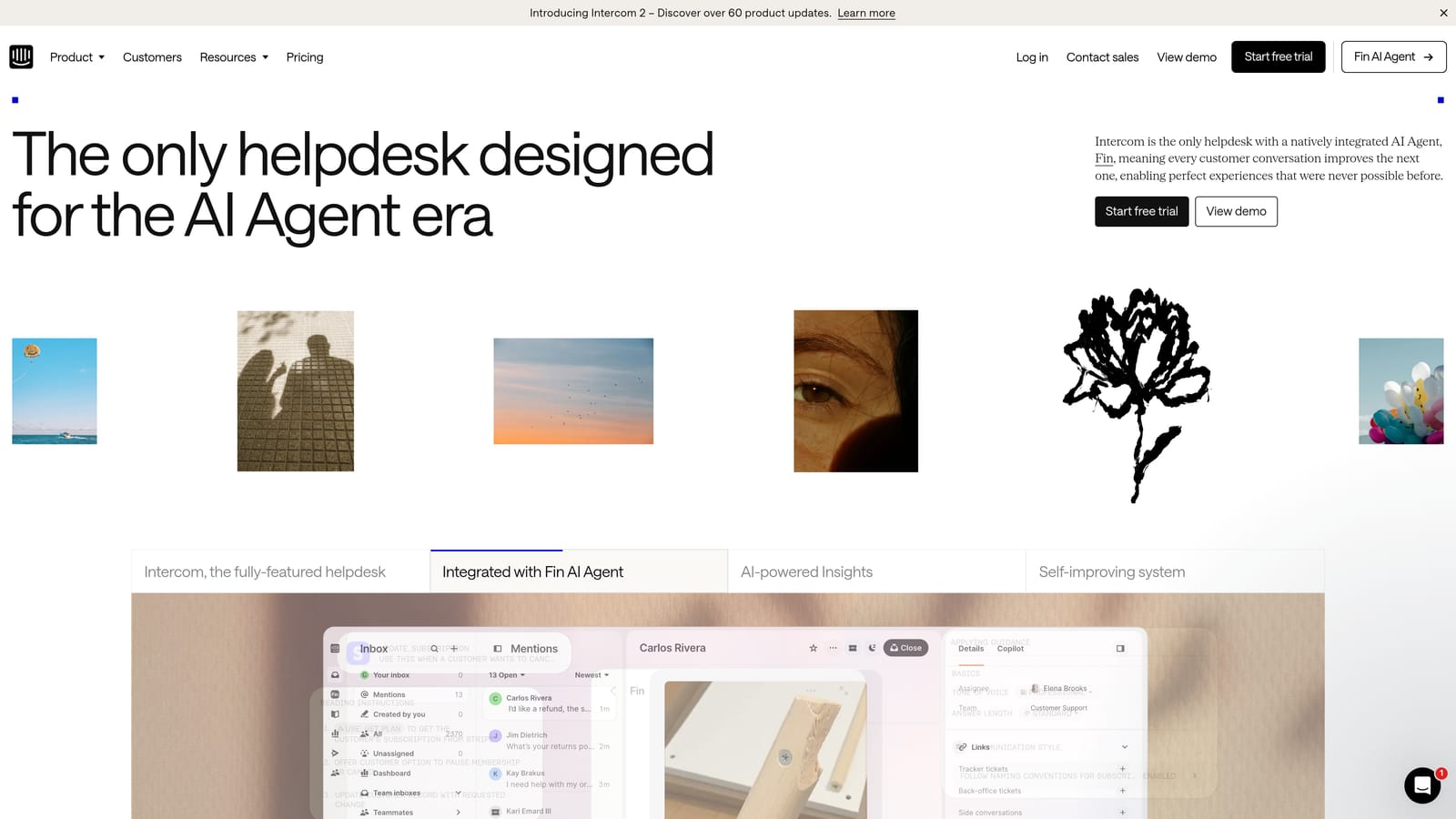
Intercom is a customer messaging platform with the Fin AI agent, designed for in-product support experiences with strong autonomous resolution capability.
Where This Tool Shines
Intercom's Fin AI agent is among the more capable resolution tools in this category. It draws on your help content to answer questions autonomously, and its conversational quality is notably high compared to older rule-based chatbots. For SaaS teams, the in-product messenger experience is polished and well-integrated.
Intercom has historically been positioned as a premium product, but more accessible plan tiers have made it relevant for a broader range of budgets. Teams that need both proactive messaging (product tours, onboarding flows) and reactive support in one platform will find the combination hard to beat.
Key Features
Fin AI Agent: Resolves support queries autonomously using your existing help documentation as its knowledge base.
In-App Messenger: Supports product tours, proactive messaging, and onboarding flows alongside reactive support.
Shared Inbox with AI Summaries: Conversation summaries help agents get up to speed quickly on complex threads.
Robust Reporting and Customer Data: Detailed analytics with customer profile data connected to support conversations.
Extensive App Marketplace: A large library of integrations and a well-documented API for custom connections.
Best For
SaaS companies with complex in-app support needs, particularly those that want proactive and reactive support unified in a single platform. Best suited for teams where AI resolution rate is a primary success metric.
Pricing
Tiered plans available. Fin AI resolution pricing varies by volume. Visit intercom.com/pricing for current rates.
5. Zoho Desk
Best for: Budget-conscious teams already using the Zoho ecosystem who want AI-assisted helpdesk features.
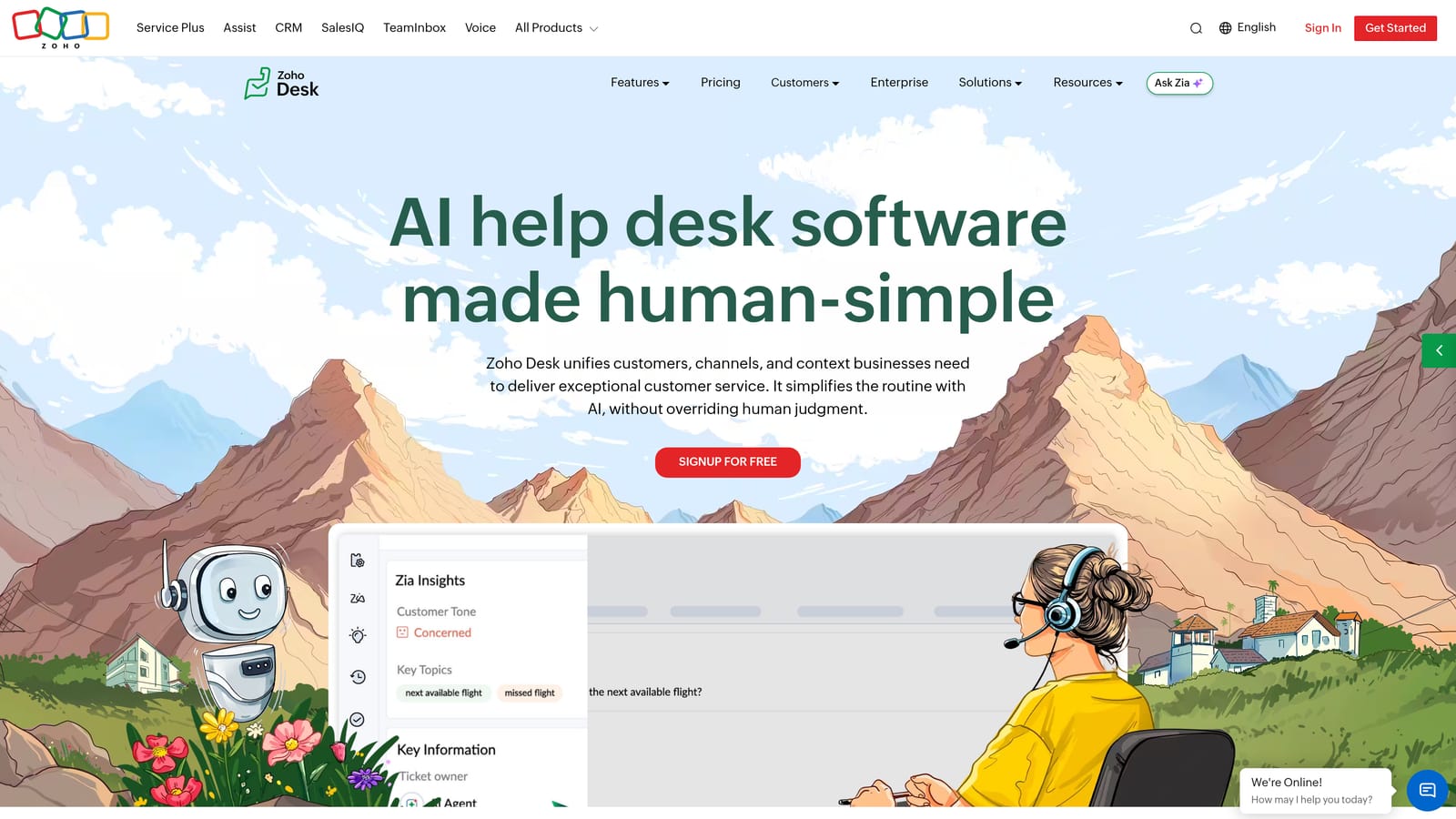
Zoho Desk is a context-aware helpdesk platform from Zoho with Zia AI built in, offering strong value for teams already in the Zoho ecosystem.
Where This Tool Shines
Zoho Desk's biggest advantage is its price-to-feature ratio. You get a genuinely capable helpdesk, AI assistance through Zia, and deep integration with Zoho CRM and Zoho Analytics at per-agent pricing that undercuts most comparable platforms. For teams already running Zoho for CRM or finance, the ecosystem cohesion alone is worth serious consideration.
Zia handles practical tasks like sentiment analysis, automatic ticket tagging, and response suggestions, which meaningfully reduces agent workload without requiring any custom configuration. The free plan for up to three agents also gives small teams a real starting point.
Key Features
Zia AI: Provides sentiment analysis, ticket tagging, and response suggestions to assist agents in real time.
Zoho Ecosystem Integration: Deep native connections to Zoho CRM, Zoho Analytics, and the broader Zoho product suite.
Multi-Channel Coverage: Handles email, live chat, social media, and telephony from a unified interface.
Workflow Automation and Blueprint: Visual process management tools for building structured support workflows.
Free Plan: Available for up to three agents with core helpdesk functionality included.
Best For
Teams already invested in the Zoho ecosystem, and budget-conscious buyers who want a capable, multi-channel helpdesk with AI features without paying premium per-agent rates.
Pricing
Free plan for up to three agents. Paid plans are competitively priced per agent. See zoho.com/desk/pricing for current rates.
6. Help Scout
Best for: Customer-first teams wanting AI assistance layered into a clean, human-feeling shared inbox.
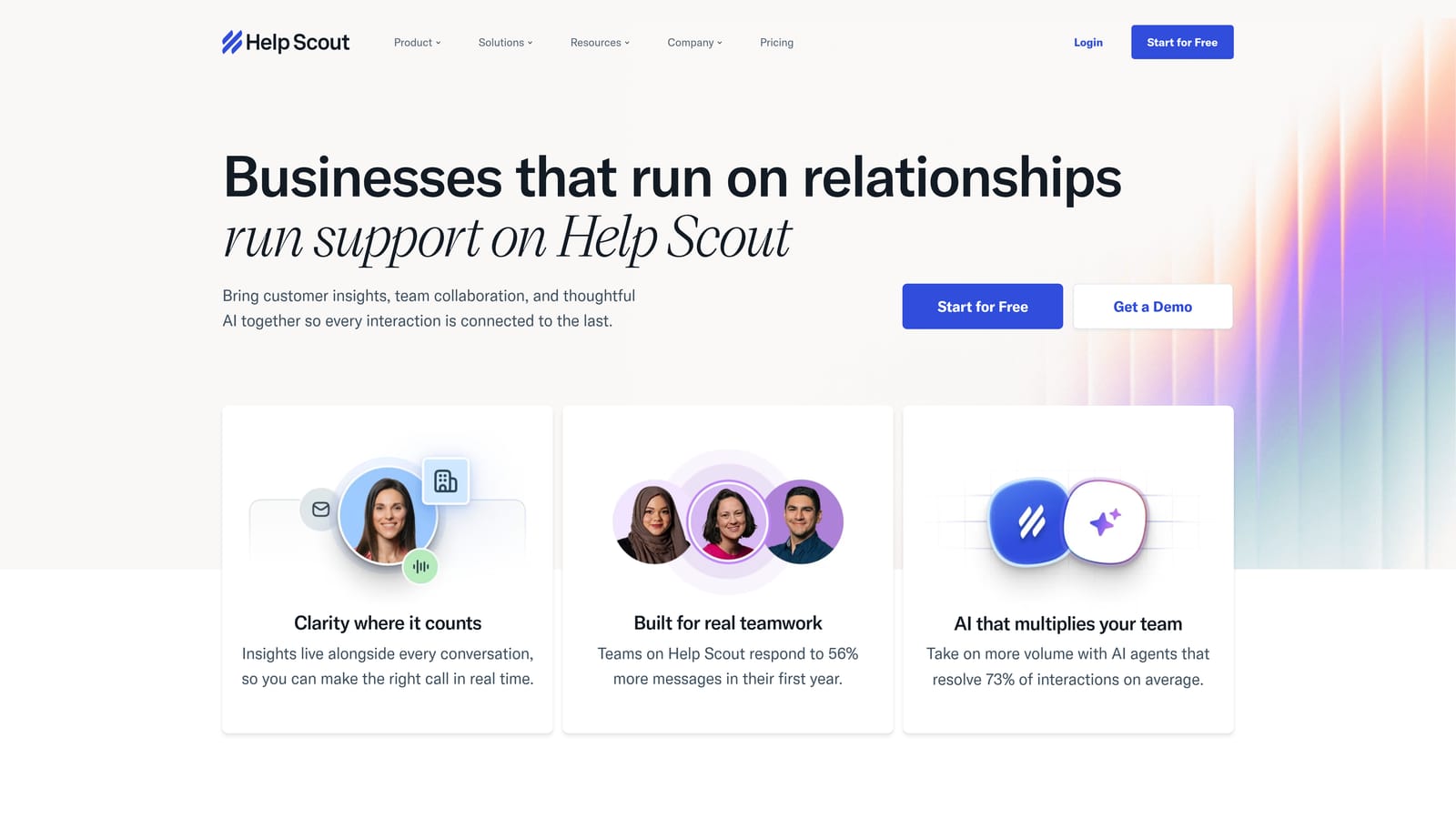
Help Scout is a shared inbox platform built for customer-first teams, with AI Drafts, AI Summarize, and AI Answers integrated into a clean, intuitive interface.
Where This Tool Shines
Help Scout takes a deliberately measured approach to AI: it uses it to assist agents rather than replace them entirely. AI Drafts suggests replies based on conversation context, AI Summarize condenses long threads so agents can get up to speed quickly, and AI Answers deflects common questions through the Docs knowledge base. It's AI as a quality multiplier, not a full automation layer.
This philosophy suits teams where support quality and brand voice matter as much as ticket deflection rates. The interface is genuinely clean, and the customer profile view gives agents useful conversation history without feeling overwhelming.
Key Features
AI Drafts: Generates suggested replies from conversation context, giving agents a strong starting point rather than a blank screen.
AI Summarize: Condenses long conversation threads into quick summaries for faster agent comprehension.
AI Answers: Powers self-service deflection through the Docs knowledge base, reducing inbound volume.
Shared Inbox with Collision Detection: Prevents two agents from responding to the same conversation simultaneously.
Customer Profiles: Surfaces full conversation history and customer data alongside every new interaction.
Best For
Startups and SMBs that prioritize support quality and team experience over maximum automation. A strong fit for teams where maintaining a human tone in customer communication is a core brand value.
Pricing
Per-user monthly pricing with no free plan, but a free trial is available. Visit helpscout.com/pricing for current rates.
7. Crisp
Best for: Early-stage and bootstrapped teams needing a unified multi-channel inbox with a genuinely useful free tier.
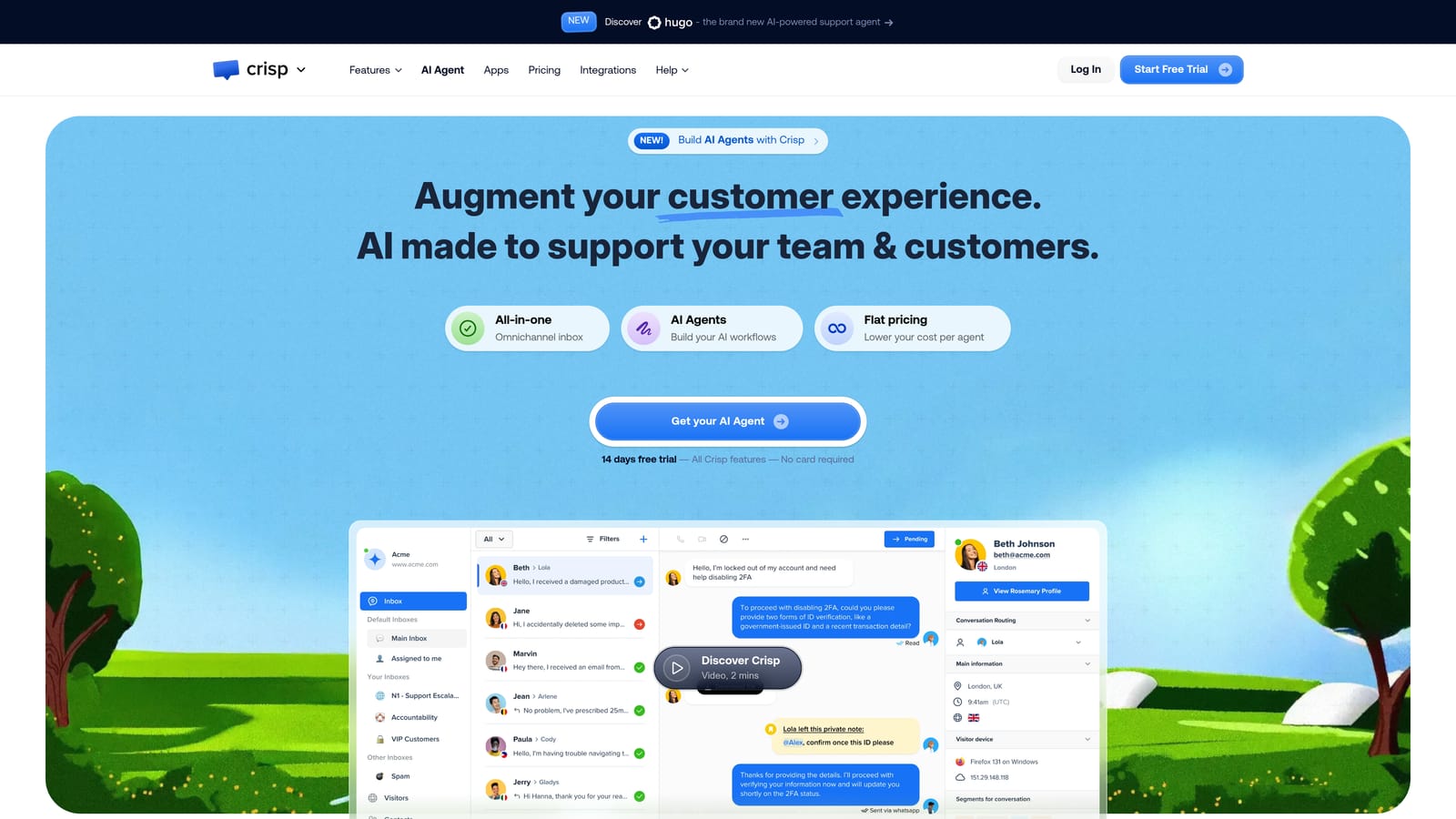
Crisp is a multi-channel customer messaging platform with MagicReply AI and one of the most generous free plans in this category.
Where This Tool Shines
Crisp's free plan is legitimately useful, not a marketing exercise. Two agents, core live chat, and a unified inbox covering multiple channels make it a real option for bootstrapped teams that can't yet justify a paid support tool. When you're ready to upgrade, paid plans remain affordable relative to most competitors.
MagicReply AI generates automated response suggestions, and the chatbot builder lets teams create structured conversation flows without writing code. It won't replace a more sophisticated AI platform as you scale, but for early-stage teams, the value-to-cost ratio is hard to argue with.
Key Features
MagicReply AI: Generates automated response suggestions to speed up agent replies and reduce handling time.
Unified Inbox: Brings together live chat, email, WhatsApp, Instagram, and Facebook Messenger in one view.
Free Plan for Two Agents: Core live chat features available at no cost with no time limit.
No-Code Chatbot Builder: Lets teams create automated conversation flows without engineering resources.
Built-In CRM: Contact management and conversation history included without a separate tool.
Best For
Bootstrapped startups, freelancers, and early-stage teams that need a multi-channel inbox with basic AI assistance and want to minimize software costs while they find their footing.
Pricing
Free plan for two agents. Paid plans are affordable for small teams. See crisp.chat/pricing for current rates.
8. Kommunicate
Best for: Teams wanting custom AI chatbot flows without engineering resources, using per-conversation pricing.
Kommunicate is a no-code chatbot and live chat platform that connects AI backends like Dialogflow and OpenAI to customer support workflows with built-in live agent handoff.
Where This Tool Shines
Kommunicate sits in an interesting position: it's not an AI model itself, but rather a layer that connects your chosen AI backend (Dialogflow, OpenAI, AWS Lex) to a polished customer-facing chat experience. This gives technically-minded teams flexibility to bring their own AI logic while using Kommunicate for the interface, routing, and handoff mechanics.
The per-conversation pricing model is worth highlighting for budget-conscious buyers. Rather than paying per agent seat regardless of volume, you pay based on actual usage, which can be more cost-effective for teams with variable or seasonal support demand.
Key Features
No-Code Bot Builder: Integrates with Dialogflow, OpenAI, and AWS Lex to build custom conversation flows without writing code.
Seamless Live Agent Handoff: Transfers conversations from bot to human agent when queries exceed the bot's capability.
Omnichannel Deployment: Supports web, mobile app, WhatsApp, and additional channels from one platform.
Per-Conversation Pricing: Usage-based cost model that scales with actual support volume rather than headcount.
Analytics Dashboard: Tracks bot performance and agent metrics side by side for a complete operational picture.
Best For
Teams with some technical capability who want to bring their own AI logic and need a reliable interface and routing layer. Also well-suited to businesses with variable support volumes where per-seat pricing feels wasteful.
Pricing
Per-conversation pricing with a free trial available. Visit kommunicate.io/pricing for current rates.
9. Gorgias
Best for: Direct-to-consumer e-commerce brands managing high support volumes tied to order data.
Gorgias is an e-commerce-focused helpdesk with AI automation built around order data from Shopify, BigCommerce, and Magento, ideal for DTC brands managing high support volumes.
Where This Tool Shines
Gorgias is purpose-built for e-commerce, and that focus shows. The Shopify integration goes deep: AI agents can autonomously handle order status checks, returns, and cancellations by pulling live order data, which covers a large share of the repetitive queries that consume DTC support teams' time.
The per-ticket pricing model is a practical fit for e-commerce brands with seasonal volume swings. You pay based on what you actually use rather than locking in a seat count that may be too high in the off-season and too low during peak periods. The revenue statistics feature also connects support interactions to sales outcomes, making it easier to demonstrate the business value of your support operation.
Key Features
Deep Shopify Integration: AI can autonomously handle order status, returns, and cancellations using live order data.
Revenue Statistics: Links support conversations to sales outcomes so teams can quantify their impact on revenue.
Automated E-Commerce Query Handling: Resolves common order-related questions without agent involvement.
Per-Ticket Pricing: Cost scales directly with support volume, aligning spend with actual usage.
Multi-Channel Coverage: Handles email, live chat, social DMs, and SMS from a unified interface.
Best For
DTC and e-commerce brands on Shopify, BigCommerce, or Magento that need AI automation tightly coupled to order management. Not the right fit for B2B SaaS, but excellent for high-volume consumer brands.
Pricing
Per-ticket pricing model. Visit gorgias.com/pricing for current rates.
Which Tool Is Right for Your Team?
The right choice here depends less on which tool has the longest feature list and more on where you are, what you're building, and what "affordable" actually means at your scale.
If you're a B2B SaaS or product team that wants AI-first support with continuous learning, page-aware context, and business intelligence built in, Halo AI is the strongest fit. It's built for teams that want their support platform to do more than close tickets.
For SMBs and early-stage teams prioritizing simplicity and low cost, Tidio and Help Scout both offer clean experiences with AI assistance at accessible price points. Crisp is the go-to if you need a genuinely useful free tier while you're still finding your footing.
E-commerce brands running on Shopify or BigCommerce will find Gorgias hard to beat, given how deeply it integrates with order data. And if you're already in the Zoho ecosystem, Zoho Desk offers competitive per-agent pricing with solid AI features already built in.
One thing worth remembering: sticker price isn't the whole story. A tool that costs less per seat but requires more agent time to manage may cost more in practice than a platform with a higher headline price and stronger automation. Think about total cost of ownership, not just the monthly invoice.
Your support team shouldn't scale linearly with your customer base. Let AI agents handle routine tickets, guide users through your product, and surface business intelligence while your team focuses on complex issues that need a human touch. See Halo in action and discover how continuous learning transforms every interaction into smarter, faster support.