9 Best Affordable AI Customer Support Tools in 2026
This guide cuts through the noise of the AI support market to identify nine genuinely capable Affordable AI Customer Support Tools in 2026 — each vetted for transparent pricing, core automation features like ticket resolution and routing, and real usability for B2B product teams and scaling startups. Whether you're replacing a costly legacy helpdesk or building your stack from scratch, these picks deliver meaningful capability without enterprise-level spend.
 Grant CooperFounder14 min read
There's a frustrating paradox at the heart of the AI customer support market: the platforms with the most powerful automation often carry enterprise price tags that put them out of reach for growing teams. Meanwhile, the cheapest options tend to be glorified FAQ bots with limited real-world utility. Neither extreme serves the B2B product teams, lean support operations, and scaling startups that need genuine capability at a reasonable cost.
The good news is that the landscape has matured. Genuinely capable AI support tools now exist at price points that work for teams without enterprise procurement budgets. The tools on this list were selected based on three criteria: transparent pricing or a meaningful free tier, core AI automation features such as ticket resolution, deflection, or routing, and real usability for B2B product teams. We've also flagged which tools go beyond basic chatbots to deliver business intelligence, because the best affordable tools should make your whole operation smarter, not just cheaper.
Whether you're migrating off an expensive legacy helpdesk or building your support stack from scratch, here are the top affordable AI customer support tools worth evaluating in 2026.
1. Halo AI
Best for: B2B SaaS teams that need autonomous ticket resolution with deep business context
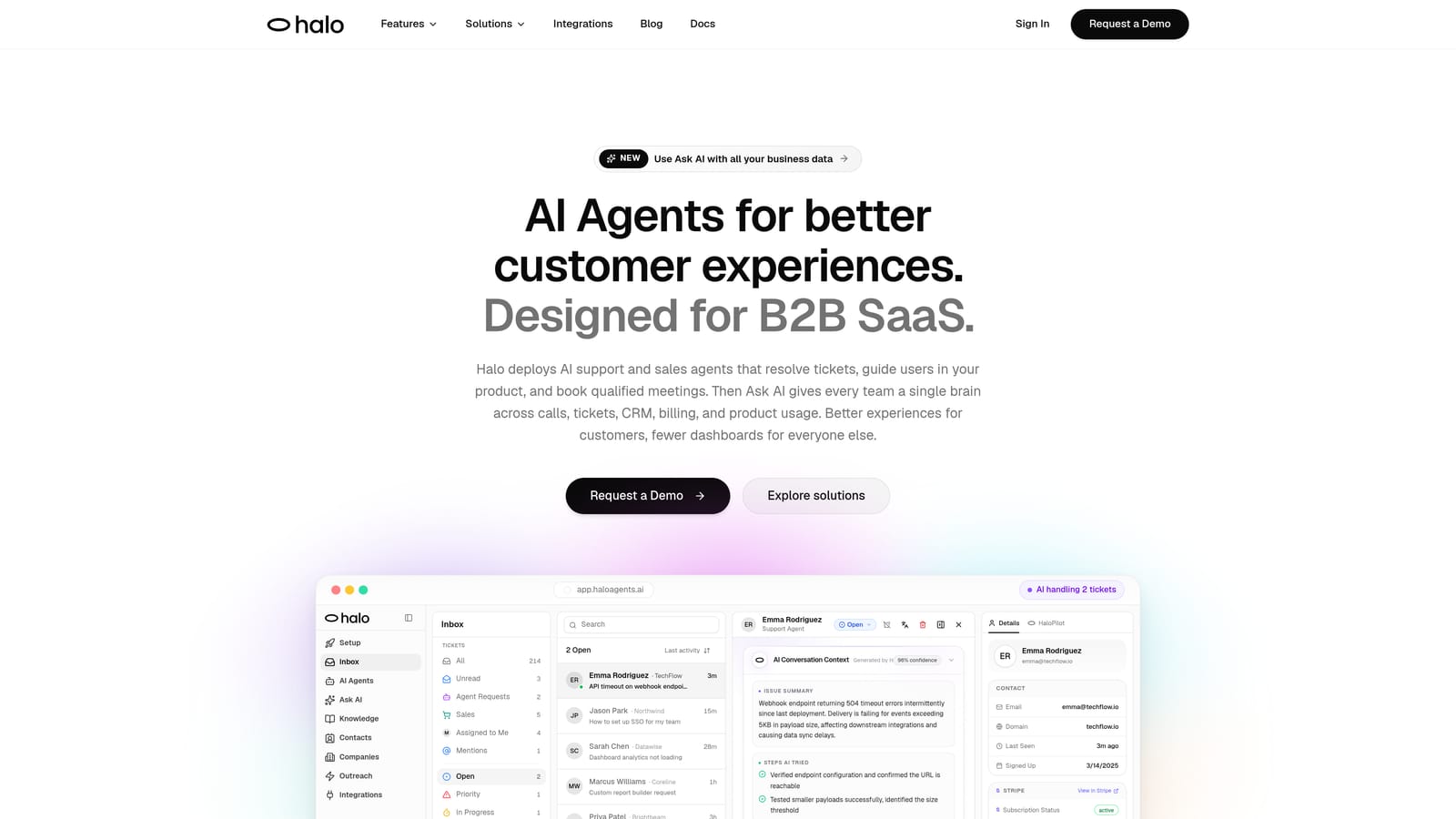
Halo AI is an AI-first customer support platform built for B2B SaaS teams that want autonomous resolution without sacrificing context or control.
Where This Tool Shines
Most AI support tools are bolt-on layers added to existing helpdesk infrastructure. Halo was built AI-first from the ground up, which means the intelligence isn't an afterthought. The platform's page-aware chat widget understands what a user is actually looking at in real time, giving agents contextual awareness that generic chatbots simply can't replicate. That context changes everything: instead of generic FAQ responses, users get guidance that's specific to where they are in your product.
What genuinely sets Halo apart from other affordable options is its smart inbox. Rather than just routing tickets, it surfaces business intelligence signals: customer health indicators, revenue anomalies, and product feedback patterns that would otherwise require a separate analytics tool to uncover. For B2B teams where every customer relationship carries significant revenue weight, that layer of intelligence is unusually valuable at this price tier.
Key Features
Page-Aware Chat Widget: Understands the user's current location within your product in real time, enabling contextually relevant guidance rather than generic responses.
Intelligent AI Agents: Resolve support tickets autonomously and continuously learn from every interaction, improving resolution quality over time without manual retraining.
Smart Inbox with Business Intelligence: Automatically surfaces customer health signals, revenue anomalies, and product feedback patterns directly within the support workflow.
Auto Bug Ticket Creation: Detects and routes bug reports to Linear automatically, eliminating the manual handoff between support and engineering teams.
Live Agent Handoff and Integrations: Escalates complex issues to human agents seamlessly, with native integrations across Slack, HubSpot, Intercom, Stripe, Zoom, PandaDoc, and Fathom.
Best For
B2B SaaS product teams and support operations that need more than ticket deflection. Particularly well-suited for teams where support data should inform product decisions, customer success workflows, and revenue intelligence, and where integration with the broader business stack is a requirement rather than a nice-to-have.
Pricing
Contact for pricing, designed specifically for B2B SaaS teams. A demo is available at haloagents.ai to explore the platform before committing.
2. Tidio
Best for: SMBs and early-stage teams that need live chat and AI in one accessible package
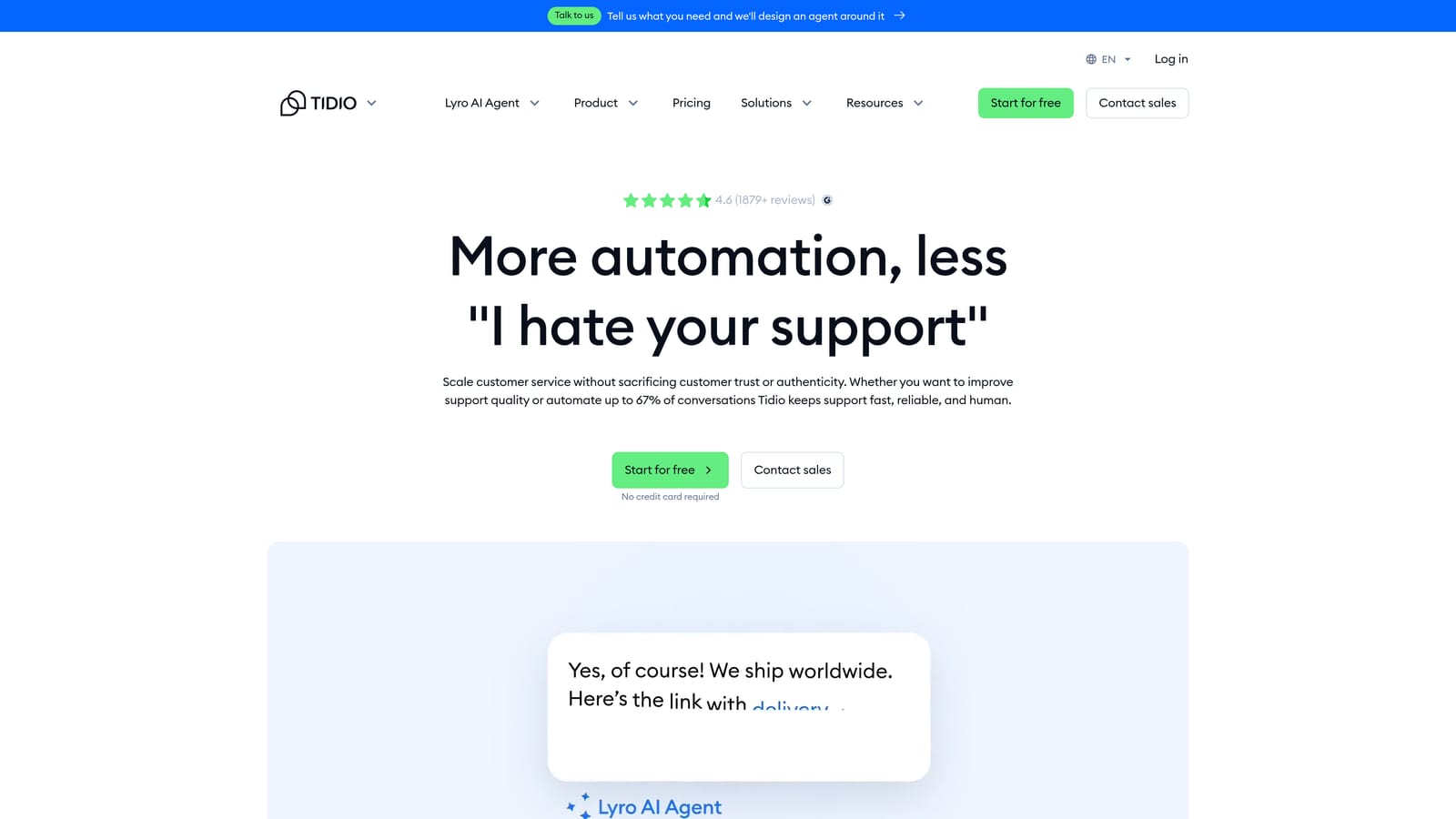
Tidio is a live chat and AI support platform that combines human agent capabilities with Lyro AI for autonomous conversation handling.
Where This Tool Shines
Tidio's biggest strength is its approachability. Setup is fast, the interface is clean, and the Lyro AI component handles multi-turn conversations without requiring extensive configuration. For teams that have never deployed AI support before, Tidio offers a low-friction entry point that doesn't demand technical expertise to get value from.
The free plan makes it genuinely accessible for early-stage teams. As volume grows, the paid tiers scale with conversation volume rather than forcing a jump to enterprise pricing. That said, costs can escalate more quickly than expected at higher conversation volumes, so it's worth modeling your expected usage before committing.
Key Features
Lyro AI: Handles multi-turn conversations autonomously, going beyond simple FAQ lookups to manage more complex customer interactions.
Unified Inbox: Consolidates live chat, email, and social messages into a single workspace for agents.
Pre-Built Automation Flows: Ready-to-use templates for common support scenarios reduce setup time significantly.
E-Commerce Integrations: Native Shopify integration and other e-commerce connectors make it particularly strong for retail and DTC brands.
Free Plan: Available with limited AI conversations, making it a realistic starting point for budget-constrained teams.
Best For
SMBs, e-commerce brands, and early-stage SaaS teams that need a combined live chat and AI solution without a steep learning curve or significant upfront investment. Less suited for teams with complex B2B support workflows or deep integration requirements.
Pricing
Free plan available; paid plans scale with conversation volume. Check tidio.com for current rates, as pricing tiers can shift with usage.
3. Freshdesk
Best for: Teams that need a mature, full-featured helpdesk with AI capabilities at a lower cost than Zendesk
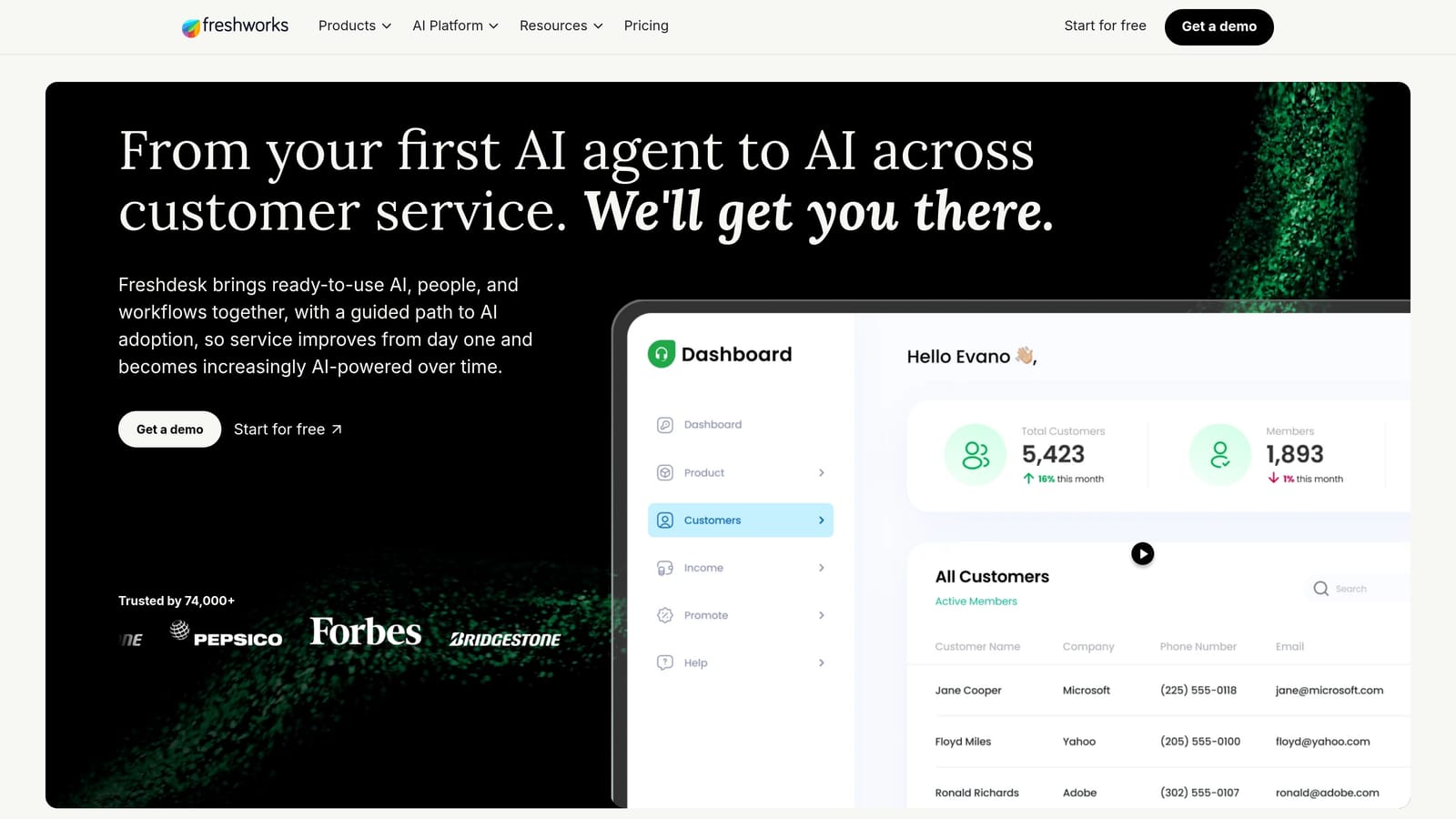
Freshdesk is a mature helpdesk platform with Freddy AI built in for response suggestions, auto-triage, and ticket summarization.
Where This Tool Shines
Freshdesk has been around long enough to have solved most of the fundamental helpdesk problems well: SLA management, ticket routing, omnichannel coverage, and agent workflows are all polished. The addition of Freddy AI layers intelligent assistance on top of that solid foundation without requiring teams to rebuild their support operations from scratch.
The free Sprout plan, which supports up to 10 agents, is one of the most generous free tiers in the market for teams that primarily need email-based ticketing. For growing teams that need AI features, the paid tiers remain competitively priced relative to comparable platforms.
Key Features
Freddy AI: Provides suggested replies, ticket summarization, and auto-categorization to reduce agent effort on repetitive tasks.
Robust Ticketing System: Full SLA management, priority routing, and agent assignment workflows built on years of product iteration.
Free Plan (Sprout Tier): Supports up to 10 agents, making it one of the most accessible free options for small teams.
Omnichannel Coverage: Handles email, chat, phone, and social from a single platform.
Integration Marketplace: Extensive library of third-party app connections for common business tools.
Best For
Teams migrating from spreadsheets or basic email tools who need a complete helpdesk foundation with AI assistance. Also strong for teams already in the Freshworks ecosystem who want unified CRM and support data.
Pricing
Free plan available for up to 10 agents; paid plans start at competitive per-agent rates. See freshdesk.com/pricing for current tiers.
4. Intercom (Fin AI Agent)
Best for: Product-led SaaS teams that want high AI resolution rates from existing knowledge base content
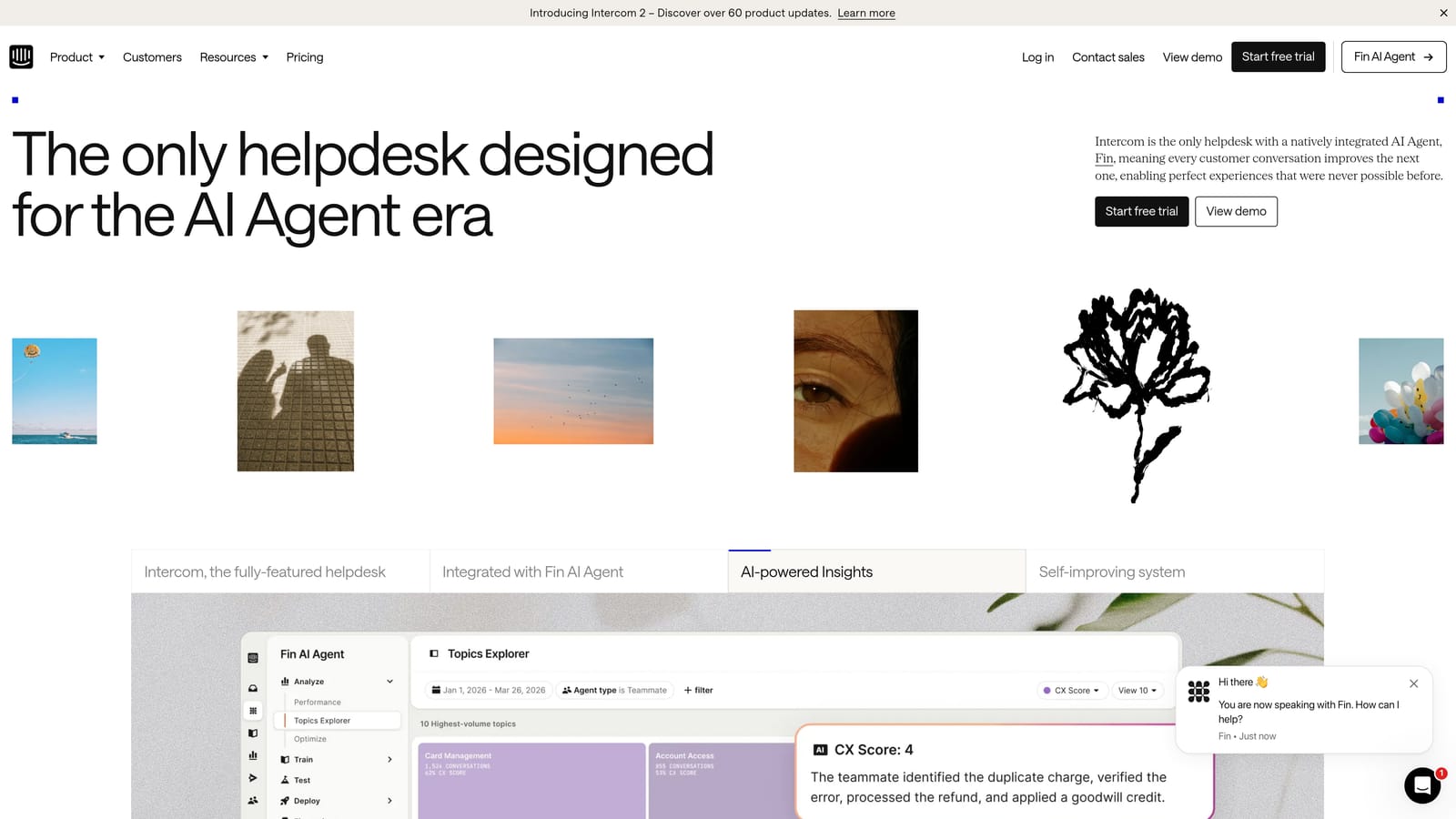
Intercom is a customer messaging platform whose Fin AI Agent is designed to resolve support queries using your existing help center content.
Where This Tool Shines
Fin AI Agent has built a strong reputation for resolution quality. It handles multi-turn, complex queries by reasoning across your knowledge base rather than pattern-matching to keywords, which translates to meaningfully higher deflection rates for teams with well-maintained documentation. For product teams that have already invested in a comprehensive help center, Fin can unlock significant value from that existing content.
The per-resolution pricing model is worth understanding carefully. For teams with high deflection rates, the cost per resolved ticket can be quite competitive. For teams with lower deflection rates or highly complex query volumes, costs can become unpredictable. Modeling your expected resolution volume before committing is essential.
Key Features
Fin AI Agent: Resolves complex, multi-turn queries by reasoning across knowledge base content rather than relying on keyword matching.
Usage-Based Pricing: Per-resolution fee structure can be cost-effective for teams with high AI deflection rates.
In-App Messaging and Product Tours: Combines reactive support with proactive user engagement in a single platform.
Resolution Analytics: Strong reporting on AI resolution rates and customer satisfaction scores.
Integration Marketplace: Extensive connections to CRM, billing, and product analytics tools.
Best For
SaaS product teams with well-maintained knowledge bases and high support volumes, where strong AI deflection rates make the per-resolution pricing model economical. Less suited for teams with sparse documentation or highly variable query types.
Pricing
Seat-based plans plus per-resolution fees for Fin AI. Check intercom.com/pricing for the current structure, as this model has evolved over time.
5. Crisp
Best for: Startups that need multi-channel coverage across chat, email, and social on a minimal budget
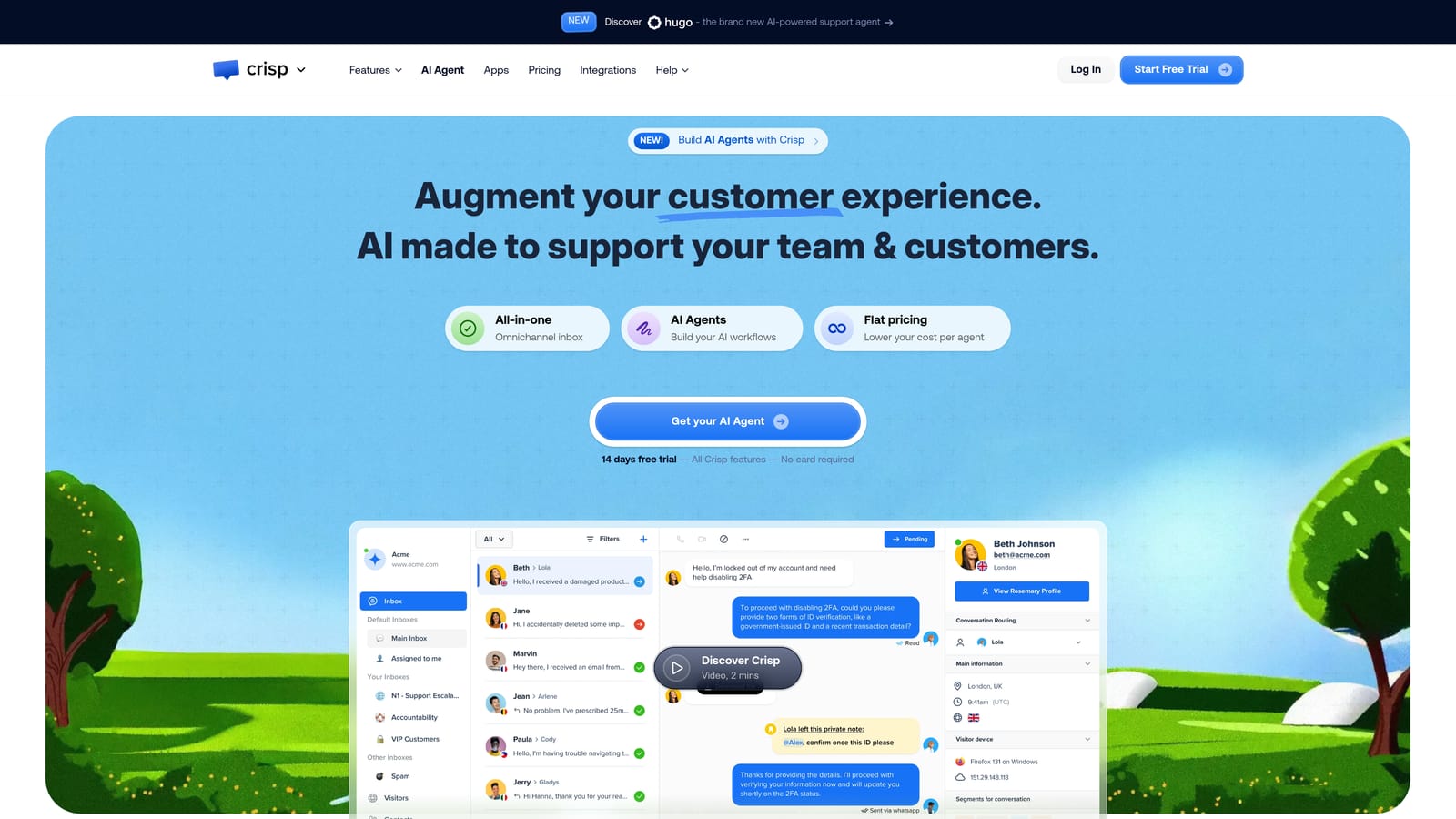
Crisp is a multi-channel customer messaging platform with a genuinely useful free tier and AI-assisted reply suggestions.
Where This Tool Shines
Crisp's free plan is legitimately useful, not a crippled demo. Two seats with unlimited conversations across chat, email, Messenger, and Instagram is a meaningful offering for early-stage teams that need multi-channel presence without a budget to match. Most competitors at this price point force you to choose one or two channels.
The MagicReply AI feature suggests responses based on conversation history, which helps agents move faster without requiring a full AI automation layer. It's an honest approach: Crisp doesn't oversell its AI capabilities, and the tool delivers reliably on what it promises. For teams that need basic coverage and are not yet ready for a full AI-first platform, Crisp is a sensible starting point.
Key Features
Free Plan with 2 Seats: Supports unlimited conversations across multiple channels, making it one of the most genuinely useful free tiers available.
MagicReply AI: Suggests responses based on conversation history to accelerate agent reply times.
Unified Multi-Channel Inbox: Consolidates chat, email, Facebook Messenger, Instagram, and more into a single workspace.
CRM-Lite Features: Contact profiles, conversation notes, and history provide basic customer context without a separate CRM.
Chatbot Builder: Basic automation flows for routing and handling common queries without code.
Best For
Early-stage startups and small teams that need multi-channel support coverage at minimal cost. Ideal as a starting point before graduating to a more powerful AI-first platform as support volume and complexity grow.
Pricing
Free plan available; paid plans are among the most affordable in the market. See crisp.chat/pricing for current tiers.
6. Zoho Desk
Best for: Teams already in the Zoho ecosystem that want AI-enhanced support with strong CRM integration
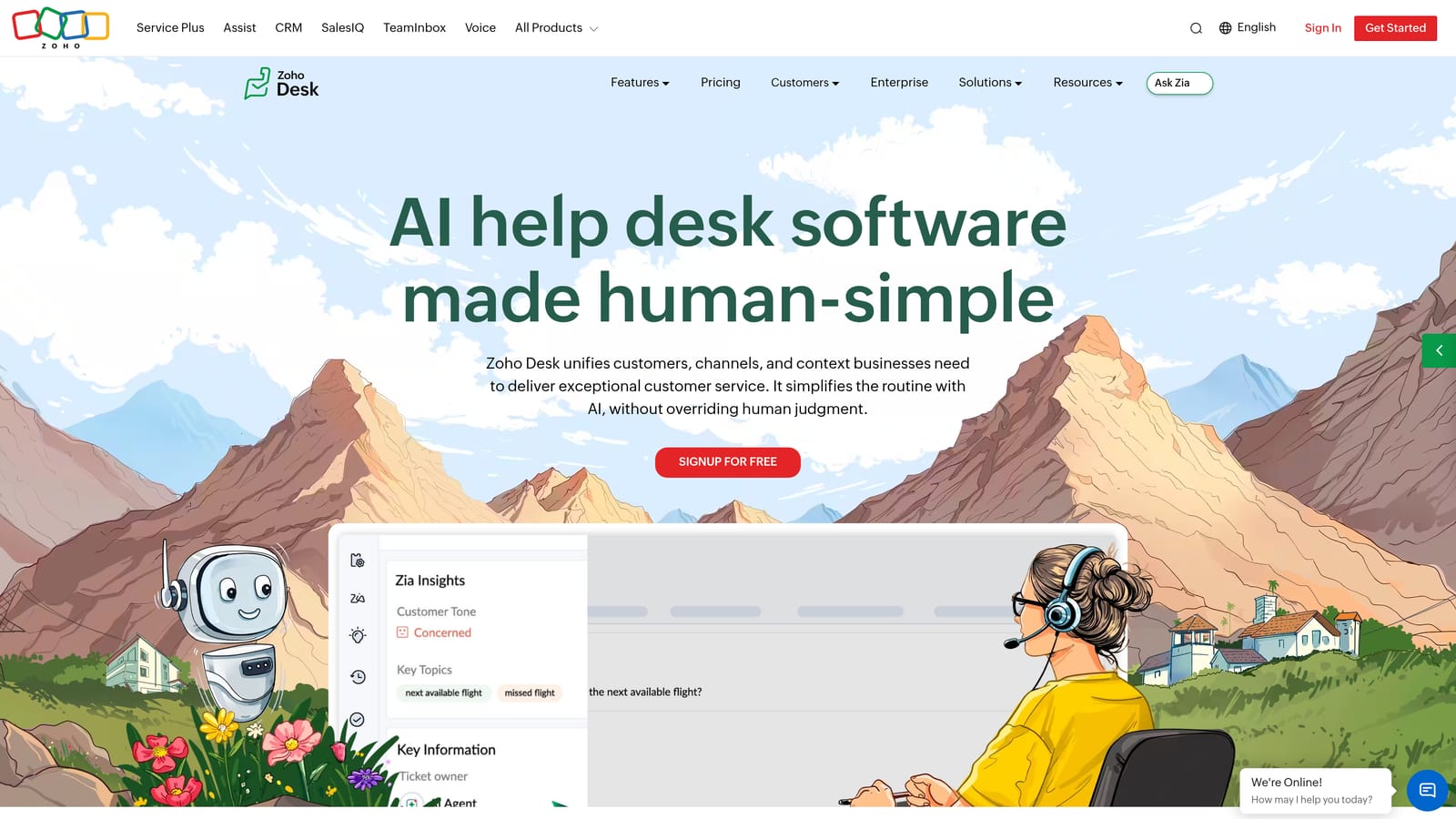
Zoho Desk is a helpdesk platform with Zia AI for sentiment analysis, anomaly detection, and response suggestions, particularly strong for Zoho CRM users.
Where This Tool Shines
Zoho Desk's Zia AI does something relatively uncommon at this price tier: ticket volume anomaly detection. When support volume spikes unexpectedly, Zia flags it, giving teams an early warning signal that something may be going wrong with the product or a specific customer segment. That kind of proactive intelligence is typically reserved for more expensive platforms.
For teams already running Zoho CRM, the integration is seamless and genuinely useful. Support agents see full customer context, purchase history, and deal status without switching tools. That unified view reduces the time agents spend context-switching and improves the quality of their responses.
Key Features
Zia AI: Provides sentiment analysis, auto-tagging, response suggestions, and ticket volume anomaly detection.
Zoho CRM Integration: Deep, native connection to Zoho CRM for unified customer context across sales and support.
Free Plan: Available for up to 3 agents, suitable for very small teams getting started.
Multi-Channel Support: Handles email, chat, social, phone, and web forms from a single platform.
Anomaly Detection: Flags unusual spikes in ticket volume to surface potential product issues or customer problems early.
Best For
Teams already using Zoho CRM or other Zoho products who want strong AI-assisted support without paying for a separate platform. Also a solid option for teams that value anomaly detection and sentiment analysis at an affordable price point.
Pricing
Free plan for up to 3 agents; paid plans at competitive per-agent rates. See zoho.com/desk/pricing for current options.
7. Help Scout
Best for: Teams where brand voice and human relationship quality take priority over full AI autonomy
Help Scout is a customer support platform built around a human-first philosophy, with AI features that assist agents rather than replace them.
Where This Tool Shines
Help Scout's philosophy is refreshingly honest: it's not trying to eliminate human agents. Instead, its AI features are designed to make agents faster and more effective. AI Summarize condenses long conversation threads so agents can get up to speed instantly. AI Assist drafts reply suggestions that agents can edit before sending. The result is a tool that maintains the warmth and brand voice your customers experience while meaningfully reducing the time each interaction takes.
The platform's clean, minimal UI is worth mentioning because agent adoption is a real challenge with many support tools. Help Scout's low learning curve means new agents become productive quickly, which matters when you're running a lean team.
Key Features
AI Summarize: Condenses long conversation threads into concise summaries so agents can quickly understand context before responding.
AI Assist: Drafts reply suggestions that agents can review, edit, and send, preserving brand voice while reducing writing time.
AI Answers: Self-service widget that resolves common queries from your documentation without agent involvement.
Shared Inbox and Knowledge Base: Both core support functions are built into a single, unified platform.
Minimal UI: Low agent learning curve means faster onboarding and higher adoption rates.
Best For
Support teams where relationship quality and brand voice are central to the customer experience. Particularly well-suited for professional services, SaaS companies with high-touch customers, and teams that want AI assistance rather than AI autonomy.
Pricing
Per-user monthly pricing with a free trial available. See helpscout.com/pricing for current tiers.
8. Chatbase
Best for: Teams that need basic AI deflection fast without committing to a full helpdesk platform
Chatbase is a no-code AI chatbot builder that trains on your own content, including PDFs, URLs, Notion pages, and plain text.
Where This Tool Shines
Chatbase solves a specific problem extremely well: getting a custom AI chatbot live quickly without engineering resources. Upload your documentation, point it at your URLs, and you have a trained AI agent embedded on your website in minutes. For teams that need to reduce inbound support volume before they've chosen a full helpdesk solution, Chatbase provides immediate value with minimal setup friction.
The trade-off is depth. Chatbase is not a full support platform. It lacks the escalation workflows, SLA management, agent collaboration tools, and business intelligence that more complete platforms provide. Think of it as a capable first line of deflection rather than a complete support solution.
Key Features
Multi-Source Training: Train a custom AI agent on PDFs, URLs, plain text, and Notion pages in minutes without technical expertise.
Embeddable Chat Widget: Deploys on any website or app with simple embed code.
API Access: Allows custom integrations for teams that want to connect Chatbase to other tools in their stack.
Lead Capture: Collects visitor information during conversations for follow-up.
Basic Conversation Analytics: Tracks conversation volume and common queries at a surface level.
Best For
Teams that need rapid AI deflection without the overhead of a full helpdesk deployment. Ideal as a standalone tool for simple use cases or as a stopgap while evaluating more comprehensive platforms. Not suited for teams that need escalation workflows or agent collaboration features.
Pricing
Free plan available with message limits; paid plans scale with message volume. See chatbase.co/pricing for current rates.
9. Gorgias
Best for: E-commerce brands on Shopify, WooCommerce, or BigCommerce that need order-aware AI automation
Gorgias is an AI-powered support platform purpose-built for e-commerce, with automation tied directly to live order and customer data.
Where This Tool Shines
Gorgias occupies a specific and well-defined niche: e-commerce support where the majority of queries are about orders, returns, and shipping. By connecting directly to Shopify, WooCommerce, and BigCommerce order data, Gorgias can automate responses to these queries using real-time information rather than generic scripts. That specificity is its greatest strength.
The per-ticket pricing model is also worth noting. For teams where headcount is fixed but ticket volume fluctuates seasonally, paying per ticket rather than per seat can be more predictable and cost-effective. Gorgias also surfaces revenue statistics per ticket, which helps support teams demonstrate their direct contribution to sales outcomes.
Key Features
Order-Aware AI Automation: Automates responses to order status, returns, and shipping queries using live data from your e-commerce platform.
Revenue Statistics per Ticket: Measures the revenue impact of each support interaction to quantify support's contribution to sales.
Automation Rules: Handles tagging, routing, and closing of repetitive tickets without agent involvement.
Unified Inbox: Consolidates email, chat, social, and SMS into a single workspace.
Per-Ticket Pricing: Costs scale with support volume rather than team headcount, which suits seasonal or variable-volume businesses.
Best For
E-commerce brands with significant order-related support volume, particularly those on Shopify. Less relevant for pure B2B SaaS teams whose support queries are less transactional in nature.
Pricing
Ticket-based pricing that scales with support volume rather than headcount. See gorgias.com/pricing for current plans.
Which Tool Is Right for Your Team?
The right choice depends on what your support operation actually looks like today and where you need it to go. Here's a practical way to think through it.
For B2B SaaS teams that need autonomous resolution and business intelligence: Halo AI is the standout option. Its page-aware context, continuous learning model, and smart inbox intelligence go well beyond what most tools at any price point deliver. If your support data should be informing product decisions and customer success workflows, that level of integration depth is hard to find elsewhere.
For teams that need a complete helpdesk with solid AI assistance: Freshdesk and Zoho Desk both offer strong foundations with AI layers at accessible price points. Freshdesk wins on breadth; Zoho Desk wins on value for teams already in the Zoho ecosystem.
For product-led SaaS teams with strong documentation: Intercom's Fin AI Agent can deliver impressive resolution rates if your knowledge base is well-maintained. Model your expected resolution volume carefully before committing to the per-resolution pricing.
For early-stage teams on a tight budget: Crisp's free plan is genuinely useful for multi-channel coverage. Chatbase gets basic AI deflection live in minutes. Neither is a long-term solution for complex support operations, but both serve their purpose well at the entry level.
For e-commerce brands: Gorgias is purpose-built for this use case and the order-aware automation is a genuine differentiator over general-purpose tools.
One thing worth remembering: the cheapest tool is rarely the most cost-effective. Ticket deflection rates and integration depth determine real ROI. A tool that deflects a high percentage of inbound tickets and surfaces actionable business intelligence will pay for itself in ways that a cheaper, less capable tool never will. That's the calculation worth making before optimizing purely on price.
Your support team shouldn't scale linearly with your customer base. Let AI agents handle routine tickets, guide users through your product, and surface business intelligence while your team focuses on complex issues that need a human touch. See Halo in action and discover how continuous learning transforms every interaction into smarter, faster support.