9 Best Affordable AI Support Solutions for Growing Teams in 2026
Growing B2B teams no longer need enterprise budgets to access powerful customer support automation — this guide evaluates nine affordable AI support solutions based on cost-effectiveness, resolution quality, setup ease, integrations, and scalability, helping teams find the right fit for their stage and workflow in 2026.
 Matt PattoliFounder13 min read
Growing B2B teams face a familiar tension: customers expect instant, intelligent support, but enterprise-grade AI platforms often come with enterprise-grade price tags. The good news is that the AI support landscape has matured rapidly through 2025 and 2026, and genuinely powerful automation is no longer reserved for companies with six-figure tool budgets.
We evaluated each tool below on five criteria: cost-effectiveness (free tiers or accessible entry-level plans), AI resolution quality, ease of setup, integration depth, and room to scale. A quick note before you dive in: SaaS pricing changes frequently, so always verify current rates on each vendor's website.
Here are the top affordable AI support solutions worth considering for growing teams.
1. Halo AI
Best for: Product-led SaaS teams that want autonomous AI resolution without migrating to a new helpdesk
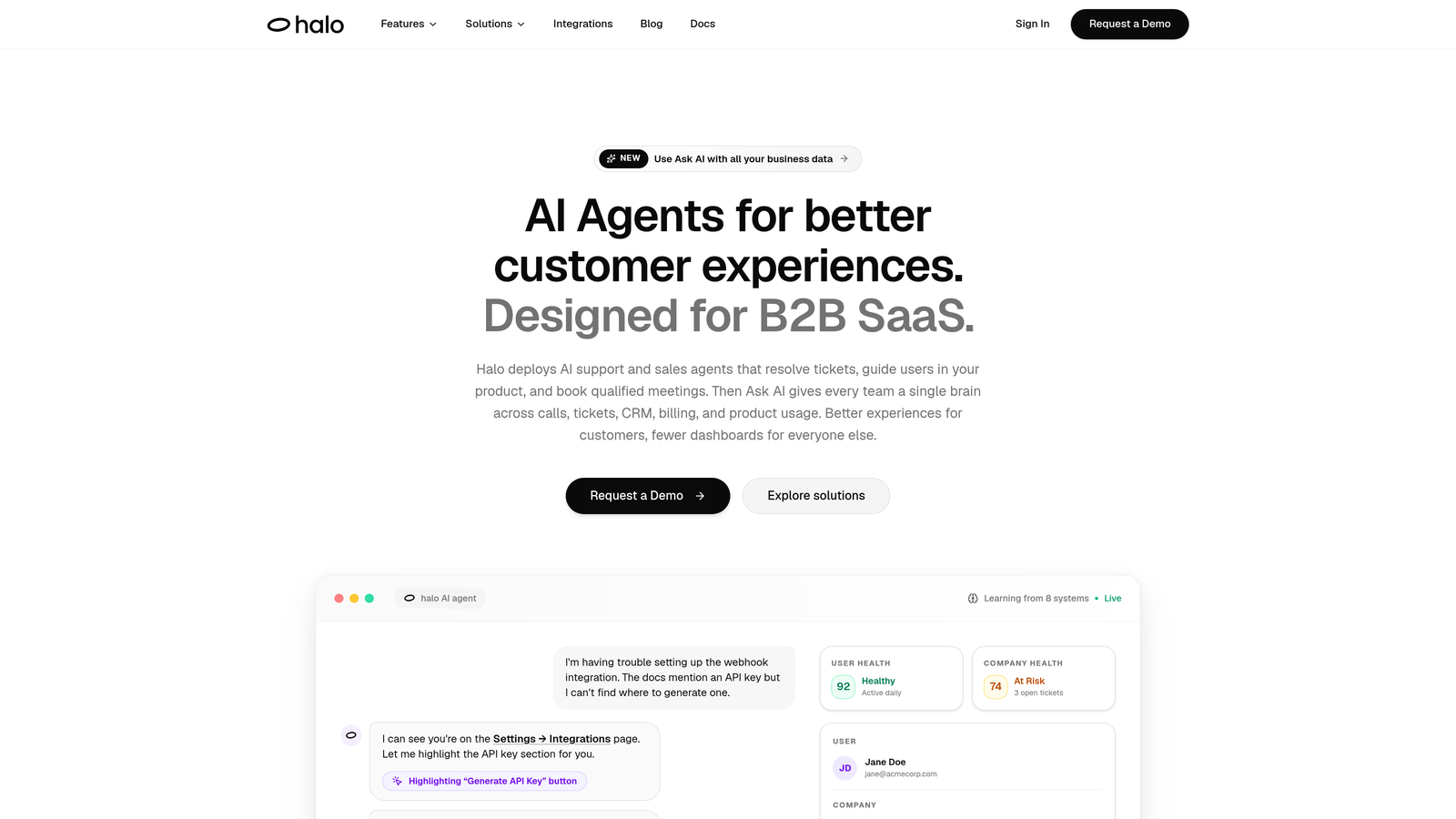
Halo AI is an AI-first customer support platform that deploys autonomous agents to resolve tickets, guide users with page-aware context, and surface business intelligence across your stack.
Where This Tool Shines
Most AI support tools are bolted onto existing helpdesks as an afterthought. Halo AI is built AI-first from the ground up, which means the intelligence layer isn't a feature—it's the foundation. The platform's page-aware chat widget is a standout: it sees what the user sees in real time, allowing it to provide visual UI guidance rather than generic text answers. That context-awareness meaningfully improves resolution rates for product-related questions.
Beyond ticket resolution, Halo surfaces business intelligence that most support tools ignore entirely. Customer health signals, anomaly detection, and revenue intelligence flow through the smart inbox, turning your support channel into a strategic data source. For growing B2B teams, that kind of signal can inform product decisions without adding headcount.
Key Features
Autonomous AI Agents: Resolve support tickets end-to-end without human intervention, learning from every interaction to improve over time.
Page-Aware Chat Widget: The AI understands the specific page a user is on and provides contextual, visual guidance rather than generic responses.
Smart Inbox with Business Intelligence: Surfaces customer health signals, anomaly detection, and revenue intelligence alongside standard ticket management.
Auto Bug Ticket Creation: Automatically generates bug reports and routes them to Linear, Slack, or other connected tools without manual intervention.
Live Agent Handoff: Escalates complex issues to human agents with full conversation context preserved, so nothing gets repeated.
Best For
Product-led SaaS companies and B2B teams that want genuine autonomous resolution rather than agent-assist features. Particularly strong for organizations already using tools like Linear, Slack, HubSpot, Stripe, or Intercom, where deep integration reduces total cost of ownership by eliminating middleware.
Pricing
Contact Halo AI for pricing details. Plans are designed for growing B2B teams with competitive entry-level options. Visit haloagents.ai for current information.
2. Tidio
Best for: Small businesses and e-commerce teams wanting live chat plus AI in one low-cost package
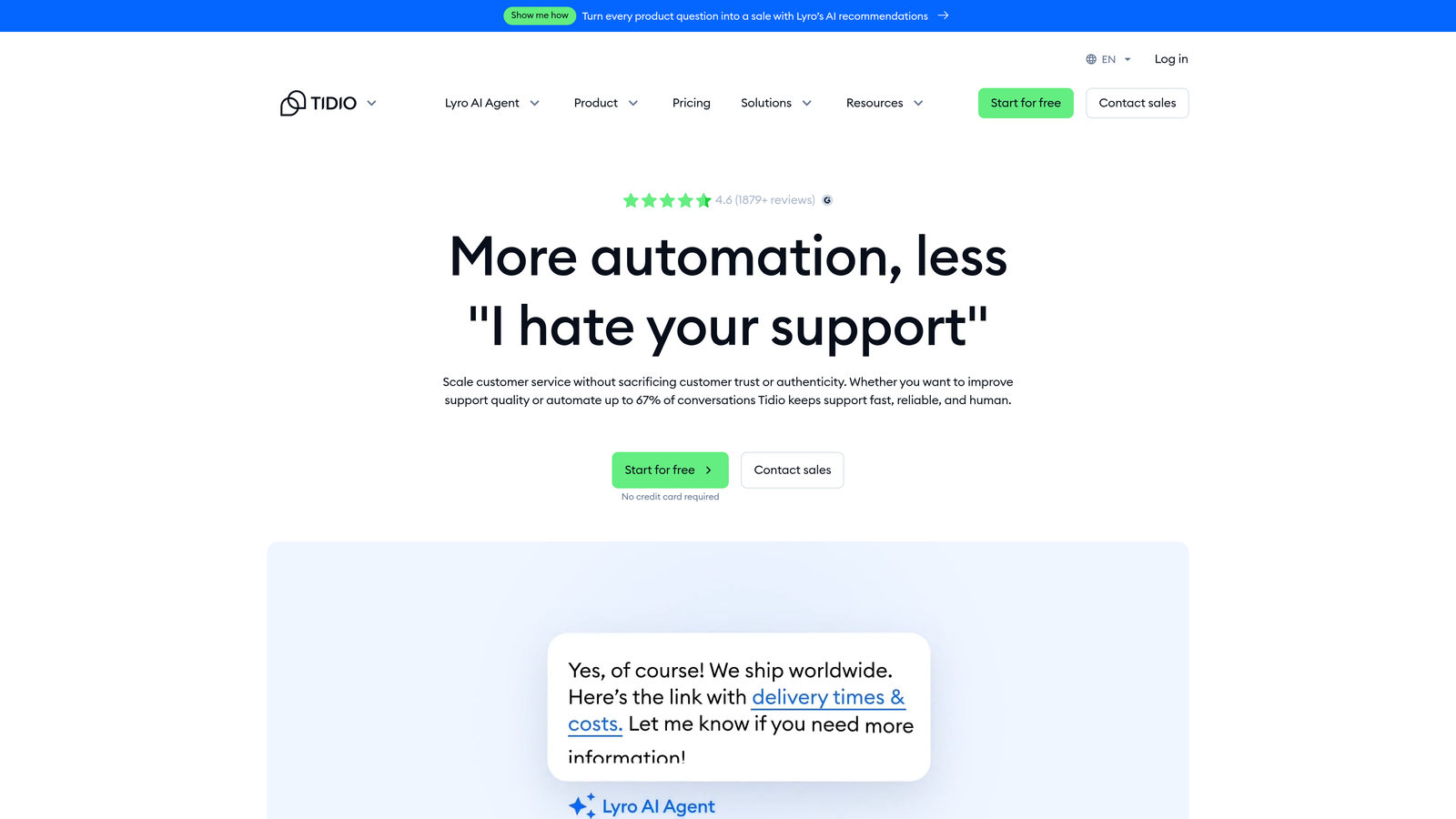
Tidio is a combined live chat and AI chatbot platform built around its Lyro AI engine, popular for its accessible pricing and visual builder.
Where This Tool Shines
Tidio hits a sweet spot for teams that aren't ready to go fully autonomous but want AI doing more than keyword matching. Lyro AI trains on your existing support content and handles a meaningful portion of repetitive questions, while the visual drag-and-drop builder lets non-technical team members create conversation flows without writing a line of code.
The e-commerce integrations with Shopify and WooCommerce make Tidio especially relevant for product companies with a direct sales component. AI-suggested replies also help live agents respond faster during peak hours.
Key Features
Lyro AI Chatbot: Trains on your help content and handles common questions autonomously with conversational responses.
Visual Flow Builder: Drag-and-drop chatbot builder requires no coding knowledge to create and deploy conversation flows.
AI-Suggested Replies: Assists live agents by surfacing relevant response suggestions during active conversations.
E-Commerce Integrations: Native connections to Shopify and WooCommerce for order status, product queries, and more.
Best For
Small businesses, e-commerce brands, and early-stage SaaS teams that want a single platform covering both live chat and AI automation without a steep learning curve or significant upfront investment.
Pricing
Free plan available with limited features. Paid plans start around $29/month. Verify current tiers on Tidio's website.
3. Freshdesk (Freddy AI)
Best for: Teams wanting a proven helpdesk with a genuinely useful free tier and built-in AI assistance
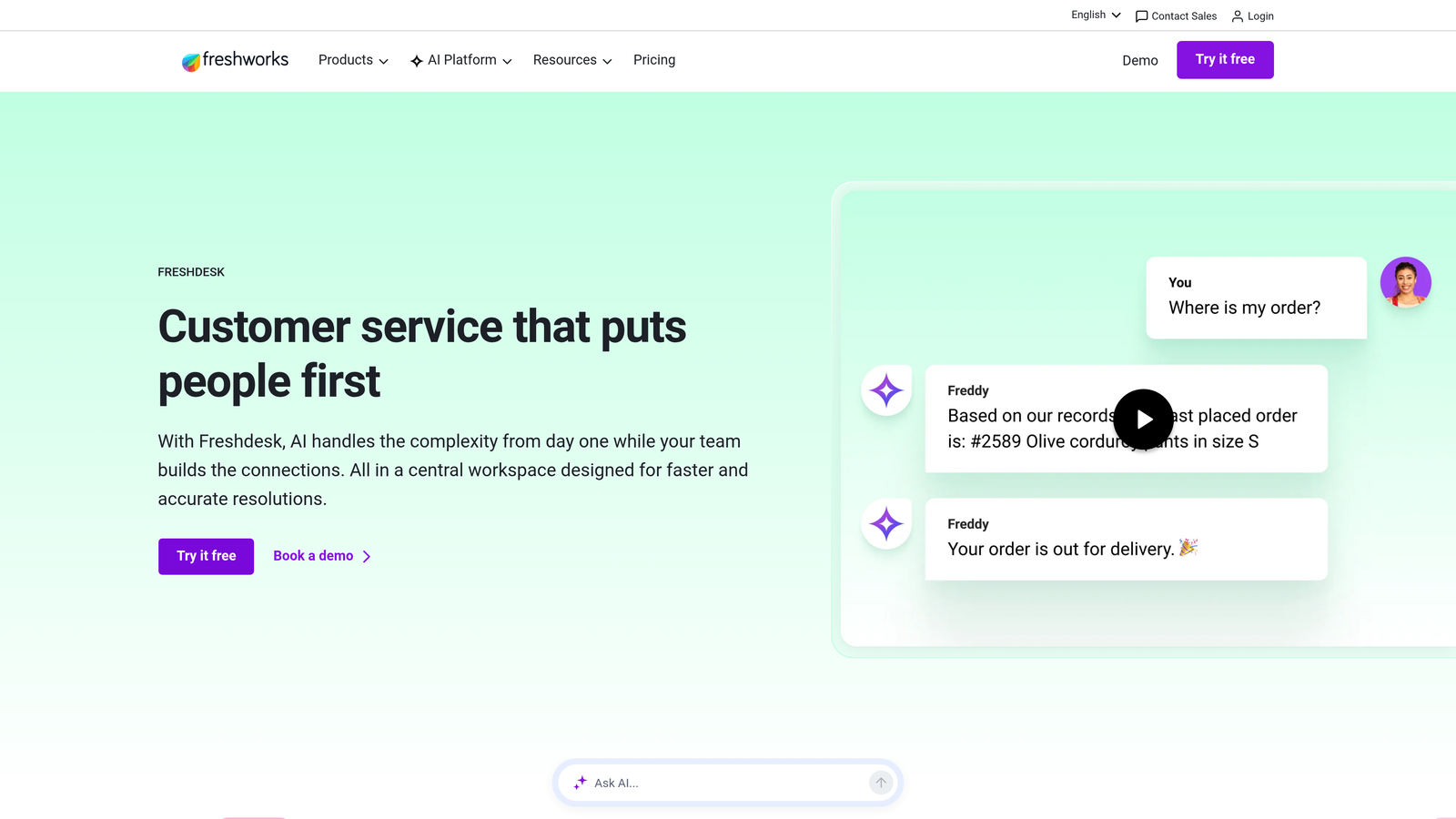
Freshdesk is an established omnichannel helpdesk platform with Freddy AI layered in for auto-triage, suggested responses, and knowledge base-powered resolution.
Where This Tool Shines
Freshdesk's free tier is one of the most generous in the helpdesk space, supporting up to two agents with core ticketing functionality. That makes it a realistic starting point for very early-stage teams. As you grow and move to paid plans, Freddy AI adds meaningful automation: ticket classification, canned response suggestions, and knowledge base search that reduces the volume of tickets reaching agents.
The omnichannel coverage—email, chat, phone, and social—from a single platform is a practical advantage for teams that don't want to manage multiple point solutions.
Key Features
Free Tier: Supports up to two agents with core ticketing, making it genuinely accessible for bootstrapped teams.
Freddy AI Triage: Automatically classifies incoming tickets and routes them to the right team or queue.
Suggested Replies: Freddy surfaces relevant canned responses and knowledge base articles for agents during ticket resolution.
Built-In Knowledge Base: Integrated help center and community forum tools reduce inbound volume through self-service.
Omnichannel Support: Handles email, chat, phone, and social media from a unified inbox.
Best For
Growing teams already comfortable with traditional helpdesk workflows who want AI assistance layered in incrementally, and smaller teams that need a free starting point with a clear upgrade path.
Pricing
Free tier available for up to two agents. AI features on paid plans starting around $15/agent/month. Check Freshdesk's site for current plan details.
4. Intercom Fin
Best for: Teams that want to pay only when the AI actually resolves a customer issue
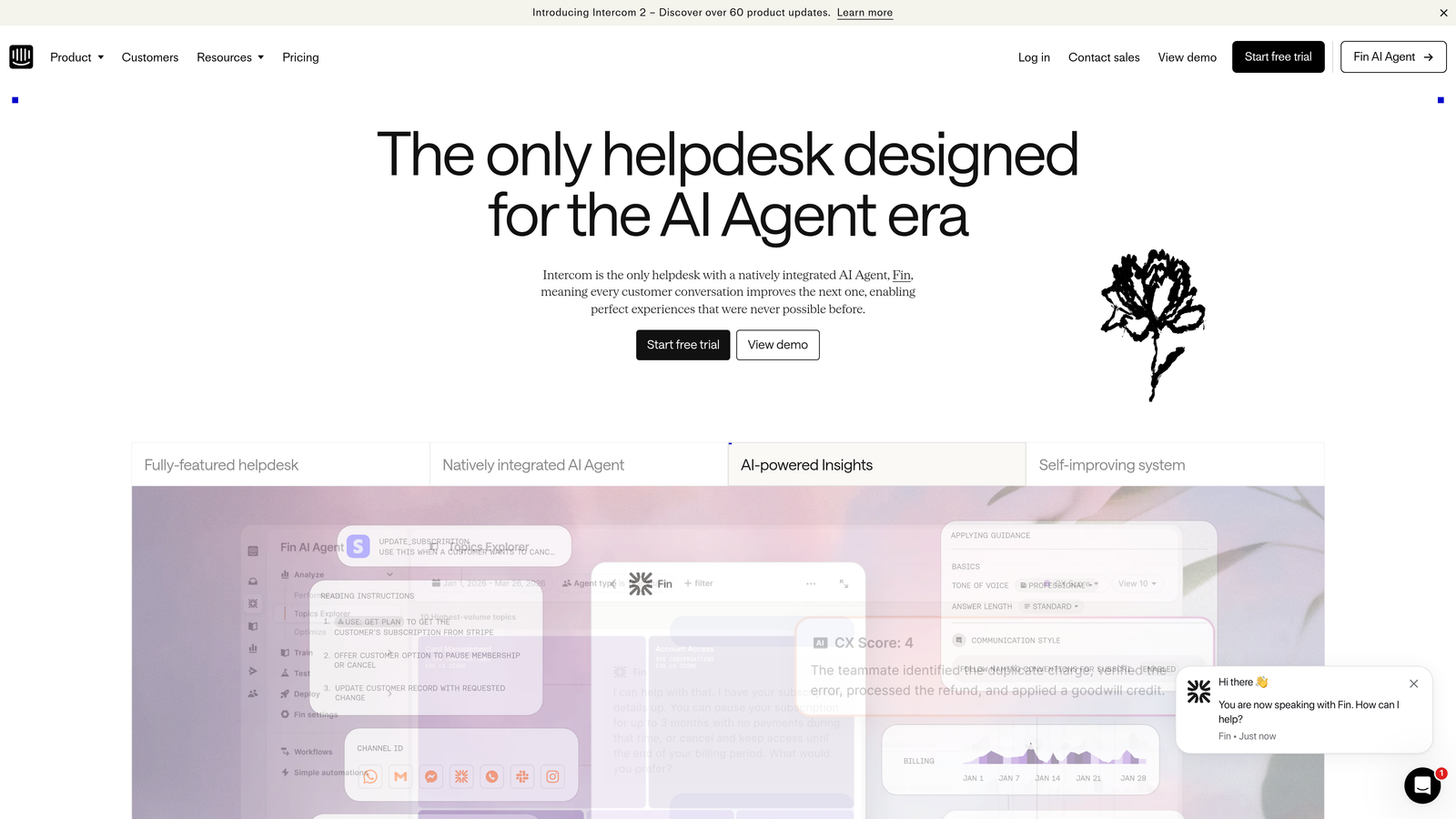
Intercom Fin is an autonomous AI support agent that operates on a pay-per-resolution model, making it one of the more financially transparent options in this category.
Where This Tool Shines
The pay-per-resolution pricing model is genuinely different from the per-seat or per-conversation models that dominate the market. You pay when Fin solves a problem, not just when it shows up in a conversation. For teams with variable support volumes, that alignment between cost and outcome is compelling.
Fin trains on your help center content and past conversations, and it handles multi-language support natively. The handoff to human agents is smooth, with full conversation context passed through so customers don't have to repeat themselves.
Key Features
Autonomous AI Resolution: Fin handles tickets end-to-end using your help center and conversation history as its knowledge source.
Pay-Per-Resolution Model: Costs are tied to successful resolutions rather than seat licenses or conversation volume.
Seamless Human Handoff: Escalates to human agents with full context intact, preserving conversation continuity.
Multi-Language Support: Handles customer inquiries across multiple languages without additional configuration.
Best For
Teams already using Intercom's messenger and inbox who want to add autonomous resolution without switching platforms. Also well-suited for teams with unpredictable ticket volumes who prefer outcome-based pricing.
Pricing
Per-resolution pricing model; requires an existing Intercom plan. Check Intercom's website for current resolution rates and plan requirements.
5. Zendesk AI (Answer Bot & AI Agents)
Best for: Teams already invested in the Zendesk ecosystem who want native AI without additional integrations
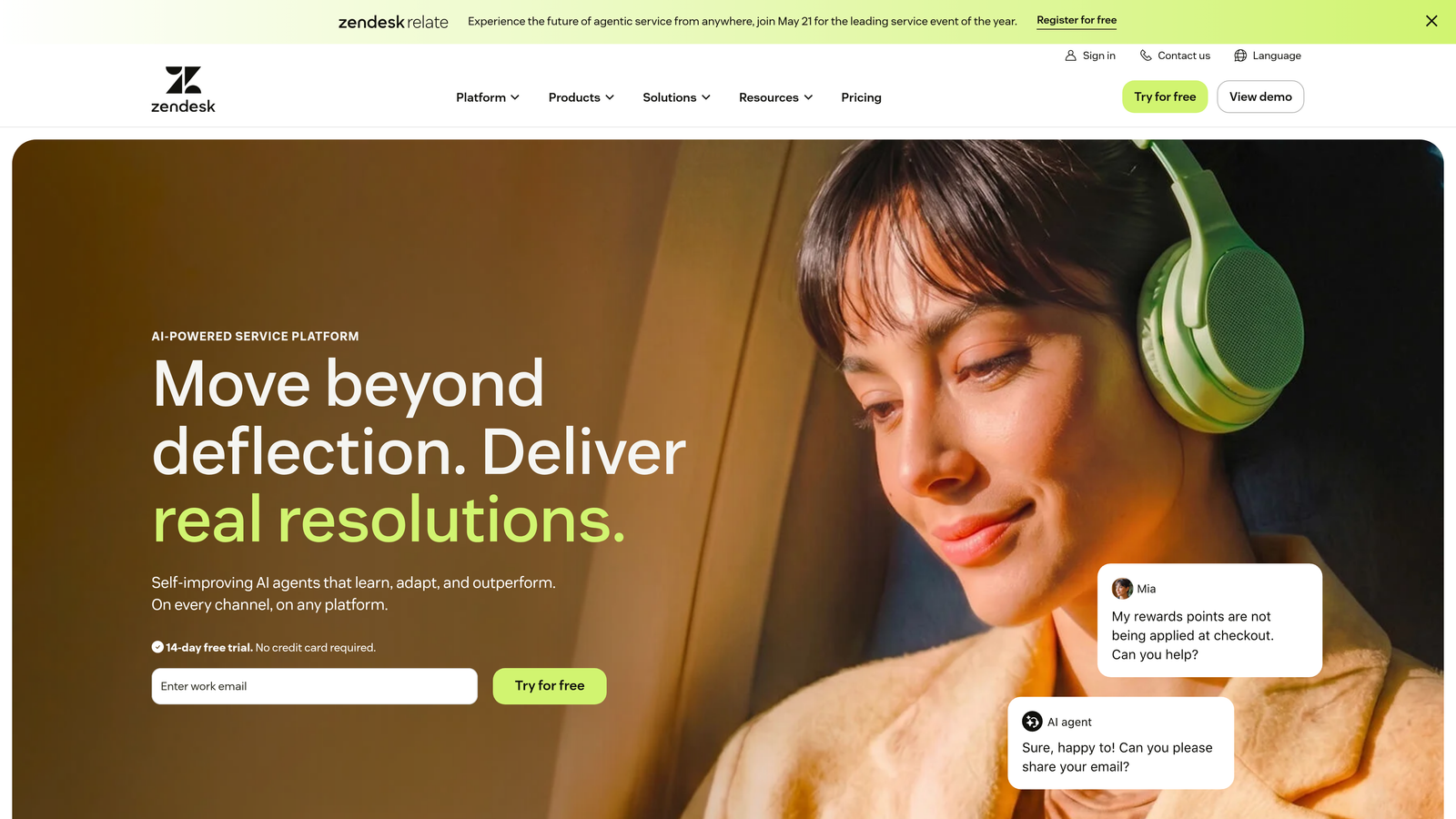
Zendesk AI is the native intelligence layer within Zendesk Suite, combining AI agents for self-service resolution with agent-assist features for human support staff.
Where This Tool Shines
If your team is already running on Zendesk, adding the AI layer is the path of least resistance. There's no new platform to learn, no data migration, and no integration work—the AI operates directly within the workflows your agents already use. Intelligent triage and routing reduce the manual sorting burden, while ticket summaries help agents get up to speed quickly on complex threads.
The tight coupling with Zendesk's knowledge base means AI agents draw from the same content your human team uses, keeping answers consistent across channels.
Key Features
AI Agents: Resolve common tickets using your knowledge base content without agent involvement.
Agent Assist: Surfaces suggested replies, ticket summaries, and next-step recommendations for human agents.
Intelligent Triage and Routing: Automatically classifies and routes incoming tickets based on intent and priority.
Knowledge Base Integration: AI draws directly from your existing Zendesk help center for consistent, accurate answers.
Best For
Organizations already operating on Zendesk Suite who want to extend their existing investment with AI capabilities rather than adding a separate platform. Less compelling for teams not yet on Zendesk, given the platform cost.
Pricing
AI features available on Suite plans starting around $55/agent/month; AI add-on pricing varies. Confirm current rates on Zendesk's website.
6. Chatling
Best for: Small teams that want a GPT-powered bot trained on their docs with minimal technical effort
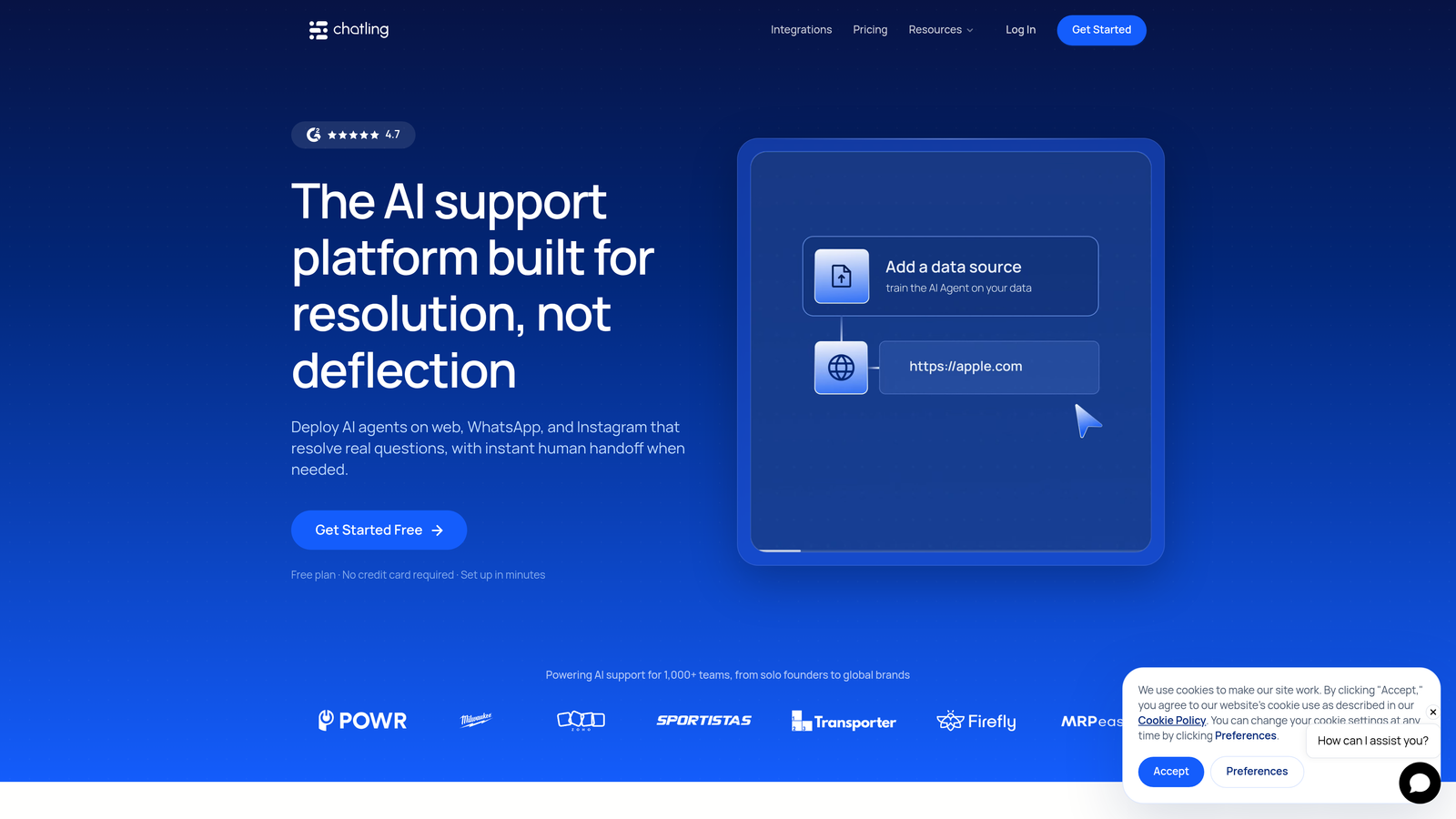
Chatling is a no-code AI chatbot builder that lets you train a GPT-powered assistant on your websites, documents, and knowledge bases without writing any code.
Where This Tool Shines
Chatling's biggest advantage is the low barrier to entry. You point it at your existing documentation or website, and it ingests that content to power a contextual chatbot. For a small team without engineering resources, that self-serve setup process is a meaningful time saver compared to platforms that require developer involvement.
The free plan supports basic usage, making it a realistic option for teams that want to test AI support before committing to a paid subscription.
Key Features
No-Code Training: Train the AI on websites, PDFs, and documents without any technical configuration.
Customizable Widget: Adjust the chat widget's appearance to match your brand without developer involvement.
Multi-Language Support: Handles conversations in multiple languages out of the box.
Usable Free Plan: Free tier supports basic chatbot usage for teams evaluating the platform.
Best For
Very small teams, solopreneurs, or early-stage startups that need a functional AI chatbot quickly and cheaply, and don't require deep CRM or helpdesk integrations in the near term.
Pricing
Free plan available. Paid plans start around $15/month. Verify current pricing on Chatling's website.
7. Botpress
Best for: Developer-led teams that want full customization control and an open-source foundation
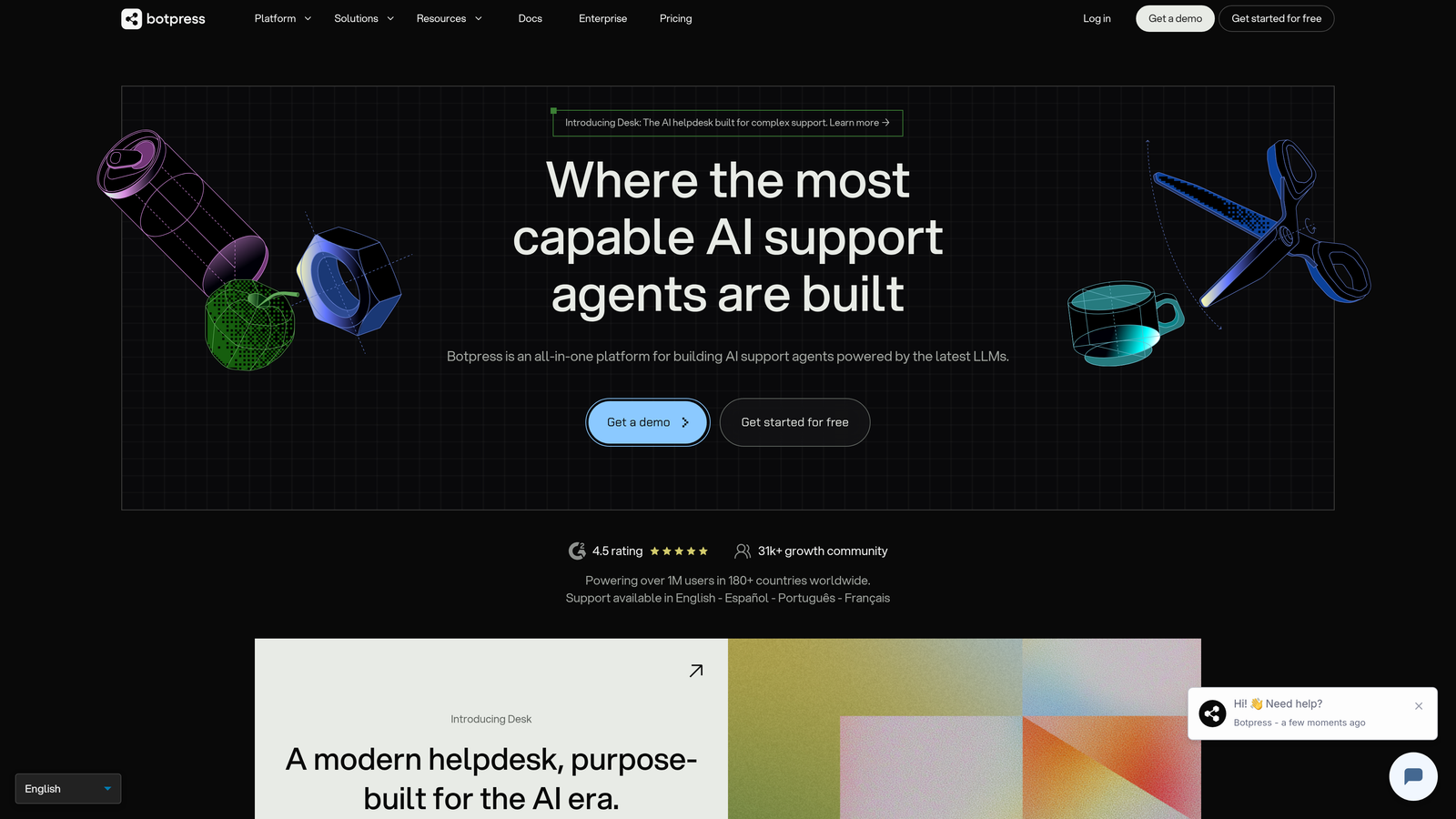
Botpress is an open-source conversational AI platform with a visual flow builder, GPT-native capabilities, and a generous free cloud tier designed for teams that want to build rather than configure.
Where This Tool Shines
Botpress gives technically capable teams something most SaaS chatbot platforms don't: genuine ownership of the underlying logic. The open-source core means you can self-host, customize deeply, and extend the platform in ways that closed systems simply don't allow. The visual flow builder makes that power accessible to team members who aren't writing code every day.
The free cloud tier is genuinely functional, not just a limited preview. Teams can build and deploy meaningful bots before spending anything, which makes it one of the best options for developer-led organizations that want to validate before committing.
Key Features
Open-Source Core: Full access to the underlying platform with self-hosting options for teams that need data control.
GPT-Native AI: Built-in large language model capabilities for contextual, conversational responses.
Visual Flow Builder: Design complex conversation flows without writing code, with developer extensibility available when needed.
Knowledge Base Ingestion: Train the bot on your documentation for contextually accurate answers.
Extensive API Access: Connect to virtually any external system through robust API and integration options.
Best For
Engineering-led teams, developer-focused startups, and organizations with specific compliance or data residency requirements that need self-hosting flexibility alongside modern AI capabilities.
Pricing
Free tier with generous usage limits. Paid plans available for higher volume and enterprise features. Check Botpress's website for current plan details.
8. Help Scout (AI Drafts & AI Answers)
Best for: Teams that want AI to augment human agents rather than replace them
Help Scout is a human-first support platform that uses AI to help agents write better replies faster and surface help content to customers instantly, without trying to automate your team out of the loop.
Where This Tool Shines
Help Scout's philosophy is deliberately different from fully autonomous AI platforms. Rather than having AI resolve tickets independently, it focuses on making your human agents more effective. AI Drafts generate reply suggestions that agents review and send, while AI Answers surface relevant help articles to customers before they even submit a ticket. The result is faster support without removing the human judgment from the equation.
The shared inbox interface is clean and minimal, which reduces the cognitive load on support teams compared to feature-heavy helpdesk platforms. For teams where tone and relationship quality matter, that human-in-the-loop model is a genuine advantage.
Key Features
AI Drafts: Generates full reply suggestions for agents based on ticket context, ready to review and send.
AI Answers: Surfaces relevant help center content to customers instantly, reducing inbound ticket volume.
Shared Inbox: Clean, minimal interface designed for collaborative team support without unnecessary complexity.
AI-Powered Knowledge Base Search: Helps customers find answers through intelligent search rather than keyword matching.
Best For
Customer-centric teams where relationship quality and tone matter, and where the goal is augmenting human agents rather than removing them from the resolution process. Strong fit for professional services, SaaS with high-touch customers, and teams where empathy is a differentiator.
Pricing
Plans start around $22/user/month with AI features included on standard plans. Verify current pricing on Help Scout's website.
9. Kommunicate
Best for: SMBs that want a hybrid AI and human chat solution at straightforward per-team pricing
Kommunicate is a hybrid AI and human chat platform that combines a GPT-powered chatbot with seamless human handoff, built for small and mid-size businesses that need both automation and live support in one place.
Where This Tool Shines
Kommunicate sits in a practical middle ground: it's more capable than a basic chatbot builder but more affordable than a full enterprise platform. The bot-to-human handoff is smooth and configurable, letting you define exactly when and how conversations escalate. Integration with Zendesk, Freshdesk, and common CRM tools means it can slot into existing workflows without requiring a platform overhaul.
The multi-language support and customizable widget make it a reasonable choice for teams serving geographically diverse customer bases without needing a complex localization setup.
Key Features
GPT-Powered Chatbot: Trains on your knowledge base to handle common questions with contextual, conversational responses.
Bot-to-Human Handoff: Configurable escalation rules ensure complex issues reach a live agent without friction.
Helpdesk Integrations: Native connections to Zendesk, Freshdesk, and CRM tools for workflow continuity.
Multi-Language Support: Handles customer conversations across languages with a customizable chat widget.
Best For
Small and mid-size B2B teams that need both AI automation and live chat in a single platform, particularly those already using Zendesk or Freshdesk who want to add a conversational AI layer without switching their core helpdesk.
Pricing
Plans start around $100/month for small teams. Free trial available. Check Kommunicate's website for current pricing.
Which Tool Is Right for Your Team?
The right choice depends less on feature lists and more on your team's operational model and where you are in your growth curve.
Budget-first teams: Chatling and Tidio offer the lowest barriers to entry, with free plans that let you test AI support before committing to any monthly spend. Both are solid starting points for teams validating the concept.
Developer-led organizations: Botpress is the clear standout. The open-source foundation, self-hosting option, and deep API access give technical teams control that closed SaaS platforms simply can't match.
Existing helpdesk users: If you're already running Zendesk, adding Zendesk AI is the lowest-friction path. Freshdesk's free tier makes it compelling for teams starting fresh, and Help Scout is the right call when human-augmented support is the goal rather than full automation.
Product-led SaaS teams: Halo AI and Intercom Fin are built for this model. Halo's page-aware context and business intelligence layer make it particularly strong for companies where the support channel is also a product feedback and customer health signal. Intercom Fin's pay-per-resolution model appeals to teams that want cost tied directly to outcomes.
Hybrid needs: Kommunicate bridges the gap well for SMBs that need both automation and live chat without choosing one or the other.
One thing worth emphasizing: affordable no longer means limited. Several of these tools offer genuine autonomous resolution, not just keyword-triggered responses. The gap between what a startup can access and what an enterprise deploys has closed considerably.
Your support team shouldn't need to grow headcount every time your customer base does. AI agents can handle routine tickets, guide users through your product in real time, and surface business intelligence your team can actually act on. See Halo in action and discover how continuous learning from every interaction builds a support system that gets smarter over time, not just bigger.