9 Best AI Agent Customer Service Tools & Pricing Compared (2026)
Comparing AI agent customer service pricing across nine leading platforms, this guide breaks down the true costs behind per-resolution fees, seat-based plans, and conversation credits—helping SaaS startups and enterprise teams identify which solution fits their budget and support needs.
 Grant CooperFounder14 min read
Buying an AI customer service agent is harder than it looks. Every vendor promises impressive deflection rates and seamless handoffs, but pricing models vary wildly: per-resolution fees, seat-based plans, conversation credits that evaporate faster than you expect, and custom enterprise contracts that require three demos before you even see a number.
This guide cuts through the noise. We've mapped out nine of the strongest AI agent platforms on the market, what they actually cost, and who each one is built for. Whether you're a lean SaaS startup looking to automate tier-1 tickets or an enterprise team replacing a large support floor, you'll find a clear-eyed breakdown here.
We cover pricing structures, key differentiators, and the use cases where each platform genuinely shines. If you want more context before diving in, our guides to automated customer support and AI helpdesk software are good starting points. Otherwise, let's get into it.
Understanding AI Customer Service Pricing Models
Before comparing tools, it helps to understand the pricing architectures you'll encounter. Each model has real trade-offs depending on your support volume and deflection rates.
Per-resolution pricing: You pay only when the AI fully resolves a ticket without human intervention. Attractive if your deflection rates are high and predictable, but costs can climb if AI performance underdelivers.
Per-seat pricing: The traditional SaaS model applied to AI, often as an add-on to agent licenses. Familiar for budgeting, but you pay regardless of how much the AI actually does.
Conversation-credit pricing: A monthly pool of AI conversations. Easy to understand, but teams often worry about running out mid-month during volume spikes.
Platform fee plus usage: A base subscription with variable usage costs layered on top. Common in enterprise tools, it gives you a cost floor with flexibility for scale.
Custom enterprise pricing: Most enterprise-grade platforms require direct sales engagement. Expect minimum contracts, implementation fees, and pricing tied to your specific use case.
Key questions to ask any vendor: What exactly counts as a "resolution"? Does a failed AI attempt still cost you? What are the overage fees? With that framing in place, here are the nine platforms worth your attention.
1. Halo AI
Best for: B2B SaaS teams wanting an AI-first support platform with business intelligence built in
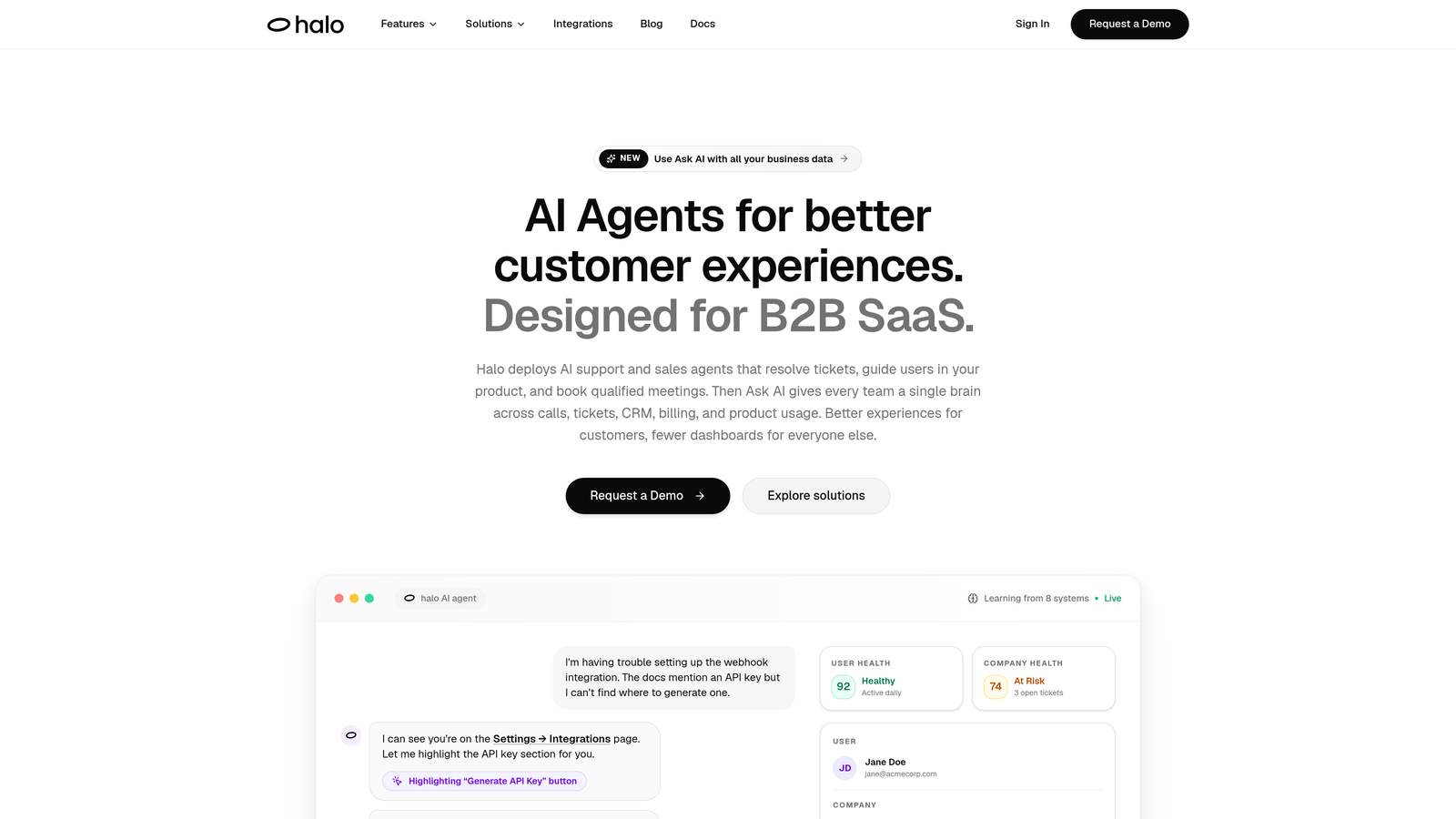
Halo AI is an AI-first customer support platform built specifically for B2B SaaS teams, deploying intelligent agents that resolve tickets, guide users through your product with contextual awareness, auto-create bug reports, and surface business intelligence from every support interaction.
Where This Tool Shines
What sets Halo apart from most tools on this list is its architecture. Rather than bolting AI onto an existing helpdesk, Halo was built AI-first from the ground up. That distinction matters: the system learns continuously from every resolved and escalated interaction, getting smarter with your specific product and customer base over time rather than staying static.
The page-aware chat widget is a standout capability. The AI sees exactly what your user sees within your product, enabling contextual guidance that goes far beyond generic FAQ responses. Pair that with a smart inbox that surfaces customer health signals, revenue intelligence, and anomaly detection, and you have a support platform that doubles as a business intelligence layer.
Key Features
Page-Aware Chat Widget: The AI understands which page or feature a user is on, enabling precise, contextual guidance rather than generic answers.
Continuous Learning: Every resolved ticket and human escalation feeds back into the model, improving accuracy and coverage over time without manual retraining.
Auto Bug Ticket Creation: Halo automatically identifies and logs bug reports, routing them directly to Linear or your preferred issue tracker without agent involvement.
Smart Inbox with Business Intelligence: Beyond ticket management, the inbox surfaces customer health signals, anomaly detection, and revenue insights, giving support data a seat at the product and revenue table.
Live Agent Handoff: When a conversation needs a human, full context is preserved so agents never start from scratch.
Deep Integration Stack: Native connections to Linear, Slack, HubSpot, Intercom, Stripe, Zoom, PandaDoc, and Fathom.
Best For
B2B SaaS companies that want more than ticket deflection. Halo is particularly well-suited to product-led growth teams where support interactions generate valuable signals about user behavior, feature confusion, and churn risk. If you want your support layer to inform your product roadmap and revenue strategy, this is worth a close look.
Pricing
Visit haloagents.ai for current pricing. Plans are designed to scale with B2B SaaS teams rather than penalize growth.
2. Intercom Fin
Best for: Teams already on Intercom who want per-resolution AI pricing with minimal setup
Intercom Fin is Intercom's native AI agent, built directly into the Intercom Messenger and inbox, resolving customer questions using your knowledge base with a pay-per-resolution model.
Where This Tool Shines
Fin's per-resolution pricing model is genuinely compelling if your deflection rates are strong. You only pay when the AI fully handles a ticket without human intervention, which aligns vendor incentives with your actual outcomes. For teams with a well-maintained knowledge base, this can make costs highly predictable.
The native integration with Intercom's inbox and workflow tools is seamless. If your team already lives in Intercom, Fin adds AI deflection without any migration friction. The handoff experience to human agents is smooth, and analytics on AI performance are built into the platform.
Key Features
Per-Resolution Pricing: Charges apply only when Fin fully resolves a conversation, not for attempts or partial answers.
Knowledge Base-Powered Resolution: Fin draws on your existing Intercom articles and content to answer questions conversationally.
Native Inbox Integration: Operates within Intercom's existing agent workspace with no separate tool to manage.
Seamless Human Handoff: Escalates to human agents within Intercom when the AI reaches its limits, preserving conversation context.
Resolution Analytics: Built-in reporting on what Fin resolved, what it couldn't, and where knowledge gaps exist.
Best For
Companies already using Intercom as their primary support and messaging platform. Fin is less compelling if you're not on Intercom, since the value is tightly tied to the native ecosystem. It works best when your knowledge base is thorough and well-maintained.
Pricing
Per-resolution fee model. Verify current rates at intercom.com, as pricing in this space updates frequently.
3. Zendesk AI
Best for: Large support operations already running on Zendesk infrastructure
Zendesk AI is the AI capability layer built across the Zendesk Suite, covering intelligent triage, intent and sentiment detection, automated replies, and an agent copilot for human-assisted workflows.
Where This Tool Shines
If your team is already deeply invested in Zendesk, the AI capabilities integrate without any platform disruption. Intelligent triage automatically categorizes and routes incoming tickets based on intent and sentiment, reducing the manual work of queue management at scale. The agent copilot surfaces suggested responses and next-best-action guidance directly within the agent workspace.
For enterprise support operations handling high ticket volumes across multiple channels, Zendesk AI's depth of integration with the broader Suite is hard to match. The trade-off is that the most powerful AI features live in higher tiers or require a paid add-on.
Key Features
Intelligent Triage: Automatically detects intent, sentiment, and urgency to route tickets to the right team or workflow.
Automated Replies: Handles common ticket types with AI-generated responses before a human agent is involved.
Agent Copilot: Provides suggested responses, knowledge article recommendations, and next-best-action prompts inside the agent workspace.
Advanced AI Add-On: Unlocks deeper automation and generative AI capabilities beyond what's included in standard Suite tiers.
Suite-Wide Integration: AI features work across Zendesk's full product ecosystem including Support, Guide, Chat, and Talk.
Best For
Enterprise and mid-market support teams with significant existing investment in Zendesk. Teams starting fresh or looking for an AI-first architecture may find better options elsewhere, but for Zendesk shops, this is the natural AI path.
Pricing
AI features are included in higher Suite tiers; Advanced AI is available as a paid add-on. Verify current pricing at zendesk.com.
4. Freshdesk Freddy AI
Best for: SMBs and growing teams wanting modular AI without a full platform migration
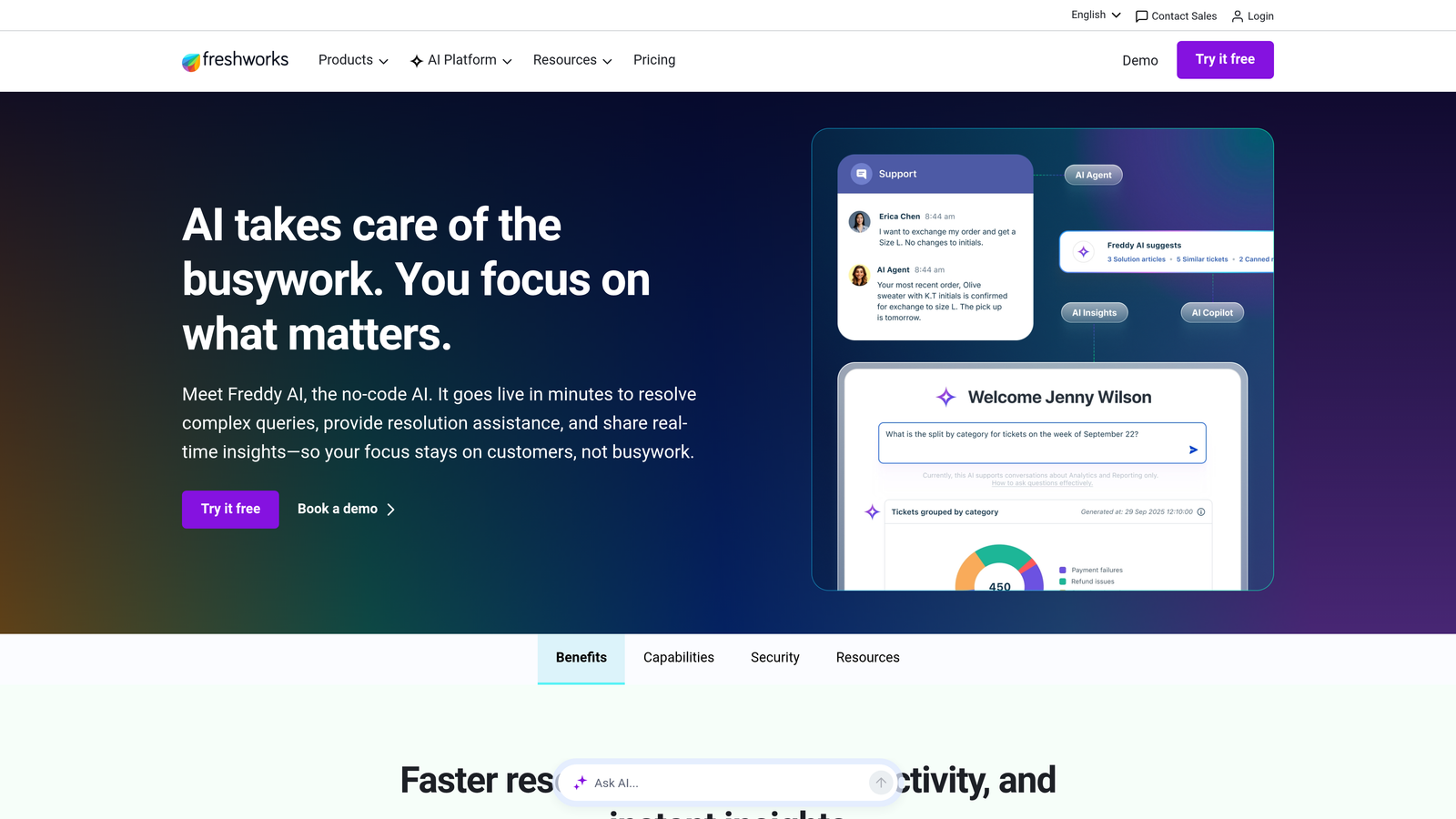
Freshdesk Freddy AI is Freshworks' modular AI layer covering customer-facing self-service, real-time agent assistance, and analytics, positioned as a more accessible entry point than many enterprise rivals.
Where This Tool Shines
Freddy AI's modular structure is its biggest advantage for teams with limited budgets or phased rollout plans. You can start with Freddy Self Service for customer deflection, add Freddy Copilot for agent assistance, and layer in Freddy Insights for analytics as your needs grow. That flexibility means you're not paying for capabilities you're not ready to use.
For teams already on Freshdesk, the integration is native and requires no platform migration. Freddy generally comes in at a lower price point than Zendesk AI or enterprise platforms like Ada, making it a practical choice for growing support teams watching their tooling costs.
Key Features
Freddy Self Service: AI-powered deflection that handles common customer questions before they reach a human agent.
Freddy Copilot: Real-time agent assistance with suggested replies, ticket summaries, and knowledge retrieval.
Freddy Insights: Analytics and recommendations that surface patterns in support data to guide team decisions.
Modular Pricing: Add only the AI capabilities your team actually needs rather than purchasing a bundled suite.
No Migration Required: Works within your existing Freshdesk setup, preserving current workflows and data.
Best For
SMBs and mid-market teams on Freshdesk who want to layer in AI incrementally. Less suited to teams looking for an AI-first architecture or advanced business intelligence beyond support metrics.
Pricing
Some Freddy features are included in higher Freshdesk tiers; additional capabilities are available as add-ons. Verify current rates at freshworks.com.
5. Tidio Lyro
Best for: Small businesses and e-commerce brands wanting fast AI deployment without engineering resources
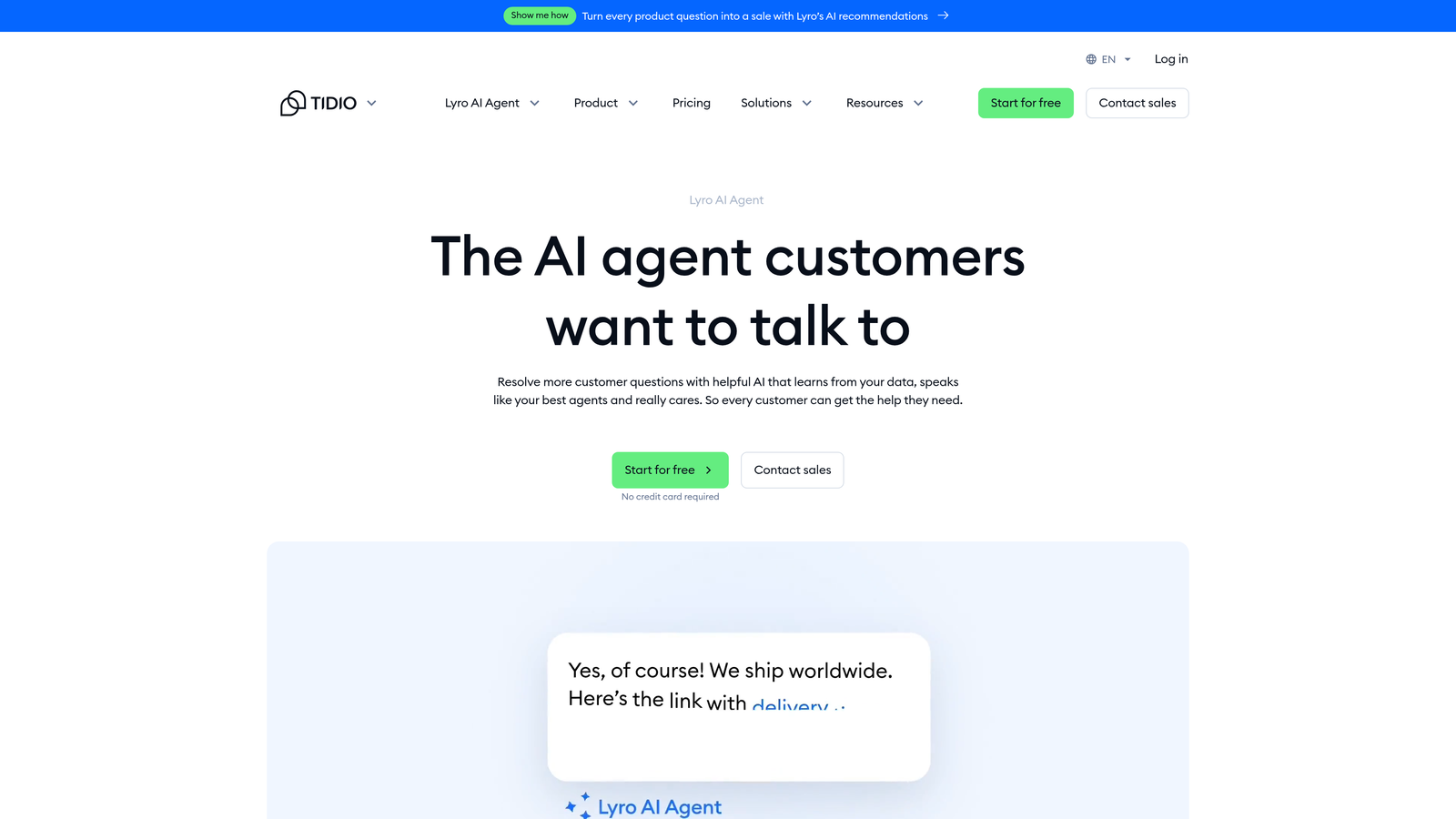
Tidio Lyro is a conversational AI agent designed for rapid deployment, with a conversation-based pricing model and strong integrations for Shopify, WordPress, and e-commerce platforms.
Where This Tool Shines
Lyro is built for speed. Non-technical teams can get an AI agent live without engineering involvement, which matters enormously for small businesses without dedicated dev resources. The Shopify and WordPress integrations are native and well-maintained, making it a natural fit for DTC brands and online retailers.
The free tier with limited monthly conversations gives teams a genuine way to test AI deflection before committing to paid plans. Conversation-based pricing scales with actual usage, which suits businesses with variable or seasonal support volumes.
Key Features
Conversation-Based Pricing: Costs scale with your actual chat volume rather than a fixed seat fee.
No-Code Setup: Deploy and configure Lyro without engineering resources or technical expertise.
E-Commerce Integrations: Native connections to Shopify, WordPress, and other e-commerce platforms.
Free Tier: A limited monthly conversation allowance lets teams evaluate the tool before purchasing.
Human Handoff: Escalates to live agents when the AI reaches the limits of its training or confidence.
Best For
Small businesses, DTC brands, and e-commerce operators with straightforward support needs. Lyro is less suited to complex B2B SaaS support environments where contextual product knowledge and business intelligence matter more than quick deployment.
Pricing
Free tier available with limited monthly conversations; paid plans scale by conversation volume. Verify current rates at tidio.com.
6. Kustomer
Best for: Consumer brands managing complex, multi-touch customer journeys across multiple channels
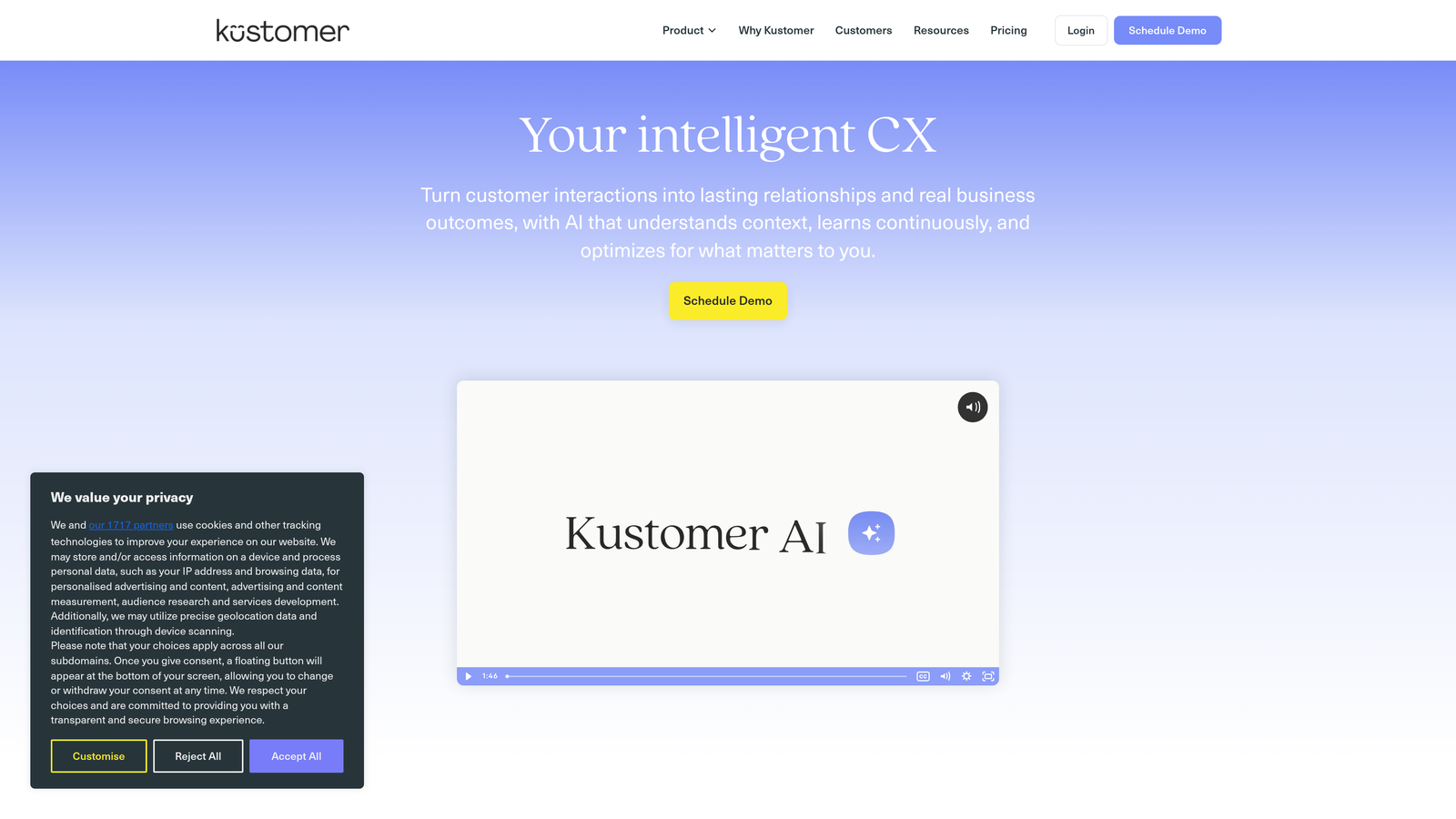
Kustomer is a CRM-native AI platform that unifies customer data into a single timeline and applies AI across omnichannel support including chat, email, social, SMS, and voice.
Where This Tool Shines
Kustomer's core strength is context. Because the AI operates within a unified customer timeline rather than an isolated ticket queue, it can factor in a customer's full history, previous interactions, and behavioral signals when handling a new request. For consumer brands where a single customer might contact you across five different channels over the course of a year, that continuity is genuinely valuable.
The omnichannel coverage is comprehensive, and AI-powered intent routing ensures conversations reach the right team or workflow based on what the customer actually needs. Enterprise buyers doing due diligence should note Kustomer's ownership history: acquired by Meta, then sold to a private equity group. Worth understanding for long-term platform decisions.
Key Features
Unified Customer Timeline: AI operates across a complete customer history rather than individual tickets in isolation.
Omnichannel Coverage: Handles chat, email, social, SMS, and voice from a single platform.
Intent Routing: AI detects customer intent and routes conversations to the appropriate team or automated workflow.
Automated Workflows: Triggered by customer behavior and history, reducing manual agent intervention for predictable scenarios.
Enterprise Compliance: Security and compliance features suited to large-scale consumer operations.
Best For
Consumer brands and retail companies with high-volume, multi-channel support needs and complex customer journeys. Less optimized for B2B SaaS teams where product-context awareness and developer tooling integrations matter more than CRM-native omnichannel coverage.
Pricing
Custom enterprise pricing. Contact the Kustomer sales team at kustomer.com for a quote.
7. Drift (Salesloft)
Best for: B2B companies where inbound chat serves both support and sales qualification simultaneously
Drift, now part of the Salesloft platform, is a conversational AI tool built for B2B companies where support and sales qualification overlap on the same website chat channel.
Where This Tool Shines
Drift occupies a unique position: it's less a pure support tool and more a revenue-focused conversational AI. The platform handles inbound questions while simultaneously qualifying leads, booking meetings, and routing revenue opportunities to the right sales rep. For B2B companies where a prospect might ask a product question before converting, that dual function is genuinely useful.
Account-based targeting allows personalized conversations based on who's visiting, which adds a layer of sophistication that pure support tools don't offer. Teams that have adopted Salesloft for their broader revenue workflow will find the integration natural.
Key Features
Dual Support and Sales Qualification: Handles customer questions and revenue qualification within the same conversation flow.
Intelligent Routing: Directs conversations to sales reps or support agents based on detected intent.
Meeting Booking: Qualifies and books sales meetings directly within the chat without human intervention.
Salesloft Integration: Works within the broader Salesloft revenue platform for teams already using that ecosystem.
Account-Based Targeting: Personalizes conversations based on the visiting company or contact profile.
Best For
B2B SaaS and technology companies where the website chat channel serves both support and inbound sales. Less suited to teams looking for a dedicated support automation platform without the sales qualification layer.
Pricing
Custom enterprise pricing. Contact Salesloft sales at salesloft.com for details.
8. Ada
Best for: Large enterprises needing multilingual, multi-channel AI agents built without engineering resources
Ada is a no-code AI agent builder with strong enterprise positioning, multilingual capabilities, and compliance features that allow non-technical teams to build and deploy sophisticated conversation flows at scale.
Where This Tool Shines
Ada's no-code builder is genuinely powerful. Non-technical teams can construct complex, branching conversation flows, configure integrations, and deploy across multiple channels without writing a line of code. For enterprise organizations where engineering resources are scarce or support teams operate independently from product and IT, that autonomy is a significant advantage.
The multilingual support and compliance certifications including GDPR and SOC 2 make Ada a credible choice for global enterprises with regulatory requirements. The platform integrates with major helpdesks and CRM systems, so it layers into existing infrastructure rather than requiring full replacement.
Key Features
No-Code Agent Builder: Non-technical teams can build and modify sophisticated AI conversation flows independently.
Multilingual Support: Handles a wide range of languages, enabling global deployment from a single platform.
Enterprise Compliance: GDPR, SOC 2, and additional certifications for regulated industries.
Helpdesk and CRM Integrations: Connects to major platforms including Zendesk, Salesforce, and others.
Omnichannel Deployment: Deploys across web, mobile, and messaging platforms from a unified configuration.
Best For
Large enterprises with multi-language, multi-channel support requirements and limited engineering bandwidth for AI tooling. Less suited to lean SaaS teams that want an AI-first platform with deep product context rather than a flexible conversation builder.
Pricing
Custom enterprise pricing. Contact Ada sales at ada.cx for a quote.
9. Forethought
Best for: Teams wanting AI automation on top of existing helpdesks without a platform migration
Forethought is an AI workflow layer designed to sit on top of existing helpdesks like Zendesk, Salesforce Service Cloud, and Freshdesk, adding deflection, intelligent routing, and agent copilot capabilities without requiring teams to abandon their current infrastructure.
Where This Tool Shines
Forethought's core proposition is additive AI: you keep your existing helpdesk investment and add meaningful automation on top. For organizations with significant Zendesk or Salesforce infrastructure that aren't ready for a full platform migration, this approach preserves sunk costs while delivering real AI capabilities.
The three-product structure maps cleanly to different stages of the support workflow. Solve handles deflection before a human is involved, Triage routes what gets through to the right team, and Assist supports agents once they're handling a ticket. That end-to-end coverage within a single AI layer is well-designed for complex support operations.
Key Features
Solve: AI-powered ticket deflection that intercepts common questions before they reach the human queue.
Triage: Intelligent routing based on intent, sentiment, and priority signals to direct tickets to the right team.
Assist: Agent copilot with suggested responses and knowledge retrieval to accelerate human resolution.
Helpdesk Agnostic: Works as a layer on top of Zendesk, Salesforce Service Cloud, Freshdesk, and others.
No Migration Required: Preserves existing helpdesk infrastructure and workflows while adding AI capabilities.
Best For
Mid-market and enterprise support teams with existing helpdesk infrastructure they want to enhance rather than replace. Less compelling for teams starting fresh who would benefit more from an AI-native platform built without legacy constraints.
Pricing
Custom enterprise pricing. Contact Forethought sales at forethought.ai for details.
Which Tool Is Right for Your Team?
Nine platforms is a lot to process, so here's a practical breakdown by use case to help you narrow the field.
If you're a B2B SaaS team that wants an AI-first platform with page-aware context, continuous learning, and business intelligence beyond ticket deflection, Halo AI is the strongest fit. It was built for exactly this environment, and the integration depth with tools like Linear, HubSpot, Stripe, and Slack reflects that focus.
If your team already lives in Intercom and wants frictionless AI deflection with per-resolution pricing, Fin is the natural next step. The model aligns costs with outcomes, which is appealing when your knowledge base is solid.
For large support operations on Zendesk or Freshdesk that want AI without migration, Zendesk AI and Freddy AI are the obvious paths. Forethought is worth considering if you want a more independent AI layer on top of either platform.
Small businesses and e-commerce brands will find Tidio Lyro the most accessible entry point, with a free tier and fast setup that doesn't require technical resources.
If you're a global enterprise with multilingual requirements and compliance constraints, Ada's no-code builder and certification coverage make it a credible choice. Kustomer fits consumer brands with complex omnichannel journeys, and Drift fits B2B teams where support and sales qualification share the same chat channel.
Your support team shouldn't scale linearly with your customer base. AI agents can handle routine tickets, guide users through your product, and surface business intelligence while your team focuses on complex issues that genuinely need a human touch. See Halo in action and discover how continuous learning transforms every interaction into smarter, faster support.