9 Best AI Agent Customer Support Platforms in 2026
This guide evaluates the 9 best AI agent customer support platforms in 2026, comparing autonomous resolution capabilities, integration depth, and scalability to help B2B SaaS teams move beyond traditional helpdesks. From AI-first architectures to intelligent add-ons, it identifies the right platform for every stage and use case.
 Matt PattoliFounder14 min read
The era of reactive, ticket-queue-drowning support is over. AI agent platforms now resolve tickets autonomously, guide users through products in real time, and surface business intelligence that traditional helpdesks never could. But not all platforms are built the same: some bolt AI onto legacy infrastructure, while others are designed AI-first from the ground up, with autonomous resolution as the core architecture rather than a feature addition.
This list covers the best AI agent customer support platforms available in 2026, evaluated on autonomous resolution capability, integration depth, learning mechanics, and scalability for B2B SaaS teams. Whether you're replacing a clunky helpdesk or adding intelligence to your existing stack, there's a platform here for your stage and use case.
1. Halo AI
Best for: B2B SaaS product teams wanting AI-first architecture with page-aware context and business intelligence
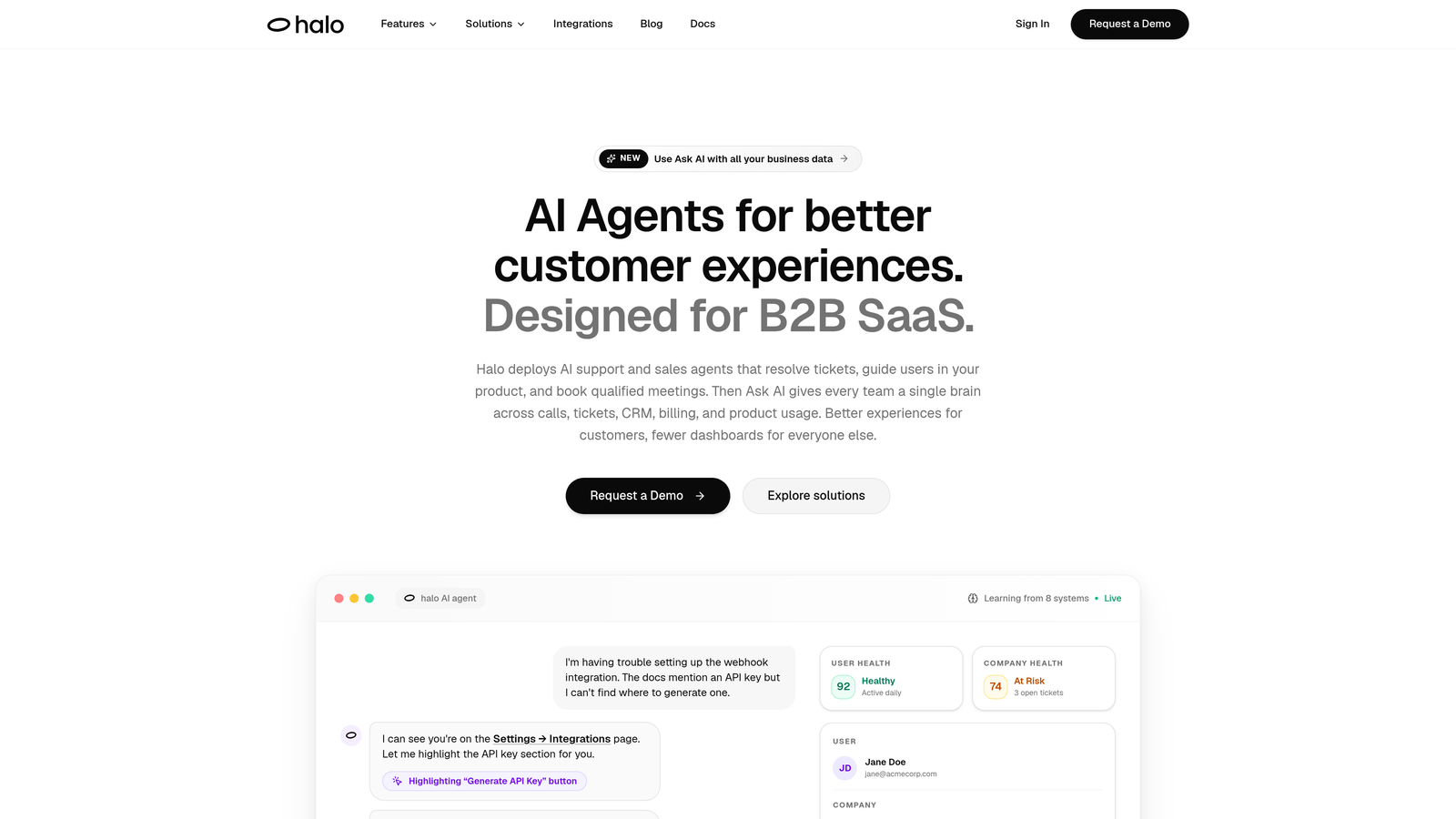
Halo AI is an AI-first customer support platform built specifically for B2B SaaS teams that need autonomous ticket resolution, visual product guidance, and intelligent business signals — not just a chatbot layered on top of an existing helpdesk.
Where This Tool Shines
What sets Halo apart from most platforms on this list is its page-aware context engine. The AI agent doesn't just respond to text: it sees what the user sees on screen and provides visual UI guidance in context. That means a user stuck on a configuration step gets shown exactly what to click, not a generic help article.
Halo also operates as a genuine business intelligence layer, not just a support tool. Its smart inbox surfaces customer health signals, revenue anomalies, and product friction patterns that would otherwise stay buried in ticket data. For product and growth teams, that's meaningful signal that goes well beyond CSAT scores.
Key Features
Page-Aware AI Agents: Agents understand which page and UI state a user is in, enabling contextual visual guidance rather than generic responses.
Autonomous Ticket Resolution: AI agents handle and close tickets end-to-end, with continuous learning from every resolved interaction to improve over time.
Automated Bug Ticket Creation: When a user reports a product issue, Halo automatically creates and routes a structured bug ticket to engineering tools like Linear — no manual triage required.
Smart Inbox with Business Intelligence: Surfaces customer health signals, revenue anomaly detection, and product usage patterns directly in the support inbox.
Live Agent Handoff: Complex issues escalate to human agents with full conversation context preserved, so nothing gets repeated.
Deep Integrations: Connects with Linear, Slack, HubSpot, Intercom, Stripe, Zoom, PandaDoc, and Fathom — covering the full B2B SaaS stack.
Best For
B2B SaaS companies that want AI-first architecture rather than an AI add-on to a legacy helpdesk. Particularly strong for product teams that want support intelligence feeding directly into engineering and revenue workflows. Less suited for teams that need a simple plug-and-play chatbot with no integration requirements.
Pricing
Pricing is not publicly listed. Halo operates on a demo-based sales model, which suggests custom pricing based on team size and usage. Contact via the website for a quote.
2. Intercom (Fin AI Agent)
Best for: Teams already using Intercom who want native AI resolution without switching platforms
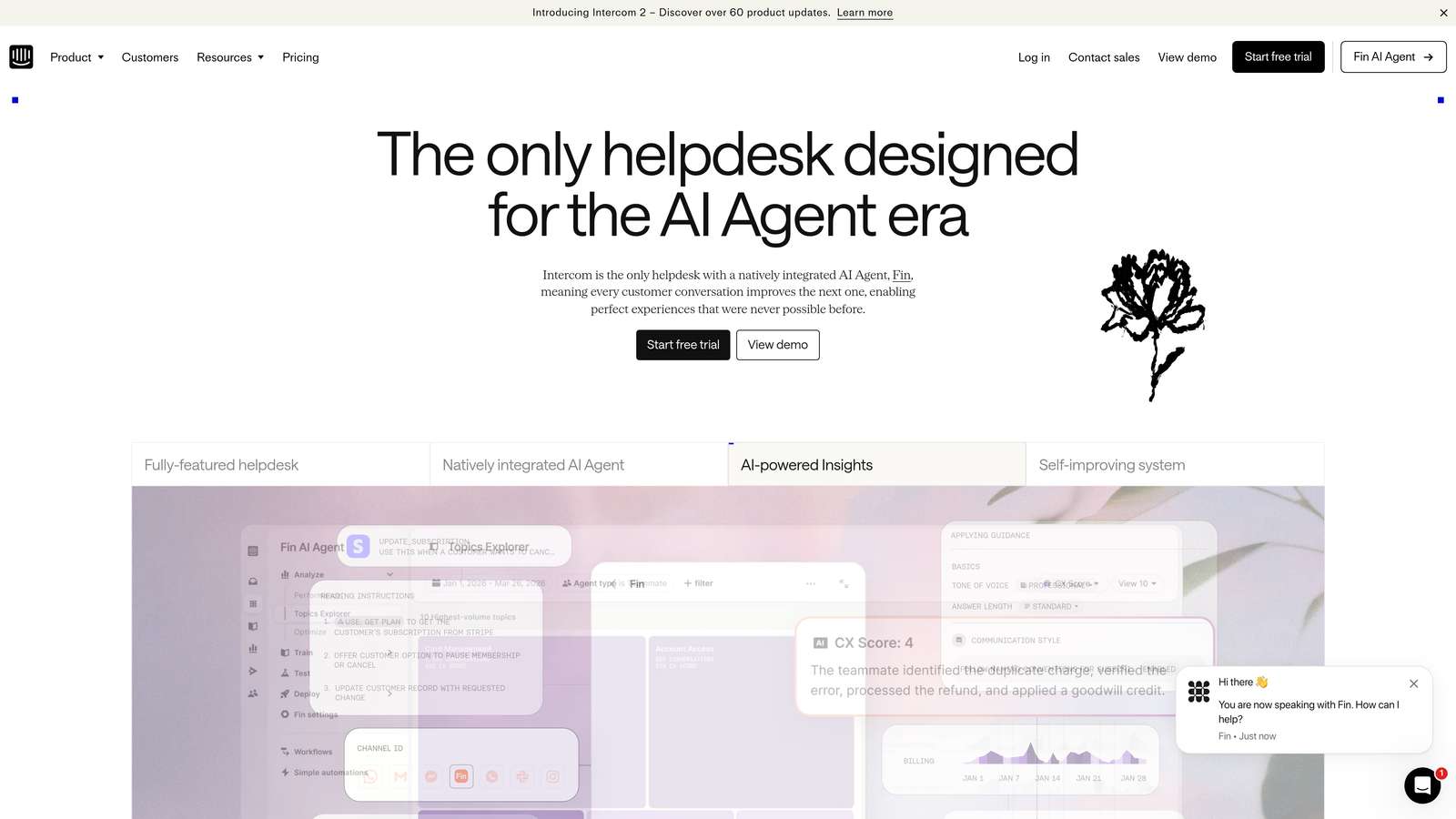
Intercom's Fin AI Agent is built directly into the Intercom messenger and handles autonomous resolution for teams already invested in the Intercom ecosystem.
Where This Tool Shines
Fin's biggest advantage is its native integration with everything else Intercom does. If your team already uses Intercom for routing, tagging, and inbox management, Fin slots in without requiring a separate platform or data migration. The generative AI draws from your existing help center content and custom knowledge sources, so setup time is relatively low for teams with mature documentation.
The usage-based pricing model is worth understanding carefully. Fin charges per resolution rather than per seat, which can work well for teams with predictable ticket volumes but may become expensive as resolution rates improve and volume scales.
Key Features
Fin AI Agent: Resolves conversations autonomously within the Intercom messenger using generative AI drawn from your knowledge base.
Native Workflow Integration: Deeply connected to Intercom's routing, tagging, inbox, and reporting workflows — no separate setup required.
Custom Knowledge Sources: Fin can be trained on help center content, URLs, and custom data beyond standard documentation.
Human Handoff: Escalates to live agents with full conversation history when Fin cannot resolve autonomously.
Usage-Based Pricing: Charged per resolved conversation rather than per seat, creating a direct cost-to-value relationship.
Best For
Support teams already running on Intercom who want to add autonomous resolution without introducing a new vendor. Less compelling for teams not already in the Intercom ecosystem, where the base plan cost adds significant overhead before Fin pricing even begins.
Pricing
Intercom base plans start at approximately $39 per seat per month. Fin AI Agent is priced per resolution on top of the base plan. Total cost scales with both seat count and resolution volume.
3. Zendesk AI
Best for: Enterprise support teams needing AI layered onto a mature, high-volume ticketing infrastructure
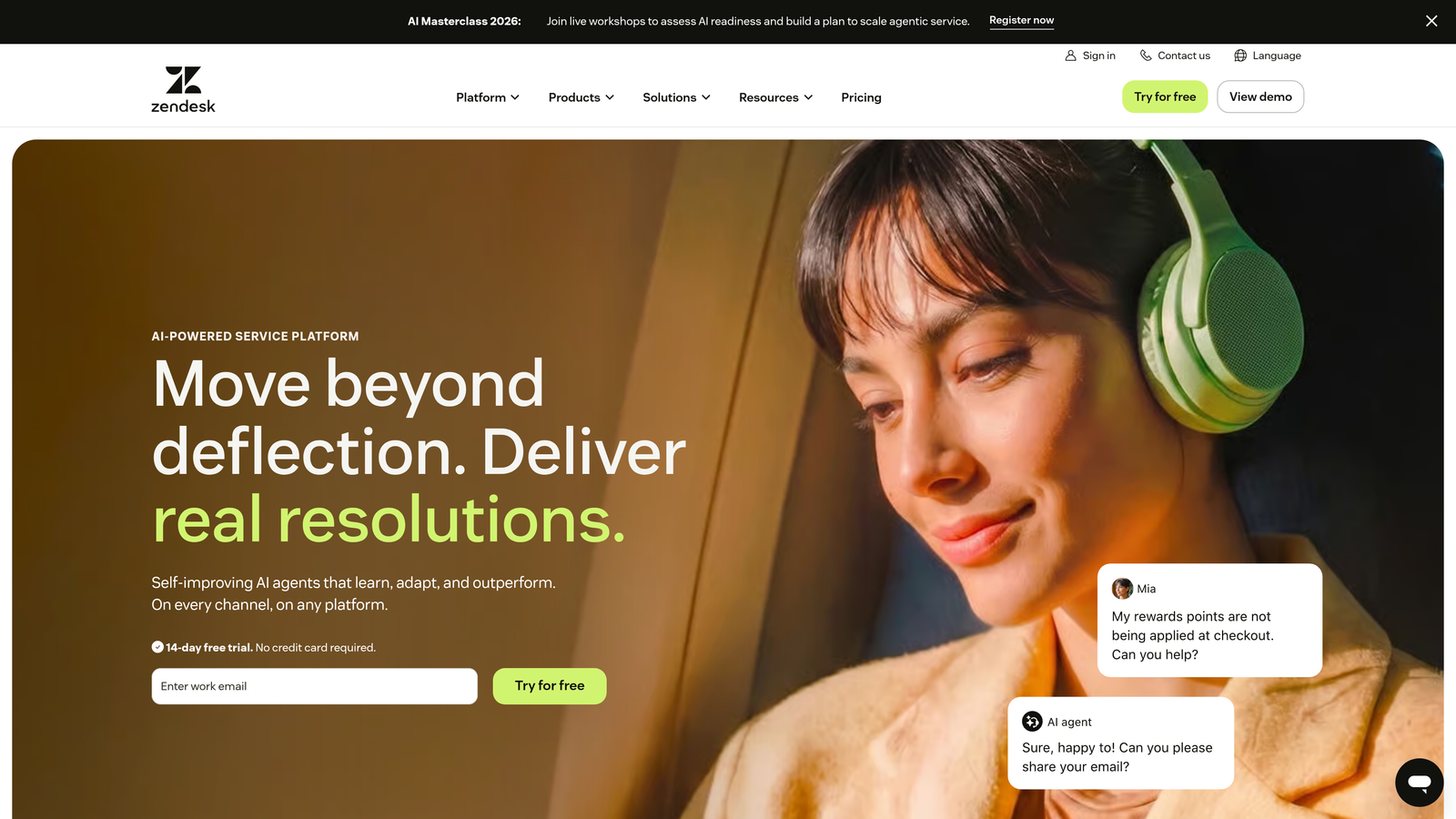
Zendesk's AI layer adds intelligent triage, intent detection, generative reply assistance, and an AI agent to the industry's most established enterprise ticketing platform.
Where This Tool Shines
Zendesk's strength is the depth of its existing infrastructure. Intelligent triage with intent, sentiment, and language detection is layered onto a ticketing system that many enterprise teams have spent years configuring. For organizations with complex routing rules, SLA requirements, and large agent teams, AI features extend what's already there rather than requiring a rebuild.
The Agent Copilot feature is particularly useful for large teams where consistency matters. Generative reply suggestions and next-step guidance help newer agents respond at the quality level of experienced ones, which can have a meaningful impact on CSAT at scale.
Key Features
Intelligent Triage: Automatically detects intent, sentiment, and language to route tickets accurately before an agent touches them.
AI Agent: Handles autonomous self-service resolution for common queries before tickets enter the queue.
Agent Copilot: Provides generative reply suggestions and next-step guidance to human agents during live conversations.
Advanced Analytics and QA: Quality assurance tooling and analytics built for large support operations with compliance requirements.
Marketplace Integrations: Extensive ecosystem of third-party integrations for enterprise environments with complex tech stacks.
Best For
Enterprise support teams with high ticket volumes who are already on Zendesk or evaluating it as a primary helpdesk. The AI features are most valuable when layered onto existing Zendesk infrastructure. For smaller teams or those without complex ticketing needs, the cost and configuration overhead may outweigh the benefits.
Pricing
Suite plans start at approximately $55 per agent per month. AI features are available on higher-tier plans. Enterprise pricing is custom. Verify current plan structure directly with Zendesk, as pricing tiers change frequently.
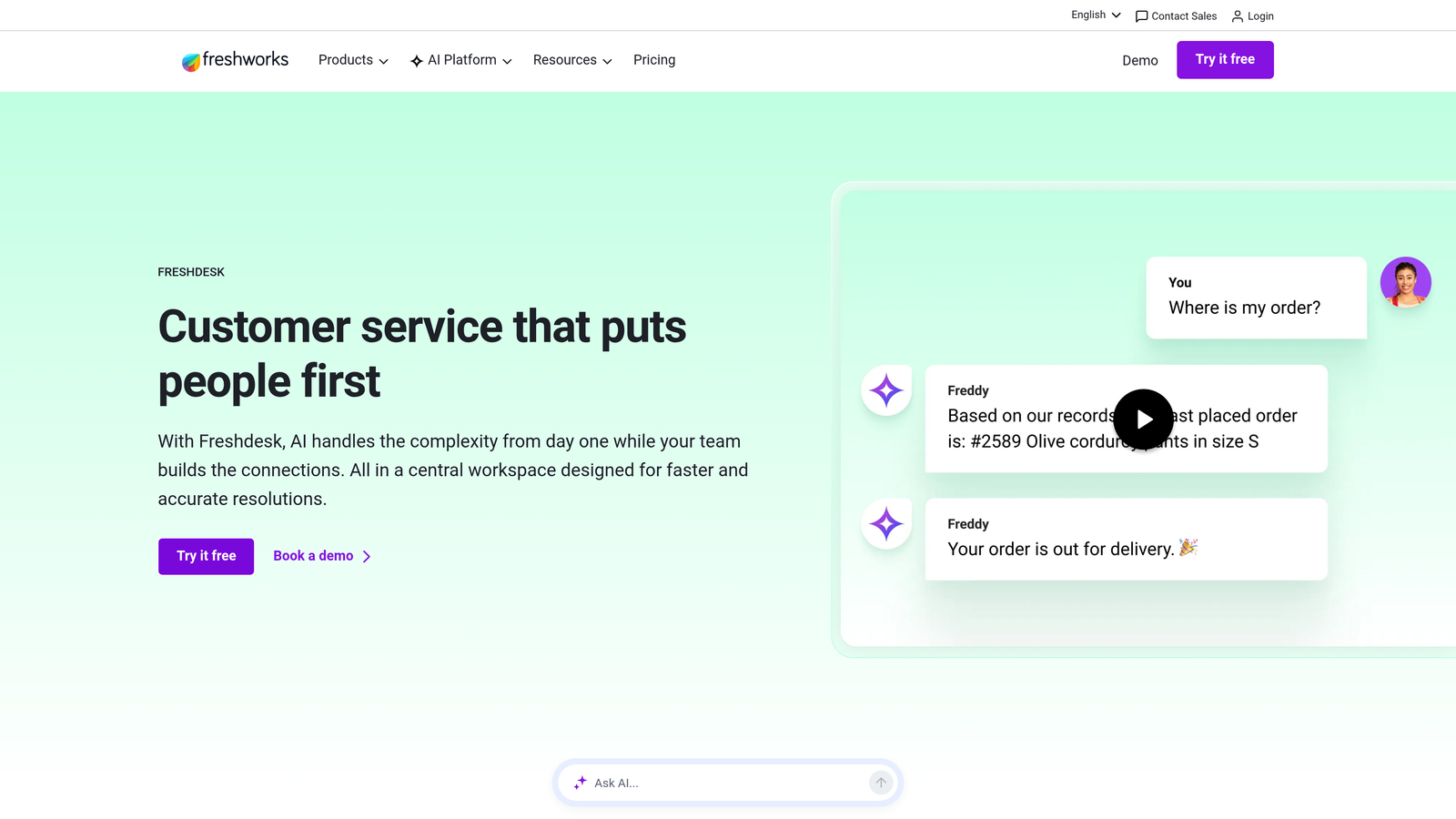
4. Freshdesk (Freddy AI)
Best for: SMB and mid-market teams wanting accessible AI-assisted support across a broad product suite
Freshdesk's Freddy AI spans self-service bots, agent assist, and analytics across the Freshworks product suite, making it a strong option for growing teams that need AI-assisted support without enterprise-level pricing.
Where This Tool Shines
Freddy AI is structured as three distinct sub-products: Freddy Self Service for autonomous customer resolution, Freddy Copilot for agent assistance with reply suggestions and summarization, and Freddy Insights for analytics that surface trends and anomalies. This modular structure means teams can adopt the pieces that match their current maturity level rather than buying capabilities they're not ready to use.
The cross-suite nature of Freddy AI is also worth noting. If your team uses Freshdesk for ticketing, Freshchat for messaging, and Freshservice for internal IT, Freddy AI spans all three — reducing the need for separate AI tooling across different workflows.
Key Features
Freddy Self Service: AI-powered bot that handles autonomous customer resolution before tickets reach agents.
Freddy Copilot: Agent assist with reply suggestions, ticket summarization, and knowledge retrieval during live support.
Freddy Insights: Analytics layer that surfaces support trends, anomalies, and performance signals for team leads.
Cross-Suite AI: Freddy AI spans Freshdesk, Freshchat, and Freshservice, providing consistent AI capabilities across the Freshworks ecosystem.
Accessible Pricing: Entry-level plans are priced for SMBs, with Freddy AI capabilities available as add-ons at incremental cost.
Best For
SMB and mid-market teams already using or evaluating Freshworks products. Particularly useful for organizations that want AI across multiple support channels without managing separate platforms. Less suited for teams that need deep custom integrations outside the Freshworks ecosystem.
Pricing
Freshdesk offers a free plan for small teams. Paid plans start at approximately $15 per agent per month. Freddy AI features are priced as add-ons separately from base plans. Verify current add-on pricing directly with Freshworks.
5. Forethought
Best for: Support operations teams focused on intelligent triage, routing efficiency, and resolution at enterprise scale
Forethought is a specialized AI platform focused on intelligent triage, routing, and resolution — purpose-built for support operations teams that need to improve efficiency and CSAT without replacing their existing helpdesk.
Where This Tool Shines
Forethought's workflow-first design is its defining characteristic. Rather than trying to be a full support platform, it plugs into existing systems like Zendesk, Salesforce Service Cloud, and ServiceNow to add an AI intelligence layer on top. For operations teams that have invested heavily in their current helpdesk configuration, this is a meaningful advantage: you get AI capabilities without rebuilding your workflows from scratch.
The three-product structure maps cleanly to the support funnel. Triage classifies and routes incoming tickets. Solve handles self-service resolution before tickets reach agents. Assist provides agent copilot capabilities with suggested replies and knowledge retrieval. Teams can deploy all three or start with the layer that addresses their biggest bottleneck.
Key Features
Triage: AI classifies and routes incoming tickets with high accuracy, reducing manual sorting and misrouted tickets.
Solve: Self-service AI resolution layer that deflects tickets before they enter the agent queue.
Assist: Agent copilot with suggested replies and knowledge retrieval during live ticket handling.
Helpdesk Integrations: Connects with Zendesk, Salesforce Service Cloud, ServiceNow, and other enterprise helpdesk platforms.
Operations-First Design: Built around support efficiency metrics — deflection rates, resolution time, and routing accuracy — rather than general chat experiences.
Best For
Enterprise support operations teams that want to add AI intelligence to an existing helpdesk investment rather than replace it. Strong fit for organizations on Zendesk or Salesforce Service Cloud that need better triage and deflection without a platform migration.
Pricing
Enterprise pricing model. Contact Forethought directly for a quote. No self-serve pricing is publicly available.
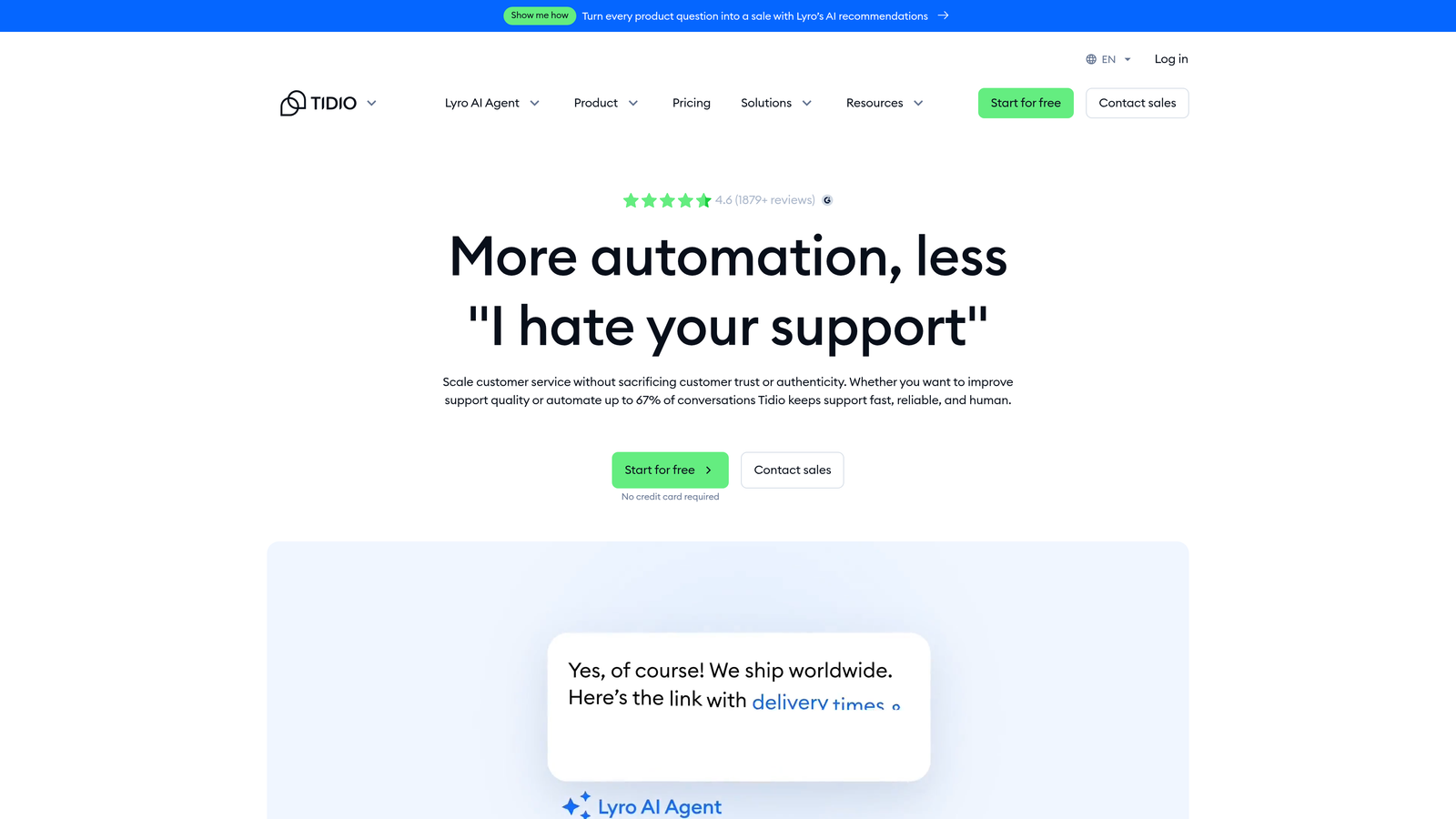
6. Tidio (Lyro AI)
Best for: E-commerce brands and small businesses needing fast, affordable conversational AI with minimal setup
Tidio's Lyro AI agent is designed for fast deployment with minimal setup, making it a popular choice for e-commerce brands and small businesses that need conversational AI without the complexity of enterprise platforms.
Where This Tool Shines
Lyro's primary advantage is speed to value. Teams can connect their knowledge base and have Lyro handling customer conversations within hours rather than weeks. For small businesses without dedicated support operations staff, that low-friction deployment is often the deciding factor.
The visual flow builder also makes Tidio accessible to non-technical teams. Custom automation flows can be built without code, and the live chat fallback ensures that conversations not handled by Lyro reach a human agent quickly. The Shopify and WooCommerce integrations make it a natural fit for direct-to-consumer brands managing order-related support at volume.
Key Features
Lyro AI Agent: Handles customer conversations autonomously using your knowledge base as the primary source.
Visual Flow Builder: No-code automation builder for creating custom conversation paths and routing logic.
Live Chat Fallback: Seamless handoff to human agents when Lyro cannot resolve a conversation.
E-Commerce Integrations: Native integrations with Shopify and WooCommerce for order status, returns, and product queries.
Fast Deployment: Designed to go live within hours, with minimal technical configuration required.
Best For
E-commerce businesses, DTC brands, and small businesses that need affordable conversational AI with quick deployment. Less suited for complex B2B SaaS environments where ticket workflows, bug routing, and product-context awareness are priorities.
Pricing
Free plan available with limited features. Paid plans start at approximately $29 per month. Lyro AI conversations are priced per usage on top of the base plan. Pricing is accessible for small business budgets.
7. Kustomer
Best for: High-touch B2C and D2C brands needing a unified customer timeline with AI-powered conversation handling
Kustomer (now owned by Meta) is a CRM-native customer service platform that combines a unified customer timeline with AI-powered conversation handling, built for brands where customer history and relationship context drive support quality.
Where This Tool Shines
Kustomer's CRM-native architecture is what separates it from most platforms on this list. Rather than treating customer data as a secondary lookup, Kustomer makes it the center of every interaction. Every touchpoint, order, conversation, and interaction is aggregated into a single timeline, which means agents and AI alike are working from complete context rather than fragmented ticket history.
For high-touch consumer brands where a customer's lifetime value and relationship history meaningfully change how support should respond, that architecture matters. The AI-powered routing, auto-resolution, and conversation summarization sit on top of that rich data layer rather than operating in isolation.
Key Features
Unified Customer Timeline: Aggregates all customer touchpoints, orders, and conversations into a single chronological view.
AI-Powered Routing and Auto-Resolution: Intelligent routing based on customer data and intent, with auto-resolution for common queries.
Conversation Summarization: AI summarizes long conversation threads to bring agents up to speed quickly.
Omnichannel Support: Handles chat, email, social, and voice conversations from a single platform.
Workflow Automation: Automates repetitive support tasks and follow-up actions based on customer data and conversation outcomes.
Best For
B2C and D2C brands with high customer interaction volume where relationship context drives support decisions. Less common in pure B2B SaaS environments where CRM-native architecture is less of a differentiator than product-aware AI and engineering integrations.
Pricing
Starts at approximately $89 per agent per month on the Enterprise plan. No lower-tier self-serve pricing is currently available. Best suited for teams with the budget to match its enterprise positioning.
8. Drift (Salesloft)
Best for: B2B revenue teams where inbound support conversations frequently overlap with sales qualification
Drift, now part of Salesloft, brings conversational AI to the intersection of support and revenue — ideal for B2B teams where the line between a support question and a sales opportunity is often blurry.
Where This Tool Shines
Drift's conversational AI is designed to handle inbound conversations and qualify leads simultaneously. For B2B companies where a prospect asking a product question might also be a buying signal, Drift routes based on conversation intent rather than treating every inbound chat as a pure support ticket. That means the right conversation can reach a sales rep rather than a support queue.
The post-Salesloft acquisition has pushed Drift's positioning further toward revenue teams. Meeting scheduling and pipeline creation are embedded directly in chat flows, making it a useful tool for teams that want their support chat to do double duty as a pipeline driver. Pure support teams may find the revenue-focused features unnecessary overhead.
Key Features
AI Chatbot with Lead Qualification: Handles inbound conversations and identifies buying intent to qualify leads in real time.
Intent-Based Routing: Routes conversations to support agents or sales reps based on detected conversation intent.
Embedded Meeting Scheduling: Allows prospects and customers to book meetings directly within the chat flow.
Revenue Workflow Integrations: Connects with Salesforce, HubSpot, and Salesloft revenue workflows for pipeline visibility.
Playbook-Based Conversation Design: Custom conversation playbooks for different buyer segments, use cases, and funnel stages.
Best For
B2B teams where support and sales functions overlap, particularly those already using Salesloft for revenue operations. Less suited for teams that need deep support-specific capabilities like autonomous ticket resolution, bug routing, or product-context awareness.
Pricing
Premium and Advanced plans available. Pricing is custom following the Salesloft acquisition. Contact Drift or Salesloft directly for current pricing.
9. Ada
Best for: Large enterprises needing no-code AI agent design with strict governance, brand controls, and global scale
Ada is an enterprise-grade no-code AI agent platform that gives large organizations deep control over conversation design, brand voice, and governance at global scale.
Where This Tool Shines
Ada's no-code builder is designed for enterprise teams that need significant customization without requiring engineering resources for every change. Conversation flows, brand persona, tone controls, and escalation logic can all be managed by operations or CX teams directly. For large organizations where brand consistency and compliance are non-negotiable, that level of control is a meaningful differentiator.
Multi-language support and enterprise governance controls make Ada well-suited for global deployments where regional compliance requirements, language coverage, and brand consistency all need to be managed from a single platform. The deep API capabilities also allow Ada to connect into existing enterprise tech stacks without requiring a full platform migration.
Key Features
No-Code AI Agent Builder: Advanced conversation design and customization without engineering dependency for ongoing changes.
Multi-Language Support: Handles global deployments with native multi-language capability for regional coverage.
Enterprise Governance Controls: Compliance and governance tooling for regulated industries and organizations with strict brand standards.
Deep API and Integration Capabilities: Connects with existing enterprise tech stacks through robust API access.
Brand Persona and Tone Controls: Allows organizations to design AI agents that reflect specific brand voice and personality at scale.
Best For
Large enterprises with global customer bases, compliance requirements, and the need for consistent brand voice across all AI-driven interactions. Less suited for early-stage SaaS teams or SMBs where the governance depth and pricing model exceed current needs.
Choosing the Right Platform for Your Team
The clearest dividing line in this list is architectural: AI-first platforms versus AI-layered platforms. If you're building a support operation from scratch or ready to move beyond a legacy helpdesk, an AI-first platform gives you autonomous resolution as the foundation rather than a feature bolted on later.
Here's a quick guide by use case:
B2B SaaS product teams: Halo AI is the strongest fit for teams that need page-aware context, autonomous resolution, bug routing to engineering, and business intelligence signals in a single platform built specifically for this environment.
Enterprise helpdesks with existing infrastructure: Zendesk AI or Forethought are the natural choices for teams with significant investments in their current ticketing system who want to add AI without rebuilding.
SMBs and growing teams: Freshdesk with Freddy AI offers accessible pricing and a modular AI structure that scales with team maturity. Tidio is the fastest path to deployment for e-commerce and small business use cases.
Revenue-focused B2B teams: Drift (Salesloft) is purpose-built for teams where support conversations and sales qualification overlap in the same chat channel.
High-touch B2C and D2C brands: Kustomer's CRM-native architecture makes it the strongest option when customer relationship history drives support quality.
Global enterprise with governance requirements: Ada provides the no-code control, multi-language support, and compliance tooling that large organizations need at scale.
Your support team shouldn't scale linearly with your customer base. Let AI agents handle routine tickets, guide users through your product, and surface business intelligence while your team focuses on complex issues that need a human touch. See Halo in action and discover how continuous learning transforms every interaction into smarter, faster support.