9 Best AI Agents for SaaS Support in 2026
Discover the 9 best AI agent for SaaS support platforms in 2026, evaluated on autonomous ticket resolution, product-aware context, and integration depth. This guide helps SaaS support teams scale efficiently without growing headcount, covering tools capable of resolving tickets independently, guiding users through complex workflows, and delivering actionable business intelligence beyond traditional helpdesk capabilities.
 Grant CooperFounder13 min read
SaaS support teams face a unique challenge: customers expect instant, knowledgeable help across complex product surfaces, but scaling human teams to match product growth is expensive and slow. A ticket backlog doesn't care that your engineering team just shipped three new features.
AI agents built specifically for SaaS support can resolve tickets autonomously, guide users through product workflows, and surface business intelligence that traditional helpdesks miss entirely. The category has matured significantly, shifting from simple chatbot deflection toward agents capable of taking real actions in connected systems.
This list covers nine AI agent platforms purpose-built or well-suited for SaaS support environments. We evaluated each tool on autonomous resolution capabilities, SaaS-specific features like product-aware context and integration depth, learning and improvement loops, pricing transparency, and how well they complement existing support stacks. Whether you're a 20-person startup drowning in a ticket backlog or a scaling SaaS company looking to maintain support quality without tripling headcount, there's a fit here for you.
1. Halo AI
Best for: B2B SaaS teams that want an AI-first support platform with deep product context and business intelligence.
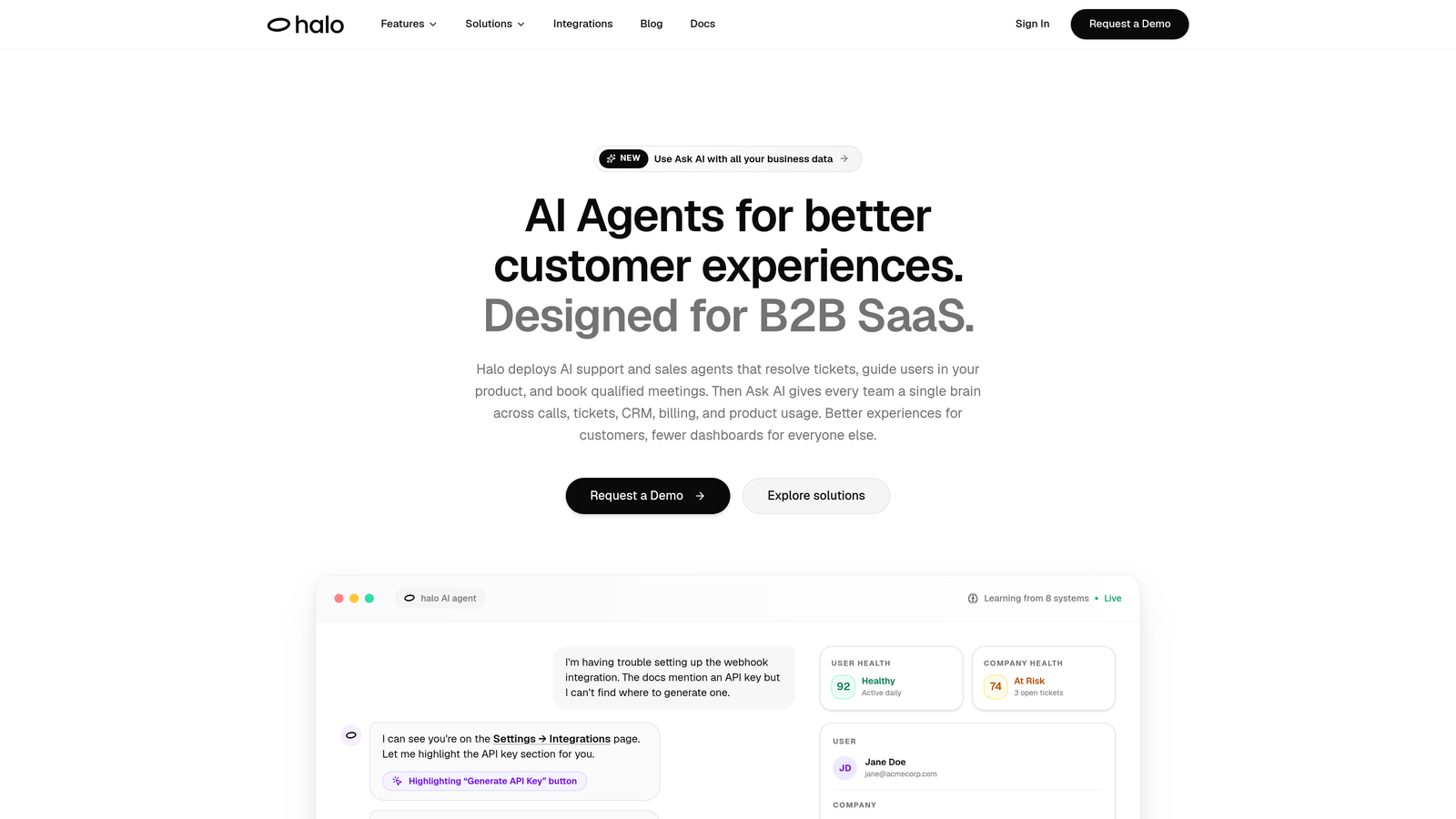
Halo AI is an AI-first customer support platform that deploys autonomous agents capable of resolving tickets, guiding users through product interfaces, and surfacing actionable intelligence from support data.
Where This Tool Shines
What separates Halo from most tools on this list is the architectural foundation. Rather than bolting AI onto an existing helpdesk, Halo is built from the ground up around AI agents. That distinction matters more than it sounds: when the entire platform is designed around autonomous resolution, the AI can reason more deeply about product context rather than just pattern-matching against a knowledge base.
The page-aware chat widget is a standout capability. Instead of asking users to describe what they're looking at, Halo's agent sees the same product surface the customer sees, enabling contextual visual guidance that significantly narrows the gap between "I'm confused" and "problem solved." Pair that with continuous learning from every interaction, and the system compounds in value over time rather than plateauing.
Key Features
Page-Aware Chat Widget: Understands which page or feature a user is viewing, enabling contextual guidance without users needing to explain their location in the product.
Continuous Learning: Improves resolution quality with every interaction, so the AI gets smarter as your product and customer base evolve.
Auto Bug Ticket Creation: Automatically generates detailed bug reports routed to engineering tools like Linear, closing the loop between support and product development.
Smart Inbox with Business Intelligence: Surfaces customer health signals, revenue insights, and anomaly detection from support data, turning your support queue into a strategic data source.
Deep SaaS Stack Integrations: Connects natively with Slack, HubSpot, Intercom, Stripe, Zoom, PandaDoc, and Fathom, enabling the AI to take meaningful actions across your entire business stack.
Best For
Halo is best suited for B2B SaaS teams that want more than ticket deflection. If you need an AI that understands your product surface, feeds intelligence back to engineering and revenue teams, and learns continuously without requiring constant retraining, Halo is built for exactly that use case. Particularly strong for product-led growth companies where the support experience directly impacts retention.
Pricing
Contact for pricing. Halo is designed for B2B SaaS teams of varying sizes, from early-stage startups to scaling companies, and pricing is scoped to your support volume and integration needs.
2. Intercom Fin
Best for: Teams already on Intercom who want AI resolution without switching platforms.
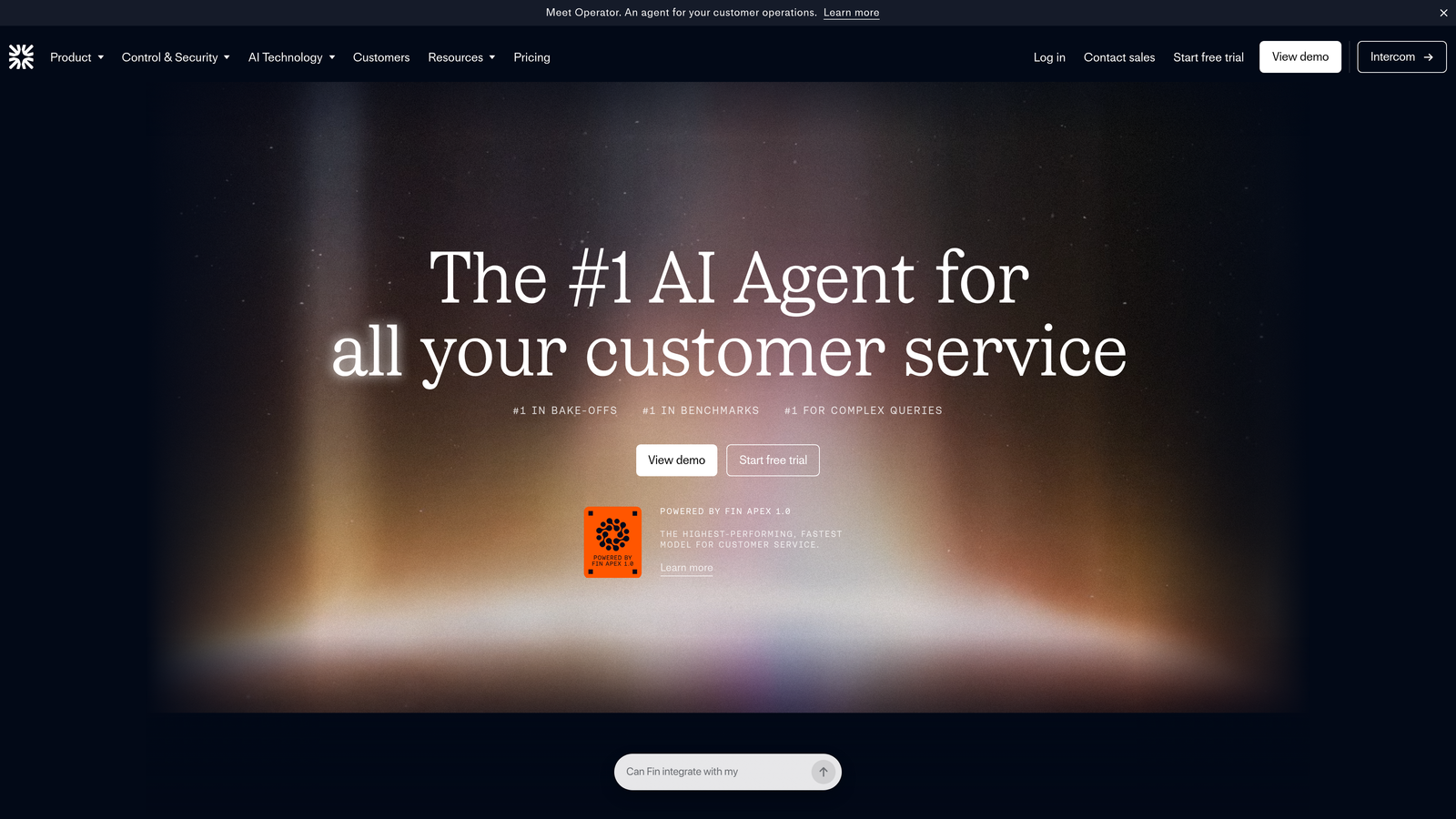
Intercom Fin is Intercom's native AI agent that resolves customer questions using your help center content, conversation history, and custom data sources within the Intercom messenger experience.
Where This Tool Shines
Fin's biggest advantage is how seamlessly it lives inside the Intercom ecosystem. If your team already runs support through Intercom, Fin requires no additional infrastructure, no new interfaces, and no migration headaches. The AI grounds its answers in your existing support content and cites sources, which builds customer trust and makes it easier to audit resolution quality.
The handoff experience is notably smooth. When Fin reaches the limits of what it can resolve, it escalates within the same conversation thread, so customers never feel like they're starting over with a human agent.
Key Features
Native Intercom Integration: Runs directly inside the Intercom messenger with no third-party setup required.
Source-Cited Answers: Grounds responses in your help center content and surfaces citations, improving accuracy and customer confidence.
Customizable Behavior Rules: Lets you define tone, escalation triggers, and topic boundaries to match your brand and support policies.
Seamless Human Handoff: Escalates to live agents within the same conversation thread, preserving full context.
Multi-Channel Support: Operates across chat, email, and social channels from a single configuration.
Best For
Teams that are already invested in the Intercom platform and want to add AI resolution without introducing new vendors or tools. Less compelling for teams not on Intercom, since the value is heavily tied to the native integration.
Pricing
Usage-based pricing per resolution. Requires an active Intercom subscription, so total cost depends on your existing plan tier and resolution volume.
3. Zendesk AI Agents
Best for: Enterprise teams running support operations on Zendesk Suite who want AI built into their existing workflow.
Zendesk AI Agents are built-in AI agents that autonomously resolve common support requests using pre-trained intent models and your knowledge base content, integrated directly into the Zendesk Suite.
Where This Tool Shines
Zendesk's AI agents benefit from the platform's extensive pre-training on support interactions across industries. Out of the box, the intent models cover a wide range of common request types, which means less setup time for teams with standard support workflows. For organizations already running Zendesk, the unified agent workspace keeps human and AI-handled tickets in the same view.
The intelligent triage layer is genuinely useful at scale. Automatically classifying tickets by intent, language, and sentiment before routing them means human agents spend less time on categorization and more time on resolution.
Key Features
Pre-Trained Intent Models: Arrives with broad coverage of common support intents, reducing the cold-start problem for new deployments.
Action-Taking Capabilities: Can perform actions in connected systems, not just answer questions, enabling more complete autonomous resolution.
Unified Agent Workspace: Human and AI interactions managed from the same interface inside Zendesk Suite.
Intelligent Triage: Classifies tickets by intent, language, and sentiment automatically before routing.
Enterprise Security and Compliance: Meets enterprise-grade security standards, important for SaaS companies handling sensitive customer data.
Best For
Mid-market to enterprise SaaS companies already standardized on Zendesk. The AI capabilities are most powerful when layered onto an existing Zendesk knowledge base and workflow configuration. Teams starting fresh may find the setup investment significant.
Pricing
Included in Zendesk Suite plans with usage-based AI add-on pricing for higher resolution volumes. Contact Zendesk for enterprise-tier quotes.
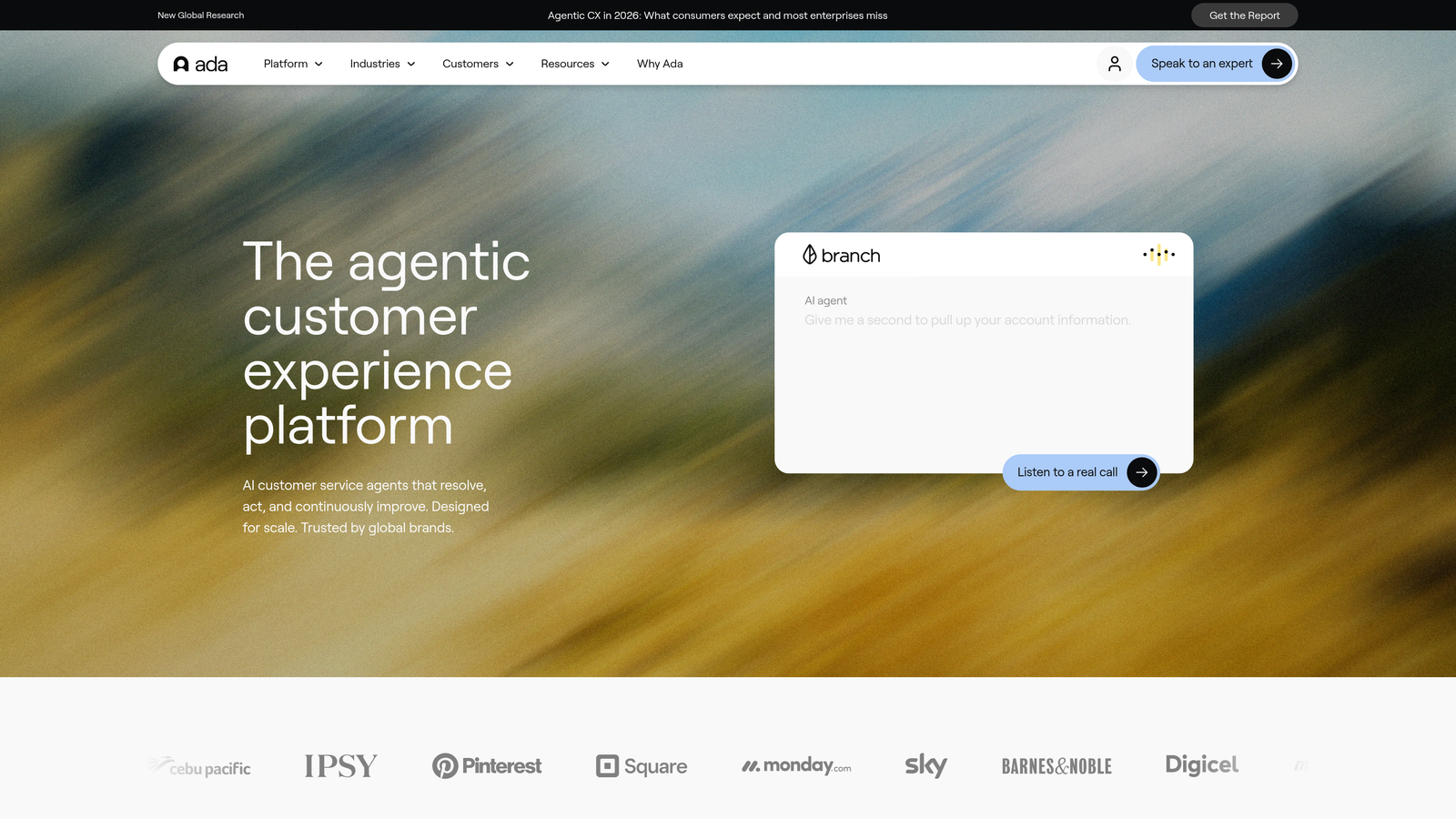
4. Ada
Best for: Enterprise SaaS companies with multilingual customer bases and complex resolution workflows.
Ada is an AI-powered customer service automation platform built for enterprise scale, with strong multilingual capabilities and no-code workflow building for complex resolution paths.
Where This Tool Shines
Ada's multilingual capabilities stand out in a category where language coverage is often an afterthought. Supporting over 50 languages with high-quality resolution makes Ada a strong choice for SaaS companies with global customer bases who can't afford degraded support quality for non-English speakers.
The no-code automation builder gives non-technical support leaders real control over complex multi-step workflows without waiting on engineering resources. That independence matters when your product ships fast and your support flows need to keep up.
Key Features
50+ Language Support: High-quality multilingual resolution across a wide range of languages, not just basic translation.
No-Code Workflow Builder: Build complex multi-step automation paths without engineering involvement.
Omnichannel Deployment: Operates across chat, email, SMS, and social from a single platform.
AI-Powered Coaching: Performance insights and coaching recommendations to improve resolution quality over time.
Broad Integration Library: Connects with major CRMs, helpdesks, and commerce platforms.
Best For
Enterprise SaaS companies serving international markets who need consistent support quality across languages and channels. Also a strong fit for teams that want non-technical ownership of automation workflows.
Pricing
Custom enterprise pricing. Contact Ada's sales team for a quote tailored to your volume and feature requirements.
5. Freshdesk Freddy AI
Best for: Teams already in the Freshworks ecosystem looking for accessible AI support automation at competitive price points.
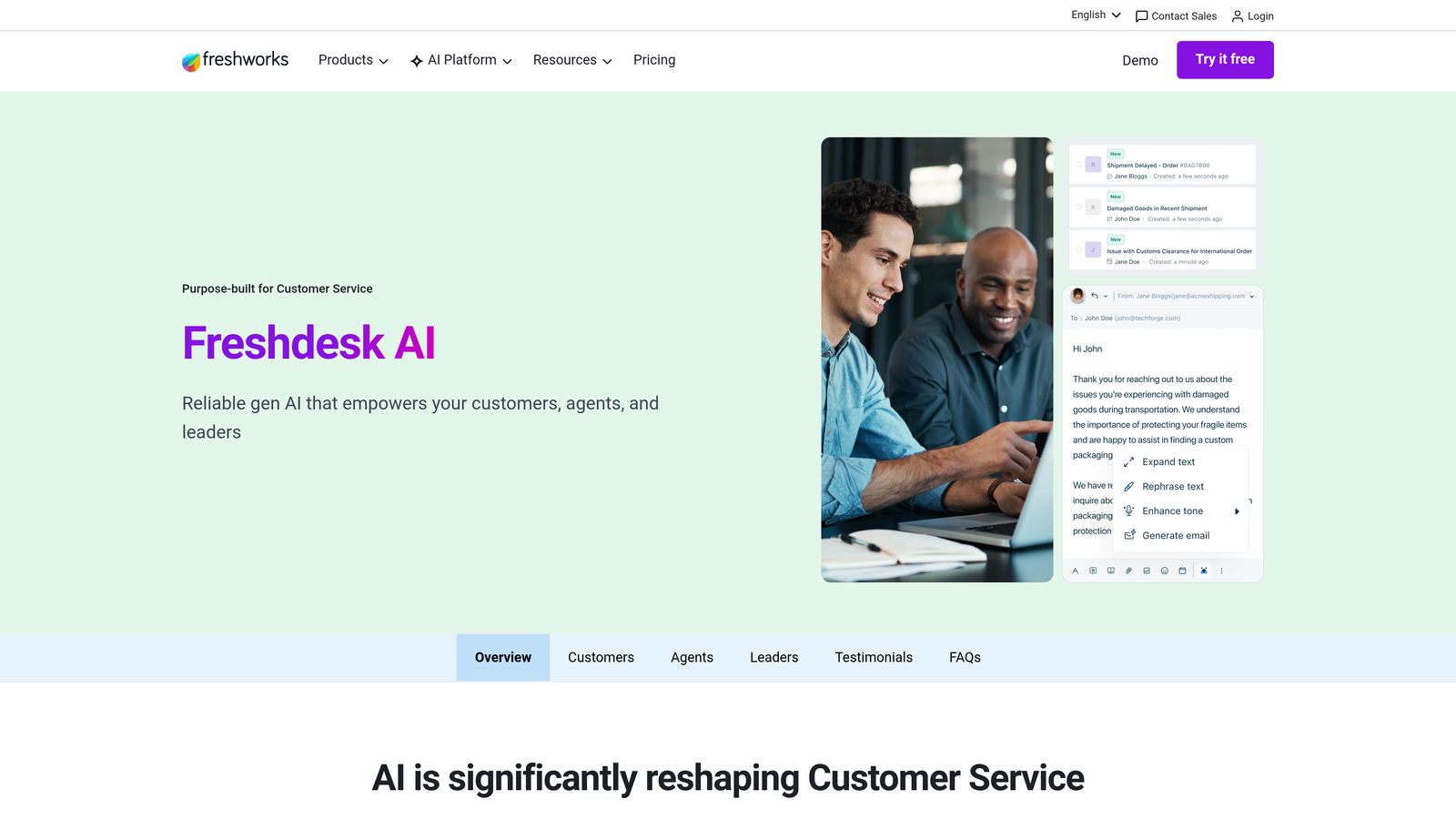
Freshdesk Freddy AI is Freshworks' AI agent layer for Freshdesk that handles ticket resolution, agent assistance, and workflow automation within the Freshworks ecosystem.
Where This Tool Shines
Freddy AI's strength is accessibility. Where many enterprise AI support platforms require significant budget and implementation overhead, Freddy brings AI-powered resolution to teams on more modest budgets without sacrificing core functionality. If you're running Freshdesk as your helpdesk, Freddy is the most natural path to AI-assisted support.
The agent assist features are particularly practical for growing teams. Suggested responses and next-best-action recommendations help newer support agents ramp faster and maintain quality consistency across the team.
Key Features
Knowledge Base-Trained Resolution: AI resolves tickets using your existing Freshdesk knowledge base content with minimal setup.
Agent Assist: Real-time suggested responses and next-best-action recommendations for human agents handling complex tickets.
Auto-Triage and Categorization: Automatically sorts and categorizes incoming tickets to reduce manual routing work.
Freshworks Suite Integration: Connects naturally with Freshworks CRM, ITSM, and marketing products for a unified view.
Accessible Pricing Tiers: AI features available at price points smaller teams can realistically budget for.
Best For
Small to mid-size SaaS teams already using Freshdesk who want to layer in AI without switching platforms or stretching the budget. Less compelling for teams not in the Freshworks ecosystem.
Pricing
Freddy AI features are available on Pro and Enterprise plans, starting at approximately $49 per agent per month. Pricing varies by plan tier and feature set.
6. Forethought
Best for: Support teams that want deep intent understanding and a modular AI approach across triage, resolution, and agent assistance.
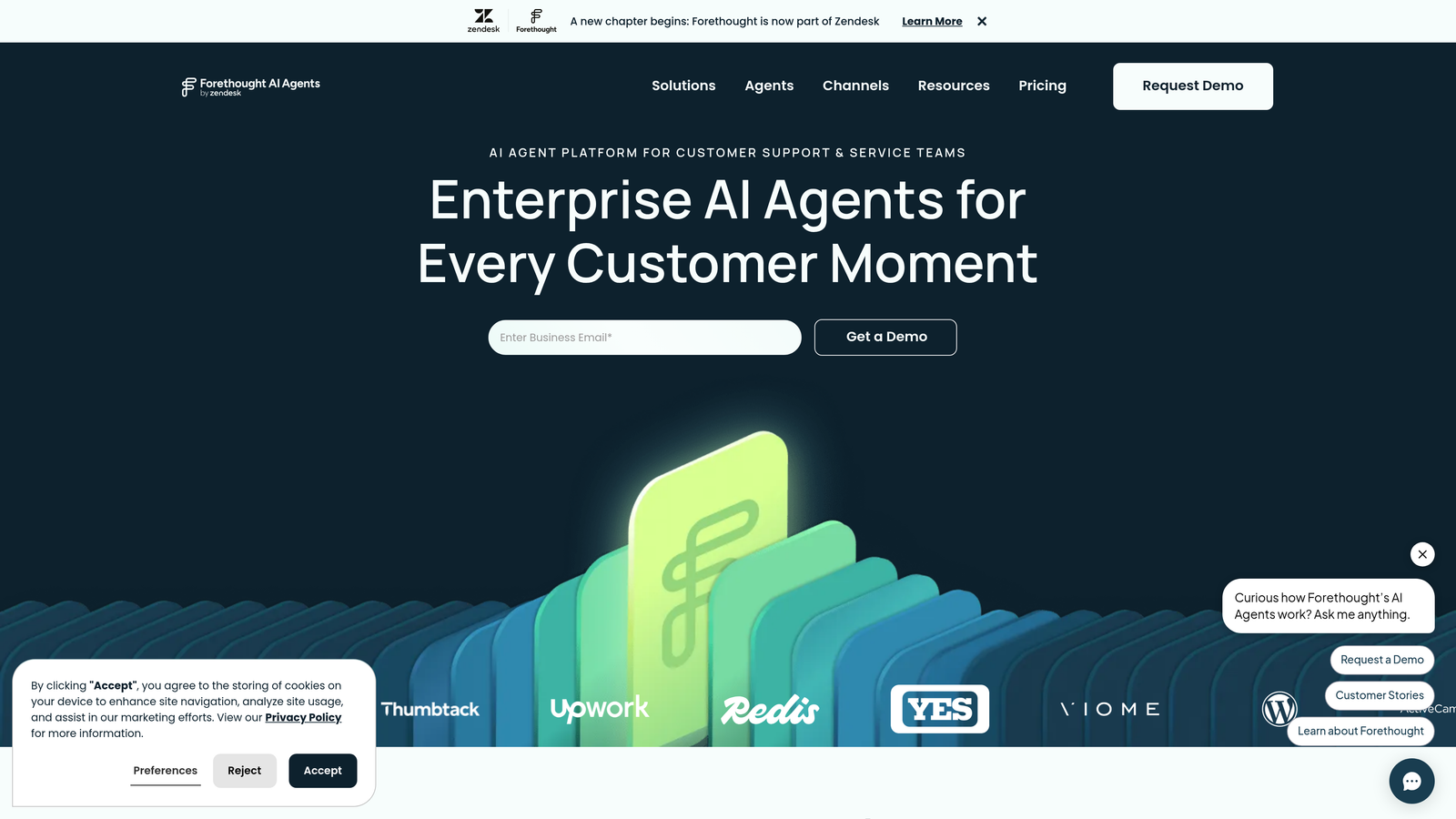
Forethought is an AI platform focused on intelligent ticket triage, resolution, and agent assistance, with a strong emphasis on understanding customer intent before routing or resolving.
Where This Tool Shines
Forethought's modular product structure is a genuine differentiator. Rather than forcing you to adopt a single AI layer, it offers distinct products for triage, autonomous resolution, agent assistance, and analytics insights. Teams can adopt the modules that address their most pressing gaps and expand from there.
The intent understanding engine is notably sophisticated. By classifying tickets on urgency and complexity alongside topic, Forethought helps teams prioritize smarter, not just faster. High-complexity tickets reach experienced agents while routine requests get resolved autonomously.
Key Features
Intelligent Triage Engine: Classifies tickets by intent, urgency, and complexity, not just topic category.
Solve (Autonomous Resolution): AI agent for end-to-end resolution of common ticket types without human involvement.
Assist (Agent Support): Real-time knowledge surfacing and response suggestions for human agents on active tickets.
Discover (Analytics): AI-powered insights into support trends, knowledge gaps, and resolution patterns.
Multi-Platform Integrations: Works with Zendesk, Salesforce, Freshdesk, and other major helpdesk platforms.
Best For
Support operations teams that want granular control over where AI is applied and the ability to measure impact by module. Strong fit for teams running Zendesk or Salesforce as their primary helpdesk.
Pricing
Custom pricing based on ticket volume and the modules selected. Contact Forethought for a scoped quote.
7. Tidio Lyro
Best for: Small SaaS teams that need fast AI deployment and affordable conversational support without heavy configuration.
Tidio Lyro is a conversational AI agent that learns from your help content to handle customer conversations, designed for fast deployment and simplicity.
Where This Tool Shines
Lyro's setup speed is genuinely impressive. Connecting your FAQ or help center content and going live can happen in minutes rather than weeks, which makes it one of the most accessible entry points into AI-powered support on this list. For small teams that need to stop the bleeding on ticket volume without a lengthy implementation project, that matters.
The confidence-based handoff logic is thoughtful. Rather than attempting to answer everything and risking low-quality responses, Lyro recognizes when it's approaching the limits of its training and routes to a human agent, preserving the customer experience.
Key Features
Fast Knowledge Base Training: Import your FAQ or help content and deploy a live AI agent in minutes.
Natural Language Understanding: Conversational AI that handles varied phrasing and follow-up questions naturally.
Confidence-Based Handoff: Automatically escalates to live chat when the AI reaches its confidence threshold, avoiding low-quality responses.
Flow Builder: Simple drag-and-drop builder for custom conversation paths without coding.
Affordable Entry Point: Pricing accessible to small teams and early-stage startups.
Best For
Early-stage SaaS startups and small support teams that need immediate AI coverage without the budget or timeline for enterprise implementation. Also useful as a first step before migrating to a more sophisticated platform as the team scales.
Pricing
Free tier available. Lyro AI starts at $39 per month for 50 conversations, with higher-volume plans available.
8. Ultimate (by Zendesk)
Best for: Teams that need sophisticated multi-turn conversation design and deep backend system integrations for complex support workflows.
Ultimate is an advanced AI-powered support automation platform acquired by Zendesk, offering sophisticated bot-building and backend integrations for complex support workflows.
Where This Tool Shines
Ultimate was built for support workflows that don't fit neatly into simple FAQ resolution. The advanced dialogue builder handles complex multi-turn conversations with branching logic, making it possible to automate resolution paths that would otherwise require experienced human agents to navigate.
The backend API integration capabilities are particularly strong. Order lookups, account modifications, and system-level actions can be built into conversation flows, enabling the AI to actually resolve issues rather than just provide information. For SaaS products with complex account management workflows, this is meaningful.
Key Features
Advanced Dialogue Builder: Design complex multi-turn conversations with branching logic for nuanced resolution paths.
Backend API Integrations: Connect to order management, account systems, and internal tools to take real actions during conversations.
Multilingual Coverage: Strong support for European languages alongside major global languages.
Resolution and Deflection Analytics: Dashboard tracking resolution rates, deflection metrics, and conversation quality.
Zendesk-Native and Flexible: Works natively within Zendesk and integrates with other helpdesks via API.
Best For
Mid-market to enterprise SaaS companies with complex support workflows that require multi-step automation and backend system actions. Strong fit for Zendesk customers looking for more sophisticated bot-building than native Zendesk AI provides.
Pricing
Custom pricing as part of Zendesk's AI offering suite. Contact Zendesk for current packaging and pricing since the acquisition.
9. Kastro
Best for: Lean SaaS teams that want a lightweight, documentation-trained AI chat agent with minimal setup overhead.
Kastro is a lightweight AI chat agent for support teams that trains on your documentation and knowledge base to answer customer questions, built for fast setup and lean teams.
Where This Tool Shines
Kastro occupies a clear niche: simple, fast, and affordable AI chat support for teams that don't need enterprise complexity. Powered by ChatGPT-grade language understanding trained on your specific documentation, it delivers relevant answers without requiring weeks of configuration or a dedicated implementation team.
For SaaS companies with well-maintained documentation, Kastro can provide meaningful coverage on common questions almost immediately. The customizable chat widget fits naturally into product interfaces without requiring design work, and the human handoff keeps the experience clean when the AI reaches its limits.
Key Features
Documentation-Trained AI: Import your knowledge base or docs and the AI learns your product context quickly.
Fast Deployment: Go live in minutes rather than weeks, with minimal technical setup required.
Human Handoff: Smooth escalation to live agents when the AI can't confidently resolve a query.
Customizable Chat Widget: Adaptable widget design that fits your product or marketing site aesthetic.
Lightweight Pricing: Accessible plans designed for small teams and bootstrapped SaaS companies.
Best For
Small SaaS teams, indie developers, and early-stage startups that need basic AI chat coverage without the overhead of enterprise platforms. Works best when you have solid documentation to train on and a relatively contained set of common support questions.
Pricing
Free plan available. Paid plans start at approximately $35 per month, making it one of the most affordable options on this list.
Choosing the Right AI Agent for Your SaaS Stack
The right AI agent depends less on feature checklists and more on where your support operation sits today and where it needs to go.
If you're an early-stage team that needs fast coverage without heavy investment, Tidio Lyro or Kastro get you live quickly at accessible price points. They're honest about their scope: great for FAQ-level resolution, less suited for complex product workflows.
If you're already committed to a helpdesk platform, the native options are hard to beat on integration simplicity. Intercom Fin for Intercom teams, Zendesk AI Agents or Ultimate for Zendesk shops, and Freddy AI for Freshdesk users all reduce friction by living inside your existing workflow.
For enterprise teams with global customers and complex automation needs, Ada and Forethought offer the depth and modularity to handle sophisticated resolution paths and multilingual support at scale.
And if you're building a SaaS product where the support experience is inseparable from the product experience itself, Halo AI offers something the others don't: an AI-first architecture with page-aware context, continuous learning, and business intelligence baked in from the ground up. It's built for the reality that support data is product data, and that every interaction is an opportunity to get smarter.
Your support team shouldn't scale linearly with your customer base. Let AI agents handle routine tickets, guide users through your product, and surface business intelligence while your team focuses on complex issues that need a human touch. See Halo in action and discover how continuous learning transforms every interaction into smarter, faster support.