9 Best AI Agent Platforms for Enterprises in 2026
This guide ranks the 9 best AI agent platforms for enterprises in 2026, evaluating each on autonomy, integration depth, scalability, and business intelligence. Whether you run a lean support team or a global operation, it cuts through the noise to help you find a platform built for real enterprise scale — not just a chatbot dressed up as one.
 Grant CooperFounder13 min read
Enterprise support teams are under pressure to do more with less. Faster resolutions, fewer escalations, and smarter workflows across increasingly complex tech stacks — the bar keeps rising. AI agent platforms have moved well beyond simple chatbots: today's solutions can autonomously resolve tickets, detect customer health signals, route issues intelligently, and integrate across your entire business stack.
But not all platforms are built for enterprise scale. Some are glorified FAQ bots. Others require months of implementation before delivering value. And many still treat AI as a bolt-on to an existing helpdesk rather than a purpose-built intelligence layer.
This list covers the top AI agent platforms for enterprise teams in 2026, evaluated on autonomy, integration depth, scalability, and business intelligence capabilities. Whether you're running a 50-person support team or a global operation, there's a platform here worth your attention.
1. Halo AI
Best for: B2B SaaS teams wanting AI-first support intelligence beyond ticket resolution
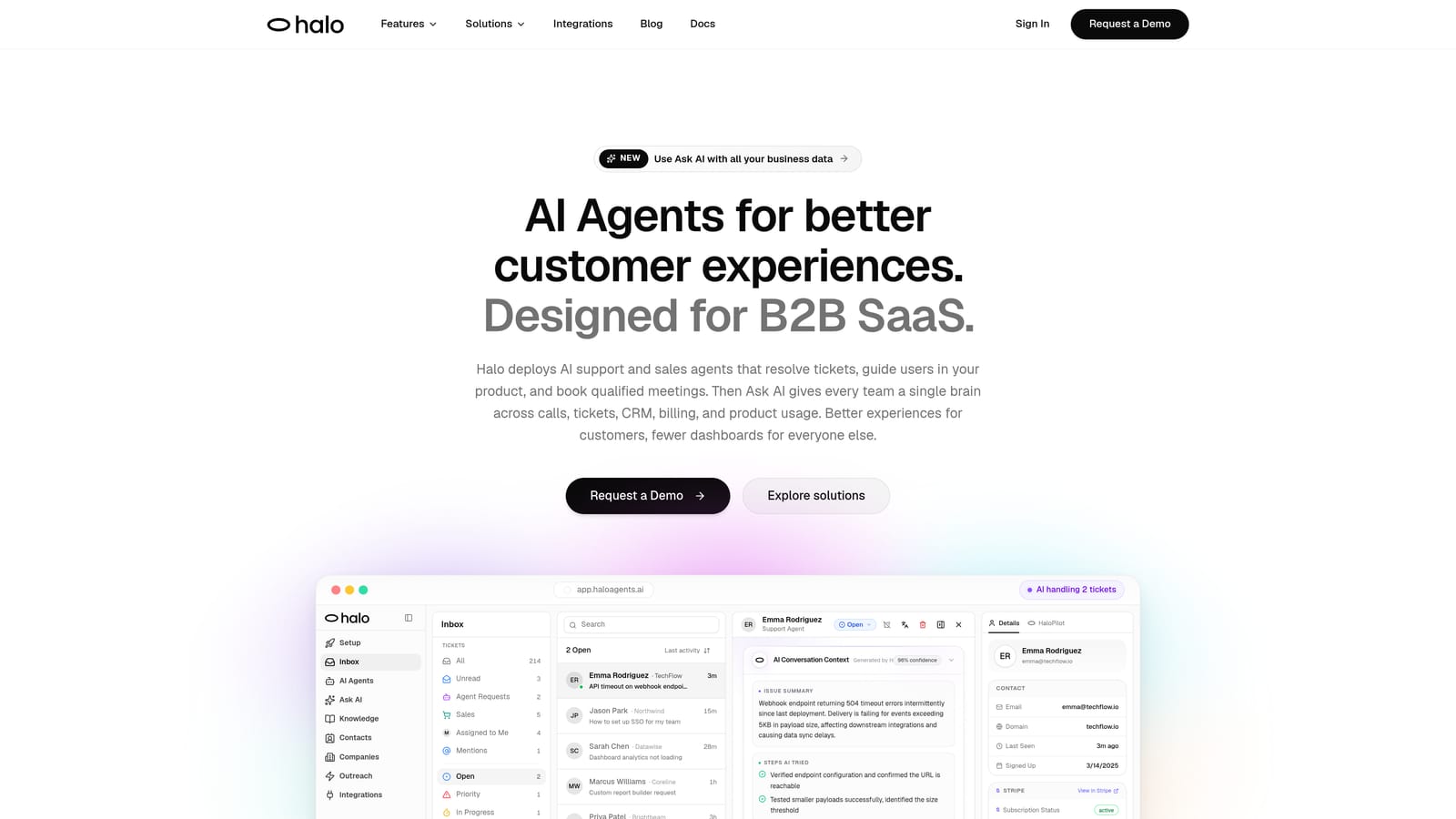
Halo AI is an AI-first customer support platform built specifically for B2B SaaS teams who want autonomous resolution, product-aware guidance, and business intelligence — without anchoring to a legacy helpdesk as the foundation.
Where This Tool Shines
What separates Halo from most platforms on this list is its architecture. Rather than layering AI onto an existing helpdesk, Halo is built from the ground up as an intelligence layer. That distinction matters: it means the AI isn't constrained by the limitations of whatever ticketing system it sits on top of.
The page-aware chat widget is a genuinely differentiated capability. Halo's agent sees what the user sees in real time, enabling it to provide visual UI guidance specific to the page they're on — not just generic help article links. Combined with a continuous learning loop that improves from every resolved interaction, the platform gets meaningfully smarter over time without requiring manual retraining.
Key Features
Page-Aware Chat Widget: The AI agent understands the user's current page context, enabling precise visual guidance rather than generic responses.
Continuous Learning Loop: Halo autonomously improves from every resolved ticket, building institutional knowledge without requiring manual model updates.
Smart Inbox with Business Intelligence: Surfaces customer health signals, revenue anomalies, churn risk indicators, and feature friction insights — turning support data into strategic intelligence.
Auto Bug Ticket Creation: Automatically identifies and routes bug reports to Linear or equivalent tools, closing the loop between support and engineering.
Live Agent Handoff: Escalates to human agents with full conversation context preserved, so customers never have to repeat themselves.
Integration Stack: Connects to Linear, Slack, HubSpot, Intercom, Stripe, Zoom, PandaDoc, and Fathom — covering the full B2B SaaS operational stack.
Best For
B2B SaaS product and support teams who want more than ticket deflection. Halo is particularly well-suited for teams that need support intelligence to feed back into product decisions, customer success workflows, and revenue operations — not just reduce ticket volume.
Pricing
Enterprise pricing is available directly through haloagents.ai. Contact the team for a tailored quote based on your team size and integration requirements.
2. Salesforce Agentforce
Best for: Enterprise teams deeply invested in the Salesforce ecosystem
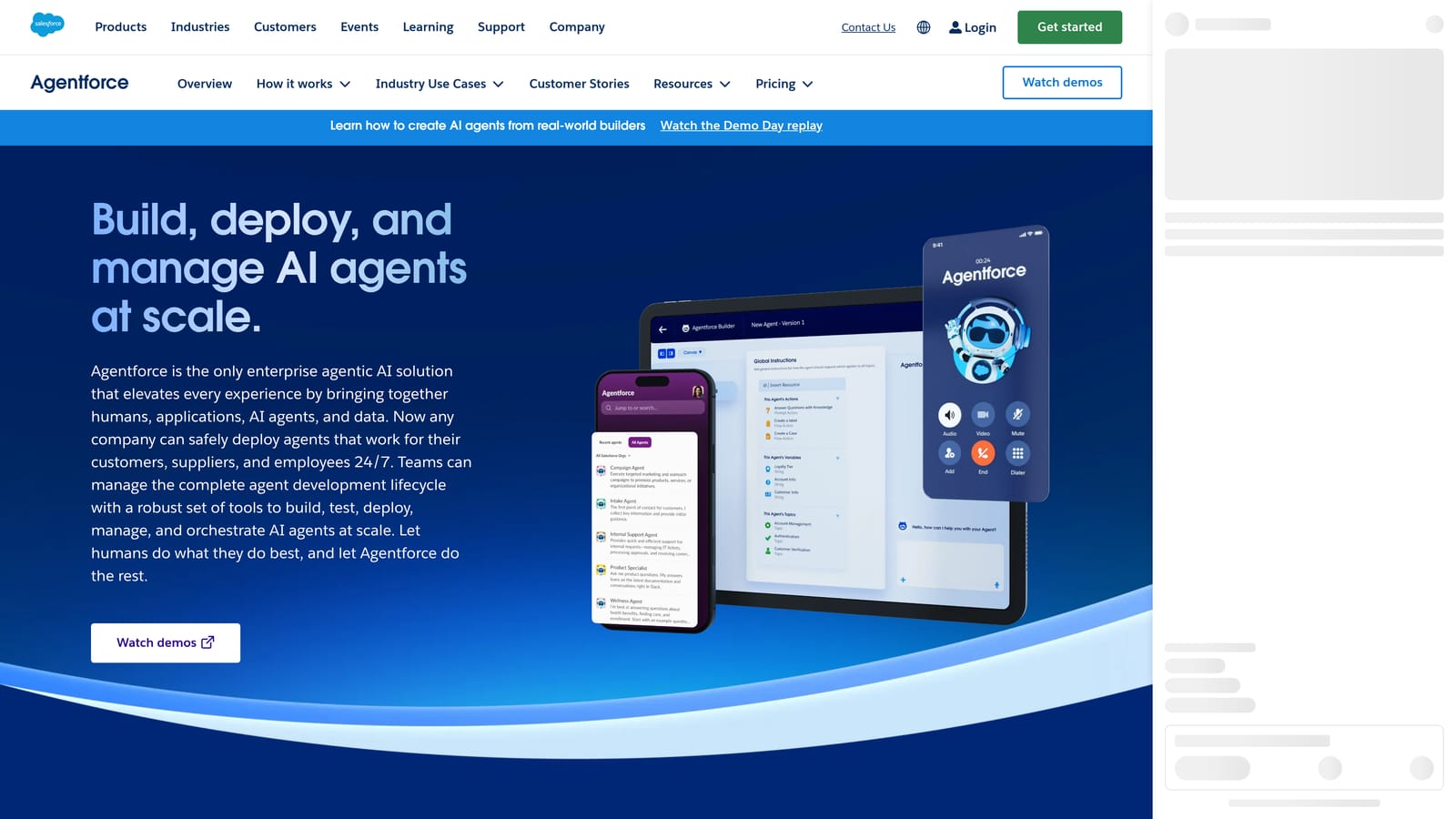
Salesforce Agentforce is Salesforce's autonomous AI agent platform built natively into Sales Cloud and Service Cloud, powered by the Atlas Reasoning Engine for multi-step decision-making.
Where This Tool Shines
For enterprises already running their sales and service operations inside Salesforce, Agentforce is a compelling native extension. The Atlas Reasoning Engine enables agents to handle genuinely complex, multi-step workflows — not just simple FAQs — pulling from native CRM data to deliver personalized, context-rich resolutions.
The tight CRM integration is Agentforce's biggest strength. When your AI agent has direct access to account history, opportunity data, and service records, it can make smarter decisions without requiring custom data pipelines. Extensibility via MuleSoft also allows connections to external systems for enterprises with broader stack requirements.
Key Features
Atlas Reasoning Engine: Powers multi-step autonomous decision chains, enabling agents to handle complex workflows rather than simple lookup tasks.
Native CRM Data Access: Agents draw on full Salesforce account and service history for personalized, context-aware resolutions.
Cross-Cloud Coverage: Operates across Sales Cloud and Service Cloud within a unified platform.
MuleSoft Extensibility: Connects to external enterprise systems via APIs for teams with broader integration needs.
Best For
Enterprises with significant existing Salesforce investment and teams that want AI agents operating natively within their CRM workflows. Less compelling for organizations outside the Salesforce ecosystem, where implementation complexity and cost can be prohibitive.
Pricing
Custom enterprise pricing; requires existing Salesforce licensing. Typically deployed with Salesforce implementation partners for complex configurations.
3. ServiceNow AI Agents
Best for: Large enterprises with complex ITSM, HR, and cross-departmental workflow needs
ServiceNow AI Agents are embedded across the Now Platform, purpose-built for enterprise IT service management, HR, and customer service workflow automation at scale.
Where This Tool Shines
ServiceNow's depth in enterprise workflow orchestration is unmatched for ITSM-heavy environments. AI agents here don't just resolve tickets — they can chain multiple actions across complex enterprise systems, triggering downstream workflows in IT, HR, field service, and customer operations simultaneously.
The platform's enterprise-grade compliance and security posture makes it a natural fit for regulated industries and large organizations with strict procurement requirements. If your support operation is deeply intertwined with IT infrastructure management, ServiceNow's AI agents operate in native territory.
Key Features
ITSM-Native AI Agents: Built directly into ServiceNow workflows, with no integration layer required for IT service management use cases.
Cross-Department Coverage: Handles IT, HR, customer service, and field service within a single platform.
Chained Multi-Agent Actions: Can orchestrate sequences of AI actions across complex enterprise systems and departments.
Enterprise Compliance Posture: Strong security, data governance, and compliance credentials for regulated industries.
Best For
Large enterprises with established ServiceNow deployments, particularly those where IT service management and employee-facing support are the primary automation targets. Implementation timelines can be lengthy, so factor that into your evaluation.
Pricing
Enterprise contract pricing; not publicly listed. Budget for implementation support alongside licensing costs.
4. Intercom Fin AI Agent
Best for: SaaS companies wanting high-autonomy customer support with smooth human handoff
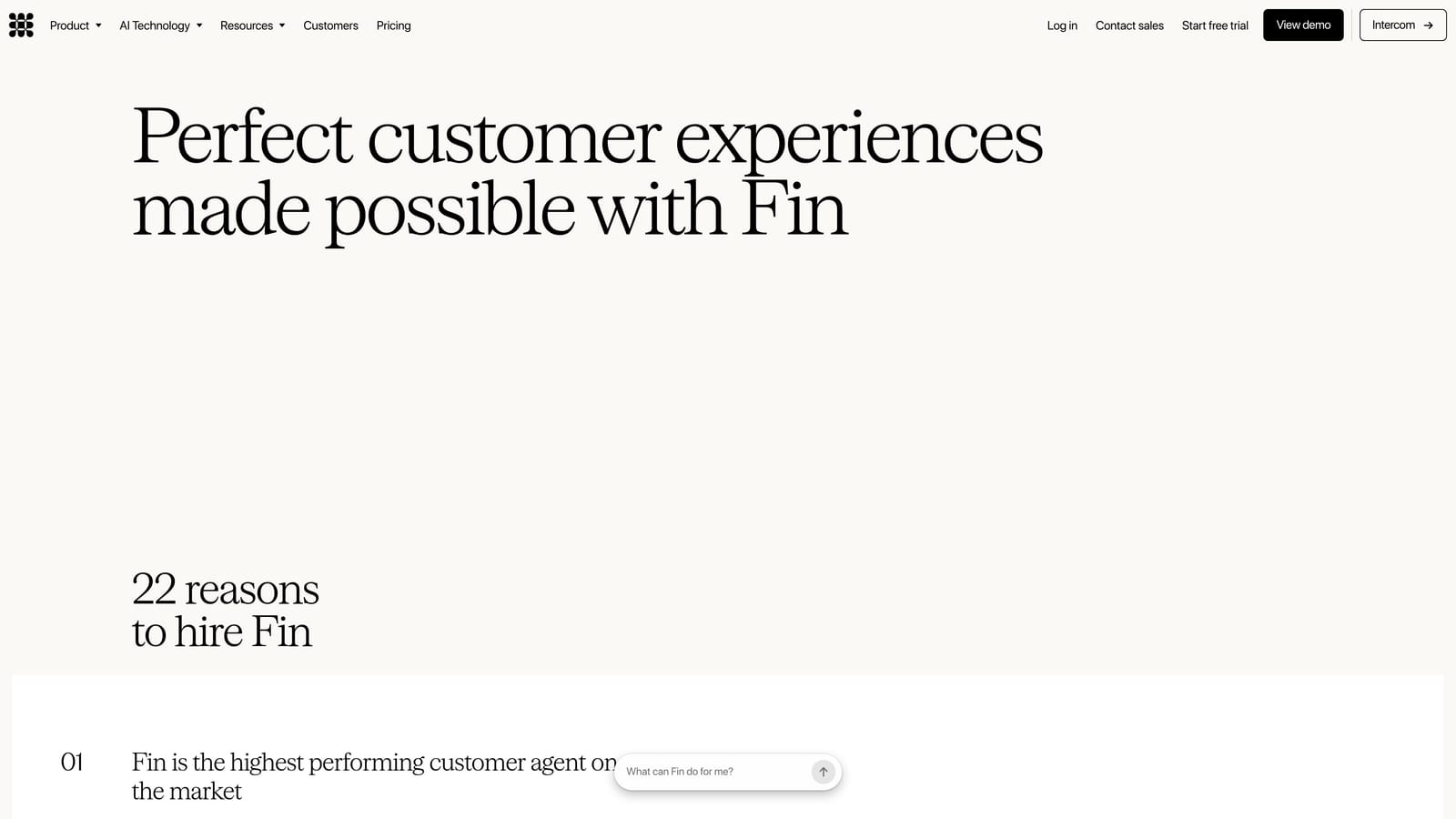
Intercom Fin is Intercom's flagship AI agent, designed to synthesize answers from multiple knowledge sources and handle autonomous ticket resolution across chat, email, and voice channels.
Where This Tool Shines
Fin's multi-source knowledge synthesis is a practical strength. Rather than requiring a perfectly structured knowledge base, it can pull from help docs, URLs, PDFs, and other content sources to construct accurate answers. This reduces the setup burden that typically slows AI agent deployments.
The handoff experience within the Intercom platform is notably smooth. When Fin escalates to a human agent, the full conversation context transfers cleanly — no context loss, no customer repetition. For SaaS teams already using Intercom as their primary support channel, Fin slots in with minimal friction.
Key Features
Multi-Source Knowledge Synthesis: Draws from help docs, URLs, PDFs, and other content to construct accurate, contextual answers.
Omnichannel Resolution: Handles chat, email, and phone (with voice availability expanding across markets).
Smooth Human Handoff: Full context preservation when escalating to human agents within the Intercom platform.
Usage-Based Pricing: Scales with resolution volume rather than seat count, which can be cost-effective for high-volume teams.
Best For
SaaS companies already on Intercom or actively evaluating it as their primary support platform. Teams outside the Intercom ecosystem will need to weigh integration complexity against the platform's strengths.
Pricing
Available as an add-on or within Intercom plans; usage-based pricing model. Contact Intercom for enterprise volume pricing.
5. Zendesk AI
Best for: Existing Zendesk customers wanting AI capabilities without platform migration
Zendesk AI is an AI layer embedded across the Zendesk support suite, offering intelligent triage, intent detection, AI-assisted agent replies, and autonomous ticket resolution for teams already on the platform.
Where This Tool Shines
The primary advantage of Zendesk AI is adoption friction: it's already inside the platform your team uses. Intelligent triage with intent and sentiment detection, AI-assisted reply suggestions, and autonomous resolution for common ticket types can all be activated without migrating to a new system or retraining your team on new workflows.
For enterprise teams with large Zendesk deployments, this is meaningful. The AI capabilities layer onto existing ticket routing, macros, and views — meaning your current operational logic doesn't get thrown out. The tradeoff is that Zendesk AI is tightly coupled to the Zendesk platform, offering less flexibility for teams wanting to extend AI capabilities beyond it.
Key Features
Intelligent Triage: Automatically detects intent, sentiment, and priority to route tickets to the right queue or agent.
Autonomous AI Agents: Resolves common ticket types without human involvement, within existing Zendesk workflows.
AI-Assisted Reply Suggestions: Provides human agents with AI-generated response drafts to accelerate resolution.
Minimal Migration Friction: Works within existing Zendesk configurations, preserving current operational logic.
Best For
Teams with established Zendesk deployments who want to activate AI capabilities without platform disruption. Less compelling for teams considering a broader rethink of their support infrastructure.
Pricing
AI features available on higher-tier Zendesk plans; enterprise pricing available on request.
6. IBM watsonx Orchestrate
Best for: Large enterprises needing multi-agent orchestration across regulated, complex environments
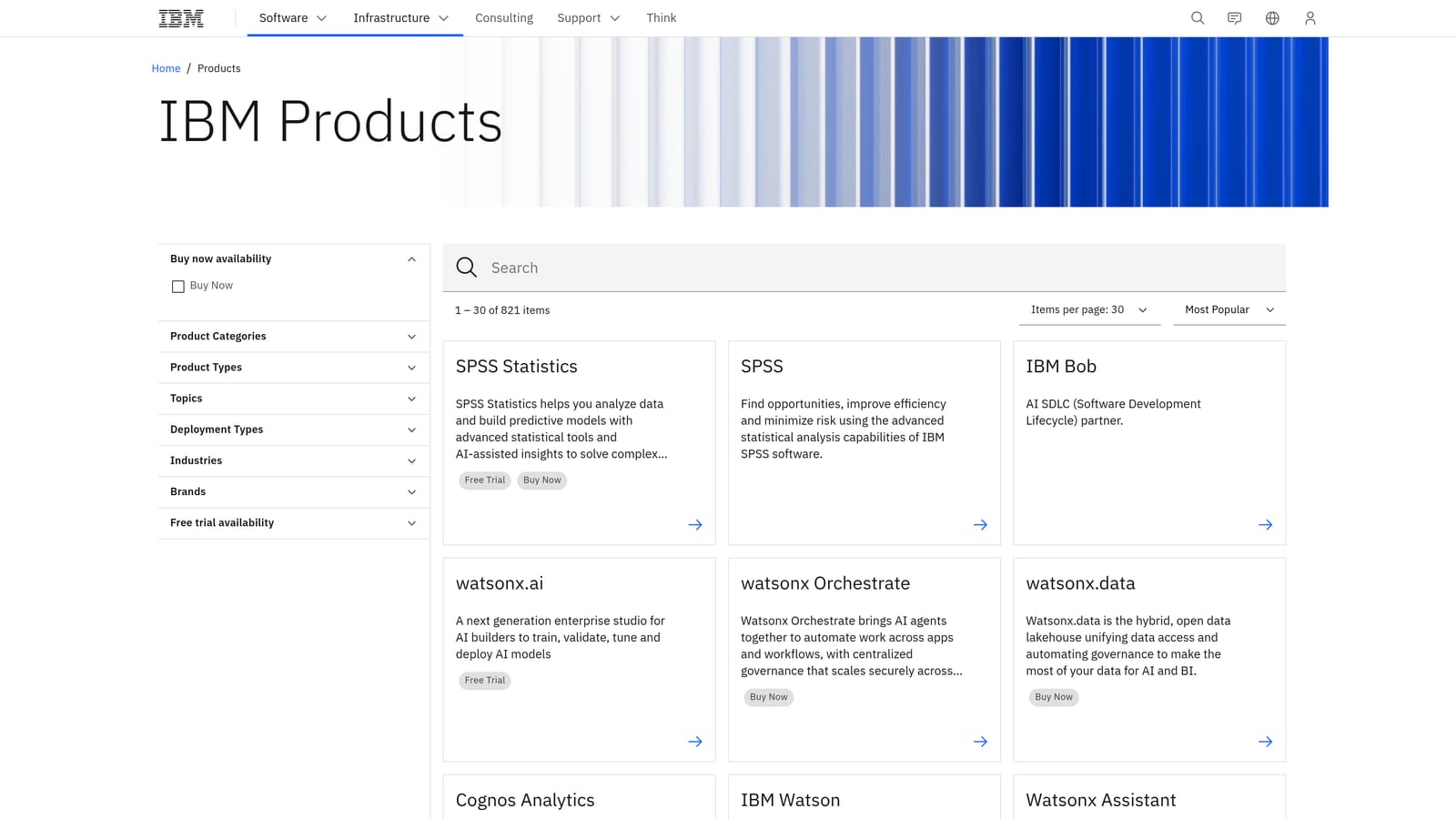
IBM watsonx Orchestrate is IBM's enterprise AI orchestration platform for building, deploying, and managing multi-agent systems across complex organizational workflows, with flexible cloud, on-premises, and hybrid deployment options.
Where This Tool Shines
watsonx Orchestrate is built for organizations that need to coordinate multiple AI agents across departments, systems, and data environments simultaneously. Rather than a single-agent solution, it's a platform for managing fleets of specialized agents working in concert — a meaningful distinction for enterprises with sophisticated automation requirements.
Deployment flexibility is a genuine differentiator here. Cloud, on-premises, and hybrid configurations make it viable for industries with strict data residency requirements, including finance, healthcare, and government. IBM's compliance credentials carry weight in procurement processes where security posture is a gating criterion.
Key Features
Multi-Agent Orchestration: Coordinates fleets of AI agents across departments and systems within a unified management layer.
Flexible Deployment: Cloud, on-premises, and hybrid options accommodate strict data residency and sovereignty requirements.
Regulated Industry Credentials: Strong compliance posture for finance, healthcare, and government use cases.
Pre-Built Agent Library: Extensible library of enterprise integrations reduces custom development requirements.
Best For
Large enterprises in regulated industries that need multi-agent orchestration at scale, particularly those with on-premises or hybrid deployment requirements. Expect a steeper implementation curve and a reliance on IBM or partner professional services.
Pricing
Enterprise licensing; not publicly listed. Contact IBM directly for pricing based on deployment model and agent volume.
7. Microsoft Copilot Studio
Best for: Microsoft 365 enterprises wanting custom AI agents without heavy development investment
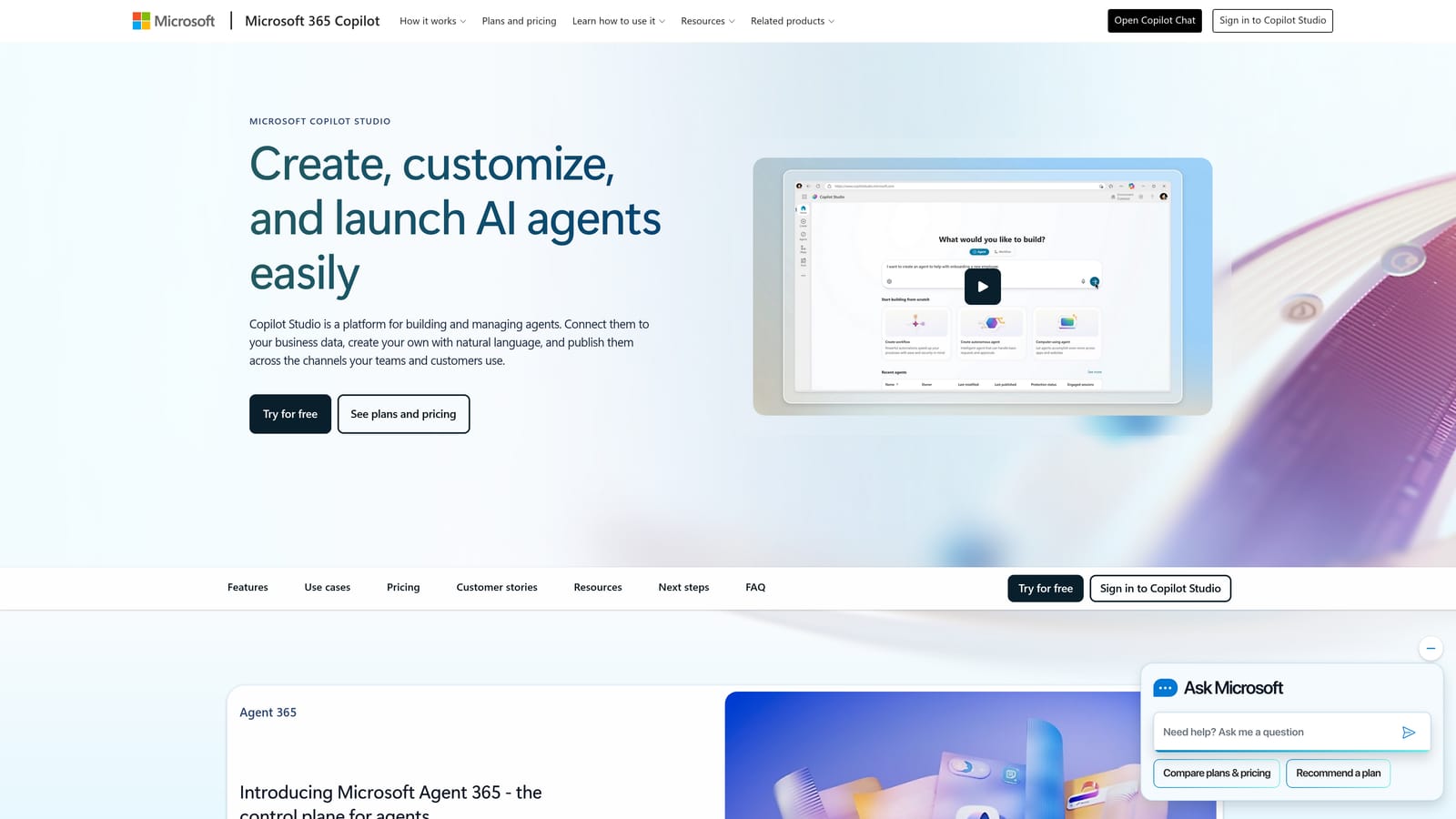
Microsoft Copilot Studio is Microsoft's low-code platform for building and deploying custom AI agents, natively integrated with Microsoft 365, Teams, Azure, and Dynamics 365.
Where This Tool Shines
For enterprises already running on the Microsoft stack, Copilot Studio removes much of the integration work that typically slows AI agent deployments. Agents built here can be deployed directly in Teams, on the web, or across external channels — and they have native access to Microsoft 365 data, SharePoint content, and Dynamics 365 records without custom connectors.
The low-code builder is genuinely accessible. Business teams can configure agents, define conversation flows, and connect knowledge sources without requiring developer involvement for every change. This matters for enterprises where IT bottlenecks often delay AI adoption timelines.
Key Features
Low-Code Agent Builder: Accessible to non-developers for building and modifying agents without engineering support for every update.
Native M365 and Teams Integration: Agents operate directly within the Microsoft ecosystem with no custom integration layer required.
Multi-Channel Deployment: Deploy across Teams, web, and external channels from a single build.
Flexible Pricing Model: Per-message and per-session pricing allows cost scaling aligned to actual usage.
Best For
Enterprises with deep Microsoft 365 investment looking to build custom AI agents for internal or customer-facing use cases. Teams outside the Microsoft ecosystem will find limited native value here.
Pricing
Per-message and per-session pricing available; enterprise agreements common for larger deployments. Contact Microsoft for volume pricing.
8. Freshdesk Freddy AI Agent
Best for: Freshworks customers wanting autonomous resolution within their existing support stack
Freshdesk Freddy AI Agent is Freshworks' AI agent embedded across the Freshdesk suite, handling autonomous ticket resolution across chat, email, and phone for teams already on the Freshworks platform.
Where This Tool Shines
Freddy AI's strength is its deep integration across the Freshworks product family. For teams running Freshdesk, Freshchat, and Freshservice together, Freddy operates as a unified AI layer across all three — meaning a single agent configuration can handle customer support, internal IT requests, and chat interactions without siloed setups.
The omnichannel coverage is solid. Freddy handles chat, email, and phone within a consistent resolution framework, and the AI-powered agent assist feature provides human agents handling escalations with contextual suggestions to accelerate resolution. It's a well-rounded solution for teams already committed to the Freshworks ecosystem.
Key Features
Autonomous Ticket Resolution: Handles common ticket types across chat, email, and phone without human involvement.
Cross-Suite Integration: Operates natively across Freshdesk, Freshchat, and Freshservice for unified coverage.
AI-Powered Agent Assist: Provides human agents with contextual suggestions and response drafts during escalations.
Omnichannel Consistency: Unified resolution logic across all supported channels reduces configuration complexity.
Best For
Teams already on the Freshworks platform who want to activate AI capabilities within their existing environment. Organizations outside the Freshworks ecosystem will find limited reason to adopt Freddy in isolation.
Pricing
Freddy AI features available on higher Freshdesk tiers; enterprise pricing available on request from Freshworks.
9. Moveworks
Best for: Enterprises automating internal IT helpdesk, HR, and finance support at scale
Moveworks is an enterprise AI agent platform specialized in employee-facing support automation — IT helpdesk, HR, and finance — with strong natural language understanding for internal request handling.
Where This Tool Shines
Moveworks occupies a distinct niche on this list: it's primarily focused on internal support rather than customer-facing resolution. Its natural language understanding for internal IT and HR requests is notably strong, enabling employees to submit and resolve requests conversationally without navigating complex ticketing interfaces.
The platform's ability to autonomously resolve employee requests without creating tickets at all is a meaningful efficiency gain for large IT and HR teams. Integrations with ServiceNow, Jira, Workday, and other enterprise systems mean it can take action across your operational stack — not just collect requests and route them.
Key Features
Specialized Internal NLP: Tuned for IT and HR request language, enabling high-accuracy understanding of employee support needs.
Ticketless Resolution: Autonomously resolves employee requests without requiring ticket creation in downstream systems.
Enterprise System Integrations: Connects to ServiceNow, Jira, Workday, and other major enterprise platforms to take action, not just route requests.
Automation Analytics: Tracks automation rates and employee satisfaction to quantify operational impact.
Best For
Large enterprises looking to reduce IT helpdesk and HR support burden through autonomous internal request handling. Moveworks is not designed for customer-facing support — teams with that as a primary requirement should look elsewhere on this list.
Pricing
Custom enterprise pricing via Moveworks sales; typically deployed with professional services support for initial configuration.
Which Platform Is Right for Your Enterprise?
The honest answer is that the best AI agent platform depends almost entirely on your existing stack, your primary use case, and how you define "value" from AI in a support context.
Here's a quick orientation by use case to help narrow the field:
AI-first B2B support intelligence: Halo AI is the strongest choice for teams that want autonomous resolution, page-aware guidance, and business intelligence signals from support interactions — without being constrained by a legacy helpdesk architecture.
CRM-native enterprise workflows: Salesforce Agentforce is the natural fit for enterprises already running Sales Cloud and Service Cloud, where native CRM data access drives resolution quality.
ITSM-heavy operations: ServiceNow AI Agents excel in environments where IT service management and cross-departmental workflow orchestration are the primary automation targets.
Product-led SaaS support: Intercom Fin is well-suited for SaaS companies already on Intercom, particularly those with high chat volume and a need for smooth human handoff.
Existing Zendesk deployments: Zendesk AI is the lowest-friction path for teams that want AI capabilities without disrupting established workflows.
Multi-agent orchestration in regulated industries: IBM watsonx Orchestrate handles complexity and compliance requirements that most other platforms on this list aren't designed for.
M365-native custom agents: Microsoft Copilot Studio is the pragmatic choice for enterprises already deep in the Microsoft ecosystem who want flexibility without heavy development investment.
Freshworks platform users: Freshdesk Freddy AI Agent delivers solid autonomous resolution for teams already running the Freshworks suite.
Internal IT and HR automation: Moveworks stands alone for employee-facing support automation, particularly for large enterprises with high internal request volume.
One final consideration worth calling out: evaluate whether the platforms you're shortlisting have a genuine learning loop. The difference between an AI agent that improves continuously from every interaction and one that requires manual retraining is significant at enterprise scale. It determines whether your AI gets smarter over time or stays static.
Your support team shouldn't scale linearly with your customer base. Let AI agents handle routine tickets, guide users through your product, and surface business intelligence while your team focuses on complex issues that need a human touch. See Halo in action and discover how continuous learning transforms every interaction into smarter, faster support.