9 Best AI Agent Software Pricing Plans Compared in 2026
AI agent software pricing varies wildly across seat-based, conversation-based, and outcome-based models, making the wrong choice costly for growing B2B support teams. This guide compares nine leading AI agent software pricing plans tier by tier, so you can find the right fit for your scale, stack, and support goals.
 Matt PattoliFounder14 min read
AI agent software has moved from experimental to essential for B2B support teams, but pricing models vary wildly, and the wrong choice can quietly drain your budget or cap your growth. Some platforms charge per seat, others per conversation, and a growing number bill by resolution or outcome. That gap matters enormously when you're handling thousands of tickets a month.
This guide breaks down nine leading AI agent platforms, comparing what you actually get at each pricing tier, not just the headline number. We've focused on tools built for B2B companies and product teams that need real automation, not glorified FAQ bots. Whether you're evaluating your first AI support agent or benchmarking your current spend, this comparison will help you find the plan that fits your scale, stack, and support goals. For deeper context on what to look for before you buy, see our guide on what is an AI helpdesk.
1. Halo AI
Best for: B2B SaaS teams that want an AI-first support platform with deep product context and business intelligence.
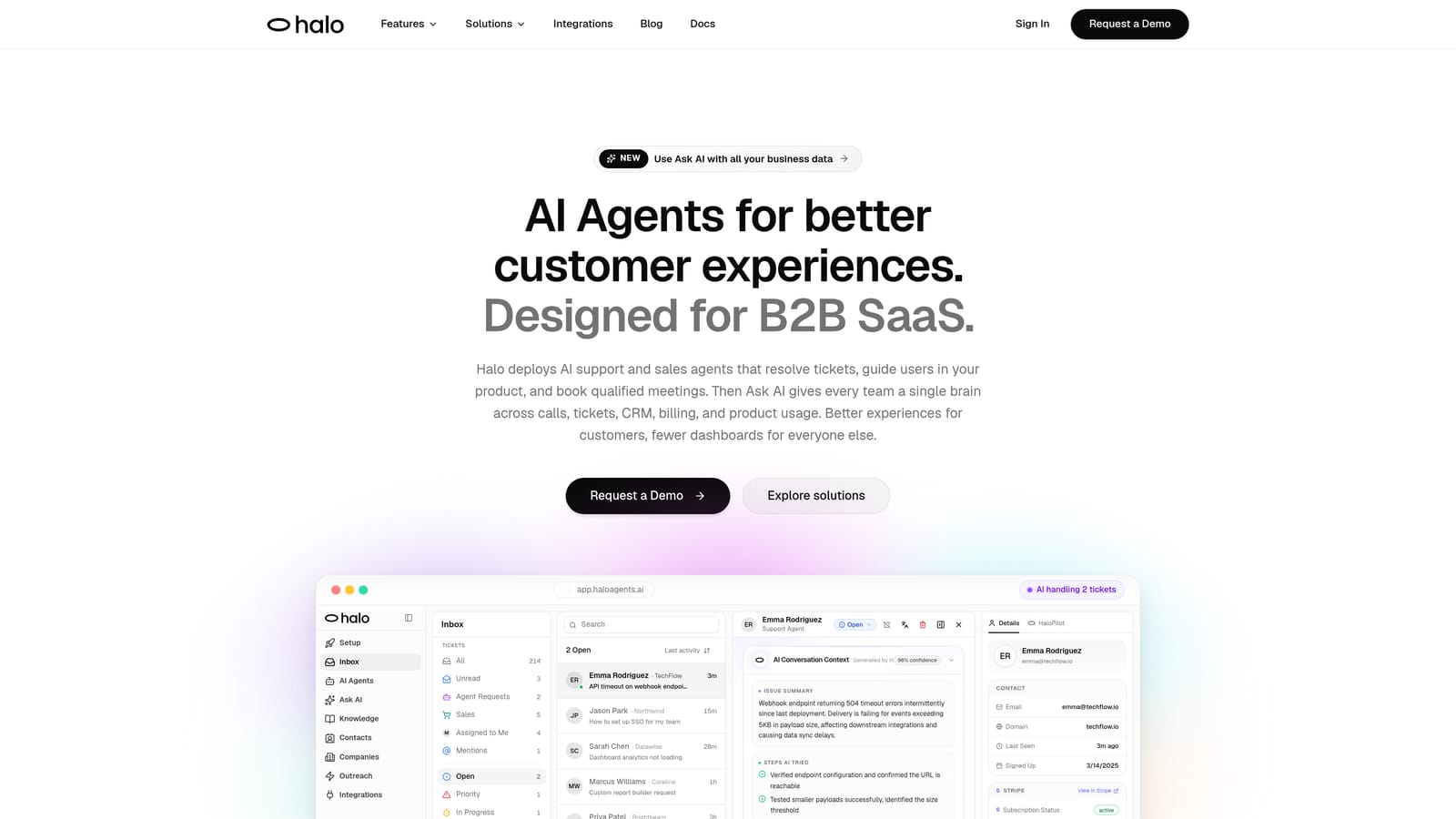
Halo AI is an AI-first customer support platform that deploys intelligent agents to resolve tickets, guide users through your product with page-aware context, and surface business intelligence signals from every interaction.
Where This Tool Shines
Halo's standout differentiator is that it wasn't built as a bolt-on to an existing helpdesk. It's architected AI-first, which means the intelligence is baked into the foundation rather than layered on top. That distinction shows up in how it handles context: the page-aware chat widget actually sees what the user sees, allowing it to provide visual UI guidance specific to where someone is in your product.
Beyond ticket resolution, Halo surfaces signals that most support tools ignore entirely. Customer health scores, revenue intelligence, and anomaly detection turn your support inbox into a source of business insight, not just a cost center. For product teams and growth-focused support leaders, that's a meaningful shift in how support data gets used.
Key Features
Page-Aware Chat Widget: Sees the user's current product context and delivers UI-specific guidance, not generic help articles.
Intelligent AI Agents: Autonomously resolve tickets end-to-end, with smooth live agent handoff when complexity warrants human involvement.
Smart Inbox with Business Intelligence: Surfaces customer health signals, churn risk, revenue intelligence, and anomaly detection from support conversations.
Auto Bug Ticket Creation: Automatically generates and routes bug reports to engineering tools like Linear, closing the loop between support and product.
Continuous Learning: Every resolved interaction trains the system, so accuracy and deflection rates improve over time without manual retraining.
Full-Stack Integrations: Connects to Slack, HubSpot, Intercom, Stripe, Zoom, PandaDoc, and Fathom, covering your entire business stack.
Best For
Halo is best suited for B2B SaaS companies and product teams that want AI-native support, not a legacy helpdesk with AI features stapled on. If you need your support layer to connect deeply to your product, engineering workflow, and revenue data, Halo is built for exactly that use case.
Pricing
Custom pricing based on your team's needs and scale. Contact the team directly at haloagents.ai for current plan details and a tailored quote.
2. Intercom (Fin AI)
Best for: Teams already on Intercom who want to activate AI resolution without migrating to a new platform.
Intercom Fin is Intercom's native AI agent, resolving customer queries autonomously using your help content and billing per successful resolution on top of your existing Intercom plan.
Where This Tool Shines
Fin's per-resolution pricing model is genuinely interesting from a budget alignment perspective. You're paying for outcomes, not seats, which means your costs scale with value delivered rather than headcount. For teams already embedded in the Intercom ecosystem, activating Fin requires no migration and no new tooling.
The tradeoff is that Intercom's base plan costs are significant, so if you're not already a customer, the total cost of ownership includes the full platform price. Teams evaluating Fin in isolation need to account for that full picture.
Key Features
Per-Resolution Pricing: You pay only when Fin successfully resolves a conversation, aligning costs directly with AI performance.
Native Intercom Integration: Works seamlessly within Intercom's messenger, inbox, and workflow tools without additional setup.
Multilingual Support: Handles queries across multiple languages with a customizable AI persona.
Confidence-Based Handoff: Escalates to human agents when Fin's confidence falls below a threshold, reducing incorrect resolutions.
LLM-Powered Reasoning: Combines Intercom's proprietary AI with large language models for flexible, context-aware responses.
Best For
Existing Intercom customers who want to layer AI resolution on top of their current setup without platform migration. Also a good fit for teams whose support volume is high enough that per-resolution pricing produces predictable, manageable costs.
Pricing
Intercom base plans start at approximately $39 per seat per month. Fin resolution pricing is charged separately and varies by volume. Check intercom.com for current rates and resolution pricing details.
3. Zendesk AI
Best for: Enterprise teams with complex routing needs that are already invested in the Zendesk ecosystem.
Zendesk AI layers intelligent triage, generative AI, and AI agents across its Suite plans, with advanced capabilities available as higher-tier add-ons for enterprise teams.
Where This Tool Shines
Zendesk's AI capabilities benefit from the platform's deep reporting infrastructure and established workflow engine. Intelligent triage and intent detection can dramatically reduce manual routing work for large support teams handling diverse ticket categories. Generative AI features like reply suggestions and ticket summarization help human agents move faster without replacing them.
The challenge is that Zendesk's AI often feels like a feature layer rather than a core architecture. Teams looking for autonomous resolution at scale may find the AI agent capabilities less mature than dedicated AI-first platforms, particularly for complex multi-step queries.
Key Features
AI-Powered Triage: Automatically detects intent and routes tickets to the right team or workflow based on content analysis.
Generative AI for Agents: Provides reply suggestions, ticket summarization, and next-step recommendations to accelerate human agent response.
AI Agents for Self-Service: Deploys bots across chat and email channels to deflect common queries before they reach a human.
Advanced AI Add-On: Higher-tier capabilities for enterprise teams requiring deeper automation and analytics.
Reporting Integration: AI insights feed directly into Zendesk's existing analytics dashboards for unified visibility.
Best For
Large enterprise support teams already running on Zendesk Suite who want to incrementally add AI capabilities without migrating platforms. Best suited for organizations with complex routing logic and established Zendesk workflows.
Pricing
Zendesk Suite plans start at approximately $55 per agent per month. Advanced AI is an additional add-on. Visit zendesk.com for current tier breakdowns and add-on pricing.
4. Freshdesk Freddy AI
Best for: SMBs and growing teams that want an accessible entry point into AI-assisted support without a major platform investment.
Freshdesk Freddy AI offers both an agent copilot and a fully autonomous AI agent as layered additions to Freshdesk's competitively priced helpdesk plans.
Where This Tool Shines
Freshdesk's pricing structure is one of the most accessible in this comparison. The base helpdesk plans start at a free tier, and Freddy AI capabilities are added modularly, letting teams scale their AI investment as their needs grow. This makes it a practical starting point for teams that aren't ready to commit to a full AI-first platform but want to move beyond manual ticketing.
The distinction between Freddy Copilot (AI assistance for human agents) and Freddy AI Agent (fully autonomous resolution) gives teams flexibility to choose how much automation they want at each stage. That layered approach suits organizations still building confidence in AI-driven support.
Key Features
Freddy Copilot: Provides human agents with reply suggestions, ticket summarization, and next-best-action recommendations in real time.
Freddy AI Agent: Handles common queries autonomously across channels without human involvement.
No-Code Bot Builder: Lets non-technical teams create custom conversation flows without developer support.
Multilingual and Omnichannel: Supports multiple languages and covers email, chat, and social channels from a single platform.
Accessible Entry Pricing: Free base tier makes it viable for small teams evaluating AI support for the first time.
Best For
SMBs, startups, and mid-market teams looking for a cost-effective path into AI-assisted support. Also a good fit for teams that want to start with a copilot model and gradually move toward full autonomous resolution.
Pricing
Freshdesk base plans start at $0. Freddy Copilot and Freddy AI Agent are paid add-ons priced separately. Check freshworks.com for current add-on rates and plan details.
5. Tidio Lyro AI
Best for: SMBs and e-commerce teams that want transparent, predictable AI conversation pricing without complex contracts.
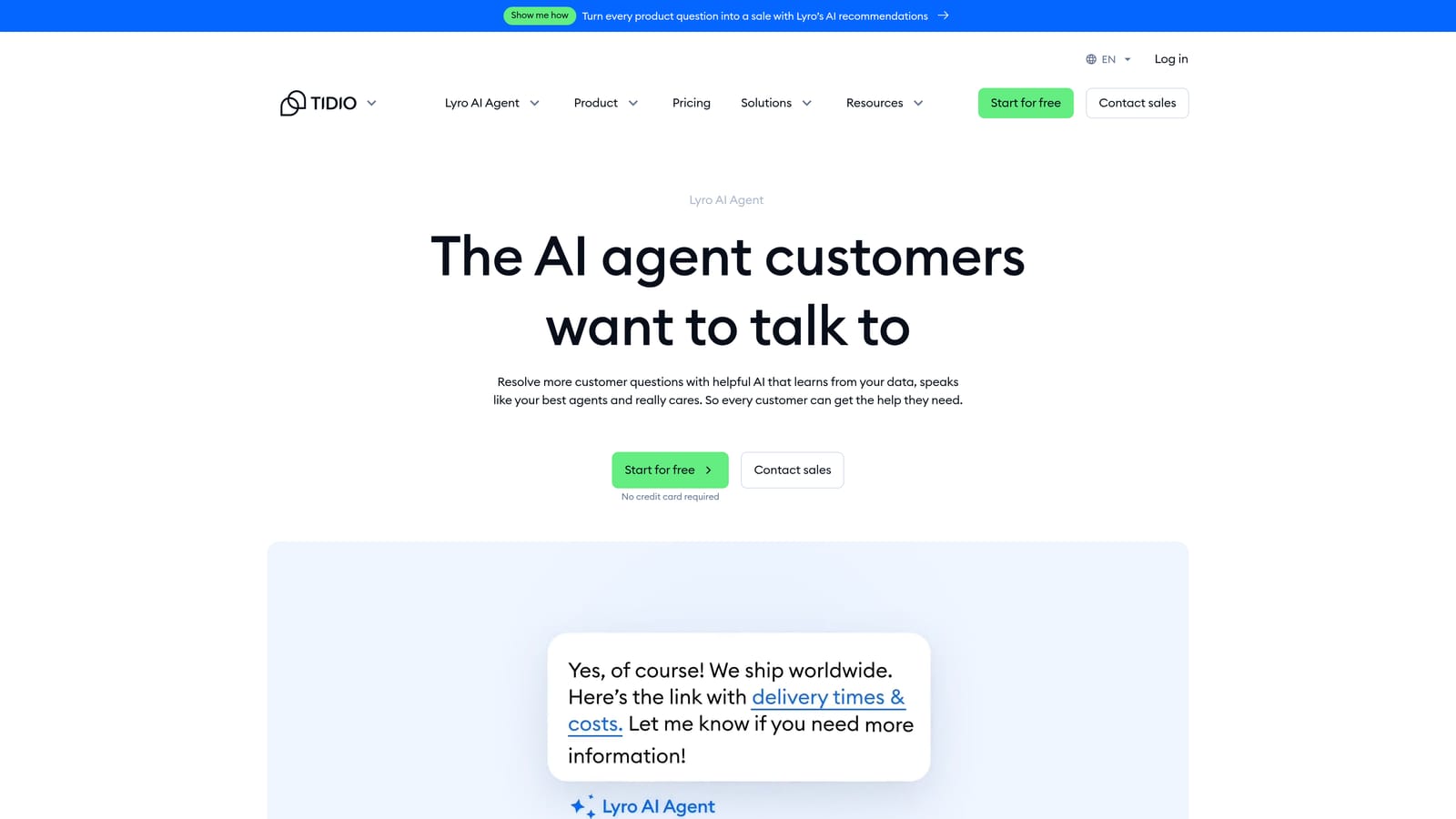
Tidio Lyro is Tidio's conversational AI agent, using a per-conversation pricing model that keeps costs visible and predictable for smaller teams with defined support volumes.
Where This Tool Shines
Lyro's biggest selling point is simplicity. Setup is fast, pricing is published openly on their website, and the per-conversation model makes it easy to forecast monthly costs based on your ticket volume. For SMBs tired of opaque enterprise pricing, that transparency is genuinely refreshing.
Tidio combines live chat and AI in a single platform, which reduces the number of tools smaller teams need to manage. The tradeoff is that Lyro is less suited to complex B2B support workflows or organizations that need deep CRM integration and multi-step reasoning across large datasets.
Key Features
Per-Conversation Pricing: A set number of Lyro conversations are included per plan, with additional conversations available as add-ons.
Fast Deployment: Connects to your existing help content with minimal configuration, getting AI resolution running quickly.
Live Chat and AI in One: Manages both automated and human-assisted conversations from a single interface.
Automatic Escalation: Hands off to a human agent when Lyro can't confidently resolve a query.
E-Commerce Integrations: Native integrations with Shopify, WooCommerce, and major CRM platforms.
Best For
Small to mid-sized e-commerce businesses and SMBs that prioritize ease of setup, pricing transparency, and a combined live chat and AI solution. Less ideal for complex B2B SaaS support environments with deep integration requirements.
Pricing
Tidio offers a free plan. Lyro AI conversations are bundled into paid plans or available as add-ons. Visit tidio.com for current conversation limits and plan pricing.
6. Drift (Salesloft AI)
Best for: Revenue-focused teams where support and sales automation intersect, particularly in account-based and sales-led growth models.
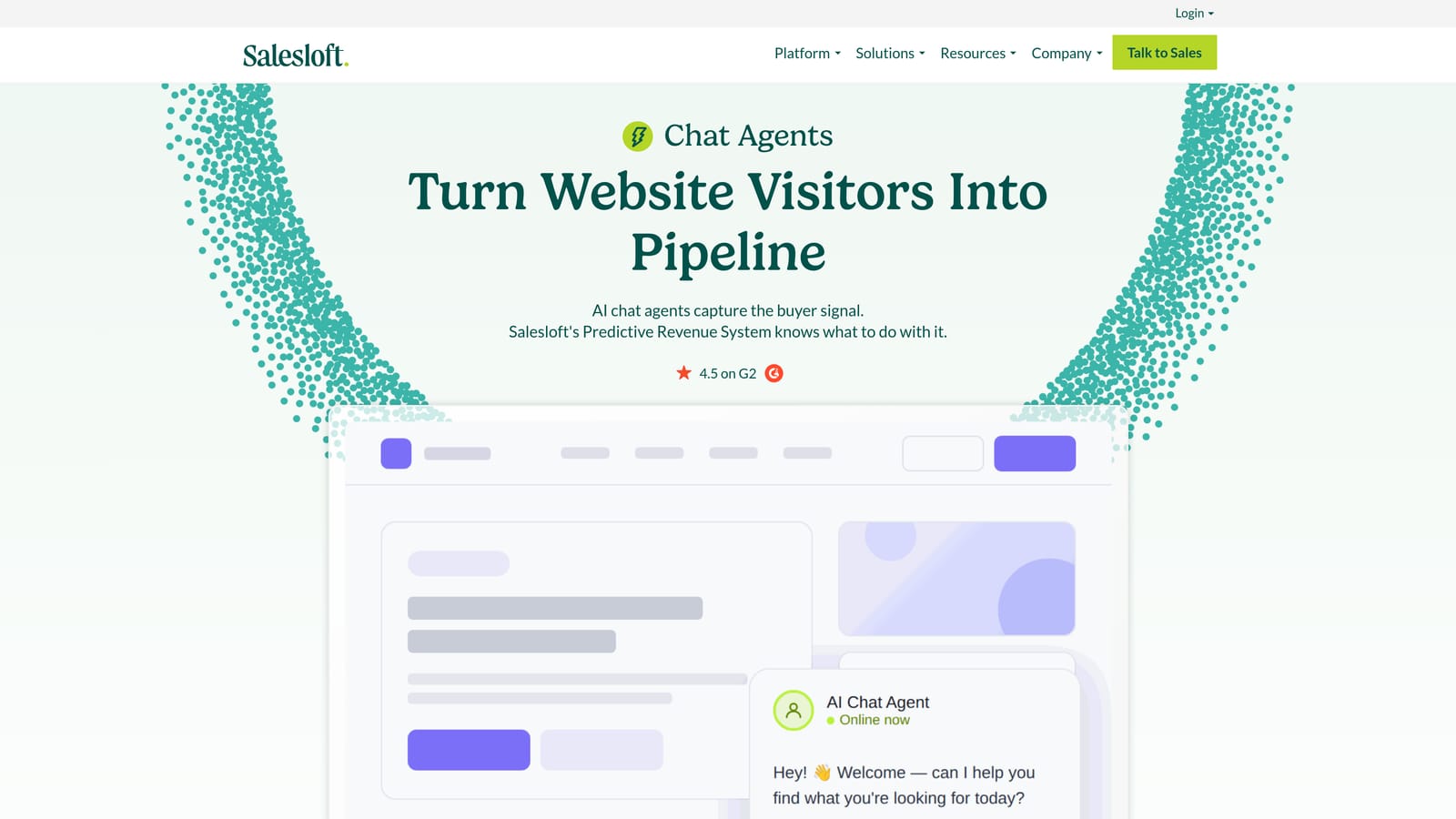
Drift, now part of the Salesloft platform, deploys AI agents designed for buyer journey conversations, qualifying leads and resolving queries within the same interaction.
Where This Tool Shines
Drift occupies a unique position in this comparison: it's less a pure support tool and more a revenue automation platform with strong conversational AI. For organizations where the line between support and sales is intentionally blurred, that positioning is a genuine advantage. AI agents can qualify a lead, book a meeting, and answer a product question in a single conversation thread.
The integration with Salesloft's broader sales engagement platform means Drift is most valuable for teams already running Salesloft workflows. For pure support teams without a sales automation angle, other tools in this list will likely be a better fit.
Key Features
Revenue-Focused AI Agents: Designed for buyer journey conversations that blend qualification, booking, and query resolution.
Salesloft Integration: Deep connection to Salesloft's sales engagement platform for unified revenue team workflows.
Real-Time Meeting Booking: AI agents can book meetings directly within the conversation without human intervention.
CRM-Driven Personalization: Tailors conversations based on visitor data and CRM records for account-specific experiences.
ABM and Sales-Led Fit: Purpose-built for account-based marketing and sales-led growth motions.
Best For
Sales-led B2B organizations using Salesloft where support and revenue generation overlap. Less suited for pure support teams focused on ticket deflection and resolution without a sales component.
Pricing
Custom enterprise pricing. Contact Drift or Salesloft directly via drift.com for a tailored quote based on your team's requirements.
7. Ada
Best for: Large enterprises with strict brand, compliance, and multilingual requirements that need a no-code AI agent builder at scale.
Ada is an enterprise AI agent platform built around a no-code builder, strong brand customization controls, and compliance infrastructure designed for complex organizational requirements.
Where This Tool Shines
Ada's strength is enterprise governance. SOC 2 Type II and GDPR compliance are built in rather than bolted on, which matters enormously for organizations in regulated industries or with strict data handling requirements. The no-code builder lets non-technical teams manage and update AI agent behavior without engineering involvement, which reduces operational overhead at scale.
Multilingual support across 50+ languages and robust brand persona controls make Ada a strong choice for global enterprises that need consistent AI behavior across markets. The tradeoff is that Ada's pricing reflects its enterprise positioning, and smaller teams may find the contract commitment and complexity more than they need.
Key Features
No-Code Agent Builder: Enables non-technical teams to build, manage, and update AI agent flows without developer support.
Enterprise Compliance: SOC 2 Type II and GDPR compliance built into the platform architecture.
Multilingual Support: Handles conversations across 50+ languages for global support operations.
Brand and Persona Controls: Granular controls over AI tone, persona, and response boundaries to maintain brand consistency.
Multi-Step Reasoning: AI reasoning engine capable of handling complex, multi-turn queries that require sequential logic.
Best For
Large enterprises in regulated industries or global markets that need compliant, brand-safe AI agents with no-code management. Organizations with significant contract commitment appetite and complex multilingual requirements.
Pricing
Custom enterprise pricing. Reach out to Ada directly via ada.cx for a quote tailored to your organization's scale and requirements.
8. Forethought AI
Best for: Mid-market to enterprise teams with large historical ticket datasets who want AI-powered triage, deflection, and resolution trained on their own data.
Forethought AI specializes in intelligent triage, deflection, and resolution using your historical support data, making it particularly effective for teams with rich datasets to train on.
Where This Tool Shines
Forethought's core insight is that your historical ticket data is an underutilized asset. By training its AI on your past interactions, it can predict routing, identify deflectable queries, and surface relevant knowledge with higher accuracy than generic AI models. For teams with years of support history, that data advantage compounds over time.
The product suite is modular: Solve handles autonomous resolution, Triage manages predictive routing, and Assist provides a copilot layer for human agents. Teams can adopt one module or all three depending on their automation maturity.
Key Features
Solve: AI resolution that deflects tickets before they reach a human agent, trained on your historical data.
Triage: Predictive routing that directs tickets based on patterns learned from past interactions.
Assist: AI copilot that surfaces relevant knowledge and suggested responses for human agents in real time.
Historical Data Training: Model accuracy improves as it learns from your specific ticket history, not just generic training data.
Integration Depth: Connects with Zendesk, Salesforce, ServiceNow, and Freshdesk for broad enterprise compatibility.
Best For
Mid-market and enterprise support teams with substantial historical ticket data and complex routing requirements. Particularly strong for organizations already using Zendesk, Salesforce, or ServiceNow who want AI layered intelligently across existing workflows.
Pricing
Custom pricing based on volume and module selection. Contact Forethought directly via forethought.ai for current plan details and a quote.
9. Kustomer
Best for: High-volume consumer support operations that need a CRM-native platform with AI woven through a unified customer timeline.
Kustomer is a CRM-native customer service platform with AI automation built around a unified customer timeline, giving every interaction full historical context from the first message.
Where This Tool Shines
Kustomer's unified customer timeline is its defining feature. Rather than treating each ticket as an isolated event, Kustomer surfaces the full history of every customer interaction across channels, giving AI and human agents complete context before they respond. For high-volume consumer operations where customer history is critical to resolution quality, that context layer is a significant advantage.
The omnichannel coverage, spanning email, chat, SMS, social, and voice, in a single platform reduces the fragmentation that plagues many support stacks. That said, Kustomer's pricing and feature set are better aligned with B2C and D2C operations than pure B2B SaaS environments.
Key Features
Unified Customer Timeline: Aggregates all past interactions across channels into a single view, giving AI full context for every conversation.
AI-Powered Routing and Deflection: Automatically routes tickets and deflects common queries based on customer data and interaction history.
Omnichannel Coverage: Manages email, chat, SMS, social, and voice support from a single unified platform.
Workflow Automation: Automates repetitive support tasks and triggers actions based on customer behavior or ticket attributes.
E-Commerce Integrations: Native connections to Shopify, Magento, Salesforce, and other major commerce and CRM platforms.
Best For
High-volume B2C and D2C brands that handle large numbers of consumer interactions across multiple channels and need CRM-native context to deliver consistent, personalized support at scale.
Pricing
Plans start at approximately $89 per user per month (Enterprise) and $139 per user per month (Ultimate). Check kustomer.com for current pricing and plan inclusions.
Which Tool Fits Your Stage and Use Case
The right AI agent platform depends less on features and more on where your team is today and where you're trying to go. Here's a quick way to think through the decision.
If you're a B2B SaaS team that wants AI-native support with product context and business intelligence: Halo AI is built specifically for this. Page-aware context, continuous learning, and revenue intelligence signals make it the strongest fit for product-led and growth-focused support teams.
If you're already on Intercom and want AI resolution without migrating: Fin is the natural next step. The per-resolution model aligns costs with outcomes, and activation is straightforward within your existing setup.
If you're an enterprise team with complex routing on Zendesk or Salesforce: Zendesk AI or Forethought will integrate most cleanly with your existing infrastructure and workflow logic.
If you're an SMB looking for an accessible starting point: Freshdesk Freddy AI offers the most flexible entry pricing, with modular AI add-ons you can layer in as confidence grows. Tidio Lyro is worth considering if e-commerce integrations and transparent per-conversation pricing are priorities.
If compliance, brand control, and multilingual scale are non-negotiable: Ada is the enterprise-grade choice, built for exactly those constraints.
One thing worth noting across all of these platforms: the pricing model you choose shapes your incentives as much as your costs. Per-seat pricing is predictable but doesn't reward AI efficiency. Per-resolution pricing aligns vendor and customer incentives but requires careful contract definition. Custom enterprise deals offer flexibility with the tradeoff of longer negotiation cycles and potential lock-in.
Your support team shouldn't scale linearly with your customer base. Let AI agents handle routine tickets, guide users through your product, and surface business intelligence while your team focuses on complex issues that need a human touch. See Halo in action and discover how continuous learning transforms every interaction into smarter, faster support.