9 Best AI Agent Support Platforms and Their Pricing in 2026
This guide compares nine leading AI agent support platforms and their pricing models—from per-resolution to per-seat structures—helping B2B SaaS and product-led teams understand exactly what they're paying for, including ticket resolution, live agent handoff, and key integrations, so they can make a confident, budget-informed decision when evaluating ai agent support platform pricing.
 Grant CooperFounder14 min read
Buying an AI agent support platform is no longer just a technical decision. It's a budget conversation. Pricing models vary wildly: some charge per resolution, others per seat, others per conversation. And the difference between a platform that saves your team 20 hours a week and one that quietly inflates your invoice can come down to how carefully you read a pricing page.
This guide breaks down nine leading AI agent support platforms, what they actually cost, and what you get for that cost. We've focused on platforms built for B2B SaaS teams and product-led companies that need more than a basic chatbot: think ticket resolution, live agent handoff, integrations with tools like Linear, Slack, and Stripe, and analytics that go beyond deflection rates.
Whether you're evaluating your first AI support platform or benchmarking your current vendor, this list gives you a clear, side-by-side view of the market. For a broader look at what separates good platforms from great ones, see our guide to AI support platform features.
Understanding AI Support Pricing Models
Before diving into specific platforms, it helps to understand the three dominant pricing architectures in this market. Each one has a different risk profile depending on your support volume and AI performance.
Per-resolution pricing: You pay only when the AI fully closes a ticket without human intervention. Attractive when your deflection rate is high, but costs can spike if AI performance drops or your query mix shifts toward complex issues.
Per-seat pricing: The traditional helpdesk model with AI features layered on top. Costs are predictable, but you pay the same whether your agents use the AI heavily or barely at all.
Conversation or interaction pricing: Charges per chat initiated. Easy to understand, but high-traffic sites can find costs escalating faster than expected.
With that framework in mind, here are the top platforms worth evaluating in 2026.
1. Halo AI
Best for: B2B SaaS teams that want AI-first architecture with business intelligence built in.
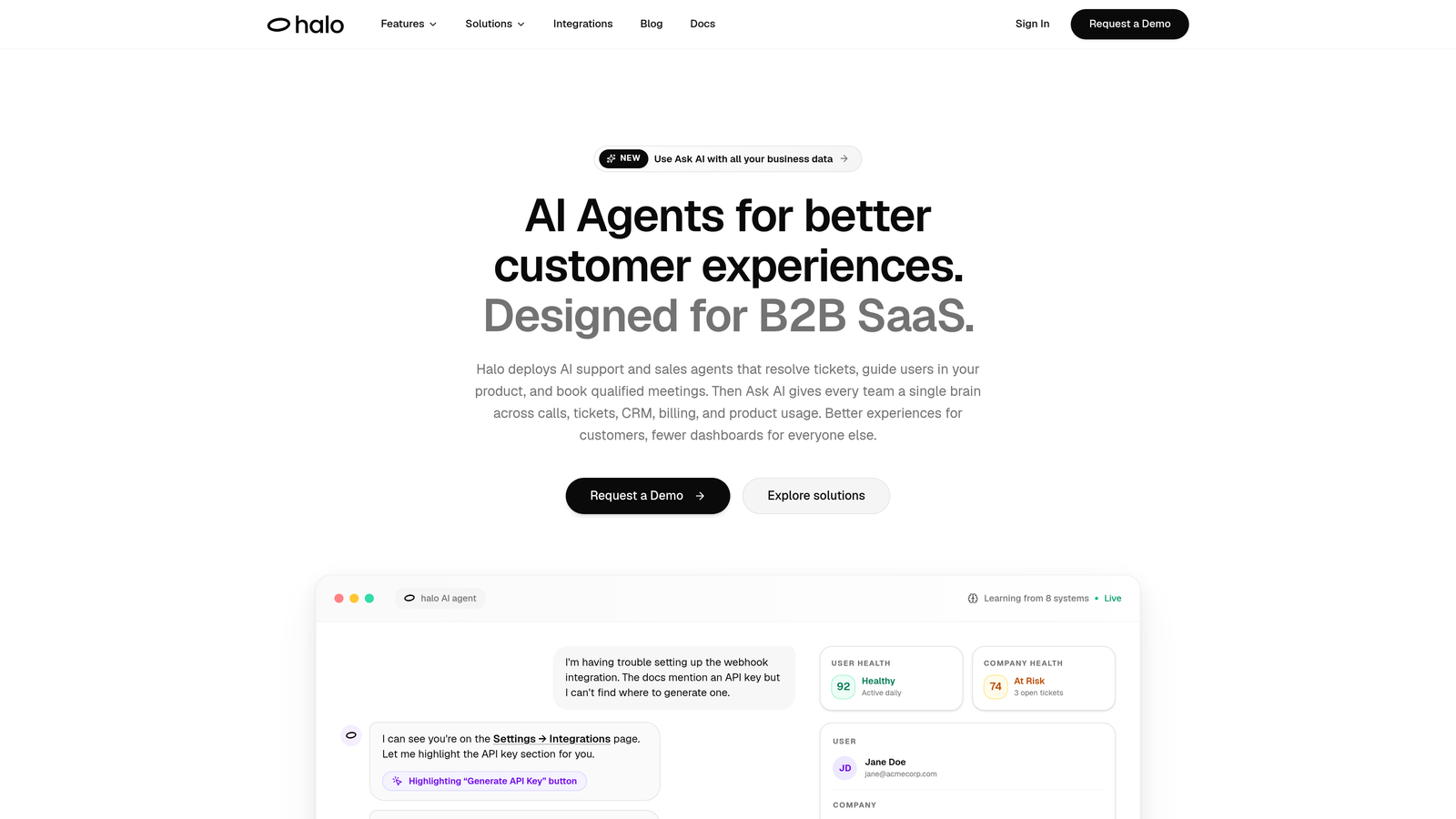
Halo AI is an AI-first customer support platform built from the ground up for product-led and B2B SaaS companies.
Where This Tool Shines
What sets Halo apart from most platforms on this list is that it wasn't built by adding AI to an existing helpdesk. It was designed AI-first, which means the architecture reflects how modern support actually works: autonomous resolution, contextual guidance, and continuous learning baked into every layer.
The page-aware chat widget is a standout capability. Halo's agents can see what the user is looking at in real time, which means they can provide step-by-step UI guidance rather than generic help article links. For SaaS products with complex onboarding flows or feature-rich interfaces, this distinction matters enormously.
Key Features
Page-Aware Context: The chat widget sees what the user sees and delivers contextual UI guidance tied to the specific page or feature they're on.
Autonomous Ticket Resolution with Escalation: AI agents resolve tickets end-to-end and hand off to live agents when complexity warrants it, with full conversation context preserved.
Auto Bug Ticket Creation: When users report issues, Halo automatically creates structured bug tickets routed directly to Linear or your preferred issue tracker, no manual triaging required.
Smart Inbox with Business Intelligence: Beyond support metrics, the inbox surfaces customer health signals, revenue anomalies, and churn indicators drawn from across your connected stack.
Deep Integration Suite: Native connections to Linear, Slack, HubSpot, Intercom, Stripe, Zoom, PandaDoc, and Fathom mean Halo plugs into your existing workflows rather than replacing them.
Continuous Learning Architecture: Every resolved interaction feeds back into the model, so the system gets measurably smarter over time without manual retraining.
Best For
Halo is best suited for B2B SaaS companies and product teams that want AI support to do more than deflect tickets. If you need revenue intelligence, bug tracking integration, and page-level product guidance alongside ticket resolution, Halo is purpose-built for that combination. It's particularly strong for teams scaling support without scaling headcount.
Pricing
Custom pricing based on team size and usage. Contact Halo directly at haloagents.ai for current plan details.
2. Intercom (Fin AI Agent)
Best for: Teams already on Intercom who want resolution-based AI pricing with minimal setup.
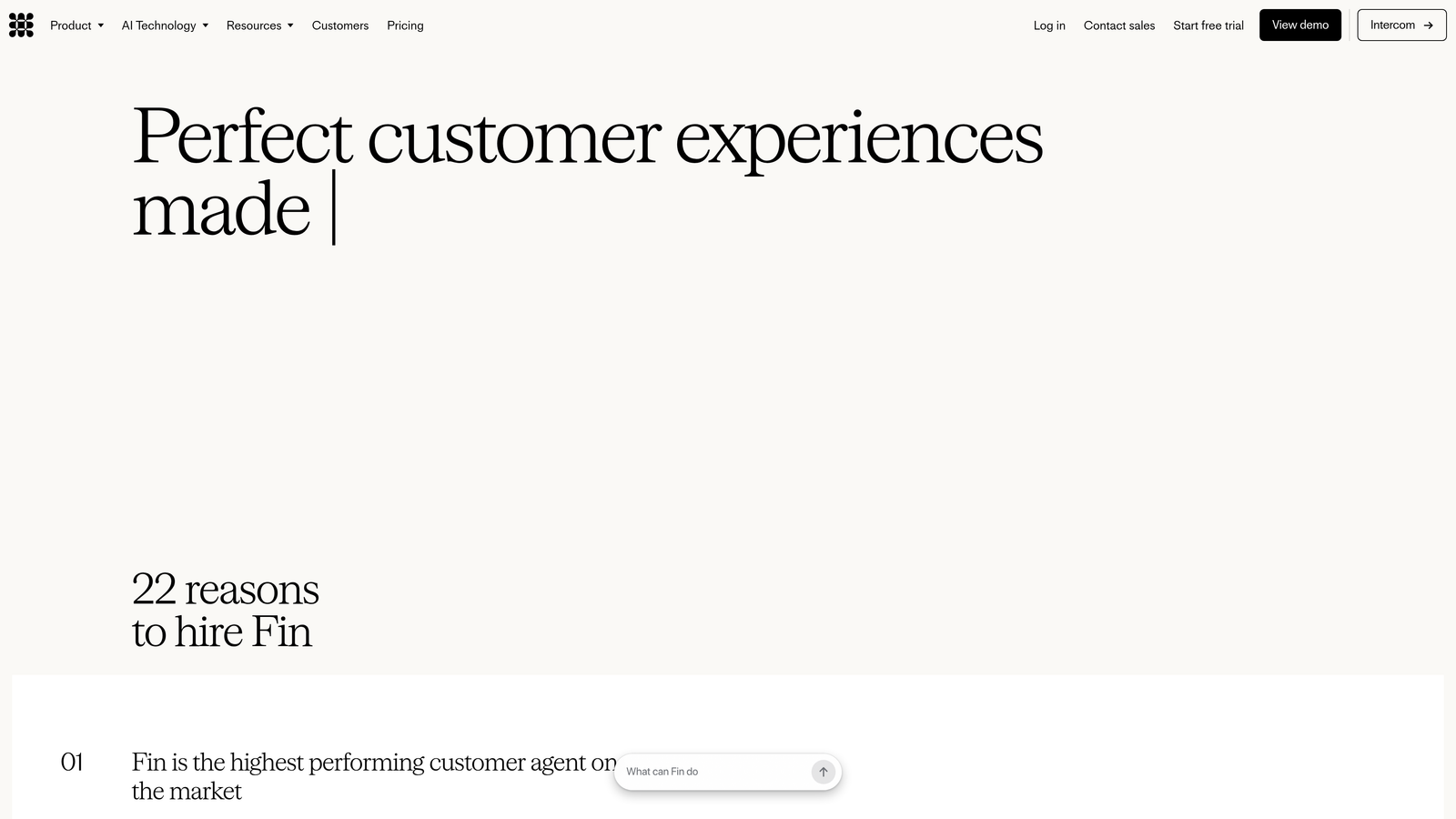
Intercom's Fin is a purpose-built AI agent that resolves customer questions using your existing help content, sitting natively on top of Intercom's messaging platform.
Where This Tool Shines
Fin's resolution-based pricing model is genuinely interesting from an incentive alignment perspective. You pay when Fin actually resolves a conversation, not just when it responds. For teams with well-structured help centers and a high proportion of straightforward queries, this model can deliver strong ROI.
The setup experience is also notably smooth for teams already in the Intercom ecosystem. Fin trains on your existing knowledge base content without requiring custom data pipelines or developer time.
Key Features
Resolution-Based Pricing: Charges apply only when Fin fully resolves a conversation without human escalation.
Knowledge Base Training: Fin learns from your existing help center and support content, making initial deployment fast for teams with documented processes.
Seamless Human Handoff: When Fin can't resolve an issue, it transfers to a human agent within the Intercom inbox with full conversation context intact.
Multilingual Support: Handles conversations in multiple languages out of the box, useful for global support teams.
Resolution Analytics: Dashboard showing resolution rates, conversation outcomes, and where Fin hands off to humans.
Best For
Teams already invested in the Intercom platform who want to add autonomous AI resolution without switching tools. Particularly effective for SaaS companies with a mature, well-organized knowledge base that Fin can learn from quickly.
Pricing
Base Intercom plans start around $39 per seat per month; Fin resolution fees are charged on top of that base. Verify current pricing at intercom.com, as resolution fees vary by plan tier.
3. Zendesk AI
Best for: Enterprises already on Zendesk Suite who want to layer AI onto a mature support operation.
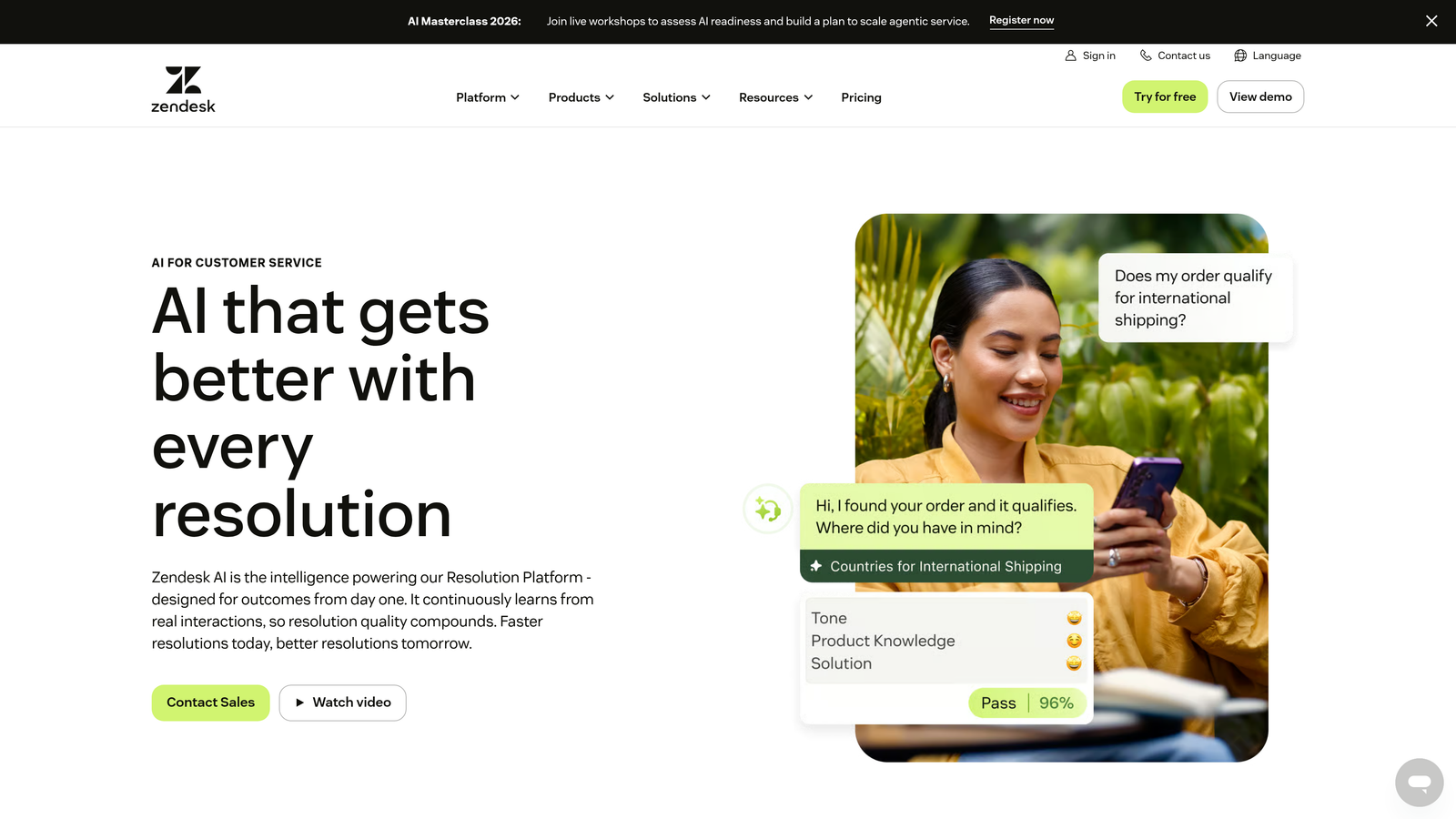
Zendesk AI adds intelligent triage, automated responses, and agent assist capabilities to the Zendesk Suite ecosystem.
Where This Tool Shines
Zendesk's strength is the depth of its existing platform. If your team has years of ticket history, custom workflows, and third-party integrations built on Zendesk, the AI layer plugs into all of that without disruption. The Agent Copilot feature is particularly useful for teams handling complex, multi-step issues where suggested replies and knowledge surfacing can meaningfully reduce handle time.
The tradeoff is that Zendesk's AI capabilities feel like additions to a legacy platform rather than a ground-up AI design. Teams starting fresh may find more AI-native options more agile.
Key Features
AI-Powered Triage: Automatically detects intent and routes tickets to the right team or workflow based on content analysis.
Answer Bot: Handles common queries with automated responses drawn from your knowledge base before a human agent gets involved.
Agent Copilot: Surfaces suggested replies and relevant knowledge articles in the agent compose window to speed up resolution.
Generative AI Add-On: Higher-tier plans include generative capabilities for drafting responses and summarizing threads.
Extensive Marketplace: Thousands of third-party integrations available through the Zendesk App Marketplace.
Best For
Enterprise teams with existing Zendesk investments who want incremental AI improvement without a platform migration. Also a strong choice for organizations with strict compliance requirements, given Zendesk's mature security and compliance certifications.
Pricing
Suite plans start around $55 per agent per month; Advanced AI is available as a paid add-on at higher tiers. Verify current pricing at zendesk.com.
4. Freshdesk Freddy AI
Best for: Growing SMBs that want modular AI adoption without overhauling their entire support stack.
Freshdesk's Freddy AI is a modular AI suite that lets teams adopt AI capabilities incrementally, starting with agent assist and expanding to autonomous resolution over time.
Where This Tool Shines
The modular approach is Freddy's defining advantage. You can start with Freddy Copilot for agent assist, add Freddy Self Service for autonomous resolution, and layer in Freddy Insights for analytics, each as a separate purchase. This makes it easier to justify AI investment in stages rather than committing to a full platform overhaul upfront.
The accessible base pricing also makes Freshdesk one of the more budget-friendly entry points for teams that are new to AI-assisted support.
Key Features
Freddy Copilot: Assists agents with suggested replies, ticket summaries, and knowledge article recommendations during live conversations.
Freddy Self Service: Handles end-to-end ticket resolution autonomously for common query types, without agent involvement.
Freddy Insights: Surfaces trends, anomalies, and performance signals from your support data to inform team decisions.
Modular Purchasing: Each Freddy module can be purchased independently, allowing teams to scale AI investment gradually.
Accessible Base Plans: Low entry-level pricing makes Freddy viable for SMBs that larger enterprise platforms price out.
Best For
SMBs and mid-market teams that want to experiment with AI support without a large upfront commitment. The modular structure is particularly appealing for teams that want to prove ROI on one AI capability before expanding.
Pricing
Base Growth plan starts around $15 per agent per month; Freddy AI modules are priced as add-ons. Verify current pricing at freshworks.com.
5. Tidio Lyro
Best for: E-commerce and SMB teams that need fast AI deployment with minimal technical overhead.
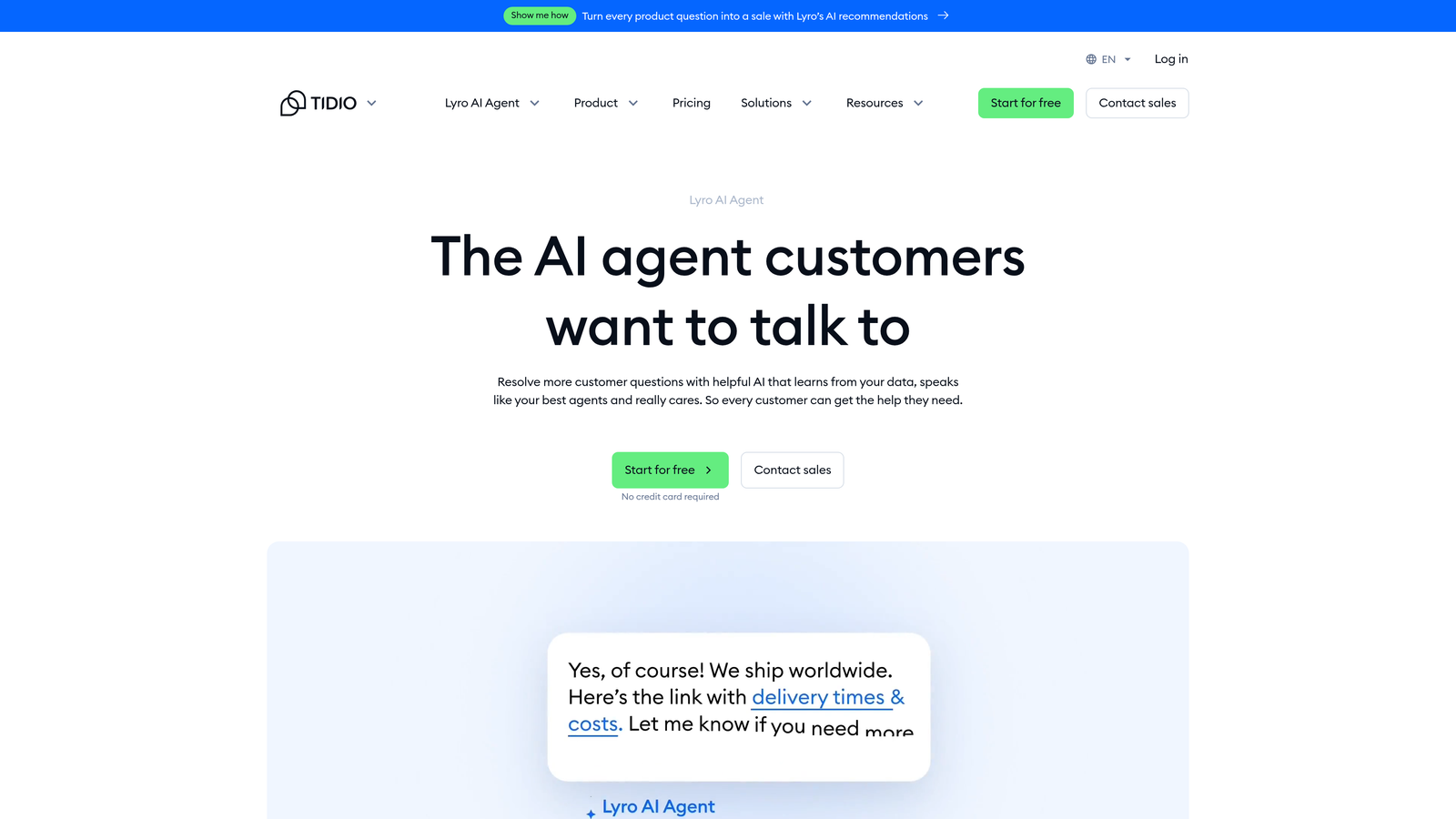
Tidio's Lyro is an AI support agent designed for rapid deployment, particularly popular with e-commerce brands and small teams that need AI support without enterprise contracts or developer resources.
Where This Tool Shines
Lyro's setup experience is genuinely fast. Teams can train the AI on FAQ and support content in minutes, not weeks. For businesses that need something working quickly and don't have a dedicated technical team to manage implementation, this is a meaningful advantage over more complex platforms.
The free tier also makes Lyro an accessible entry point for teams that want to test AI support before committing budget.
Key Features
Conversation-Based Pricing with Free Tier: Low-volume teams can start for free, with paid plans scaling based on conversation volume.
Fast Training: Lyro learns from your FAQ and support content quickly, without requiring custom data pipelines or developer involvement.
Live Chat Fallback: When AI confidence is low, conversations route to a live agent automatically.
E-Commerce Integrations: Native connections to Shopify and other e-commerce platforms for order-related support queries.
No-Code Setup: Designed for non-technical teams, with a visual interface for configuration and training.
Best For
Small e-commerce businesses, DTC brands, and SMBs that need AI support deployed quickly and affordably. Less suited for B2B SaaS teams with complex integration requirements or a need for deep business intelligence.
Pricing
Free tier available with limited conversations; paid plans start around $29 per month. Verify current pricing at tidio.com.
6. Drift (Salesloft)
Best for: Revenue-focused teams that want AI to handle support and sales qualification in a single flow.
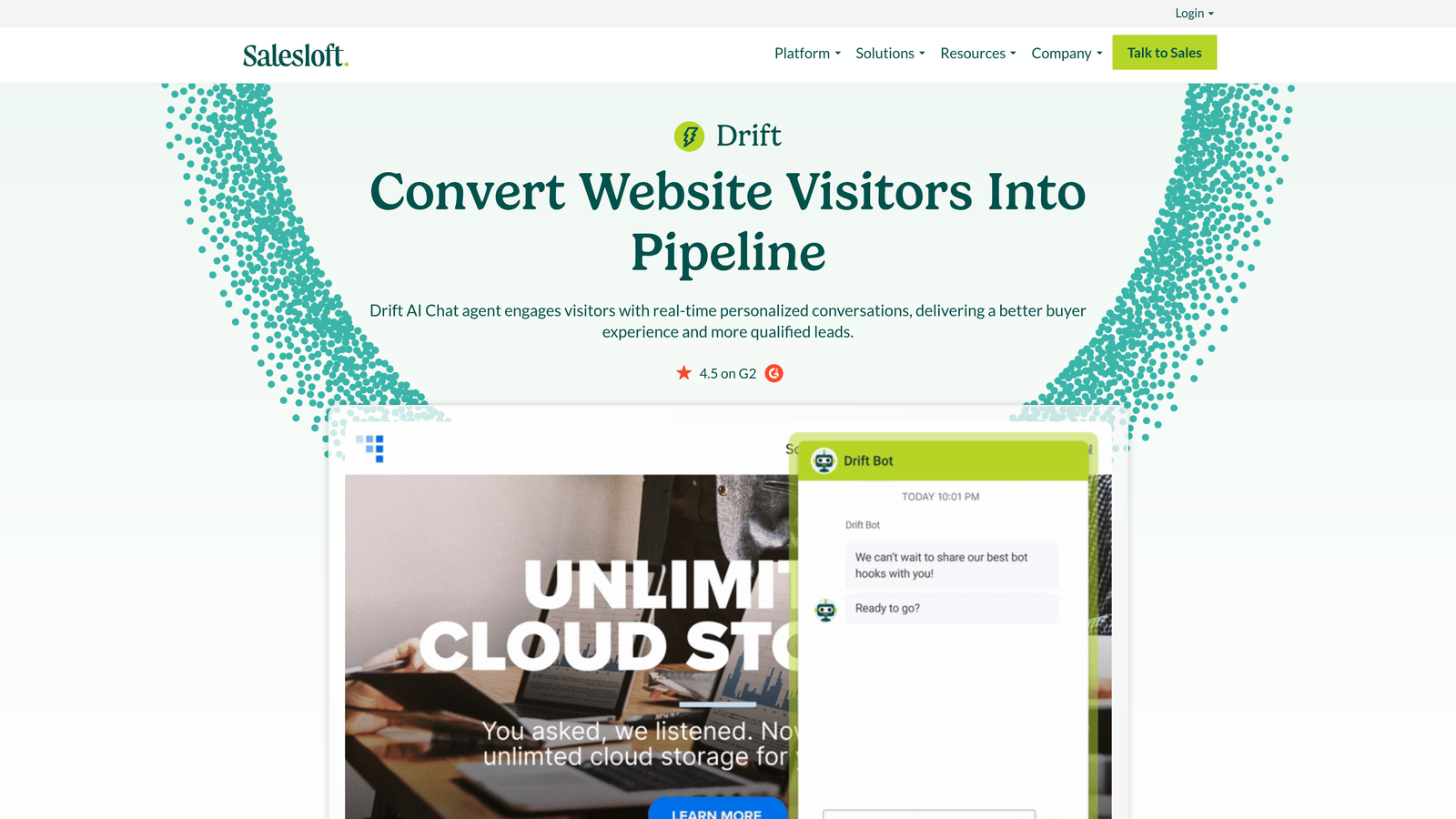
Drift, now part of the Salesloft revenue platform, blends AI-powered support with pipeline qualification, making it a distinct option for teams where sales and support overlap significantly.
Where This Tool Shines
Drift's differentiation is its dual role: AI agents can handle incoming support queries while simultaneously identifying and routing high-intent visitors to sales. For companies running account-based marketing programs or where product-qualified leads come through the support channel, this overlap can be genuinely valuable.
The integration with Salesloft also means support interactions can feed directly into revenue workflows, a capability most pure-play support platforms don't offer.
Key Features
Dual-Purpose AI Agents: Handle support queries and sales qualification within the same conversation flow.
Playbook-Based Routing: Routes visitors to the right team, support or sales, based on detected intent and account data.
Revenue Attribution: Connects support and chat interactions to pipeline and revenue outcomes.
CRM Integrations: Tight connections to Salesforce and HubSpot for account-level context in every conversation.
Conversational Landing Pages: Supports ABM campaigns with personalized conversation experiences for target accounts.
Best For
Enterprise teams where the boundary between support and sales is intentionally blurred. Less suited for pure support use cases or teams that want transparent, self-serve pricing before engaging a sales team.
Pricing
Custom enterprise pricing with no self-serve plan. Contact Drift or Salesloft directly for a quote at drift.com.
7. Kustomer
Best for: High-volume B2C and D2C support operations that need full customer timeline context in every AI interaction.
Kustomer is a CRM-native support platform where AI agents operate with complete customer history available by default, including order history, past interactions, and account data.
Where This Tool Shines
The CRM-native architecture is what makes Kustomer distinct. Most support platforms treat CRM data as an integration to be configured. Kustomer treats it as the foundation. This means AI agents can resolve issues with full context without asking customers to repeat themselves, which has a meaningful impact on experience quality for high-volume operations.
The omnichannel timeline, which unifies email, chat, SMS, and social interactions in a single view, also gives agents and AI a complete picture of every customer relationship.
Key Features
CRM-Native Architecture: AI agents have full customer history, order data, and account context available in every interaction by default.
Unified Omnichannel Timeline: Email, chat, SMS, and social interactions consolidated in a single customer view.
AI-Powered Routing: Routes tickets based on customer value, issue type, and historical interaction patterns.
Workflow Automation: Automates repetitive resolution paths for common issue types without agent involvement.
High-Volume Fit: Architecture designed for operations handling large volumes of customer interactions across multiple channels.
Best For
High-volume B2C and D2C brands where customer history context is critical to resolution quality. Less optimized for B2B SaaS teams that need deep product integrations or developer-facing workflows.
Pricing
Custom enterprise pricing. Historically positioned in the $89 to $139 per user per month range. Verify current pricing at kustomer.com.
8. Help Scout AI
Best for: Small teams that want AI-assisted support with transparent pricing and a human-first philosophy.
Help Scout takes a deliberately human-first approach to support, with AI features designed to assist agents rather than replace them, and pricing that stays predictable as teams grow.
Where This Tool Shines
Help Scout's AI features are thoughtfully scoped. AI Summarize condenses long conversation threads so agents can get up to speed instantly. AI Assist drafts replies and suggests edits in the compose window. Neither feature tries to remove the human from the equation, which is intentional and resonates with teams that have built their brand around personal, high-quality support.
The pricing model is also genuinely transparent, which is refreshing in a market full of "contact us for pricing" landing pages.
Key Features
AI Summarize: Condenses long conversation threads into a quick summary so agents can respond without reading every message.
AI Assist: Drafts replies and suggests edits in the agent compose window, reducing time spent on routine responses.
Docs Integration: AI-powered answer suggestions drawn from your Help Scout Docs knowledge base for self-service.
Transparent Per-User Pricing: No hidden add-ons or usage-based surprises on mid-tier and above plans.
Beacon Chat Widget: Embeddable widget with AI-powered answer suggestions before a conversation is initiated.
Best For
Small to mid-sized teams that prioritize agent experience and predictable costs over autonomous AI resolution. Help Scout is an excellent choice for companies where support quality and personal touch are brand differentiators.
Pricing
Plans start around $20 per user per month; AI features are included on Plus and Pro plans. Verify current pricing at helpscout.com.
9. Salesforce Einstein for Service
Best for: Large enterprises already on Salesforce Service Cloud that need the deepest possible CRM-to-support integration.
Salesforce Einstein for Service brings generative AI and predictive intelligence to Service Cloud, giving enterprises a unified AI layer across the entire Salesforce platform.
Where This Tool Shines
For organizations already running their business on Salesforce, Einstein for Service offers something no standalone support platform can match: real-time access to the full Salesforce data model during every support interaction. AI agents can reference account health, contract status, open opportunities, and case history simultaneously, which enables a level of contextual resolution that's genuinely difficult to replicate with integrations alone.
The generative AI capabilities, including case summaries, reply drafts, and knowledge article creation, are also maturing quickly as Salesforce continues to invest heavily in the Einstein platform.
Key Features
Einstein Copilot for Service: AI assistant embedded in the agent console for reply drafting, case summarization, and next-best-action recommendations.
Generative AI Capabilities: Drafts replies, summarizes cases, and creates knowledge articles using generative AI trained on your data.
Predictive Classification and Routing: Automatically classifies cases and routes them based on predicted outcomes and agent skills.
Full CRM Data Access: AI agents have real-time access to the complete Salesforce data model, including accounts, opportunities, and contracts.
Einstein Bots: Self-service automation for web and mobile channels, with escalation paths to human agents when needed.
Best For
Large enterprises with Salesforce as their system of record that want AI support deeply integrated with their CRM, sales, and service operations. The complexity and cost make it less suitable for SMBs or teams without existing Salesforce infrastructure.
Pricing
Priced as an add-on to Salesforce Service Cloud; costs vary significantly by edition and Einstein tier. Contact Salesforce directly for enterprise pricing at salesforce.com.
Which Platform Is Right for Your Team?
The honest answer is that the best platform depends less on feature lists and more on where you are as a business and what you need AI to actually do.
If you're a startup or early-stage SaaS team that needs fast deployment and predictable costs, Tidio Lyro or Help Scout offer accessible entry points without long-term lock-in. If you're already embedded in Intercom or Zendesk, their native AI layers are the path of least resistance.
For mid-market B2B SaaS teams that want AI support to do more than answer tickets, Halo AI stands out. The combination of page-aware context, continuous learning, auto bug ticket creation, and business intelligence signals means Halo is built for teams where support is a growth function, not just a cost center. Freshdesk Freddy is a strong alternative for teams that want to start small and expand AI capabilities incrementally.
Enterprise teams with Salesforce or complex CRM requirements will find Salesforce Einstein or Kustomer better suited to their data architecture. And for revenue-focused teams where support and sales overlap, Drift offers a model no pure-play support platform can replicate.
Your support team shouldn't scale linearly with your customer base. Let AI agents handle routine tickets, guide users through your product, and surface business intelligence while your team focuses on complex issues that need a human touch. See Halo in action and discover how continuous learning transforms every interaction into smarter, faster support.