9 Best AI Agent Support Software to Buy in 2026
This guide evaluates nine leading platforms to help B2B teams make a confident AI agent support software purchase in 2026, comparing each on autonomous ticket resolution, integration depth, escalation intelligence, and total cost of ownership. Whether you're replacing a legacy helpdesk or building a support operation from scratch, you'll find clear, honest recommendations tailored to how your team actually works.
 Matt PattoliFounder13 min read
Buying AI agent support software is no longer a question of "if" — it's a question of which one actually fits how your team works. The market has matured quickly, and the gap between platforms that bolt AI onto a legacy helpdesk and those built AI-first from the ground up has never been wider.
This guide cuts through the noise. We evaluated nine platforms on the criteria that matter most to B2B product teams and support leaders: autonomous ticket resolution, integration depth, context awareness, escalation intelligence, and total cost of ownership. Whether you're replacing a traditional helpdesk, layering AI on top of an existing stack, or building a support operation from scratch, you'll find a clear recommendation here. Each tool is assessed honestly, including its limitations, so you can make a confident purchase decision.
1. Halo AI
Best for: B2B SaaS teams that want AI-first support with deep product and business stack integration
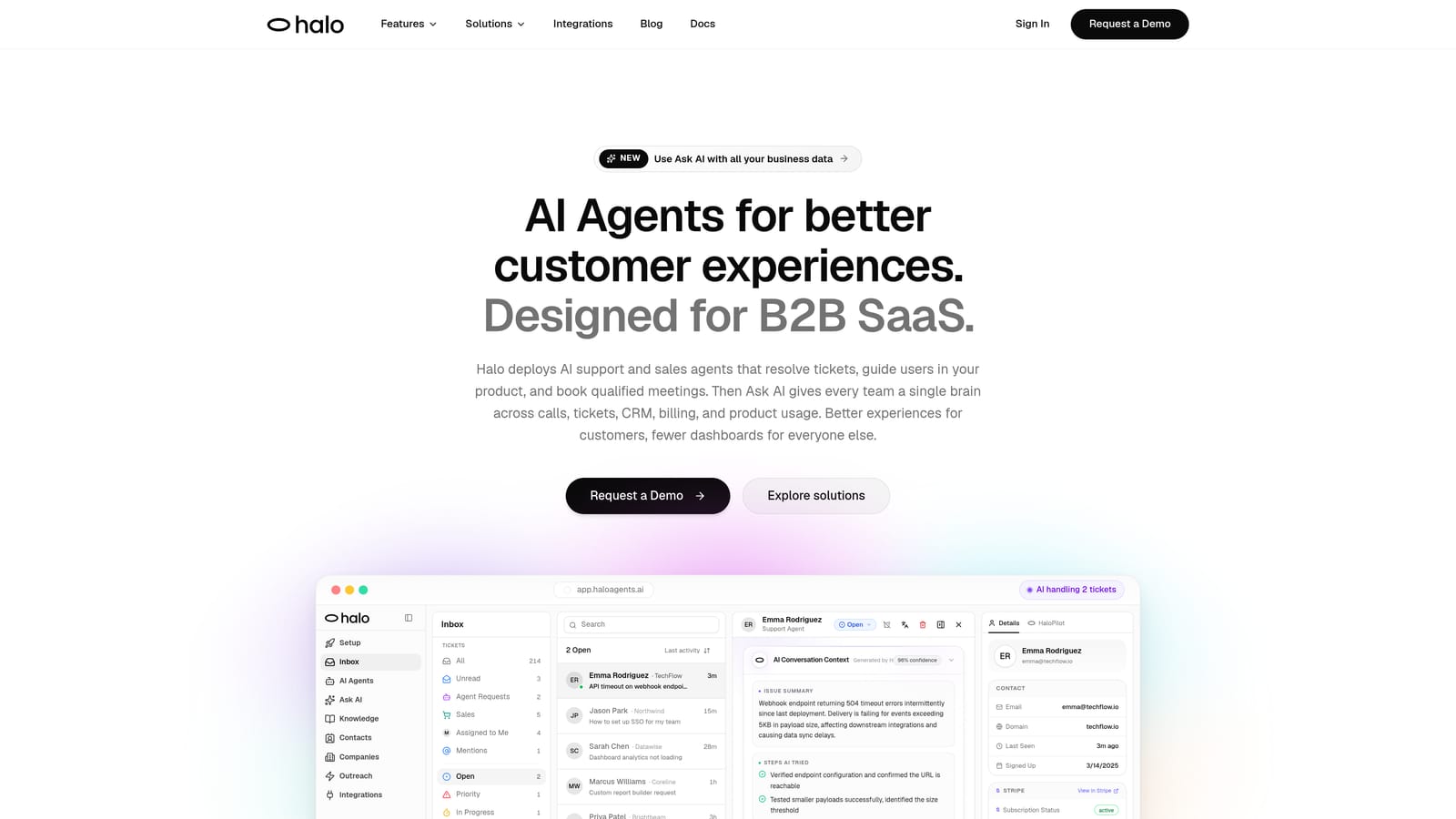
Halo AI is an AI-first customer support platform that deploys intelligent agents to resolve tickets, guide users visually through your product, auto-create bug reports, and surface business intelligence — all while learning continuously from every interaction.
Where This Tool Shines
Halo is built differently from most platforms on this list. Rather than adding an AI layer to an existing helpdesk, it was architected from the ground up around autonomous resolution. The most distinctive capability is its page-aware chat widget: the AI agent actually sees the exact UI context a user is on, which means it can provide visual guidance specific to what's on screen rather than generic article suggestions.
The business intelligence layer inside the Smart Inbox is another genuine differentiator. Instead of just tracking ticket volume, Halo surfaces customer health signals, anomaly detection, and revenue intelligence — giving support leaders and product teams visibility that typically requires a separate analytics platform. For teams that want support to inform product decisions, this is a meaningful advantage.
Key Features
Page-Aware Chat Widget: Sees the exact UI state a user is on, enabling context-specific visual guidance rather than generic deflection.
Autonomous Ticket Resolution: Continuously learns from past interactions so resolution quality improves with every ticket handled.
Auto Bug Ticket Creation: Automatically generates and routes bug reports directly to Linear or your engineering tool, closing the loop between support and product.
Smart Inbox with Business Intelligence: Surfaces customer health signals, anomaly detection, and revenue intelligence beyond standard support metrics.
Live Agent Handoff: Escalates to human agents with full conversation context preserved, so customers never have to repeat themselves.
Deep Integrations: Connects natively to Linear, Slack, HubSpot, Intercom, Stripe, Zoom, PandaDoc, and Fathom.
Best For
Halo is best suited for B2B SaaS companies and product teams that want more than deflection — teams that want their support operation to actively contribute to product improvement, customer retention signals, and engineering workflows. It's particularly valuable for organizations that are tired of support data living in a silo.
Pricing
Contact for pricing. Growth and enterprise tiers are available. Given the depth of integration and AI-first architecture, it's worth a direct conversation to scope the right plan for your team's volume and needs.
2. Intercom Fin
Best for: Teams already running Intercom who want AI resolution without switching platforms
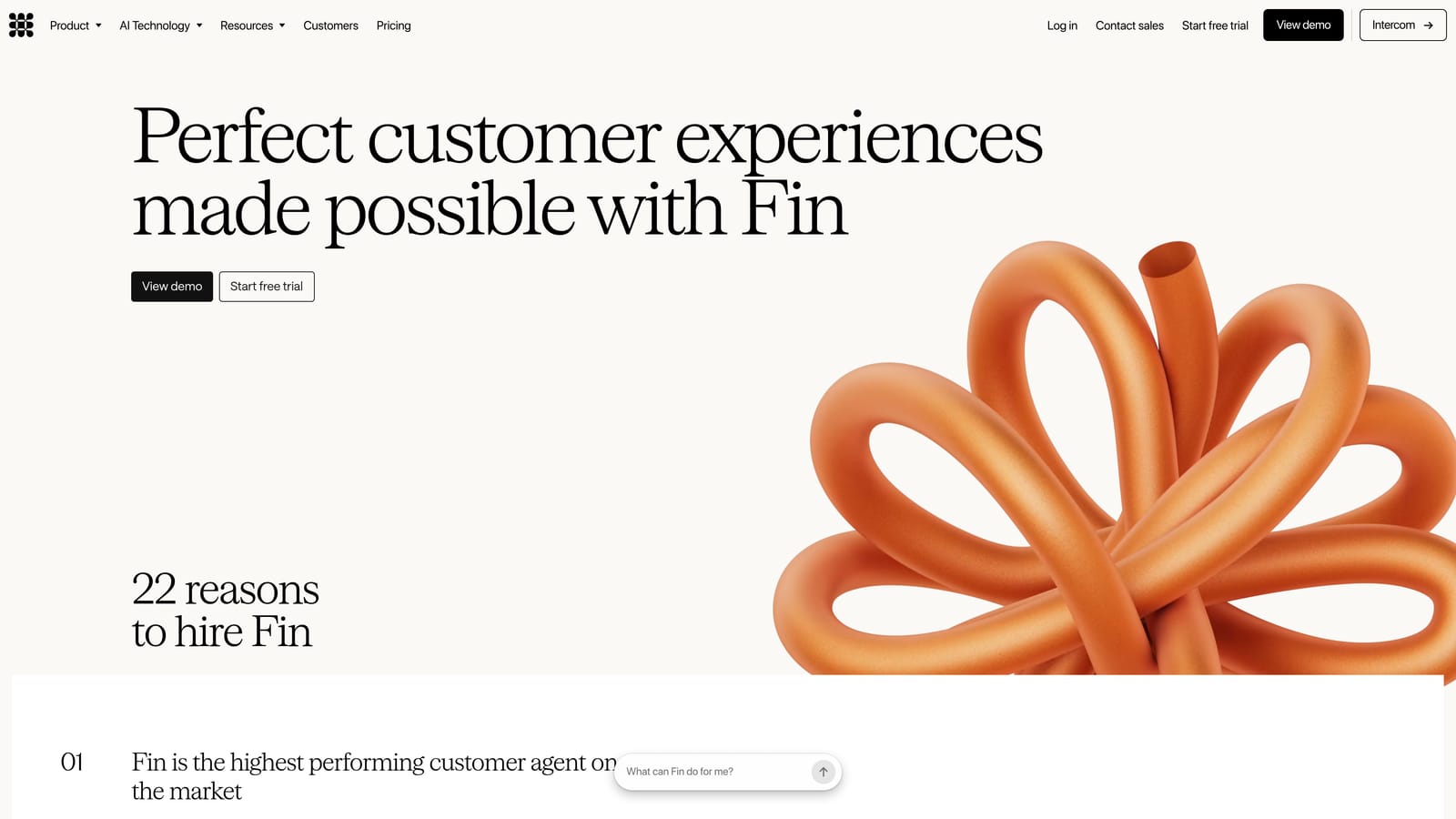
Intercom Fin is Intercom's native AI agent, built on large language models, designed to resolve customer queries directly inside the Intercom messenger without human intervention.
Where This Tool Shines
If your team is already deeply embedded in Intercom, Fin is the path of least resistance to AI-powered resolution. There's no new vendor relationship, no data migration, and no retraining your team on a new interface. Fin sits inside the messenger your customers already use and can draw on your existing knowledge base and customer data from day one.
The per-resolution pricing model is also worth noting. For teams with predictable query volumes, it can be more cost-effective than seat-based pricing, and it creates a direct line between AI performance and cost — you pay when it works.
Key Features
Native Intercom Integration: Works within Intercom's inbox, customer data, and workflow infrastructure without any additional setup.
Per-Resolution Pricing: Available alongside seat-based plans, allowing teams to align costs with actual AI performance.
Multilingual Support: Handles queries across multiple languages without separate configuration.
Contextual Handoff: Passes full conversation context to human agents when escalation is needed.
Custom Actions and Knowledge Sources: Configurable to pull from specific knowledge bases and trigger defined workflows.
Best For
Intercom Fin is the right choice for teams already using Intercom as their primary support and messaging platform. If you're not an Intercom customer, the calculus changes significantly — you'd be adopting an entire platform ecosystem rather than just an AI agent.
Pricing
Available as an add-on to existing Intercom plans. Per-resolution pricing is available as an alternative to seat-based billing. Contact Intercom for current plan details.
3. Zendesk AI
Best for: Established Zendesk customers looking to extend their existing investment with AI capabilities
Zendesk AI is Zendesk's AI layer built into its Suite plans, offering Agent Copilot assistance, automated triage, generative reply suggestions, and intent-based routing.
Where This Tool Shines
Zendesk AI's biggest strength is familiarity. For teams with years of macros, triggers, and routing logic already built inside Zendesk, the AI capabilities layer onto that infrastructure rather than replacing it. Agent Copilot provides in-ticket suggestions and next-step recommendations that help agents move faster without needing to change how they work.
Automated triage with intent and sentiment detection is genuinely useful for high-volume teams where manual categorization creates bottlenecks. The generative reply drafting also reduces time-to-response for agents handling repetitive query types.
Key Features
Agent Copilot: Provides in-ticket suggestions, next-step recommendations, and reply drafts directly in the agent interface.
Automated Triage: Detects intent and sentiment to route tickets before agents engage.
Generative Reply Drafting: Suggests AI-written responses based on ticket content and knowledge base.
Macro and Routing Integration: Works within Zendesk's existing automation infrastructure without requiring rebuilds.
Suite Plan Inclusion: Available across Suite Professional and Enterprise tiers without a separate AI-specific contract.
Best For
Teams with significant existing Zendesk customization who want to incrementally improve agent efficiency rather than replace their stack. Less compelling for teams starting fresh who want autonomous resolution rather than agent assistance.
Pricing
Included in higher-tier Zendesk Suite plans. Contact Zendesk for enterprise pricing specific to your team size and usage.
4. Freshdesk Freddy AI
Best for: Cost-conscious teams on Freshworks who want AI-assisted agents and customer-facing deflection
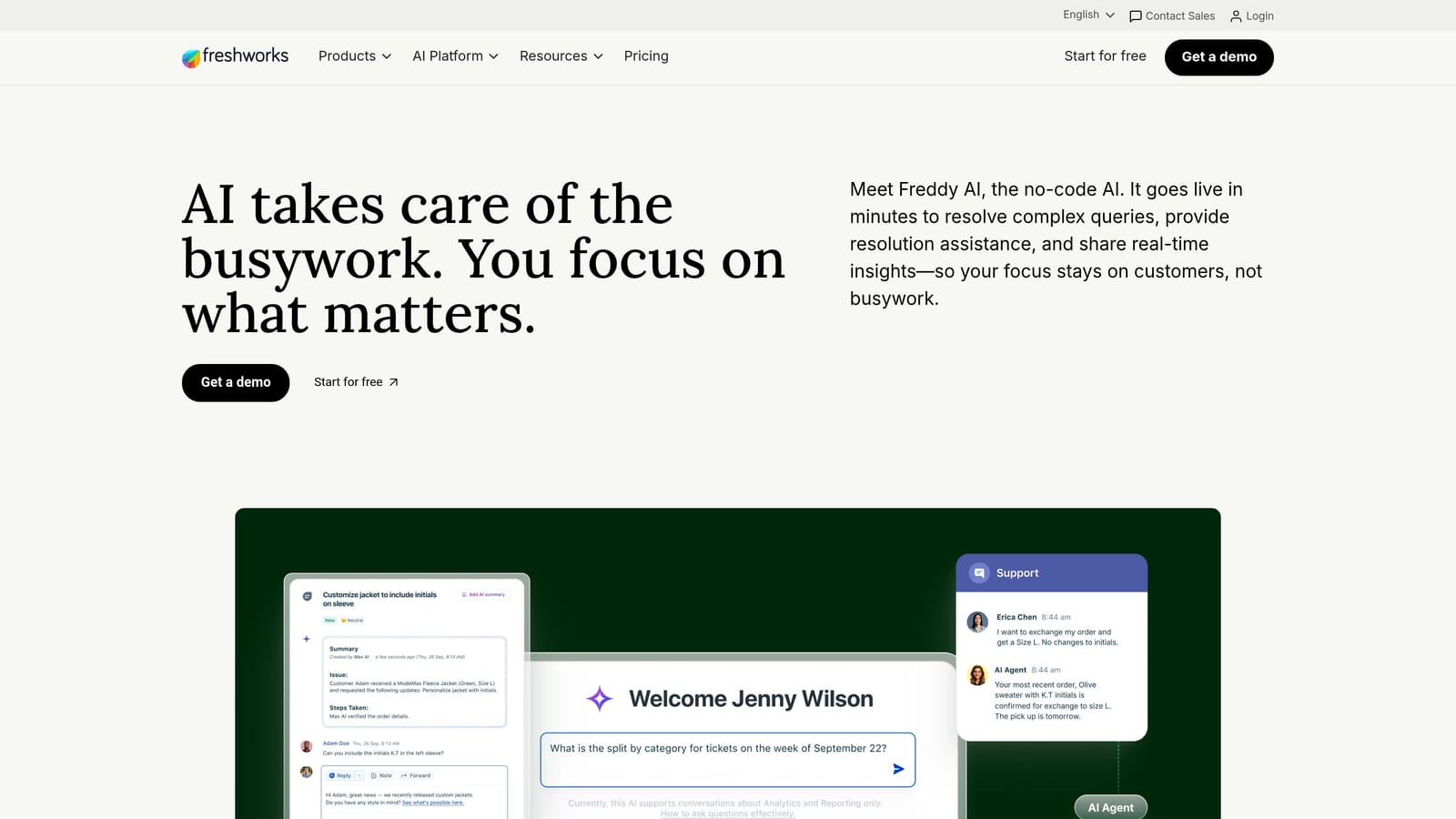
Freshdesk Freddy AI is Freshworks' AI layer for Freshdesk, combining Freddy Copilot for agent assistance with Freddy Self Service for customer-facing deflection.
Where This Tool Shines
Freshdesk's competitive pricing has always been a draw, and Freddy AI extends that value proposition into the AI tier. Freddy Copilot helps agents draft replies and summarize tickets faster, while Freddy Self Service handles deflection for end customers before they reach the queue. For teams that want both agent-assist and customer-facing AI without paying Zendesk or Intercom rates, this is a credible option.
The no-code bot configuration is also a practical advantage for smaller teams without dedicated technical resources. Setting up deflection flows doesn't require engineering involvement, which means support managers can iterate on automation without creating a backlog of requests.
Key Features
Freddy Copilot: AI-assisted reply drafting and ticket summarization for agents inside the Freshdesk interface.
Freddy Self Service: Customer-facing AI deflection that handles common queries before they reach the queue.
Cross-Suite Compatibility: Works across Freshdesk, Freshchat, and Freshsales for teams using the broader Freshworks ecosystem.
No-Code Bot Configuration: Support managers can build and adjust deflection flows without engineering support.
Competitive Bundling: Some Freddy AI features are included in Growth and Pro plans rather than requiring a separate add-on.
Best For
Teams already on Freshworks looking to add AI capabilities without a significant price jump. Less suited for teams that need deep integrations outside the Freshworks ecosystem or want genuinely autonomous resolution rather than agent assistance.
Pricing
Freddy AI is available as an add-on, with some features bundled into Growth and Pro plans. Generally more affordable than Zendesk or Intercom equivalents at comparable feature sets.
5. Salesforce Agentforce
Best for: Enterprise teams running Salesforce as their CRM who need autonomous multi-step service workflows
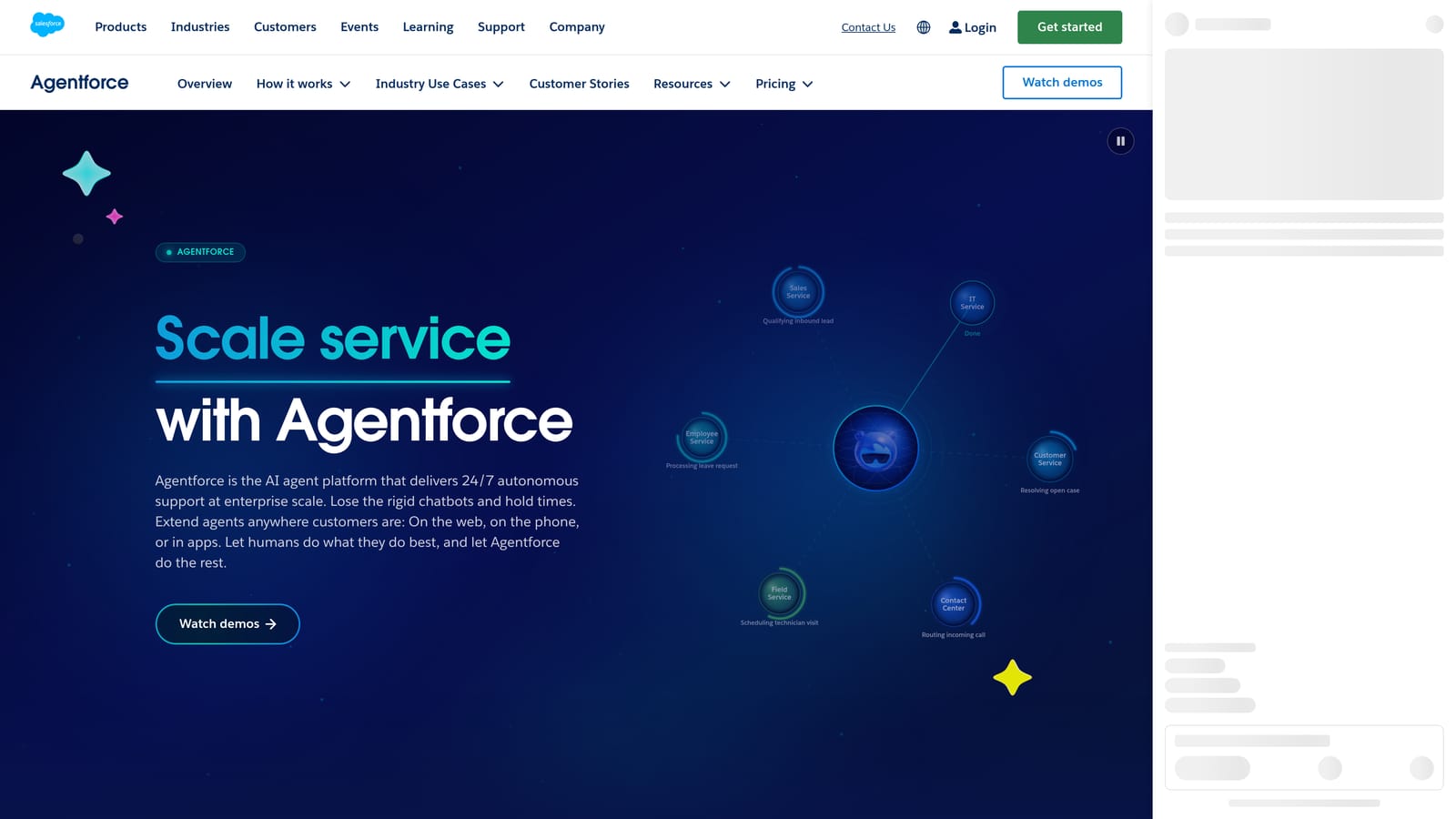
Salesforce Agentforce is Salesforce's autonomous AI agent platform that handles multi-step support and service workflows using native access to CRM, order, and case data inside Salesforce clouds.
Where This Tool Shines
Agentforce's core advantage is data access. Because it lives natively inside Salesforce, it can draw on CRM records, order history, case data, and account information without any external sync. For support scenarios that require understanding a customer's full commercial relationship before responding, this is a meaningful capability that bolt-on AI tools can't easily replicate.
The Atlas Reasoning Engine enables genuinely multi-step autonomous workflows. Rather than just answering a question, Agentforce can execute sequences of actions across Service Cloud and Sales Cloud, making it more capable for complex service scenarios than simpler AI agents.
Key Features
Native Salesforce Data Access: Draws directly from CRM, Service Cloud, and Sales Cloud without external data syncing.
Multi-Step Autonomous Workflows: Handles complex service scenarios across multiple systems without human intervention.
Atlas Reasoning Engine: Powers complex decision-making for nuanced support and service cases.
Pre-Built Agent Templates: Common service scenarios come with configurable templates to accelerate deployment.
Consumption-Based Pricing: Pay per conversation rather than per seat, aligning cost with usage.
Best For
Enterprise organizations with Salesforce as their CRM backbone. If Salesforce isn't already your platform, the setup complexity and licensing requirements make Agentforce impractical. This is a powerful option for the right context, but not a general-purpose AI support tool.
Pricing
Consumption-based pricing per conversation. Requires an existing Salesforce platform license. Contact Salesforce for enterprise pricing specific to your service volume.
6. Ada
Best for: Enterprise teams with high query volume and multilingual support requirements
Ada is an enterprise-grade no-code AI agent platform focused on high-volume customer query automation, with strong multilingual capabilities and integrations across major helpdesks.
Where This Tool Shines
Ada has built a strong reputation in enterprise deployments where query volume is high and the query types are relatively structured. The no-code builder means non-technical teams can configure, adjust, and expand automation without engineering involvement, which matters for support operations that need to move quickly.
Multilingual support across many languages is a genuine differentiator for global teams. Ada handles language switching without requiring separate bot configurations per language, which simplifies management significantly for international support operations.
Key Features
No-Code AI Agent Builder: Non-technical teams can build and modify automation flows without engineering resources.
Multilingual Support: Handles queries across a wide range of languages within a single configuration.
Helpdesk Integrations: Connects with Zendesk, Salesforce, Freshdesk, and other major platforms.
Proactive Messaging: Triggers automated outreach based on customer behavior or defined conditions.
Conversation Analytics: Dashboard tracking resolution rates, escalation patterns, and conversation performance.
Best For
Enterprise teams handling large volumes of structured, repeatable queries across multiple languages. Ada performs best when query types are well-defined. For nuanced B2B SaaS support scenarios with complex, unpredictable queries, its capabilities are less well-matched.
Pricing
Enterprise pricing with custom quotes. Contact Ada directly for pricing based on conversation volume and feature requirements.
7. Forethought
Best for: Teams that want intelligent triage and routing layered on top of an existing helpdesk
Forethought is an AI platform powered by SupportGPT that specializes in intelligent ticket triage, routing, and agent assist, designed to layer on top of existing helpdesk systems.
Where This Tool Shines
Forethought occupies a specific niche: making existing helpdesks smarter before and during agent engagement. SupportGPT classifies intent and sentiment at the moment a ticket arrives, routing it to the right queue and suggesting relevant replies before an agent even opens it. For teams where misrouting and slow first response are the primary pain points, this targeted approach can deliver fast results.
The knowledge-base-grounded reply suggestions are practical rather than generic. Suggested responses draw from your actual support content, which means agents get relevant drafts rather than hallucinated answers.
Key Features
SupportGPT Triage Engine: Classifies ticket intent and sentiment automatically at the point of submission.
Intelligent Routing: Directs tickets to the right queue or agent before manual review is needed.
Knowledge-Grounded Suggestions: Suggested replies are based on your actual knowledge base content, not generated from scratch.
Helpdesk Integrations: Connects with Zendesk, Salesforce, and ServiceNow.
Workflow Automation: Handles common resolution paths automatically for qualifying ticket types.
Best For
Support teams on Zendesk, Salesforce, or ServiceNow who want to improve triage accuracy and agent efficiency without replacing their existing platform. Forethought is an AI layer, not a standalone platform, so teams looking for a full support solution will need to look elsewhere.
Pricing
Enterprise pricing. Contact Forethought directly for a quote based on ticket volume and integration requirements.
8. Tidio Lyro
Best for: Small businesses and startups that need fast deployment and accessible pricing
Tidio Lyro is Tidio's conversational AI product designed for small businesses and startups, offering fast deployment, a generous free tier, and simple FAQ-based deflection.
Where This Tool Shines
Lyro's standout quality is speed to value. It can be live in under an hour with minimal configuration, which makes it genuinely accessible for small teams that don't have the time or resources for a lengthy implementation. For a startup handling a manageable volume of straightforward queries, Lyro can deflect a meaningful portion of inbound tickets from day one.
The free tier also deserves mention. For teams that are early-stage or simply want to test conversational AI before committing budget, Lyro's free access removes the usual evaluation barrier. It's a low-risk way to introduce AI into a support workflow.
Key Features
Fast Deployment: Can be configured and live in under an hour without technical resources.
Conversational AI: Trained on your support content to answer common questions in natural language.
Free Tier: Available for low-volume teams without a paid commitment.
Live Chat Handoff: Escalates to human agents when queries exceed the AI's capability.
E-Commerce Integrations: Connects with Shopify, WordPress, and common e-commerce platforms.
Best For
Small businesses, startups, and e-commerce teams with straightforward, high-frequency query types. Lyro is not designed for complex B2B SaaS support scenarios with nuanced technical queries, multi-system integrations, or enterprise-scale volume.
Pricing
Free tier available for low-volume teams. Paid plans start at SMB-accessible price points. Check Tidio's website for current plan details and conversation limits.
9. Kustomer KIQ
Best for: DTC and subscription businesses that want AI grounded in full omnichannel customer history
Kustomer KIQ is Kustomer's AI layer built into its CRM-native support platform, enabling AI responses grounded in full omnichannel customer history including purchases, returns, and prior conversations.
Where This Tool Shines
Kustomer's CRM-native architecture means KIQ has access to a customer's complete timeline before generating any response. Purchase history, return records, prior conversations across email, chat, and social — all of it is visible to the AI agent without any external data sync. For support scenarios where understanding a customer's full history is essential to resolving their issue, this is a meaningful capability.
The unified inbox across email, chat, social, and voice also simplifies operations for teams managing multiple channels. Rather than stitching together separate tools, agents and AI work from a single view of the customer.
Key Features
Omnichannel Customer Timeline: AI responses are informed by complete purchase, return, and conversation history without separate data integration.
CRM-Native Architecture: No external data sync required — customer context is always current and complete.
Automated Routing and Intent Detection: Routes conversations based on detected intent before agent engagement.
Proactive Outreach Triggers: Initiates outreach based on customer behavior signals or defined conditions.
Unified Inbox: Consolidates email, chat, social, and voice into a single agent and AI interface.
Best For
DTC brands and subscription businesses with complex omnichannel customer relationships. Worth noting for enterprise buyers: Kustomer is now owned by Meta, which raises data and privacy considerations worth discussing with your legal and security teams before purchasing. Less well-suited for pure B2B SaaS support operations.
Pricing
Enterprise pricing. Contact Kustomer directly for a quote based on your team size and channel requirements.
Which Tool Is Right for Your Team
The honest answer is that the best AI agent support software depends almost entirely on where you're starting from and what you actually need the AI to do.
If you're building or rebuilding a support operation and want AI at the core rather than bolted on, Halo AI is the strongest option for B2B SaaS teams. The page-aware context, continuous learning, auto bug ticket creation, and business intelligence layer address problems that most platforms don't even recognize as support problems.
If you're already committed to a specific platform ecosystem, the native options make sense: Intercom Fin for Intercom customers, Zendesk AI for Zendesk customers, Freddy AI for Freshworks teams, and Agentforce for Salesforce enterprises. Each delivers incremental AI value without forcing a platform switch.
For teams that want to improve triage and routing without replacing their helpdesk, Forethought is purpose-built for that use case. For high-volume multilingual enterprise deployments, Ada is a proven choice. For small businesses and startups that need something live today, Tidio Lyro removes almost all the barriers to getting started. And for DTC and subscription brands with complex omnichannel histories, Kustomer KIQ offers a data-rich foundation worth evaluating.
Your support team shouldn't scale linearly with your customer base. Let AI agents handle routine tickets, guide users through your product, and surface business intelligence while your team focuses on complex issues that need a human touch. See Halo in action and discover how continuous learning transforms every interaction into smarter, faster support.