9 Best AI Agent Support Software Trials Worth Testing in 2026
Choosing the right AI agent support software starts with a meaningful trial — not a polished demo. This guide evaluates 9 top platforms offering substantive trial access in 2026, ranking each on setup complexity, out-of-the-box AI performance, integration depth, and escalation handling so support teams can make a confident, evidence-based decision.
 Grant CooperFounder14 min read
If you're evaluating AI agent support software, the trial period is where the real decision gets made. Demos look polished. Trials reveal the truth: how fast the AI learns your product, how well it handles edge cases, and whether it actually reduces ticket volume or just adds another layer to manage.
This list focuses on platforms that offer meaningful trial access, not just a 15-minute sandbox. It covers the full spectrum from AI-first autonomous agents to AI-enhanced helpdesks, assessing each on what you can actually test during a trial: setup complexity, out-of-the-box performance, integration depth, and escalation handling.
Whether you're a SaaS product team looking to deflect tier-1 tickets or a support leader evaluating Zendesk alternatives, this guide covers the platforms worth your evaluation time. Before you start trialing, it's worth reading our overview of automated customer support and AI support agents to frame what "good" actually looks like.
1. Halo AI
Best for: B2B SaaS teams that want an AI-first support agent, not a smarter chatbot bolted onto a legacy helpdesk.
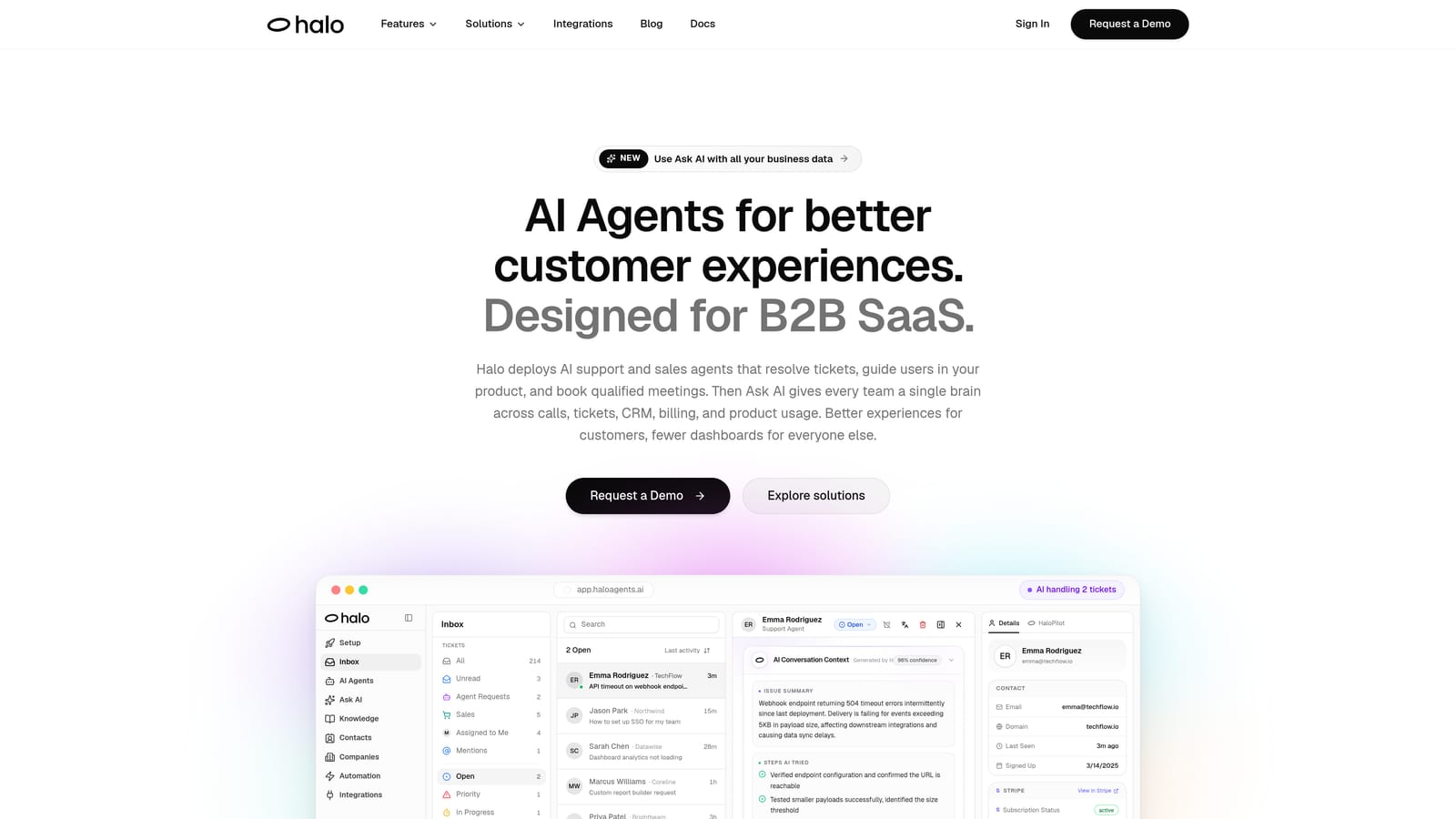
Halo AI is an AI-first customer support platform built specifically for B2B SaaS teams who need autonomous ticket resolution, product guidance, and business intelligence in a single system.
Where This Tool Shines
Halo's architecture is genuinely AI-first, meaning it wasn't built as an add-on to an existing helpdesk. The platform deploys intelligent agents that resolve tickets autonomously, guide users through your product with visual UI context, and surface business intelligence signals that go well beyond support metrics. Every resolved ticket feeds back into the model, so performance improves continuously rather than plateauing after initial setup.
What separates Halo from most competitors in a trial is the page-aware chat widget. The AI sees what the user sees in your product, which means it can provide contextual, step-by-step UI guidance rather than generic help center links. For SaaS teams where product complexity drives ticket volume, this is a meaningful differentiator you'll notice in the first week of testing.
Key Features
Page-Aware Chat Widget: The AI understands which page or feature a user is on and delivers visual guidance tailored to that exact context, reducing the back-and-forth typical of text-only support.
Continuous Learning Engine: Every resolved ticket improves the model's future performance, so the AI gets measurably smarter over time rather than requiring manual retraining.
Smart Inbox with Business Intelligence: The inbox surfaces customer health signals, anomaly detection, and revenue intelligence, turning your support data into strategic insight for product and success teams.
Auto Bug Ticket Creation: When the AI identifies a recurring technical issue, it automatically creates and routes a bug ticket to Linear or your preferred system, closing the loop between support and engineering.
Live Agent Handoff: Escalations pass full conversation context to human agents, so customers never have to repeat themselves and agents have everything they need to resolve immediately.
Deep Integration Stack: Connects natively with Slack, HubSpot, Intercom, Stripe, Zoom, PandaDoc, Linear, and Fathom, covering the full B2B SaaS toolchain.
Best For
Halo is the strongest fit for B2B SaaS product teams and support leaders who want an AI agent that operates autonomously from day one, not a co-pilot that still requires humans to close every ticket. Teams already using Zendesk or Intercom and frustrated by the limitations of bolted-on AI will find the architecture shift significant.
Pricing
Contact for trial access directly at haloagents.ai. Given the integration depth and AI-first architecture, this is better evaluated through a direct conversation with the team rather than a self-serve signup.
2. Intercom (Fin AI Agent)
Best for: Teams already using Intercom Messenger who want generative AI answers without switching platforms.
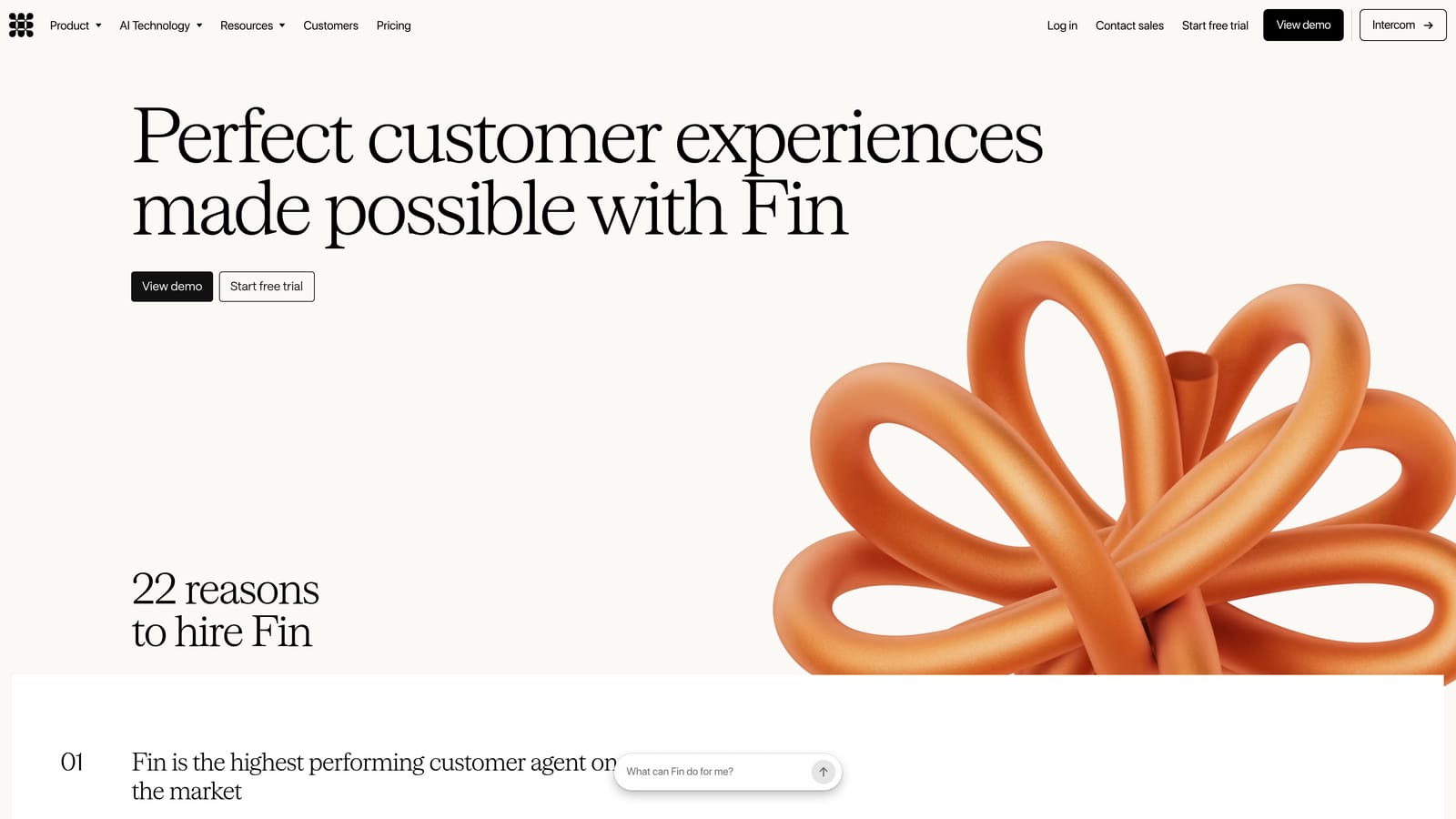
Intercom Fin is Intercom's generative AI agent, trained on your existing help center content and embedded natively within the Intercom Messenger experience.
Where This Tool Shines
Fin's biggest advantage is how little setup it requires if you're already an Intercom customer. Point it at your existing help center articles and it starts generating answers almost immediately. The generative response quality is strong for straightforward queries, and the handoff to human agents within the Intercom Inbox is seamless.
During a trial, you'll notice Fin performs best when your help center content is well-structured and comprehensive. Thin or outdated content produces noticeably weaker AI responses, so the trial period is also a useful audit of your documentation quality.
Key Features
Generative AI Answers: Draws from your help center articles to generate natural-language responses rather than serving static FAQ links.
Seamless Human Handoff: Escalates to agents within the Intercom Inbox with full conversation context intact.
Resolution-Based Pricing: You pay per resolved conversation rather than per seat, which can work in your favor at lower resolution volumes.
Built-in A/B Testing: Lets you test AI response variations to improve resolution quality over time.
Native Intercom Integration: Works within Intercom's full messenger, workflow, and automation suite without additional configuration.
Best For
Existing Intercom customers looking to add AI resolution without migrating to a new platform. Less compelling as a standalone AI agent purchase for teams not already in the Intercom ecosystem.
Pricing
Resolution-based pricing; Intercom plans start from approximately $39 per seat per month. Verify current Fin-specific pricing at intercom.com as it has evolved with product updates.
3. Zendesk AI
Best for: Enterprises already invested in the Zendesk Suite wanting to layer AI across triage, agent assist, and self-service.
Zendesk AI is Zendesk's native AI layer embedded across the full Zendesk Suite, covering intelligent triage, agent copilot functionality, and automated self-service resolutions.
Where This Tool Shines
Zendesk AI's strength is breadth. Because it's embedded across Support, Chat, and Voice, teams get a consistent AI layer across every channel without integration work. The intelligent triage capabilities, which route tickets by intent, sentiment, and language, are particularly mature and can have an immediate impact on queue management during a trial.
The trade-off is that Zendesk AI is fundamentally an enhancement to an existing helpdesk, not a rethink of it. If you're evaluating whether AI can replace significant ticket volume autonomously, you may find the copilot-first approach still requires more human involvement than a dedicated AI-first platform.
Key Features
Intelligent Triage: Auto-routes tickets based on detected intent, sentiment, and language with minimal manual rule configuration.
Agent Copilot: Suggests responses and next-best actions in real time as agents work through tickets.
AI-Powered Self-Service Bots: Handles common queries autonomously before escalating to the human queue.
Advanced Analytics and QA AI: Automated quality assurance scoring and performance analytics across the support operation.
Cross-Channel Coverage: AI capabilities extend across Zendesk Support, Chat, and Voice in a unified configuration.
Best For
Organizations already running Zendesk at scale who want to extend their existing investment with AI rather than migrate to a new platform. Not ideal for teams evaluating AI-first alternatives to traditional helpdesks.
Pricing
AI features are included in Zendesk Suite plans; Suite Team starts at approximately $55 per agent per month. Verify current pricing at zendesk.com as plan structures change regularly.
4. Freshdesk Freddy AI
Best for: SMBs and mid-market teams wanting AI across self-service, agent assist, and analytics at accessible pricing.
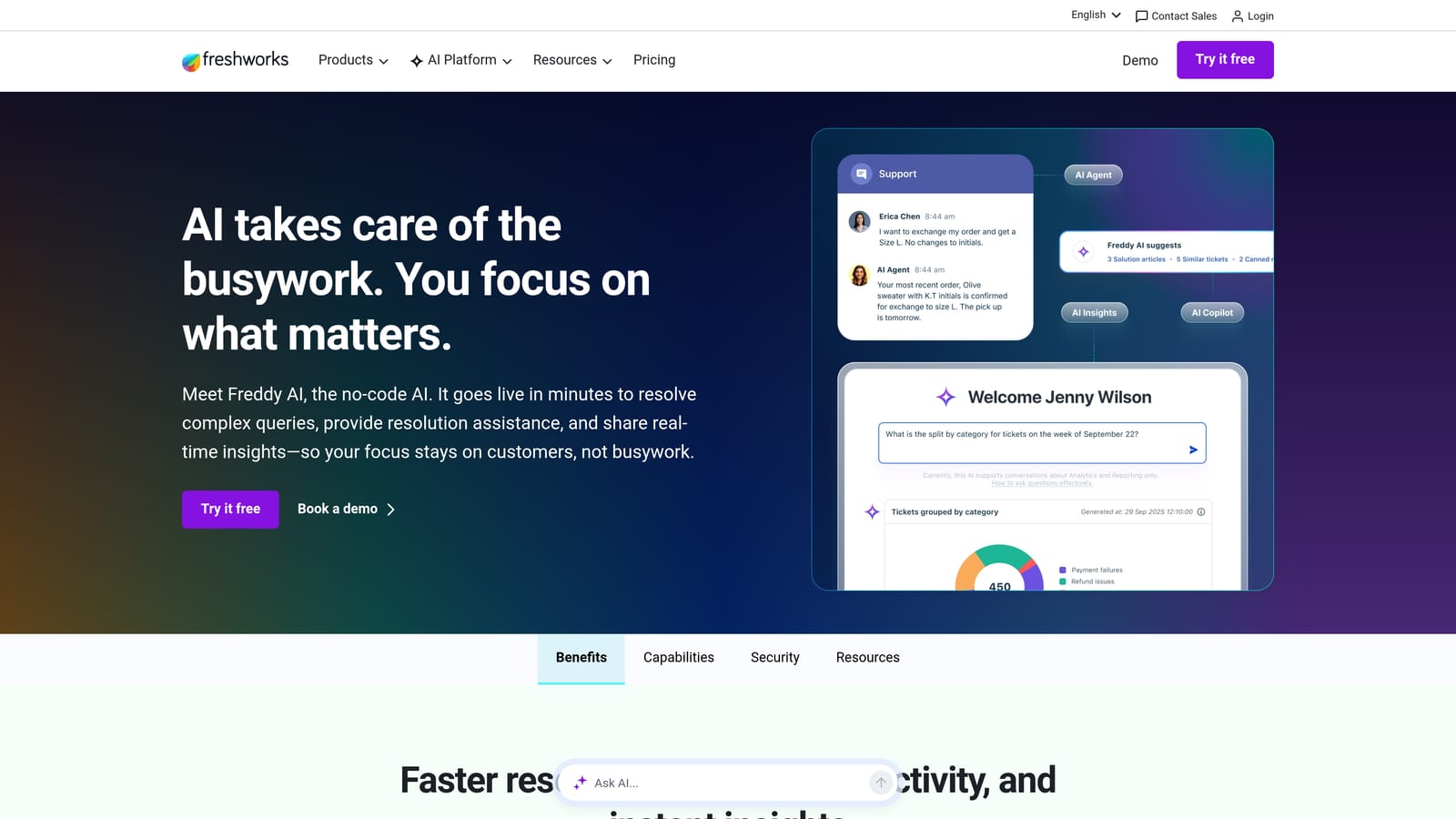
Freshdesk Freddy AI is Freshworks' AI layer spanning Freshdesk, Freshchat, and Freshservice, covering customer-facing deflection, agent assistance, and analytics under a single brand.
Where This Tool Shines
Freddy AI covers three distinct use cases under one umbrella: self-service deflection via Freddy Self Service, real-time agent assistance via Freddy Copilot, and proactive analytics via Freddy Insights. For teams that want AI across the full support lifecycle without purchasing separate tools, this breadth at Freshdesk's price point is genuinely competitive.
During a trial, Freddy Insights tends to surface quickly as a differentiator: it generates AI-powered anomaly alerts and performance summaries that give support leaders visibility they'd otherwise build manually. The self-service bot performance, however, typically requires meaningful training data to reach strong deflection rates, so teams with thin knowledge bases may not see peak performance in a short trial window.
Key Features
Freddy Self Service: Customer-facing AI chatbot that deflects common queries before they reach the human queue.
Freddy Copilot: Provides agents with real-time response suggestions, ticket summarization, and next-action recommendations.
Freddy Insights: AI-generated analytics with anomaly detection and performance summaries for support leaders.
Multilingual Support: Handles queries in multiple languages out of the box without separate configuration.
Cross-Product Integration: Unified AI layer across Freshdesk, Freshchat, and Freshservice for teams using multiple Freshworks products.
Best For
SMBs and growing mid-market teams already using Freshdesk who want to add AI across multiple support functions without significant additional spend. Less suited to complex B2B SaaS environments with sophisticated escalation requirements.
Pricing
Freddy AI add-ons are available on Growth plans and above; Freshdesk Growth starts at approximately $15 per agent per month. Verify current Freddy AI add-on pricing at freshworks.com.
5. Tidio Lyro AI
Best for: E-commerce and SMB teams that need fast deployment with minimal configuration and a free entry point.
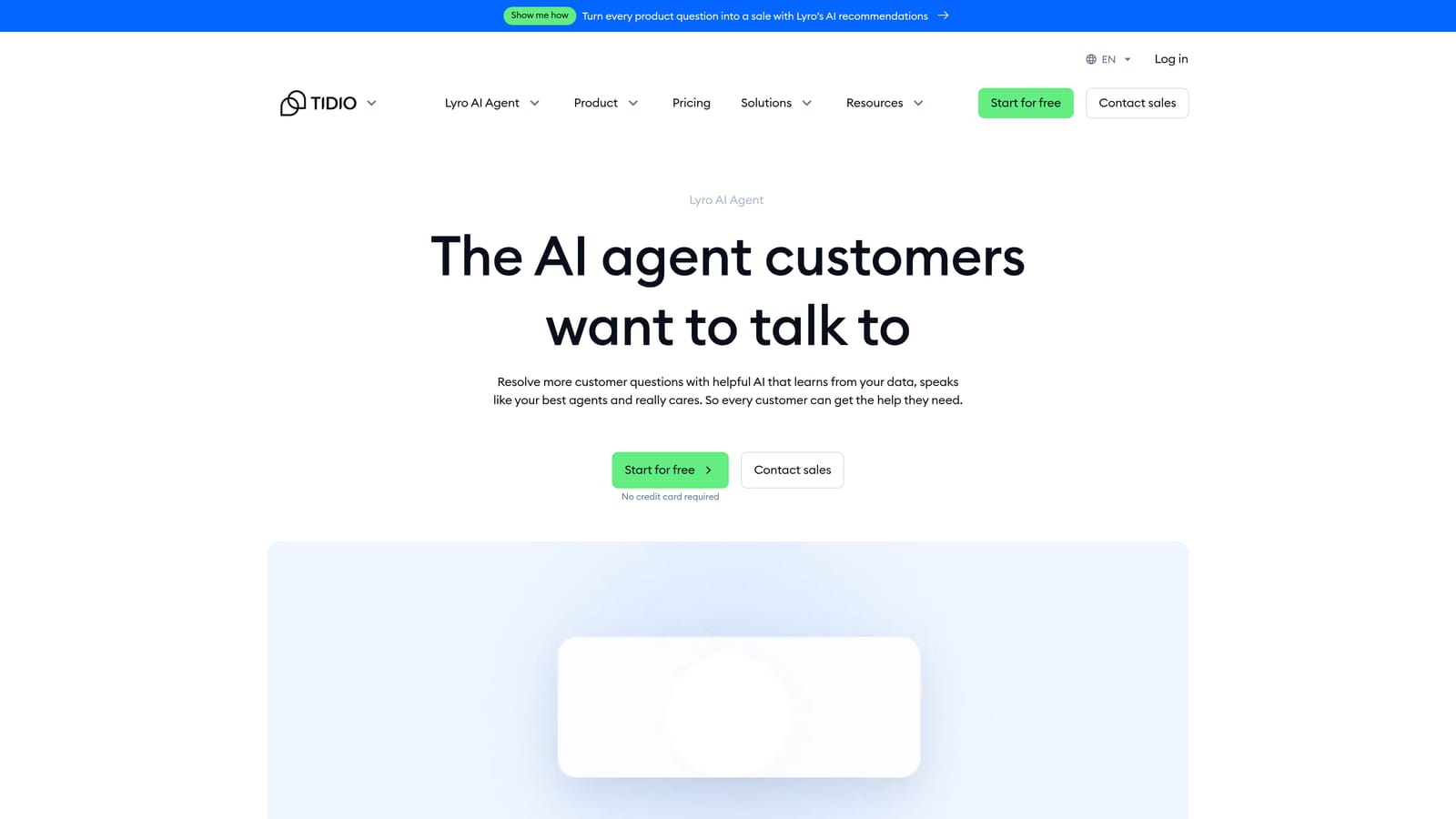
Tidio Lyro is a conversational AI agent designed for rapid activation, using your existing FAQ and help content to start resolving queries with minimal setup time.
Where This Tool Shines
Lyro's defining characteristic is speed to value. Where most AI support platforms require days of configuration, knowledge base structuring, and integration work before you see meaningful deflection, Lyro activates from existing FAQ content quickly. For teams that need to demonstrate AI value fast, this low-friction trial experience is a genuine advantage.
The free tier with limited monthly AI conversations also makes Lyro one of the most accessible entry points for teams that want to test AI support without budget approval. That said, the platform is optimized for e-commerce and high-volume consumer support scenarios rather than complex B2B SaaS queries with multi-step troubleshooting requirements.
Key Features
Fast Activation from FAQ Content: Lyro uses your existing help content to start answering queries almost immediately, with minimal training required.
Free Tier Available: Includes a limited number of AI conversations per month, making it one of the few AI support tools with a genuine no-cost entry point.
Autonomous Query Handling with Human Fallback: Handles common questions independently and escalates to live chat when queries exceed its confidence threshold.
Unified Live Chat and AI Platform: Combines AI resolution and human live chat in a single interface without separate tooling.
E-Commerce Integrations: Native integrations with Shopify and WooCommerce for order-related query handling.
Best For
E-commerce businesses and SMBs with high FAQ-style query volumes. Less suited to B2B SaaS teams with complex, multi-step support scenarios or deep integration requirements.
Pricing
Free tier available with limited monthly AI conversations; Lyro AI paid plans start at approximately $29 per month. Verify current pricing at tidio.com.
6. Drift (Salesloft AI)
Best for: B2B companies where support conversations and pipeline qualification happen in the same thread.
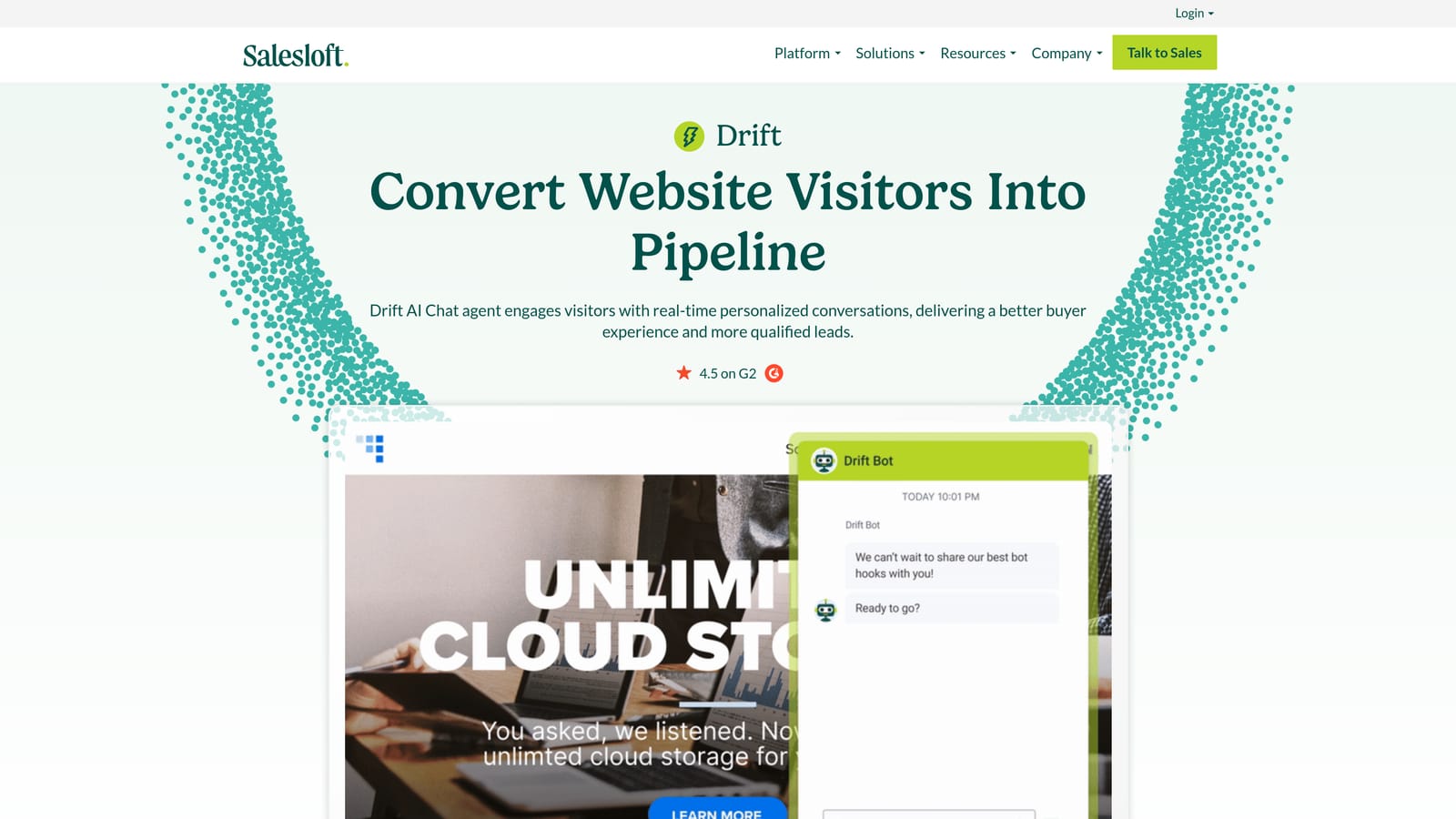
Drift, now part of the Salesloft revenue platform, offers AI-powered conversation capabilities that blend support handling and sales qualification within a single conversation flow.
Where This Tool Shines
Drift's positioning has shifted significantly since the Salesloft acquisition. It's now most compelling for revenue-focused B2B teams where the line between support and sales is intentionally blurred. The AI can handle a support query and simultaneously qualify the account for an upsell or expansion conversation, which is a workflow most pure-play support tools can't replicate.
If your primary goal is ticket deflection and autonomous resolution, Drift may feel over-engineered for that use case. But if your support team operates close to your growth motion, the revenue intelligence reporting and CRM integrations make the trial worth running.
Key Features
Dual-Purpose AI Agents: Handles support queries and lead qualification simultaneously within the same conversation thread.
Playbook-Driven Flows with AI Flexibility: Combines structured conversation playbooks with generative AI flexibility for edge cases.
CRM and MAP Integrations: Native connections to Salesforce, HubSpot, and Marketo for revenue context and data sync.
Meeting Booking Built In: AI agents can book and route meetings directly within the conversation without human intervention.
Revenue Intelligence Reporting: Cross-conversation analytics that surface pipeline and revenue signals from support interactions.
Best For
B2B companies with closely aligned sales and support motions, particularly those using Salesforce or HubSpot as their CRM. Not the right fit for teams evaluating pure-play AI support deflection.
Pricing
Contact Salesloft/Drift for current pricing. Drift is now enterprise-focused and pricing reflects that positioning. Verify at drift.com.
7. Forethought AI
Best for: Enterprise teams that want AI triage and resolution without replacing their existing helpdesk.
Forethought is an AI layer that sits on top of existing helpdesks, including Zendesk, Salesforce, and ServiceNow, adding intelligent triage, routing, and autonomous resolution without requiring a platform migration.
Where This Tool Shines
Forethought's core value proposition is additive AI: you keep your existing helpdesk investment and add a purpose-built AI layer on top. This makes it particularly appealing for enterprise teams with significant Zendesk or Salesforce configurations they're not willing to dismantle. The triage AI, which predicts ticket priority, sentiment, and intent, can have a measurable impact on queue management without touching your existing workflows.
The trial process typically requires sales engagement rather than self-serve access, which means the evaluation cycle is longer than most tools on this list. That said, the ROI and deflection reporting Forethought provides during a trial is detailed enough to build a strong internal business case.
Key Features
Triage AI: Predicts ticket priority, sentiment, and intent to route tickets accurately before agents engage.
Solve AI: Autonomous resolution for common query types without human involvement.
Assist AI: Suggested responses and knowledge base recommendations for human agents handling complex tickets.
Multi-Helpdesk Compatibility: Works across Zendesk, Salesforce Service Cloud, ServiceNow, and others simultaneously.
Deflection and ROI Reporting: Detailed analytics on ticket deflection rates, resolution quality, and cost savings for internal stakeholders.
Best For
Enterprise support operations with existing helpdesk investments they want to enhance rather than replace. Particularly strong for organizations running multiple helpdesk systems across business units.
Pricing
Contact for pricing; trial access typically requires sales engagement. Verify at forethought.ai.
8. Aisera
Best for: Large enterprises needing generative AI across IT service management, HR service delivery, and customer support in a unified platform.
Aisera is an enterprise-grade generative AI platform covering ITSM, HR service delivery, and customer support, designed for organizations with complex internal and external service management requirements.
Where This Tool Shines
Aisera operates at a different scale than most tools on this list. Where others focus on customer-facing support deflection, Aisera addresses the full enterprise service management landscape: IT tickets, HR queries, and customer support in a single AI layer. For large organizations where these three functions currently operate in silos, the consolidation potential is significant.
Autonomous workflow execution is a particular strength. Aisera doesn't just answer questions; it can execute multi-step workflows across ServiceNow, Salesforce, and Workday. Trial access requires sales engagement, and the evaluation process reflects the platform's enterprise complexity.
Key Features
Generative AI for Enterprise Service Management: Purpose-built for the scale and complexity of large enterprise service operations across IT, HR, and customer support.
Unified AI Layer: Covers IT, HR, and customer support in a single platform rather than requiring separate AI tools per function.
Pre-Built Enterprise Integrations: Native connections to ServiceNow, Salesforce, and Workday with minimal custom development.
Autonomous Workflow Execution: Executes multi-step service workflows rather than simply answering queries and escalating.
Enterprise Security and Compliance: Built-in controls for enterprise security, data governance, and compliance requirements.
Best For
Large enterprises with complex, multi-function service management needs spanning IT, HR, and customer support. Not the right fit for SMBs or SaaS teams focused purely on customer-facing support deflection.
Pricing
Contact for pricing; Aisera operates on enterprise contracts. Verify at aisera.com.
9. Kustomer (Meta AI)
Best for: High-volume consumer support teams that need AI agents operating with full CRM and order history context.
Kustomer is a CRM-native customer service platform owned by Meta, where AI agents operate with complete access to customer history, order data, and CRM context rather than working from isolated ticket threads.
Where This Tool Shines
Kustomer's differentiator is context depth. Most AI support agents see only the current conversation. Kustomer's AI agents see the full customer timeline: every previous interaction, order history, subscription status, and CRM data. This makes AI responses significantly more relevant and reduces the back-and-forth that erodes customer experience in context-blind systems.
The platform handles omnichannel volume well, consolidating chat, email, social, and voice into unified threads. For high-volume consumer businesses where customers contact support across multiple channels about the same issue, this unification is practically valuable during a trial.
Key Features
Full Customer Timeline Context: AI agents access complete customer history across all previous interactions, not just the current ticket.
Unified CRM and Support Platform: CRM and support tooling in a single interface, eliminating the context-switching between systems that slows agent performance.
True Omnichannel Threading: Chat, email, social, and voice conversations unified into a single customer thread regardless of channel.
AI-Powered Routing by Customer Value: Routes conversations based on customer history, lifetime value, and prior interaction patterns rather than just ticket type.
Automation-First Design for High Volume: Built to handle large conversation volumes with automation handling the majority of interactions before human escalation.
Best For
High-volume consumer support operations where customer history and omnichannel context are critical to resolution quality. Less common in pure B2B SaaS environments where ticket complexity typically outweighs volume as the primary challenge.
Pricing
Starts at approximately $89 per agent per month; trial available. Verify current pricing at kustomer.com.
Which Platform Is Right for Your Evaluation?
After running through this list, the right choice comes down to where you're starting from and what "success" looks like at the end of your trial.
If you're a B2B SaaS team that wants an AI agent built from the ground up, not layered onto a legacy helpdesk, Halo AI is the most purpose-built option. The page-aware context, continuous learning, and business intelligence signals make it particularly strong for product-led teams where support and product quality are tightly linked.
Zendesk AI and Freshdesk Freddy AI are the natural choices for teams with existing helpdesk investments who want incremental AI improvement without a platform change. Forethought fits the same pattern for enterprise teams running multiple helpdesks simultaneously.
Tidio Lyro wins on speed and accessibility for SMBs and e-commerce teams. Intercom Fin is the obvious choice if you're already running Intercom Messenger. Drift makes sense when support and pipeline are intentionally blended. Aisera and Kustomer address enterprise-scale and high-volume consumer scenarios respectively.
Your support team shouldn't scale linearly with your customer base. Let AI agents handle routine tickets, guide users through your product, and surface business intelligence while your team focuses on complex issues that need a human touch. See Halo in action and discover how continuous learning transforms every interaction into smarter, faster support.
For further reading on building your AI support strategy, explore our guides on AI helpdesk software and the broader customer support AI benefits that teams are realizing in practice.