9 Best AI Agents with CRM Integration for B2B Teams in 2026
This guide ranks the 9 best AI agent with CRM integration platforms for B2B teams in 2026, evaluating each on depth of bidirectional CRM connectivity, autonomous action capabilities, and fit for support and customer success workflows. If you need an AI agent that reads deal stages, subscription tiers, and churn risk — and writes context back when it's done — this list covers your options.
 Grant CooperFounder14 min read
AI agents that can't talk to your CRM are half-solutions. The real value comes when your support agent already knows a contact's subscription tier, deal stage, or churn risk before the conversation starts — and can write that context back when it's done. Without that bidirectional connection, you're just automating responses, not intelligence.
This list covers the best AI agents with genuine CRM integration: tools that read from and write to your CRM, not just ones that technically "connect" via a Zapier workaround. Each tool was evaluated on depth of CRM connectivity, autonomous action capabilities, and how well it serves B2B support and success teams.
Whether you're running support on Zendesk, managing customer health in HubSpot, or trying to reduce ticket volume without growing headcount, there's a solution here built for your stack.
1. Halo AI
Best for: B2B SaaS teams that need AI support connected to CRM, product, and billing data
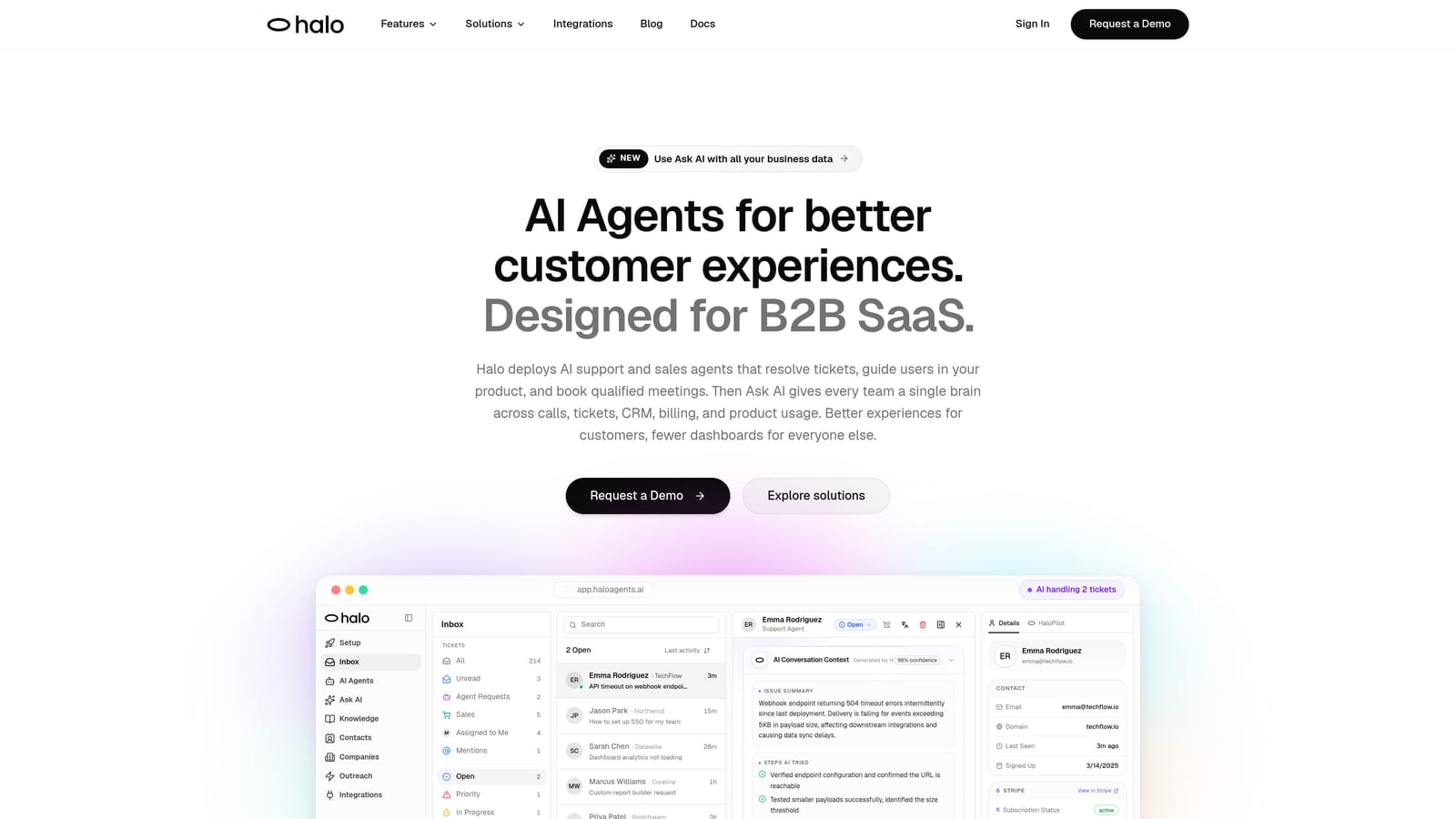
Halo AI is an AI-first customer support platform that deploys intelligent agents to resolve tickets, guide users visually through your product, and surface business intelligence — all connected to your CRM and broader business stack.
Where This Tool Shines
What separates Halo from most AI support tools is the architecture. It wasn't built as a bolt-on to an existing helpdesk — it was designed from the ground up to connect your entire business stack. That means when a user opens a chat, the AI agent already has context from HubSpot, Stripe, Intercom, and your product data before a single message is typed.
The page-aware chat widget is particularly notable for SaaS teams. The AI agent sees what the user sees on-screen, enabling it to give contextual, visual guidance rather than generic documentation links. Combine that with a smart inbox that surfaces churn signals, customer health scores, and revenue anomalies, and you have a support layer that doubles as a business intelligence feed.
Key Features
Native CRM and Stack Integrations: Connects directly to HubSpot, Intercom, Stripe, Linear, Slack, Zoom, PandaDoc, and Fathom — no middleware required.
Page-Aware Chat Widget: The AI agent sees what users see on-screen, enabling precise, visual UI guidance that resolves issues faster than documentation alone.
Smart Inbox with Business Intelligence: Surfaces customer health signals, churn risk indicators, and revenue anomalies alongside your support queue — turning support data into strategic insight.
Auto Bug Ticket Creation: Automatically creates and routes bug tickets to Linear when issues are detected, closing the loop between support and engineering without manual handoffs.
Live Agent Handoff with Full Context: When escalation is needed, the handoff preserves the full conversation history and CRM context so agents never start from scratch.
Best For
B2B SaaS companies that want AI support agents operating across their entire stack — not just a helpdesk. Particularly strong for product-led growth teams where support, CRM, and billing data need to work together to deliver intelligent, contextual responses at scale.
Pricing
Contact for pricing at haloagents.ai. Pricing is tailored to team size and integration requirements.
2. Salesforce Agentforce
Best for: Enterprises already standardized on the Salesforce platform
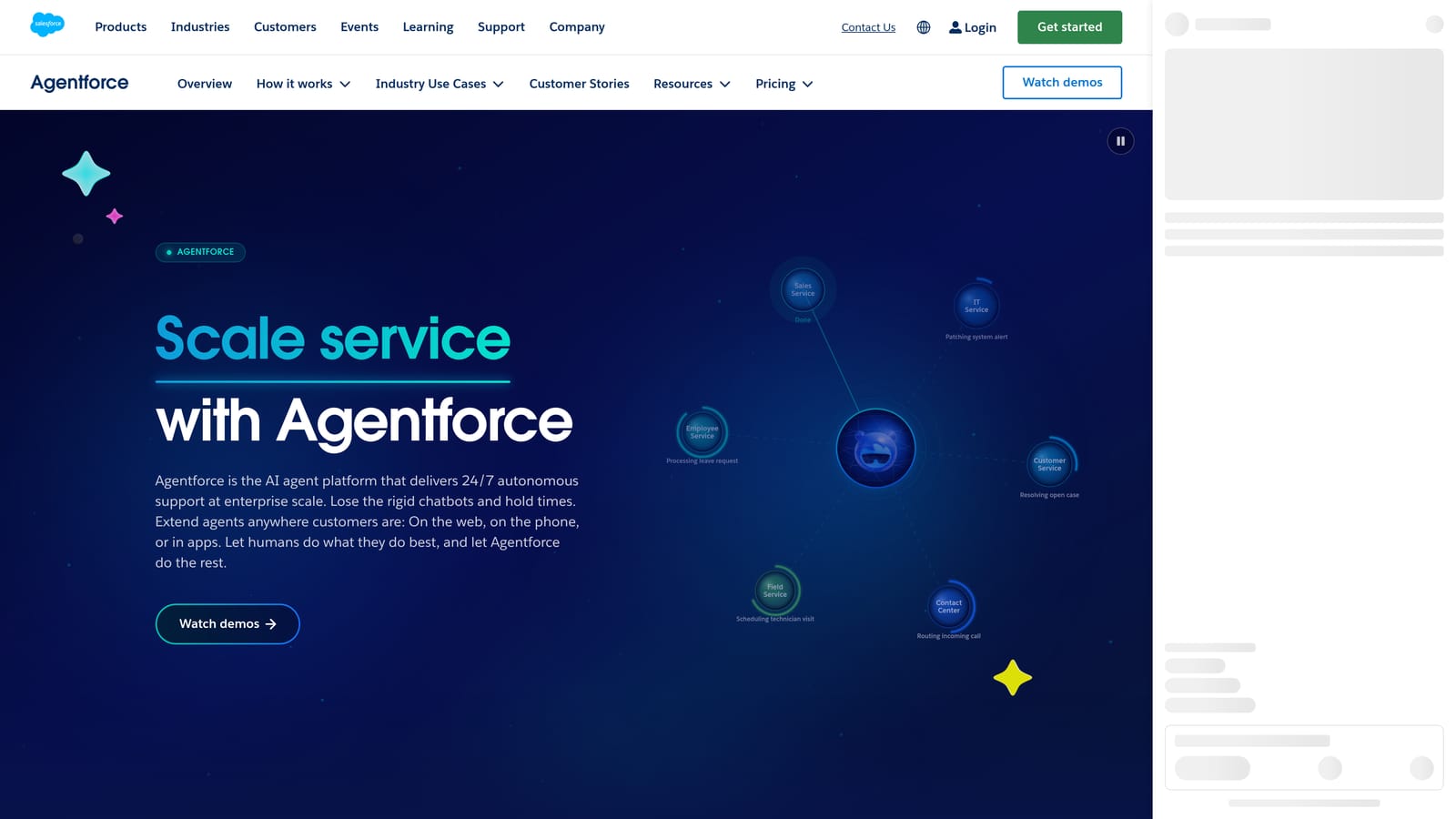
Salesforce Agentforce is Salesforce's native AI agent platform built across Sales Cloud, Service Cloud, and Marketing Cloud — with direct access to all CRM objects without any external sync.
Where This Tool Shines
If your organization runs on Salesforce, Agentforce is the most natural extension of that investment. Because the AI is built directly into the platform, it has native read and write access to every CRM object — contacts, accounts, opportunities, cases — without the latency or reliability concerns of third-party connectors.
The ability to take autonomous actions within Salesforce flows is a genuine differentiator. Agentforce can update records, trigger automations, and move deals through stages without leaving the platform or requiring middleware. For enterprises with complex Salesforce configurations, that native depth is hard to replicate elsewhere.
Key Features
Native CRM Object Access: Read and write access to contacts, accounts, cases, and opportunities directly within Salesforce — no sync overhead or API rate limits from third-party connectors.
Autonomous Actions in Salesforce Flows: Agents can take actions within existing Salesforce automation flows without requiring external triggers or middleware.
Cross-Cloud Intelligence: Spans Sales Cloud, Service Cloud, and Marketing Cloud data, giving agents a unified view across the full customer lifecycle.
Einstein AI Foundation: Built on Salesforce's Einstein AI layer with enterprise-grade security, compliance controls, and data residency options.
Best For
Enterprise teams that have Salesforce as their system of record and want AI agents that operate natively within that ecosystem. Less suitable for teams using other CRMs or wanting to avoid adding to an already significant Salesforce spend.
Pricing
Agentforce is an add-on to existing Salesforce licenses. Pricing is available through Salesforce sales; details at salesforce.com.
3. HubSpot Breeze
Best for: Teams using HubSpot as their CRM, marketing, and support platform
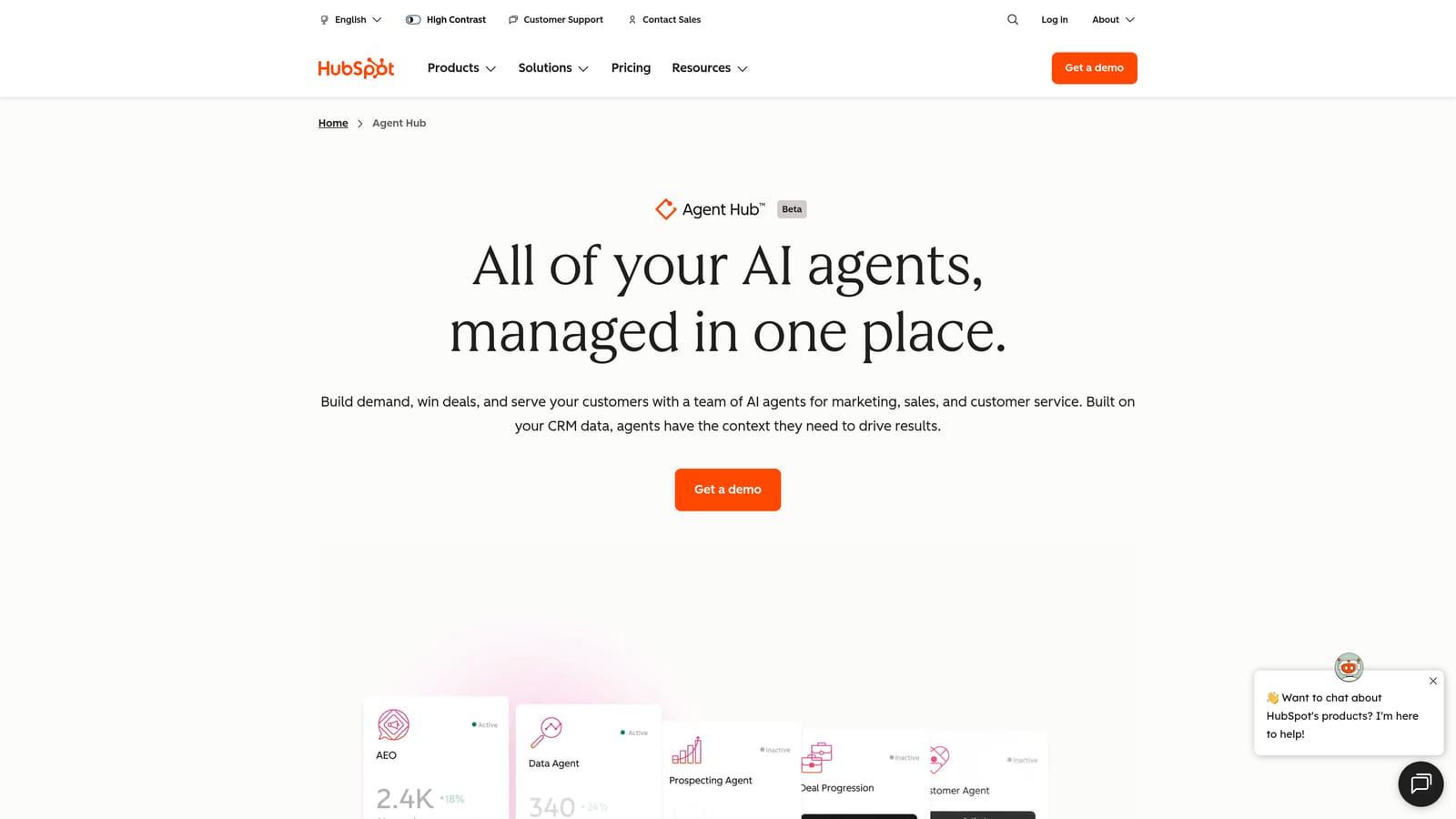
HubSpot Breeze is HubSpot's AI layer embedded across its CRM, marketing, sales, and service hubs — enabling AI agents that operate on unified contact and deal data without any sync overhead.
Where This Tool Shines
The core advantage of Breeze is the unified data model. Because HubSpot's CRM, support, and marketing data all live in the same platform, the Breeze Customer Agent doesn't need to pull context from an external source — it's already there. That means faster, more accurate responses with no sync delays or data freshness issues.
For teams that have consolidated their go-to-market stack onto HubSpot, Breeze is the most frictionless path to AI-powered support. There's no new platform to onboard, no separate vendor to manage, and no CRM mapping to configure.
Key Features
Breeze Customer Agent: Resolves support tickets using full HubSpot contact and deal context — including lifecycle stage, recent activity, and associated deals.
Unified Data Model: No separate CRM sync required; support and CRM data are natively co-located, eliminating a common source of integration failure.
AI Across the Full Platform: Breeze extends AI capabilities across marketing, sales, and service in a single platform — useful for teams wanting a consistent AI layer across functions.
Plan-Based Access: Available on higher-tier HubSpot Professional and Enterprise plans, making it accessible without a separate AI vendor contract.
Best For
Companies already using HubSpot as their primary CRM and customer platform. If you're not on HubSpot, the switching cost to access Breeze makes it less compelling compared to standalone AI agent tools.
Pricing
Included in select HubSpot Professional and Enterprise plans. Full pricing details at hubspot.com.
4. Intercom Fin
Best for: SaaS teams already using Intercom as their primary support messenger
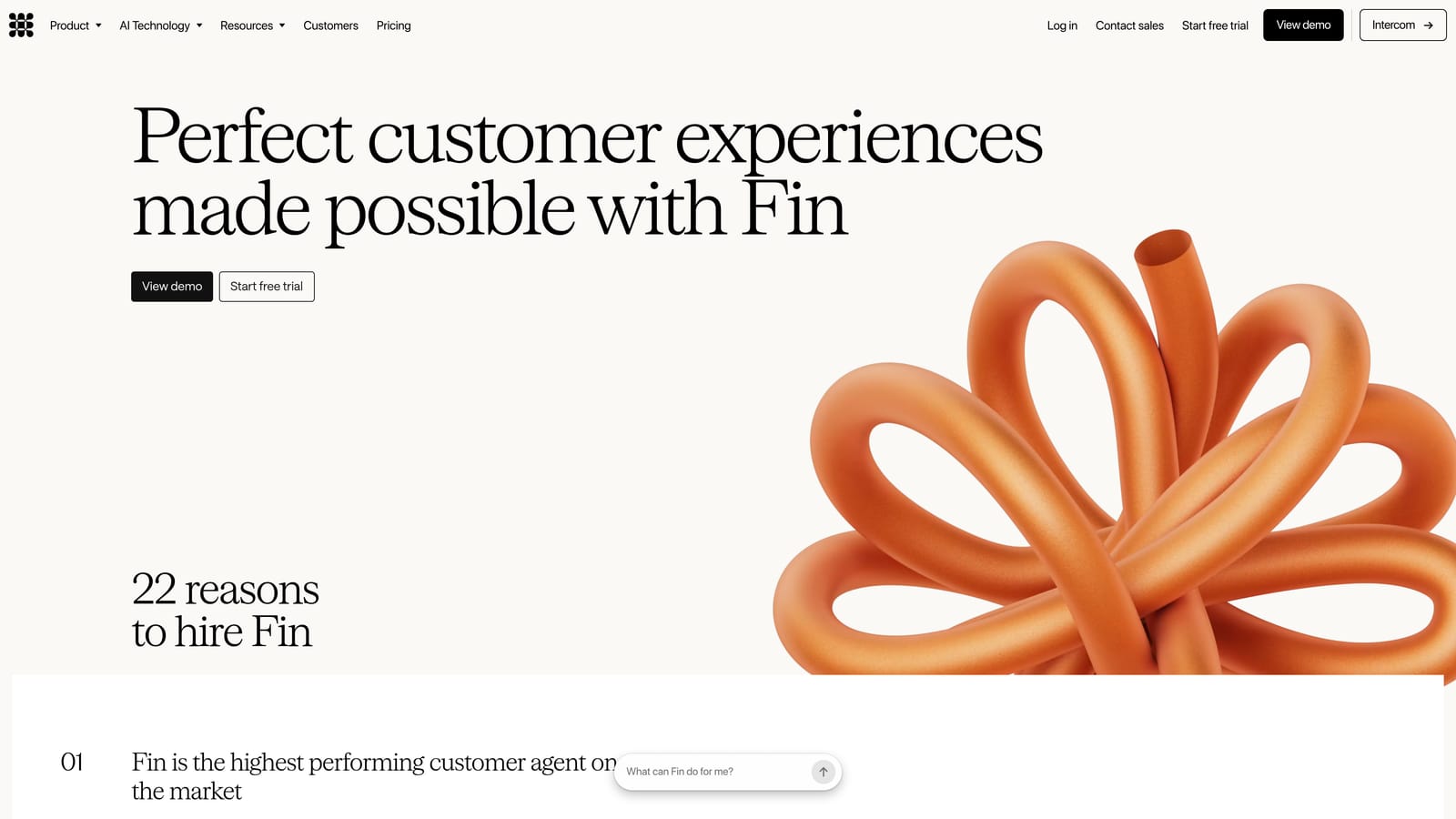
Intercom Fin is Intercom's AI agent built on its messenger platform, known for strong resolution rates on SaaS support queries with access to Intercom's People and Company records.
Where This Tool Shines
Fin's strength is its depth within the Intercom ecosystem. It accesses People and Company records natively, giving it contact-level context at the conversation level without any additional configuration. For SaaS teams with established Intercom workflows, Fin slots in without disrupting what's already working.
Fin 2 expanded autonomous action capabilities — the agent can now trigger ticket actions and workflow automations, not just surface suggested responses. The per-resolution pricing model is worth scrutinizing carefully at scale, but for teams with moderate volumes, it can be cost-effective compared to seat-based alternatives.
Key Features
Intercom People and Company Record Access: Reads contact and company CRM data natively at the conversation level for contextual responses.
External CRM Connections: API-based integrations with Salesforce and HubSpot extend CRM context beyond Intercom's native records.
Autonomous Actions in Fin 2: Supports ticket actions and workflow triggers, moving beyond suggestion-only AI into autonomous resolution territory.
Per-Resolution Pricing: Charges per successful AI resolution rather than per seat, which aligns cost with value but requires careful volume forecasting.
Best For
SaaS support teams already using Intercom who want to layer AI resolution on top of existing workflows. Teams not on Intercom would need to evaluate whether the platform switch is justified by Fin's capabilities alone.
Pricing
Per-resolution pricing model; full details at intercom.com. Costs can scale significantly at high ticket volumes.
5. Freshdesk Freddy AI
Best for: Mid-market teams standardized on the Freshworks product suite
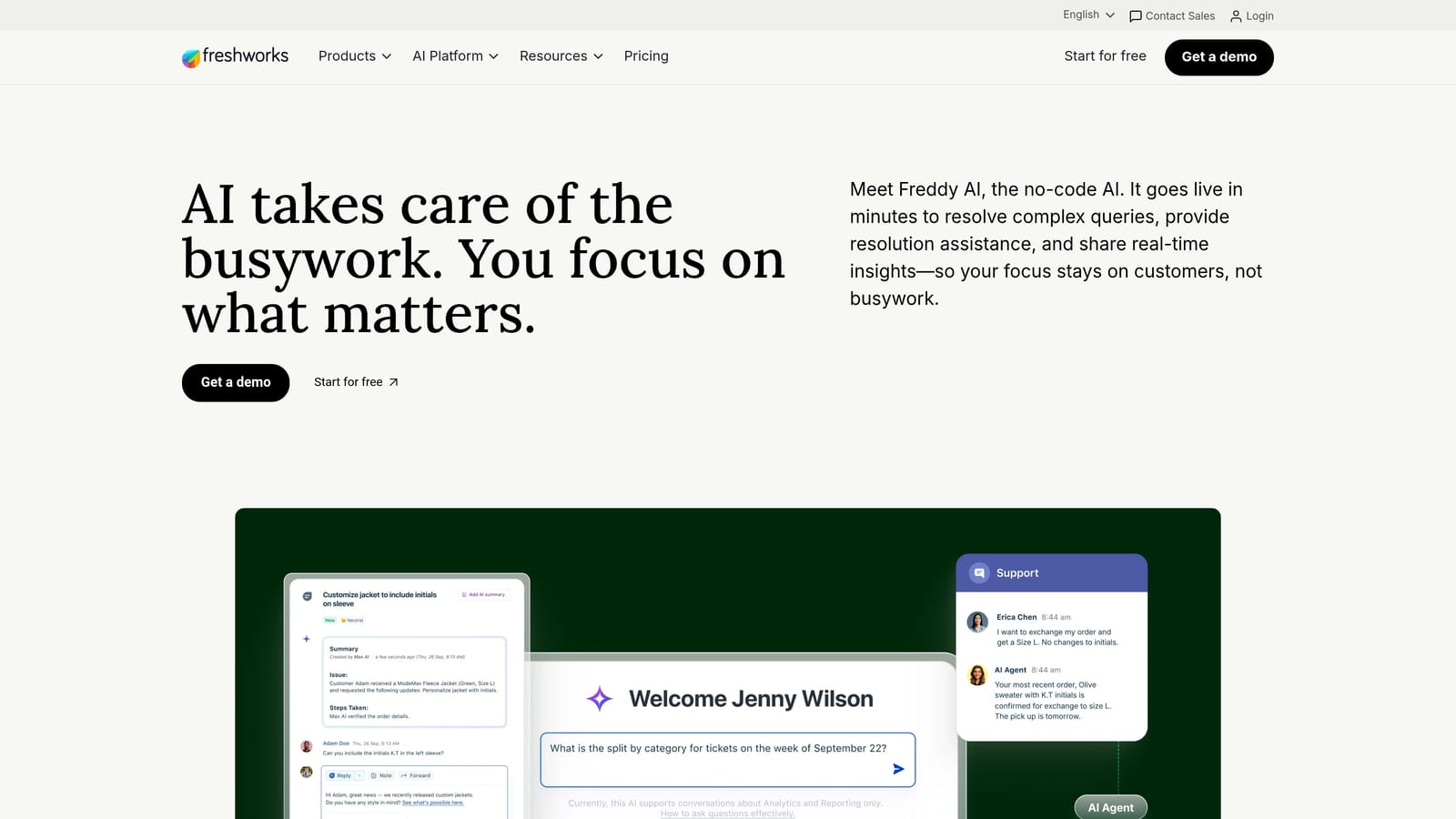
Freshdesk Freddy AI is Freshworks' AI layer spanning Freshdesk (support), Freshsales (CRM), and Freshchat (messaging) — providing cross-suite intelligence for teams using multiple Freshworks products together.
Where This Tool Shines
Freddy's value proposition is strongest when you're using multiple Freshworks products. The cross-suite data access means a support agent in Freshdesk can draw on CRM context from Freshsales and conversation history from Freshchat without any external integration work. That's a meaningful efficiency advantage for mid-market teams that have standardized on the Freshworks ecosystem.
Freddy Agent Assist (for human agents) and Freddy Self Service (for end users) address different parts of the support workflow, giving teams flexibility to deploy AI where it has the most impact. Pricing is competitive relative to Salesforce and HubSpot enterprise tiers, which matters for teams managing tight software budgets.
Key Features
Cross-Suite Data Access: Draws on data from Freshdesk, Freshsales, and Freshchat when multiple products are in use, creating a unified customer context layer.
Freddy Agent Assist: Provides AI-powered suggestions, summaries, and next-best-action guidance to human agents during live interactions.
Freddy Self Service: AI agent for end-user self-service resolution, reducing ticket volume before it reaches the human queue.
CRM-Aware Routing: Routes tickets based on CRM data such as account tier, deal stage, or customer segment for prioritized handling.
Best For
Mid-market B2B teams using Freshworks products for both CRM and support. If your CRM is Salesforce or HubSpot, Freddy's cross-suite advantage diminishes and other options may serve you better.
Pricing
Included in select Freshworks plans; pricing varies by product and tier. Full details at freshworks.com.
6. Zendesk AI
Best for: High-volume support operations with established Zendesk workflows
Zendesk AI is Zendesk's AI capability layer embedded across its support suite — including intelligent triage, routing, and AI agents — with access to Zendesk's native CRM layer.
Where This Tool Shines
Zendesk's AI capabilities are built for scale. Intelligent triage and routing use ticket history and CRM context to prioritize and direct incoming volume efficiently, which is where Zendesk tends to outperform lighter-weight tools. For teams processing thousands of tickets per week, that routing intelligence alone can meaningfully reduce resolution time.
The integration with Zendesk Sell provides a CRM context layer for support interactions, though teams whose primary CRM is Salesforce or HubSpot will need to manage that connection separately. The advanced AI capabilities are available as an add-on to Suite plans, so teams should factor that into total cost of ownership calculations.
Key Features
Intelligent Triage and Routing: Uses CRM data, ticket history, and intent signals to automatically prioritize and route incoming tickets to the right queue or agent.
AI Agents for Self-Service: Handles routine queries autonomously with access to knowledge base content and CRM context, reducing load on the human team.
Zendesk Sell Integration: Connects support interactions with Zendesk's CRM layer for unified customer context across sales and support touchpoints.
Advanced AI Add-On: Enhanced AI capabilities available as an add-on to existing Zendesk Suite plans for teams needing deeper automation.
Best For
Large support teams with high ticket volumes that are already invested in Zendesk. The platform's scale and routing sophistication are most valuable when you're managing complex, high-volume support operations.
Pricing
Advanced AI is available as an add-on to Zendesk Suite plans. Pricing details at zendesk.com.
7. Drift by Salesloft
Best for: Revenue and sales teams using AI for pipeline acceleration and inbound qualification
Drift by Salesloft is Salesloft's AI-powered conversation platform focused on revenue acceleration — with CRM-aware routing and qualification for sales-led B2B teams.
Where This Tool Shines
Drift's CRM integration is purpose-built for sales conversations, not support. Deal-stage-aware routing uses Salesforce and HubSpot data to ensure the right conversation happens with the right prospect at the right moment in the pipeline. For revenue teams running account-based programs, that contextual awareness translates directly into better conversion rates.
Since Drift's acquisition by Salesloft, the platform has become more deeply integrated into the broader revenue workflow — connecting AI conversation data with sales engagement, forecasting, and pipeline management. Teams looking primarily for customer support automation should look elsewhere, but for sales-led B2B teams, Drift's CRM depth is genuinely useful.
Key Features
Deal-Stage-Aware Routing: Reads Salesforce and HubSpot CRM data to route inbound conversations based on deal stage, account tier, or segment.
AI Qualification and Conversation Handling: Qualifies inbound leads and handles initial conversations autonomously before routing to sales reps.
ABM Playbooks: Triggers targeted conversation playbooks based on CRM account segments for account-based marketing programs.
Salesloft Platform Integration: Connects AI conversation data with Salesloft's revenue engagement, forecasting, and pipeline management tools.
Best For
Sales-led B2B teams using Salesforce or HubSpot who want AI to handle inbound qualification and pipeline acceleration. Not designed as a primary customer support tool.
Pricing
Contact Salesloft for pricing; details at salesloft.com.
8. Kustomer
Best for: Teams wanting a unified CRM and customer service platform with AI built throughout
Kustomer is a CRM-native customer service platform where AI operates on a unified customer timeline — combining order history, past interactions, and CRM data in a single view rather than isolated tickets.
Where This Tool Shines
The unified customer timeline is Kustomer's defining feature. Instead of treating each support interaction as an isolated ticket, Kustomer's AI operates on the full customer record: every interaction, transaction, and CRM data point in one place. That context depth allows for more intelligent, personalized responses without agents needing to manually pull information from multiple systems.
For teams frustrated by the fragmentation of having a separate CRM, helpdesk, and AI tool, Kustomer offers a genuine consolidation play. The trade-off is platform lock-in — if your CRM is Salesforce or HubSpot, you'd be replacing it, not integrating with it.
Key Features
Unified Customer Timeline: Combines CRM records, support history, and transaction data in a single view that AI agents can act on holistically.
AI Agents with Full Customer Context: AI operates on the complete customer record rather than individual tickets, enabling more contextually accurate responses.
Automated Workflows on CRM Data Changes: Triggers support workflows automatically when CRM data changes — for example, when a subscription status updates or a renewal is approaching.
CRM and Support in One Platform: Eliminates the need for a separate CRM and helpdesk, reducing integration complexity for teams willing to consolidate.
Best For
Teams that want to consolidate CRM and customer service in one platform and layer AI throughout. Less suitable for organizations with deep existing investments in Salesforce, HubSpot, or other CRM platforms they want to keep.
Pricing
Per-agent, per-month pricing; contact Kustomer for enterprise rates at kustomer.com.
9. Tidio Lyro
Best for: Early-stage and lean teams wanting accessible AI support with basic CRM connectivity
Tidio Lyro is an SMB-accessible AI agent with integrations into HubSpot, Pipedrive, and Shopify — offering an affordable entry point for smaller teams that need AI-assisted support without enterprise-level complexity.
Where This Tool Shines
Lyro makes AI-assisted support accessible for teams that can't yet justify the cost or operational overhead of enterprise platforms. The integrations with HubSpot, Pipedrive, and Shopify cover the most common stacks for early-stage B2B and e-commerce teams, and the setup process is designed to be lightweight rather than requiring a dedicated implementation project.
It's worth being clear-eyed about the trade-offs: Lyro's CRM write-back capabilities are more limited than enterprise tools, and the depth of autonomous action is shallower than what you'd get from Agentforce or Halo AI. But for teams where the alternative is no AI support at all, Lyro provides genuine value at a price point that fits early-stage budgets.
Key Features
HubSpot, Pipedrive, and Shopify Integrations: Out-of-the-box connections to the most common SMB CRM and commerce platforms without custom development.
Lyro AI Conversation Handling: Handles customer conversations with access to connected CRM contact data for basic personalization and context.
Accessible Pricing: Free tier available; paid plans start at SMB-friendly price points that scale with usage rather than requiring large upfront commitments.
Live Chat and AI in One Interface: Combines AI automation and live agent chat in a single platform, reducing tool sprawl for lean teams.
Best For
Startups and lean support teams that want AI-assisted support with basic CRM connectivity and can't yet justify enterprise pricing. As teams scale and require deeper CRM write-back or autonomous action capabilities, they'll likely outgrow Lyro.
Pricing
Free tier available; paid plans at SMB-accessible pricing. Full details at tidio.com.
Which Tool Is Right for Your Stack?
The right choice here depends less on which tool has the most features and more on where your CRM already lives and how deeply you need the AI to interact with it.
If your organization runs on Salesforce, Agentforce is the most natural fit — native access to every CRM object with no integration overhead. Teams using HubSpot as their primary platform will find Breeze the path of least resistance, with AI that operates on unified data without any sync configuration. Intercom users get the most from Fin, particularly if Intercom's People and Company records are already your source of truth for customer context.
For Freshworks shops, Freddy AI's cross-suite intelligence is most valuable when you're using Freshdesk, Freshsales, and Freshchat together. High-volume Zendesk operations benefit most from staying in-platform with Zendesk AI's triage and routing capabilities. Sales-led teams focused on pipeline acceleration rather than support should evaluate Drift. Teams wanting to consolidate CRM and support into one platform should look at Kustomer. And lean startups needing an affordable starting point with basic CRM connectivity will find Tidio Lyro a practical entry point.
For B2B SaaS teams that need AI agents connecting support, CRM, product, and billing data in one place — with business intelligence built in — Halo AI is built specifically for that. The combination of page-aware context, smart inbox intelligence, and native integrations across HubSpot, Stripe, Linear, and Intercom means your support layer becomes a strategic asset, not just a ticket queue.
Your support team shouldn't scale linearly with your customer base. Let AI agents handle routine tickets, guide users through your product, and surface business intelligence while your team focuses on complex issues that need a human touch. See Halo in action and discover how continuous learning transforms every interaction into smarter, faster support.