9 Best AI Agents for Software Companies in 2026
Discover the 9 best AI agents for software companies in 2026, evaluated on what matters most to technical teams—developer tool integrations, complex query handling, and product-led workflow compatibility. This guide helps software businesses move beyond scripted chatbots to autonomous systems that resolve sophisticated customer issues, adapt to rapid product changes, and deliver actionable intelligence back to the teams building the product.
 Grant CooperFounder12 min read
Software companies face a support challenge unlike any other. Their customers are technically sophisticated, their products evolve constantly, and a single feature release can trigger a wave of tickets that overwhelms even a well-staffed support team. Traditional helpdesks and scripted chatbots weren't built for this pace. They require constant manual updates, can't reason through complex product questions, and offer no intelligence back to the teams building the product.
AI agents change that equation. These are autonomous systems that understand context, take real actions, and improve with every interaction. But the market has matured quickly, and not every platform is designed with software companies in mind. We evaluated the field based on what actually matters to software teams: integration depth with developer tools, ability to handle technical queries, learning capabilities, and how well they fit into product-led workflows.
Here are the top AI agents for software companies in 2026.
1. Halo AI
Best for: Software companies wanting an AI-first support platform with deep developer tool integrations and continuous learning
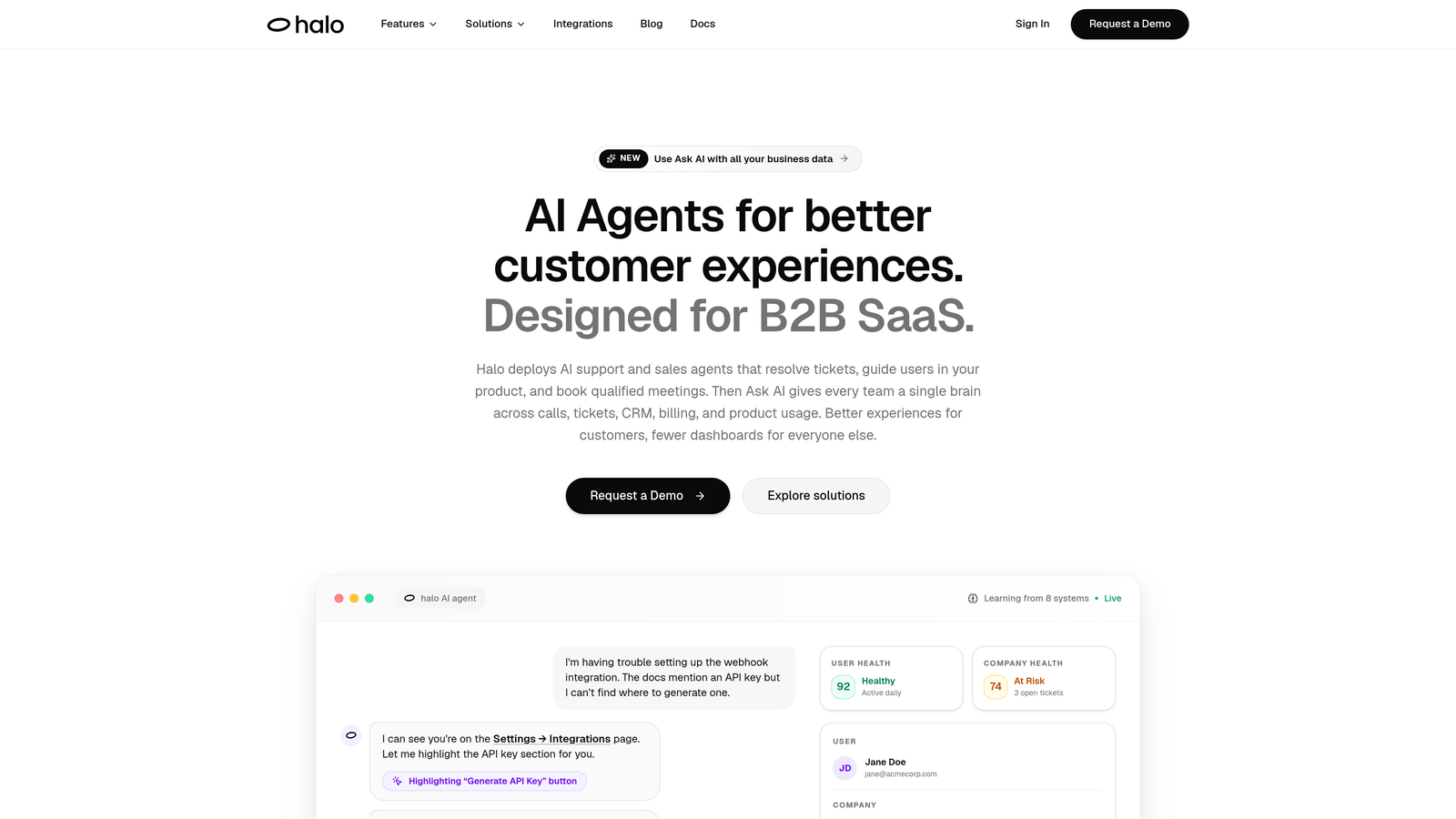
Halo AI is an AI-first customer support platform built specifically for software companies, featuring page-aware context, automatic bug ticket creation, and a smart inbox that surfaces business intelligence from every support interaction.
Where This Tool Shines
Most AI support tools are built on top of existing helpdesk infrastructure. Halo was designed from the ground up with an AI-first architecture, which means intelligence isn't a bolt-on feature — it's the foundation. The platform's page-aware chat widget is a standout: it understands what screen a user is on and can provide visual UI guidance rather than generic text instructions. That's a meaningful difference when your customers are troubleshooting a complex configuration screen at 11pm.
The continuous learning engine is equally notable. Rather than requiring manual retraining every time your product ships new features, Halo learns from every resolved interaction automatically. For software companies that ship frequently, this means the AI stays current without creating extra work for your team.
Key Features
Page-Aware Chat Widget: Understands the user's current screen context and delivers visual UI guidance, not just text-based answers.
Auto Bug Ticket Creation: Automatically files bug reports directly into Linear, Jira, and other developer tools when support conversations surface product issues.
Continuous Learning: Improves from every resolved ticket without requiring manual retraining, staying current as your product evolves.
Smart Inbox with Business Intelligence: Goes beyond support metrics to surface customer health signals, revenue intelligence, and anomaly detection from conversation data.
Full Business Stack Integrations: Connects to Linear, Slack, HubSpot, Intercom, Stripe, Zoom, PandaDoc, and Fathom for a unified workflow.
Best For
Product-led software companies that want their support layer to feed intelligence back to the product and revenue teams. Particularly well-suited for teams that are tired of manually filing bug tickets and want their AI to take real action, not just answer questions.
Pricing
Contact for pricing; plans scale based on resolution volume, making it flexible for growing software companies at different stages.
2. Intercom Fin
Best for: Teams already using Intercom who want a native AI agent without switching platforms
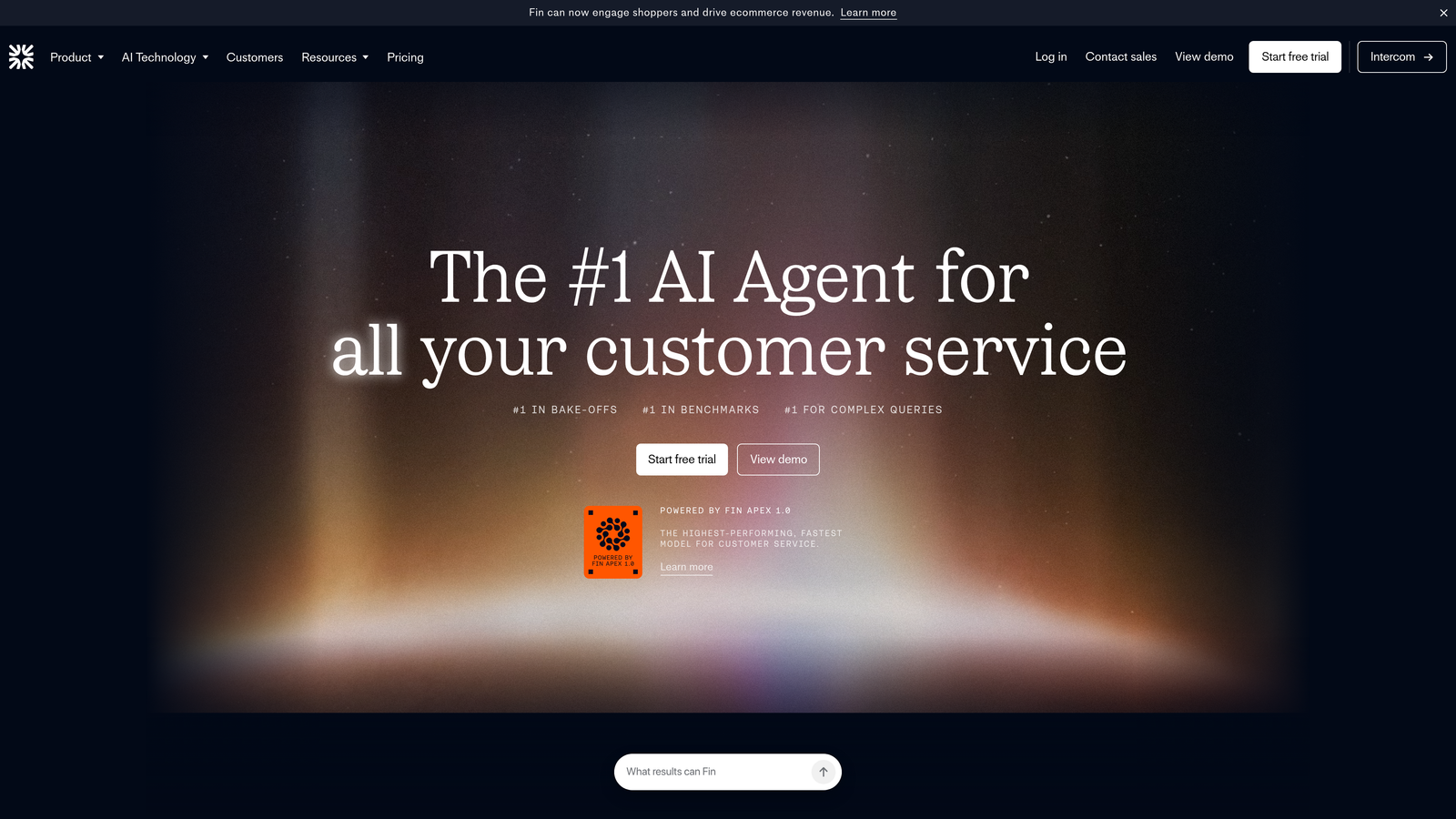
Intercom Fin is Intercom's native AI agent that resolves support questions using your help center, conversation history, and custom data sources, deeply integrated into the Intercom messenger experience.
Where This Tool Shines
If your team is already living inside Intercom, Fin is the path of least resistance to AI-powered support. It draws on your existing help center content and conversation history without requiring a separate integration layer. The setup experience is genuinely smooth for Intercom users.
Fin AI Copilot adds another dimension by assisting human agents in real time with suggested replies and relevant context surfaced during live conversations. For teams handling complex technical escalations, this can meaningfully speed up resolution time.
Key Features
Native Intercom Integration: Built directly into Intercom's messenger, inbox, and help center with no separate setup required.
Custom Actions via Workflows: Can trigger API integrations and workflows to take actions beyond answering questions.
Multilingual Support: Handles conversations in multiple languages out of the box without additional configuration.
Fin AI Copilot: Assists human agents with suggested replies and surfaced context during live support conversations.
Best For
Software companies already using Intercom as their primary support and messaging platform who want to add AI resolution capabilities without introducing a new vendor relationship.
Pricing
Usage-based pricing per resolution; requires an active Intercom subscription. Costs scale with resolution volume, so high-traffic teams should model this carefully.
3. Zendesk AI Agents
Best for: Enterprise software companies running support operations on the Zendesk platform
Zendesk AI Agents are enterprise-grade AI capabilities built into the Zendesk platform, offering automated ticket resolution, intelligent triage, and agent assistance across all Zendesk channels.
Where This Tool Shines
Zendesk's AI benefits from the platform's long history in enterprise support. The intent detection models are pre-trained on a large volume of support interactions, which means out-of-the-box performance is often stronger than platforms requiring extensive custom training. For organizations with complex SLA requirements and multi-channel support operations, Zendesk AI fits naturally into existing workflows.
The agent assist capabilities are practical: AI-generated reply suggestions and knowledge surfacing help human agents respond faster without toggling between multiple tools.
Key Features
Pre-Trained Intent Detection: Models trained on a broad corpus of support interactions for strong out-of-the-box accuracy.
Automated Ticket Routing: Intelligent triage, prioritization, and SLA management across ticket queues.
Agent Assist: AI-generated reply suggestions and knowledge article surfacing during live agent conversations.
Omnichannel Coverage: Supports email, chat, voice, and social channels within the Zendesk ecosystem.
Best For
Mid-market to enterprise software companies with established Zendesk deployments and complex multi-channel support operations where switching platforms isn't practical.
Pricing
AI agents available as an add-on to Zendesk Suite plans with usage-based resolution pricing. Enterprise contracts typically involve custom negotiation.
4. Ada
Best for: Companies needing omnichannel AI automation with strong multilingual capabilities
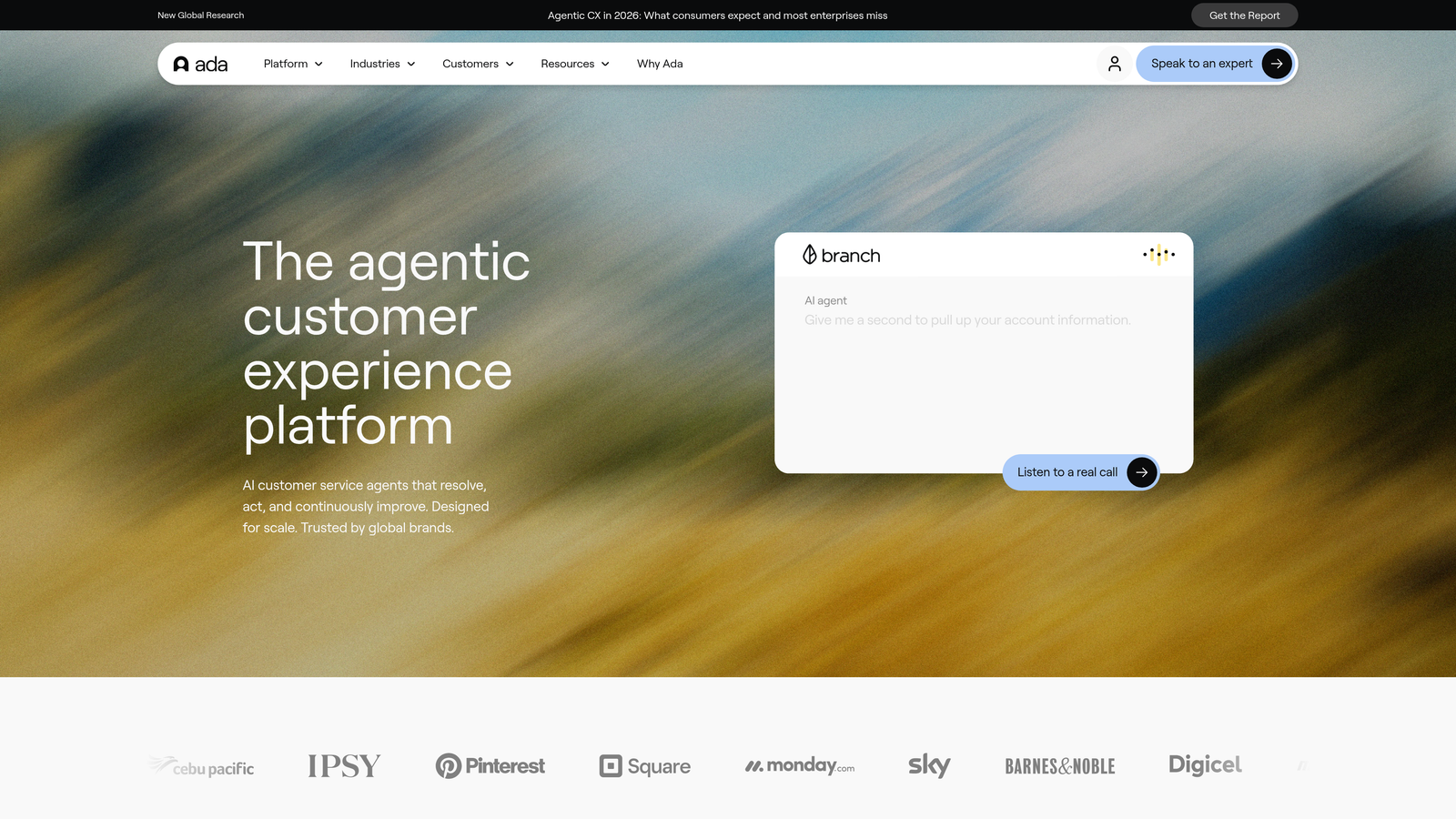
Ada is an AI-powered customer service automation platform with a reasoning engine designed to handle complex, multi-step queries across channels and languages without requiring engineering involvement to customize.
Where This Tool Shines
Ada's reasoning engine is its core differentiator. Rather than matching queries to scripted responses, it breaks down complex questions into resolution paths and works through them step by step. This matters for software companies whose customers often ask layered technical questions that don't fit neatly into a single FAQ answer.
The no-code customization layer means support and product teams can adjust AI behavior without filing engineering tickets. That independence is valuable when your product is shipping fast and your AI needs to keep up.
Key Features
Reasoning Engine: Breaks complex multi-part queries into step-by-step resolution paths rather than matching to static responses.
No-Code Customization: Build and adjust AI agent behavior without engineering involvement.
Omnichannel Coverage: Operates across web chat, mobile, social messaging, email, and SMS from a single platform.
Multilingual Support: Handles 50+ languages with automatic detection and switching.
Best For
Software companies with global customer bases and complex product questions that require reasoning rather than simple lookup. Strong fit for teams that want non-technical staff to manage AI behavior.
Pricing
Custom enterprise pricing based on resolution volume and channels. Requires a sales conversation to get a quote.
5. Forethought
Best for: Support teams that want AI across the entire ticket lifecycle, from intake to resolution
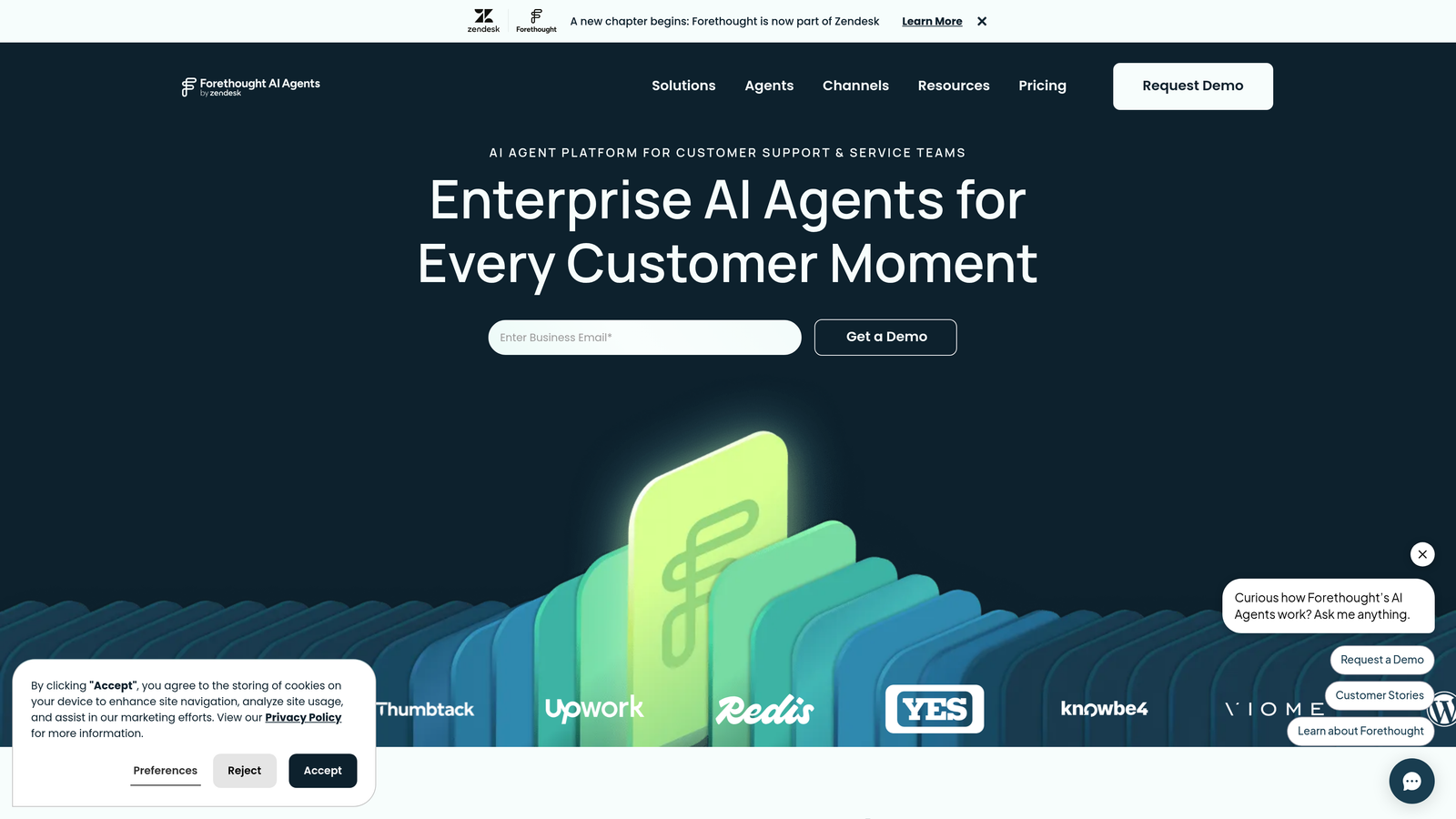
Forethought is an AI platform that combines customer-facing resolution (Solve), intelligent triage (Triage), and agent assistance (Assist) to optimize the full support pipeline rather than just one part of it.
Where This Tool Shines
Most AI support tools focus on the customer-facing layer. Forethought goes deeper by optimizing what happens after a ticket enters the queue. Its Triage module classifies and routes tickets based on intent and sentiment, which reduces the manual overhead of queue management for support leads.
The modular structure is useful for teams that want to adopt AI incrementally. You can start with Triage to improve routing, add Assist to help agents respond faster, and layer in Solve for full automation as confidence builds.
Key Features
Solve: Customer-facing AI that autonomously resolves common queries before they reach a human agent.
Triage: Intelligent ticket classification and routing based on detected intent and sentiment signals.
Assist: Real-time AI suggestions for human agents during complex conversations.
Helpdesk Integrations: Connects with Zendesk, Salesforce, and other major helpdesk platforms.
Best For
Support operations teams at mid-market software companies who want end-to-end AI optimization across the ticket lifecycle, particularly those already using Zendesk or Salesforce Service Cloud.
Pricing
Custom pricing based on ticket volume and which modules are selected. Modular structure means you can start smaller and expand.
6. Freshdesk Freddy AI
Best for: Budget-conscious software teams wanting AI features bundled into an affordable helpdesk
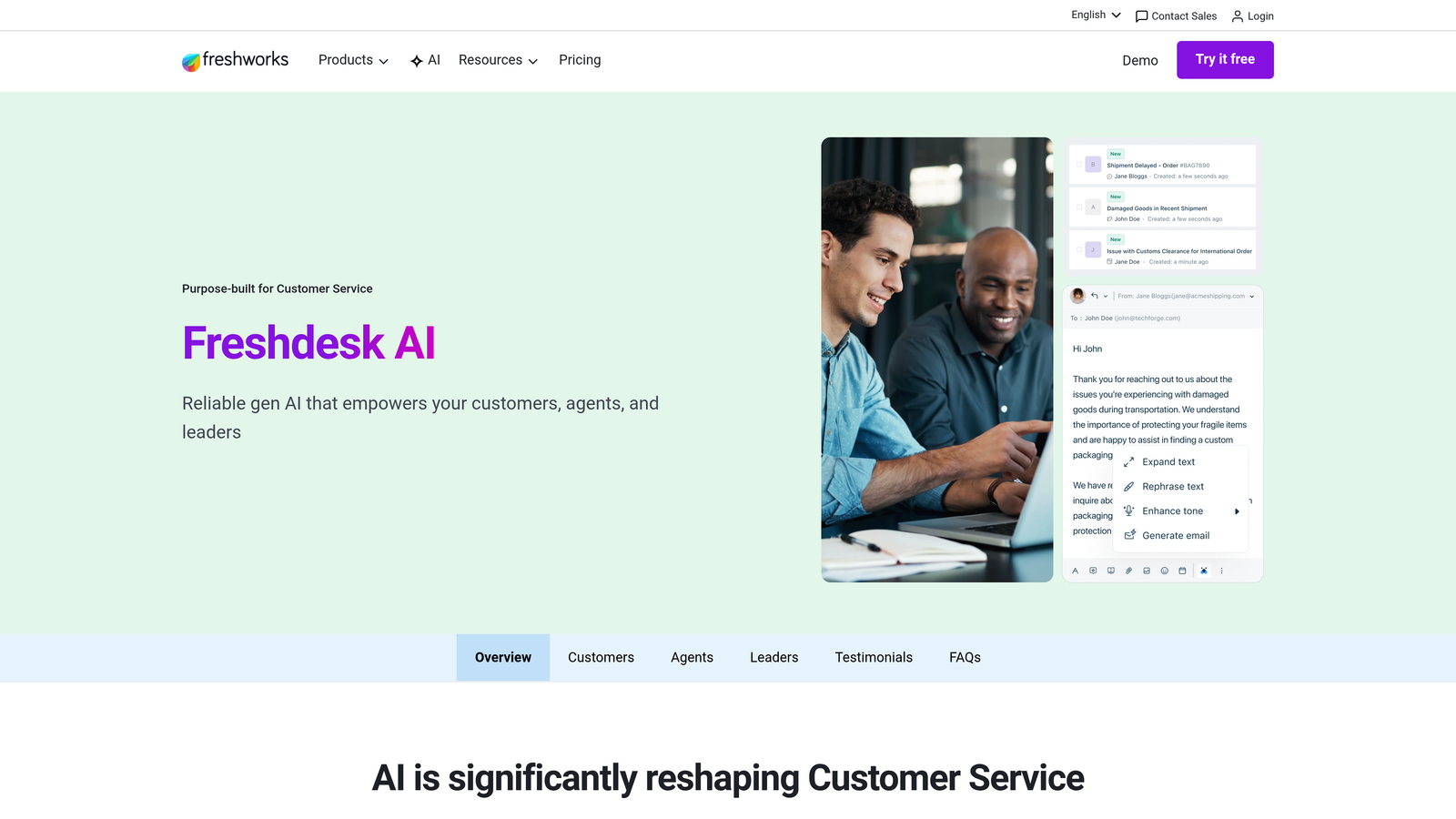
Freshdesk Freddy AI is Freshworks' built-in AI agent offering automated responses, agent copilot capabilities, and analytics within a helpdesk suite known for competitive pricing.
Where This Tool Shines
Freddy AI's strongest argument is value. For software companies that need a capable helpdesk with AI features and don't want to pay enterprise pricing, Freshdesk bundles AI capabilities into plans that are accessible for smaller teams. The trade-off is depth: Freddy is solid across the board but rarely best-in-class in any single capability.
The Freddy Copilot features for human agents are genuinely useful: tone adjustment, reply drafts, and knowledge suggestions reduce the time agents spend on routine composition tasks.
Key Features
AI Auto-Responses: Automated responses and ticket summarization built directly into Freshdesk workflows.
Freddy Copilot: Assists agents with tone adjustment, reply drafting, and knowledge article suggestions during live conversations.
Built-In Analytics: Reporting on AI performance and deflection rates without requiring a separate analytics tool.
Bundled Pricing: AI capabilities included in Pro and Enterprise plans rather than charged as a separate add-on.
Best For
Early-stage to mid-size software companies that want AI-assisted support without the complexity or cost of enterprise platforms. Good fit for teams that are new to AI support and want to start with something approachable.
Pricing
Included in Freshdesk Pro and Enterprise plans; additional AI credits available for higher usage volumes. Generally one of the more affordable options in this list.
7. Decagon
Best for: Enterprise software companies that need AI to take real backend actions, not just answer questions
Decagon is an enterprise AI agent platform designed for companies whose support workflows require the AI to actually do things: process refunds, update account records, trigger API calls, and execute complex multi-step resolution processes autonomously.
Where This Tool Shines
The distinction between AI that answers and AI that acts is significant. Decagon sits firmly in the "acts" category. Its agentic architecture allows it to connect to internal systems and databases, then take meaningful actions based on what it finds. For software companies with complex subscription management, billing workflows, or account provisioning processes, this capability can deflect a category of tickets that most AI tools simply hand off to humans.
Enterprise security and compliance features are built in, which matters for software companies operating in regulated industries or with enterprise customers who have strict vendor requirements.
Key Features
Agentic Architecture: AI can process refunds, update account records, and trigger API calls autonomously without human intervention.
Custom Workflow Builder: Design complex multi-step resolution processes tailored to your specific business logic.
Deep Backend Integrations: Connects to internal systems and databases, not just surface-level helpdesk integrations.
Enterprise Security: Compliance and data governance features for organizations with strict security requirements.
Best For
Enterprise software companies with complex support workflows that involve backend system actions, particularly those in regulated industries or with sophisticated subscription and billing processes.
Pricing
Custom enterprise pricing; a sales conversation is required to get a quote. Positioned at the higher end of the market.
8. Tidio Lyro
Best for: Early-stage software companies that need AI support up and running quickly with minimal investment
Tidio Lyro is a lightweight conversational AI agent designed for small-to-mid-size businesses, offering fast setup and accessible pricing that makes AI support practical for companies that aren't ready for enterprise platforms.
Where This Tool Shines
Lyro's setup experience is genuinely fast. Point it at your help center or FAQ content and it's operational in minutes, not weeks. For early-stage software companies where the support team might be one person wearing multiple hats, that speed matters. There's no lengthy implementation project, no professional services engagement, and no complex configuration required.
The multi-turn dialogue handling is better than you'd expect at this price point. Lyro can follow up on its own answers and handle clarifying questions without losing context, which keeps conversations from dead-ending.
Key Features
Fast Setup: Operational within minutes by pointing Lyro at existing help center or FAQ content.
Multi-Turn Dialogue: Handles follow-up questions and maintains context across conversational turns.
Live Chat Handoff: Smoothly transfers to a human agent when queries exceed AI capabilities.
Accessible Pricing: Free tier available with paid plans that don't require enterprise budget approval.
Best For
Early-stage and bootstrapped software companies that need a functional AI support layer quickly and affordably, without the complexity of enterprise platforms.
Pricing
Free tier available; paid plans start at approximately $29/month, making it one of the most accessible entry points in this category.
9. Cognigy
Best for: Large software companies with complex voice and chat support needs and strict compliance requirements
Cognigy is an enterprise conversational AI platform with advanced voice capabilities, LLM orchestration, and compliance features designed for large organizations managing complex, multi-channel support operations.
Where This Tool Shines
Cognigy's voice AI capabilities set it apart from most tools on this list. While the majority of AI support platforms focus on chat, Cognigy handles phone-based support with genuine sophistication. For software companies with enterprise customers who still expect phone support, this is a meaningful differentiator.
The LLM orchestration layer is architecturally interesting: rather than committing to a single AI model, Cognigy can combine multiple models to optimize for different types of queries. This flexibility gives large organizations more control over quality and cost as AI model capabilities continue to evolve.
Key Features
Advanced Voice AI: Handles phone-based support alongside chat channels, not just text-based interactions.
LLM Orchestration: Combines multiple AI models to optimize response quality for different query types.
Enterprise Compliance: GDPR and SOC 2 compliance features with robust data governance controls.
Multi-Bot Architecture: Manage specialized AI agents across different product lines or customer segments from a single platform.
Best For
Large software companies with enterprise customers, compliance requirements, and support operations that span voice and chat channels. Best suited for organizations with dedicated AI implementation resources.
Pricing
Enterprise pricing with custom quotes; contact sales for specifics. Implementation typically involves professional services engagement.
Which Tool Is Right for Your Software Company?
The right choice depends on where you are, what you already use, and what you need your AI to actually do.
If you're an early-stage company that needs something running this week, Tidio Lyro gets you there with minimal friction. If you're already deep in the Intercom or Zendesk ecosystem, Intercom Fin or Zendesk AI Agents are the natural extensions of what you already have. For teams that want AI to optimize the full ticket lifecycle rather than just the customer-facing layer, Forethought is worth a close look.
At the enterprise end, Decagon is the choice for companies whose support workflows require real backend actions, while Cognigy serves large organizations with voice support requirements and strict compliance needs.
For software companies that want something built specifically for how they work — with developer tool integrations, page-aware context, automatic bug ticket creation, and intelligence that feeds back to the product team — Halo AI is in a category of its own. It's the only platform on this list where the AI understands not just what a user is asking, but where they are in your product when they ask it.
Your support team shouldn't scale linearly with your customer base. Let AI agents handle routine tickets, guide users through your product, and surface business intelligence while your team focuses on complex issues that need a human touch. See Halo in action and discover how continuous learning transforms every interaction into smarter, faster support.