9 Best AI Chatbot Customer Support Platforms in 2026
This guide evaluates nine leading AI chatbot customer support platforms across five criteria — autonomous resolution capability, integration depth, learning mechanisms, pricing transparency, and B2B SaaS fit — covering both AI-first architectures and AI-augmented helpdesks. Whether you're building a support function from scratch or optimizing an existing stack, it surfaces the right platform for your team's maturity and goals.
 Matt PattoliFounder13 min read
AI chatbot platforms have quietly crossed a threshold: they're no longer a productivity experiment for forward-thinking teams. For B2B SaaS companies managing growing customer bases without proportionally growing headcount, they've become a core part of how support actually works. The question isn't whether to adopt one; it's which one fits your team's architecture, stack, and maturity.
This list covers platforms across two broad categories: AI-first architectures built around autonomous resolution, and AI-augmented helpdesks where AI capabilities have been layered onto traditional ticketing systems. Both have legitimate use cases, and the right choice depends on where you're starting from.
To put this list together, we evaluated platforms on five criteria: autonomous resolution capability, integration depth, learning and improvement mechanisms, pricing transparency, and fit for B2B and SaaS support workflows. Whether you're building a support function from scratch or looking to get more from an existing helpdesk investment, you'll find a relevant option here.
For a deeper look at how AI-first support compares to traditional helpdesk approaches, check out our AI customer support solutions page and our breakdown of Zendesk vs. a modern AI support platform.
1. Halo AI
Best for: B2B SaaS teams that want autonomous ticket resolution, product guidance, and business intelligence in one platform.
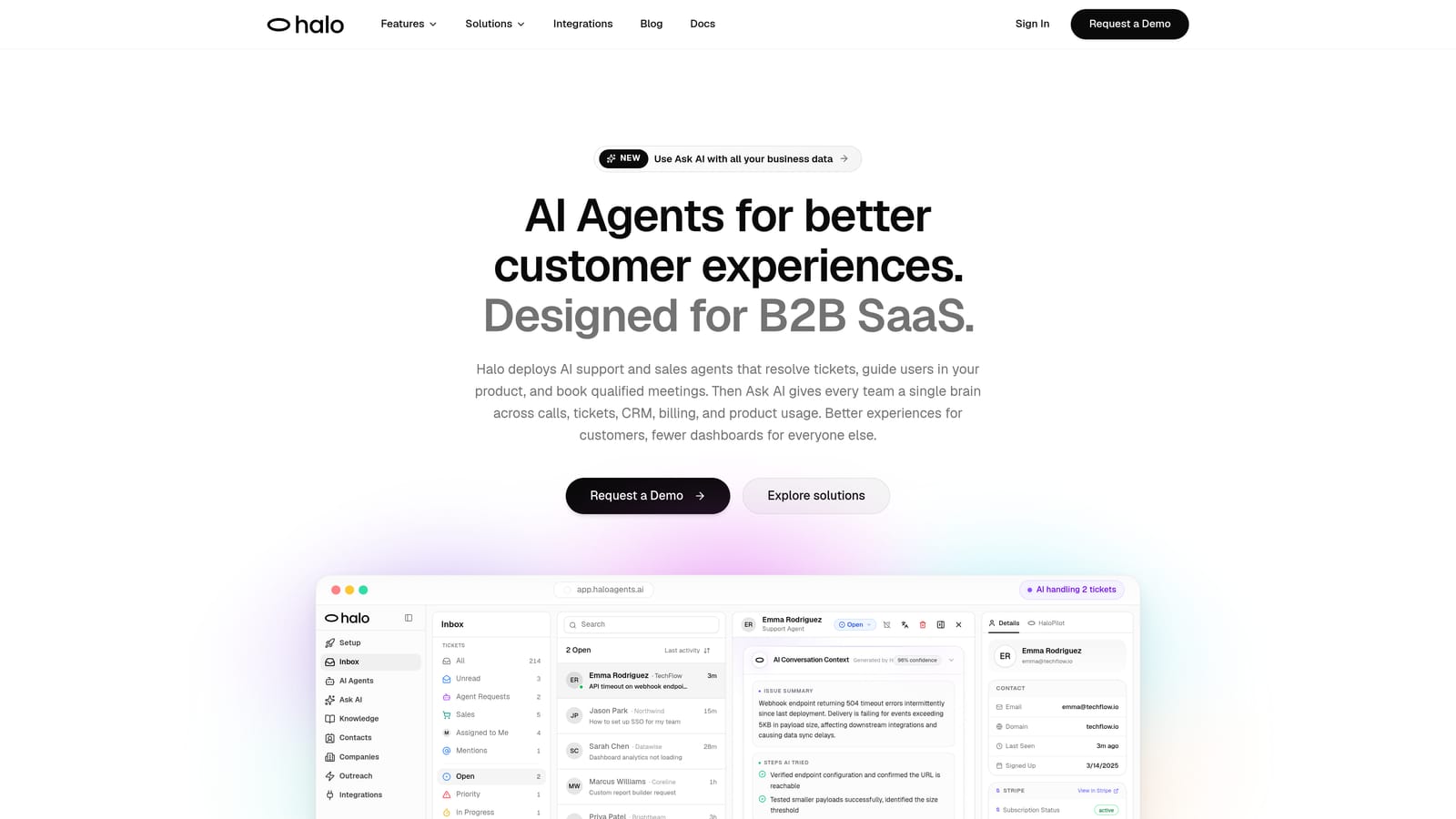
Halo AI is an AI-first customer support platform built specifically for B2B SaaS teams who need more than a chatbot sitting on top of a helpdesk.
Where This Tool Shines
Most AI support tools treat every conversation the same way: a user sends a message, the bot searches a knowledge base, and it either answers or escalates. Halo takes a different approach. Its page-aware architecture means the AI understands exactly which screen or feature the user is on when they reach out, allowing it to provide contextual, visual guidance rather than generic help center links.
Beyond resolving tickets, Halo surfaces intelligence from those conversations. Its smart inbox identifies customer health signals, revenue anomalies, and product feedback patterns, turning your support queue into a source of business insight rather than just a cost center to manage. For SaaS teams, that kind of signal is genuinely valuable.
Key Features
Page-Aware Chat Widget: The AI knows which screen the user is on and delivers contextual guidance, including visual cues, rather than one-size-fits-all responses.
Smart Inbox with Business Intelligence: Surfaces customer health signals, revenue anomalies, and product feedback patterns directly from support interactions.
Auto Bug Ticket Creation: Automatically logs recurring issues to Linear or other project management tools, closing the loop between support and engineering without manual triage.
Seamless Live Agent Handoff: When escalation is needed, full conversation context is preserved so human agents aren't starting from zero.
Continuous Learning: The platform learns from every resolved interaction, improving resolution quality over time rather than staying static.
Integration Ecosystem: Connects with Linear, Slack, HubSpot, Intercom, Stripe, Zoom, PandaDoc, and Fathom, covering the typical B2B SaaS stack.
Best For
Halo is a strong fit for product-led SaaS companies where the support team is expected to do more than close tickets. If you want AI that guides users through your product, flags churn signals, and feeds bugs back to engineering automatically, Halo is built for exactly that workflow. Less suited to teams that need a simple bolt-on to an existing helpdesk they're not ready to move away from.
Pricing
Contact Halo for pricing. The platform is positioned for B2B SaaS teams and enterprise buyers, so expect a conversation around your team size and use case rather than a self-serve checkout.
2. Intercom
Best for: SaaS teams already using Intercom who want AI resolution without switching platforms.
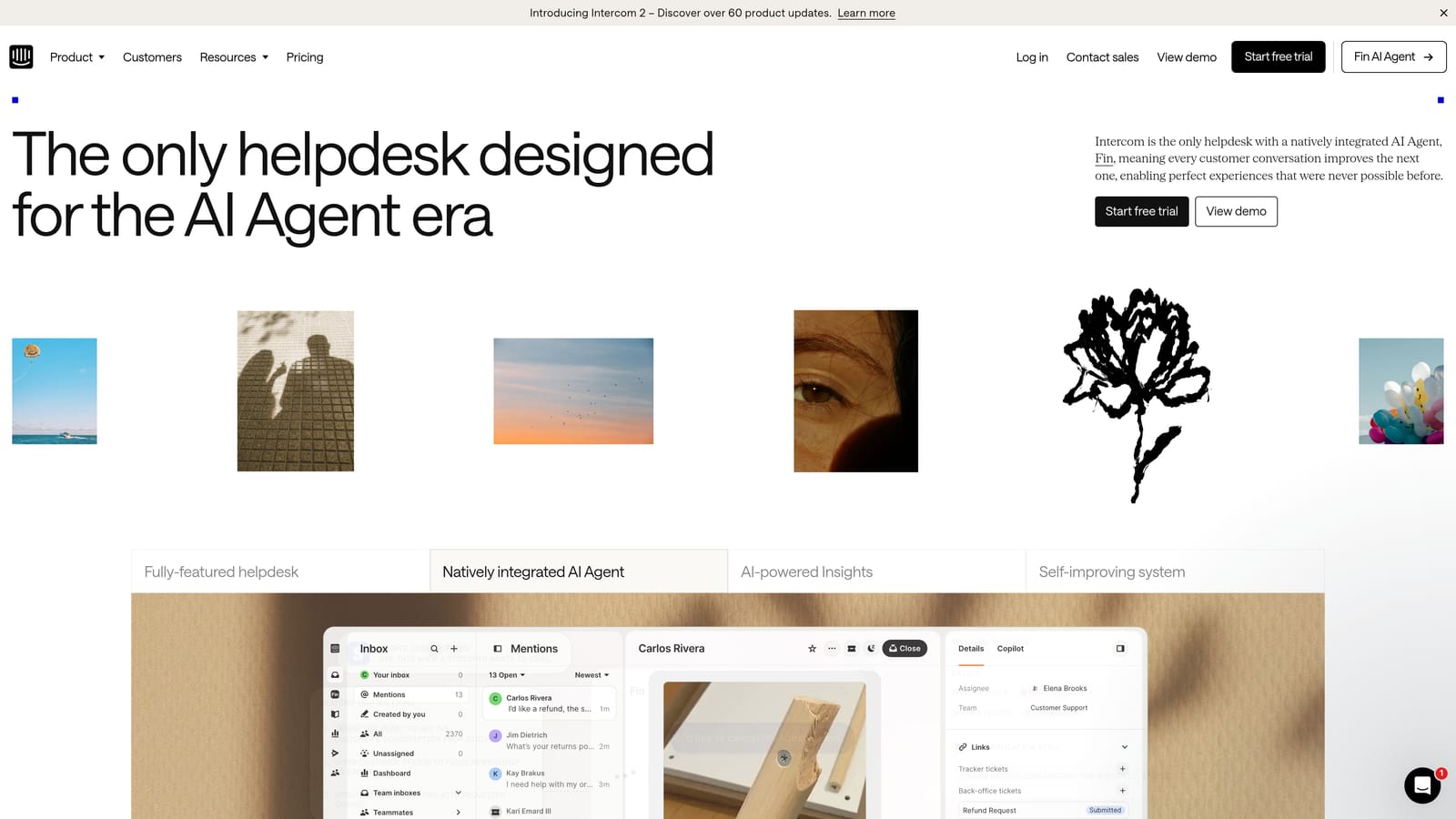
Intercom is a widely-adopted customer messaging platform whose AI agent, Fin, has become a flagship product for teams looking to automate common query resolution.
Where This Tool Shines
Fin is trained on your existing help center content, which means deployment can be relatively fast for teams that already have solid documentation. The in-messenger experience is polished, and the handoff from Fin to a human agent is among the smoother transitions you'll find in this category.
For teams already embedded in the Intercom ecosystem, adding Fin is a natural evolution rather than a migration. The tradeoff is that Intercom's pricing has increased significantly in recent years, and costs can climb quickly as your customer volume grows.
Key Features
Fin AI Agent: Ingests help center content and resolves common queries autonomously, with confidence-based escalation when needed.
Omnichannel Messaging: Covers chat, email, and in-app messaging from a single platform.
Human Handoff: Smooth escalation to live agents within the Intercom messenger, with conversation context intact.
Reporting and CSAT: Built-in analytics and customer satisfaction tracking without requiring a third-party reporting tool.
Best For
Teams that are already running Intercom as their primary support and messaging layer. If you're starting fresh and evaluating platforms without existing lock-in, it's worth comparing Intercom's total cost against AI-first alternatives, particularly as your volume scales.
Pricing
Seat-based plans start at approximately $39 per seat per month. Fin AI usage is billed per resolution, which means costs vary based on how much the AI actually handles.
3. Zendesk AI
Best for: Large enterprise support teams with existing Zendesk infrastructure who want AI-assisted triage and agent productivity.
Zendesk AI layers intelligent triage, intent detection, and agent assist capabilities onto the Zendesk Suite, targeting high-volume enterprise support operations.
Where This Tool Shines
Zendesk's AI capabilities are strongest in the agent productivity layer. Intelligent triage, sentiment detection, and macro suggestions help experienced agents work faster rather than replacing them entirely. For enterprise teams managing thousands of tickets per month across complex product lines, that kind of assist can meaningfully reduce handle time.
The knowledge base deflection bot can reduce ticket creation for common questions, but Zendesk's architecture is fundamentally ticket-centric. If your goal is proactive conversational AI or autonomous resolution without agent involvement, you may find the platform's AI feels more like a productivity enhancer than a resolution engine.
Key Features
Intelligent Triage: Automatically detects intent, sentiment, and urgency to route tickets to the right team or queue.
AI Macro Suggestions: Recommends response templates and macros to agents based on ticket content.
Automated Routing: Prioritizes and routes tickets without manual intervention.
Knowledge Base Deflection: Surfaces relevant articles before a ticket is formally submitted.
Best For
Enterprise support organizations already running Zendesk Suite who want AI gains without migrating to a new platform. Less ideal for teams looking for deep autonomous resolution or AI-first architecture from the ground up.
Pricing
Zendesk Suite starts at approximately $55 per agent per month. AI features are add-ons, which adds meaningful cost to an already substantial base plan investment.
4. Freshdesk Freddy AI
Best for: SMB and mid-market teams that want AI-assisted support within a more affordable helpdesk ecosystem.
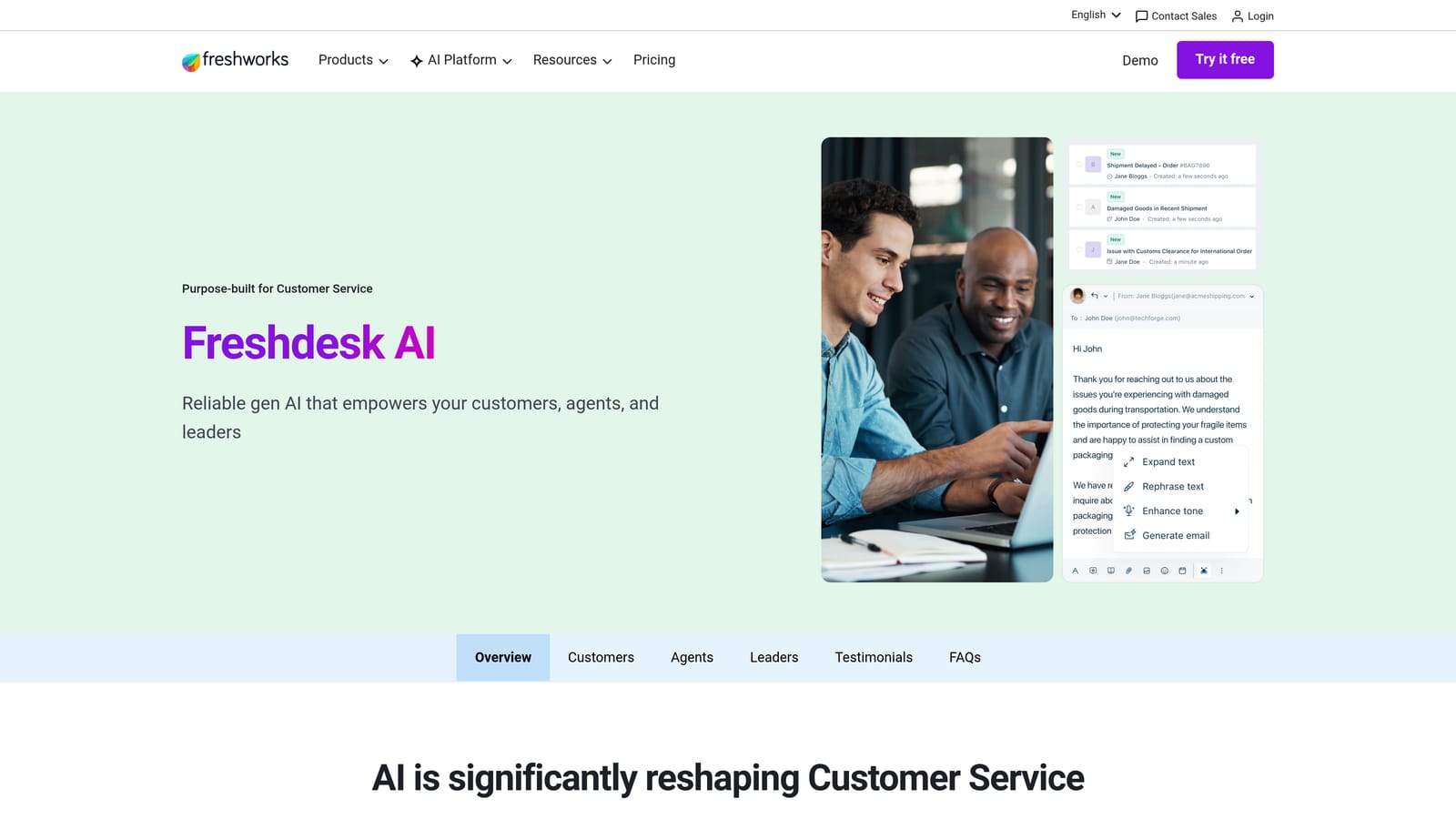
Freshdesk's Freddy AI includes both a customer-facing self-service bot and an agent copilot, built natively into the Freshdesk helpdesk environment.
Where This Tool Shines
Freddy's dual approach, handling both customer-facing deflection and agent-side assistance, gives teams flexibility in how they deploy AI. Freddy Self Service handles common inbound queries before they become tickets, while Freddy Copilot helps agents draft responses, summarize conversations, and work faster.
For teams that want a full Freshworks suite (Freshchat, Freshsales, Freshdesk), the native integration across products is a genuine advantage. Everything lives in one ecosystem, which reduces the integration overhead that plagues multi-vendor support stacks.
Key Features
Freddy Self Service: Customer-facing AI bot that deflects common queries before they hit the agent queue.
Freddy Copilot: Agent-side AI assist with suggested responses, conversation summaries, and drafting support.
Freshworks Suite Integration: Native connections to Freshchat, Freshsales, and other Freshworks products.
Competitive Pricing: More accessible pricing than comparable Zendesk tiers, particularly for smaller teams.
Best For
SMB and mid-market teams looking for a cost-effective helpdesk with solid AI capabilities, especially if they're open to adopting the broader Freshworks ecosystem. AI depth is more limited than dedicated AI-first platforms, but the value-to-cost ratio is strong for the segment it targets.
Pricing
Growth plan starts at approximately $15 per agent per month. Freddy AI add-ons are available on Growth and above.
5. Tidio
Best for: Small teams that need AI-powered chat deployed quickly with minimal configuration overhead.
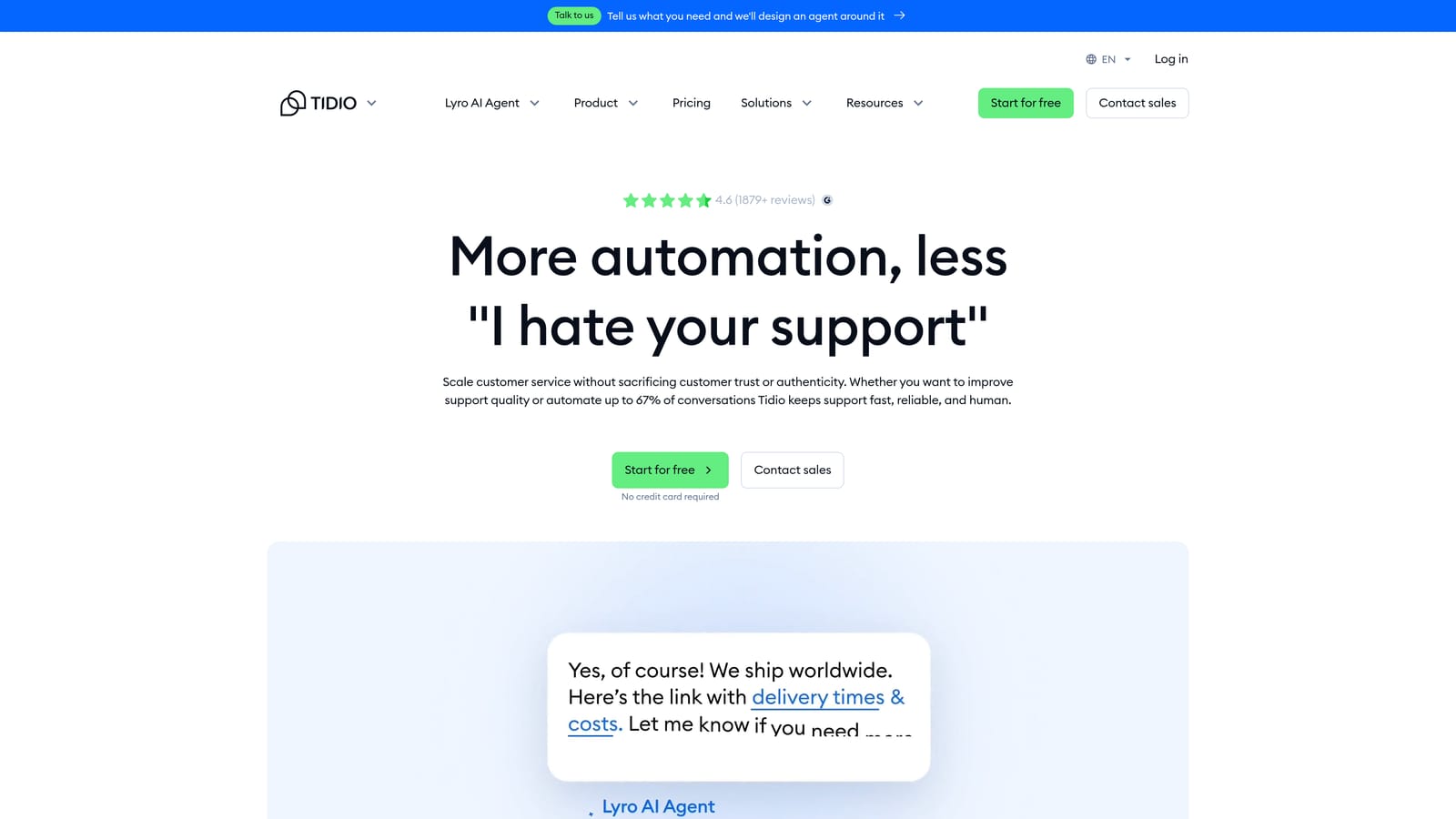
Tidio is a live chat and AI chatbot platform featuring Lyro, its conversational AI, built for teams that prioritize speed to deployment over deep customization.
Where This Tool Shines
Tidio's strongest selling point is how fast you can go from signup to a working AI chatbot. Where enterprise platforms can take weeks to configure and integrate, Tidio is designed to be deployable in hours. Lyro handles common conversational queries and falls back gracefully to live chat when its confidence is low.
The platform started in e-commerce and shows it, with strong Shopify and WooCommerce integrations. Smaller SaaS teams use it too, but the integration ecosystem is shallower than what you'd find on enterprise-grade platforms. If your stack is relatively simple and your priority is getting something working fast, Tidio delivers on that promise.
Key Features
Lyro AI Chatbot: Conversational AI that resolves common queries and escalates to live chat when confidence thresholds aren't met.
Fast Deployment: Designed to be live in hours rather than weeks, with minimal technical setup required.
Live Chat Fallback: Smooth transition to human agents when the AI can't confidently resolve a query.
E-Commerce Integrations: Native connections to Shopify and WooCommerce, with broader SaaS use cases supported.
Best For
Small teams and startups that need a functional AI chatbot quickly without enterprise-level complexity or budget. Not the right fit for teams that need deep CRM integration, complex routing logic, or business intelligence from support data.
Pricing
Free plan available. Lyro AI starts at approximately $29 per month, making it one of the more accessible entry points in this category.
6. Drift (Salesloft)
Best for: Revenue teams where support and sales conversations happen in the same channel and need to be handled intelligently.
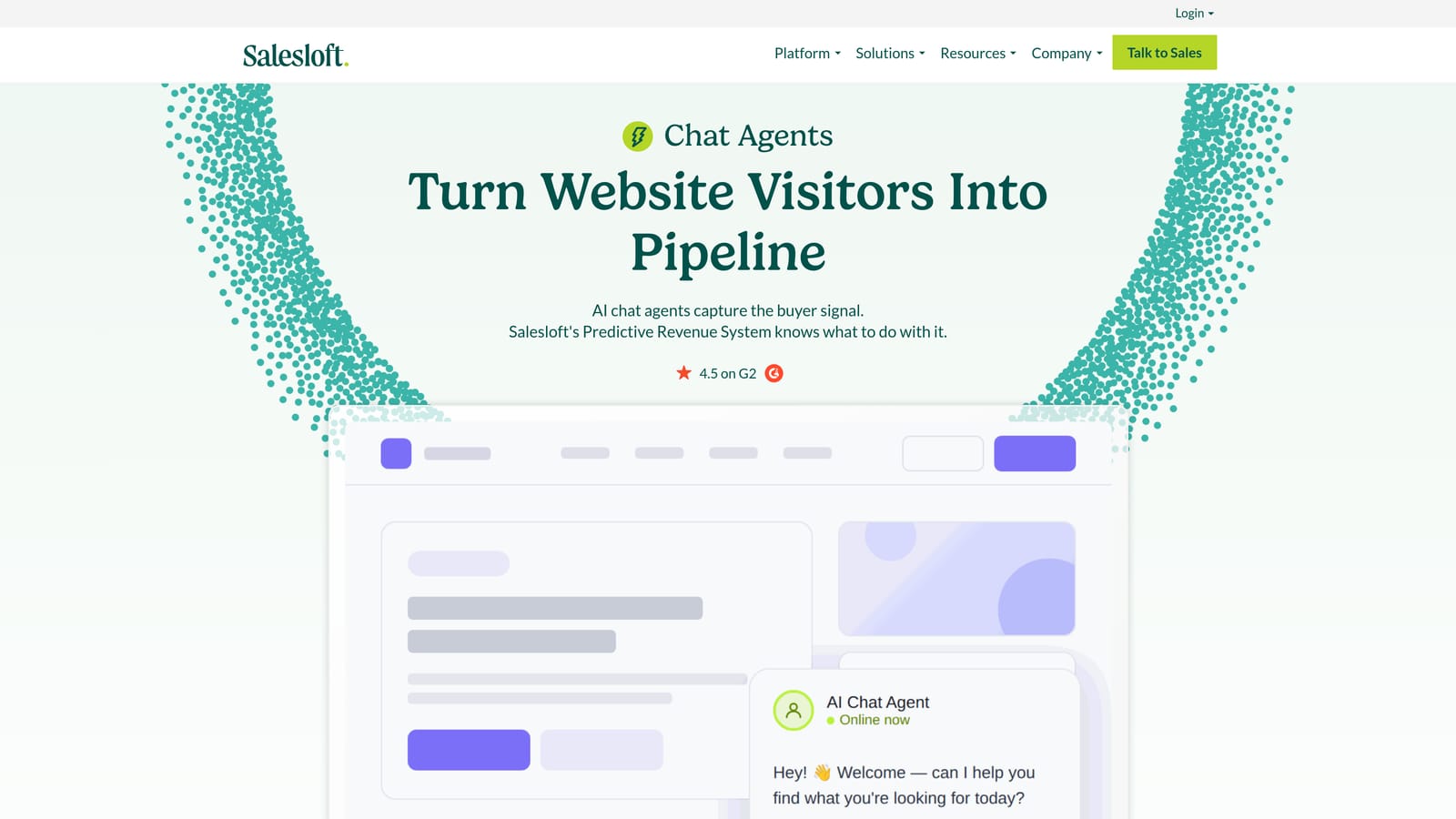
Drift, now part of the Salesloft revenue platform, blends conversational AI for support deflection with sales qualification and pipeline routing in a single chat interface.
Where This Tool Shines
Drift's differentiation is that it doesn't treat support and sales as separate problems. A visitor landing on your pricing page and a customer asking a billing question can both be handled within the same system, with different playbooks routing each conversation appropriately. For teams where the lines between support and sales are genuinely blurry, that unified approach has real value.
The meeting booking and pipeline routing capabilities are mature, and the Salesforce and HubSpot integrations are among the strongest in the category. The tradeoff is that pure support automation is secondary to the revenue intelligence use case, so teams looking primarily for ticket deflection may find better-suited options elsewhere.
Key Features
Conversational AI: Handles both support deflection and sales qualification within the same chat interface.
Meeting Booking: Routes qualified visitors to calendar booking flows directly from chat.
Playbook Automation: Different conversation flows for different visitor segments, based on page, firmographic data, or CRM status.
CRM Integration: Deep connections to Salesforce and HubSpot for pipeline visibility.
Best For
B2B teams where inbound chat is shared between support and sales, particularly those already using Salesloft for revenue operations. Less suited to teams focused purely on post-sale customer support automation.
Pricing
Enterprise pricing. Contact Salesloft for a quote based on your team size and use case.
7. Ada
Best for: Large enterprises with complex automation requirements, multilingual support needs, and deep integration demands.
Ada is an enterprise-grade, AI-first customer service automation platform with a no-code builder and a track record in high-complexity enterprise deployments.
Where This Tool Shines
Ada's no-code bot builder allows non-technical teams to build complex conversation flows with branching logic, conditions, and integrations, without requiring engineering resources for every change. For large organizations where support workflows are intricate and frequently updated, that flexibility is significant.
Multilingual support across dozens of languages makes Ada a strong choice for global enterprises serving customers across multiple regions. The platform has established itself particularly in telecom, fintech, and retail enterprise segments, where the volume and complexity of support interactions justifies the investment in a dedicated AI-first platform.
Key Features
No-Code Bot Builder: Build and modify complex conversation flows with branching logic without engineering involvement.
Multilingual Support: Handles customer interactions across dozens of languages natively.
Enterprise Integrations: Deep connections to Salesforce, Zendesk, SAP, and other enterprise systems.
Containment Rate Analytics: Detailed reporting on how effectively the AI is resolving issues without human escalation.
Best For
Large enterprises with global customer bases, complex automation requirements, and the internal resources to configure and maintain a sophisticated AI platform. Likely over-engineered for early-stage SaaS teams or smaller organizations.
Pricing
Enterprise pricing. Contact Ada directly for a quote tailored to your organization's scale and requirements.
8. Kustomer
Best for: Teams that need AI-powered support informed by deep customer history and a built-in CRM rather than a separate data layer.
Kustomer is a CRM-native customer service platform where AI suggestions are grounded in the full customer timeline, including purchase history, past interactions, and account data.
Where This Tool Shines
The core differentiator here is context. Most support AI tools see only the current conversation. Kustomer's AI operates with visibility into the customer's entire relationship with your company: every past ticket, purchase, and interaction. That context makes AI suggestions more relevant and reduces the frustrating experience of customers having to repeat themselves.
The built-in CRM also eliminates the need for a separate customer data tool, which simplifies the stack for teams that don't already have a CRM they're committed to. The omnichannel view across chat, email, SMS, and social in a single interface is well-executed.
Key Features
Unified Customer Timeline: AI suggestions are informed by the full customer history, including purchases, interactions, and account status.
AI-Powered Suggested Responses: Context-aware response recommendations and automatic conversation tagging.
Omnichannel Support: Chat, email, SMS, and social media managed in a single unified view.
Built-In CRM: Removes the dependency on a separate customer data platform for teams that don't have one.
Best For
B2C or hybrid teams where customer history is central to support quality. Pure B2B SaaS teams with simpler account structures may find the CRM-native approach more than they need, but for teams handling high-context customer relationships, the unified timeline is a genuine advantage.
Pricing
Starts at approximately $89 per agent per month, with enterprise tiers available for larger organizations.
9. Forethought
Best for: Teams with existing helpdesk investment who want meaningful AI gains without a full platform migration.
Forethought is a modular AI platform designed to sit on top of your existing helpdesk, adding deflection, intelligent routing, and agent assist without requiring you to replace the tools you already use.
Where This Tool Shines
Forethought's modular architecture is its defining characteristic. Rather than asking you to migrate to a new platform, it layers AI capabilities onto Zendesk, Salesforce Service Cloud, and other established helpdesks. Teams with significant investment in their current stack, and the institutional knowledge built around it, can adopt AI incrementally rather than all at once.
The three-module structure (Solve for deflection, Triage for routing, Assist for agent copilot) means you can start with the component that addresses your most pressing problem and expand from there. That flexibility makes the adoption curve less steep than a full platform switch.
Key Features
Solve: AI self-service deflection that handles common queries before they become tickets in your helpdesk.
Triage: Intelligent ticket routing and prioritization based on intent, urgency, and category detection.
Assist: Agent copilot that surfaces suggested responses and relevant knowledge base articles during live conversations.
Helpdesk Compatibility: Designed to work alongside Zendesk, Salesforce Service Cloud, and other major helpdesk platforms.
Best For
Support teams that are locked into an existing helpdesk, whether by contract, internal adoption, or technical integration, but want to add AI capabilities without a full migration. Also a practical choice for teams that want to pilot AI in a low-risk, modular way before committing to a larger architectural change.
Pricing
Contact Forethought for pricing. The modular structure means costs vary depending on which components you deploy and at what scale.
Which Platform Is Right for Your Team?
The most important decision in this category isn't which platform has the most features. It's whether you need an AI-first architecture or AI layered onto an existing helpdesk. Those are genuinely different bets, and the right answer depends on where you're starting from.
If you're a B2B SaaS team building or rethinking your support function, Halo AI stands out for teams that want autonomous resolution paired with business intelligence. The page-aware context, smart inbox signals, and auto bug ticket creation go beyond what most support AI platforms offer, making it particularly well-suited to product-led companies where support, product, and engineering are tightly connected.
For teams with significant existing investment in Intercom or Zendesk, switching costs are real. Intercom's Fin is a capable AI agent for teams already in that ecosystem, and Forethought offers a practical path to AI gains without abandoning your current helpdesk. Zendesk AI makes sense if your primary need is agent productivity and triage efficiency rather than autonomous resolution.
If you're a smaller team that needs something working fast without enterprise complexity, Tidio's accessible pricing and quick deployment make it a sensible starting point. And for organizations where support and sales share the same inbound channel, Drift's revenue-oriented approach fills a niche that pure support platforms don't address.
Your support team shouldn't scale linearly with your customer base. Let AI agents handle routine tickets, guide users through your product, and surface business intelligence while your team focuses on complex issues that need a human touch. See Halo in action and discover how continuous learning transforms every interaction into smarter, faster support.