9 Best AI Chatbots for SaaS Companies in 2026
Choosing the right AI chatbot for SaaS companies requires more than basic automation—it demands contextual product awareness, seamless helpdesk integrations, and intelligent live agent handoff. This guide evaluates nine top platforms for 2026 based on SaaS-specific criteria, helping support teams at every growth stage scale ticket resolution without scaling headcount.
 Grant CooperFounder12 min read
SaaS support teams face a familiar paradox: as your product grows, so does ticket volume, but headcount can't scale at the same pace. A generic FAQ chatbot won't solve this. What SaaS teams actually need is an AI agent that understands product context, connects to their existing stack, and gets smarter with every resolved ticket.
The tools in this list were selected based on SaaS-specific criteria: helpdesk integrations, contextual awareness, live agent handoff quality, analytics depth, and scalability for B2B use cases. Whether you're running a lean support team at a Series A startup or managing enterprise-scale ticket queues, here are the best AI chatbots for SaaS companies in 2026, starting with the one built from the ground up for this exact problem.
1. Halo AI
Best for: SaaS teams that want an AI-first support platform with deep product context and business intelligence.
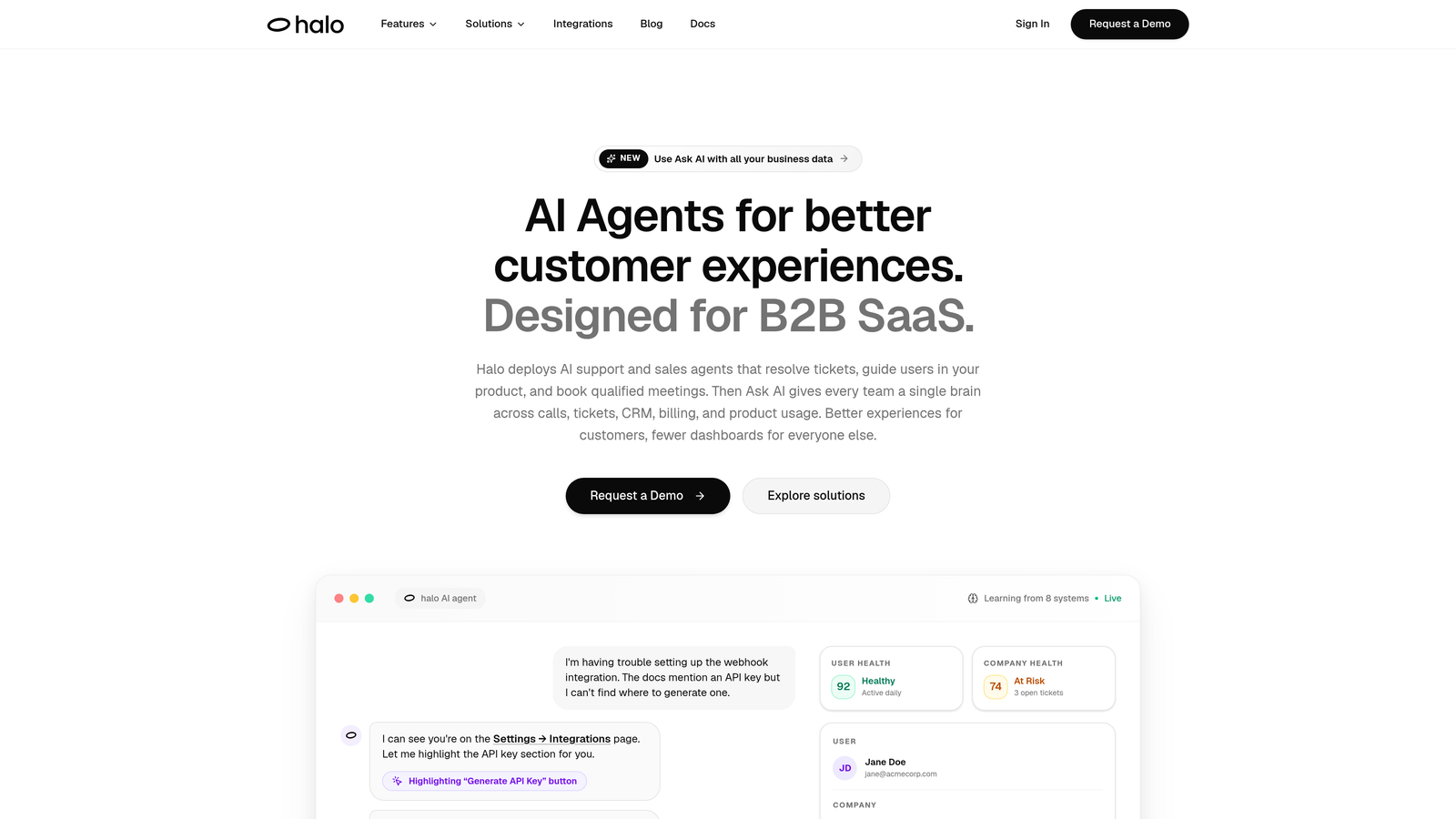
Halo AI is an AI-first customer support platform built specifically for SaaS companies, deploying intelligent agents that resolve tickets, guide users through your product, and surface business signals — all while learning continuously from every interaction.
Where This Tool Shines
What separates Halo from most AI chatbots is page-aware context. The agent sees exactly what the user sees on screen, which means it can provide visual UI guidance rather than generic instructions. If a user is stuck on your billing settings page, Halo knows that and responds accordingly.
Beyond ticket resolution, Halo's smart inbox functions as a business intelligence layer. It surfaces customer health signals, revenue indicators, and anomaly detection that most support tools completely ignore. Your support queue becomes a source of strategic insight, not just a backlog to clear.
Key Features
Page-Aware Chat Widget: The AI agent sees what the user sees and delivers visual UI guidance specific to their current location in your product.
Autonomous Ticket Resolution with Live Agent Handoff: Handles tickets end-to-end and escalates intelligently to human agents when complexity warrants it.
Auto Bug Ticket Creation: Automatically generates and routes bug reports to Linear, reducing manual triage for your engineering team.
Smart Inbox with Business Intelligence: Surfaces customer health signals, revenue indicators, and anomaly detection directly within the support workflow.
Broad Integration Stack: Connects with Slack, HubSpot, Intercom, Stripe, Zoom, PandaDoc, and Fathom for a unified support and business operations view.
Continuous Learning: Every resolved interaction makes the AI smarter, improving resolution quality over time without manual retraining.
Best For
B2B SaaS companies that want to scale support without scaling headcount, particularly product-led growth teams and organizations that need their support data to inform customer success and revenue decisions. Well-suited for teams ready to move beyond bolt-on AI features.
Pricing
Contact Halo AI for pricing. Designed for B2B SaaS teams; visit haloagents.ai for details.
2. Intercom Fin
Best for: Teams already on Intercom who want native AI resolution without adding another platform.
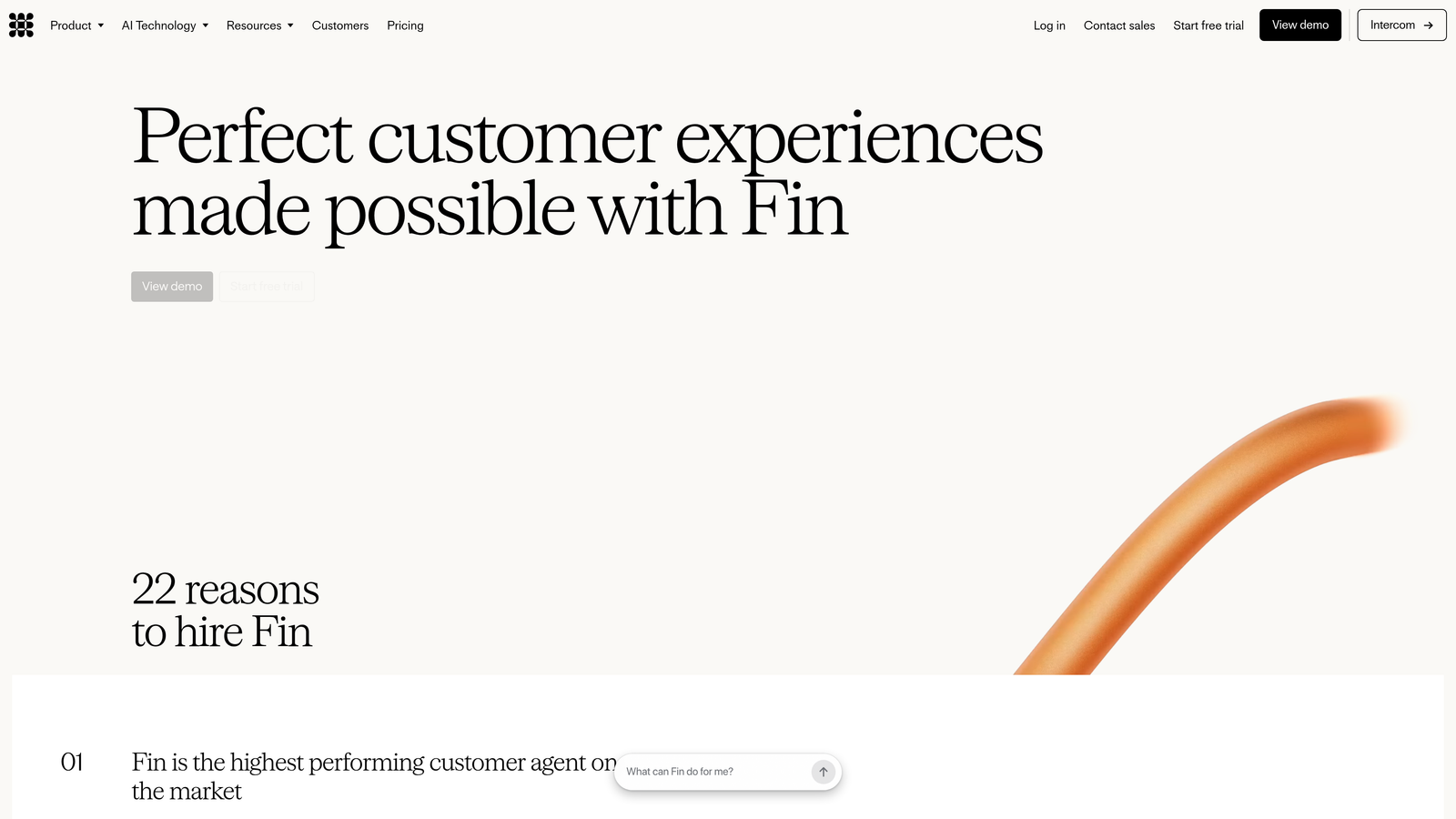
Intercom Fin is Intercom's native AI agent that resolves customer conversations using your help center content, then routes to human agents when needed.
Where This Tool Shines
Fin's biggest advantage is how tightly it integrates with the rest of the Intercom platform. There's no third-party connection to manage: your help center, inbox, workflows, and reporting all live in one place. For teams already standardized on Intercom, the activation friction is minimal.
The per-resolution pricing model is also worth noting. Rather than paying for seats or monthly access, you pay for outcomes. For teams with variable support volume, this can be a more predictable cost structure.
Key Features
LLM-Powered Resolution: Uses large language models to answer questions based on your existing help center articles, without manual bot scripting.
Seamless Human Handoff: Routes conversations to the Intercom inbox when the AI can't resolve, with full conversation context preserved.
Conversation Routing and Workflow Automation: Automates routing logic and support workflows natively within Intercom.
Per-Resolution Pricing: Pay for successful resolutions rather than user seats, aligning cost with actual value delivered.
Native Platform Integration: No third-party setup required; Fin works directly within existing Intercom configurations.
Best For
SaaS companies already using Intercom as their primary support and messaging platform who want to add AI resolution without migrating tools or managing separate integrations.
Pricing
Per-resolution pricing model. Check intercom.com for current rates, as pricing changes regularly.
3. Zendesk AI
Best for: Teams standardized on Zendesk Suite who want AI without switching platforms.
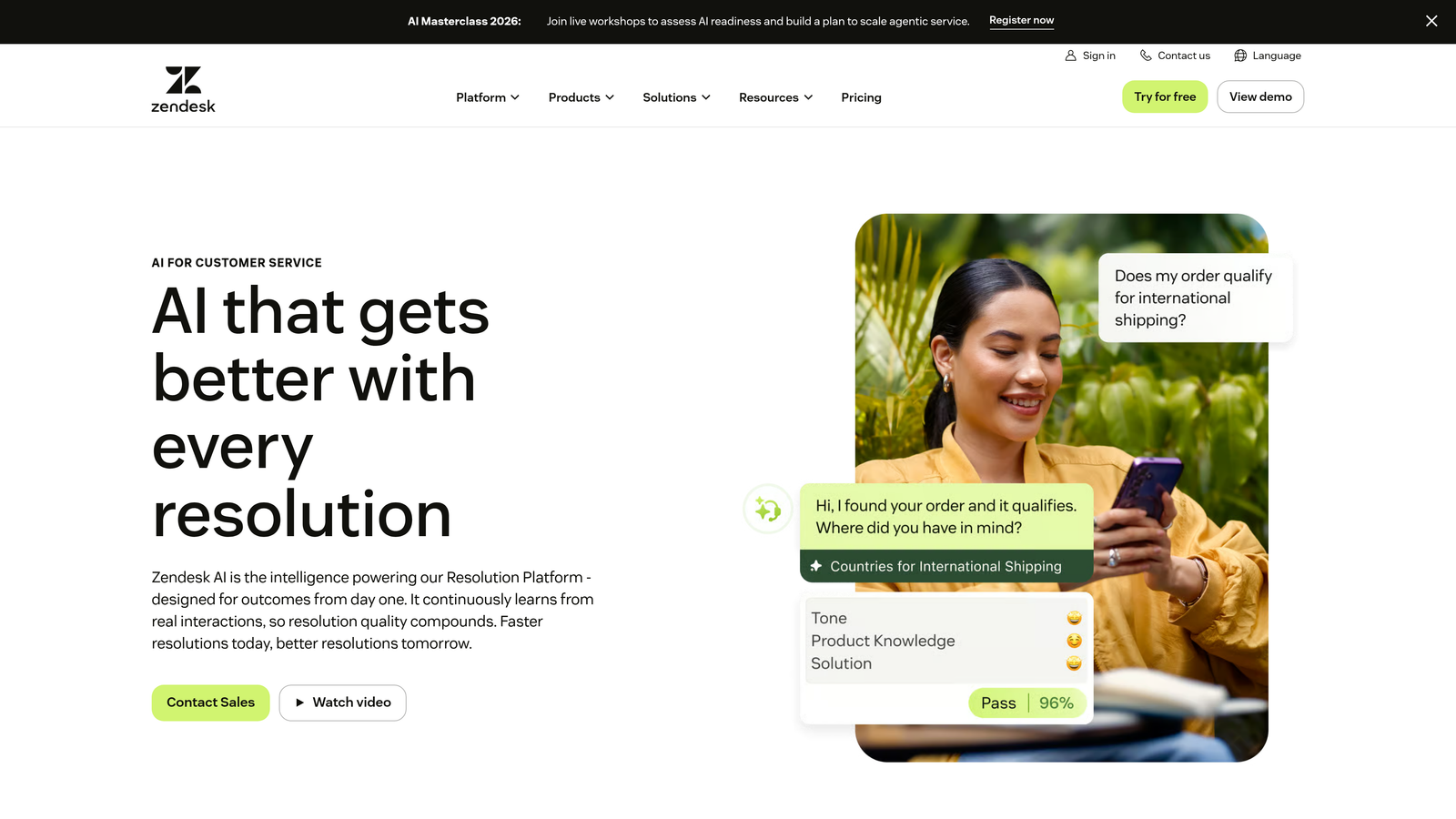
Zendesk AI is a suite of AI capabilities embedded across the Zendesk platform, covering intelligent triage, intent detection, agent assist, and a bot builder for automated self-service conversations.
Where This Tool Shines
Zendesk AI's strength is depth of integration with the Zendesk ecosystem. Triage, routing, macros, reporting, and bot flows all work within the same environment your agents already use. There's no context switching and no migration risk.
For high-volume support operations with complex routing needs, the intent and sentiment detection features add meaningful efficiency. Agents get suggested responses and macros surfaced automatically, which can meaningfully reduce handle time on repetitive ticket types.
Key Features
Intelligent Triage: Automatically tags, routes, and prioritizes incoming tickets based on intent and content analysis.
Intent and Sentiment Detection: Identifies customer intent and emotional tone across channels to inform routing and response.
Suggested Macros and Response Recommendations: Surfaces relevant macros and response templates to agents in real time.
Bot Builder: Visual tool for creating self-service conversation flows without coding.
Deep Zendesk Integration: Works natively with Zendesk ticketing, reporting, triggers, and automation workflows.
Best For
Mid-market and enterprise SaaS companies already running Zendesk as their core helpdesk, particularly those with large agent teams who benefit from AI-assisted response recommendations and automated triage.
Pricing
Included in higher-tier Zendesk Suite plans; available as an add-on on lower tiers. Check zendesk.com for current pricing.
4. Freshdesk Freddy AI
Best for: Freshdesk users who want a full AI layer covering self-service, agent assist, and analytics.
Freshdesk Freddy AI is Freshworks' AI suite for Freshdesk, combining a customer-facing bot, real-time agent assist, and AI-driven analytics into a single integrated offering.
Where This Tool Shines
Freddy covers the full support stack in one place. Freddy Self Service handles customer-facing deflection, Freddy Copilot assists agents with real-time suggestions, and Freddy Insights surfaces trends and gaps in your support data. That breadth is rare in a single product without significant additional cost.
Freshdesk's overall pricing tends to be more accessible than comparable Zendesk tiers, which makes Freddy AI an attractive option for growing SaaS companies that need enterprise-grade AI features without enterprise-grade pricing.
Key Features
Freddy Self Service: Customer-facing AI bot that handles common questions and deflects tickets before they reach agents.
Freddy Copilot: Real-time agent assist with suggested responses, summaries, and next-step recommendations.
Freddy Insights: AI-driven analytics that detect support trends, volume spikes, and emerging issues.
Embedded in Freshdesk: No separate platform to manage; everything lives within your existing Freshdesk workspace.
Competitive Pricing: More accessible than comparable enterprise helpdesk AI tools for similar feature sets.
Best For
SaaS teams on the Freshdesk suite looking for a comprehensive AI layer that covers customer-facing deflection, agent productivity, and analytics without needing to evaluate multiple separate tools.
Pricing
Tiered within Freshdesk plans; Freddy Copilot available as an add-on. Check freshworks.com for current pricing.
5. Drift
Best for: B2B SaaS teams that blend sales qualification and customer support in the same conversational layer.
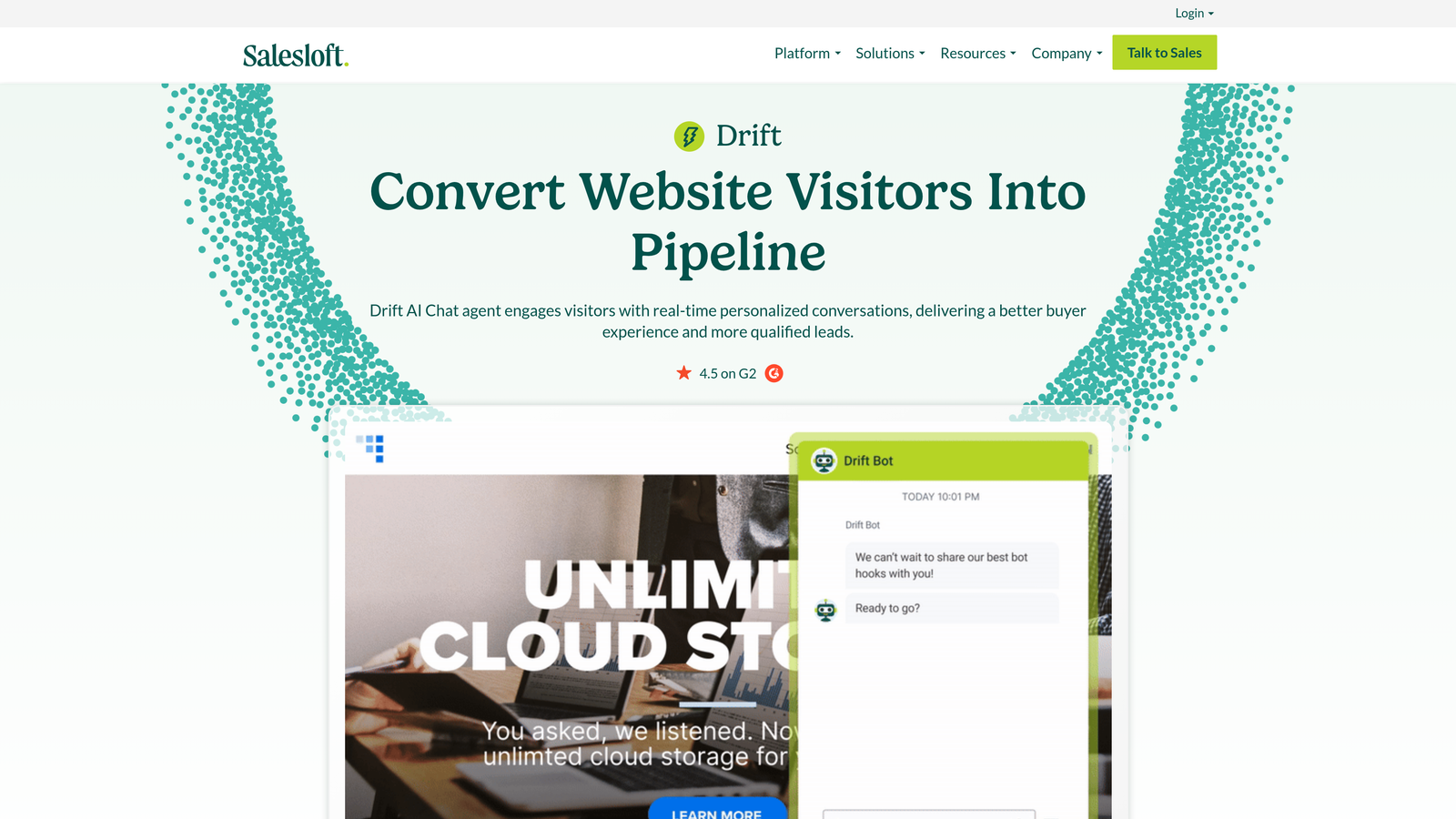
Drift is a conversational AI platform with strong account-based routing and AI-powered conversation handling, designed for B2B teams managing both sales and support interactions.
Where This Tool Shines
Drift's differentiation is its account-based intelligence. It can identify high-value visitors, route them based on account signals, and trigger personalized playbooks — all before a human gets involved. For SaaS companies where sales and support overlap, that context is genuinely useful.
The pipeline qualification and meeting scheduling features make Drift particularly valuable for product-led growth companies where support conversations can turn into expansion opportunities. It's worth noting that Drift was acquired by Salesloft, and the product roadmap continues to evolve under that umbrella.
Key Features
AI-Powered Conversation Routing: Routes conversations based on account tier, intent signals, and visitor behavior.
Playbooks: Automated conversation flows for both sales qualification and support scenarios.
Account-Based Targeting: Identifies high-value accounts visiting your site and triggers personalized engagement.
CRM Integrations: Connects with Salesforce, HubSpot, Marketo, and Slack for full pipeline context.
Meeting Scheduling and Pipeline Qualification: Allows prospects and customers to book meetings directly from the chat interface.
Best For
B2B SaaS companies where the line between sales and support is blurry, particularly those with account-based sales motions who want AI to handle initial qualification and routing across both functions.
Pricing
Enterprise pricing. Contact Drift or Salesloft sales for current rates; check drift.com for details.
6. Tidio Lyro
Best for: Early-stage SaaS teams that need fast AI deployment with minimal configuration overhead.
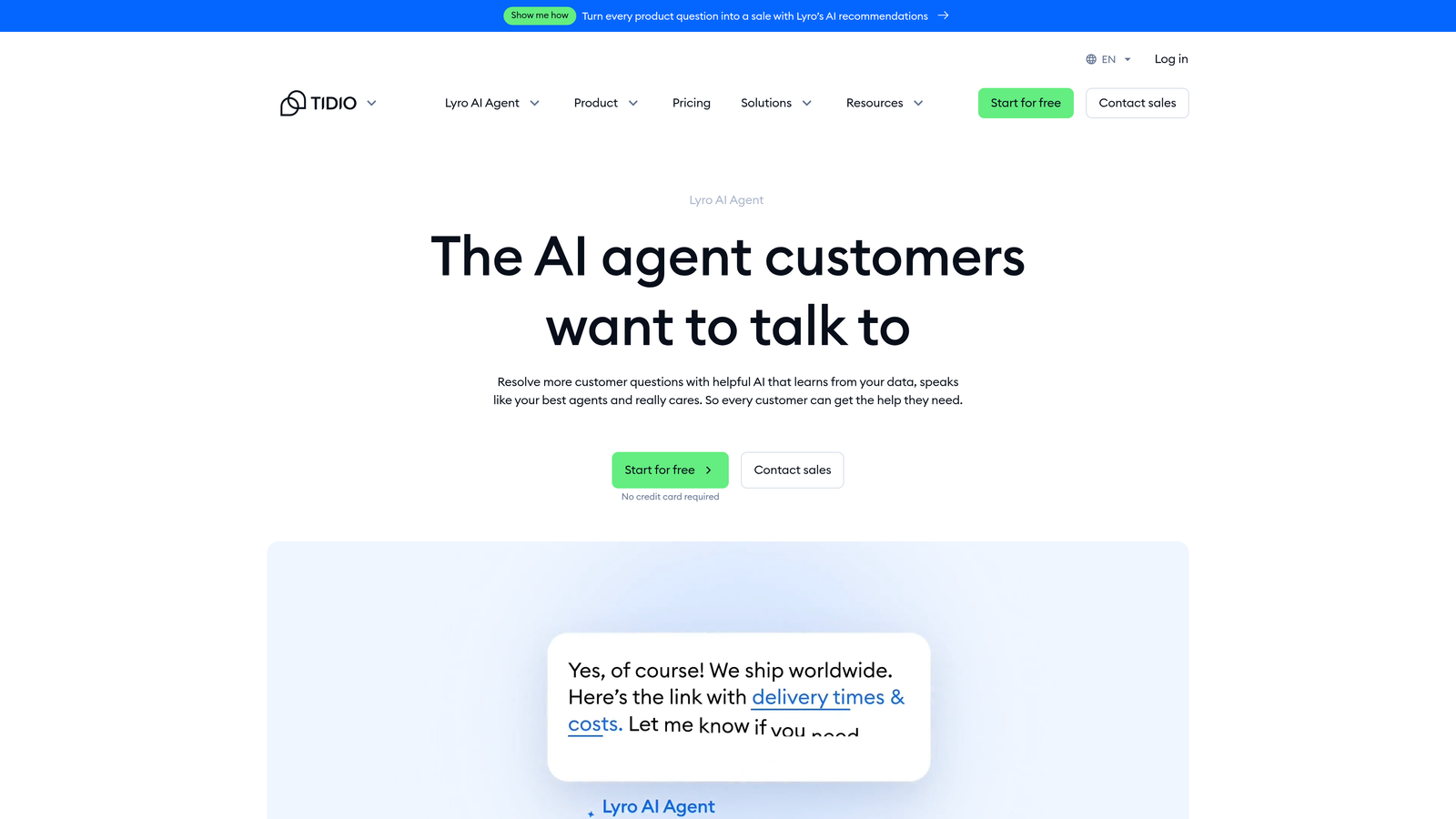
Tidio Lyro is an AI conversation agent that learns from your existing help content and handles customer conversations autonomously, with a setup process designed for speed rather than complexity.
Where This Tool Shines
Lyro's primary appeal is how quickly you can get it running. Point it at your existing support content, and it starts handling conversations without complex training workflows or bot scripting. For lean teams that can't afford weeks of implementation, that matters.
The fallback to live chat when AI confidence is low is a practical safety net. Rather than giving a wrong answer, Lyro routes to a human, which preserves customer experience without requiring you to build complex escalation logic manually.
Key Features
Autonomous AI Conversations: Handles customer queries end-to-end based on your existing support and help content.
Fast Setup: Minimal configuration required; no complex training data or bot scripting needed to get started.
Confidence-Based Fallback: Routes to live chat when AI confidence is low, preventing incorrect automated responses.
Volume-Based Pricing: Accessible pricing model that scales with conversation volume rather than agent seats.
Platform Integrations: Connects with Shopify, WordPress, Wix, and major CRMs for e-commerce and SaaS use cases.
Best For
Startups and small SaaS teams with straightforward support scenarios who need AI deflection running quickly without dedicated implementation resources. Less suited for complex, multi-step technical support workflows.
Pricing
Free tier available. Paid plans scale by conversation volume. Check tidio.com for current pricing.
7. Chatbase
Best for: Documentation-heavy SaaS products that want a custom AI chatbot trained on their own knowledge base.
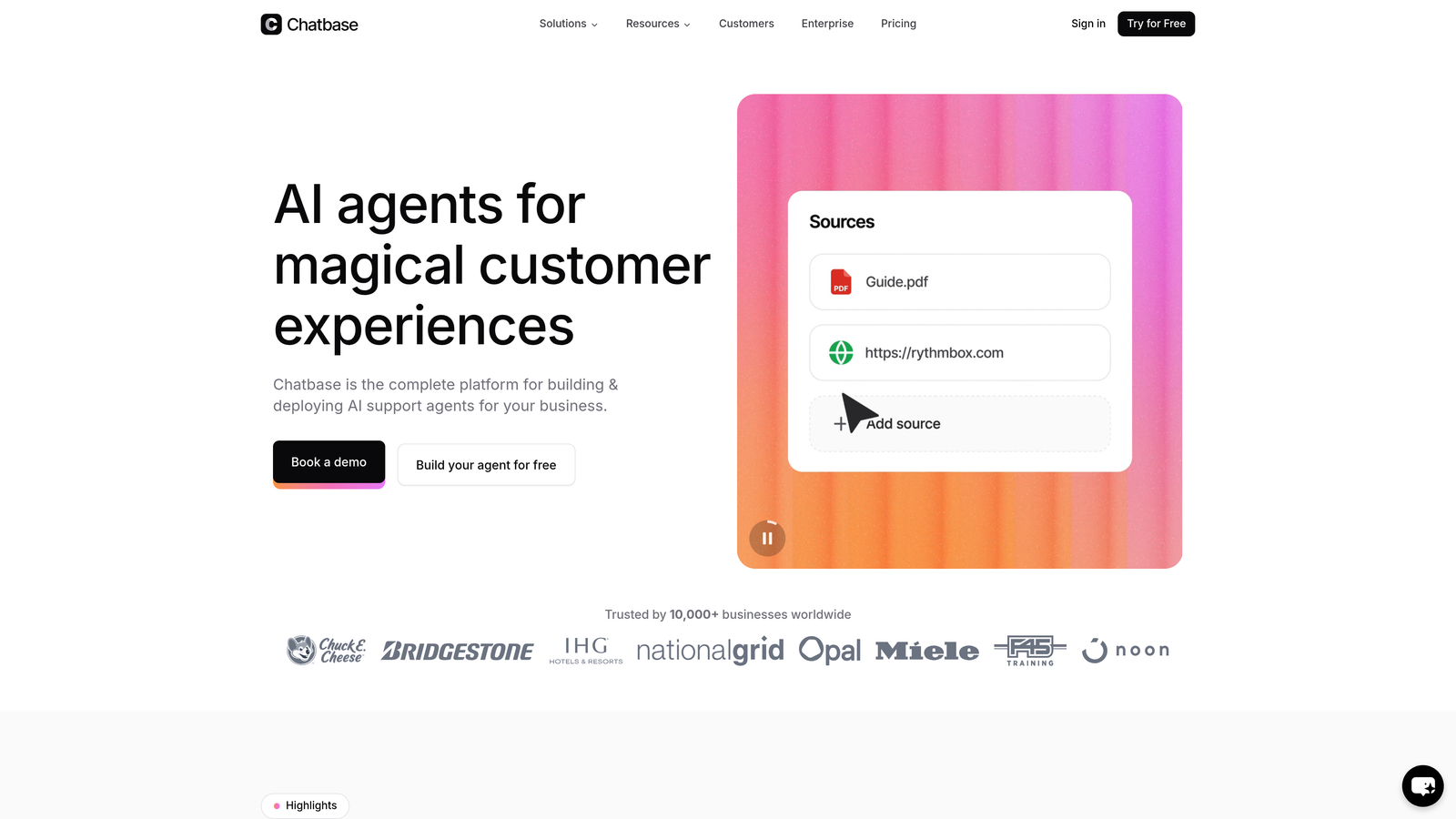
Chatbase is a platform for building custom AI chatbots trained on your own data sources, including PDFs, URLs, sitemaps, and Notion pages, and embedding them directly on your website or product.
Where This Tool Shines
Chatbase is built around the idea that your existing documentation is your training data. If your product has extensive help docs, a developer knowledge base, or a Notion wiki, Chatbase can ingest that content and turn it into a conversational interface without manual Q&A scripting.
The API access and embeddable widget make it flexible enough to deploy across different surfaces. It's a strong fit for self-serve SaaS products where users expect to find answers on their own, and where the support team's goal is deflection rather than deep conversation handling.
Key Features
Custom Data Training: Train on PDFs, URLs, sitemaps, Notion pages, and plain text — no manual Q&A building required.
Embeddable Widget: Customizable chat widget that can be embedded on your website or within your product.
API Access: Enables custom integrations for teams that want to build Chatbase into their own workflows or applications.
Slack and WhatsApp Integrations: Extends the chatbot to messaging channels beyond the website widget.
Analytics Dashboard: Conversation review and performance analytics for identifying gaps in your knowledge base coverage.
Best For
SaaS companies with rich documentation and self-serve user bases who want a fast, customizable AI chatbot without building one from scratch. Works well as a first layer of AI support before investing in more sophisticated platforms.
Pricing
Freemium model. Paid plans based on message credits. Check chatbase.co for current pricing.
8. Forethought
Best for: High-volume support teams with existing helpdesk infrastructure who need intelligent triage and routing at scale.
Forethought is an AI platform focused on ticket triage, routing, and agent assist, purpose-built for support teams with large ticket volumes and established helpdesk systems.
Where This Tool Shines
Forethought's architecture is modular: Solve handles customer-facing resolution, Triage handles predictive routing and tagging, Assist surfaces real-time suggestions for human agents, and Discover provides analytics on support trends and gaps. Each module adds value independently, but they compound when used together.
The predictive triage capability is particularly strong for teams with large historical ticket datasets. Forethought trains on your actual ticket history, which means its routing logic reflects your real support patterns rather than generic intent categories.
Key Features
Solve: AI agent for customer-facing conversation resolution across channels.
Triage: Predictive routing and tagging trained on your historical ticket data for accurate classification.
Assist: Real-time response suggestions and next-step recommendations for human agents.
Discover: Analytics module for identifying support trends, volume drivers, and knowledge gaps.
Helpdesk Integrations: Connects with Zendesk, Salesforce, ServiceNow, and Freshdesk for seamless deployment within existing infrastructure.
Best For
Mid-market and enterprise SaaS companies with high ticket volumes and existing Zendesk, Salesforce, or ServiceNow infrastructure who want AI to improve triage accuracy and agent efficiency without replacing their current helpdesk.
Pricing
Enterprise pricing. Contact Forethought for current rates at forethought.ai.
9. Kustomer
Best for: SaaS companies that need CRM-native AI support with a unified customer data view across purchases, behavior, and history.
Kustomer is a CRM-native customer service platform with built-in AI that unifies customer history, purchase behavior, and support context into a single view for personalized, context-aware support interactions.
Where This Tool Shines
Kustomer's unified customer timeline is the differentiator. Where most support tools see a ticket in isolation, Kustomer shows you the full customer picture: their purchase history, past interactions, behavioral signals, and account status, all in one place. The AI uses that context to route and respond more intelligently.
This makes Kustomer particularly strong for SaaS companies with complex customer data needs, where the quality of a support interaction depends heavily on knowing who you're talking to and what they've experienced with your product before.
Key Features
Unified Customer Timeline: Combines purchases, product behavior, and support history into a single customer view accessible to agents and AI alike.
AI-Powered Routing and Response Suggestions: Routes conversations and suggests responses based on full customer context, not just ticket content.
Omnichannel Support: Handles customer interactions across chat, email, SMS, and social from a single platform.
Workflow Automation: Automates repetitive support processes and escalation logic based on customer data rules.
Deep CRM Data Integration: Connects CRM data directly into the support workflow for context-aware AI responses and agent decisions.
Best For
SaaS companies with complex customer data environments, particularly those with significant B2C components or high-touch customer success motions where support quality depends on rich customer context.
Pricing
Per-agent/month pricing. Check kustomer.com for current plans.
Which Tool Is Right for Your SaaS Team?
The right choice depends less on feature lists and more on where you are as a company and what you're trying to solve.
If you're building AI-first from scratch: Halo AI is the strongest option for SaaS teams that want a platform designed for this problem from the ground up, with page-aware context, business intelligence signals, and continuous learning built into the core product rather than bolted on.
If you're already on Intercom or Zendesk: Intercom Fin and Zendesk AI are the natural paths of least resistance. They won't require platform migration, and they add meaningful AI capability within your existing workflow. Freshdesk Freddy AI offers similar value for teams on the Freshworks suite, often at more accessible pricing.
If you have high ticket volume and need smarter triage: Forethought is purpose-built for this. Its predictive routing trained on historical ticket data is hard to replicate with general-purpose chatbots.
If you're early-stage and need something running fast: Tidio Lyro or Chatbase get you to functional AI support quickly without complex implementation. They're not the most sophisticated options, but they're the right starting point for lean teams with limited setup bandwidth.
If your support and sales motions overlap: Drift's account-based routing and pipeline qualification features make it the strongest fit for B2B SaaS teams where conversations blur the line between support and expansion.
Your support team shouldn't scale linearly with your customer base. Let AI agents handle routine tickets, guide users through your product, and surface business intelligence while your team focuses on complex issues that need a human touch. See Halo in action and discover how continuous learning transforms every interaction into smarter, faster support.