9 Best AI Chatbots for SaaS Support in 2026
Discover the 9 best AI chatbot for SaaS support solutions in 2026, evaluated on AI capability, SaaS-specific integrations, and ticket resolution quality. This guide covers purpose-built tools ranging from fully autonomous AI agents to hybrid helpdesk platforms, helping SaaS teams of all sizes close support gaps without compromising customer experience.
 Grant CooperFounder13 min read
If your support queue is growing faster than your team, an AI chatbot built for SaaS can close the gap without sacrificing the quality your customers expect. But not all AI chatbots are created equal. Generic chatbots struggle with SaaS-specific workflows: product context, bug reporting, account lookups, and seamless handoff to human agents when things get complex.
The tools in this list are purpose-built (or well-suited) for SaaS support environments, whether you're running a lean startup or scaling a mid-market product team. We evaluated each tool on depth of AI capability, SaaS-specific integrations, ticket resolution quality, and value for B2B teams. You'll find options ranging from fully autonomous AI agents to hybrid platforms that augment your existing helpdesk. Let's get into it.
1. Halo AI
Best for: SaaS teams that want an AI-first support agent with product-aware context and business intelligence
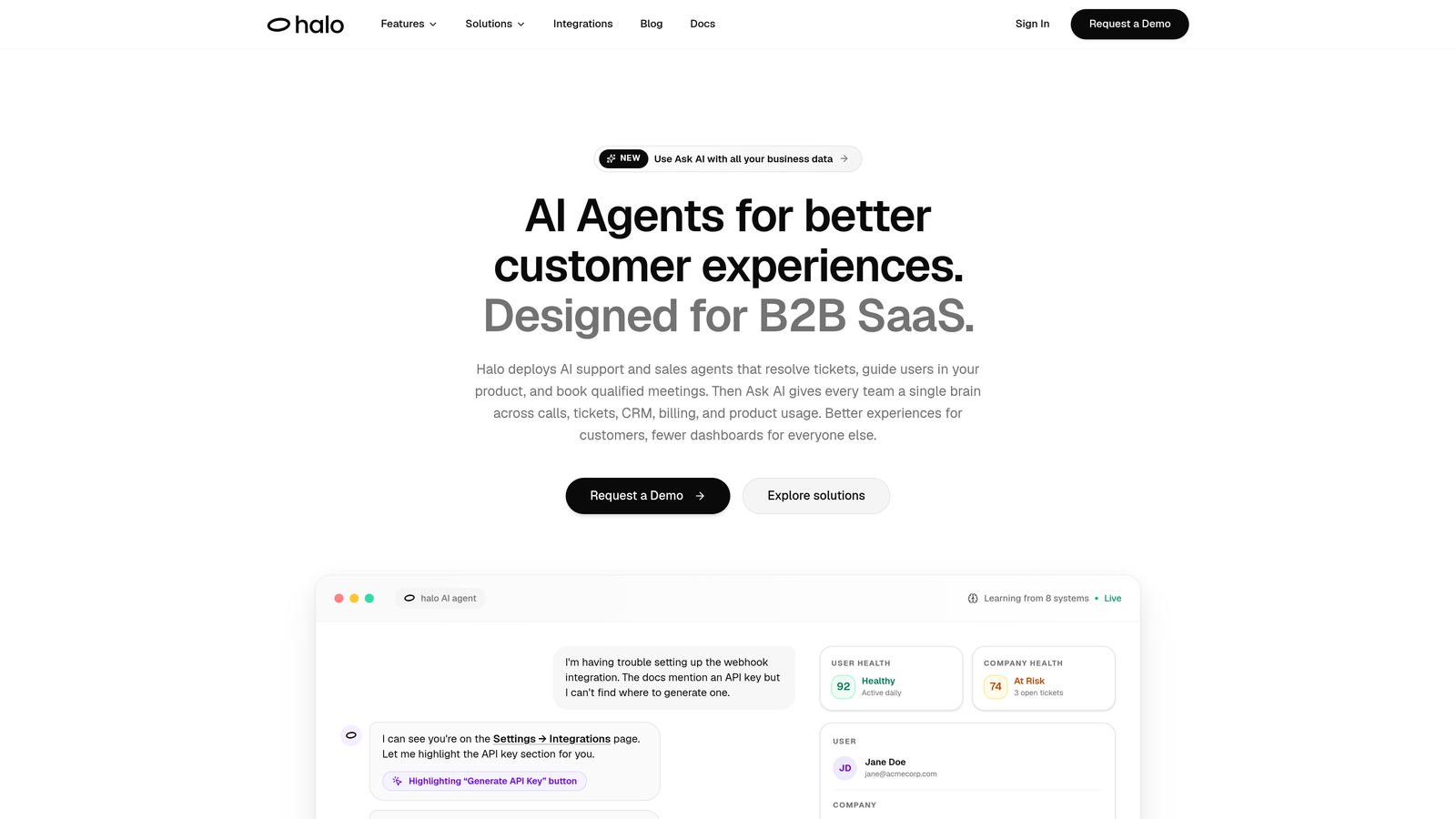
Halo AI is an AI-first customer support agent platform built specifically for SaaS teams, resolving tickets autonomously while surfacing business intelligence from every interaction.
Where This Tool Shines
What sets Halo apart from most chatbots is its page-aware architecture. The AI agent knows exactly which page or feature a user is on, which means it can provide contextual UI guidance rather than generic answers. That's a meaningful difference when your users are stuck mid-workflow and need step-by-step help right now.
Beyond resolution, Halo treats every support interaction as a data signal. Its smart inbox surfaces customer health indicators, revenue anomalies, and churn signals, turning your support queue into a source of business intelligence that your entire team can act on.
Key Features
Page-Aware Chat Widget: The agent sees what the user sees and delivers contextual guidance based on their current location in your product.
Autonomous Ticket Resolution: AI agents resolve tickets end-to-end with continuous learning built into the core architecture, not layered on as an afterthought.
Auto Bug Ticket Creation: When users report issues, Halo automatically creates structured bug tickets and routes them to Linear or other dev tools.
Smart Inbox with Business Intelligence: Goes beyond deflection metrics to surface customer health signals, revenue anomalies, and churn indicators from support data.
Live Agent Handoff: Escalates to human agents with full conversation context preserved, so customers never have to repeat themselves.
Deep SaaS Integrations: Connects with Slack, HubSpot, Intercom, Stripe, Zoom, PandaDoc, and Fathom for a unified support and business stack.
Best For
SaaS product teams and B2B companies that want more than deflection from their AI layer. Halo is particularly well-suited for teams that need their support system to integrate with dev workflows (bug tracking), revenue tools (Stripe, HubSpot), and communication platforms simultaneously.
Pricing
Contact for pricing. Visit haloagents.ai for current plan details and to book a demo.
2. Intercom Fin
Best for: Teams already on Intercom who want native AI resolution without a separate integration
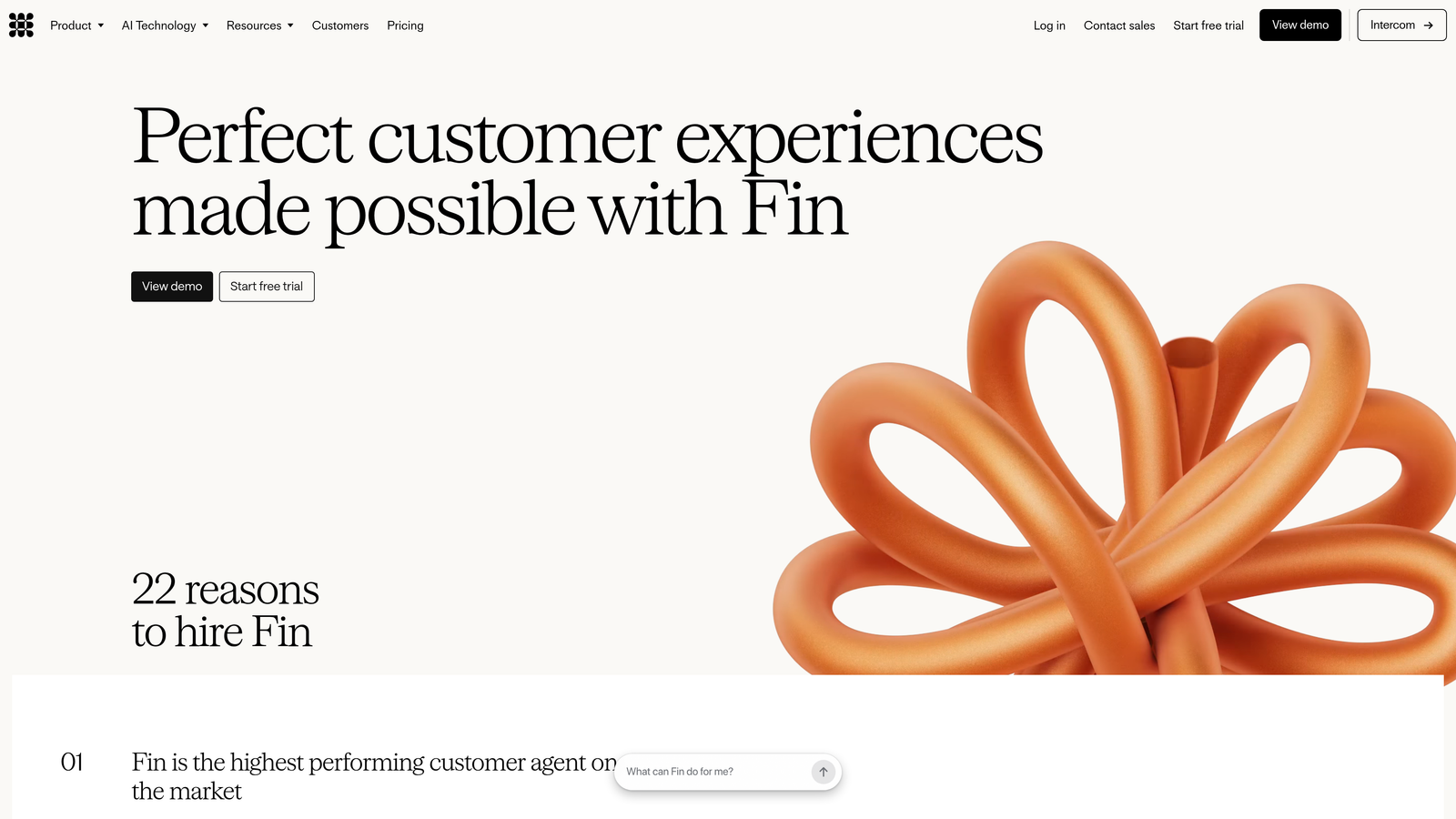
Intercom Fin is Intercom's native AI agent, powered by large language models and designed to resolve support conversations directly within the Intercom messenger.
Where This Tool Shines
Fin's biggest advantage is frictionless deployment for Intercom customers. There's no separate product to integrate or manage: it lives inside the same messenger your team already uses, pulling from your existing help center content and conversation history to generate accurate responses.
The consumption-based pricing model (charged per resolution rather than per seat) is also worth noting. For teams with variable support volume, this can be more cost-efficient than flat-rate alternatives, though costs can scale quickly during high-traffic periods.
Key Features
Native Intercom Integration: No separate setup required for existing Intercom customers; Fin activates within your current messenger environment.
Help Content Training: Answers questions using your existing help center articles and historical conversation data.
Per-Resolution Pricing: Consumption-based model charges only when Fin successfully resolves a conversation.
Contextual Handoff: Passes unresolved conversations to human agents with full context intact.
Multilingual Support: Handles conversations across multiple languages without separate configuration.
Best For
SaaS teams deeply invested in the Intercom ecosystem who want to activate AI resolution quickly without managing a separate vendor. Less ideal for teams not already on Intercom, as the value proposition is closely tied to platform lock-in.
Pricing
Charged per resolution; requires a base Intercom plan. See intercom.com for current pricing details.
3. Zendesk AI (Agents)
Best for: High-volume SaaS support operations running on Zendesk Suite
Zendesk AI is Zendesk's native AI layer embedded across its Suite, offering autonomous agents, intelligent triage, and agent assist capabilities for enterprise-scale support teams.
Where This Tool Shines
Zendesk AI benefits from being embedded in one of the most widely used helpdesk platforms in SaaS. For teams already running Zendesk Suite, the AI features activate without a separate deployment, and the triage and routing intelligence draws on years of historical ticket data to improve accuracy quickly.
The Agent Copilot feature is particularly useful for teams that aren't ready to go fully autonomous. It surfaces suggested replies and next-best-action recommendations in real time, helping agents respond faster without removing human judgment from the loop entirely.
Key Features
Autonomous AI Agents: Resolve tickets end-to-end without human involvement for common, well-defined query types.
Intelligent Triage and Routing: Classifies tickets by intent, sentiment, and priority to route them to the right team automatically.
Agent Copilot: Provides agents with suggested replies and next-best-action guidance during live conversations.
Native Suite Integration: No separate deployment required for existing Zendesk customers.
Advanced QA and Analytics: Built-in quality assurance tools and reporting beyond standard deflection metrics.
Best For
Mid-market to enterprise SaaS teams running Zendesk Suite at scale. Teams with complex routing logic, multiple support tiers, or strict QA requirements will get the most value here. Smaller teams may find the pricing and complexity disproportionate to their needs.
Pricing
Included in Zendesk Suite plans; advanced AI features available on higher tiers. See zendesk.com for current pricing.
4. Freshdesk Freddy AI
Best for: SMB SaaS teams on the Freshworks stack looking for an accessible AI upgrade
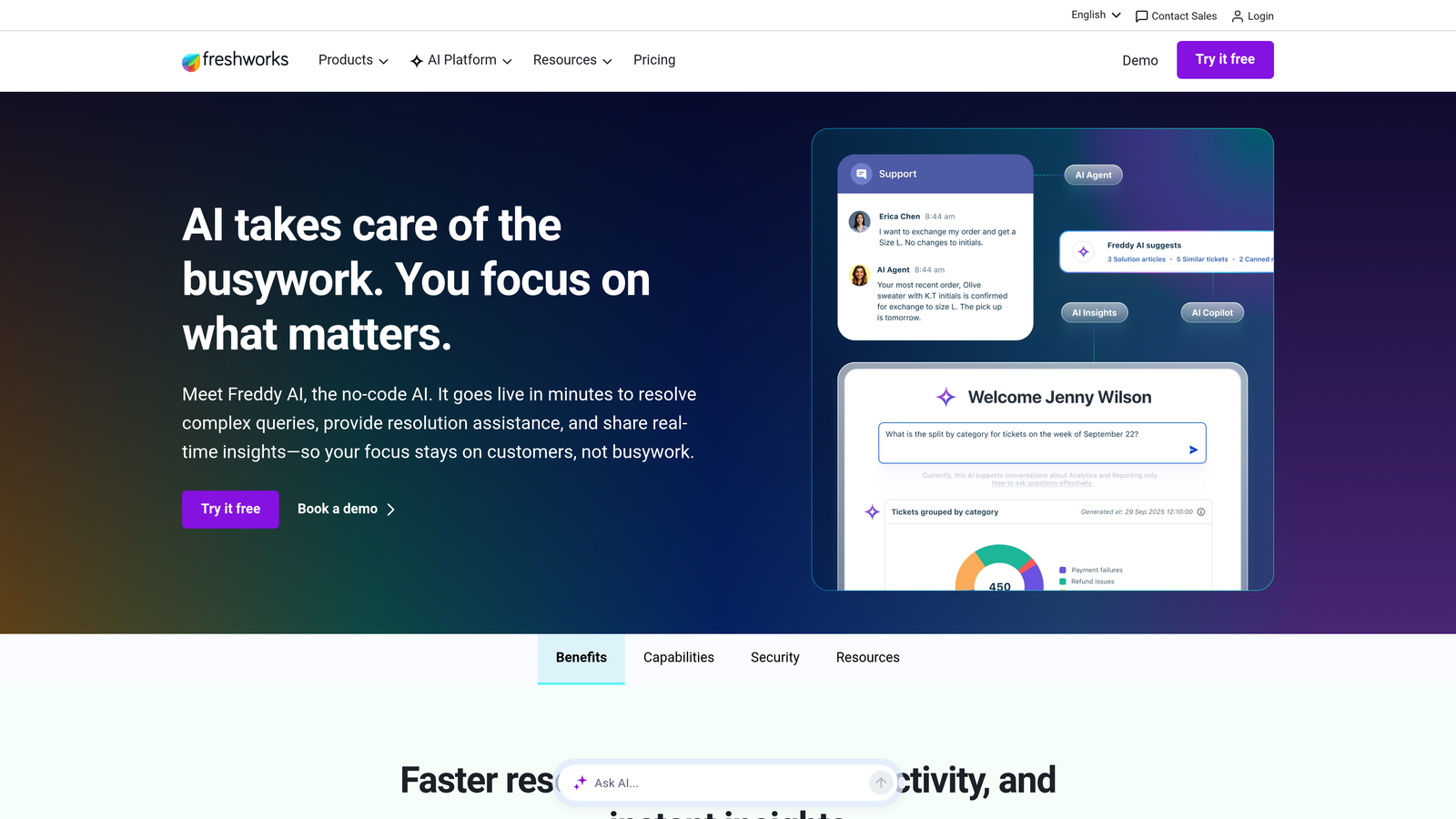
Freshdesk Freddy AI is Freshworks' embedded AI assistant, offering auto-resolution, agent assist, and intent detection across Freshdesk and Freshchat.
Where This Tool Shines
Freddy AI is positioned as the approachable, affordable entry point into AI-powered support. For teams already on Freshdesk, activating Freddy doesn't require a new vendor relationship or complex integration work. The feature set covers the core AI use cases: self-service resolution, in-app agent assist, and smarter ticket routing.
The Freddy Copilot feature is particularly practical for smaller teams where agents handle a wide variety of query types. It drafts replies and summarizes tickets in real time, reducing the cognitive load on agents without requiring full automation.
Key Features
Freddy Self Service: AI bot that resolves common queries without agent involvement, trained on your help content.
Freddy Copilot: In-app assistant that helps agents draft replies, summarize tickets, and identify next steps.
Intent and Sentiment Detection: Classifies incoming tickets for smarter routing and prioritization.
Native Freshdesk Integration: Easy activation for existing Freshworks customers with no separate deployment.
Multilingual Support: Handles queries across multiple languages out of the box.
Best For
SMB SaaS teams already using Freshdesk or Freshchat who want to add AI capabilities without switching platforms or increasing complexity. Freddy AI is a natural first step into AI-assisted support for teams on the Freshworks ecosystem.
Pricing
Available on Growth plans and above; pricing varies by product. See freshworks.com for current details.
5. Drift (Salesloft)
Best for: SaaS teams where support and sales conversations happen on the same channel
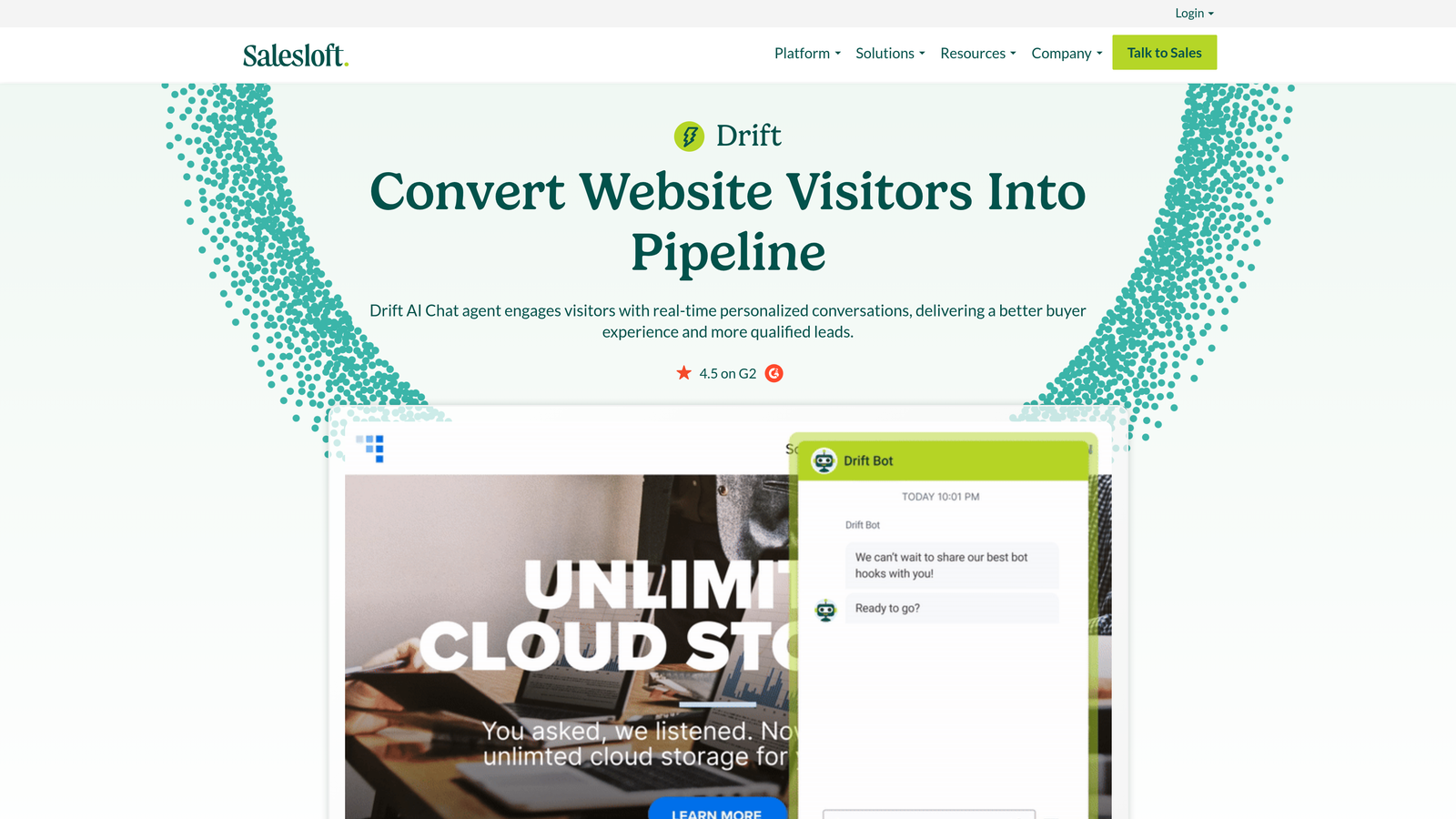
Drift is a conversational platform, now part of Salesloft's revenue suite, that spans sales qualification and support use cases within a single AI-powered chat interface.
Where This Tool Shines
Drift occupies a unique position in this list: it's not a pure support tool, but for SaaS teams where the same chat channel handles both inbound support and pipeline generation, that overlap is actually a strength. Visitor personalization based on CRM signals means the chat experience can adapt dynamically depending on whether someone is a prospect, a trial user, or an existing customer.
Since joining Salesloft, Drift's roadmap has tilted more toward revenue teams. This is worth considering if your primary need is support automation, as the platform's priorities may not align perfectly with a support-first use case.
Key Features
AI-Powered Conversational Chat: Handles both support queries and sales qualification within the same chat interface.
Meeting Booking and Routing: Built-in scheduling flows that route conversations to the right team or rep automatically.
CRM-Based Personalization: Adapts chat behavior based on visitor account data and signals from connected CRM systems.
Revenue Platform Integrations: Native connections to Salesforce, HubSpot, and Marketo for unified pipeline and support data.
Salesloft Revenue Platform: Access to broader revenue intelligence features as part of the Salesloft suite.
Best For
SaaS teams, particularly in PLG or sales-assisted models, where support and sales conversations overlap on the same channel. Less suited for teams that need deep support automation or helpdesk-native workflows.
Pricing
Custom-quoted through Salesloft. Contact drift.com for current pricing information.
6. Tidio Lyro
Best for: Early-stage SaaS teams that need fast AI deployment at an accessible price point
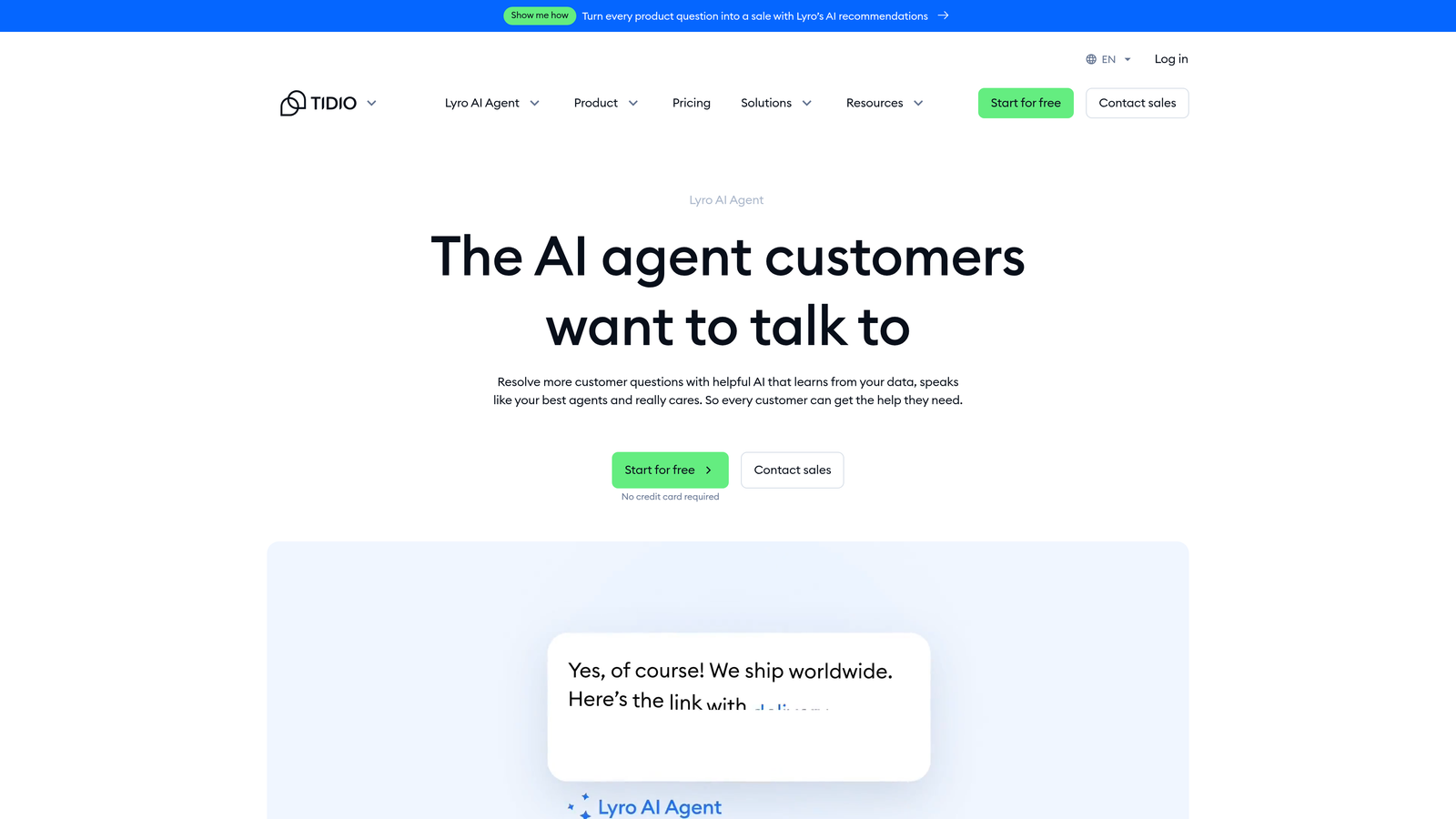
Tidio Lyro is Tidio's conversational AI product, built on Anthropic's Claude, offering natural language support coverage with minimal setup time and startup-friendly pricing.
Where This Tool Shines
Lyro's standout quality is speed to value. It trains on your existing FAQ and help content automatically, which means a small team can have a functioning AI support layer running in hours rather than weeks. The Claude foundation delivers noticeably natural, accurate responses compared to older rule-based alternatives.
For early-stage teams, the pricing model is a genuine differentiator. Lyro is accessible at a price point where many enterprise tools don't even offer a trial, making it a practical starting point before a team's support volume justifies a more complex platform.
Key Features
Claude-Powered Responses: Built on Anthropic's Claude for natural, context-aware conversational quality.
Automatic Content Training: Ingests your FAQ and help documentation automatically to build its knowledge base.
Visual Chatbot Builder: No-code flow builder for non-technical teams to customize conversation paths.
Live Chat Fallback: Seamless handoff to human agents when Lyro reaches the limits of its knowledge.
Startup-Friendly Pricing: Entry-level plans designed for small teams with limited budgets.
Best For
Early-stage and bootstrapped SaaS teams that need AI support coverage quickly without significant engineering investment. Lyro is less suited for teams that need deep SaaS-specific integrations or complex ticket workflow automation.
Pricing
Available on Tidio's paid plans with accessible entry-level pricing. See tidio.com for current plan details.
7. Chatbase
Best for: Product-led SaaS teams that want a custom AI chatbot trained on their own documentation
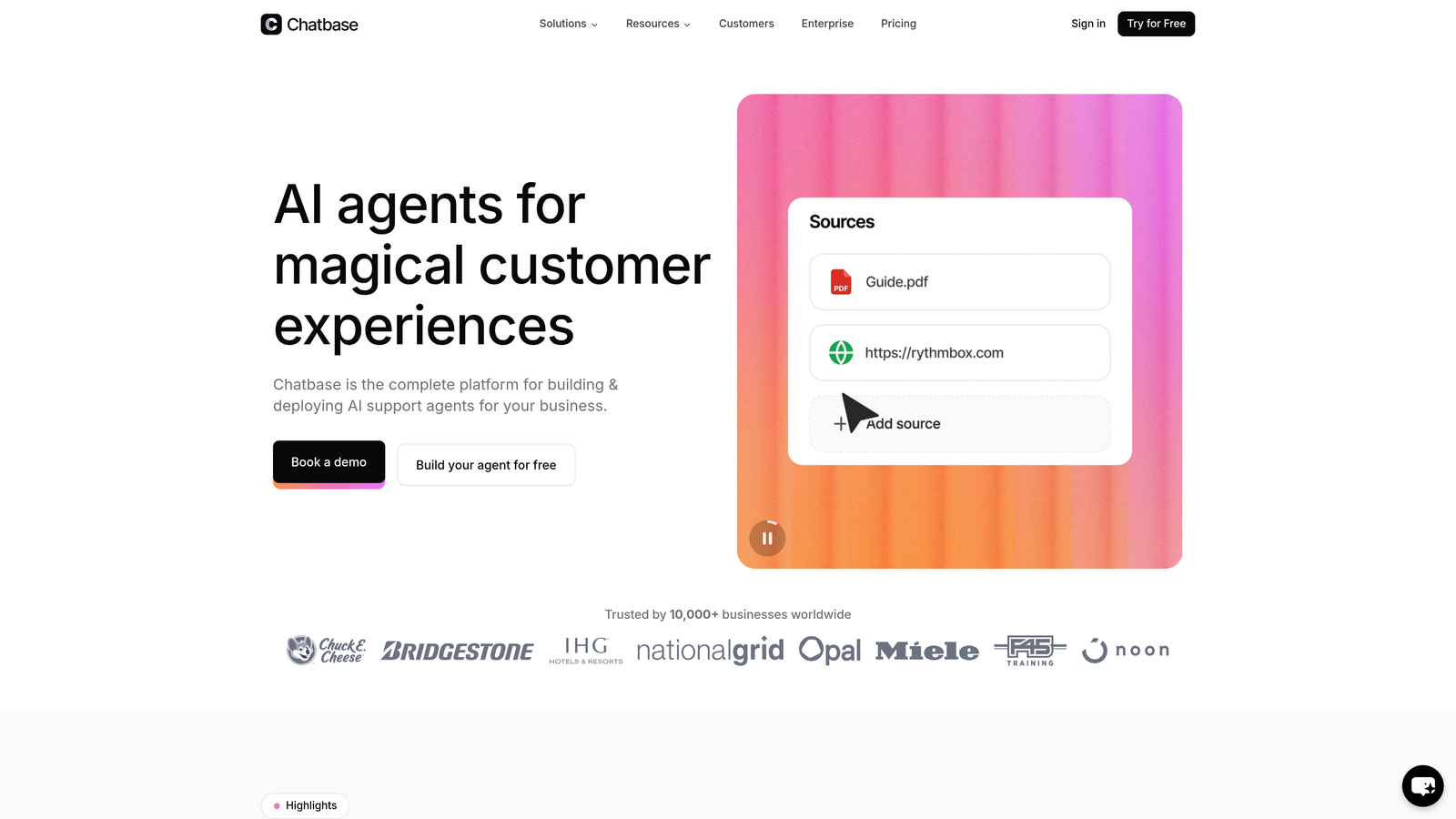
Chatbase is a tool for building custom AI chatbots trained on your existing documentation, URLs, or uploaded files, embeddable on any SaaS product with minimal engineering effort.
Where This Tool Shines
Chatbase solves a specific problem elegantly: turning your existing documentation into a conversational interface. If you have a solid knowledge base, help center, or Notion workspace, Chatbase can transform that content into a queryable chatbot without requiring a dedicated engineering sprint. The setup time is genuinely fast.
The conversation analytics feature is a practical bonus. By tracking where users ask questions that the bot can't answer well, you get a clear signal about gaps in your documentation, which is valuable beyond support alone.
Key Features
Multi-Source Training: Train on docs, PDFs, URLs, or Notion pages in minutes without technical configuration.
Embeddable Widget and API: Deploy as a chat widget or integrate via API into your product directly.
Customizable Personality: Adjust response style, tone, and persona to match your brand voice.
Conversation Analytics: Identifies knowledge gaps by tracking questions the bot handles poorly or can't answer.
Multi-Language Support: Handles queries across multiple languages from a single trained chatbot.
Best For
Documentation-heavy SaaS teams that want self-serve knowledge retrieval without building a full support automation stack. Chatbase is more of a knowledge retrieval layer than a complete ticket management system, so teams needing full workflow automation should pair it with a helpdesk or consider a more comprehensive platform.
Pricing
Free tier available; paid plans at accessible monthly rates. See chatbase.co for current pricing.
8. Ada
Best for: Enterprise SaaS organizations with compliance requirements and complex automation needs
Ada is an enterprise-grade AI automation platform featuring a no-code builder, strong governance controls, and multilingual support designed for larger SaaS organizations operating at scale.
Where This Tool Shines
Ada's enterprise credentials are its primary differentiator. For SaaS companies operating in regulated industries or with strict data governance requirements, Ada's SOC 2 compliance, GDPR controls, and role-based access management provide the guardrails that consumer-grade chatbot tools simply can't match.
The no-code automation builder is genuinely powerful at the enterprise level, enabling support operations teams to build complex decision trees and multi-step automation flows without engineering dependency. The AI performance coaching tools also help teams continuously improve resolution quality over time.
Key Features
No-Code Automation Builder: Non-technical teams can build complex support automation flows without engineering involvement.
Enterprise Governance: SOC 2 compliance, GDPR controls, and role-based access management built in.
Multilingual Support: Handles customer conversations across a wide range of languages at scale.
Deep System Integrations: Connects with CRM, billing, and identity systems for context-rich automated responses.
AI Performance Coaching: Analytics and coaching tools that help teams identify and improve resolution quality gaps.
Best For
Enterprise SaaS companies with compliance requirements, large multilingual customer bases, or complex support automation needs that exceed what SMB-focused tools can handle. The price point reflects this positioning, so smaller teams should evaluate whether the governance features justify the investment.
Pricing
Enterprise pricing with custom quotes. Contact ada.cx for details.
9. Forethought
Best for: SaaS teams that want AI efficiency gains within their existing helpdesk without full automation
Forethought is an AI platform focused on triage, routing, and agent augmentation inside existing helpdesks, ideal for teams that want smarter support operations without replacing their human agents.
Where This Tool Shines
Forethought takes a different philosophical approach from fully autonomous platforms. Rather than replacing agents, it makes them significantly more effective by ensuring every ticket reaches the right person with the right context and suggested resolution already surfaced. For teams where human judgment is important or where ticket complexity is high, this augmentation model is a natural fit.
The workflow intelligence that improves over time with ticket data is a genuine strength. As Forethought processes more of your historical tickets, its classification and routing accuracy improves, which means the efficiency gains compound rather than plateau.
Key Features
Triage AI: Automatically classifies and routes incoming tickets to the right team based on intent and context.
Assist AI: Surfaces relevant knowledge articles and suggested replies for agents during live ticket handling.
Solve AI: Autonomous deflection layer for common, repetitive queries that don't require human involvement.
Native Helpdesk Integrations: Works within Zendesk, Salesforce Service Cloud, and other major helpdesk platforms.
Compounding Workflow Intelligence: Accuracy and routing quality improve continuously as the system processes more ticket data.
Best For
SaaS support teams running established helpdesks (particularly Zendesk or Salesforce) that want AI efficiency gains without a full platform migration. Forethought is also a strong choice for teams handling complex or high-stakes tickets where human judgment should remain in the loop.
Pricing
Enterprise-focused with custom quotes. See forethought.ai for details.
Which AI Chatbot Is Right for Your SaaS Team?
The right tool depends less on which platform has the longest feature list and more on where your team is right now and where you're trying to go.
If you're an early-stage startup that needs AI coverage fast without a complex setup, Tidio Lyro or Chatbase offer the fastest path from zero to functional. Both are accessible on limited budgets and require minimal engineering time to deploy.
If you're already deeply invested in a major helpdesk platform, the native AI layers from Intercom Fin, Zendesk AI, or Freshdesk Freddy AI offer the lowest-friction upgrade path. You're building on infrastructure you already own rather than introducing a new vendor relationship.
For enterprise SaaS organizations with compliance requirements, multilingual customer bases, or complex governance needs, Ada is the most mature option in this category. Teams that want AI efficiency gains without full automation will find Forethought's augmentation model compelling, particularly if they're running Zendesk or Salesforce.
For SaaS teams that want an AI-first platform built for the full complexity of modern product support, Halo AI stands out for a specific reason: it's designed around the reality that support conversations contain more signal than most teams capture. Page-aware context, automatic bug ticket creation, smart inbox intelligence, and deep integrations across the SaaS stack mean you're not just deflecting tickets. You're building a system that gets smarter with every interaction and surfaces insights your product, engineering, and revenue teams can actually use.
Your support team shouldn't scale linearly with your customer base. Let AI agents handle routine tickets, guide users through your product, and surface business intelligence while your team focuses on complex issues that need a human touch. See Halo in action and discover how continuous learning transforms every interaction into smarter, faster support.