9 Best AI Chatbot Support Platforms in 2026
Choosing the right AI chatbot support platform in 2026 means evaluating tools that autonomously resolve tickets, integrate deeply with your tech stack, and scale without adding headcount. This guide compares the nine strongest options for B2B SaaS teams and support organizations, focusing on what actually matters: autonomous resolution rates, learning capabilities, integration depth, and sensible pricing as your support volume grows.
 Grant CooperFounder13 min read
Customer support has changed fundamentally. The rule-based bots of five years ago, the ones that matched keywords and returned FAQ links, have given way to AI agents that understand context, take action, and improve with every conversation. But not every platform has kept pace with that shift.
Choosing the right AI chatbot support platform now comes down to a handful of criteria that actually matter: how autonomously it resolves tickets (not just deflects them), how deeply it integrates with your existing stack, whether it learns over time or stays static, and whether the pricing scales sensibly as you grow.
This list is built for B2B SaaS teams, product-led companies, and support organizations that need to scale without adding headcount. Whether you're evaluating your first AI support tool or replacing a legacy helpdesk setup, these platforms represent the strongest options available in 2026. If you're also exploring the broader landscape of AI customer support automation or thinking about how AI agents differ from traditional chatbots, the tools below cover the full spectrum from enterprise-grade to developer-first.
1. Halo AI
Best for: B2B SaaS teams wanting autonomous ticket resolution with deep product and stack integration
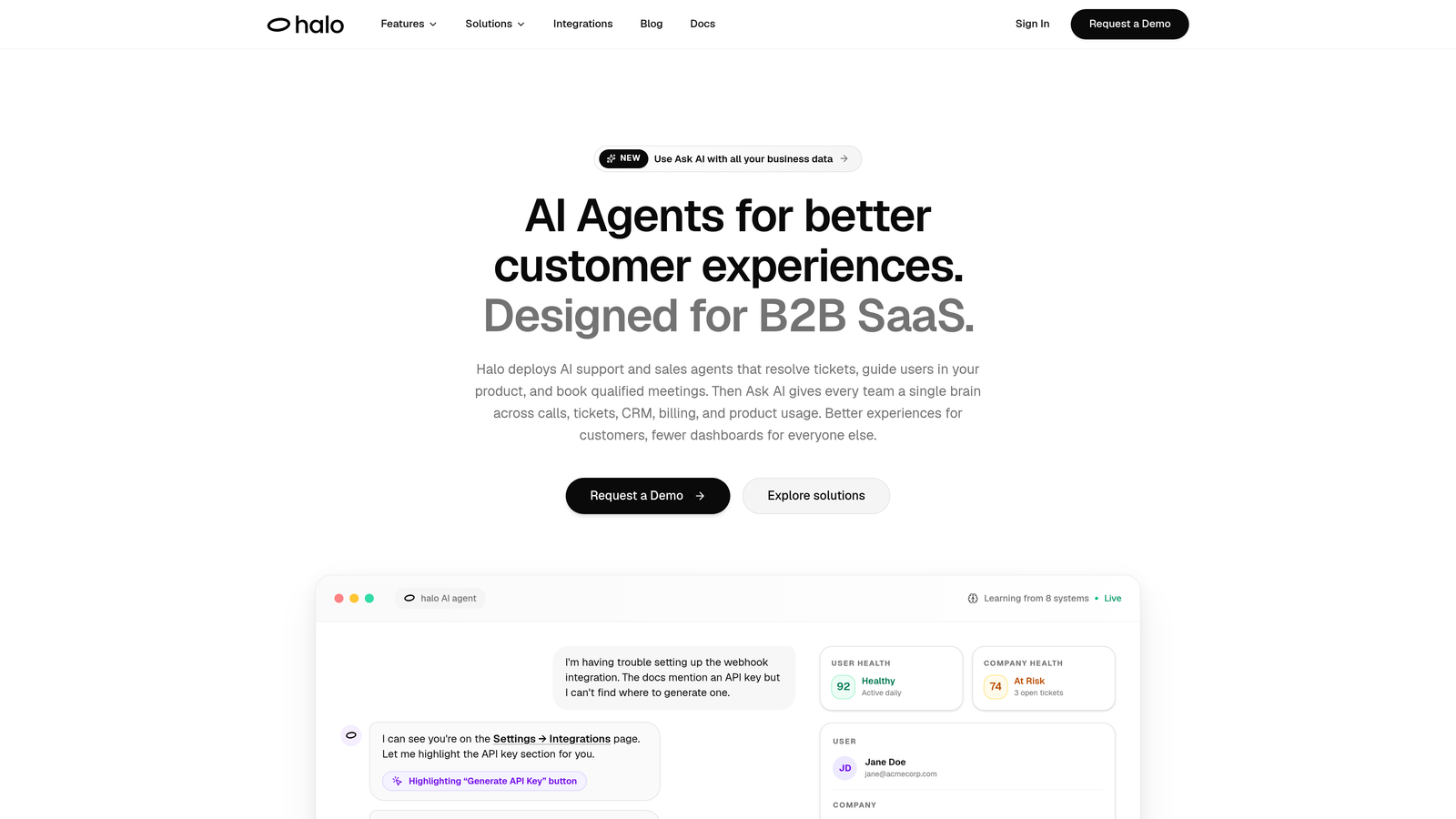
Halo AI is an AI-native customer support platform that deploys intelligent agents to resolve tickets, guide users visually through your product, and surface business intelligence across your entire support operation.
Where This Tool Shines
What separates Halo AI from most platforms on this list is its architecture. It wasn't built by layering AI onto an existing helpdesk. It was designed from the ground up around AI agents, which means the intelligence is core to how it operates, not an add-on feature you unlock at a higher pricing tier.
The page-aware chat widget is a particularly strong differentiator. It sees what the user sees in real time, allowing the AI to provide contextual, visual UI guidance rather than generic help content. Combined with continuous learning from every interaction, the system gets meaningfully smarter without requiring manual retraining from your team.
Key Features
Page-Aware Chat Widget: The AI understands which page a user is on and what they're looking at, enabling precise visual guidance rather than generic responses.
Smart Inbox with Business Intelligence: Goes beyond support metrics to surface customer health signals, revenue intelligence, and anomaly detection across your customer base.
Autonomous Ticket Resolution with Live Agent Handoff: Handles routine tickets end-to-end while escalating complex issues to human agents with full conversation context intact.
Auto Bug Ticket Creation: Automatically identifies and routes bug reports directly to Linear and connected developer tools, closing the loop between support and engineering.
Deep Stack Integrations: Connects natively with Linear, Slack, HubSpot, Intercom, Stripe, Zoom, PandaDoc, and Fathom, making it a hub across your entire business stack rather than a siloed support tool.
Best For
Halo AI is purpose-built for B2B SaaS companies and product-led teams that want their support function to operate as a source of business intelligence, not just a ticket queue. If your team is spending engineering cycles on bug triage or your support agents are manually routing issues between tools, Halo AI addresses both problems simultaneously.
Pricing
Contact Halo AI for pricing. Given its AI-native architecture and deep integration capabilities, it's positioned for teams that want enterprise-level intelligence without enterprise-level headcount.
2. Intercom
Best for: Mid-market SaaS teams wanting unified messaging with AI-assisted query resolution
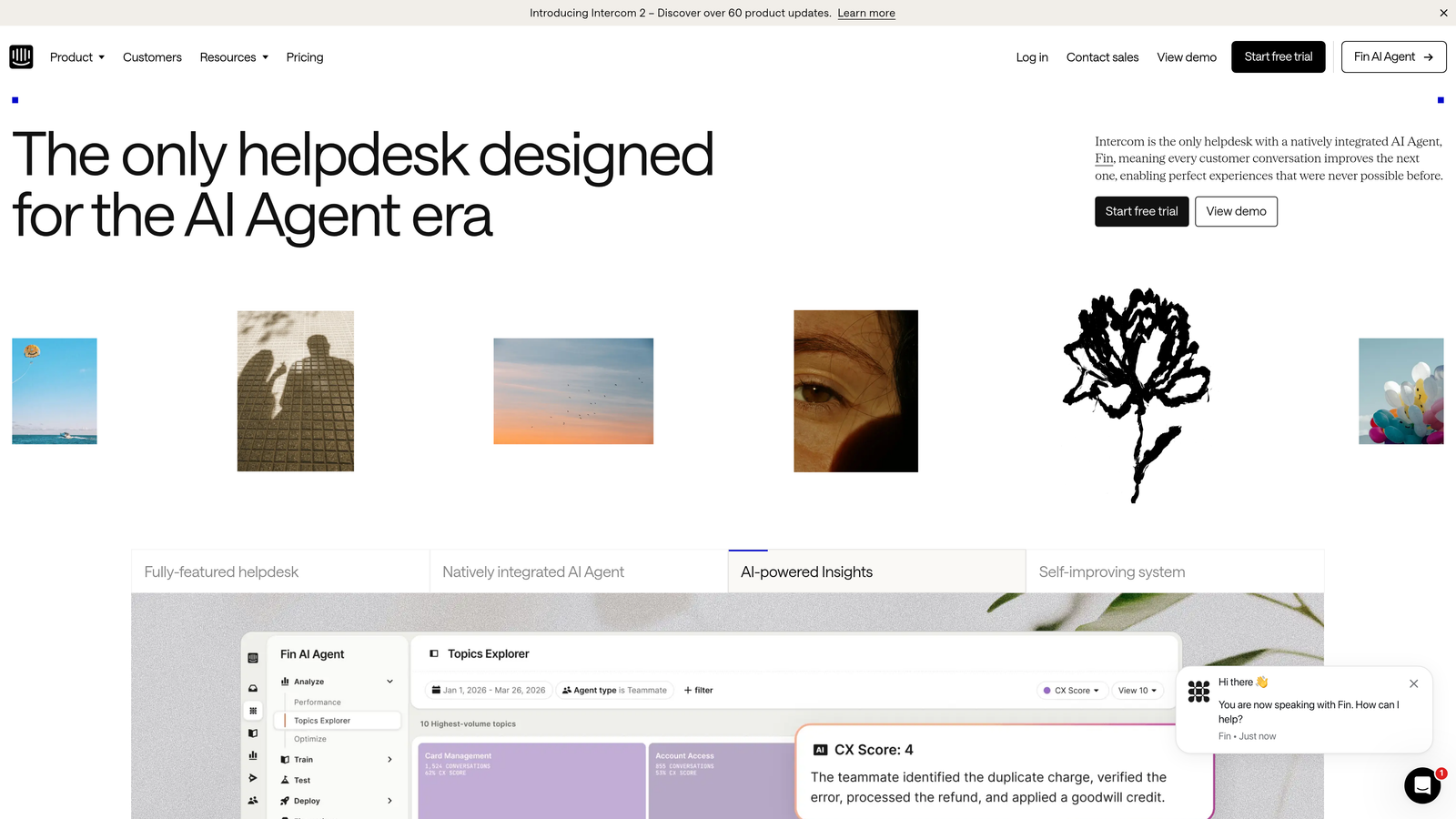
Intercom is a mature conversational support and messaging platform with Fin, its GPT-4 powered AI agent that resolves queries from your help content and hands off seamlessly to human agents.
Where This Tool Shines
Intercom's strength is its unified inbox. Email, chat, and in-app messaging all converge in one place, and Fin sits on top of that infrastructure to handle routine questions automatically. For teams already using Intercom for lifecycle messaging or in-app communication, adding Fin is a natural extension rather than a new tool entirely.
The CRM data context Intercom surfaces during conversations is genuinely useful. Agents and AI alike can see relevant customer attributes, subscription status, and interaction history without switching tabs, which speeds up both automated and human-assisted resolution.
Key Features
Fin AI Agent: GPT-4 powered bot that answers questions directly from your help content with high accuracy and minimal setup.
Unified Inbox: Combines chat, email, and in-app messaging into a single workspace for support teams.
CRM Data Context: Surfaces customer attributes and history within every conversation for richer, faster responses.
Lifecycle Messaging: Supports proactive outreach and onboarding flows alongside reactive support.
App Marketplace: Extensive ecosystem of integrations with CRMs, analytics tools, and developer platforms.
Best For
Mid-market SaaS companies that want a single platform handling both customer messaging and support automation. Particularly strong for teams already invested in Intercom's broader product suite.
Pricing
Usage-based pricing across multiple tiers. Costs can scale quickly as conversation volume and seat count grow. Contact Intercom for current rates specific to your team size.
3. Zendesk AI
Best for: Large enterprise support organizations with complex SLA and compliance requirements
Zendesk AI is an enterprise-grade helpdesk platform with AI capabilities layered across ticket triage, routing, macro suggestions, and a configurable bot builder.
Where This Tool Shines
Zendesk's AI is most valuable in high-volume enterprise environments where the sheer complexity of routing, SLA management, and compliance tooling justifies the platform's weight. Intent detection and sentiment analysis help triage tickets before they reach human agents, reducing the cognitive load on support teams handling thousands of interactions daily.
The tradeoff is that Zendesk's AI is additive rather than foundational. It enhances an existing helpdesk workflow rather than reimagining how support operates. For teams already deeply embedded in Zendesk, that's often the right approach. For teams starting fresh, it may feel like a lot of infrastructure for AI features that newer platforms deliver more natively.
Key Features
AI-Powered Ticket Triage: Detects intent and sentiment to automatically classify and prioritize incoming tickets.
Automated Routing: Routes tickets based on topic, priority, and agent skill sets to reduce manual assignment.
Macro and Response Suggestions: Surfaces relevant canned responses and macros to human agents during live conversations.
Bot Builder: Configurable self-service bot for deflecting common queries before they reach the queue.
SLA and Compliance Tooling: Robust reporting and SLA management built for enterprise governance requirements.
Best For
Large support organizations with established Zendesk infrastructure, complex SLA requirements, and teams that need enterprise-grade compliance and reporting alongside AI capabilities.
Pricing
Per-agent pricing across multiple Suite tiers. AI features are included at higher tiers or available as add-ons. Contact Zendesk for current rates based on team size and feature requirements.
4. Freshdesk Freddy AI
Best for: SMBs already in the Freshworks ecosystem wanting accessible AI without a steep price jump
Freshdesk Freddy AI is Freshworks' AI layer built into Freshdesk, handling intent classification, auto-routing, suggested replies, and a self-service chatbot for teams at accessible price points.
Where This Tool Shines
Freddy AI's strongest selling point is accessibility. For smaller teams already using Freshdesk, enabling AI features doesn't require switching platforms or renegotiating contracts. The Freddy Self Service bot deflects common queries, and Agent Assist surfaces suggested replies that help human agents respond faster without starting from scratch.
The free tier makes it genuinely low-risk to trial. Teams can validate whether AI deflection moves the needle on their ticket volume before committing to higher-tier plans where Freddy's full capabilities unlock.
Key Features
Freddy Self Service Bot: Handles common queries automatically, reducing ticket volume before issues reach human agents.
Intent Detection and Smart Routing: Classifies incoming tickets by intent and routes them to the right team or agent.
Agent Assist: Provides suggested replies and next-best-action recommendations to human agents in real time.
Freddy Insights Dashboard: Analytics layer that surfaces trends and performance data across your support operation.
Free Tier Available: Entry-level access with paid upgrades for full AI feature sets.
Best For
SMBs and growing teams already invested in the Freshworks ecosystem who want AI capabilities without migrating to a new platform. Less suited for teams needing deep autonomous action or complex multi-system integrations.
Pricing
Free tier available. Freddy AI features are included in higher-tier plans or available as an add-on. Check the Freshworks pricing page for current rates.
5. Drift
Best for: B2B companies where sales qualification and support automation overlap in the same conversation
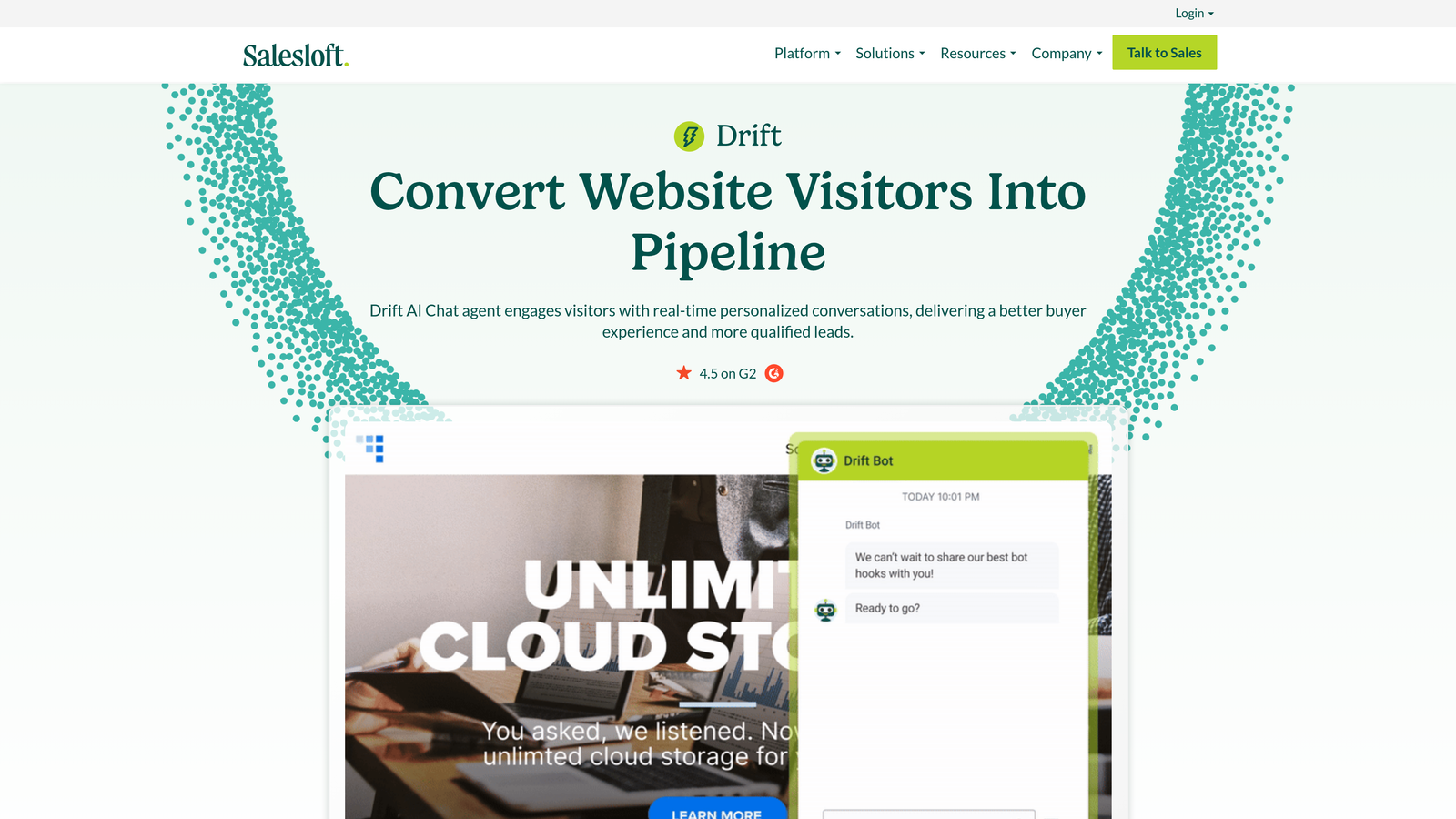
Drift is a conversational AI platform that blends support automation with revenue qualification, handling queries, booking meetings, and qualifying leads within a single conversation flow.
Where This Tool Shines
Drift occupies a unique position in this list because it was never purely a support tool. Its AI handles support queries, but it also identifies high-value accounts, routes them to sales, and books demos without human intervention. For B2B companies where the line between support and sales is blurry, that convergence is genuinely useful.
Following its acquisition by Salesloft, Drift's positioning has shifted further toward revenue-focused conversational AI. Teams evaluating it purely for support volume reduction may find the feature set broader than they need, but for revenue teams that want support automation as part of a larger go-to-market motion, it fits well.
Key Features
Conversational AI Bots: Handles both support queries and lead qualification within unified conversation flows.
Meeting Scheduling Integration: Books demos and sales meetings directly inside chat without human handoff.
Account-Based Targeting: Identifies and prioritizes high-value visitors for personalized engagement.
CRM Integrations: Deep connections with Salesforce, HubSpot, and major CRM platforms.
Revenue Analytics: Tracks pipeline influence and revenue metrics alongside standard support data.
Best For
B2B companies with overlapping sales and support motions, particularly those using account-based marketing strategies where the same conversation tool serves both functions.
Pricing
Enterprise pricing. Contact Drift or Salesloft directly for current rates and packaging options.
6. Tidio
Best for: E-commerce businesses and small teams needing fast AI chatbot deployment without technical resources
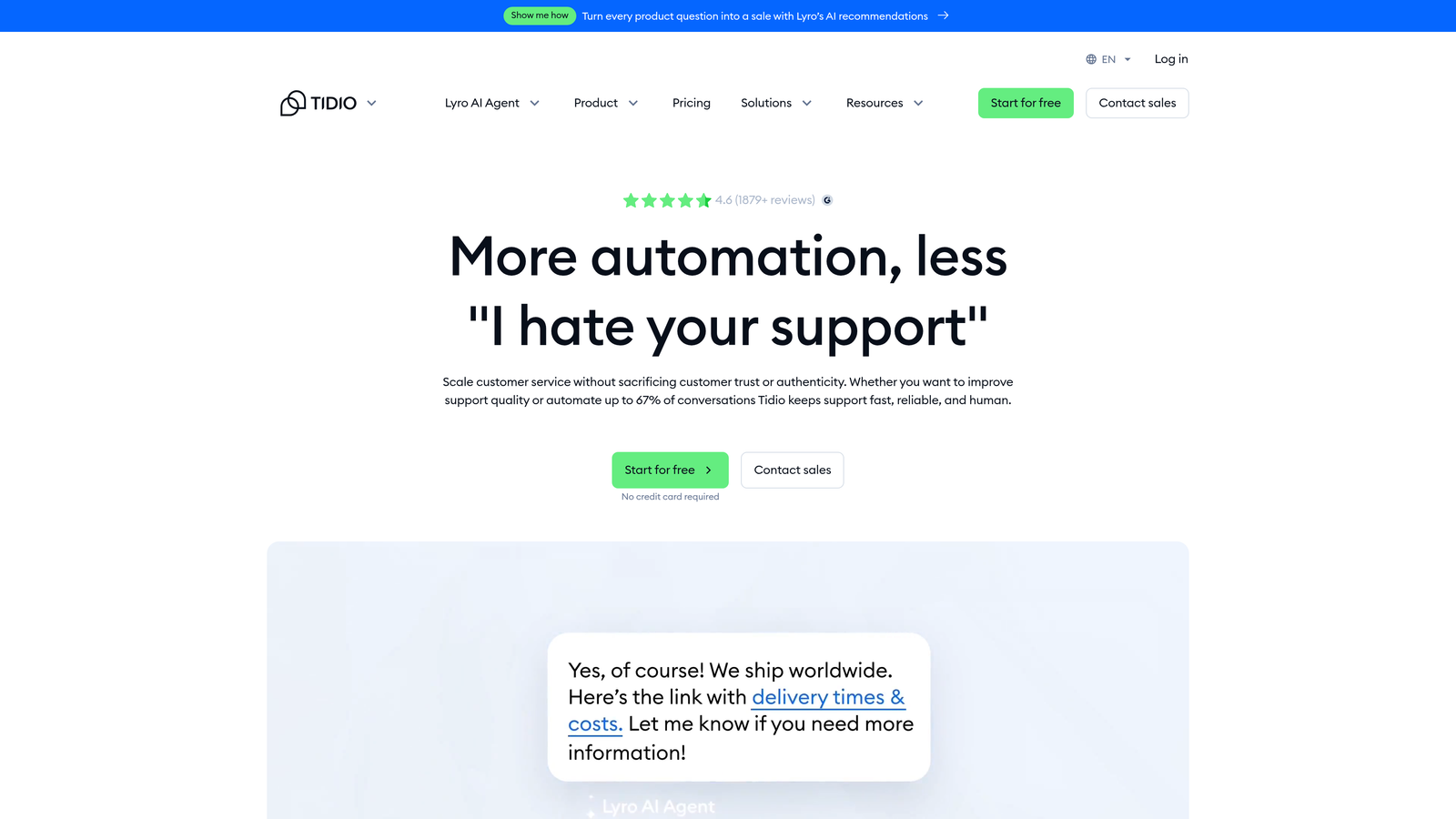
Tidio is an accessible chatbot and live chat platform with Lyro, its AI chatbot designed for rapid deployment with no-code setup and strong e-commerce integrations.
Where This Tool Shines
Tidio's core advantage is speed to value. Lyro can be deployed and handling queries within hours rather than days, making it one of the fastest paths from signup to automated support on this list. For small teams without dedicated technical resources, the no-code setup removes a barrier that often delays AI adoption.
The native Shopify and WooCommerce integrations make Tidio particularly well-suited for e-commerce contexts, where order status, returns, and product questions represent a large share of support volume. It's less optimized for complex B2B SaaS workflows or deep enterprise integrations.
Key Features
Lyro AI Chatbot: Automated query handling with conversational AI and no-code configuration.
Live Chat with Bot-to-Human Handoff: Smooth transition from automated to human support when queries exceed the bot's capability.
E-Commerce Integrations: Native connections with Shopify and WooCommerce for order and product context.
Visual Flow Builder: Drag-and-drop chatbot flow builder for custom automation without coding.
Free Tier: Entry-level access suitable for small teams testing AI chatbot automation.
Best For
Small e-commerce businesses, startups, and teams that need quick deployment over deep customization. Not the right fit for B2B SaaS teams with complex integration requirements or enterprise-scale support operations.
Pricing
Free tier available. Paid plans start at a low monthly cost. Check the Tidio pricing page for current rates and feature breakdowns.
7. Ada
Best for: Enterprise teams needing action-capable AI agents across global, multilingual customer bases
Ada is an enterprise no-code AI agent platform that enables support teams to build agents that take action, not just answer questions, across 50+ languages without engineering dependency.
Where This Tool Shines
Ada's distinction is the gap it closes between answering and doing. Most chatbot platforms resolve questions by returning information. Ada's agents can take actions: updating records, triggering workflows, and completing multi-step processes on behalf of the user. That action-capability is what separates genuine AI agents from sophisticated FAQ bots.
The no-code builder means support teams can build and iterate on these agents without waiting on engineering. For global organizations, 50+ language support removes the localization bottleneck that often limits AI adoption in international markets.
Key Features
Action-Based AI Agents: Agents perform tasks and complete workflows, not just surface answers to questions.
No-Code Agent Builder: Non-technical teams can build, test, and deploy agents without engineering involvement.
50+ Language Support: Multilingual capability for global customer bases without separate configurations per region.
CRM and Helpdesk Integrations: Connects with major CRMs, helpdesks, and data platforms for rich context during interactions.
Enterprise Analytics: Performance reporting and optimization tools built for large-scale deployments.
Best For
Large consumer-facing enterprises and global organizations that need AI agents capable of completing tasks autonomously across multiple languages and channels without ongoing engineering involvement.
Pricing
Enterprise pricing. Contact Ada directly for current rates and implementation details.
8. Kustomer
Best for: High-volume, omnichannel support teams that need rich customer context in every AI interaction
Kustomer is a CRM-native customer support platform where every conversation is enriched with the full customer timeline, giving AI agents deep context across orders, interactions, and attributes.
Where This Tool Shines
Kustomer's architecture puts the customer record at the center of every interaction. Where most support platforms show conversation history, Kustomer surfaces a unified timeline: orders, past interactions, subscription data, and custom attributes all visible in a single view. For AI-assisted support, that context depth translates to more relevant, accurate responses.
The omnichannel coverage is also genuinely broad. Chat, email, social, SMS, and voice all feed into the same unified workspace, which reduces the fragmentation that plagues teams managing multiple support channels separately.
Key Features
CRM-Native Architecture: Full customer timeline visible in every conversation, including orders, interactions, and custom attributes.
AI-Powered Routing and Triage: Intelligent routing and suggested responses informed by customer context, not just conversation content.
Omnichannel Support: Unified workspace across chat, email, social media, SMS, and voice channels.
Workflow Automation: Multi-step automation for complex support processes that span multiple systems.
Customer Lifetime Value Reporting: Connects support metrics to revenue and customer value data for business-level insight.
Best For
High-volume support teams in e-commerce, consumer SaaS, or subscription businesses where customer history is critical context for every interaction. Less suited for pure B2B SaaS teams with simpler customer data models.
Pricing
Per-agent pricing at enterprise-focused rates. Contact Kustomer for current pricing and packaging.
9. Botpress
Best for: Developer teams building bespoke support automation with full control over conversation logic
Botpress is an open-source, developer-first chatbot framework with LLM integration that gives technical teams complete control over conversation flows and AI logic without vendor lock-in.
Where This Tool Shines
Botpress sits at the opposite end of the spectrum from no-code platforms. Where tools like Ada or Tidio prioritize accessibility, Botpress prioritizes control. Developers can design conversation flows visually, then drop into code for custom logic, LLM prompting, and integration with any external system. That flexibility makes it genuinely powerful for teams with specific requirements that off-the-shelf platforms can't satisfy.
The open-source foundation also eliminates vendor lock-in, which matters for organizations with long-term infrastructure concerns. You own your deployment, your data, and your conversation logic. The tradeoff is that implementation requires real technical investment. It's not a tool you configure in an afternoon.
Key Features
Open-Source Foundation with LLM Integration: Integrates with GPT-4 and other LLMs while remaining fully customizable at the code level.
Visual Flow Builder Plus Code Access: Design flows visually for speed, then extend with custom code for complex logic.
Multi-Channel Deployment: Deploy across web, WhatsApp, Slack, and other channels from a single codebase.
Community and Plugin Ecosystem: Large open-source community with reusable plugins and shared components.
Free Self-Hosted Tier: Full open-source access at no cost for teams that manage their own infrastructure.
Best For
Engineering teams and technical organizations building highly customized support automation where off-the-shelf solutions don't fit the use case. Requires development resources to implement and maintain effectively.
Pricing
Free open-source tier for self-hosted deployments. Cloud and enterprise plans available for teams that want managed infrastructure. Check the Botpress pricing page for current rates.
Which Platform Is Right for Your Team
The best AI chatbot support platform isn't the one with the most features. It's the one that resolves tickets autonomously rather than just deflecting them, and that fits the way your team actually works.
Here's a practical way to cut through the options:
B2B SaaS team wanting full autonomy and business intelligence: Halo AI is built for this. Page-aware context, continuous learning, deep stack integrations, and a smart inbox that surfaces revenue signals alongside support data make it the strongest fit for product-led teams scaling without adding headcount.
Enterprise organization already on Zendesk: Zendesk AI adds meaningful intelligence to an existing investment without a platform migration. Best when your team is too embedded in Zendesk workflows to consider switching.
SMB on Freshdesk with budget constraints: Freddy AI unlocks solid automation within a familiar environment at an accessible price point. A reasonable first step into AI-assisted support.
Global enterprise needing multilingual action-capable agents: Ada's no-code builder and 50+ language support make it the strongest choice for large consumer-facing organizations.
Developer team wanting full control: Botpress gives technical teams the flexibility to build exactly what they need without vendor constraints.
E-commerce or small team wanting fast deployment: Tidio gets you from signup to automated support quickly with minimal technical overhead.
Across all of these, the underlying principle holds: your support team shouldn't scale linearly with your customer base. The platforms that deliver real ROI are the ones that resolve issues end-to-end, not just route them to a human faster.
If you're evaluating AI-native support that handles tickets autonomously, guides users through your product visually, and surfaces the kind of intelligence that informs your whole business, See Halo in action and discover how continuous learning transforms every interaction into smarter, faster support.