9 Best AI Customer Experience Platforms in 2026
Discover the 9 best AI customer experience platforms of 2026, evaluated across AI sophistication, integration capabilities, and B2B scalability. This guide breaks down top solutions—from autonomous ticket resolution to predictive analytics—helping teams identify the right platform based on their specific customer engagement priorities.
 Grant CooperFounder14 min read
Customer experience has become the defining competitive advantage for B2B companies, and AI is now at the center of how teams deliver it. From resolving support tickets autonomously to surfacing real-time customer health signals, AI customer experience platforms are transforming how businesses interact with their users at every touchpoint.
But the market has exploded with options, and not every platform approaches the problem the same way. Some focus on conversational AI for support, others on journey orchestration, and others on predictive analytics. Choosing the right one depends on your team's priorities: Do you need autonomous ticket resolution? Omnichannel engagement? Deep analytics?
We evaluated dozens of platforms and narrowed the field to nine that stand out in 2026. Our selection criteria included AI sophistication, integration ecosystem, ease of deployment, scalability for B2B use cases, and the ability to turn customer interactions into actionable business intelligence. Here are the best AI customer experience platforms available today.
1. Halo AI
Best for: B2B SaaS teams that want autonomous ticket resolution and business intelligence from support interactions.
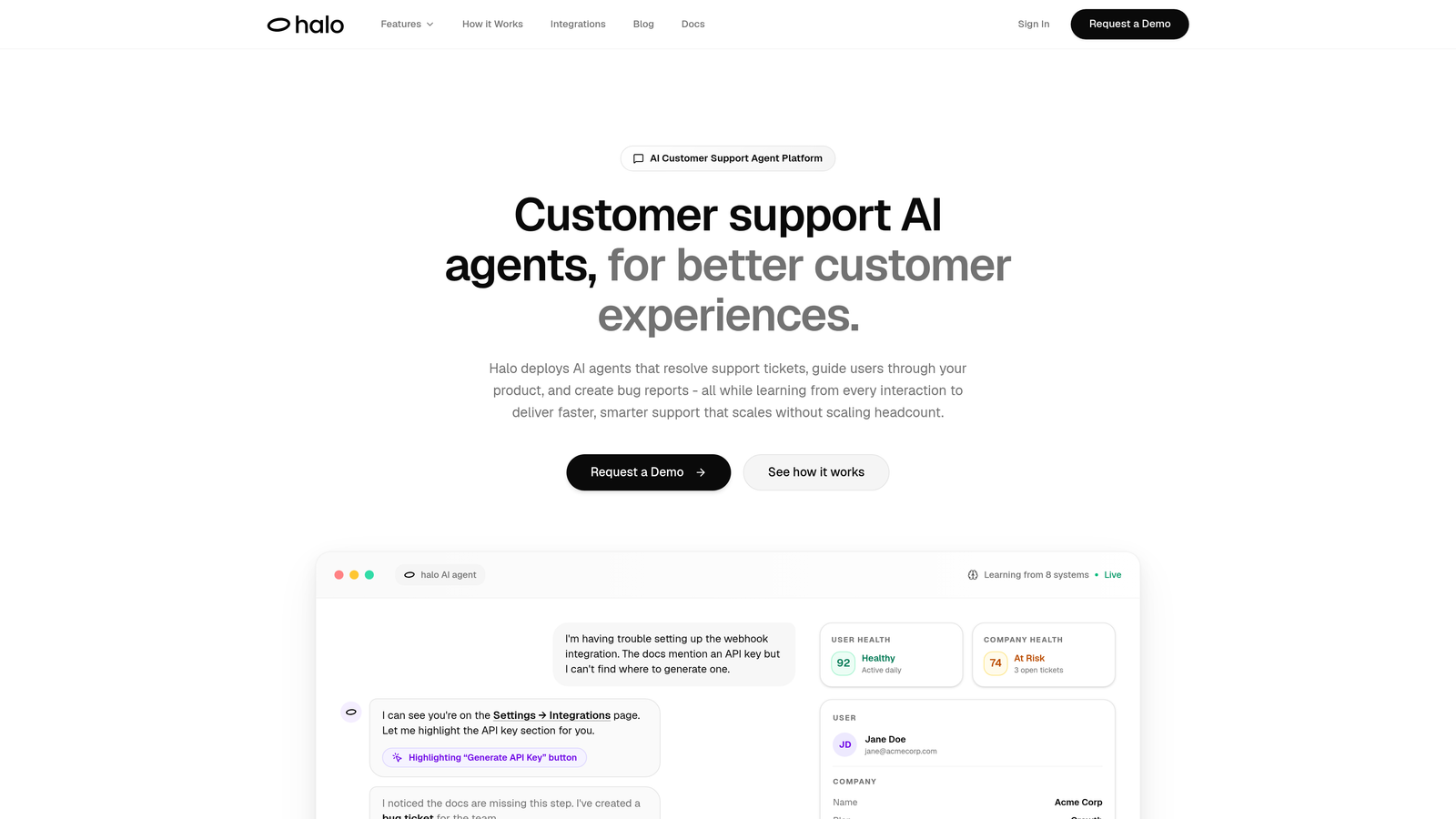
Halo AI is an AI-native customer support platform that deploys autonomous agents to resolve tickets, guide users through your product with page-aware context, and surface business intelligence from every interaction.
Where This Tool Shines
Halo AI is built AI-first, not AI-added. That distinction matters more than it might sound. Most platforms on this list started as helpdesks or CRMs and layered AI on top. Halo was architected from the ground up around autonomous agents, which means the intelligence isn't a feature you activate. It's the foundation everything else runs on.
What genuinely separates Halo from the crowd is its page-aware context engine. The chat widget doesn't just respond to what users type. It sees what users see, understanding which page or product state they're in and delivering visual UI guidance accordingly. Pair that with a smart inbox that surfaces customer health signals and revenue anomalies, and you're getting business intelligence well beyond what a traditional support tool provides.
Key Features
Autonomous AI Agents: Resolve support tickets end-to-end without human intervention, learning continuously from every interaction to improve over time.
Page-Aware Chat Widget: Understands the user's current product context to deliver precise, visual guidance rather than generic answers.
Smart Inbox with Business Intelligence: Surfaces customer health signals, anomaly detection, and revenue intelligence directly from support data.
Auto Bug Ticket Creation: Automatically creates and routes bug reports with direct Linear integration, eliminating manual handoffs between support and engineering.
Live Agent Handoff: Escalates complex issues to human agents with full conversation context transferred, so nothing gets lost in the handoff.
Best For
Halo AI is the strongest fit for B2B SaaS companies that want to scale support capacity without scaling headcount. It's particularly well-suited for product teams who want their support layer to feed back into product development through automated bug reporting and customer health signals. Companies already using Linear, Slack, HubSpot, Intercom, Stripe, or Zoom will find the integration ecosystem immediately useful.
Pricing
Contact for pricing; a demo is available directly through the website. Given the platform's AI-native architecture and business intelligence capabilities, it's positioned for teams that view support as a strategic function rather than a cost center.
2. Zendesk AI
Best for: Established support teams looking to add AI capabilities to an existing Zendesk deployment.
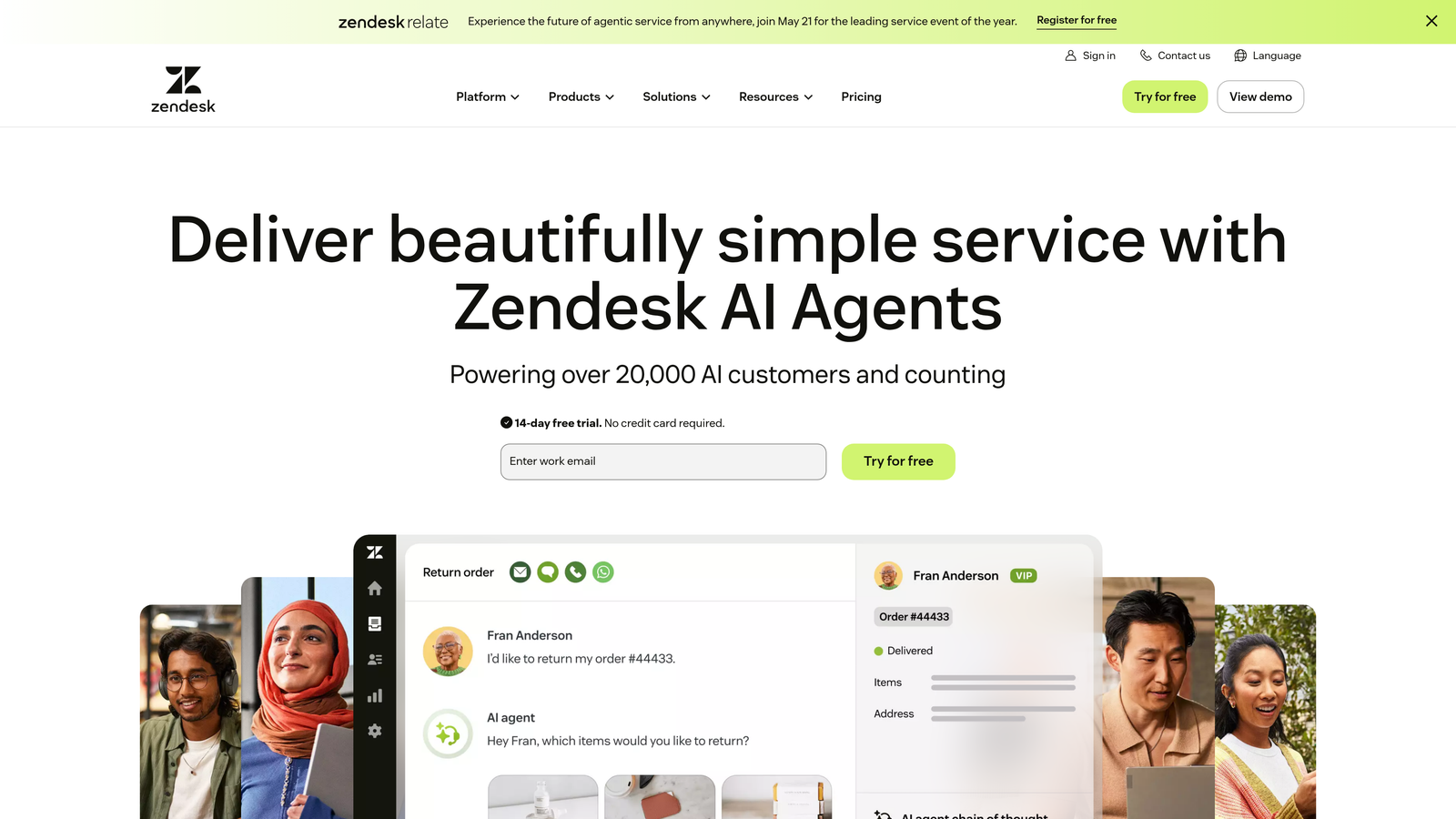
Zendesk AI is a suite of AI capabilities layered across Zendesk's helpdesk platform, covering self-service agents, agent copilot assistance, and intelligent ticket triage.
Where This Tool Shines
Zendesk's strength is its ecosystem. If your team is already operating inside Zendesk Support, Guide, Chat, and Talk, the AI layer activates across all of them without requiring a platform migration. That's a significant operational advantage for teams with established workflows and large knowledge bases already built out in Zendesk.
The agent copilot is particularly useful for teams handling complex, high-volume queues. Rather than replacing agents, it accelerates them with suggested replies and next-best-action guidance, making it a good fit for organizations that want to augment human performance rather than fully automate resolution.
Key Features
AI Agents for Self-Service: Automated resolution across email, chat, and messaging channels using existing help center content.
Agent Copilot: Provides suggested replies and next-best-action recommendations to help human agents work faster and more consistently.
Intelligent Triage: Automatically detects intent, sentiment, and language to route tickets to the right queue or agent.
Generative AI Knowledge Suggestions: Surfaces and suggests knowledge base articles during live interactions for both agents and customers.
Suite-Wide Integration: AI capabilities span the entire Zendesk product suite for a consistent experience across channels.
Best For
Teams already invested in the Zendesk ecosystem who want to incrementally add AI capabilities without a platform change. Less ideal for teams seeking a fully autonomous, AI-first architecture from the ground up.
Pricing
AI features are available on Suite Professional and above; an AI add-on is available with pricing that varies by feature set. Contact Zendesk for current tier details.
3. Intercom Fin
Best for: Product-led growth companies that want AI support tightly integrated with in-product engagement.
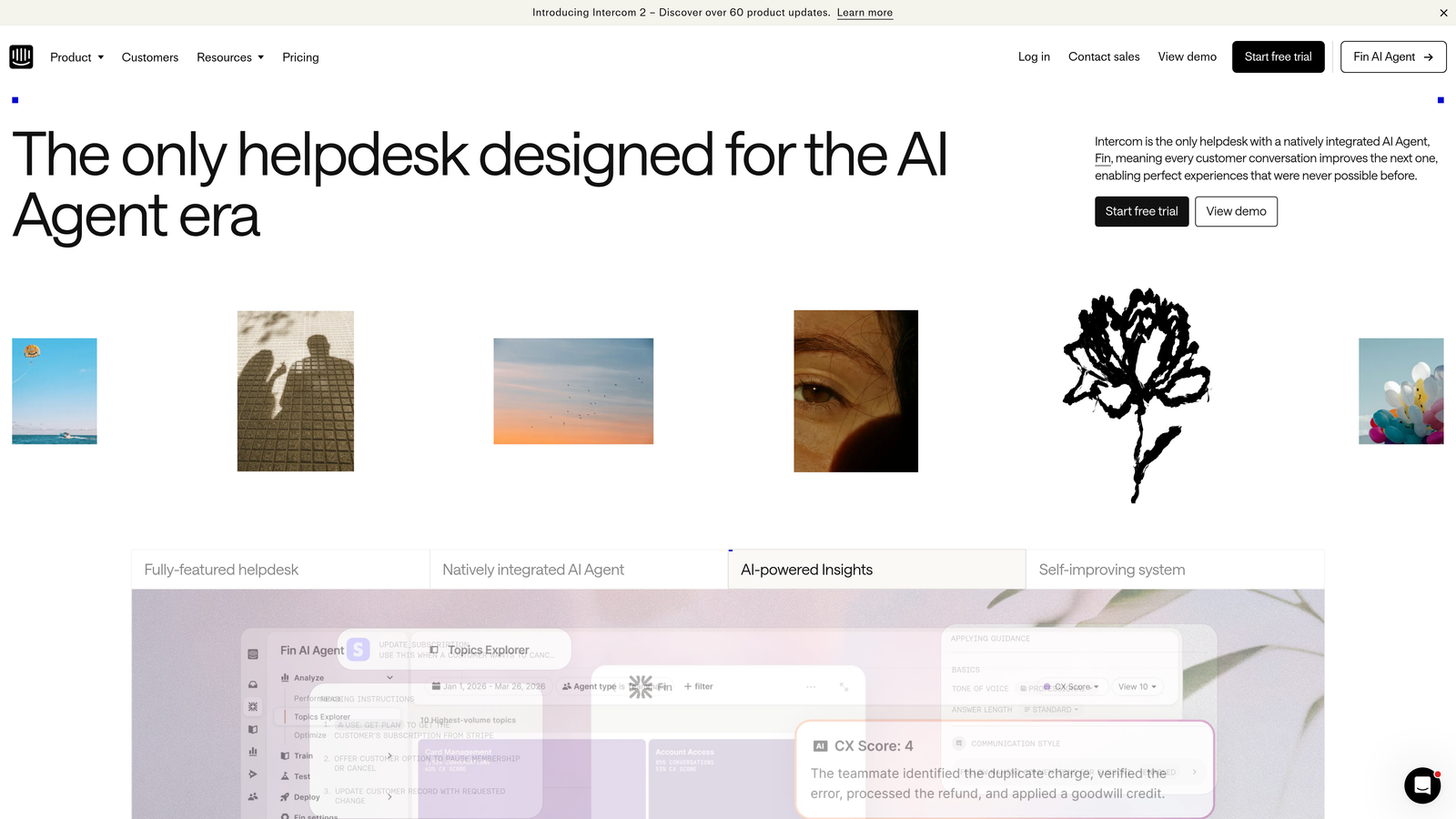
Intercom Fin is Intercom's AI agent that resolves customer questions using your help center and custom content, with seamless handoff to human agents within Intercom's messaging platform.
Where This Tool Shines
Fin's biggest advantage is how naturally it fits into Intercom's broader product engagement toolkit. If you're already using Intercom for in-app messaging, product tours, and onboarding flows, Fin extends that infrastructure into support resolution without requiring a separate tool. The experience feels cohesive to the end user rather than a bolted-on chatbot.
The per-resolution pricing model is worth noting. For teams with predictable, lower-volume support needs, it can be cost-effective. For high-volume operations, costs can scale quickly, so it's worth modeling your expected resolution volume before committing.
Key Features
Fin AI Agent: Trained on your help center content to deliver instant, accurate resolutions without human intervention.
In-App Messaging Integration: Connects support with product tours and onboarding flows for a unified in-product experience.
AI Copilot for Agents: Provides conversation summarization and suggested responses to help human agents close tickets faster.
Custom Answers and Workflows: Handles complex, multi-step queries through configurable conversation flows.
Product-Led Growth Alignment: Designed to support PLG motions with in-product engagement tools built into the same platform.
Best For
SaaS companies with a strong PLG motion that want support, onboarding, and in-product messaging managed from a single platform. Teams with highly variable support volumes should evaluate the per-resolution pricing model carefully.
Pricing
Fin AI agent is charged per resolution. Intercom plans start at $39/seat/month, with Fin costs layered on top depending on usage volume.
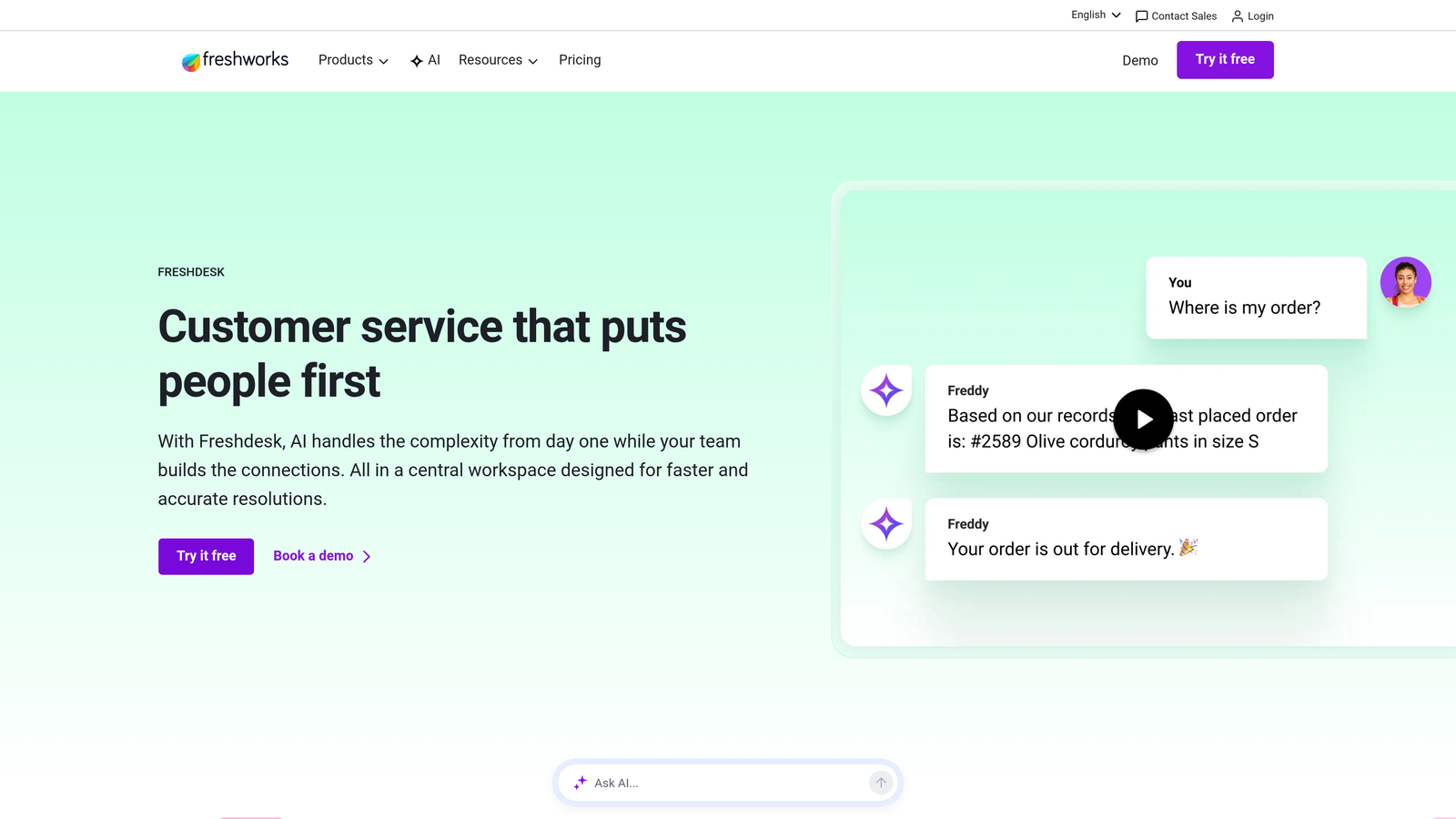
4. Freshdesk Freddy AI
Best for: Mid-market teams that need omnichannel AI support without enterprise-level pricing.
Freshdesk Freddy AI is Freshworks' AI engine powering self-service bots, agent assistance, and analytics across the Freshdesk helpdesk platform with accessible mid-market pricing.
Where This Tool Shines
Freshdesk's value proposition is breadth at a reasonable price point. Freddy AI covers ticket deflection, agent assist, and analytics across email, chat, phone, social, and messaging channels. For a mid-market team that needs omnichannel coverage without paying enterprise software prices, it's one of the more balanced options on this list.
The free tier also makes it genuinely accessible for smaller teams or those evaluating AI support tooling for the first time. You can test the platform's capabilities before committing to a paid plan, which reduces the risk of a misaligned purchase.
Key Features
Freddy AI Agent: Automated ticket deflection and self-service resolution using your knowledge base content.
Agent Assist: Canned response suggestions and auto-triage to help agents resolve tickets faster.
Omnichannel Support: Covers email, chat, phone, social, and messaging from a single platform.
AI-Powered Analytics: Customer satisfaction insights and reporting powered by Freddy's analytics layer.
Marketplace Integrations: Connects with CRM, project management, and business tools through Freshworks' integration marketplace.
Best For
Growing mid-market companies that need solid omnichannel coverage with AI assistance at a price point that doesn't require a large budget. Also a good starting point for teams new to AI support tooling.
Pricing
Free tier available. Pro plan starts at $49/agent/month, with Freddy AI add-ons priced separately depending on the features required.
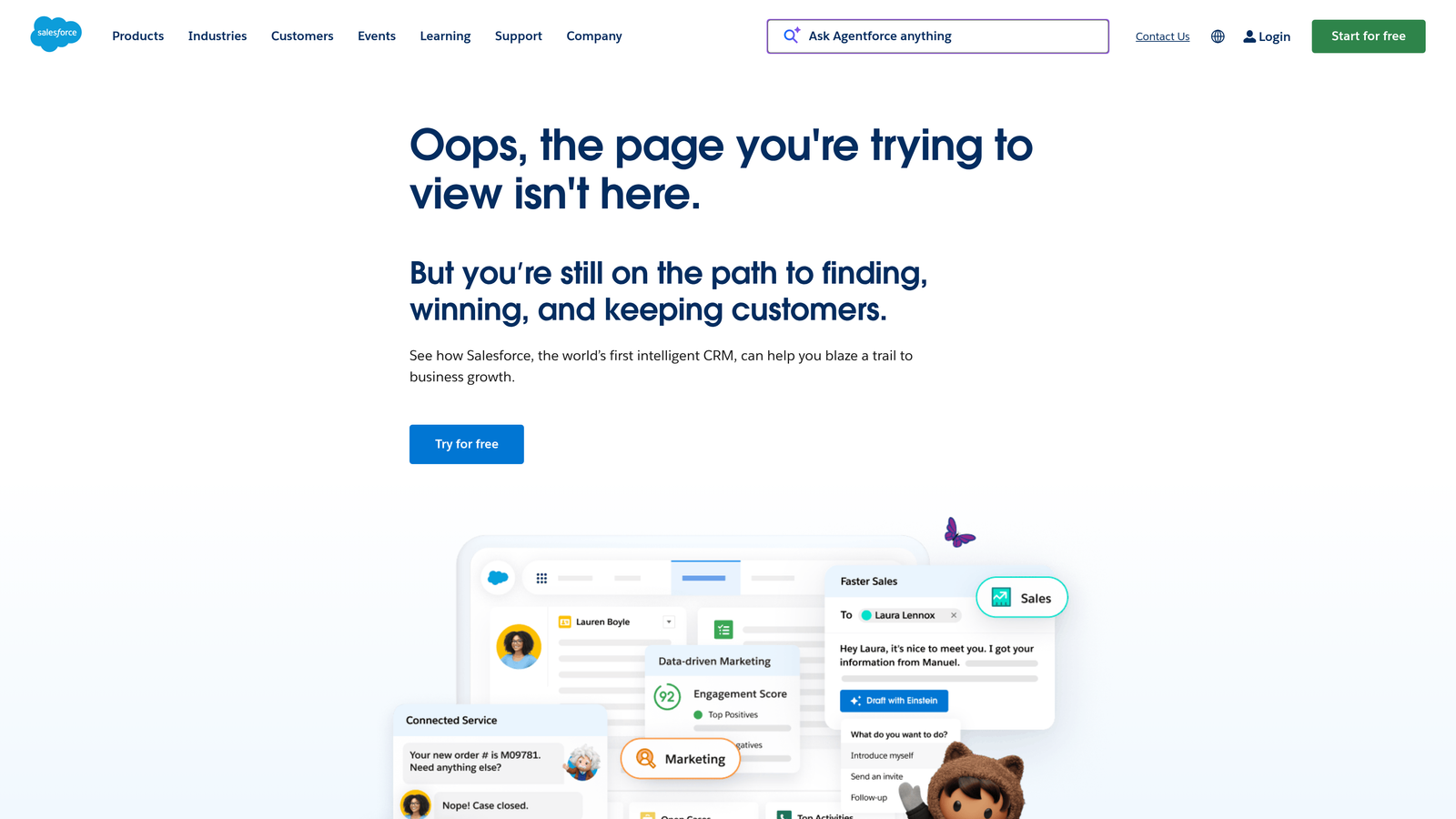
5. Salesforce Einstein for Service
Best for: Enterprise organizations already running Salesforce CRM that want AI service capabilities unified with their sales and marketing data.
Salesforce Einstein for Service delivers AI-powered service capabilities within Service Cloud, leveraging the full Salesforce CRM data model for predictive routing, generative replies, and case intelligence.
Where This Tool Shines
The defining advantage here is data unification. When your service AI has access to the same customer record that your sales and marketing teams use, the quality of context available for every interaction is fundamentally different. Einstein can ground its generative replies and routing decisions in a complete customer history rather than just recent support tickets.
Agentforce, Salesforce's newer platform for building custom AI service agents, adds significant flexibility for enterprises with complex service workflows. It's a powerful option for organizations with the technical resources to configure and maintain custom agents.
Key Features
Predictive Case Classification and Routing: Einstein AI automatically classifies and routes cases based on historical patterns and CRM data.
Generative AI Replies: Grounded in both CRM data and knowledge base content for context-rich, accurate responses.
Unified Customer View: Aggregates data across sales, marketing, and service interactions in a single record.
Einstein Bots: Automated self-service across channels, configurable within the Salesforce environment.
Agentforce: A platform for building and deploying custom AI service agents tailored to specific enterprise workflows.
Best For
Large enterprises already running Salesforce CRM that want to avoid managing a separate service platform. The value scales with how deeply embedded your organization is in the Salesforce ecosystem.
Pricing
Service Cloud starts at $25/user/month. Einstein AI features require Enterprise tier or above, with additional costs for advanced AI capabilities.
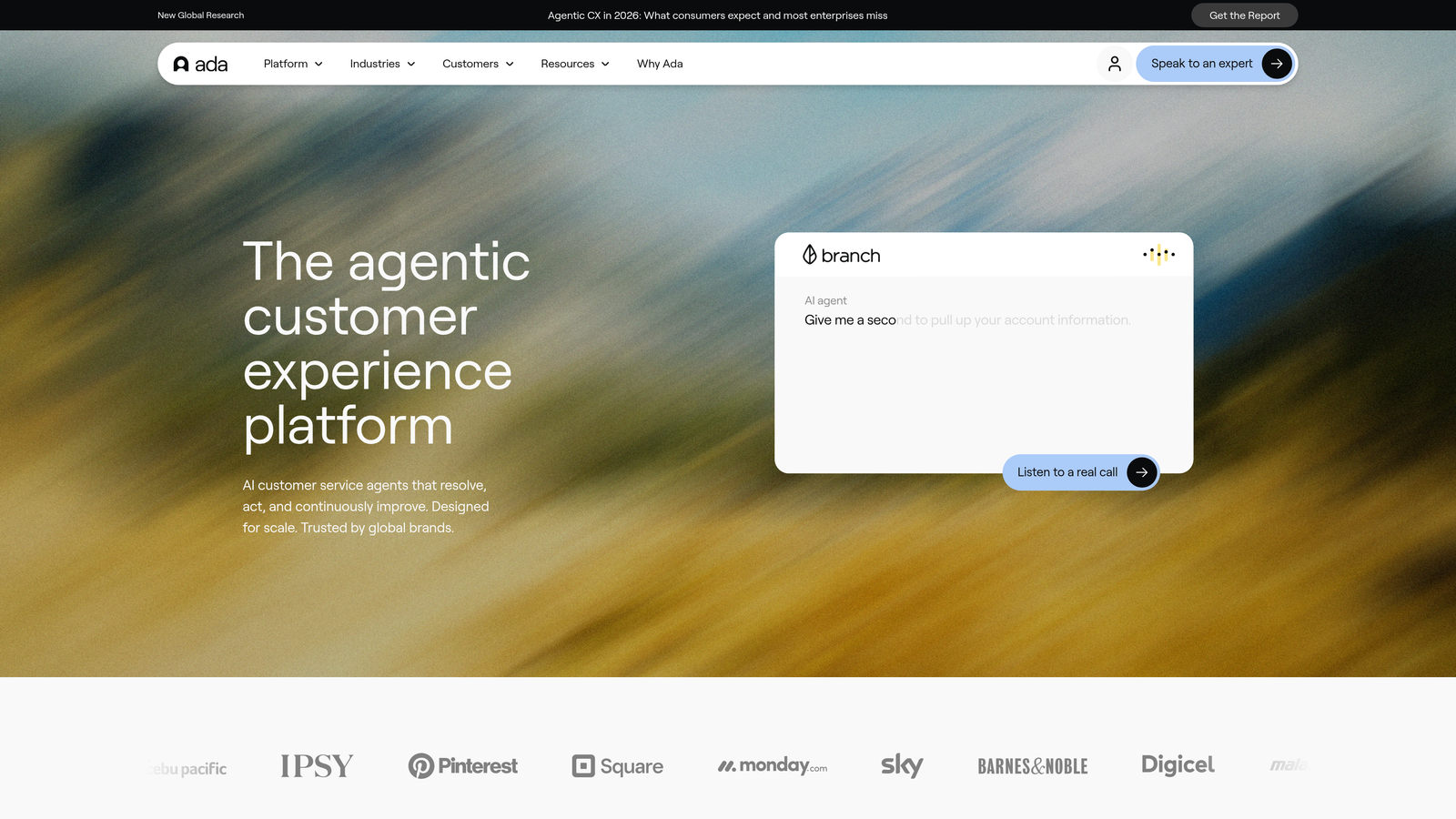
6. Ada
Best for: Teams that want to build and deploy AI agents across multiple channels without writing code.
Ada is an AI-powered customer service automation platform focused on building no-code AI agents that resolve inquiries across web, mobile, social, and messaging channels.
Where This Tool Shines
Ada's no-code builder is genuinely accessible. Non-technical teams can design conversation flows, configure automated resolutions, and launch agents across multiple channels without relying on engineering resources. For organizations where the support team owns the tooling rather than IT, that independence is a real operational advantage.
The multilingual capability is worth highlighting for companies with a global customer base. Automatic language detection and multilingual support means you don't need to build and maintain separate agents for each language market, which significantly reduces the overhead of international expansion.
Key Features
No-Code AI Agent Builder: Drag-and-drop conversation design that lets non-technical teams build and deploy agents without engineering support.
Multichannel Automated Resolution: Handles inquiries across web, mobile, SMS, social, and messaging from a single platform.
Multilingual Support: Automatic language detection with native multilingual resolution capabilities.
CRM and Helpdesk Integrations: Connects with Salesforce, Zendesk, and other major platforms to pull and push customer data.
Resolution and Containment Measurement: Dashboard tracking resolution rate and containment to quantify AI agent performance.
Best For
Mid-market to enterprise companies with global customer bases that want multichannel AI agents deployable by non-technical teams. Strong fit for organizations prioritizing speed to deployment over deep customization.
Pricing
Custom pricing based on resolution volume. Contact Ada directly for a quote tailored to your expected usage.
7. Qualtrics XM
Best for: CX leaders and product teams that need deep customer feedback analysis and predictive journey intelligence.
Qualtrics XM is an experience management platform using AI to analyze customer feedback, predict behavior, and optimize journeys across the full customer lifecycle.
Where This Tool Shines
Qualtrics plays a different game than most tools on this list. It's less about resolving individual tickets and more about understanding the patterns across thousands of customer interactions to predict what's going to happen next. XM Discover, its unstructured data analysis engine, can process calls, chats, and reviews to surface themes and sentiment that would be impossible to detect manually.
For CX leaders trying to make the case for investment in experience improvements, Qualtrics provides the kind of structured, predictive data that translates into executive-level conversations. It's a strategic intelligence layer, not just a support tool.
Key Features
AI-Driven Sentiment and Text Analytics: Analyzes feedback across channels to identify trends, themes, and emotional signals at scale.
Predictive Churn and Satisfaction Modeling: Uses historical data to forecast customer behavior before it becomes a problem.
Journey Orchestration: Real-time experience optimization across the full customer lifecycle.
XM Discover: Unstructured data analysis from calls, chats, and reviews to surface insights from conversations at scale.
Role-Based Dashboards: Tailored views for CX leaders, product teams, and support managers to act on relevant insights.
Best For
Enterprise organizations and CX leadership teams that need to understand and predict customer behavior across the full lifecycle, not just manage individual support interactions. Complements rather than replaces a dedicated support platform.
Pricing
Enterprise pricing only. Contact Qualtrics directly for a custom quote based on your organization's size and use case.
8. Sprinklr Service
Best for: Large enterprise brands managing customer engagement across a high volume of social and digital channels.
Sprinklr Service is a unified customer experience management platform with AI-powered service capabilities spanning 30+ digital and social channels for large-scale brand engagement.
Where This Tool Shines
Sprinklr's channel breadth is unmatched on this list. If your customer base reaches you across a combination of social platforms, messaging apps, review sites, and digital channels simultaneously, Sprinklr is one of the few platforms built to handle that complexity at scale. The unified agent desktop means your team isn't toggling between a dozen different tools to manage those conversations.
The enterprise governance capabilities are also notable. For regulated industries or large organizations with complex approval workflows, Sprinklr's compliance and governance layer adds a level of operational control that most support-focused tools don't offer.
Key Features
30+ Channel Coverage: AI-powered engagement across social, messaging, and digital channels from a single unified platform.
Conversational AI Bots: Intent detection and guided workflows for automated resolution across channels.
Unified Agent Desktop: AI-assisted case management consolidating all channels into a single view for human agents.
AI Quality Management: Agent performance analytics and quality scoring powered by AI analysis of interactions.
Enterprise Governance: Compliance, approval workflows, and brand governance controls built into the platform.
Best For
Large enterprise brands with significant social and digital presence that need to manage high-volume, multi-channel engagement with governance controls. The complexity and pricing make it less suitable for smaller teams.
Pricing
Self-serve plan starts at $199/seat/month. Enterprise plans are custom-priced based on channels, volume, and feature requirements.
9. Kustomer
Best for: Customer service teams that want a CRM-native support platform with full interaction history and AI-powered automation.
Kustomer is a CRM-native customer service platform with AI-powered automation, offering a complete timeline view of every customer interaction for context-rich support.
Where This Tool Shines
Kustomer's CRM-native architecture means the customer record and the support interaction live in the same place by design. Agents see a complete timeline of every touchpoint, purchase, conversation, and event before they type a single response. That context changes the quality of support conversations significantly, particularly for high-value customer relationships where history matters.
The KIQ AI agent brings self-service resolution into that same context-rich environment, drawing on your knowledge base to deflect routine inquiries while the full customer timeline remains available for escalations. It's a coherent architecture rather than a patchwork of integrated tools.
Key Features
Unified Customer Timeline: Aggregates all interactions, purchases, and data points into a single chronological customer view.
AI-Powered Intent Detection: Automatically identifies customer intent and routes conversations through the appropriate workflow.
KIQ AI Agent: Self-service resolution engine trained on your knowledge base for automated deflection.
Omnichannel Support: Covers email, chat, SMS, social, and voice from a single platform.
CRM-Native Architecture: Eliminates the need for a separate CRM integration by building the customer record into the support platform itself.
Best For
Customer service teams where relationship context is critical to resolution quality, particularly in B2C or high-touch B2B environments. Organizations already running a separate CRM may find the CRM-native value proposition less compelling.
Pricing
Enterprise plan starts at $89/user/month. The Ultimate plan, which includes full AI features, is priced at $139/user/month.
How to Choose the Right AI Customer Experience Platform
Nine platforms, very different philosophies. Here's how to cut through the options based on what actually matters for your situation.
If you're a B2B SaaS company that wants autonomous ticket resolution, business intelligence from support data, and deep integration with your product stack, Halo AI is the strongest fit. Its AI-first architecture and page-aware context engine are purpose-built for the kind of intelligent, scalable support that modern SaaS teams need. It's also the only platform on this list that actively surfaces revenue signals and customer health data from support interactions, making it a strategic asset rather than just a cost management tool.
If your team is already running on Zendesk and you want to add AI without a platform migration, Zendesk AI is the natural next step. For product-led growth companies that want support woven into their in-product experience, Intercom Fin makes sense. Mid-market teams watching budget will find Freshdesk Freddy AI offers solid coverage at a reasonable price point.
Enterprise organizations embedded in Salesforce should evaluate Einstein for Service first, since the CRM data unification is a genuine advantage at that scale. For global brands managing dozens of digital and social channels simultaneously, Sprinklr Service handles the complexity that other platforms don't. And if your priority is understanding customer behavior across the full lifecycle rather than just resolving tickets, Qualtrics XM operates at a different layer of intelligence altogether.
Ada is worth serious consideration for teams that want multichannel AI agents deployable without engineering resources, and Kustomer stands out when relationship context and interaction history are central to your support quality.
The broader principle: choose based on where AI sits in your support strategy. If you want AI to assist your agents, most of these platforms will do that. If you want AI to autonomously resolve tickets, surface business intelligence, and scale without adding headcount, you need a platform built AI-first from the start.
Your support team shouldn't scale linearly with your customer base. Let AI agents handle routine tickets, guide users through your product, and surface business intelligence while your team focuses on complex issues that need a human touch. See Halo in action and discover how continuous learning transforms every interaction into smarter, faster support.