9 Best AI Customer Service Agent Software Tools in 2026
This guide evaluates the 9 best AI customer service agent software tools available in 2026, comparing platforms on autonomous ticket resolution, integration depth, and ease of setup for B2B teams. From purpose-built AI-first agents to traditional helpdesks adding AI layers, it helps SaaS companies and product teams identify the right solution to scale support operations without increasing headcount.
 Matt PattoliFounder14 min read
AI customer service agent software has moved well beyond simple chatbots. Today's platforms can autonomously resolve tickets, guide users through complex workflows, detect bugs, escalate to humans when needed, and surface business intelligence—all without adding headcount. Whether you're a SaaS company drowning in support tickets or a product team trying to scale without scaling your team, the right AI agent platform can be transformative.
This guide covers the best AI customer service agent software tools available in 2026, evaluated on autonomous resolution capability, integration depth, ease of setup, and value for B2B teams. We've included platforms ranging from AI-first purpose-built agents to established helpdesk tools adding AI layers—so you can find the right fit for your stack and support maturity. If you're exploring the broader landscape, our guide to automated customer support is a useful starting point.
1. Halo AI
Best for: B2B SaaS teams that need autonomous resolution, page-aware guidance, and business intelligence in one platform.
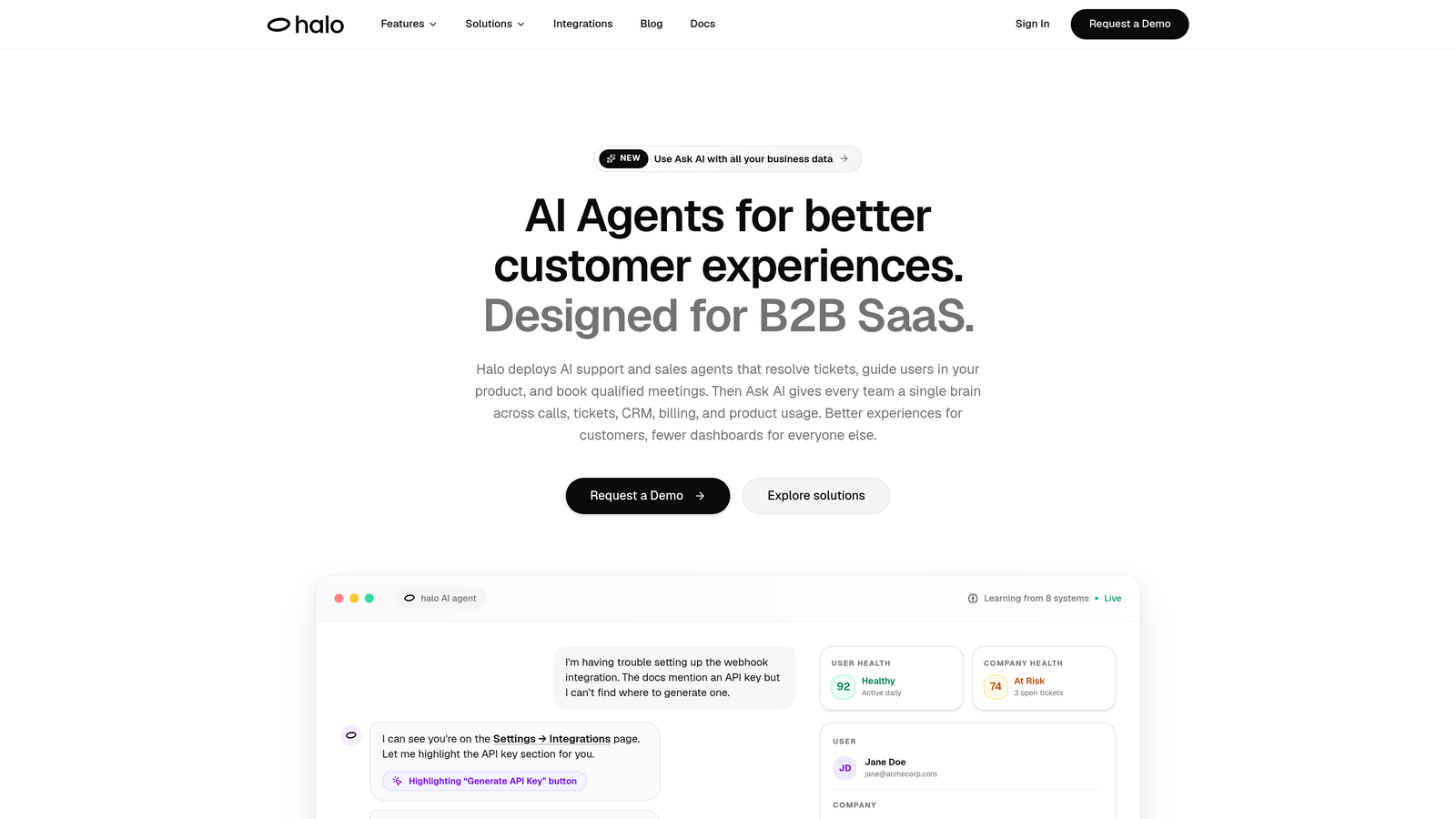
Halo AI is an AI-first customer support agent platform built specifically for B2B SaaS teams, not a chatbot layer bolted onto an existing helpdesk.
Where This Tool Shines
Halo's most distinctive capability is its page-aware chat widget. Rather than responding generically to a user's typed question, Halo's agent actually sees what the user sees—their current page, their UI state, their context—and provides visual guidance tailored to exactly where they are in your product. This is a meaningful step beyond keyword-matching bots.
The platform is also genuinely AI-first in architecture. It continuously learns from every resolved interaction, which means the system gets measurably smarter over time rather than staying static. Combine that with auto bug ticket creation routed directly to Linear or your issue tracker, and Halo starts functioning less like a support tool and more like an intelligent layer across your entire product operation.
Key Features
Page-Aware Chat Widget: The agent sees the user's current UI state and provides contextually relevant visual guidance, not generic answers.
Autonomous Ticket Resolution: AI agents handle routine tickets end-to-end, with smart escalation to human agents for complex issues that genuinely need them.
Auto Bug Ticket Creation: Automatically identifies and routes bug reports to Linear or your preferred issue tracker without manual triage.
Smart Inbox with Business Intelligence: Surfaces customer health signals, anomaly detection, and revenue intelligence derived from support interactions—turning your inbox into a business signal feed.
Deep Integration Stack: Connects natively with Linear, Slack, HubSpot, Intercom, Stripe, Zoom, PandaDoc, and Fathom, covering your entire business stack.
Continuous Learning: Every resolved interaction improves the model, so resolution quality compounds over time.
Best For
Halo is purpose-built for B2B SaaS product teams and support orgs that want more than ticket deflection. It's particularly well-suited to teams that want support data to feed back into product development, customer success, and revenue operations—not just sit in a helpdesk queue.
Pricing
Contact Halo AI directly for pricing. Given the platform's enterprise-grade integration depth and AI-first architecture, pricing is tailored to team size and use case.
2. Intercom Fin
Best for: Teams already invested in the Intercom ecosystem who want autonomous AI resolution without switching platforms.
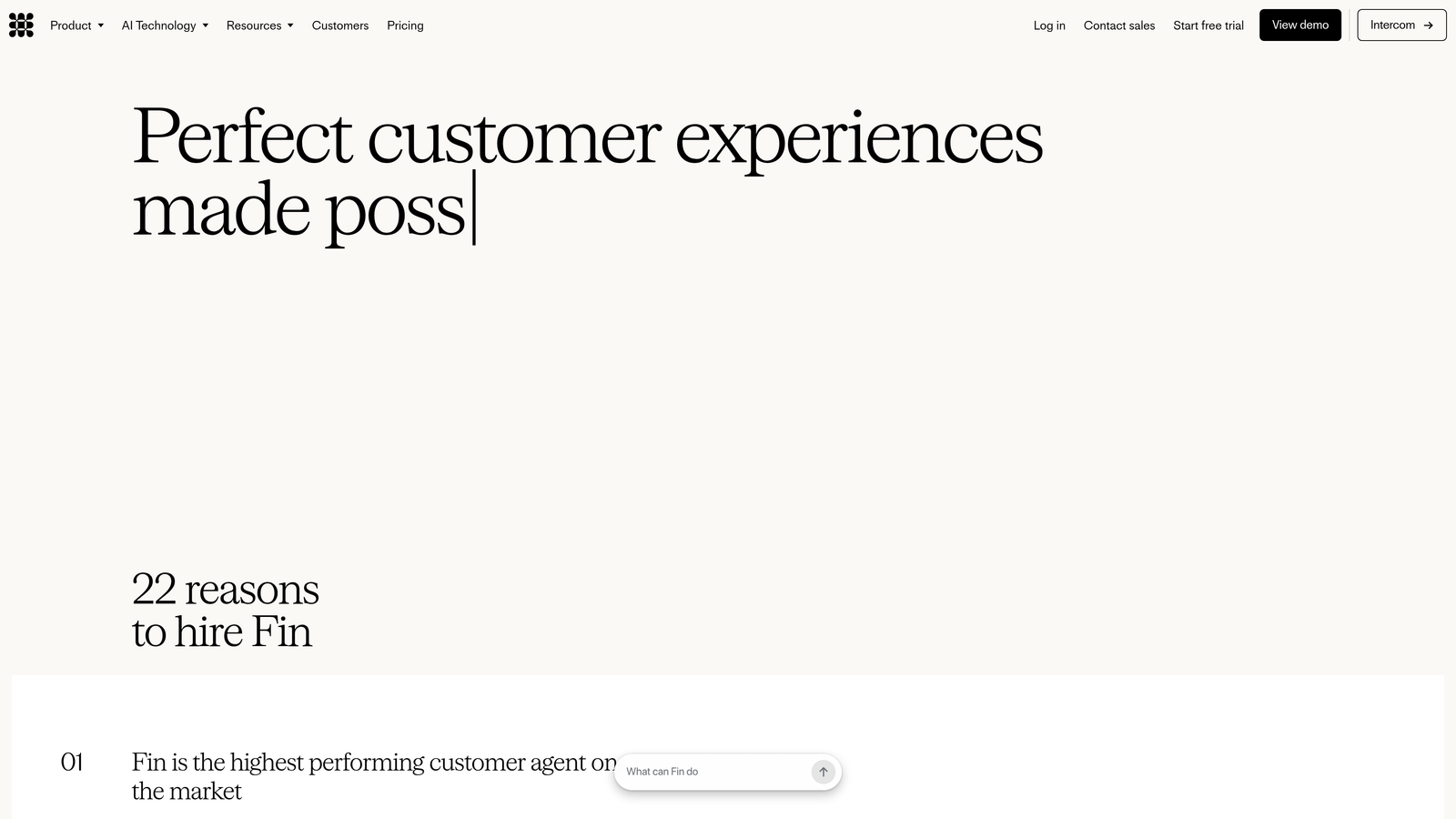
Intercom Fin is Intercom's native AI agent, built to autonomously resolve customer conversations using your existing help content.
Where This Tool Shines
Fin's biggest advantage is how naturally it fits into teams already running on Intercom. There's no new platform to onboard, no separate interface to manage—Fin operates within the same Intercom messenger your team already uses. For companies with a mature help center, Fin can start resolving conversations quickly because it leverages existing content rather than requiring you to build a new knowledge base from scratch.
The consumption-based pricing model is also worth noting. Rather than paying per seat, you pay per resolution, which aligns costs directly with value delivered. For teams with variable support volume, this can be more predictable than flat-rate alternatives.
Key Features
LLM-Powered Autonomous Resolution: Fin uses large language model technology to resolve conversations using your help center content, not rigid decision trees.
Native Intercom Integration: Operates fully within the Intercom platform, sharing data, threads, and workflows with your existing setup.
Seamless Human Handoff: When Fin can't resolve an issue, it hands off to a human agent within the same messenger thread, preserving full conversation context.
Multi-Language Support: Handles queries in multiple languages out of the box without additional configuration.
Pay-Per-Resolution Pricing: Consumption-based model means you pay for outcomes, not licenses.
Best For
Intercom Fin is the natural choice for companies already using Intercom as their primary support and engagement platform. It's less compelling for teams not in the Intercom ecosystem, since the value is tightly coupled to that infrastructure.
Pricing
Consumption-based pricing per resolved conversation, on top of an existing Intercom platform subscription. Verify current rates at intercom.com.
3. Zendesk AI
Best for: Enterprise support organizations with complex workflows that need AI embedded across the full support lifecycle.
Zendesk AI embeds artificial intelligence across the full Zendesk suite, covering autonomous agents, intelligent triage, agent copilot assistance, and automated quality assurance.
Where This Tool Shines
Zendesk AI's strength is breadth. Rather than a single AI feature bolted on, Zendesk has woven AI into multiple layers of the support workflow: self-service resolution, intelligent routing, real-time agent assistance, and automated QA scoring. For large support teams managing high ticket volumes across multiple channels, this comprehensive coverage reduces the need to stitch together separate tools.
The enterprise-grade compliance and security controls also matter for regulated industries. If your support org operates under strict data governance requirements, Zendesk's established compliance posture is a genuine advantage over newer AI-first entrants.
Key Features
AI Agents for Self-Service: Autonomous resolution for common ticket types before they reach a human agent.
Intelligent Triage and Routing: AI classifies tickets by intent and sentiment and routes them to the right team or agent automatically.
Agent Copilot: Real-time assistance for human agents with suggested replies and relevant knowledge surfaced in context.
Automated QA Scoring: AI reviews agent conversations and scores them against quality standards, reducing manual QA overhead.
Enterprise Compliance Controls: Security and compliance features built for large organizations with strict data requirements.
Best For
Zendesk AI is best suited to enterprise support teams already on Zendesk Suite who want AI capabilities without a platform migration. It's less ideal for smaller teams or those looking for an AI-first architecture rather than AI layered onto a traditional helpdesk.
Pricing
AI features are included in higher-tier Zendesk Suite plans. Verify current plan pricing at zendesk.com, as tiers and inclusions change regularly.
4. Freshdesk Freddy AI
Best for: SMB and mid-market teams on the Freshworks ecosystem looking for competitive AI pricing across self-service, agent assist, and analytics.
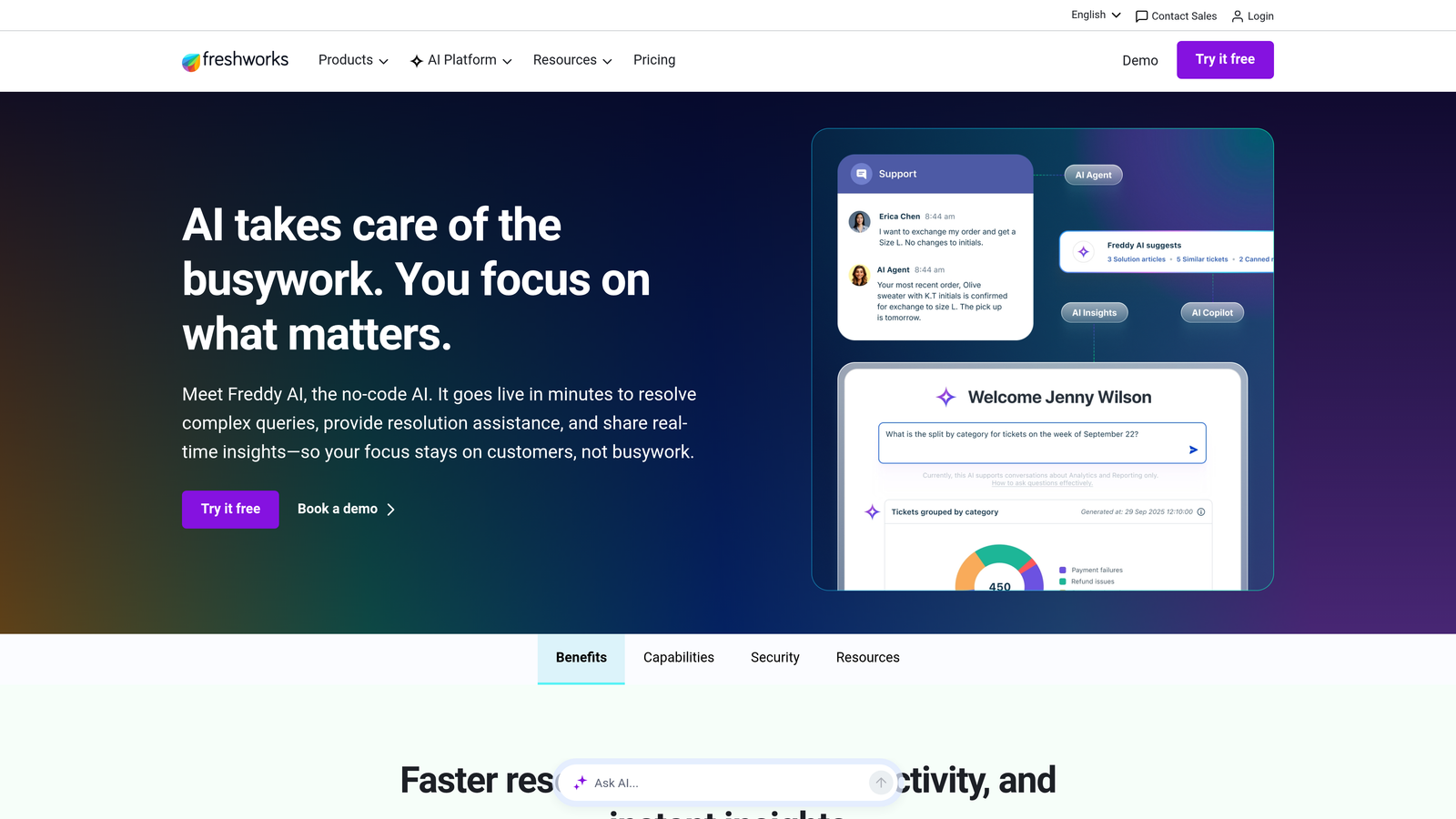
Freshdesk Freddy AI is Freshworks' AI brand spanning self-service bots, agent assist, and analytics across the Freshdesk helpdesk platform.
Where This Tool Shines
Freddy is structured as three distinct products working together: Freddy Self Service handles autonomous query resolution, Freddy Copilot provides real-time agent assistance, and Freddy Insights surfaces analytics and trend detection. This modular approach means teams can adopt the components most relevant to their current maturity without paying for capabilities they don't need yet.
Pricing is also a genuine differentiator here. Freshdesk's base plans are competitive relative to Zendesk, making Freddy AI accessible to teams that find enterprise-tier AI pricing prohibitive. For growing companies that want meaningful AI capabilities without enterprise-level spend, Freshdesk Freddy is worth serious consideration.
Key Features
Freddy Self Service: AI bot that handles common queries autonomously before they reach the agent queue.
Freddy Copilot: Real-time agent assist with suggested responses and contextual knowledge surfacing during live conversations.
Freddy Insights: AI-powered analytics that identify trends, anomalies, and resolution patterns across your support data.
Cross-Suite Compatibility: Works across Freshdesk, Freshchat, and the broader Freshworks product suite for teams using multiple Freshworks tools.
Competitive Pricing: More accessible price points than many enterprise alternatives, particularly for SMB and mid-market teams.
Best For
Freshdesk Freddy is well-suited to SMB and mid-market support teams already using Freshworks products, or those evaluating Zendesk alternatives with a tighter budget. It's less differentiated for teams needing deep custom integrations or AI-first architecture.
Pricing
Freddy Copilot is available as an add-on; base Freshdesk plans start free with paid tiers scaling up. Verify current add-on pricing at freshworks.com.
5. Tidio Lyro
Best for: SMBs and e-commerce brands that need fast AI chat deployment with minimal technical setup.
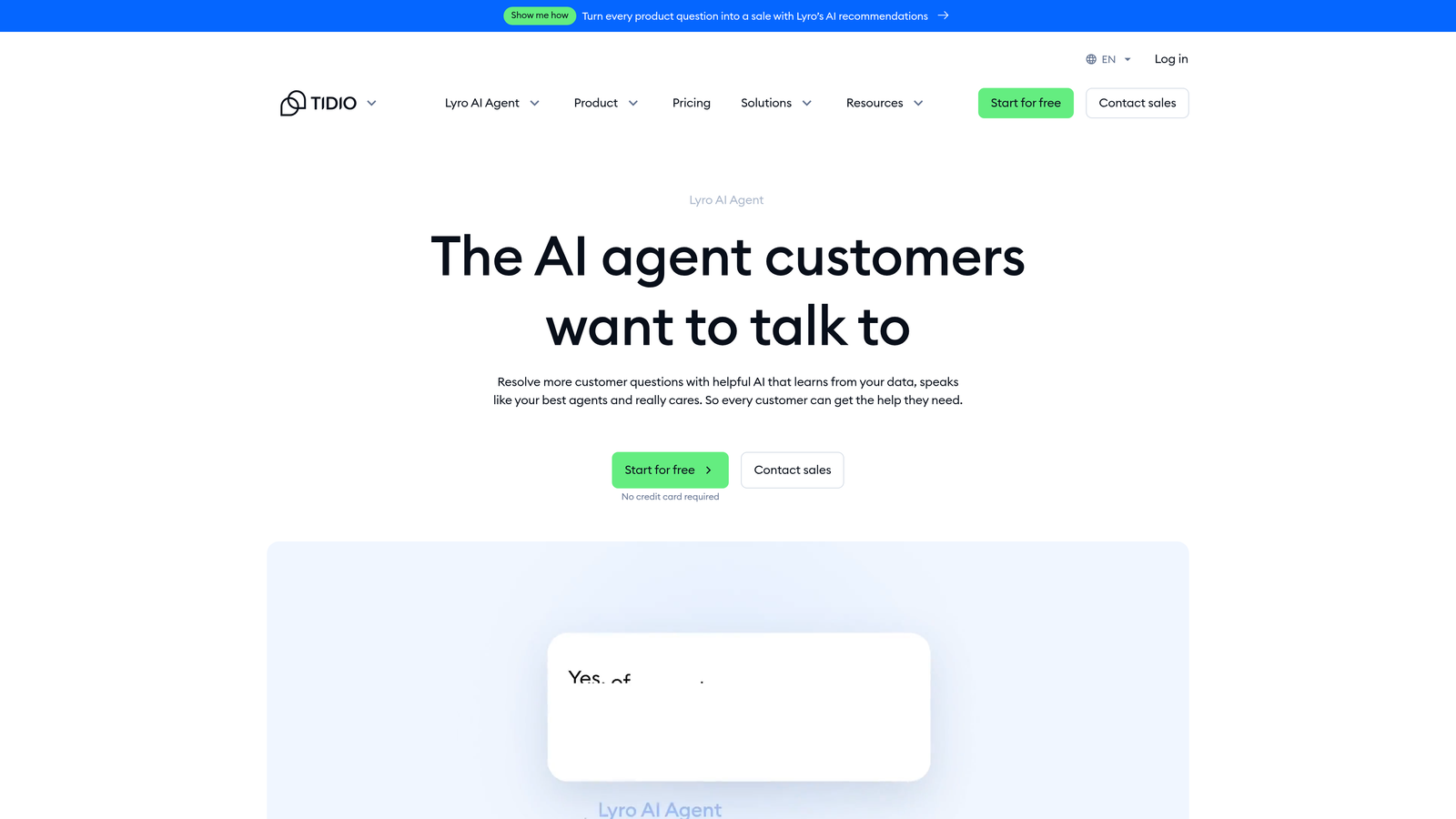
Tidio Lyro is Tidio's conversational AI product designed for rapid deployment, particularly popular with smaller businesses and e-commerce brands needing immediate chat automation.
Where This Tool Shines
Lyro's primary appeal is speed to value. Where enterprise AI platforms often require weeks of configuration, Lyro is designed to be operational quickly with minimal technical overhead. For a small team without a dedicated support engineer, that matters significantly. The free tier also lowers the barrier to experimentation, allowing teams to test AI-driven chat before committing to a paid plan.
E-commerce integrations with platforms like Shopify and WooCommerce make Lyro particularly practical for online retail teams. If your support volume is heavily order-related, shipping-related, or product FAQ-driven, Lyro handles those categories well without requiring complex configuration.
Key Features
Conversational AI Resolution: Handles common customer queries autonomously without requiring decision-tree scripting.
Fast Setup: Minimal technical configuration required, making it accessible to teams without dedicated engineering resources.
Integrated Live Chat Escalation: Smooth handoff to live agents within the same interface when AI can't resolve an issue.
E-Commerce Integrations: Native connections to Shopify and WooCommerce for order-aware support conversations.
Free Tier Available: Entry-level access with conversation limits, allowing teams to validate AI chat before upgrading.
Best For
Tidio Lyro is best for SMBs, e-commerce brands, and early-stage companies that need functional AI chat quickly and affordably. It's less suited to complex B2B SaaS workflows or teams that need deep CRM and project management integrations.
Pricing
Free tier available with conversation limits; paid plans scale with conversation volume. Verify current tier pricing at tidio.com.
6. Drift (Salesloft)
Best for: Revenue teams where support conversations and sales pipeline conversations overlap significantly.
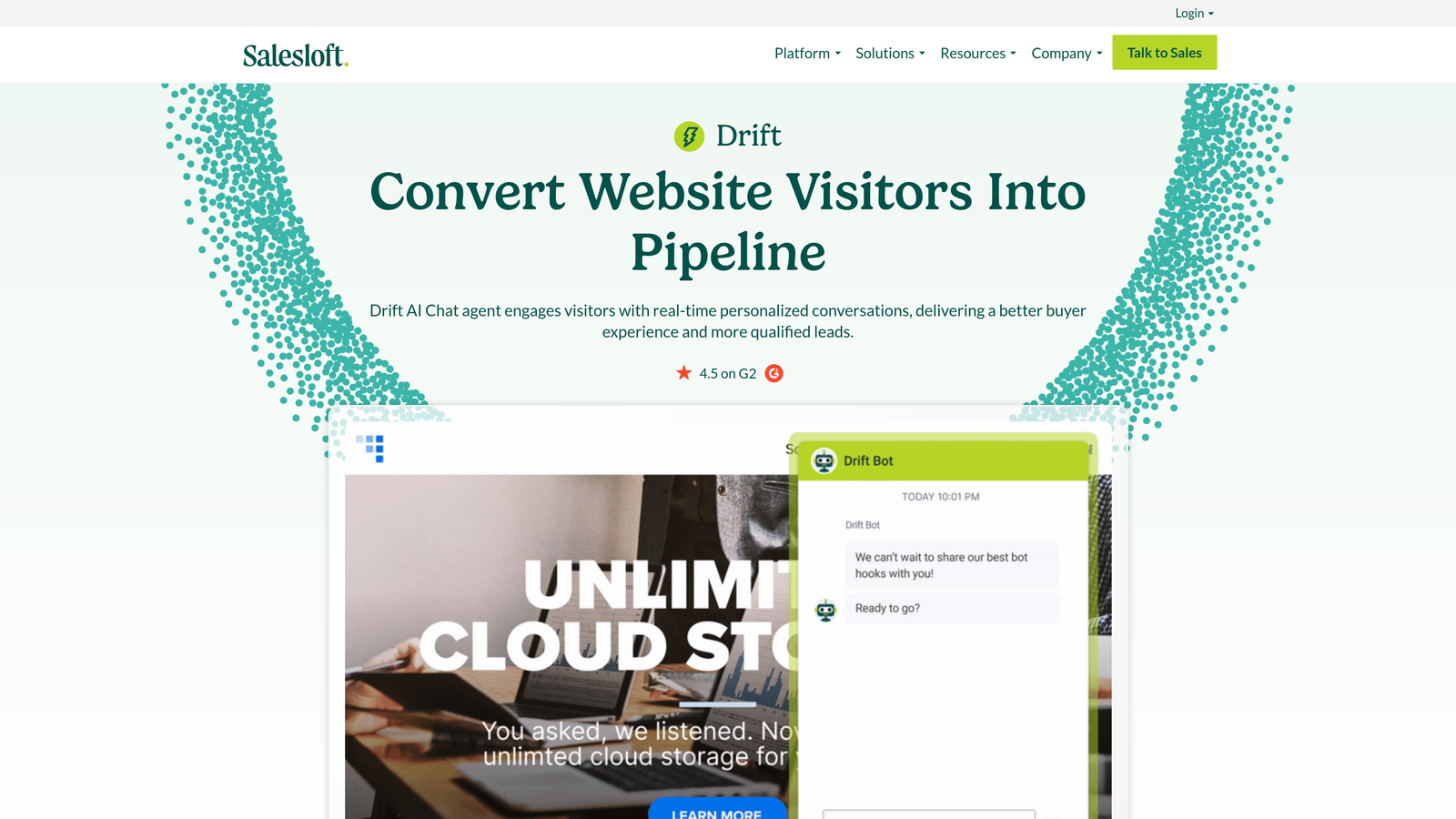
Drift is a conversational AI platform now operating under the Salesloft umbrella, positioned for revenue teams that need AI-powered conversations spanning both support and sales use cases.
Where This Tool Shines
Drift's positioning is distinct from pure support tools: it's built for the intersection of support and revenue. If your support team regularly fields questions that have pipeline implications—pricing inquiries, upgrade conversations, enterprise feature requests—Drift's account-based targeting and meeting scheduling capabilities add value that a pure support tool wouldn't provide.
The Salesloft acquisition has deepened the revenue team angle. For organizations already using Salesloft's broader platform, Drift's integration into that ecosystem can create a more unified view of customer conversations across the sales and support lifecycle.
Key Features
AI-Powered Revenue Conversations: Handles both support and sales conversations with AI, blending the two use cases in a single interface.
Account-Based Targeting: Identifies high-value visitors and routes them to appropriate playbooks or human reps based on account data.
Salesloft Platform Integration: Deep integration with Salesloft's revenue platform for teams using both products.
Meeting Scheduling and Routing: Built-in calendar scheduling and rep routing within chat flows, reducing friction for demo and sales conversations.
Playbook-Based Automation: Conversation flows built around defined playbooks for different visitor segments and intents.
Best For
Drift is best for B2B companies where the line between support and sales is blurry, particularly those already invested in the Salesloft ecosystem. Teams looking for a pure support AI tool will find better-fit options elsewhere on this list.
Pricing
Enterprise pricing; contact Drift or Salesloft directly for current rates. Pricing is not publicly listed.
7. Forethought
Best for: Enterprise teams that want to add AI resolution and triage on top of their existing helpdesk without switching platforms.
Forethought is an AI layer that sits on top of existing helpdesks—Zendesk, Salesforce Service Cloud, Freshdesk—adding intelligent triage, autonomous resolution, and agent assist without requiring a platform migration.
Where This Tool Shines
Forethought's core value proposition is additive AI: you don't have to abandon your existing helpdesk investment to get meaningful AI capabilities. For enterprise organizations with significant Zendesk or Salesforce Service Cloud deployments, ripping and replacing isn't realistic. Forethought slots in on top, adding autonomous resolution and intelligent routing while preserving existing workflows and data.
The Discover product is particularly interesting for support leaders. Rather than just resolving tickets, it identifies gaps in your resolution capability—surfacing the categories where AI is failing and where additional training or content is needed. That kind of feedback loop is valuable for teams serious about continuously improving their support quality.
Key Features
Triage: AI-powered ticket classification and intelligent routing that improves accuracy over time.
Solve: Autonomous resolution for common ticket types before they reach a human agent.
Assist: Agent copilot that surfaces relevant knowledge and suggested responses in real time during live tickets.
Discover: Analytics layer that identifies resolution gaps, training opportunities, and content deficiencies across your support data.
Helpdesk Compatibility: Works natively on top of Zendesk, Salesforce Service Cloud, and Freshdesk without requiring a platform switch.
Best For
Forethought is ideal for enterprise support teams committed to their current helpdesk who want to layer in AI capabilities incrementally. It's less relevant for teams open to a full platform change or those looking for AI-native architecture.
Pricing
Enterprise pricing; contact Forethought directly for current rates. Pricing is customized based on helpdesk, volume, and product selection.
8. Kustomer
Best for: High-volume consumer brands that need omnichannel AI coverage including social and messaging channels.
Kustomer is a CRM-native customer service platform owned by Meta, with AI built into its core architecture and strong omnichannel coverage across social, messaging, email, and chat.
Where This Tool Shines
Kustomer's CRM-native architecture is its primary differentiator. Rather than treating the customer as a ticket, Kustomer maintains a full customer timeline—every interaction, purchase, and conversation in a single view. When AI responds or routes a conversation, it has that full context available, which produces more relevant and personalized responses than systems working from isolated ticket data.
Meta's ownership also translates into native integrations with WhatsApp and Instagram that are deeper than what third-party connectors typically provide. For consumer brands with significant social and messaging support volume, this is a meaningful practical advantage.
Key Features
CRM-Native Architecture: Full customer timeline context available to AI and human agents, not just isolated ticket history.
Omnichannel AI Coverage: AI-powered responses and routing across email, chat, social, and messaging apps in a unified interface.
Meta Platform Integrations: Native WhatsApp and Instagram integrations for brands with significant social support volume.
AI-Powered Routing: Intelligent conversation routing based on customer context, intent, and agent availability.
Workflow Automation: High-volume automation capabilities for consumer support teams managing large transaction-related inquiry volumes.
Best For
Kustomer is best suited to consumer brands and high-volume B2C support teams, particularly those with significant WhatsApp, Instagram, or social channel presence. It's less optimized for B2B SaaS teams with complex product-specific support needs.
Pricing
Enterprise pricing; contact Kustomer directly for current rates. Pricing is not publicly listed.
9. Helpshift
Best for: Mobile-first companies and gaming studios that need AI-powered support embedded natively inside mobile applications.
Helpshift is a mobile-first support platform that uses an in-app SDK approach to embed AI-powered support directly inside mobile applications, without routing users to external channels.
Where This Tool Shines
Helpshift's SDK-based architecture is genuinely different from web-first support tools. Rather than directing mobile users to a separate chat window or email thread, Helpshift embeds the support experience natively inside the app itself. For gaming companies and mobile-first businesses, keeping users inside the app during a support interaction significantly reduces friction and drop-off.
The AI bots are also optimized for mobile UX specifically: short-form interactions, contextual FAQ surfacing, and flows designed for thumb navigation rather than desktop keyboard input. This mobile-native design consideration separates Helpshift from tools that simply make their desktop experience responsive.
Key Features
In-App SDK: Embeds support natively inside mobile applications, keeping users in the app throughout the support interaction.
Mobile-Optimized AI Bots: Bots designed for mobile UX patterns and short-form interactions rather than ported from desktop interfaces.
Smart FAQs: Contextually relevant FAQ content surfaced in-app based on where the user is and what they're doing.
Unified Agent Console: Single console for managing both in-app and web support interactions across channels.
Mobile Analytics: Performance metrics focused on mobile support patterns, in-app resolution rates, and SDK-specific data points.
Best For
Helpshift is the clear choice for gaming companies, mobile app publishers, and any business where the primary support surface is a native mobile application. For web-based B2B SaaS teams, the mobile-first specialization is a mismatch rather than an advantage.
Pricing
Contact Helpshift directly for current pricing. Rates vary based on monthly active users and support volume.
Which Tool Is Right for Your Team?
The right choice depends heavily on where you are in your support maturity, what your existing stack looks like, and whether you're building for B2B or B2C.
If you're a B2B SaaS team that wants AI-first architecture with page-aware guidance, business intelligence, and deep product integrations, Halo AI is the strongest purpose-built option. If you're already running on Intercom, Fin is the natural starting point. For enterprise teams committed to Zendesk or Salesforce, Zendesk AI or Forethought are the least-disruption paths to meaningful AI capability.
For SMBs and growing teams watching budget, Freshdesk Freddy and Tidio Lyro both offer accessible entry points. Drift makes sense specifically when support and sales pipeline conversations overlap. Kustomer stands out for high-volume consumer brands with heavy social channel presence. And Helpshift is the clear winner for mobile-first and gaming companies.
One pattern worth noting across all these tools: the platforms that deliver the most value are the ones where AI resolution compounds over time. Static bots plateau. Systems that learn from every interaction keep improving, which means the gap between good and great widens the longer you use them.
Your support team shouldn't scale linearly with your customer base. Let AI agents handle routine tickets, guide users through your product, and surface business intelligence while your team focuses on complex issues that need a human touch. See Halo in action and discover how continuous learning transforms every interaction into smarter, faster support.