9 Best AI Customer Service Tools to Buy in 2026
Choosing the right AI customer service tool to buy in 2026 requires understanding the critical difference between bolt-on AI and purpose-built AI agent platforms. This guide evaluates the 9 top solutions based on AI capability depth, integration breadth, and team fit—helping B2B SaaS startups and enterprise operations alike find the best match for their support architecture and growth goals.
 Matt PattoliFounder13 min read
Buying AI customer service software in 2026 looks very different from even two years ago. The market has matured past basic chatbots, and buyers now face a more nuanced decision: do you bolt AI onto your existing helpdesk, or invest in a platform built with AI agents at the core from the start?
That distinction matters more than most vendors will tell you. Bolt-on AI inherits the architectural constraints of legacy helpdesks. Purpose-built AI agents, by contrast, can learn continuously, act autonomously, and integrate across your entire business stack without compromise.
This list covers the top AI customer service tools worth evaluating in 2026, selected based on AI capability depth, integration breadth, time-to-value, and fit across different team sizes and use cases. Whether you're a B2B SaaS team scaling support without scaling headcount, or an enterprise operation looking to modernize a Zendesk or Freshdesk deployment, there's a right tool for your architecture. Here's how they stack up.
1. Halo AI
Best for: B2B SaaS and product teams wanting AI-native support that learns continuously and surfaces business intelligence.
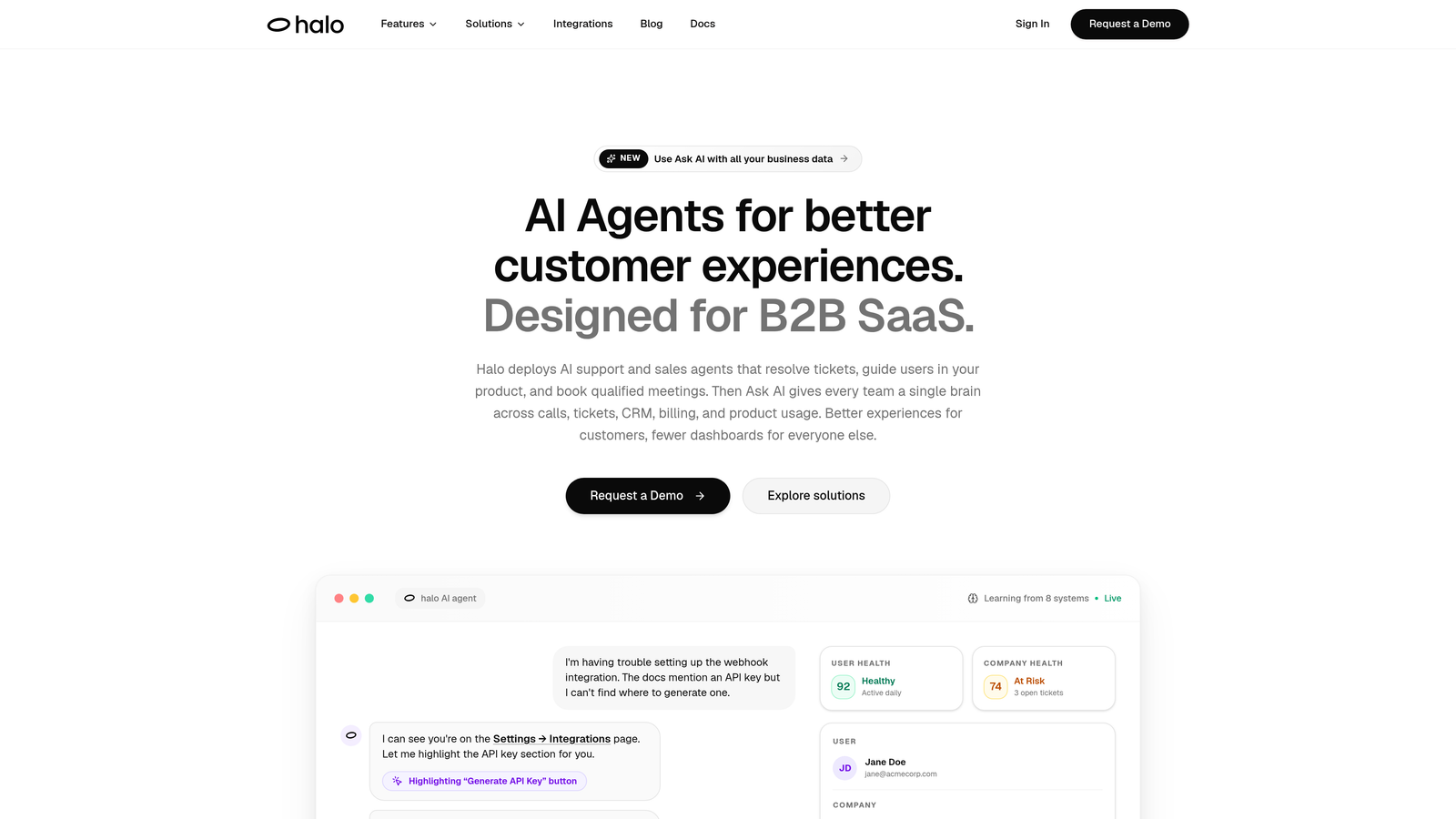
Halo AI is an AI-first customer support platform that deploys intelligent agents to resolve tickets, guide users visually through your product, auto-create bug reports, and surface revenue and health signals from every support interaction.
Where This Tool Shines
What sets Halo apart from most tools on this list is its architecture. It isn't AI layered onto a legacy helpdesk. Every component, from ticket resolution to the chat widget to the smart inbox, is built around autonomous AI agents that learn from every interaction without requiring manual retraining.
The page-aware chat widget is a particularly standout capability. Rather than responding to text queries in isolation, Halo's AI sees what the user is currently looking at in your product and provides contextual, visual UI guidance. For SaaS teams with complex products, this closes the gap between "I'm confused" and "I understand now" far faster than a generic knowledge base response ever could.
Key Features
Page-Aware AI Chat Widget: Sees the user's current product context and delivers visual, in-app guidance rather than generic text responses.
Continuous Learning: Every resolved ticket improves the AI's future performance without manual intervention or retraining cycles.
Auto Bug Ticket Creation: Automatically identifies and routes bug reports to Linear, Jira, or other dev tools, removing a manual step from your support workflow.
Smart Inbox with Business Intelligence: Goes beyond support metrics to surface customer health scores, revenue signals, and anomaly detection directly from support data.
Live Agent Handoff: Complex or sensitive issues escalate seamlessly to human agents without disrupting the customer experience.
Deep Integrations: Connects natively with Linear, Slack, HubSpot, Intercom, Stripe, Zoom, PandaDoc, and Fathom.
Best For
Halo is best suited for B2B SaaS companies and product-led growth teams that want support AI to do more than deflect tickets. If you want your support layer to also generate business intelligence, proactively identify at-risk accounts, and guide users through your product visually, Halo is built for that ambition. Less ideal for e-commerce or D2C brands with simple, high-volume query patterns.
Pricing
Demo-first model with custom pricing based on your team's needs. Contact Halo directly via haloagents.ai to explore options.
2. Intercom
Best for: Teams already on the Intercom platform seeking a capable AI agent with outcome-based pricing.
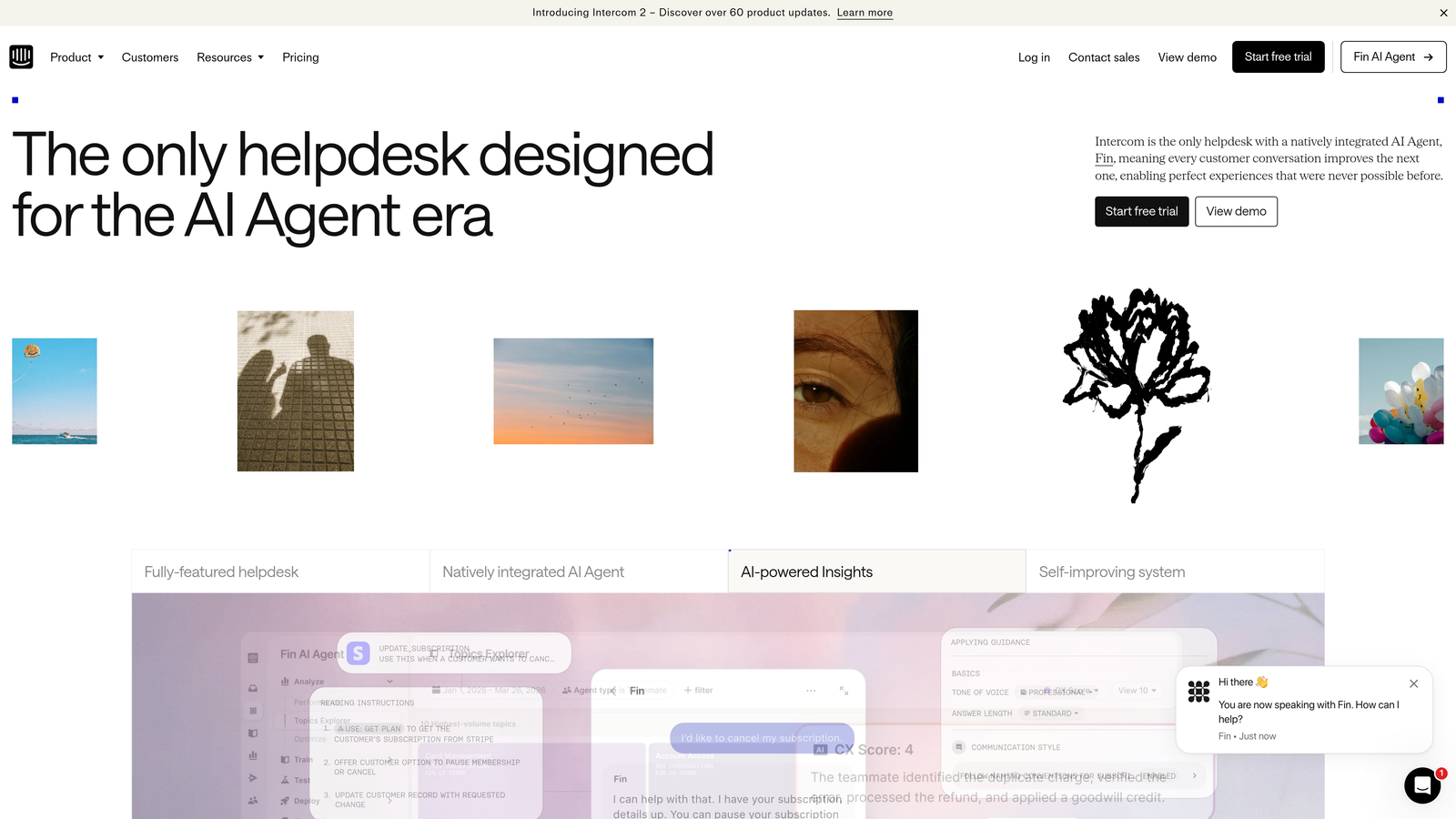
Intercom is a leading customer messaging platform featuring Fin, an AI agent built natively into the Intercom ecosystem that resolves support queries using your existing help content.
Where This Tool Shines
Fin's biggest advantage is how naturally it fits into the Intercom Messenger experience. If your team already lives in Intercom for inbox, ticketing, and customer communication, adding Fin requires no platform migration and no context switching. It's trained on your help center content and powered by large language models, giving it a reasonable baseline for resolving common queries out of the box.
The per-resolution pricing model is worth noting. Rather than paying a flat seat fee for AI capability, you pay for outcomes. This can be cost-effective for teams with high deflection rates, though it requires careful monitoring as volume scales.
Key Features
Fin AI Agent: LLM-powered agent trained on your help center content for automated query resolution.
Native Intercom Integration: Works directly within Intercom Messenger, inbox, and ticketing without additional setup.
Per-Resolution Pricing: Pay for outcomes rather than seats, aligning cost with actual AI performance.
Human Handoff: Seamless escalation to live agents within the same interface customers are already using.
Resolution Reporting: Tracks AI resolution rates and deflection metrics to measure ROI.
Best For
Teams already invested in the Intercom ecosystem who want to add AI without switching platforms. Also well-suited for SaaS companies with a strong, well-structured help center that Fin can learn from immediately.
Pricing
Fin charges per resolution; base Intercom plans start from approximately $39 per seat per month. Verify current pricing at intercom.com before purchasing.
3. Zendesk AI
Best for: Large enterprise support operations with existing Zendesk Suite investments looking to add AI without migrating platforms.
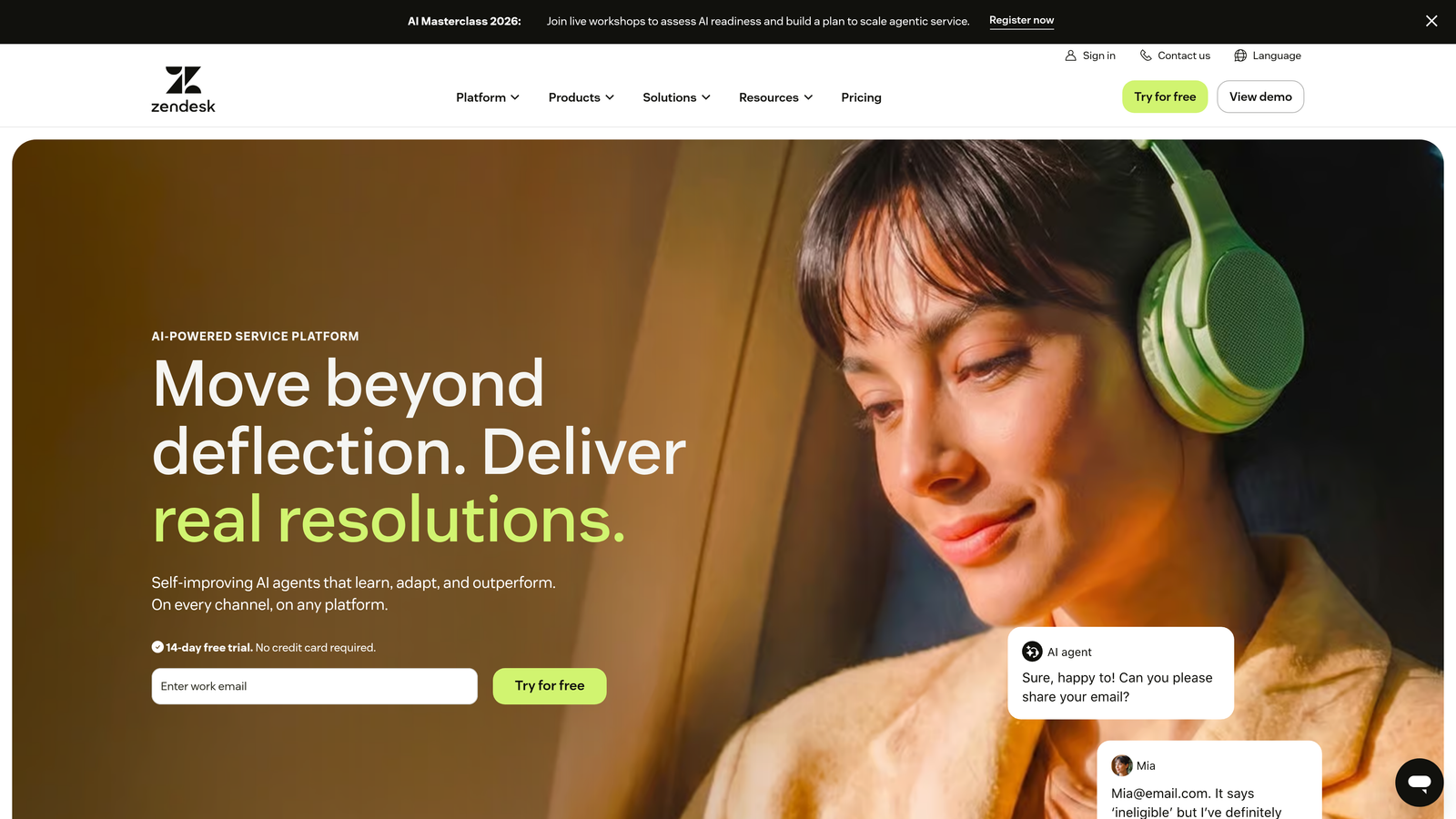
Zendesk AI is enterprise-grade AI layered onto the Zendesk Suite, offering intelligent triage, agent copilot capabilities, and automated workflows for large-scale support operations.
Where This Tool Shines
For organizations already running Zendesk as their primary support infrastructure, Zendesk AI is the path of least resistance to adding AI capability. The Agent Copilot feature is particularly useful for teams with high ticket volumes, surfacing suggested replies and next-best-action recommendations directly in the agent's existing workflow.
Intelligent triage, which detects intent, sentiment, and language automatically, helps large teams prioritize and route tickets without manual review. The tradeoff is that Zendesk AI is fundamentally an enhancement to an existing platform, not a rethink of how support AI should work.
Key Features
Intelligent Triage: Automatically detects intent, sentiment, and language to route tickets accurately at scale.
Agent Copilot: Suggests replies and next-best-action recommendations to human agents in real time.
Automated Workflows: AI-powered ticket routing and workflow automation to reduce manual handling.
Knowledge Base Optimization: Surfaces suggestions for improving your help content based on AI-detected gaps.
No Migration Required: AI capabilities layer directly onto the existing Zendesk Suite environment.
Best For
Enterprise support teams with hundreds of agents and existing Zendesk infrastructure. If your organization has already standardized on Zendesk and needs to add AI without a platform change, this is the natural choice.
Pricing
Zendesk Suite starts from approximately $55 per agent per month; AI features are available as add-ons. Verify current pricing at zendesk.com.
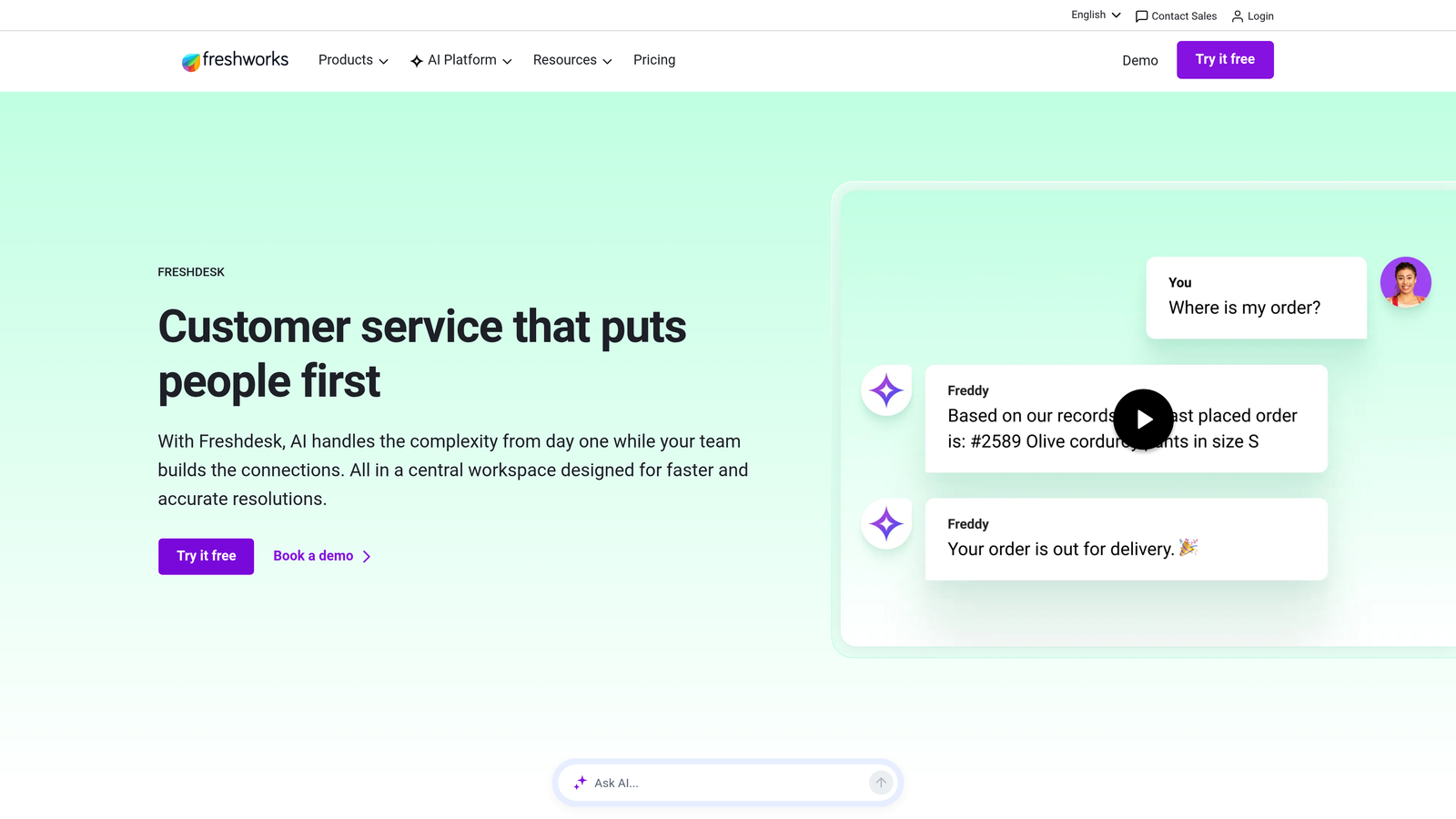
4. Freshdesk Freddy AI
Best for: SMBs and growing support teams wanting accessible AI automation across helpdesk, CRM, and ITSM in one ecosystem.
Freshdesk Freddy AI is Freshworks' AI layer spanning its helpdesk, CRM, and ITSM products, offering practical AI automation at price points that work for smaller teams.
Where This Tool Shines
Freddy AI's strength is breadth across the Freshworks product family. If your team uses Freshdesk for support, Freshsales for CRM, and Freshservice for IT, Freddy AI creates a unified intelligence layer across all three. That cross-product context is genuinely useful for teams that don't want separate AI tools for each function.
Freddy Copilot handles agent assist, offering suggested replies and conversation summarization. Freddy Self Service handles customer-facing deflection. And Freddy Insights surfaces support analytics and trend detection. Together, they cover the core AI use cases without requiring enterprise-level budget.
Key Features
Freddy Self Service: AI-powered customer-facing chatbot that deflects common queries before they reach agents.
Freddy Copilot: Assists agents with suggested replies, summarization, and next steps.
Freddy Insights: Analytics layer that detects support trends and surfaces actionable data.
Cross-Product AI: Spans Freshdesk, Freshsales, and Freshservice for unified intelligence.
SMB-Friendly Pricing: Accessible tiers make AI automation viable for teams that aren't enterprise scale.
Best For
SMBs and mid-market teams already in the Freshworks ecosystem, or those evaluating Freshworks as a more affordable alternative to Zendesk. Less compelling for teams outside the Freshworks stack.
Pricing
Free tier available; paid plans start from approximately $15 per agent per month with Freddy AI features on higher tiers. Verify current pricing at freshdesk.com.
5. Tidio
Best for: E-commerce businesses and small teams wanting fast AI chat deployment with minimal technical setup.
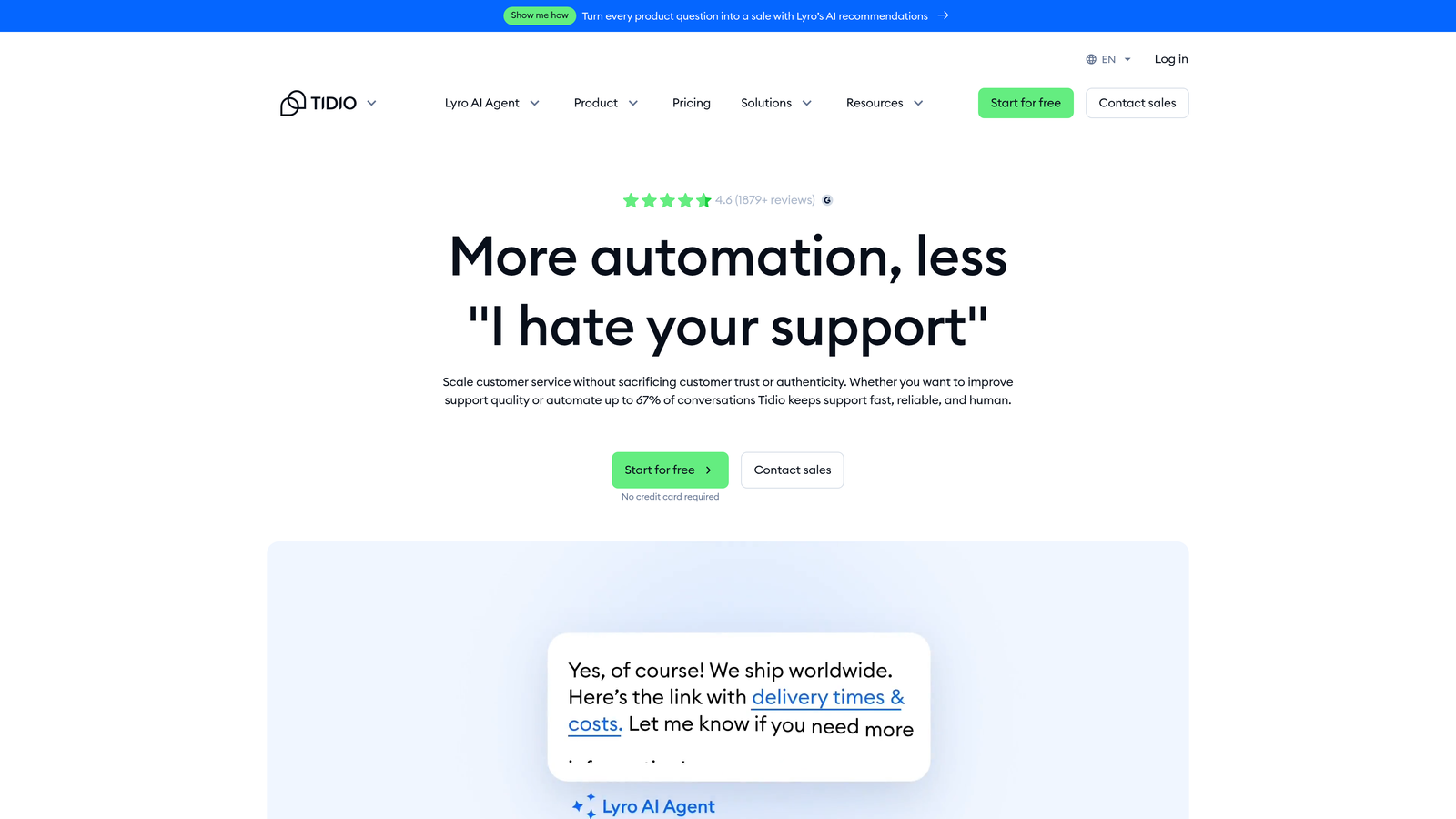
Tidio is a live chat and AI chatbot platform popular with e-commerce businesses, featuring Lyro AI for automated conversational support that can be up and running quickly.
Where This Tool Shines
Tidio's primary appeal is speed to value. For an e-commerce store on Shopify or WooCommerce, getting Lyro AI deployed and handling common queries takes hours, not weeks. The integration with major e-commerce platforms is native and well-documented, which removes a significant barrier for small teams without dedicated technical resources.
Lyro AI is trained on your own support content and handles the conversational layer, while the live chat fallback ensures customers can reach a human when needed. For high-volume, relatively simple query patterns typical of e-commerce, this combination works well.
Key Features
Lyro AI: Conversational AI chatbot trained on your support content for automated query resolution.
E-Commerce Integrations: Native integrations with Shopify, WooCommerce, and WordPress.
Live Chat Fallback: Seamless handoff to human agents when AI reaches its limits.
Visual Flow Builder: Drag-and-drop chatbot conversation flow builder for custom paths.
Quick Deployment: Minimal technical setup with no engineering dependency required.
Best For
E-commerce businesses, small online retailers, and content sites that need a capable AI chat layer without complexity or enterprise pricing. Not ideal for B2B SaaS teams with complex, multi-step support workflows.
Pricing
Free tier available; Lyro AI plans start from approximately $29 per month. Verify current pricing at tidio.com.
6. Drift (Salesloft)
Best for: B2B revenue teams where sales qualification and support conversations overlap in the same customer journey.
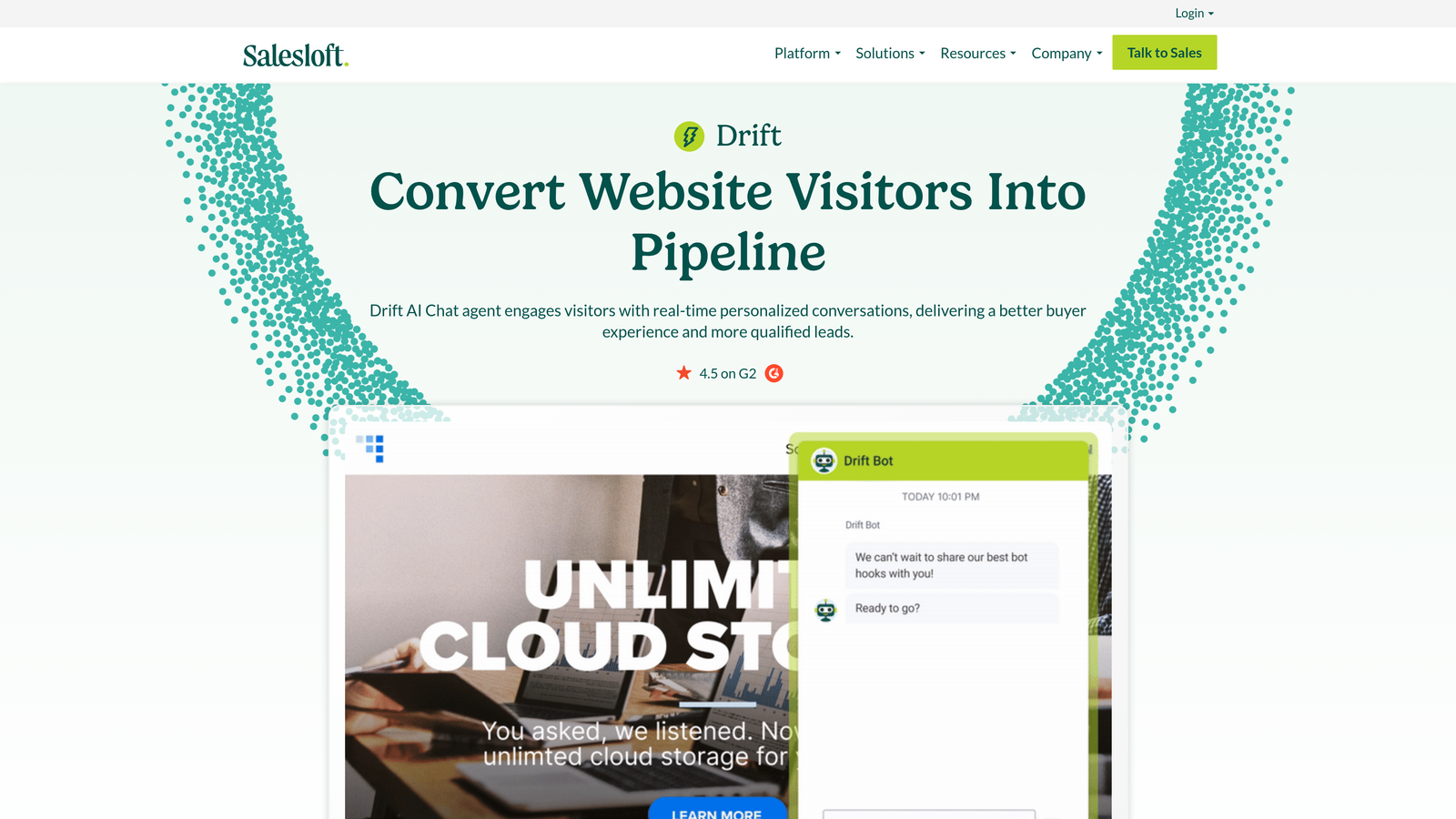
Drift, now part of Salesloft, is a conversational platform that blends AI-powered sales qualification with support automation, making it relevant for teams where the boundary between sales and support is deliberately blurred.
Where This Tool Shines
Drift's differentiation is its ability to route conversations intelligently based on visitor intent, distinguishing between someone who needs support and someone who is ready to buy, and treating each appropriately. For B2B companies running account-based marketing or high-touch sales motions, this intent-routing capability can meaningfully improve both pipeline and support outcomes from a single platform.
The meeting scheduling integration is practical for sales-adjacent support scenarios, where resolving a complex question often means booking a call rather than sending a knowledge base article.
Key Features
AI Playbooks: Route conversations based on detected visitor intent, separating sales prospects from support needs.
Buyer Intent Signals: Real-time signals that help prioritize both sales outreach and support escalation.
Meeting Scheduling: Integrated calendar booking for conversations that need to move offline.
CRM Integrations: Native connections with Salesforce, HubSpot, and Marketo.
Conversation Analytics: Pipeline influence reporting and conversation performance metrics.
Best For
B2B revenue teams with overlapping sales and support workflows, particularly those running ABM programs or high-touch sales cycles. Pure support teams with no sales overlap may find it more than they need.
Pricing
Custom enterprise pricing following the Salesloft acquisition. Contact Drift or Salesloft directly for current rates.
7. Ada
Best for: Enterprise brands needing highly customized, multilingual AI support agents built without engineering resources.
Ada is an enterprise no-code AI agent platform that enables large organizations to build complex, multilingual AI support agents without requiring engineering involvement in the build process.
Where This Tool Shines
Ada's no-code builder is genuinely capable for enterprise-level complexity. Teams can create branching conversation flows, personalized responses based on customer data, and multilingual experiences across dozens of languages without writing a line of code. For global brands with diverse customer bases, that multilingual depth is a meaningful differentiator.
Ada also integrates with major helpdesks including Zendesk, Salesforce, and Freshdesk, which means it can sit in front of your existing support infrastructure as an AI deflection and resolution layer without requiring a full platform replacement.
Key Features
No-Code Agent Builder: Build complex, branching AI conversation flows without engineering overhead.
Multilingual Support: Supports dozens of languages for global customer bases.
Helpdesk Integrations: Connects with Zendesk, Salesforce, Freshdesk, and other major platforms.
Proactive Personalization: Triggers personalized messages based on customer data and behavior.
Enterprise Compliance: Enterprise-grade security and compliance controls for regulated industries.
Best For
Large enterprises with global, multilingual support needs and a desire to build sophisticated AI agents without engineering dependency. Strong fit for brands in regulated industries or those with complex compliance requirements.
Pricing
Custom enterprise pricing. Contact Ada directly at ada.cx for current rates and packaging.
8. Kustomer
Best for: D2C and B2C brands that want CRM-first support with a unified customer timeline and AI-powered routing.
Kustomer, owned by Meta, is a CRM-first customer service platform that unifies all customer interactions into a single timeline view and applies AI routing and response suggestions based on that full history.
Where This Tool Shines
The unified customer timeline is Kustomer's defining feature. Rather than treating each support ticket as an isolated event, Kustomer surfaces the entire customer history, purchases, previous conversations, behavioral data, in a single view. AI routing and suggested responses are then informed by that full context, which can significantly improve resolution quality for high-volume consumer brands.
For D2C brands managing relationships with large, diverse customer bases across email, chat, voice, and social, the omnichannel consolidation in a CRM-native environment is genuinely useful.
Key Features
Unified Customer Timeline: All interactions across channels consolidated into a single customer view.
AI-Powered Routing: Routes tickets based on full customer history and context, not just the current message.
Omnichannel Support: Handles email, chat, voice, and social from a single platform.
Workflow Automation: Automates repetitive support tasks and follow-up sequences.
Deep CRM Integration: Customer data informs every support interaction, not just ticket metadata.
Best For
D2C and B2C brands with complex customer histories and high interaction volumes across multiple channels. Less common in pure B2B SaaS environments where CRM-first support isn't the primary architecture.
Pricing
Custom enterprise pricing. Contact Kustomer directly at kustomer.com for current rates.
9. Chatbase
Best for: Startups and technical teams wanting a lightweight, custom AI chatbot trained on their own content, deployed fast.
Chatbase is a RAG-based chatbot builder that lets teams train a custom AI chatbot on their own documents, URLs, or knowledge base content and deploy it quickly without an enterprise contract.
Where This Tool Shines
Chatbase occupies a useful niche: it's not trying to be a full support platform, and that clarity of purpose is a strength. If you need a custom AI chatbot trained on your specific content and embedded on your website within a day, Chatbase delivers that without forcing you into a lengthy sales process or complex onboarding.
The API access makes it extensible for technical teams that want to build Chatbase into a larger custom workflow. For startups or indie products that need AI chat coverage without platform complexity, it's often the fastest path from zero to deployed.
Key Features
Custom Training: Train the chatbot on uploaded PDFs, documents, URLs, or existing knowledge base content.
Embeddable Widget: Deploy a chat widget on any website or web app with minimal setup.
API Access: Connect Chatbase to custom workflows and integrations via API.
Basic Analytics: Track chat interactions and identify common query patterns.
Fast Deployment: No enterprise contract or complex onboarding required to get started.
Best For
Startups, indie developers, and technical teams that need a simple, customizable AI chat layer without the overhead of a full support platform. Not a replacement for teams that need ticketing, routing, agent handoff, or business intelligence alongside their AI chat.
Pricing
Free tier available; paid plans start from approximately $19 per month. Verify current pricing at chatbase.co.
Which Tool Is Right for Your Team?
Every tool on this list solves a real problem. The key is matching the solution to your architecture, team size, and what you actually need AI to do in your support workflow.
Here's a quick orientation by use case:
Enterprise helpdesk already on Zendesk: Zendesk AI is the lowest-friction path to adding AI without migrating.
SMB or growing team on a budget: Freshdesk Freddy AI offers accessible AI automation across the Freshworks ecosystem at pricing that scales with you.
E-commerce business: Tidio's Lyro AI gets you deployed fast with native Shopify and WooCommerce integrations.
B2B revenue team blending sales and support: Drift (Salesloft) handles intent-based routing across both motions from one platform.
Enterprise brand needing no-code AI agents in multiple languages: Ada is built for exactly that complexity without engineering dependency.
D2C brand with CRM-first support needs: Kustomer's unified timeline and omnichannel approach fits high-volume consumer brands well.
Startup needing a quick custom chatbot: Chatbase trains on your content and deploys in hours without enterprise overhead.
Teams already invested in Intercom: Fin AI agent extends your existing setup with outcome-based pricing.
B2B SaaS team wanting AI-native support that learns and scales: Halo AI is built from the ground up for this. The page-aware context, continuous learning, business intelligence signals, and deep integrations with your existing stack make it the strongest fit for product-led SaaS teams that want support AI to do more than close tickets.
The broader lesson here is architectural. Bolt-on AI can get you started, but if you're building for scale, the underlying platform design matters. AI that learns from every interaction without manual retraining, that sees product context, and that surfaces revenue signals from support data is a fundamentally different capability than a rules-based chatbot with an LLM wrapper.
Your support team shouldn't scale linearly with your customer base. Let AI agents handle routine tickets, guide users through your product, and surface business intelligence while your team focuses on complex issues that need a human touch. See Halo in action and discover how continuous learning transforms every interaction into smarter, faster support.