9 Best AI Customer Service Chatbot Pricing Plans Compared in 2026
Navigating AI customer service chatbot pricing is complex, with seat fees, resolution-based billing, and hidden add-ons that can dramatically inflate costs. This guide compares nine leading chatbot platforms across different pricing models—from resolution-based to flat-rate plans—helping support teams and SaaS companies identify the most cost-effective solution for their specific volume and budget.
 Grant CooperFounder14 min read
Buying an AI customer service chatbot is straightforward — until you see the pricing page. Seat-based fees, resolution-based billing, conversation limits, and add-on charges can turn a $50/month quote into a five-figure annual commitment before you've resolved a single ticket.
This guide cuts through the noise by comparing nine leading AI customer service chatbots on what actually matters: what you get, what it costs, and where the hidden fees hide. Whether you're a lean product team evaluating your first AI support tool or a scaling SaaS company outgrowing your current helpdesk, this breakdown will help you match the right pricing model to your support volume and budget.
We've organized these tools by their pricing approach, from resolution-based models to flat-rate and open-source plans, so you can quickly identify which structure fits your operation. For a broader look at how costs compare across the category, see our customer support automation pricing comparison.
1. Halo AI
Best for: B2B SaaS teams that want AI-first support with deep product context and business intelligence
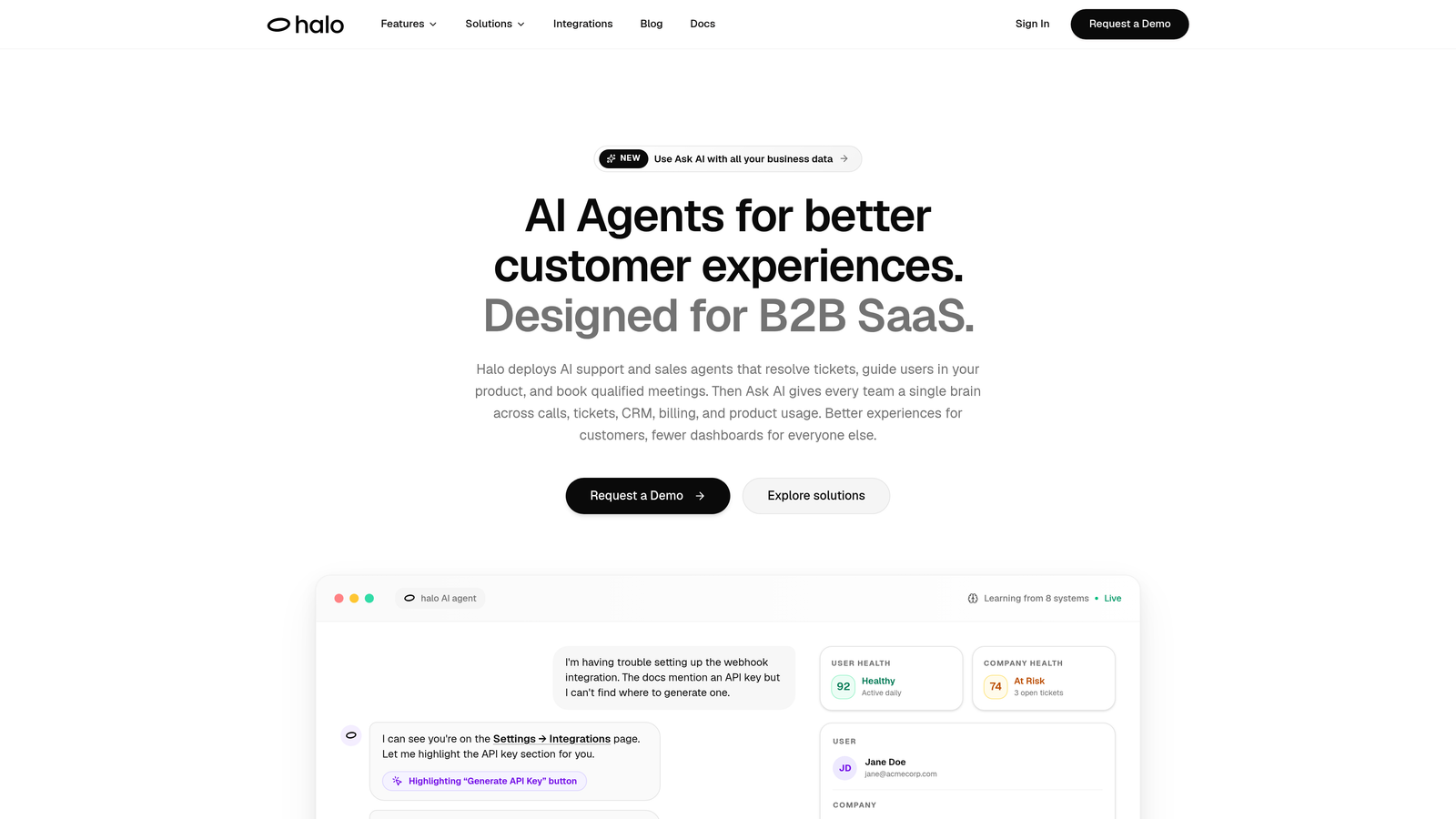
Halo AI is an AI-first customer support platform that deploys intelligent agents to resolve tickets, guide users through your product with page-aware context, and surface business intelligence — all while learning from every interaction.
Where This Tool Shines
Most AI support tools are bolt-ons to an existing helpdesk. Halo is built AI-first from the ground up, which means the intelligence isn't layered on top of a legacy ticketing system — it's the foundation. That architectural difference shows up in features that genuinely set it apart.
The page-aware chat widget is a standout capability: the AI sees exactly what the user sees on screen, enabling contextual guidance rather than generic FAQ responses. Pair that with continuous learning from every resolved interaction, and the system genuinely gets smarter over time rather than staying static.
Key Features
Page-Aware Context: The chat widget understands which page or product area the user is on, delivering guidance that's relevant to their exact situation rather than surfacing generic help articles.
Autonomous Ticket Resolution: AI agents handle routine tickets end-to-end, with smart escalation to human agents when complexity warrants it — keeping resolution rates high without overwhelming your team.
Auto Bug Ticket Creation: When users report product issues, Halo automatically generates and routes bug tickets directly to Linear, closing the loop between support and engineering without manual handoff.
Smart Inbox with Business Intelligence: Beyond support, the inbox surfaces customer health signals, revenue anomalies, and trend detection — turning support data into strategic insight for product and revenue teams.
Deep Integrations: Connects with Slack, HubSpot, Intercom, Stripe, Zoom, PandaDoc, and Fathom, meaning it fits into your existing stack rather than requiring you to rebuild around it.
Best For
Halo is best suited for B2B SaaS companies and product teams that want more than ticket deflection. If your support data should be informing product decisions, customer success conversations, and revenue forecasting, Halo's business intelligence layer makes that possible. It's particularly strong for teams that have outgrown generic helpdesk tools and want AI that's genuinely contextual.
Pricing
Contact Halo AI directly for pricing details — the platform is designed for B2B SaaS teams and pricing is tailored accordingly. Visit haloagents.ai for current information.
2. Intercom (Fin AI)
Best for: Teams already on Intercom who want resolution-based AI pricing with minimal setup
Intercom's Fin AI is a resolution-based AI agent built natively into the Intercom platform, charging per successful resolution rather than per seat or conversation.
Where This Tool Shines
Fin's resolution-based model is genuinely appealing in theory: you only pay when the AI fully resolves a conversation without human involvement. For teams with high deflection rates and well-documented knowledge bases, this can be very cost-effective.
Because Fin is native to Intercom, it has immediate access to your full conversation history, customer data, and existing workflows. There's no integration work required if you're already on the platform, which lowers the activation cost considerably.
Key Features
Resolution-Based Pricing: You're charged only when Fin resolves a conversation autonomously — a model that aligns cost directly with demonstrated value.
Native Intercom Integration: Full access to conversation history, customer segments, and Intercom's existing automation rules without any additional setup.
Multi-Language and Multi-Channel Support: Fin handles conversations across languages and channels within the Intercom ecosystem.
Confidence-Based Handoff: When Fin's resolution confidence is low, it escalates to a human agent rather than attempting a response it may get wrong.
Best For
Teams already invested in Intercom who want to add AI resolution without switching platforms. The model works best when your knowledge base is comprehensive and your support queries are well-defined. Teams with lower deflection rates or highly complex query mixes should model the total cost carefully before committing.
Pricing
Fin AI charges per resolution on top of Intercom's base per-seat subscription. Total cost depends on your resolution rate, query volume, and plan tier. Because the costs layer, calculate your expected monthly resolutions before assuming it's cheaper than seat-based alternatives. Verify current rates at intercom.com.
3. Zendesk AI
Best for: Enterprise teams with complex compliance requirements and established Zendesk workflows
Zendesk AI adds intelligent triage, automated responses, and agent assist capabilities to its well-established enterprise ticketing platform.
Where This Tool Shines
Zendesk's AI layer benefits from the platform's deep enterprise infrastructure: robust SLA management, strong compliance certifications, and a mature analytics suite. For organizations where audit trails and security controls are non-negotiable, Zendesk provides a level of enterprise readiness that newer AI-native tools often can't match.
The Agent Copilot feature is genuinely useful for teams that need to keep humans in the loop — it surfaces suggested replies and relevant knowledge base articles in real time, reducing handle time without fully automating responses.
Key Features
AI-Powered Triage and Intent Detection: Automatically classifies and routes incoming tickets based on intent, sentiment, and content — reducing manual sorting work for agents.
Agent Copilot: Provides real-time suggested replies and knowledge surfacing to help human agents respond faster and more consistently.
Advanced Analytics and SLA Management: Enterprise-grade reporting with SLA tracking built directly into the workflow.
Compliance and Security Certifications: Meets the security and compliance standards required by regulated industries and large enterprise procurement teams.
Best For
Large enterprise teams already on Zendesk Suite who need AI capabilities without migrating platforms. Also strong for regulated industries where compliance documentation is a procurement requirement. Smaller teams may find the cost-per-agent model expensive relative to the AI value delivered.
Pricing
AI features are available as add-ons to Zendesk Suite plans, which are priced per agent per month. Enterprise pricing is custom. The add-on structure means costs can escalate quickly as team size grows. Verify current add-on costs at zendesk.com.
4. Freshdesk Freddy AI
Best for: SMBs and growing teams wanting bundled AI without a separate platform purchase
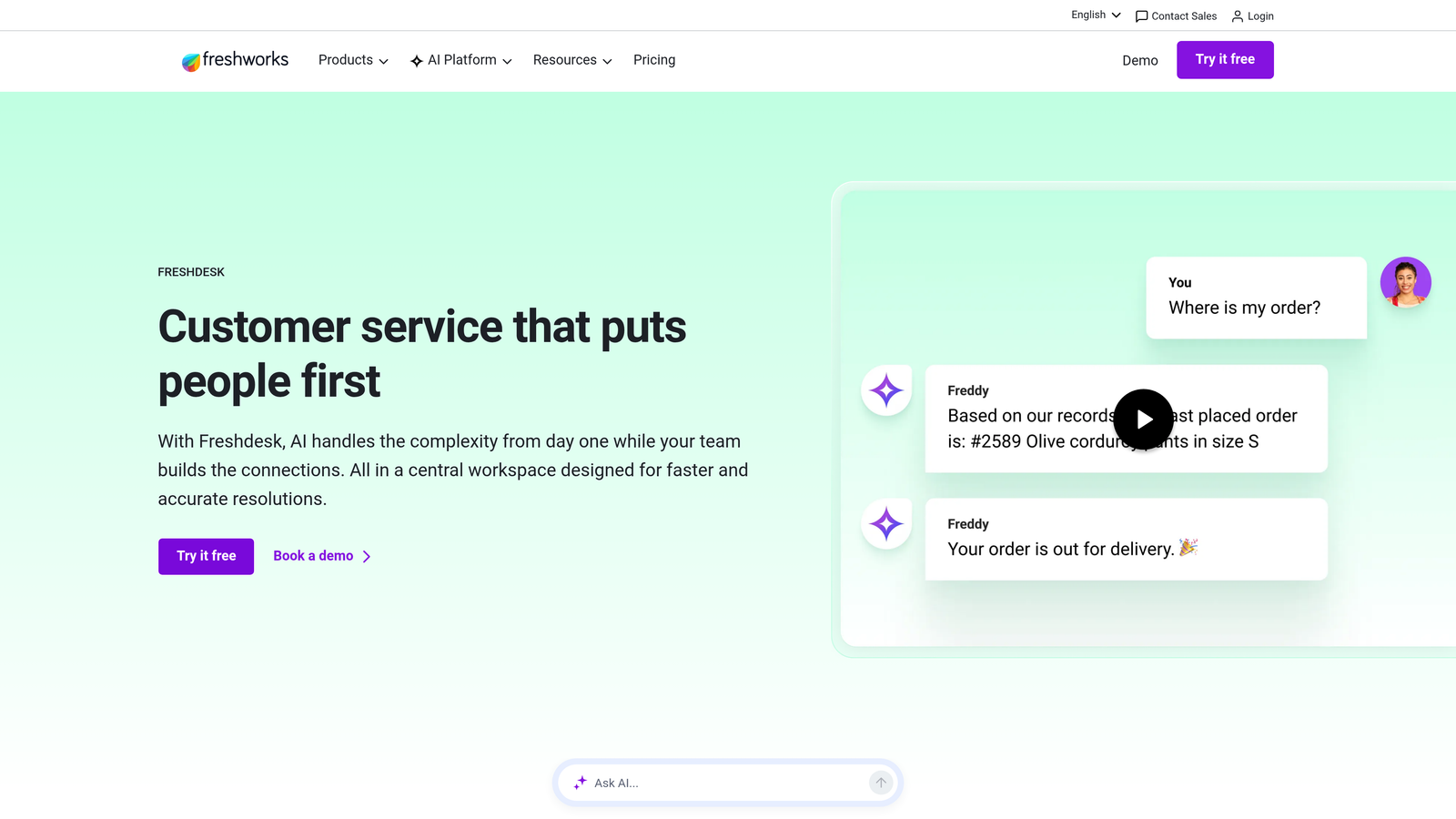
Freshdesk's Freddy AI brings automated responses, self-service bots, and agent assist into Freshdesk's helpdesk platform at a generally more accessible price point than its enterprise competitors.
Where This Tool Shines
Freddy AI's biggest advantage is that it's bundled into Freshdesk's existing tier structure. Teams moving from a basic helpdesk to AI-assisted support don't need to evaluate a separate AI vendor — upgrading your Freshdesk plan unlocks Freddy capabilities progressively.
For teams that also use Freshworks' broader suite (telephony, CRM, ITSM), Freddy creates a unified AI layer across products, which reduces the integration complexity that often plagues multi-vendor support stacks.
Key Features
Freddy Self Service: A chatbot that deflects common queries before they reach an agent, with conversation flows built on your existing knowledge base.
Freddy Copilot: Provides agents with response suggestions, ticket summarization, and knowledge article recommendations in real time.
Tiered AI Bundling: AI features are included in higher Freshdesk tiers rather than sold as a separate platform, simplifying procurement for smaller teams.
Native Freshworks Ecosystem Integration: Works natively with Freshdesk's ticketing, telephony, and CRM products for teams using multiple Freshworks tools.
Best For
SMBs and mid-market teams that want AI-assisted support without the complexity of a separate AI vendor. Particularly strong for companies already using Freshworks products. Teams with sophisticated AI requirements or complex B2B workflows may find Freddy's capabilities less advanced than dedicated AI-first platforms.
Pricing
Freddy AI features are tiered across Freshdesk Growth, Pro, and Enterprise plans, all priced per agent per month. Some advanced Freddy capabilities require higher tiers or additional add-ons. Generally considered more affordable than Zendesk at comparable team sizes. Verify current tier details at freshworks.com.
5. Tidio
Best for: Small businesses and e-commerce brands wanting a free entry point with conversation-based AI scaling
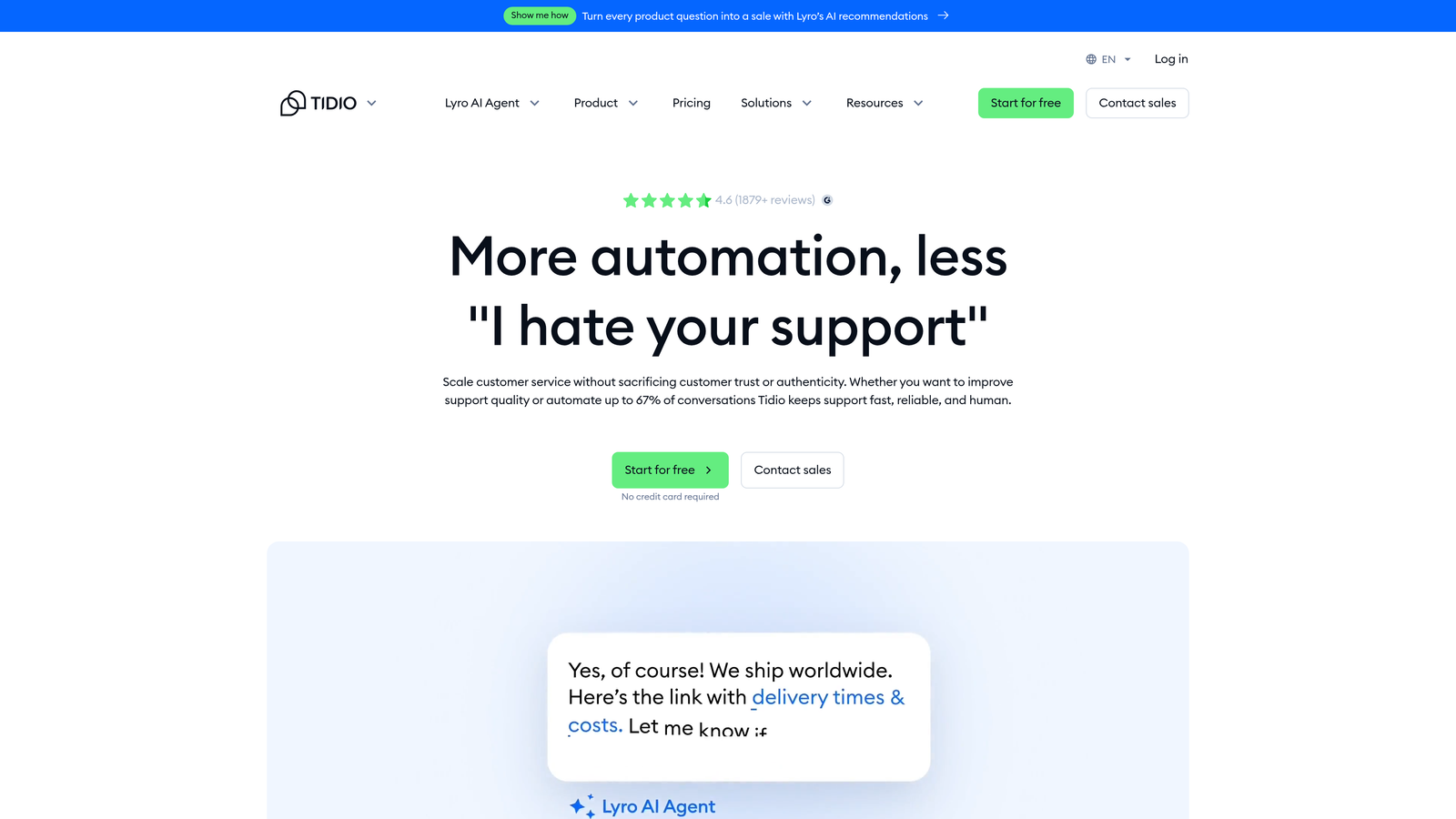
Tidio combines live chat and AI chatbot capabilities in a single platform aimed at small businesses and e-commerce brands, with a free tier and conversation-based scaling for AI features.
Where This Tool Shines
Tidio's free plan makes it one of the lowest-friction entry points in this category. For small teams testing AI chatbot value before committing budget, the ability to start without a credit card is genuinely useful. The live chat and AI chatbot share a single interface, which reduces the operational complexity of managing multiple tools.
Lyro AI, Tidio's AI chatbot, is designed to handle common customer queries autonomously using your existing content. For e-commerce brands with repetitive order and shipping queries, this can deliver meaningful deflection without significant setup work.
Key Features
Free Plan with Limited Conversations: A no-cost entry tier that lets small teams test the platform before committing to paid tiers.
Lyro AI Chatbot: Conversation-based AI pricing that scales with usage, priced separately from the base Tidio plan.
Combined Live Chat and AI Interface: Agents and AI operate from the same inbox, simplifying handoff and conversation management.
E-Commerce Integrations: Native integrations with Shopify and WooCommerce for order status, product queries, and customer data context.
Best For
Small businesses and e-commerce brands with relatively straightforward support queries and limited initial budget. Tidio is less suited for complex B2B SaaS workflows, multi-product support environments, or teams that need deep CRM integration and business intelligence beyond basic chat analytics.
Pricing
Free plan available with limited monthly conversations. Lyro AI is priced on a conversation basis on top of the base Tidio plan. Paid plans are positioned at accessible price points for SMBs. Verify current tier structures and conversation limits at tidio.com.
6. Drift (Salesloft)
Best for: B2B teams where support and sales pipeline conversations significantly overlap
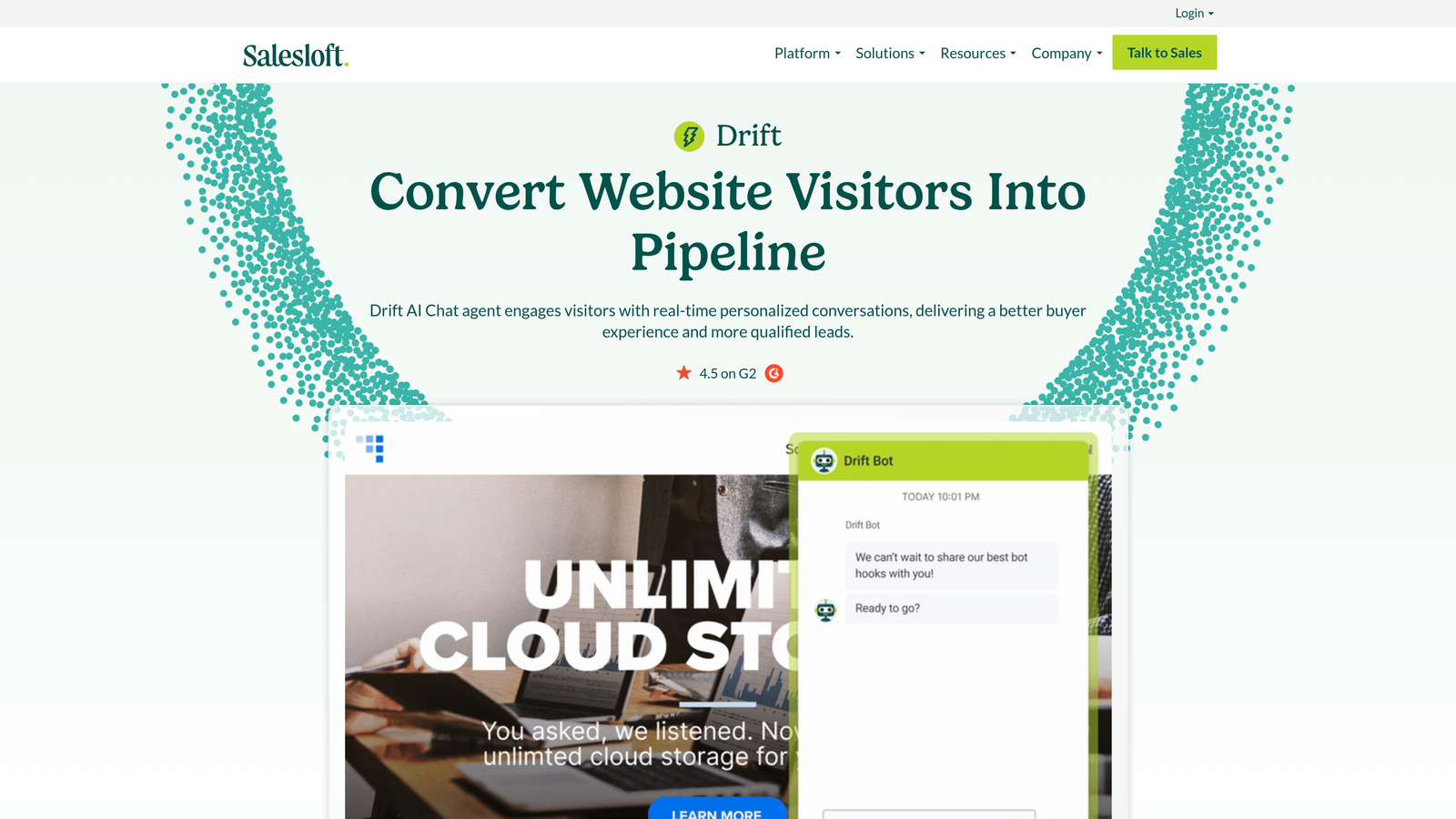
Drift blends AI chatbot capabilities with pipeline generation, making it a distinct fit for B2B teams where the line between support and sales qualification is intentionally blurred.
Where This Tool Shines
Drift's core differentiation is that it was never purely a support tool. It's designed to qualify, route, and convert website visitors alongside handling support conversations. For revenue teams that want a single conversational layer covering both inbound sales and support, that dual purpose is genuinely valuable.
The meeting booking and routing capabilities are particularly strong. When a support conversation reveals an upsell opportunity, or when a prospect needs to speak to sales, Drift can route and book that meeting within the conversation flow without requiring a separate tool.
Key Features
Sales and Support AI Chatbot: Handles both support deflection and sales qualification within a single conversation interface.
Meeting Booking and Routing: Books and routes meetings directly within conversation flows, eliminating friction between chat and calendar.
Visitor Personalization: Adapts conversation flows based on visitor identity, account data, and behavioral signals.
CRM and Marketing Automation Integration: Connects with major CRM and marketing tools to sync conversation data with existing revenue workflows.
Best For
B2B mid-market and enterprise teams where sales and support conversations genuinely overlap, and where pipeline generation is as important as ticket deflection. Teams looking purely for support automation may find Drift's sales-first orientation adds complexity they don't need. Note that Drift is now part of Salesloft, and the product roadmap continues to evolve.
Pricing
Pricing is not publicly listed and requires a sales conversation. Positioned at mid-market and enterprise price points. Verify current pricing and packaging at drift.com.
7. Gorgias
Best for: E-commerce brands on Shopify, BigCommerce, or Magento with ticket-volume-based support needs
Gorgias is a helpdesk built specifically for e-commerce, with ticket-based pricing and deep native integrations with the major e-commerce platforms.
Where This Tool Shines
Gorgias's ticket-based pricing model is genuinely different from the seat-based norm. You pay based on how many tickets you process each month, not how many agents are in your team. For e-commerce brands with seasonal volume spikes and variable team sizes, this structure can be more predictable than paying for agent seats you don't always need.
The out-of-the-box AI automation for order status, returns, and shipping queries is particularly strong. These are the queries that dominate e-commerce support queues, and Gorgias handles them without requiring significant configuration work.
Key Features
Ticket-Based Pricing: Cost scales with ticket volume rather than agent headcount — a meaningful structural difference for teams with variable staffing.
E-Commerce AI Automation: Pre-built automation for order status, returns, and shipping queries that covers the majority of common e-commerce support interactions.
Native Platform Integrations: Deep integrations with Shopify, BigCommerce, and Magento that pull order and customer data directly into the support context.
Macros and Rules Engine: Automated response workflows and routing rules that reduce manual handling for predictable query types.
Best For
E-commerce brands on Shopify, BigCommerce, or Magento with high volumes of transactional support queries. Gorgias is not well-suited for B2B SaaS support, where queries are more complex, less transactional, and require deeper product context rather than order data integration.
Pricing
Plans are priced by monthly ticket volume rather than agent seats. Starter plans begin at accessible monthly rates for smaller e-commerce operations, with higher tiers covering larger volumes. Verify current ticket volume tiers and rates at gorgias.com.
8. Kustomer
Best for: High-volume B2C operations that want per-conversation pricing independent of headcount
Kustomer offers a CRM-native support platform with per-conversation pricing and an AI automation layer, designed for operations where customer volume is high and team size varies.
Where This Tool Shines
Kustomer's per-conversation pricing model decouples cost from headcount, which is structurally appealing for operations that flex their agent teams seasonally or across shifts. The unified customer timeline is one of the stronger implementations in this category: every touchpoint across channels appears in a single chronological view, giving agents full context without tab-switching.
The CRM-native architecture means customer data isn't just a lookup — it's embedded in the support workflow. For B2C brands where purchase history, loyalty status, and previous interactions should inform every support response, this integration depth matters.
Key Features
Per-Conversation Pricing: Cost scales with conversation volume rather than agent seats, decoupling your support bill from your headcount decisions.
Unified Customer Timeline: All customer touchpoints across channels appear in a single view, giving agents complete context without navigating multiple systems.
AI Automation Layer: Handles routing, classification, and response suggestions to reduce manual work and improve consistency at scale.
Omnichannel Support: Covers email, live chat, social media, and voice within a single platform.
Best For
High-volume B2C operations where customer history and omnichannel context are central to support quality. Kustomer is enterprise-focused, with pricing and minimums that reflect that positioning. B2B SaaS teams with lower volumes and more complex individual queries may find the per-conversation model less efficient than alternatives.
Pricing
Conversation-based pricing model at enterprise-focused price points. Minimum commitments typically apply. Verify current plan details, volume tiers, and minimums at kustomer.com.
9. Chatwoot
Best for: Engineering-led teams that want infrastructure control, cost predictability, and open-source flexibility
Chatwoot is an open-source customer support platform offering a self-hosted option that eliminates per-seat SaaS fees entirely, alongside a cloud plan for teams that prefer managed infrastructure.
Where This Tool Shines
Chatwoot's self-hosted option is genuinely unique in this list. For engineering-led teams with the infrastructure capacity to run their own deployment, the cost structure is fundamentally different: you pay infrastructure costs rather than per-seat SaaS fees, which can represent significant savings at scale.
The open-source codebase also means Chatwoot can be extended with custom AI integrations. Teams that want to bring their own AI model, build custom automation, or integrate with internal tooling that commercial vendors don't support have a level of flexibility here that closed-source platforms simply can't offer.
Key Features
Self-Hosted Deployment: Run Chatwoot on your own infrastructure with no per-seat SaaS fees — you pay only for the infrastructure you use.
Cloud Plan Option: For teams that prefer managed infrastructure, a cloud plan is available at per-agent pricing generally lower than enterprise competitors.
Multi-Channel Inbox: Handles email, live chat, social media, and WhatsApp from a single unified inbox.
Open-Source Extensibility: The codebase can be forked and extended to support custom AI integrations, internal tooling, and workflows that commercial APIs don't accommodate.
Best For
Engineering-led teams, startups with infrastructure capacity, and organizations where data sovereignty or cost ceiling control is a priority. Native AI features are more limited than commercial alternatives, so teams expecting out-of-the-box AI resolution without custom development should evaluate that gap carefully.
Pricing
Self-hosted version is free and open-source — infrastructure costs are your only expense. Cloud plans are per-agent per-month at rates generally lower than enterprise competitors. Verify current cloud pricing at chatwoot.com.
Which Tool Fits Your Situation
The right AI customer service chatbot isn't just about feature lists — it's about which pricing model matches your support volume, team structure, and growth trajectory. Here's a quick framework for cutting through the options.
If you're a B2B SaaS team that wants AI-first support with product context and business intelligence: Halo AI is built for this. Page-aware context, continuous learning, and business intelligence signals make it more than a support tool — it becomes a strategic layer across your product and revenue operations.
If you're already on Intercom and have a well-documented knowledge base: Fin AI's resolution-based model is worth modeling carefully. Run the numbers on your expected deflection rate before assuming it's cheaper than alternatives.
If you're an enterprise team with compliance requirements and established Zendesk workflows: Zendesk AI adds capability without platform migration, though the add-on cost structure deserves close scrutiny as team size grows.
If you're an SMB wanting bundled AI without a separate vendor: Freshdesk Freddy AI offers a practical path to AI-assisted support within a familiar helpdesk structure.
If you're an e-commerce brand on Shopify or BigCommerce: Gorgias's ticket-based pricing and native integrations make it the most purpose-built option for transactional support at volume.
If you're engineering-led and prioritize cost control: Chatwoot's self-hosted option removes the per-seat ceiling entirely, though it requires the infrastructure capacity and technical appetite to match.
One important note: pricing models in this category are evolving rapidly. Resolution-based, conversation-based, and seat-based structures are all shifting as vendors compete for market position. Always request a demo using your actual ticket volume data and ask vendors to model your specific cost scenario — don't rely on list pricing alone.
For a deeper look at how these cost structures compare across the category, see our customer support automation pricing comparison.
Your support team shouldn't scale linearly with your customer base. Let AI agents handle routine tickets, guide users through your product, and surface business intelligence while your team focuses on complex issues that need a human touch. See Halo in action and discover how continuous learning transforms every interaction into smarter, faster support.