9 Best AI Customer Service Tools for B2B Companies in 2026
This guide evaluates the nine best AI customer service for B2B platforms in 2026, helping support teams handle complex, high-stakes accounts with intelligent ticket resolution, proactive insights, and seamless AI-to-human handoffs. Each tool was assessed on integration depth, scalability, and analytics to help B2B companies maintain the responsiveness that enterprise contracts demand.
 Grant CooperFounder13 min read
B2B customer service operates in a fundamentally different world than B2C. Your customers aren't filing one-off complaints about a shipping delay. They're navigating complex products, managing multi-user accounts, and expecting the kind of responsiveness that keeps six-figure contracts intact.
When a single ticket can involve technical troubleshooting, cross-team escalation, and account-level context, generic chatbots simply don't cut it. That's where AI customer service platforms purpose-built for B2B come in. These tools go beyond scripted responses to deliver intelligent ticket resolution, proactive account insights, and seamless handoffs between AI and human agents.
We evaluated dozens of platforms and narrowed the field to nine that genuinely move the needle for B2B support teams, considering factors like integration depth, learning capabilities, scalability, analytics sophistication, and pricing transparency. Here's what made the cut.
1. Halo AI
Best for: B2B teams that want AI-first support with deep product context and business intelligence
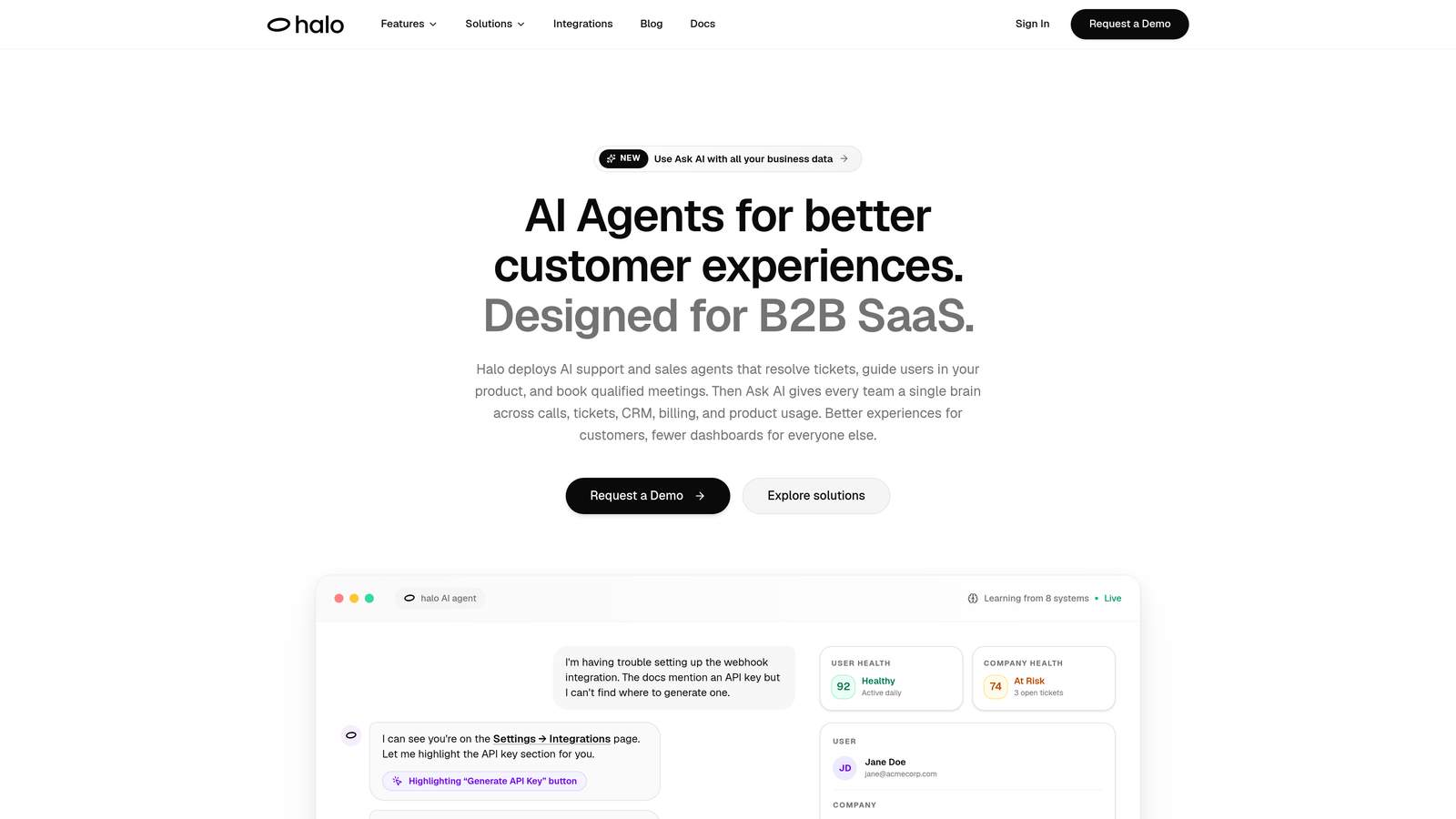
Halo AI is an AI-first customer support platform that deploys intelligent agents to resolve tickets, guide users through your product, and surface business intelligence from every interaction.
Where This Tool Shines
What sets Halo apart from most platforms on this list is its architecture. It wasn't built as a bolt-on to an existing helpdesk. It was designed from the ground up as an AI-first system, which means the intelligence isn't layered on top of legacy infrastructure. It's baked into every interaction.
The standout capability is page-aware context. Halo's chat widget can see what screen the user is currently on, which means its AI agents don't just answer questions in the abstract. They guide users through your actual product interface with visual UI guidance. For B2B SaaS companies where onboarding complexity and product depth are constant support drivers, this is a meaningful differentiator.
Key Features
Page-Aware Chat Widget: The AI sees the user's current screen and delivers contextual, visual guidance rather than generic answers.
Continuous Learning AI Agents: Halo's agents improve from every interaction automatically, without requiring manual retraining cycles.
Smart Inbox with Business Intelligence: Beyond support metrics, the inbox surfaces customer health signals, revenue insights, and anomaly detection that connect support data to broader business outcomes.
Automated Bug Ticket Creation: When a support conversation reveals a product issue, Halo automatically creates a bug ticket in tools like Linear, closing the loop between customer-facing support and your engineering team.
Deep Integration Stack: Native connections to Slack, HubSpot, Intercom, Stripe, Zoom, PandaDoc, and more, so Halo plugs into your existing B2B tech stack rather than replacing it.
Best For
B2B SaaS companies and product teams that want more than ticket deflection. Halo is particularly well-suited for teams where support conversations carry revenue signals, where product complexity drives ticket volume, and where engineering and support need to stay tightly aligned.
Pricing
Contact for pricing. Halo is designed for B2B teams looking to scale support capacity without scaling headcount proportionally.
2. Intercom Fin
Best for: Teams already using Intercom that want autonomous AI resolution without switching platforms
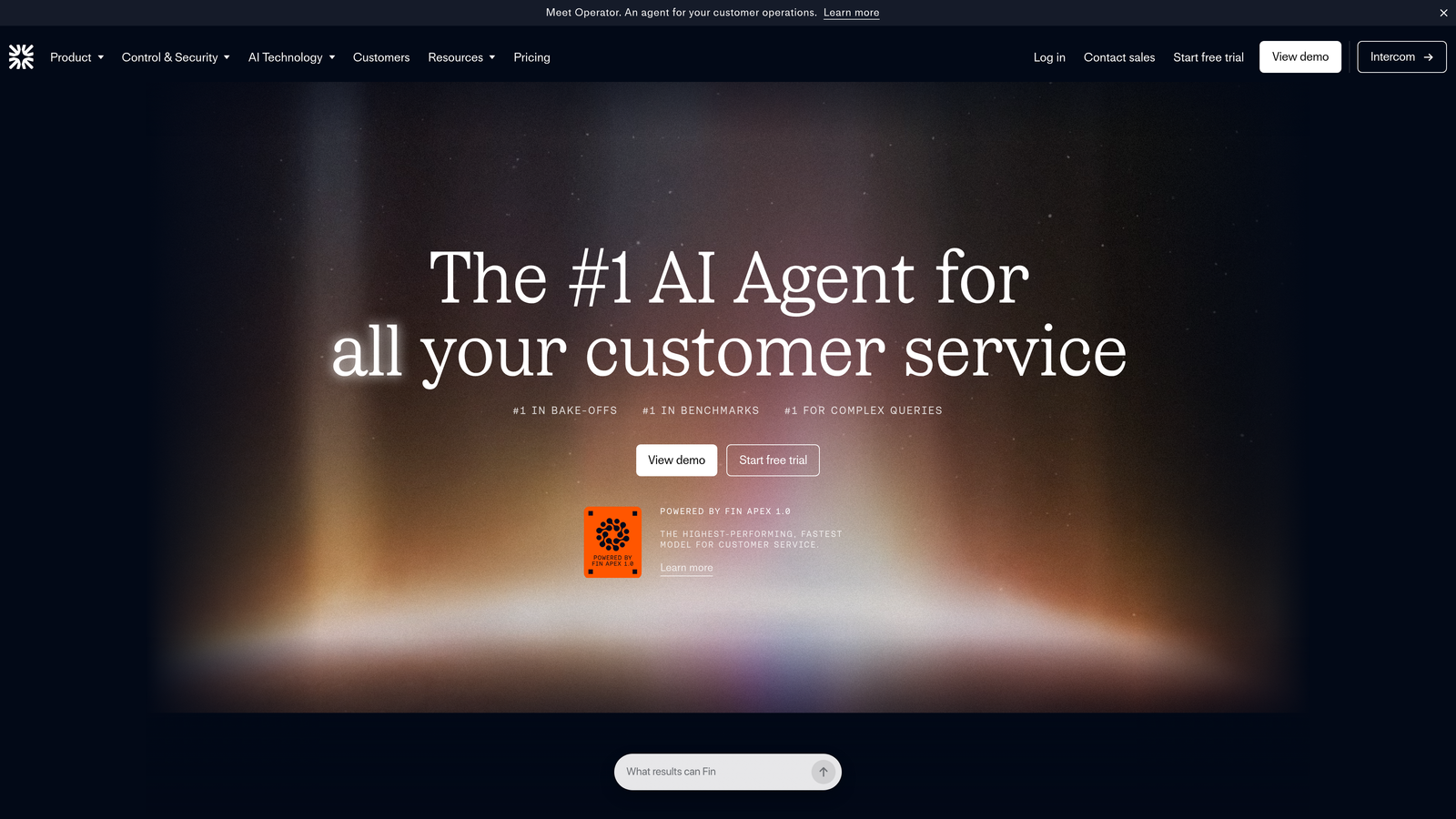
Intercom Fin is an AI agent built on top of Intercom's established messaging platform, leveraging your existing help center content to resolve conversations autonomously.
Where This Tool Shines
If your team is already in the Intercom ecosystem, Fin is a natural extension. It draws on your existing knowledge base, documentation, and past conversations to answer questions without requiring a separate AI platform to be configured from scratch. The setup curve is relatively low for existing Intercom customers.
Fin's conversation handoff is particularly well-executed. When an issue exceeds the AI's confidence threshold, it passes the full conversation context to a human agent, so the customer never has to repeat themselves. For B2B teams managing ongoing relationships with named accounts, that continuity matters.
Key Features
Content-Driven AI Resolution: Fin resolves conversations by drawing on your help center, documentation, and historical conversations.
Customizable Tone and Guardrails: You can configure Fin's tone and set guardrails to keep responses on-brand and within defined boundaries.
Seamless Human Handoff: Full conversation context is preserved when escalating to a live agent, eliminating repetitive customer explanations.
Multi-Language and Multi-Channel: Supports conversations across chat, email, and social in multiple languages.
Resolution Rate Reporting: Built-in analytics track AI resolution rates and conversation quality, not just volume.
Best For
Existing Intercom customers looking to add AI resolution without migrating platforms, and mid-market B2B teams with solid help center content already in place.
Pricing
Fin is charged per resolution rather than per seat. Base Intercom plans start at $39/seat/month, with Fin costs varying based on resolution volume.
3. Zendesk AI
Best for: Enterprise B2B support teams running high ticket volumes on an established helpdesk
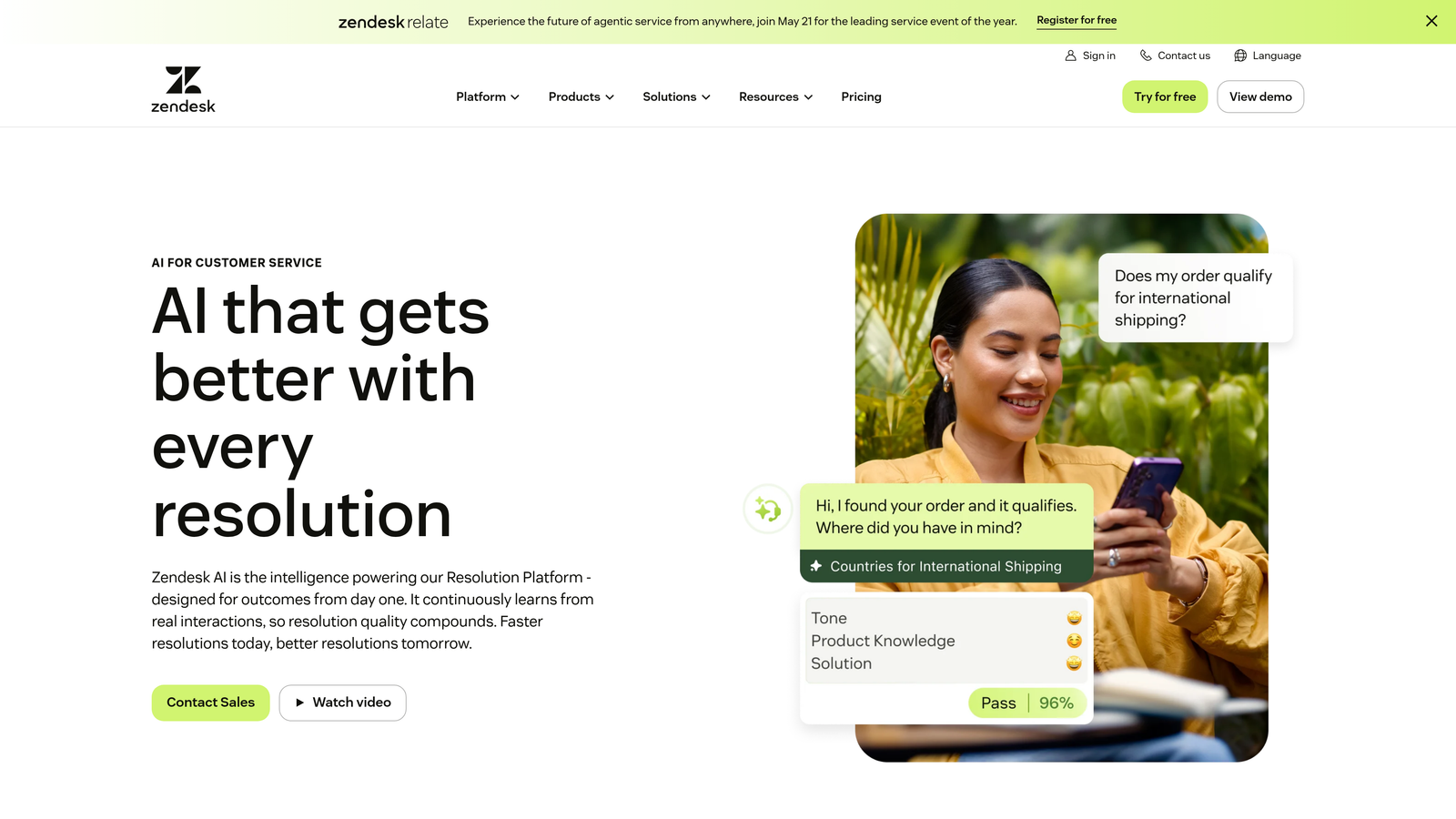
Zendesk AI layers intelligent triage, automated responses, and agent assistance tools into Zendesk's enterprise-grade helpdesk platform.
Where This Tool Shines
Zendesk's AI capabilities are most compelling for large support organizations that are already deeply embedded in the Zendesk ecosystem. The intelligent triage features, which automatically classify ticket intent, language, and sentiment before a human ever sees the ticket, can meaningfully reduce time-to-first-response at scale.
The agent assistance tools are also worth noting. Rather than replacing agents entirely, Zendesk AI surfaces suggested replies and relevant knowledge base articles in real time, helping agents respond faster and more consistently. For complex B2B products where agents need to be subject matter experts, this kind of augmentation can be as valuable as full automation.
Key Features
Intelligent Triage: Automatically classifies ticket intent, language, and sentiment to route issues appropriately from the start.
AI-Generated Suggested Replies: Recommends responses and knowledge base articles to agents during live ticket handling.
Autonomous AI Agents: Handles common, repetitive requests end-to-end without agent involvement.
Advanced Analytics Dashboards: Custom reporting gives support leaders visibility into performance, trends, and team efficiency.
1,500+ Integrations: An extensive marketplace ensures Zendesk connects to virtually any tool in a B2B tech stack.
Best For
Enterprise support teams with established Zendesk workflows, high ticket volumes, and the resources to configure and maintain a sophisticated helpdesk environment.
Pricing
Suite plans start at $55/agent/month. AI add-on features are available on Professional plans and above.
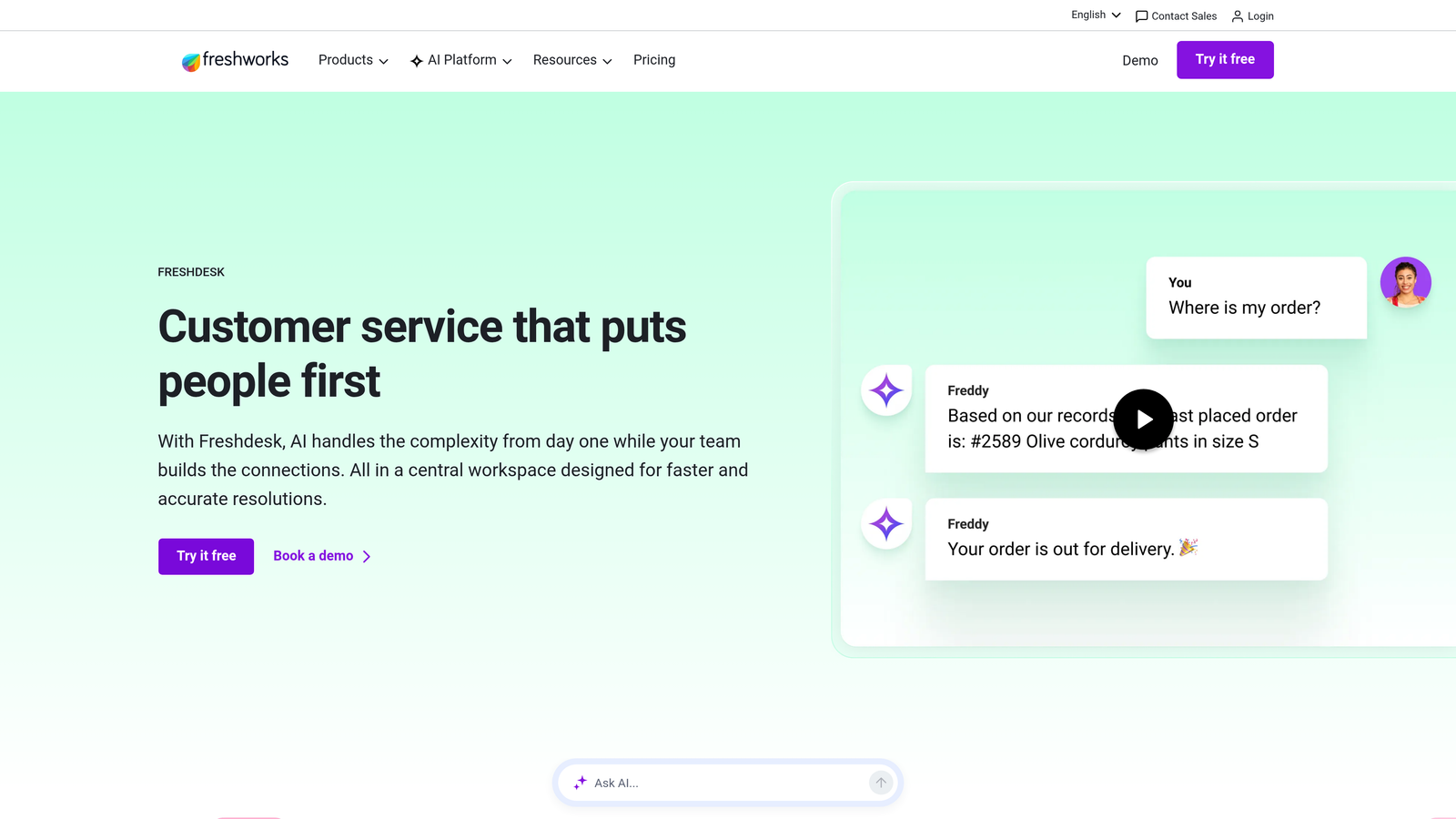
4. Freshdesk Freddy AI
Best for: Cost-conscious B2B teams wanting AI triage and self-service without a large platform investment
Freshdesk embeds Freddy AI across its helpdesk suite, offering automated ticket triage, agent assistance, and self-service bots at a competitive price point.
Where This Tool Shines
Freshdesk Freddy AI's strongest argument is value. The combination of AI-powered triage, a no-code chatbot builder, and omnichannel support at a price point well below many enterprise alternatives makes it genuinely accessible for growing B2B teams that aren't yet at enterprise scale.
The no-code workflow designer deserves mention specifically. Support managers who aren't technical can build and modify AI-driven support flows without engineering involvement, which reduces the time between identifying a support gap and deploying a solution for it.
Key Features
Freddy AI Auto-Triage: Automatically categorizes tickets and assigns priority levels based on content and context.
AI-Suggested Responses: Recommends canned replies and response drafts to speed up agent handling time.
No-Code Chatbot Builder: Visual workflow designer for building self-service bots without writing code.
AI-Powered Knowledge Base: Surfaces relevant articles automatically during both agent and customer-facing interactions.
Omnichannel Coverage: Unified inbox across email, chat, phone, and social channels.
Best For
Small to mid-sized B2B teams looking for a capable, affordable helpdesk with solid AI features and minimal configuration overhead.
Pricing
Free tier available. Pro plan at $49/agent/month includes core Freddy AI features.
5. Ada
Best for: B2B teams focused on measurable resolution rates and action-taking AI, not just answer-giving
Ada is an AI-powered customer service automation platform focused on driving genuine resolution rather than simple deflection, with a no-code builder for complex support workflows.
Where This Tool Shines
Ada's core philosophy is worth understanding: the goal isn't to contain customers in a chatbot loop. It's to actually resolve their issues. That distinction drives its architecture. Ada's AI agent can take actions by connecting to backend systems, not just surface answers from a knowledge base. It can look up account information, process requests, and complete multi-step workflows on behalf of the customer.
The reasoning engine is designed for the kind of layered, conditional inquiries that B2B customers frequently bring. When a question involves multiple factors, account-specific context, or sequential steps, Ada's reasoning approach handles the complexity more gracefully than simpler intent-matching systems.
Key Features
Action-Taking AI Agent: Connects to backend systems to take actions, not just retrieve answers, enabling genuine end-to-end resolution.
No-Code Workflow Builder: Build and manage AI-driven support flows without engineering resources.
Multi-Channel Deployment: Operates across web, mobile, social, and messaging apps from a single configuration.
Multi-Step Reasoning Engine: Handles complex, conditional inquiries that require sequential logic rather than single-turn responses.
Resolution-Focused Analytics: Measures actual outcomes and resolution rates rather than containment metrics that can mask poor customer experiences.
Best For
Mid-market and enterprise B2B teams where resolution quality matters as much as deflection volume, and where the AI needs to interact with backend systems to truly close tickets.
Pricing
Custom pricing based on resolution volume. Contact Ada directly for B2B-specific quotes.
6. Forethought
Best for: Mid-market support teams wanting generative AI layered on top of their existing helpdesk
Forethought combines generative AI with intelligent triage and workflow automation, designed to work as an intelligence layer on top of platforms like Zendesk and Salesforce.
Where This Tool Shines
Forethought's approach is additive rather than replacement-oriented. If your team has invested in a helpdesk like Zendesk or Salesforce Service Cloud and isn't ready to migrate, Forethought slots in as a smarter layer on top, improving triage accuracy, response quality, and routing decisions without requiring a platform switch.
The SupportGPT-powered agent generates context-aware responses that feel more natural and accurate than template-based systems. For B2B support teams handling nuanced technical questions, the generative quality of responses can meaningfully improve customer satisfaction compared to rigid, rule-based alternatives.
Key Features
SupportGPT-Powered AI Agent: Generates context-aware, conversational responses rather than pulling from fixed templates.
Intelligent Ticket Routing: Routes tickets based on intent, urgency, and individual agent expertise profiles.
Predictive Triage Model: Predicts ticket priority and category before an agent reviews it, enabling proactive queue management.
Knowledge Base Integration: Surfaces relevant articles automatically to both AI agents and human agents during ticket handling.
Helpdesk-Agnostic Layer: Works on top of Zendesk, Salesforce, and other major platforms without requiring migration.
Best For
Mid-market and enterprise B2B teams with 10 or more support agents who want AI improvements without abandoning their current helpdesk investment.
Pricing
Custom pricing. Typically suited for teams with 10 or more support agents; contact Forethought for specifics.
7. Tidio
Best for: Smaller B2B teams and startups getting started with AI-assisted support on a limited budget
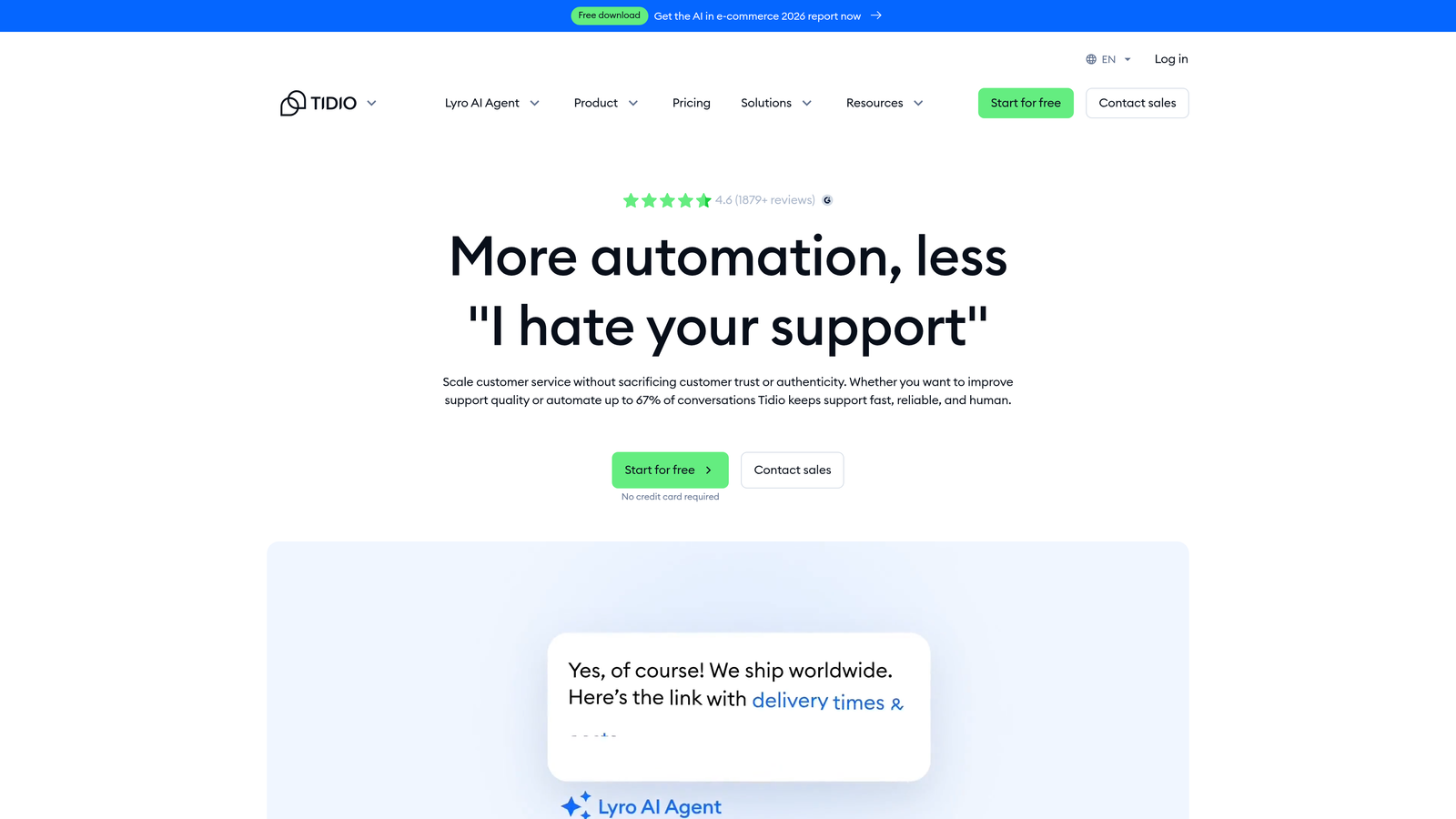
Tidio is an accessible customer service platform combining live chat, the Lyro AI chatbot, and helpdesk features at a price point designed for smaller teams.
Where This Tool Shines
Tidio earns its place on this list by being genuinely approachable for teams that aren't ready to invest in enterprise-grade AI infrastructure. The Lyro chatbot learns from your existing FAQ and support content, which means you can get a functional AI support layer running without a lengthy implementation project.
The real-time visitor monitoring feature adds a proactive dimension that many budget-tier tools skip. Knowing which page a visitor is on before they even start a conversation gives support teams and AI alike a useful head start on understanding context, though it's worth noting this is more basic than the deep page-aware intelligence offered by platforms like Halo AI.
Key Features
Lyro AI Chatbot: Learns from your FAQ and support content to handle common questions automatically.
Live Chat with Visitor Monitoring: Real-time visibility into what pages visitors are browsing before and during conversations.
Visual Chatbot Builder: Drag-and-drop workflow creation for building automated conversation flows without coding.
Platform Integrations: Connects to Shopify, WordPress, HubSpot, and other common tools.
Shared Inbox: Unified view for managing conversations across channels within a single interface.
Best For
Small B2B teams, early-stage startups, and businesses that want to introduce AI support capabilities incrementally without committing to an enterprise platform.
Pricing
Free plan available. Lyro AI starts at $39/month for 50 conversations, with higher tiers available for greater volume.
8. Salesforce Einstein Service Cloud
Best for: B2B organizations already running on Salesforce that need AI woven into their CRM-driven support workflows
Salesforce Einstein Service Cloud delivers AI-powered case classification, next-best-action recommendations, and a unified customer view for organizations operating within the Salesforce ecosystem.
Where This Tool Shines
The fundamental advantage here is data unification. For B2B companies where the sales team, account managers, and support agents all need to operate with shared context on an account, having support AI that draws on the full Salesforce CRM, including open opportunities, contract history, and renewal dates, is genuinely powerful. The AI isn't just answering support questions; it's operating with full account intelligence.
Agentforce, Salesforce's autonomous AI agent capability, extends this further by enabling cases to be handled end-to-end within Service Cloud. For enterprise B2B organizations where support, sales, and success are tightly connected, the depth of native integration is difficult to replicate with a standalone tool.
Key Features
Einstein AI Case Classification: Automatically classifies and routes cases based on content, history, and account data.
Agentforce Autonomous Agents: AI agents that handle cases independently within the Service Cloud environment.
Unified Customer Profile: Combines sales, service, and marketing data into a single view for every case interaction.
AI-Recommended Knowledge Articles: Surfaces relevant articles for both agents and customers based on case context.
Deep CRM Context: Every support interaction is informed by full account history, opportunity status, and relationship data.
Best For
Enterprise B2B organizations already invested in Salesforce where cross-functional account context is critical to delivering quality support.
Pricing
Service Cloud starts at $25/user/month. Einstein AI features are available on Enterprise tier and above.
9. Kustomer
Best for: B2B teams that need a complete omnichannel customer history with AI-powered prioritization
Kustomer is a CRM-powered customer service platform that provides a single-thread timeline of every customer interaction, enhanced with AI classification and sentiment analysis.
Where This Tool Shines
Kustomer's unified timeline is its defining feature. Rather than managing disconnected tickets across channels, agents see a complete, chronological history of every interaction a customer has had, regardless of whether it came through email, chat, phone, or social. For B2B accounts with multiple stakeholders and long relationship histories, this view eliminates the "let me look up your account" friction that erodes trust.
The AI layer adds prioritization intelligence on top of that rich history. Sentiment analysis flags conversations that need urgent attention, and intent detection classifies incoming messages automatically, so agents spend less time sorting and more time resolving.
Key Features
Unified Customer Timeline: Single-thread view of every interaction across all channels, giving agents complete relationship context instantly.
AI Intent Detection: Automatically classifies incoming conversations by topic and intent without manual tagging.
Sentiment Analysis: Identifies negative or urgent interactions so they can be prioritized before they escalate.
Custom Workflow Automation: Business process automation with flexible workflow builders for routing, escalation, and follow-up.
Proactive Messaging: Triggers outbound messages based on customer behavior and lifecycle stage, shifting support from reactive to proactive.
Best For
B2B support teams managing complex, multi-stakeholder accounts where relationship history and cross-channel context are essential to delivering consistent service.
Pricing
Enterprise plan at $89/user/month; Ultimate plan at $139/user/month.
Which Tool Is Right for Your B2B Team?
The right platform depends heavily on where your team is today and what you're optimizing for. Here's a practical way to think through the decision.
If you want AI-first architecture with product intelligence: Halo AI is the strongest option for B2B SaaS teams. Its page-aware context, continuous learning, and business intelligence capabilities go well beyond ticket deflection into genuine product and revenue intelligence. It's purpose-built for the kind of support complexity that comes with technical B2B products.
If you're already on Intercom: Fin is the natural starting point. Low migration friction, solid resolution rates, and a per-resolution pricing model that aligns cost with actual value delivered.
If you're running enterprise-scale on Zendesk or Salesforce: Stay in your ecosystem. Zendesk AI and Salesforce Einstein Service Cloud are both mature, deeply integrated options that leverage your existing infrastructure investment rather than working around it.
If you're mid-market and want AI without a platform migration: Forethought layers cleanly on top of your existing helpdesk. Ada is worth evaluating if resolution quality and backend action-taking are priorities.
If budget is a primary constraint: Freshdesk Freddy AI offers strong value at its price point. Tidio is the right entry point for smaller teams or startups building their first AI support layer.
If relationship context across accounts is your biggest pain point: Kustomer's unified timeline approach is hard to match for teams managing complex, multi-stakeholder B2B accounts.
The broader shift happening across all these platforms is worth naming directly. The best B2B support tools in 2026 aren't just faster ticket systems. They're intelligence layers that connect support data to product decisions, customer health, and revenue outcomes. That's the standard worth holding any platform to.
Your support team shouldn't scale linearly with your customer base. Let AI agents handle routine tickets, guide users through your product, and surface business intelligence while your team focuses on the complex issues that genuinely need a human touch. See Halo in action and discover how continuous learning transforms every interaction into smarter, faster support.