9 Best AI Customer Service Tools for Enterprises in 2026
This guide evaluates the 9 best AI customer service platforms for enterprises in 2026, comparing tools on automation depth, integration ecosystems, analytics, and human-agent handoff capabilities. Enterprise support teams handling high-volume, high-stakes interactions will find actionable criteria to identify which AI customer service for enterprises solution fits their scale, whether managing 20 agents or 2,000.
 Matt PattoliFounder13 min read
Enterprise customer service teams face a unique challenge: volume, complexity, and the expectation of fast, consistent support at scale. A single missed ticket or slow response can erode a contract worth six figures. That's why enterprise teams are moving beyond basic chatbots and investing in AI platforms that can reason, route, escalate, and learn, not just auto-reply.
This list covers the best AI customer service tools built for enterprise scale. We evaluated each on depth of automation, integration ecosystem, analytics capabilities, and how well they handle the handoff between AI and human agents. Whether you're running a team of 20 support agents or 2,000, these platforms are worth a serious look.
A quick note on methodology: we focused on tools with proven enterprise deployment, meaningful AI capabilities beyond keyword matching, and the ability to connect to the broader business stack, not just a ticketing system.
1. Halo AI
Best for: B2B SaaS teams wanting AI-first architecture with business intelligence built in
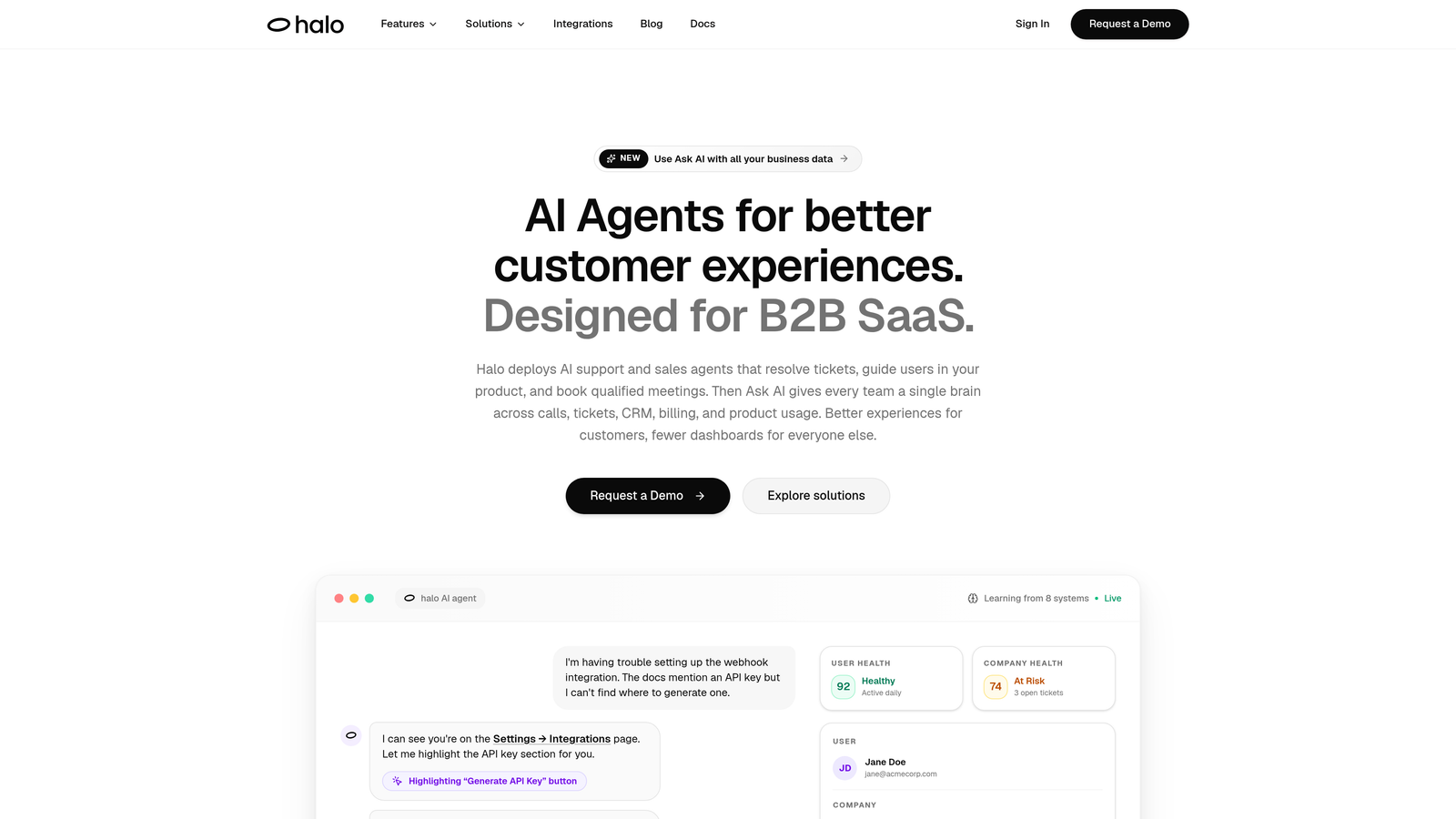
Halo AI is an AI-first customer support platform that resolves tickets, guides users through your product, and surfaces business intelligence signals, all while learning from every interaction.
Where This Tool Shines
What separates Halo from most enterprise AI tools is the page-aware context engine. The AI sees exactly what the user is looking at inside your product, so it can provide specific UI guidance rather than generic help center responses. That's a meaningful difference when your customers are stuck on a specific workflow, not just looking for a FAQ answer.
The smart inbox goes well beyond ticket metrics. It surfaces customer health signals, revenue anomalies, and churn indicators, turning your support queue into a business intelligence layer. For B2B SaaS teams where every account represents real ARR, that kind of signal is genuinely valuable.
Key Features
Page-Aware Chat Widget: The AI understands what page the user is on and provides contextual, step-by-step UI guidance tailored to their current view.
Autonomous Ticket Resolution: Handles routine and complex tickets independently, with intelligent escalation to live agents when the situation requires human judgment.
Auto Bug Ticket Creation: Automatically identifies and routes bug reports directly to engineering via Linear integration, removing a manual step from your support-to-dev pipeline.
Smart Inbox with Business Intelligence: Surfaces customer health signals, revenue anomalies, and churn indicators alongside standard ticket data.
Broad Integration Ecosystem: Connects with Slack, HubSpot, Intercom, Stripe, Zoom, PandaDoc, and Fathom, linking support to the full business stack.
Continuous Learning: Every resolved interaction feeds back into the model, improving resolution quality over time without manual retraining.
Best For
B2B SaaS companies that want AI-first architecture rather than AI bolted onto an existing helpdesk. Particularly strong for product teams that want support to generate business intelligence, not just close tickets. Less suited for high-volume consumer support or organizations deeply embedded in legacy ITSM platforms.
Pricing
Custom pricing based on team size and usage. Contact Halo AI directly for enterprise quotes.
2. Salesforce Agentforce
Best for: Enterprises where Salesforce is the primary system of record
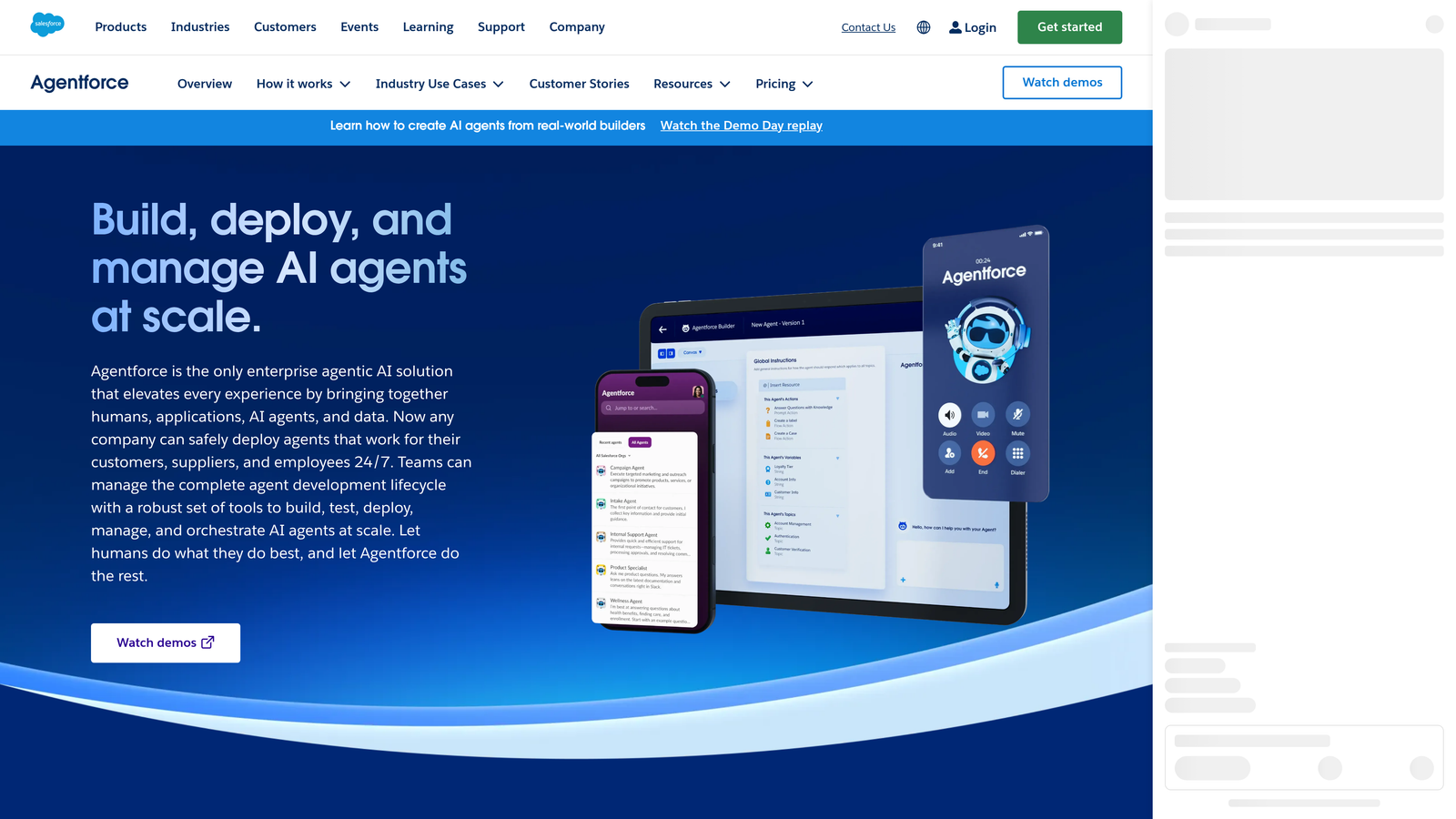
Salesforce Agentforce is an autonomous AI agent platform deeply embedded in Service Cloud and the broader Salesforce ecosystem, allowing enterprises to define agent roles, guardrails, and actions across CRM data.
Where This Tool Shines
If your organization runs on Salesforce, Agentforce is a natural extension rather than a new vendor relationship. The agents operate directly on CRM records, which means they're working with the same data your sales and service teams already rely on. That eliminates a significant integration headache common with third-party AI tools.
The governance layer is a standout for regulated industries. You can define precisely what an agent can and cannot do, which actions it can take autonomously, and when it must escalate. For enterprises with compliance requirements, that configurability matters.
Key Features
Native Salesforce Integration: Works directly within Service Cloud, Sales Cloud, and Data Cloud without middleware or custom connectors.
Configurable Agent Roles: Define agent responsibilities, permissions, and guardrails at a granular level to meet enterprise governance requirements.
Autonomous CRM Actions: Agents can update records, create cases, and trigger workflows without human intervention.
Multi-Channel Support: Handles email, chat, and voice within the Salesforce environment.
Einstein AI Foundation: Built on Salesforce's Einstein AI with enterprise-grade security and data residency controls.
Best For
Large enterprises already invested in the Salesforce ecosystem where consolidating vendors is a priority. Less compelling if Salesforce isn't your core platform, since the value is largely tied to that existing infrastructure.
Pricing
Custom enterprise pricing, typically bundled with existing Salesforce Service Cloud contracts. Contact Salesforce for current rates.
3. Zendesk AI
Best for: Teams already on Zendesk who want incremental AI capability without switching platforms
Zendesk AI is a native AI suite layered across the Zendesk ticketing and agent workspace, including intelligent triage, generative AI bots, agent copilot suggestions, and automated routing.
Where This Tool Shines
The appeal here is minimal disruption. If your team already lives in Zendesk, adding the AI suite means your agents don't need to learn a new interface. The agent copilot works in context, surfacing suggested responses and ticket summaries directly in the workspace where agents are already operating.
Intelligent triage is a practical strength. The system detects intent, scores priority, and routes tickets automatically, which reduces the manual triage burden on team leads. For high-volume environments, that kind of upstream automation has a real impact on response times.
Key Features
Intelligent Triage: Detects ticket intent and automatically routes to the right agent or queue based on content and priority scoring.
Generative AI Bot: Customer-facing self-service bot powered by generative AI, grounded in your knowledge base.
Agent Copilot: Real-time response suggestions and ticket summarization delivered directly in the agent workspace.
Automated Ticket Tagging: Applies consistent tags and categories at scale, improving reporting accuracy.
Native Add-On Model: Extends existing Zendesk plans rather than requiring a platform migration.
Best For
Enterprises already running Zendesk who want to layer AI on top of existing workflows. Teams evaluating a full platform switch will find more transformative options elsewhere on this list.
Pricing
AI capabilities are available as an add-on to existing Zendesk plans. Pricing varies by tier; contact Zendesk for enterprise-specific rates.
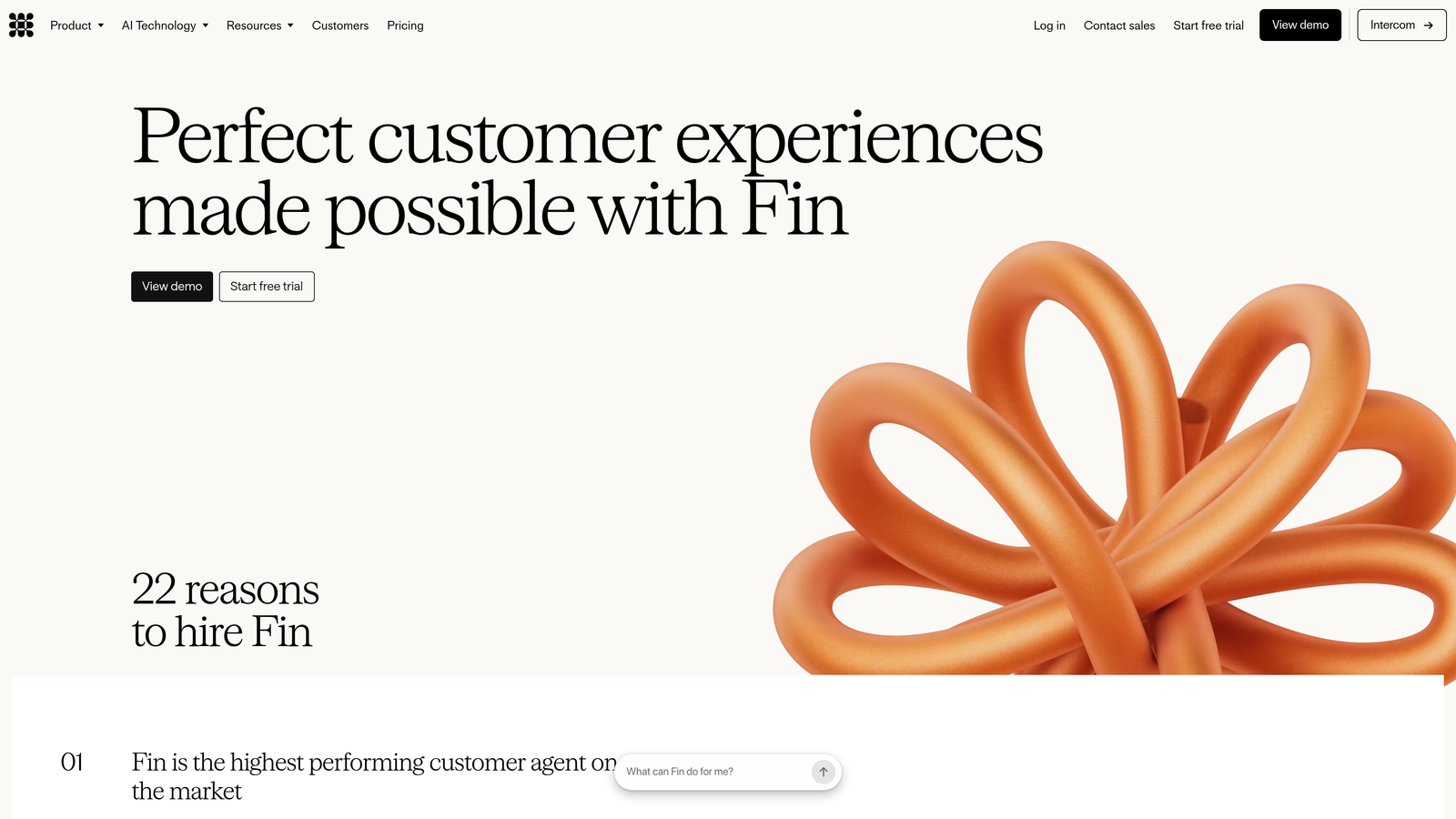
4. Intercom Fin
Best for: Teams that want outcome-based pricing and strong tier-1 resolution rates
Intercom Fin is an LLM-powered AI agent grounded in your knowledge base, help documentation, and conversation history, with the ability to take actions across multiple knowledge sources.
Where This Tool Shines
Fin's resolution quality on tier-1 queries is a genuine differentiator. Because it's grounded in your specific content rather than a generic model, the answers tend to be accurate and on-brand. The multi-source knowledge ingestion means you're not limited to a single help center; Fin can pull from PDFs, URLs, and past conversations simultaneously.
The per-resolution pricing model is worth examining carefully for enterprise budgeting. Instead of paying per seat, you pay for outcomes. For teams with predictable ticket volume, this can simplify cost forecasting. For teams with unpredictable spikes, it requires more careful modeling.
Key Features
LLM-Powered Resolution: Answers grounded in your own knowledge sources, not a generic AI model, for brand-consistent responses.
Multi-Source Knowledge Ingestion: Pulls from help docs, PDFs, URLs, and past conversations simultaneously.
Action-Capable: Can check order status, update records, and complete tasks, not just answer questions.
Per-Resolution Pricing: Pay for outcomes rather than agent seats, a notable model in the enterprise space.
Seamless Human Handoff: Transitions to live agents within the Intercom inbox without friction.
Best For
Teams already using Intercom as their primary messaging platform, and those who want outcome-based pricing transparency. Also strong for SaaS companies with well-maintained knowledge bases that can serve as the AI's foundation.
Pricing
Per-resolution pricing model with enterprise plans available at volume discounts. Contact Intercom for specific rates.
5. Freshdesk Freddy AI
Best for: Organizations running the full Freshworks suite across support, CRM, and ITSM
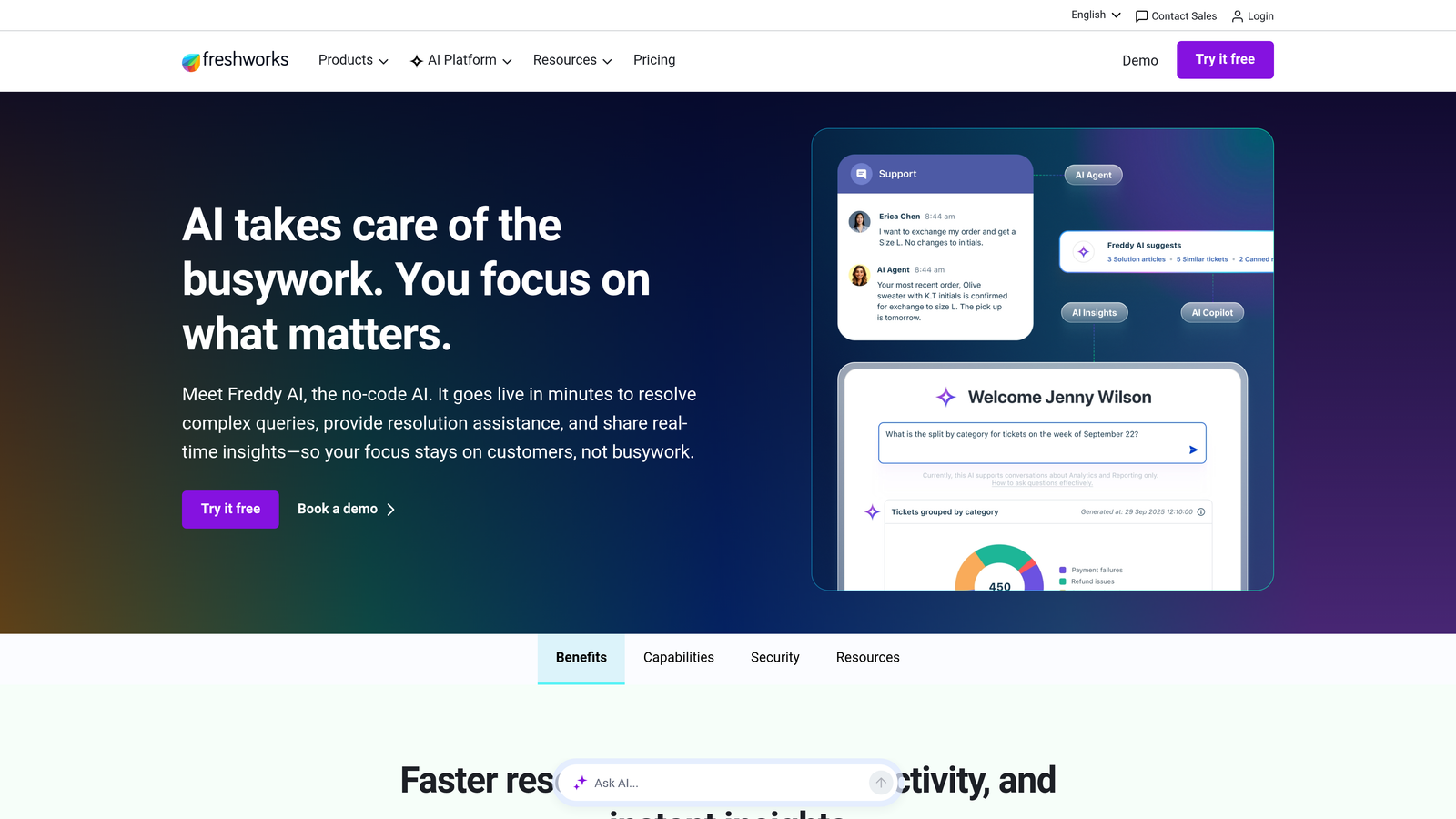
Freshdesk Freddy AI is Freshworks' unified AI layer spanning Freshdesk for support, Freshsales for CRM, and Freshservice for ITSM, with both agent-assist and customer-facing automation capabilities.
Where This Tool Shines
The single-vendor AI story is Freddy's strongest argument. If your organization uses multiple Freshworks products, the AI layer spans all of them with shared context. An agent handling a support ticket can see CRM history and ITSM incidents in the same workspace, with AI suggestions informed by all of that data.
Freddy Self Service handles customer-facing automation with multi-language support, which matters for enterprises operating across regions. Predictive CSAT scoring gives managers early warning signals before a customer experience turns negative.
Key Features
Cross-Product AI: Single AI layer spanning support, CRM, and ITSM within the Freshworks ecosystem.
Freddy Copilot: Real-time suggestions, ticket summarization, and response drafting for human agents.
Freddy Self Service: Customer-facing bot with multi-language support for global enterprise deployments.
Predictive CSAT Scoring: Flags at-risk interactions before they escalate using sentiment analysis.
Tiered Availability: AI features scale with Freshworks plan tier, from Growth through Enterprise.
Best For
Enterprises already committed to the Freshworks ecosystem who want AI across their entire suite without adding another vendor. Teams using only Freshdesk in isolation will get value, but the cross-product capability is where Freddy really earns its place.
Pricing
Included in higher Freshworks plan tiers. Enterprise pricing is available on request from the Freshworks sales team.
6. ServiceNow AI Agents
Best for: Large enterprises with complex internal ITSM and HR service delivery workflows
ServiceNow AI Agents are part of the Now Assist suite, bringing generative AI and autonomous workflow automation to enterprise IT, HR, and operations support functions.
Where This Tool Shines
ServiceNow is the dominant platform in enterprise ITSM, and the AI Agents capability extends that dominance into autonomous action. The platform excels at complex internal workflows: incident routing, change risk assessment, knowledge article creation, and resolution note generation. For large IT organizations, that level of automation can meaningfully reduce mean time to resolution.
Compliance and audit trail capabilities are best-in-class for regulated industries. Role-based access controls, full audit logging, and enterprise governance features make this a viable choice for financial services, healthcare, and government organizations where every action needs to be traceable.
Key Features
AI-Powered Workflow Automation: Autonomous handling of IT, HR, and operations workflows at enterprise scale.
Generative AI for Documentation: Automatic case summarization, resolution notes, and knowledge article creation.
Enterprise Compliance Controls: Full audit trails, role-based access, and governance features for regulated industries.
Predictive Intelligence: ML-based incident routing and change risk assessment to reduce manual triage.
Deep Platform Integration: Works natively within existing ServiceNow modules without additional connectors.
Best For
Large enterprises with existing ServiceNow deployments focused on internal IT and HR support. Less suited for external customer-facing support; this is primarily an internal operations tool.
Pricing
Enterprise contract pricing that requires an existing ServiceNow platform license. Contact ServiceNow for current rates.
7. Kustomer AI
Best for: High-volume consumer-facing support teams needing full omnichannel context
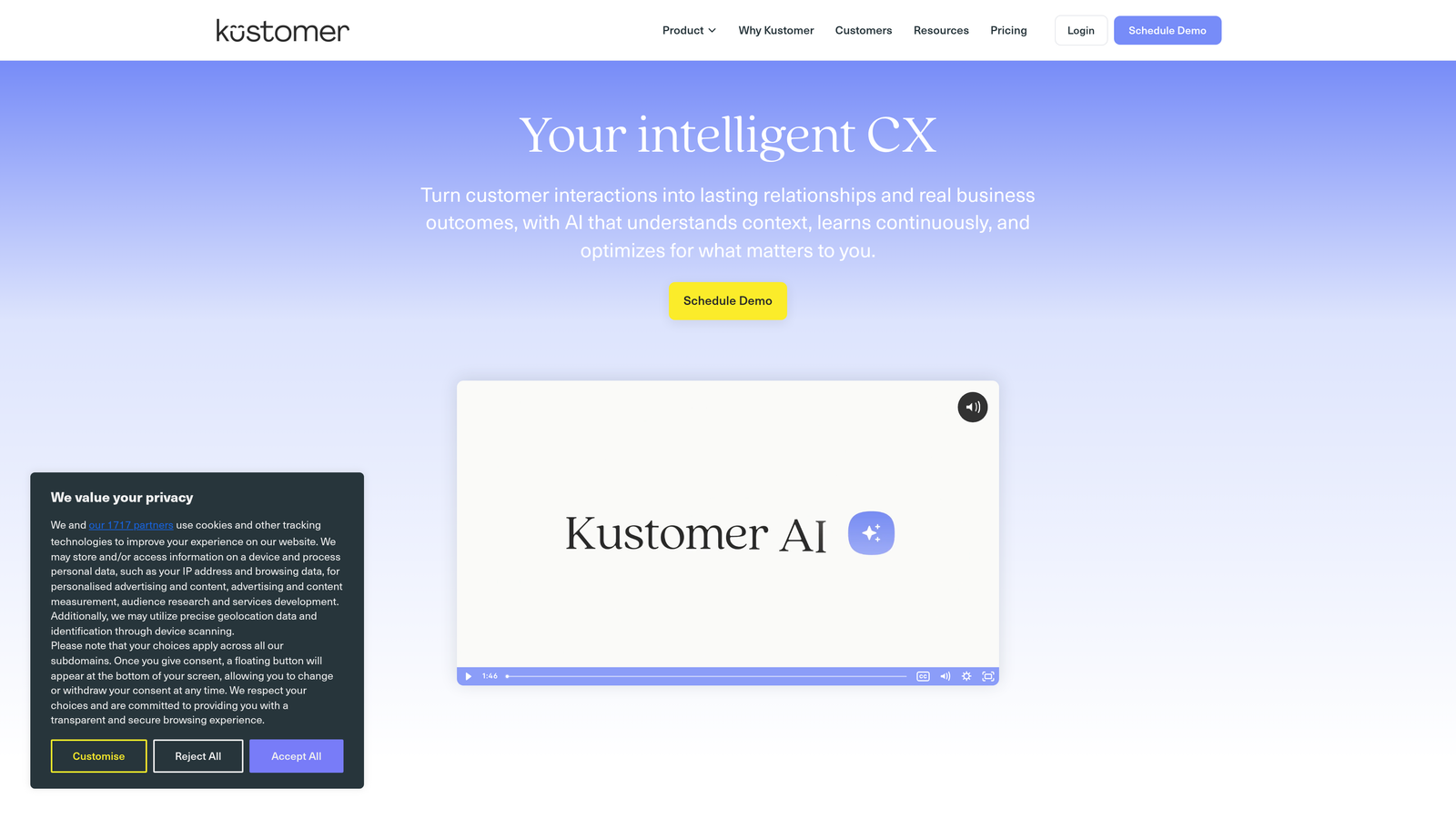
Kustomer AI is an omnichannel CRM with AI layered throughout, built around a unified customer timeline that gives the AI full context across every interaction regardless of channel.
Where This Tool Shines
The customer timeline is the architectural advantage here. Rather than treating each channel as a separate data silo, Kustomer aggregates email, chat, SMS, voice, and social interactions into a single chronological view. The AI operates with that full context, which produces more relevant routing decisions and response suggestions than systems working from partial information.
Proactive outreach triggers based on customer behavior signals add a layer of capability beyond reactive support. When a customer's behavior pattern suggests frustration or abandonment, the system can trigger an outreach before they submit a ticket or escalate on social media.
Key Features
Unified Customer Timeline: Complete interaction history across all channels in a single view, giving AI full context for every response.
AI-Powered Routing and Sentiment Detection: Intelligent assignment and real-time sentiment analysis to prioritize at-risk interactions.
Conversational Self-Service: AI-driven automation across chat and messaging channels with natural language understanding.
Proactive Outreach Triggers: Behavior-based signals that initiate outreach before a customer escalates.
Omnichannel Coverage: Email, chat, SMS, voice, and social media in a single platform.
Best For
High-volume consumer brands in e-commerce, retail, and direct-to-consumer categories. The omnichannel strength is less relevant for B2B SaaS teams with simpler channel mixes.
Pricing
Per-agent per-month pricing with enterprise tiers available. Contact Kustomer for volume-based quotes.
8. Ada CX
Best for: Enterprises needing no-code agent deployment with strong governance and multi-language support
Ada CX is a no-code AI agent builder with enterprise governance features, action-based capabilities, and multi-language support across more than 50 languages.
Where This Tool Shines
Ada's no-code builder reduces the technical barrier to deploying AI agents, which matters for enterprises where IT resources are constrained or where business teams want to manage their own AI content. The governance layer gives enterprise administrators meaningful control: content guardrails, escalation logic, and approval workflows that keep the AI within defined boundaries.
The action-based architecture is a meaningful distinction. Ada agents don't just retrieve information; they can complete transactions, look up account details, and process requests. For industries like telecom and fintech where customers frequently need to do something, not just know something, that capability closes a significant gap.
Key Features
No-Code Agent Builder: Business teams can build and manage AI agents without engineering involvement, using content controls and guardrails.
Action-Based AI: Completes transactions, processes requests, and updates records rather than just answering questions.
Multi-Language Support: Operates across 50+ languages for global enterprise deployments.
Configurable Escalation Logic: Granular control over when and how the AI hands off to human agents.
Proven Enterprise Verticals: Strong deployment track record in telecom, fintech, and e-commerce.
Best For
Enterprises in regulated or transaction-heavy industries that need AI to complete actions, not just answer questions. Also well-suited for global organizations that need consistent multi-language support without building separate bots per region.
Pricing
Custom enterprise pricing. Contact Ada directly for a quote based on volume and deployment scope.
9. Forethought AI
Best for: Large human agent teams that want AI to accelerate agents rather than replace them
Forethought AI is an AI platform focused on intelligent triage, automated resolution, and real-time agent augmentation, designed to work alongside existing helpdesk platforms rather than replace them.
Where This Tool Shines
Forethought's architecture reflects a specific philosophy: AI should make human agents faster and smarter, not just deflect tickets. The Assist product delivers real-time suggested responses and relevant knowledge articles directly in the agent's workflow, reducing the time spent searching for information during a live interaction.
The predictive triage capability is well-suited for complex enterprise environments with multiple queues, skill groups, and SLA tiers. ML-based routing that correctly assigns tickets upstream reduces misrouting, which is one of the more persistent inefficiencies in large support organizations.
Key Features
Predictive Triage: ML-based routing that assigns tickets to the right agent or queue based on content, history, and predicted complexity.
Real-Time Agent Assist: Surfaces suggested responses and relevant knowledge articles during live interactions.
Automated Resolution (Solve): Handles common, repetitive ticket types autonomously to reduce agent workload.
Helpdesk Integrations: Works with Salesforce, Zendesk, ServiceNow, and other major platforms without replacing them.
Performance Analytics: Dashboard focused on deflection rate, handle time, and agent performance metrics.
Best For
Enterprises with large human agent teams and existing helpdesk investments who want AI augmentation rather than a full platform replacement. Strong fit for organizations where the human touch is a deliberate service differentiator.
Pricing
Custom pricing based on team size and usage. Contact Forethought for enterprise-specific rates.
Which Tool Is Right for Your Enterprise?
The right choice here depends less on which platform has the most features and more on where your organization sits today and where you want to go.
If you're a B2B SaaS team wanting AI-first architecture: Halo AI is purpose-built for this. The page-aware context, business intelligence signals, and continuous learning architecture address problems that helpdesk add-ons weren't designed to solve.
If Salesforce is your system of record: Agentforce is the logical choice. The native CRM integration and enterprise governance make it a natural extension of what you already have.
If your team lives in Zendesk: Zendesk AI offers the lowest-friction path to AI capability without a platform migration. It won't transform your architecture, but it will meaningfully improve what your agents can do today.
If you need enterprise ITSM and internal operations AI: ServiceNow Now Assist is in a category of its own for large IT organizations with complex internal workflows and compliance requirements.
If you have large human agent teams and want augmentation over automation: Forethought's triage and assist capabilities are designed specifically for that model, and they layer onto your existing helpdesk investment rather than replacing it.
For global enterprises needing multi-language and transaction-capable AI: Ada CX handles both with strong governance controls that enterprise administrators can manage without engineering support.
Your support team shouldn't scale linearly with your customer base. Let AI agents handle routine tickets, guide users through your product, and surface business intelligence while your team focuses on complex issues that need a human touch. See Halo in action and discover how continuous learning transforms every interaction into smarter, faster support.