9 Best AI Customer Service Tools for Global Teams in 2026
Discover the 9 best AI customer service tools for global teams in 2026, covering platforms built to handle multilingual support, 24/7 autonomous ticket resolution, and seamless human handoffs across time zones. Whether you're managing a lean distributed support function or scaling a global SaaS product, this guide helps you identify the right solution for your team's operational realities.
 Grant CooperFounder14 min read
Global support teams face a challenge that only compounds with scale: customers expect fast, accurate help regardless of time zone, language, or channel. When your team spans continents and your users span even more, traditional helpdesk workflows buckle under the pressure.
AI customer service tools have matured significantly. Today's platforms don't just deflect tickets, they resolve them end-to-end, learn from every interaction, and surface intelligence that helps teams improve continuously. The shift from "chatbot deflection" to genuine autonomous resolution is the defining product narrative of 2026.
This list covers the top AI customer service tools built for the realities of global operations: multilingual support, 24/7 autonomous resolution, seamless handoff to human agents, and integrations with the tools distributed teams already use. Whether you're running a lean support function across three time zones or scaling a global SaaS product, these platforms represent the strongest options available today. Selection criteria include multilingual capabilities, AI resolution quality, integration depth, scalability, and pricing transparency.
1. Halo AI
Best for: AI-first SaaS teams wanting autonomous resolution with deep product and business context
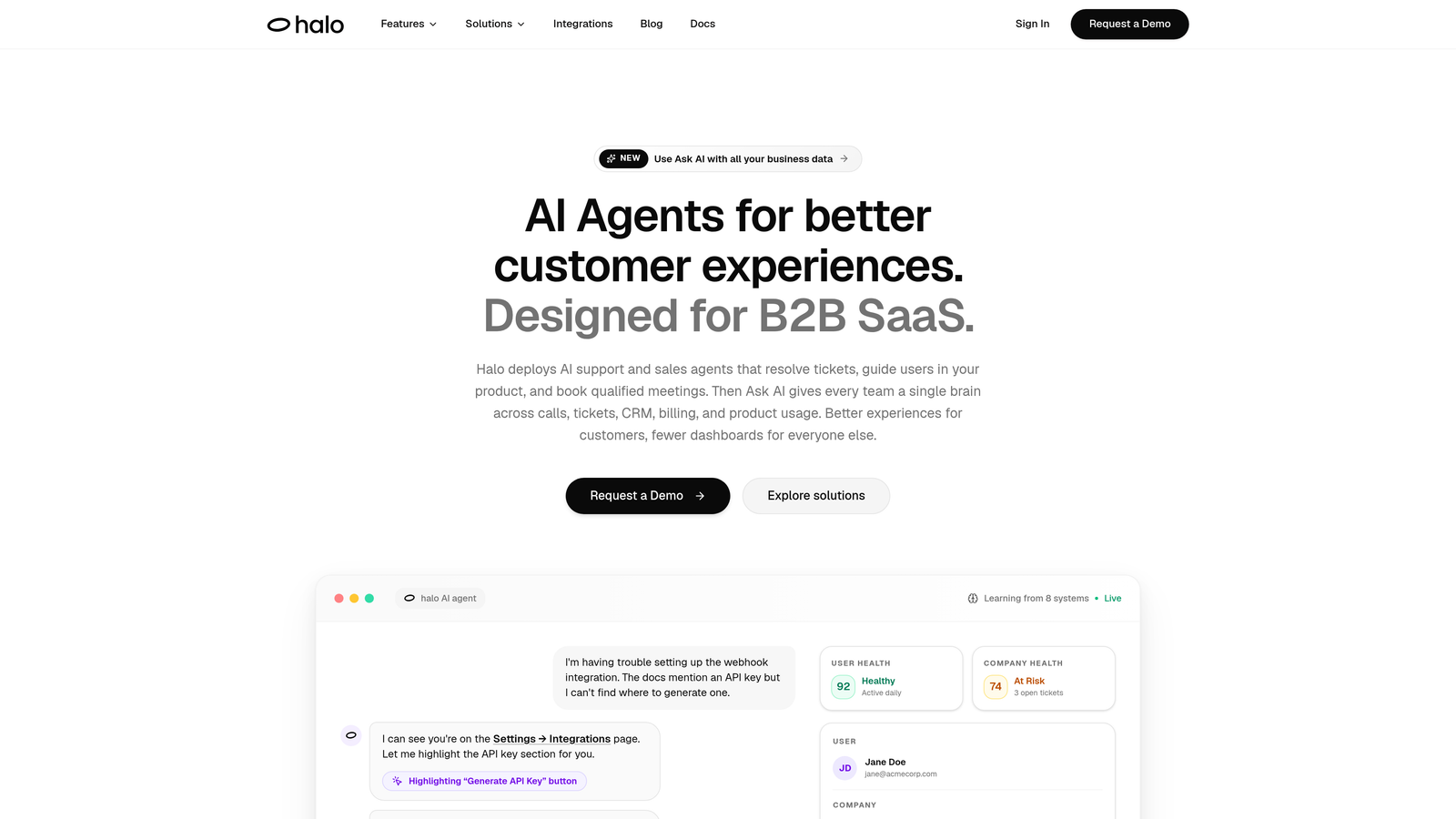
Halo AI is an AI-first customer support platform that deploys intelligent agents to resolve tickets, guide users through your product with page-aware context, and generate business intelligence, all while learning from every interaction.
Where This Tool Shines
What separates Halo from most AI support tools is its architecture. Rather than bolting AI onto an existing helpdesk, Halo is built AI-first from the ground up. The most notable capability is page-aware context: the AI agent actually sees what a user is currently viewing inside your product, enabling guidance that is genuinely specific to their situation rather than generic knowledge base responses.
For global SaaS teams, this matters because product complexity doesn't shrink just because a user is in a different time zone. Halo handles that complexity autonomously, escalating to human agents only when the situation genuinely requires it. Every resolved interaction feeds back into the system, so the AI gets sharper over time without additional configuration work from your team.
Key Features
Page-Aware AI Agent: The agent sees what users are currently viewing in your product, enabling contextually accurate guidance that goes beyond static FAQ responses.
Autonomous Ticket Resolution with Smart Escalation: Halo handles routine and complex queries independently, routing to human agents when escalation is genuinely warranted.
Auto Bug Ticket Creation: Automatically generates and routes bug reports to Linear or your preferred issue tracker, removing a manual step that typically falls through the cracks in high-volume support environments.
Smart Inbox with Business Intelligence: Beyond standard support metrics, the inbox surfaces customer health signals, revenue anomalies, and product friction patterns, giving support teams visibility that typically lives in separate analytics tools.
Deep Integration Stack: Connects to Linear, Slack, HubSpot, Intercom, Stripe, Zoom, PandaDoc, and Fathom, covering the full operational stack most SaaS teams run on.
Best For
Product-led SaaS companies and B2B teams that want AI support tightly integrated with their product experience, bug tracking, and business context. Particularly well-suited to teams that have outgrown bolt-on chatbot solutions and want a platform that learns continuously rather than requiring constant manual updates.
Pricing
Pricing is not publicly listed. Contact the team directly or request a demo at haloagents.ai to discuss your team's requirements and get a tailored quote.
2. Intercom
Best for: Teams already using Intercom who want a mature AI agent with strong multilingual coverage
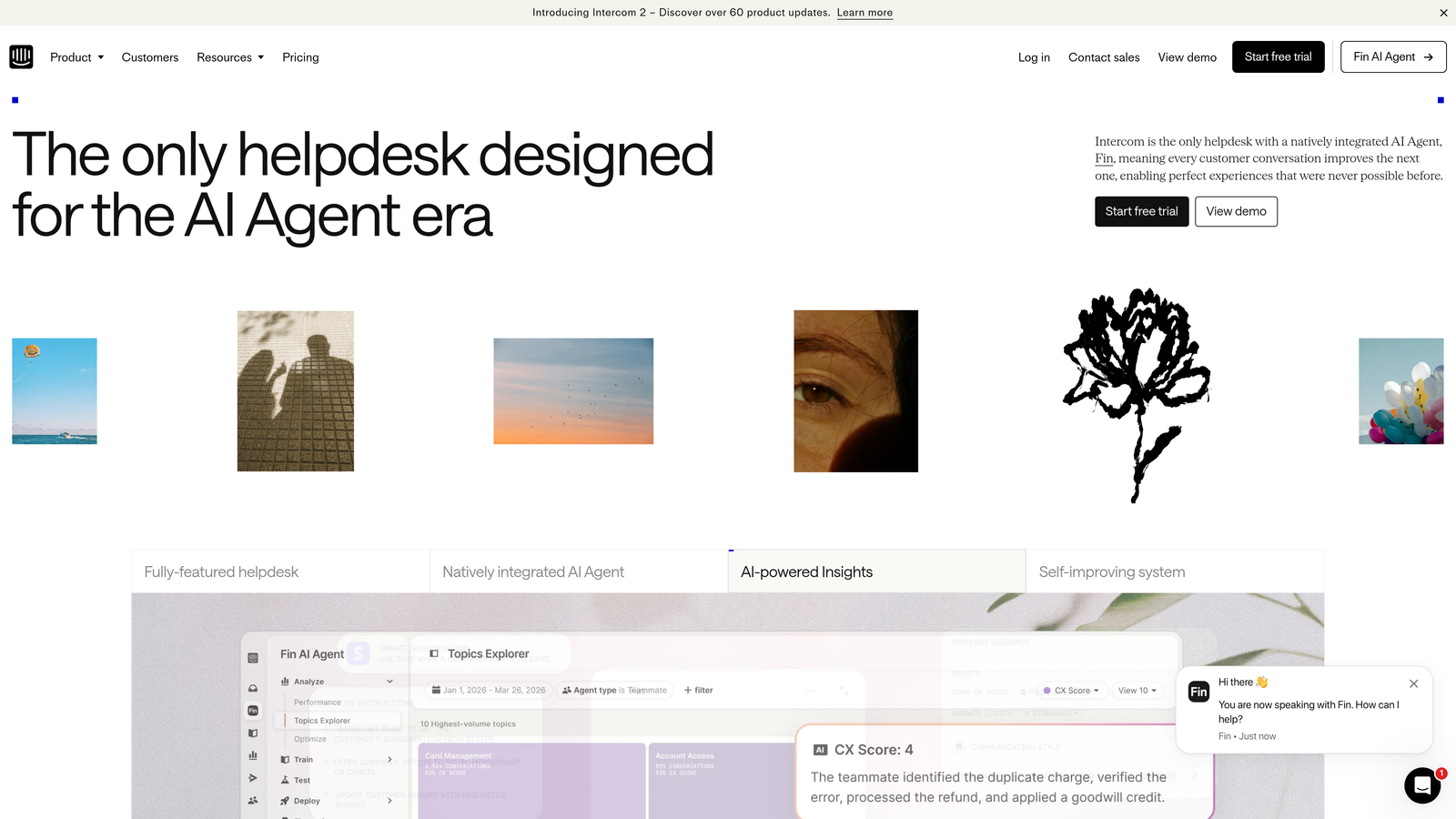
Intercom is a mature customer communications platform featuring Fin, an LLM-powered AI agent that resolves support queries using your knowledge base and product documentation.
Where This Tool Shines
Fin is one of the most capable AI agents in the market for teams that have already invested in a well-structured knowledge base. Because it's trained directly on your own documentation, responses tend to stay on-brand and accurate rather than hallucinating generic answers. The unified inbox, which combines AI-handled and human-handled conversations in one view, makes handoff management clean for distributed teams.
Intercom's ecosystem is also a genuine advantage. With over 300 integrations and a well-documented API, connecting Fin to your broader stack is straightforward. The multilingual support across 45+ languages makes it a strong choice for teams serving diverse global markets.
Key Features
Fin AI Agent: LLM-powered agent trained on your knowledge base, delivering accurate and on-brand responses for common support queries.
Multilingual Support: Handles conversations across 45+ languages, with automatic language detection for global customer bases.
Unified Inbox: Combines AI-handled and human-handled conversations in a single view, making oversight and escalation management straightforward.
AI-Generated Summaries and Suggested Replies: Assists human agents with conversation context and response recommendations, reducing handle time on complex tickets.
300+ App Integrations: Broad marketplace coverage for connecting Intercom to CRM, billing, and productivity tools.
Best For
Teams already running on Intercom's messenger and inbox who want to layer in AI resolution without migrating platforms. Also well-suited to companies with mature, well-organized knowledge bases where Fin can perform at its best.
Pricing
Base plans start at approximately $39 per seat per month. Fin AI usage is billed per resolution, so costs scale with volume. Enterprise features add to the total cost of ownership.
3. Zendesk AI
Best for: Large enterprise organizations already invested in the Zendesk Suite
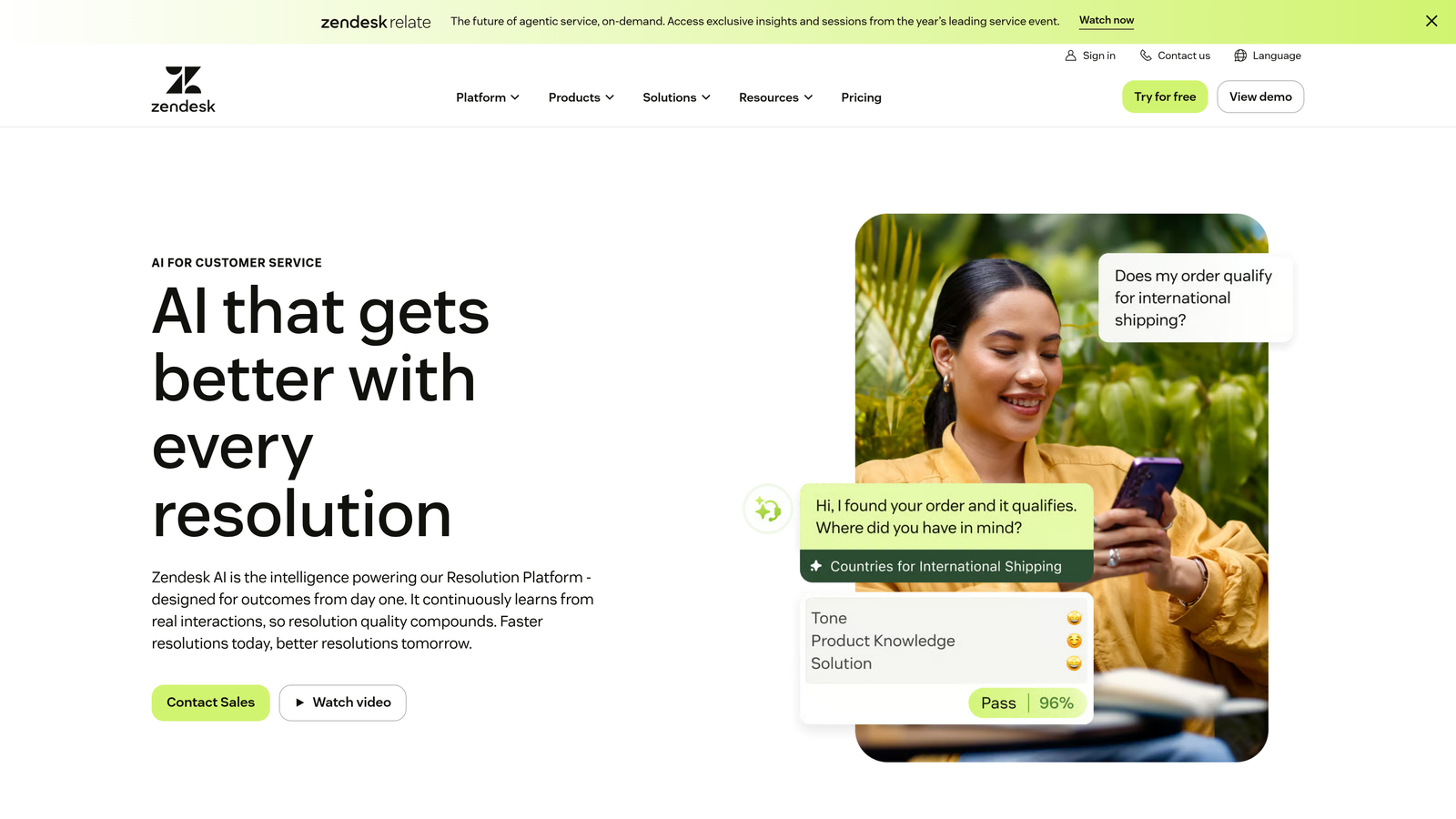
Zendesk AI is a set of AI capabilities embedded natively throughout the Zendesk Suite, covering intelligent triage, AI agents, agent copilot tools, and automated knowledge management.
Where This Tool Shines
The biggest advantage of Zendesk AI is that it doesn't feel like a separate product. Because the AI is woven into the platform rather than integrated on top, there's no additional configuration layer to manage. Intent detection, sentiment analysis, language identification, and automatic routing all happen within the same environment your agents already use daily.
For large global teams with high ticket volumes, the Agent Copilot feature is particularly valuable: it surfaces suggested responses, ticket summaries, and next-best-action prompts in real time, reducing the cognitive load on agents handling complex multilingual queues.
Key Features
Intelligent Triage: Automatic detection of intent, sentiment, and language at the point of ticket creation, enabling accurate routing before a human touches the queue.
Zendesk AI Agent: Handles autonomous ticket deflection and resolution for common queries without agent involvement.
Agent Copilot: In-inbox assistant providing suggested responses, ticket summaries, and next-best-action guidance for human agents.
Multilingual Support: Covers 30+ languages natively across triage, routing, and AI agent interactions.
Native Suite Integration: All AI features work across Zendesk's full product suite without separate configuration or third-party connections.
Best For
Enterprise organizations with existing Zendesk deployments, large agent teams, and high ticket volumes where native AI integration reduces implementation risk and administrative overhead.
Pricing
AI features are included in Suite Professional and above, starting at approximately $115 per agent per month. Not the most accessible price point for smaller teams.
4. Freshdesk Freddy AI
Best for: Growing teams that want strong AI capabilities at a more accessible price point
Freshdesk Freddy AI is Freshworks' AI layer across the Freshdesk platform, spanning self-service bots, agent assistance, and analytics at a price point accessible to growing teams.
Where This Tool Shines
Freddy AI covers three distinct use cases within one platform: self-service resolution for customers, in-inbox assistance for agents, and analytics for team leads. This breadth at a lower price point than Zendesk or Intercom makes it genuinely attractive for mid-market teams that need comprehensive AI coverage without enterprise-tier budgets.
Freshdesk is also particularly popular in Asia-Pacific markets, and Freddy's multilingual bot support reflects that global orientation. Teams serving markets in Southeast Asia or South Asia often find Freshdesk's language coverage and regional pricing more practical than alternatives.
Key Features
Freddy Self Service: AI chatbot for autonomous customer resolution, handling common queries without agent involvement.
Freddy Copilot: In-inbox suggestions, auto-summaries, and canned response recommendations that help agents respond faster and more consistently.
Freddy Insights: AI-powered analytics that surface trends, anomalies, and performance patterns across the support operation.
Multilingual Bot Support: Coverage across major global languages with automatic detection for diverse customer bases.
Competitive Pricing: Meaningfully more affordable than Zendesk and Intercom at comparable feature tiers, making it accessible to teams earlier in their growth curve.
Best For
SMBs and mid-market teams looking for a comprehensive AI support stack without enterprise pricing. Also a strong fit for teams in Asia-Pacific regions where Freshworks has deep market presence and strong localization.
Pricing
Freddy AI is available as an add-on from approximately $29 per agent per month. Base Freshdesk plans start at around $15 per agent per month, making the combined cost competitive.
5. Tidio
Best for: E-commerce SMBs needing fast deployment with AI chat and live chat in one tool
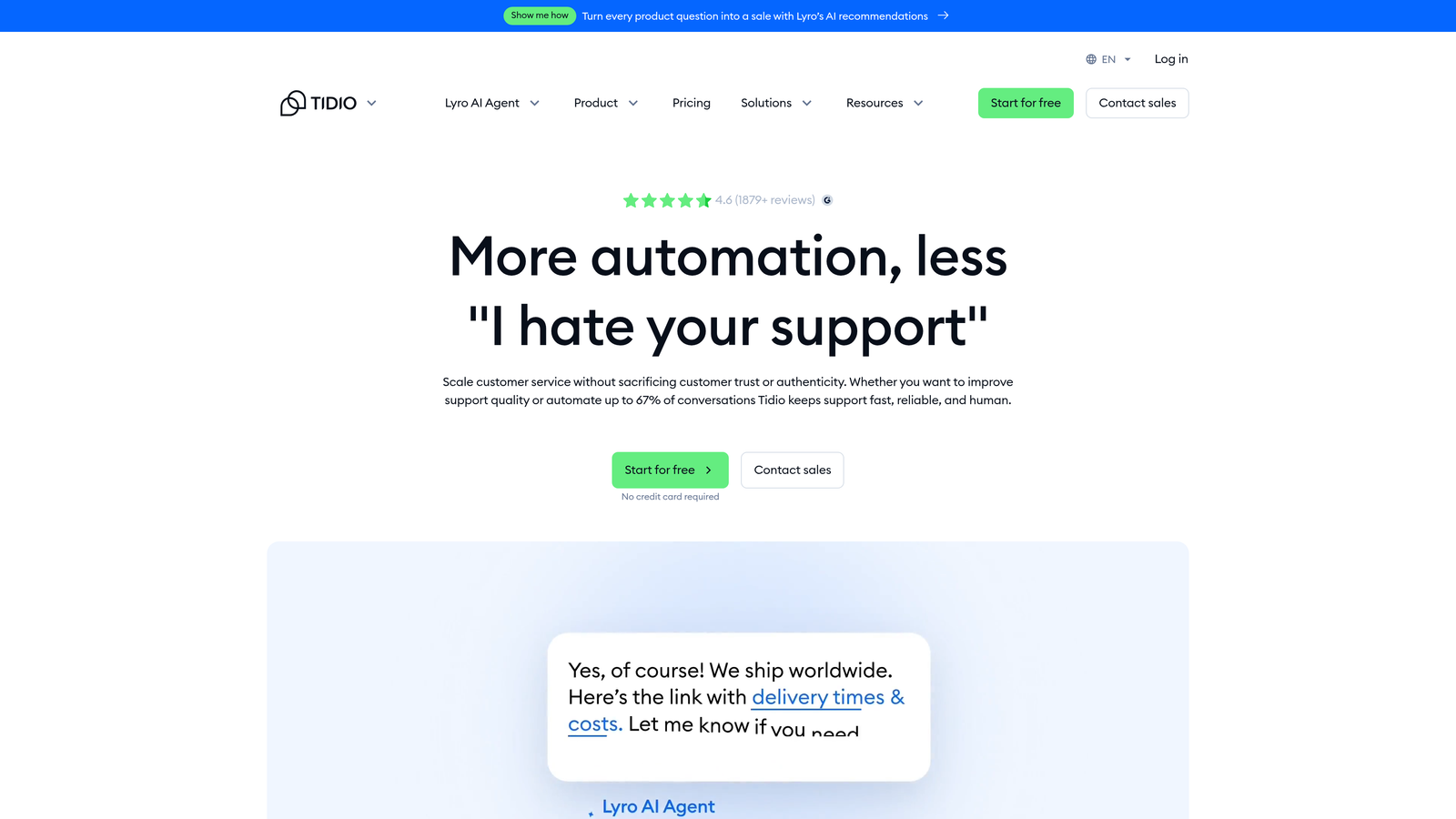
Tidio is a fast-to-deploy AI customer service platform built for SMBs and e-commerce teams, featuring the Lyro AI chatbot and live chat in a single interface.
Where This Tool Shines
Tidio's primary advantage is speed to value. Most teams are up and running within hours rather than weeks, which matters enormously for small e-commerce operations that don't have a dedicated implementation team. The Lyro AI chatbot handles conversational resolution for common support queries, while the live chat fallback ensures customers always have a path to a human agent when needed.
The Shopify and WooCommerce integrations are notably tight, giving Lyro access to order data and product information that makes responses genuinely useful for e-commerce support scenarios rather than generic FAQ deflection.
Key Features
Lyro AI Chatbot: Conversational AI that handles common support queries with smooth escalation to live chat when issues exceed its scope.
Live Chat with Seamless Handoff: Integrated live chat ensures customers reach a human agent without leaving the conversation thread.
E-Commerce Integrations: Native connections to Shopify, WooCommerce, and other major e-commerce platforms, giving the AI access to order and product context.
Visual Chatbot Flow Builder: No-code customization for teams that want to control conversation flows without developer involvement.
Multilingual Support: Auto-detection and support for multiple languages, though coverage is less extensive than enterprise alternatives.
Best For
Small to mid-sized e-commerce businesses that need a quick-to-deploy AI support solution with strong shopping platform integrations. Less suited to complex B2B SaaS workflows or teams with sophisticated escalation requirements.
Pricing
A free plan is available with limited features. Lyro AI starts at approximately $29 per month; broader paid plans begin around $19 per month.
6. Kustomer
Best for: Consumer and D2C brands where full customer history context drives better AI resolution
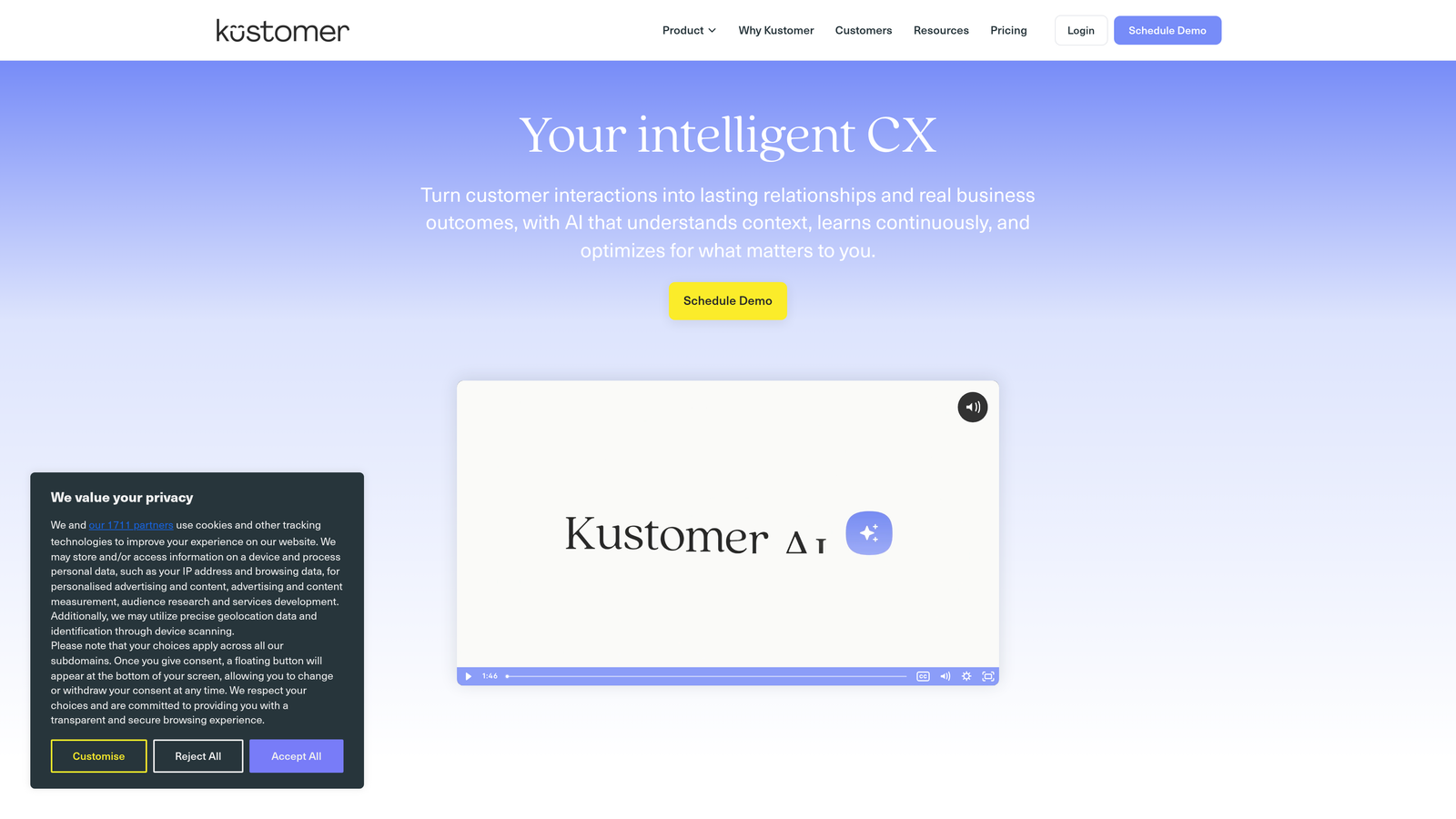
Kustomer is a CRM-native customer service platform where AI automation has full access to customer history, order data, and lifetime context, enabling more intelligent resolution for consumer brands.
Where This Tool Shines
The CRM-native architecture is Kustomer's defining differentiator. When the AI handles a support interaction, it doesn't just see the current ticket. It sees the customer's full timeline: every past interaction, order history, lifetime value, and behavioral signals. This context enables resolution quality that purely support-focused tools can't match for consumer-facing operations.
For global consumer brands handling high volumes of order-related queries, returns, and account issues, this depth of context translates into meaningfully better automated resolution rates and more appropriate escalation decisions.
Key Features
Unified Customer Timeline: Every support interaction, order, and CRM data point in a single view, giving both AI and human agents full context.
AI-Powered Routing with Customer Context: Routing decisions incorporate customer lifetime value, history, and behavioral signals, not just ticket content.
Omnichannel Support: Handles email, chat, social, SMS, and voice within a unified platform for global consumer operations.
Proactive AI Workflows: Automated workflows triggered by customer behavior or data signals, enabling proactive outreach before issues escalate.
Multilingual Support: Coverage for global consumer operations across major languages.
Best For
D2C brands, retail companies, and consumer businesses with high ticket volumes where customer history context meaningfully improves resolution quality and customer experience.
Pricing
Enterprise-tier pricing starts at approximately $89 per agent per month. Best suited to organizations with sufficient volume to justify the investment.
7. Drift (Salesloft)
Best for: B2B teams where sales conversations and support queries overlap significantly
Drift is a conversational AI platform that blends marketing, sales, and support interactions, useful for B2B teams where customer inquiries span pipeline and post-sale support.
Where This Tool Shines
Drift occupies an interesting position in this list: it's not a pure-play support tool, which is both its limitation and its advantage depending on your team's reality. For B2B companies where the line between sales, customer success, and support is genuinely blurry, Drift's revenue-aware context is valuable. The AI knows where a contact sits in the sales cycle, which informs how it routes and responds to incoming conversations.
The integration with Salesloft adds a layer of revenue workflow context that traditional support tools don't offer. If your support team is also fielding renewal questions, upsell inquiries, or onboarding support alongside technical issues, Drift handles that mixed environment more naturally than a dedicated support platform.
Key Features
AI-Powered Conversational Bots: Handles qualification, routing, and common support queries within a single conversational interface.
Revenue-Aware Context: The AI understands where a contact sits in the sales cycle, enabling more appropriate routing and response.
Salesloft Integration: Unified revenue workflow context connecting support interactions with pipeline and account data.
Real-Time Notifications and Meeting Booking: Allows prospects and customers to book meetings directly within the chat interface.
Multilingual Bot Capabilities: Supports global GTM teams operating across multiple language markets.
Best For
B2B companies with significant overlap between sales and support functions, particularly those already using Salesloft for revenue operations. Less suited to teams running dedicated, high-volume pure support operations.
Pricing
Premium plans with pricing available on request through the Salesloft/Drift sales team. Expect enterprise-level investment.
8. Helpshift
Best for: Mobile app and gaming companies with high-volume async in-app support needs
Helpshift is a mobile-first AI customer support platform designed for in-app support experiences, particularly well-suited to gaming, consumer apps, and high-volume asynchronous support.
Where This Tool Shines
Most customer service tools are designed with a web-first, agent-facing interface in mind. Helpshift is built from the opposite direction: the primary experience is the customer inside a mobile app. The AI bots, asynchronous messaging flows, and push notification follow-ups are all optimized for mobile UX patterns, which makes a meaningful difference in completion rates and customer satisfaction for app-based support.
For gaming companies and consumer apps handling support at global scale, Helpshift's ability to manage high ticket volumes asynchronously without requiring customers to leave the app is a genuine operational advantage. The multilingual coverage across 150+ languages reflects its global mobile audience.
Key Features
In-App Messaging and AI Bots: Support interactions happen within the app itself, reducing friction and improving completion rates for mobile users.
Asynchronous Support Flows: Push notification follow-ups keep conversations active without requiring customers to stay in the app.
AI-Powered Bot Flows: Autonomous issue resolution without the customer ever leaving the app experience.
Multilingual Support: Coverage across 150+ languages, reflecting the global scale of mobile app audiences.
High-Volume Architecture: Designed to handle the ticket volumes typical of large consumer app and gaming operations.
Best For
Gaming studios, consumer app companies, and mobile-first businesses with large global user bases requiring high-volume asynchronous support. Less suited to web-first B2B SaaS teams.
Pricing
Pricing is available on request and is enterprise-focused. Best to engage the Helpshift sales team with volume estimates for accurate scoping.
9. Forethought
Best for: Enterprises wanting AI capabilities without migrating away from an existing helpdesk
Forethought is an AI layer that sits above existing helpdesks, adding intelligent triage, resolution, and agent assist capabilities to Zendesk, Salesforce Service Cloud, or Freshdesk without replacing them.
Where This Tool Shines
Forethought's value proposition is straightforward: if your organization has invested heavily in a helpdesk and migration isn't on the table, Forethought adds meaningful AI capabilities without displacing that investment. The three-product structure covers the full support workflow from ticket arrival through resolution and agent assistance.
For global teams with established Zendesk or Salesforce Service Cloud deployments, Forethought's multilingual detection and routing adds genuine value to existing infrastructure. It's a practical choice for enterprises that need to move faster on AI without the organizational disruption of a platform migration.
Key Features
Triage AI: Automatic intent detection, tagging, and routing before tickets reach the agent queue, reducing manual triage work at scale.
Solve AI: Autonomous resolution for common queries using your existing knowledge base, without requiring customers to be redirected to a separate tool.
Assist AI: In-inbox copilot that surfaces relevant articles and suggested responses for human agents handling complex tickets.
Helpdesk Compatibility: Works on top of Zendesk, Salesforce Service Cloud, Freshdesk, and other major platforms without replacing them.
Multilingual Detection and Routing: Identifies language at the point of ticket creation and routes accordingly for global support queues.
Best For
Enterprise teams with significant existing helpdesk investments who want to accelerate AI capabilities without migrating platforms. Note that Forethought requires an existing helpdesk to function and is not a standalone support platform.
Pricing
Pricing is available on request. Requires an existing helpdesk subscription in addition to the Forethought investment, so factor both into total cost of ownership.
Which Tool Is Right for Your Global Team?
The right AI customer service platform depends heavily on your team's architecture, existing stack, and the nature of your support volume. Here's a quick-reference guide to cut through the noise.
AI-first SaaS teams: Halo AI is built for this exact use case. Page-aware context, continuous learning, and deep integrations with the tools SaaS teams actually use make it the strongest choice for product-led companies that want support intelligence, not just ticket deflection.
Existing Intercom users: Fin AI is the natural upgrade path. If your knowledge base is well-organized and you're already on Intercom's messenger, adding Fin is lower-risk than migrating platforms.
Enterprise Zendesk organizations: Zendesk AI is the path of least resistance. Native integration means no additional implementation overhead for teams already managing complex Zendesk configurations.
Budget-conscious growing teams: Freshdesk Freddy AI delivers comprehensive AI coverage, including self-service, agent assist, and analytics, at a price point that doesn't require an enterprise budget to justify.
E-commerce SMBs: Tidio deploys fast, integrates tightly with Shopify and WooCommerce, and covers the most common e-commerce support scenarios without overcomplicating the setup.
Consumer and D2C brands: Kustomer's CRM-native approach gives the AI full customer history context, which matters enormously when resolution quality depends on knowing who you're talking to.
Sales-support overlap: Drift handles the blurry territory between pipeline conversations and post-sale support better than any dedicated support tool, especially for teams already in the Salesloft ecosystem.
Mobile app and gaming companies: Helpshift is purpose-built for in-app async support at global scale. Nothing else on this list matches its mobile UX optimization and language coverage for consumer app audiences.
Legacy helpdesk plus AI layer: Forethought is the pragmatic choice for enterprises that can't migrate platforms but need to accelerate AI capabilities across their existing Zendesk or Salesforce investment.
Your support team shouldn't scale linearly with your customer base. Let AI agents handle routine tickets, guide users through your product, and surface business intelligence while your team focuses on complex issues that need a human touch. See Halo in action and discover how continuous learning transforms every interaction into smarter, faster support.