9 Best AI Customer Service Tools for Healthcare in 2026
This guide evaluates the 9 best AI customer service for healthcare tools in 2026, helping organizations automate routine patient inquiries like appointment scheduling and billing while maintaining HIPAA compliance and routing urgent cases to human agents—addressing the growing challenge of rising inquiry volumes, staffing shortages, and the need for empathetic, around-the-clock patient support.
 Grant CooperFounder14 min read
Healthcare organizations are caught in a difficult position. Patients and members expect fast, empathetic responses to sensitive questions at any hour, while HIPAA regulations demand rigorous data handling at every single touchpoint. Traditional call centers are buckling under rising inquiry volumes, long hold times, and agent burnout, all compounded by persistent staffing shortages across healthcare administration.
AI-powered customer service tools are helping bridge this gap, automating routine inquiries like appointment scheduling, billing questions, and insurance verification, while triaging urgent cases to human agents and maintaining compliance throughout. But not every AI platform is built for healthcare's demands. The stakes are simply too high for a generic solution.
In this guide, we evaluate the top AI customer service tools for healthcare in 2026, covering everything from AI-first support agents to specialized patient engagement platforms. Each tool was assessed on healthcare compliance capabilities, integration depth, AI accuracy, scalability, and ease of deployment.
1. Halo AI
Best for: Healthcare SaaS and digital health teams wanting an AI-first support agent that learns continuously
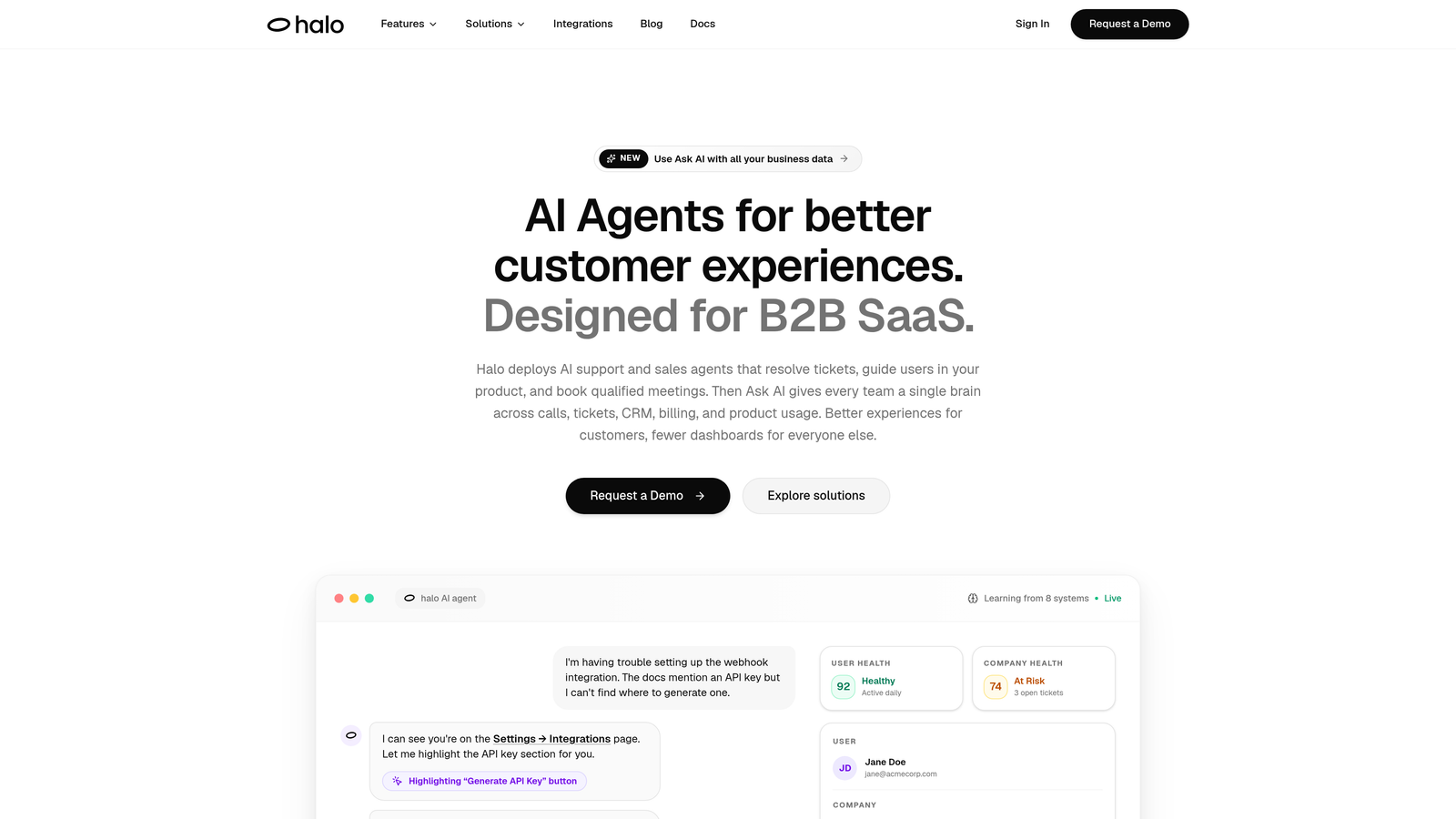
Halo AI is an AI-first customer support platform that deploys intelligent agents capable of resolving tickets, guiding users with page-aware context, and generating business intelligence from every interaction.
Where This Tool Shines
What sets Halo apart is its architecture. Rather than bolting AI onto an existing helpdesk, Halo is built AI-first from the ground up. Its agents don't just respond to questions: they see what users see, understand the context of the page a patient or member is on, and provide guidance that's genuinely relevant to their current situation.
For healthcare SaaS companies and digital health platforms, this matters enormously. A patient confused about a billing portal screen gets different guidance than one navigating a care plan dashboard. Halo's continuous learning loop means every resolved ticket makes the next resolution smarter, compounding value over time rather than staying static.
Key Features
Page-Aware AI Agents: Agents understand the specific page and context a user is on, delivering guidance that's visually and functionally relevant rather than generic.
Continuous Learning: Every interaction feeds back into the system, improving resolution accuracy and reducing the need for manual knowledge base updates.
Smart Inbox with Business Intelligence: Goes beyond support metrics to surface customer health signals, anomaly detection, and revenue intelligence from support patterns.
Auto Bug Ticket Creation: Automatically generates bug reports and routes complex issues to the right team, reducing manual triage overhead for technical support teams.
Live Agent Handoff: Seamlessly escalates to human agents when conversations require empathy, clinical judgment, or nuanced handling, with full conversation context preserved.
Multi-System Integrations: Connects with Linear, Slack, HubSpot, Intercom, Stripe, Zoom, PandaDoc, Fathom, and more, fitting into existing healthcare and SaaS tech stacks.
Best For
Halo AI is an excellent fit for healthtech SaaS companies, digital health apps, and patient-facing platforms that need scalable, intelligent support without scaling headcount. It's particularly strong for teams that want their support function to generate business intelligence, not just deflect tickets.
Pricing
Contact for pricing; plans scale based on usage and team size. Reach out directly at haloagents.ai for a tailored quote.
2. Hyro AI
Best for: Health systems, hospitals, and payers automating high-volume call center and web chat inquiries
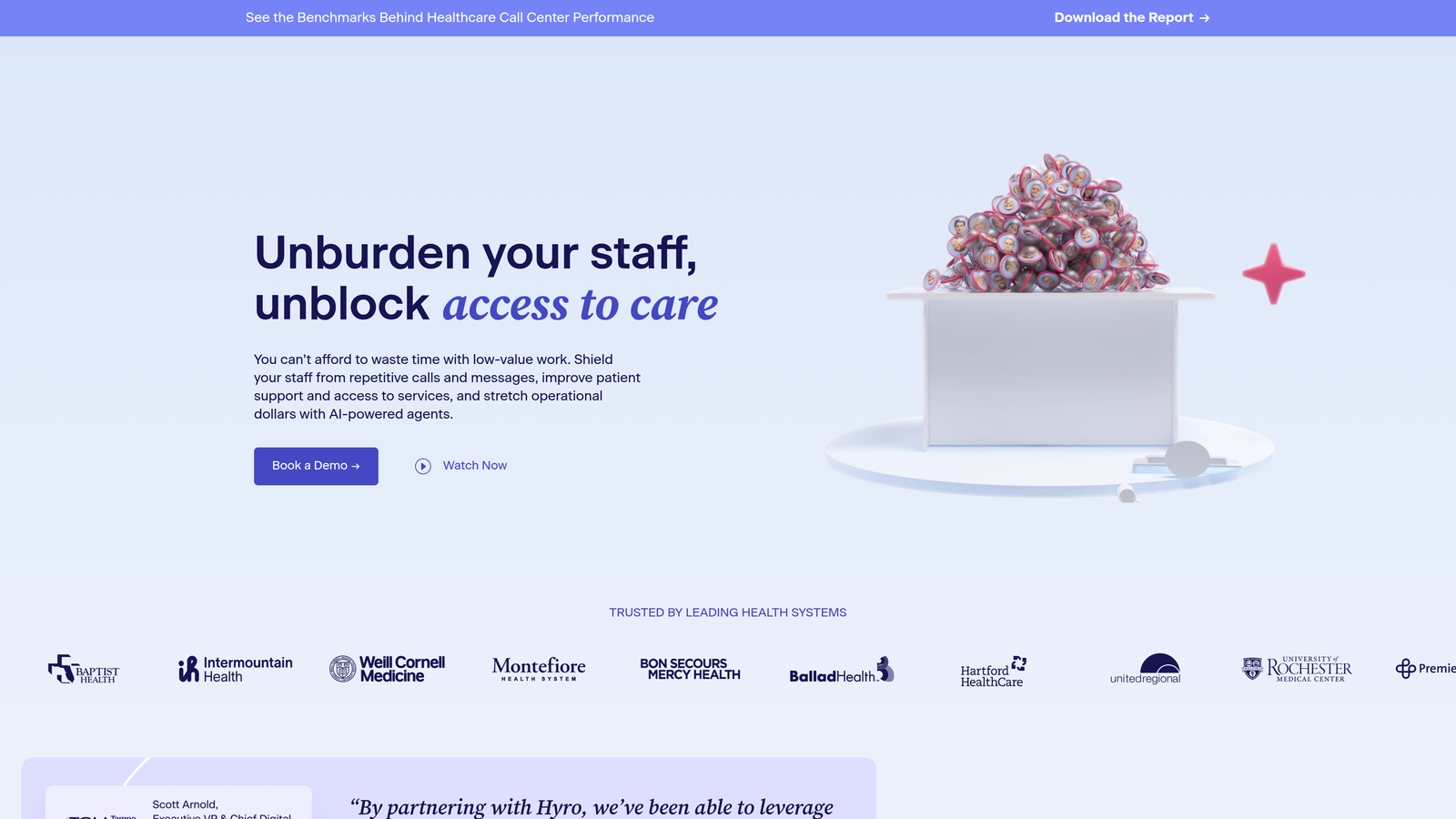
Hyro AI is a healthcare-specific conversational AI platform built for health systems, hospitals, and payers, handling call center automation, web chat, and SMS with responsible AI guardrails and EHR integrations.
Where This Tool Shines
Hyro was designed with healthcare as its primary context, not an afterthought. Its knowledge graph architecture means the platform pulls from structured healthcare data sources rather than relying solely on large language models, which significantly reduces the risk of hallucinated or inaccurate clinical information reaching patients.
The platform's plug-and-play deployment philosophy is a genuine differentiator for health systems that can't afford lengthy implementation timelines. Pre-built integrations with scheduling systems and EHRs mean teams can go live quickly without heavy custom development work.
Key Features
HIPAA-Compliant Architecture: Built from the ground up for healthcare data privacy, with appropriate safeguards for PHI handling across all channels.
AI-Powered Call Center Automation: Natural language routing handles inbound call volume, reducing hold times and freeing human agents for complex cases.
Pre-Built EHR Integrations: Native connections to major scheduling and EHR systems accelerate deployment and reduce integration risk.
Responsible AI Guardrails: Specifically designed to prevent hallucination on clinical topics, a critical safeguard for patient-facing interactions.
Plug-and-Play Deployment: Designed for rapid time-to-value, minimizing the technical burden on healthcare IT teams.
Best For
Hospital call centers, large health systems, and payer organizations dealing with high volumes of scheduling, referral, and administrative inquiries. Particularly strong for voice channel automation where call deflection rates matter most.
Pricing
Custom enterprise pricing; contact Hyro directly for a quote tailored to your organization's call volume and channel needs.
3. Salesforce Health Cloud with Agentforce
Best for: Enterprise healthcare organizations wanting a unified patient CRM with autonomous AI agents
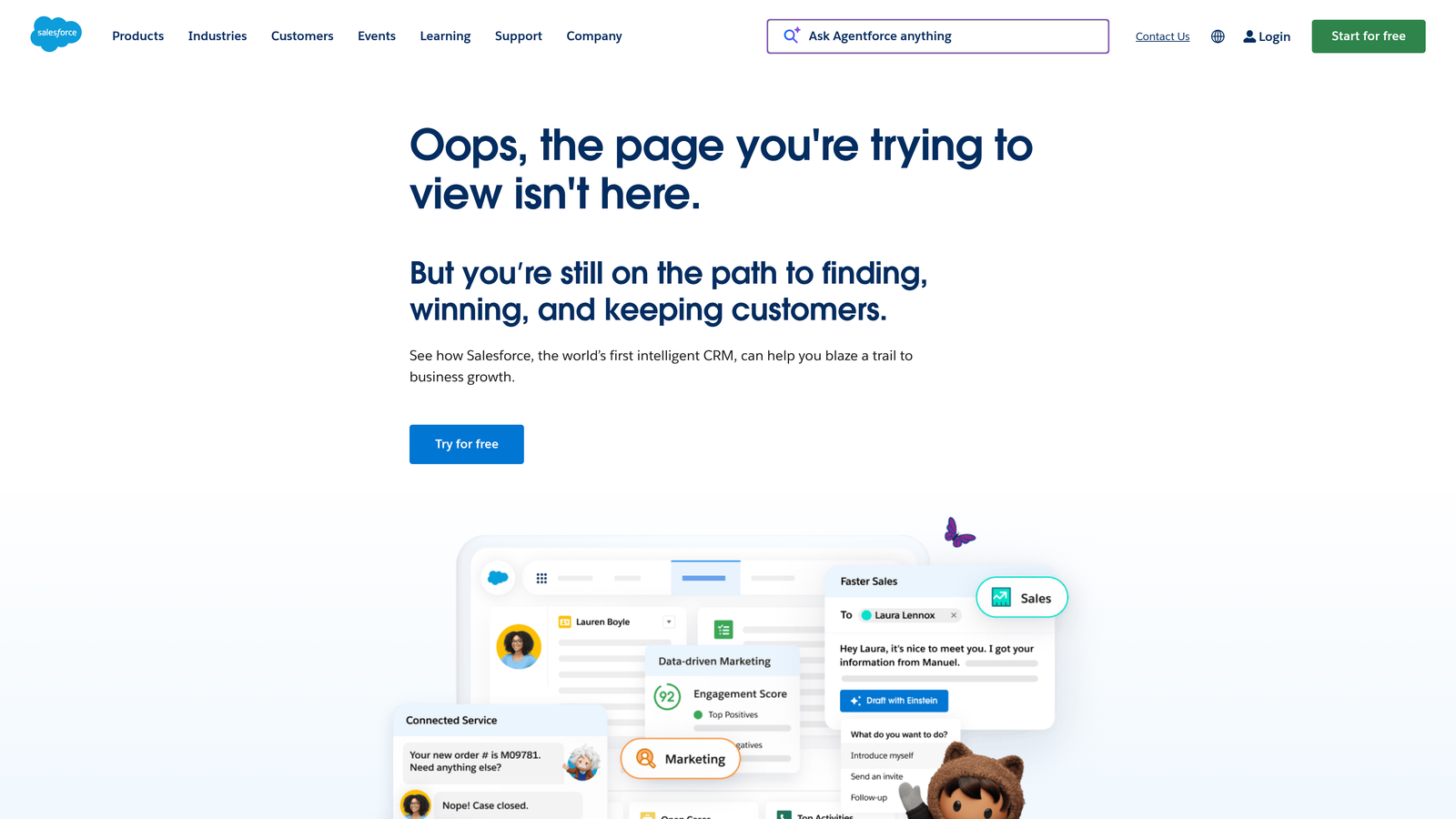
Salesforce Health Cloud is an enterprise healthcare CRM platform that combines unified patient and member profiles with Agentforce AI agents capable of taking action across scheduling, claims processing, and care coordination workflows.
Where This Tool Shines
Salesforce Health Cloud's core strength is its 360-degree patient and member view. When an AI agent or human agent handles an inquiry, they're working from a complete picture of that individual's history across every touchpoint, not a fragmented snapshot from a single system. This context depth is hard to replicate with point solutions.
The addition of Agentforce brings autonomous AI action to that rich data foundation. Agents can complete tasks, not just answer questions, which is a meaningful step forward for healthcare organizations looking to automate multi-step workflows like prior authorization support or claims status updates.
Key Features
Patient/Member 360 View: Unified profiles aggregate data from all touchpoints, giving agents and AI the full context needed for accurate, personalized responses.
Agentforce AI Agents: Autonomous agents that can complete tasks across service channels, not just suggest responses to human agents.
Pre-Built Healthcare Workflows: Purpose-built workflows for payers, providers, and pharmaceutical organizations reduce time to deployment.
Salesforce Shield: HIPAA-compliant infrastructure with encryption, audit trails, and field-level security for sensitive PHI.
AppExchange Ecosystem: Extensive marketplace of healthcare-specific extensions and integrations for virtually any workflow need.
Best For
Large payer organizations, IDNs, and enterprise healthcare companies that are already invested in the Salesforce ecosystem or need a comprehensive CRM and AI service platform under one roof. Less suited for smaller teams due to cost and implementation complexity.
Pricing
Health Cloud starts at $325/user/month; Agentforce pricing is usage-based. Enterprise contracts typically involve custom negotiation.
4. Zendesk for Healthcare
Best for: Healthtech companies wanting proven helpdesk infrastructure with modern AI capabilities
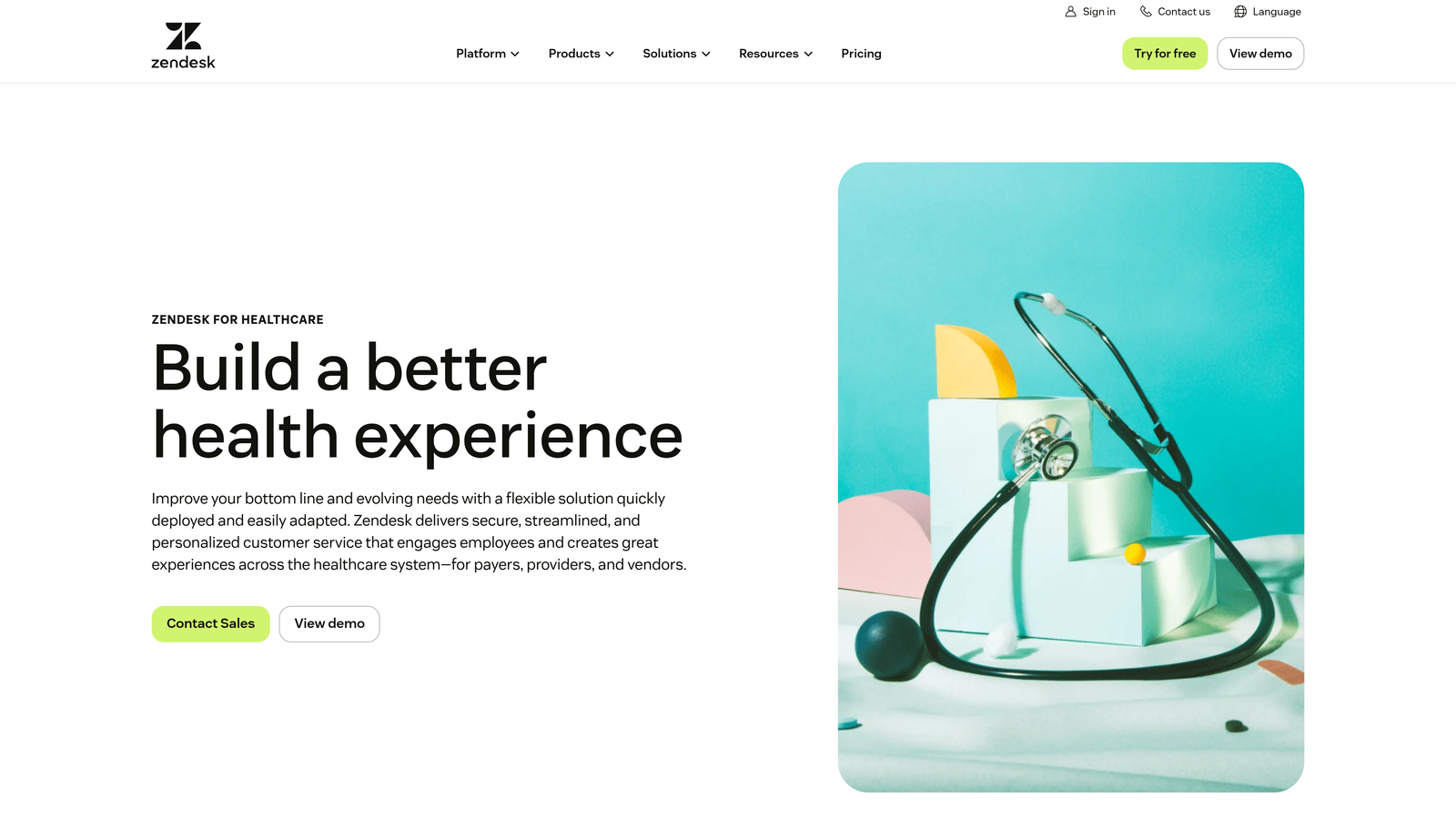
Zendesk is a mature helpdesk platform with healthcare-specific AI bots, a HIPAA-eligible environment, and a large integration marketplace, making it a reliable choice for digital health companies that want battle-tested infrastructure.
Where This Tool Shines
Zendesk's greatest asset in healthcare is its maturity. The platform has been deployed at scale across thousands of organizations, which means its reliability, documentation, and support ecosystem are well-established. For healthtech companies that have experienced painful outages or data issues with less proven tools, that stability carries real value.
The AI capabilities have matured significantly, with AI-powered bots handling ticket deflection and an agent copilot assisting human agents with suggested responses and next steps. It's not as AI-native as some newer platforms, but the breadth of what Zendesk does well is genuinely impressive.
Key Features
HIPAA-Eligible Environment: Business Associate Agreement available, with appropriate controls for PHI handling across the platform.
AI Bots and Agent Copilot: Automated ticket deflection combined with AI assistance for human agents handling complex inquiries.
Omnichannel Support: Unified management of email, chat, phone, and social channels from a single workspace.
Integration Marketplace: Hundreds of pre-built integrations including healthcare-specific connectors for scheduling, billing, and EHR systems.
Advanced Analytics: Comprehensive reporting dashboards for tracking resolution rates, CSAT, and agent performance.
Best For
Healthtech startups and mid-market digital health companies that need a reliable, well-documented platform with strong omnichannel capabilities. Also a good fit for teams migrating from legacy ticketing systems who want a familiar, proven environment.
Pricing
Suite plans start at $55/agent/month; enterprise and healthcare-specific tiers are available with additional compliance features.
5. Freshdesk (Freshworks)
Best for: Growing healthcare organizations needing omnichannel support without enterprise-level pricing
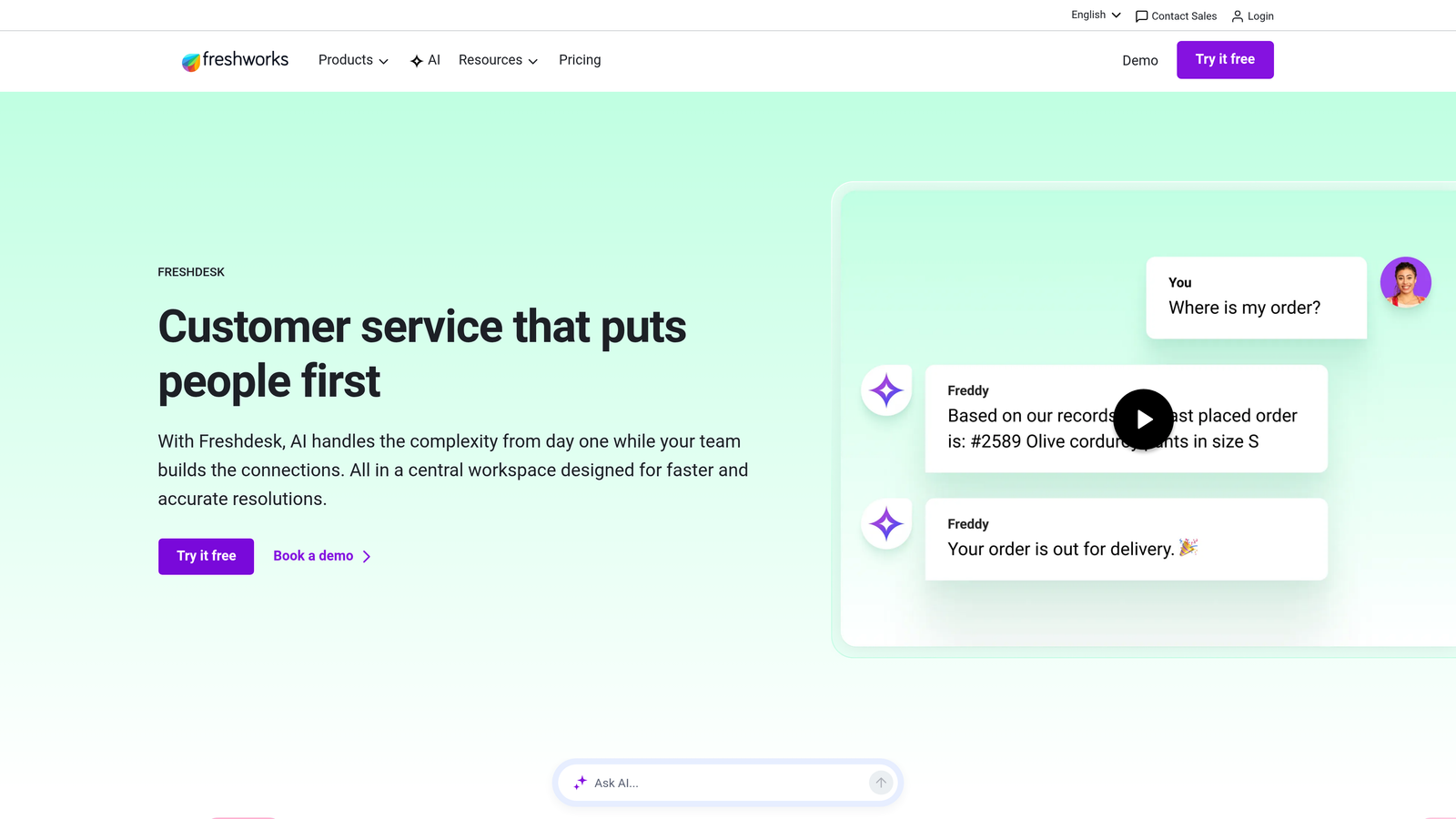
Freshdesk is an AI-enhanced helpdesk platform with Freddy AI for auto-triage and suggested responses, offering a cost-effective path to intelligent omnichannel support for healthcare teams watching their budgets.
Where This Tool Shines
Freshdesk's value proposition is straightforward: you get a capable, AI-assisted helpdesk at a price point that doesn't require executive sign-off. For smaller healthcare organizations, regional health plans, or early-stage digital health companies, the ability to deploy omnichannel support with AI assistance without committing to enterprise pricing is genuinely useful.
Freddy AI handles the most time-consuming parts of ticket management: classifying incoming tickets, routing them to the right team, and suggesting responses based on similar past cases. It won't match the sophistication of purpose-built AI platforms, but for teams just beginning their automation journey, it's a practical starting point.
Key Features
Freddy AI: Intelligent ticket triage, classification, and response suggestions that reduce manual workload for support agents.
Omnichannel Support: Manages email, chat, phone, and messaging app inquiries from a unified agent workspace.
HIPAA Compliance: Available on higher-tier plans with appropriate data handling controls for PHI.
Intuitive Setup: Low administrative overhead and straightforward configuration make it accessible for teams without dedicated IT resources.
Competitive Pricing: Multiple tiers accommodate teams at different growth stages without requiring long-term enterprise commitments.
Best For
Smaller healthcare organizations, regional health plans, and early-stage digital health companies that need a capable, affordable helpdesk with AI assistance. Teams that expect to outgrow the platform as they scale should plan for eventual migration.
Pricing
Free tier available; Pro plan starts at $49/agent/month; Enterprise at $79/agent/month. HIPAA features require higher-tier plans.
6. Hippocratic AI
Best for: Healthcare organizations needing AI for clinical-adjacent patient outreach and care navigation
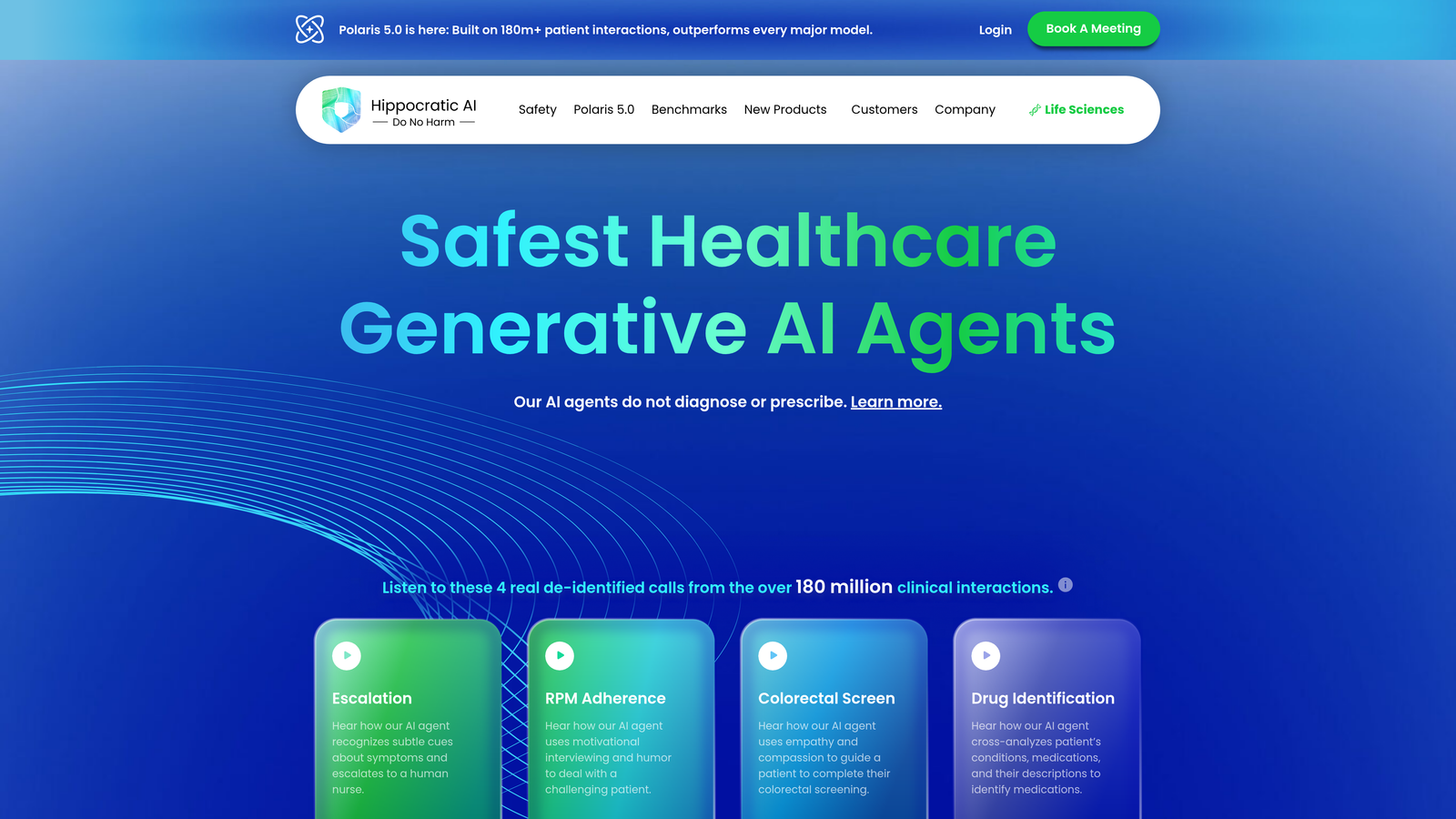
Hippocratic AI is a safety-focused AI platform specifically designed for clinical-adjacent healthcare conversations, handling patient outreach, care navigation, post-discharge follow-up, and similar tasks that require genuine clinical awareness.
Where This Tool Shines
Most AI platforms in this list are built for administrative support. Hippocratic AI occupies a different category: it's designed for conversations that sit closer to clinical territory, like pre-op instructions, discharge follow-up, and care navigation. The platform was developed with rigorous safety testing involving healthcare professionals, which distinguishes it from general-purpose AI applied to healthcare contexts.
The clinical guardrails are the defining feature. Rather than relying on a standard LLM with healthcare prompting, Hippocratic AI's model has been specifically trained and tested to avoid harmful or inaccurate health information, a critical distinction when patients may act on what the AI tells them.
Key Features
Healthcare-Trained LLM: Model specifically trained and safety-tested for healthcare conversations, not a general-purpose AI adapted for clinical use.
Clinical Guardrails: Built-in safeguards prevent the AI from providing harmful, inaccurate, or inappropriate health information.
Pre-Built Use Cases: Ready-to-deploy workflows for care navigation, pre-op instructions, discharge follow-up, and chronic care outreach.
Designed to Supplement, Not Replace: Explicitly positioned as a tool to extend clinical staff capacity, with clear escalation pathways to human clinicians.
Safety Validation: Rigorous testing process involving healthcare professionals before deployment of new capabilities.
Best For
Health systems, care management organizations, and value-based care companies that need AI to handle patient outreach and care navigation at scale. Not primarily a customer service tool: it's better understood as a clinical operations AI with strong safety credentials.
Pricing
Custom enterprise pricing; contact Hippocratic AI directly for details and deployment options.
7. Intercom with Fin AI
Best for: Digital health apps and patient-facing platforms wanting messenger-first in-app support
Intercom is a modern messenger-first support platform with Fin AI agent that resolves questions using your knowledge base and custom data sources, popular among digital health apps that prioritize in-product patient experiences.
Where This Tool Shines
Intercom's design philosophy centers on the in-product experience. For digital health apps where patients are already engaged in the interface, having support feel native rather than redirected to an external portal is a meaningful UX advantage. Fin AI delivers conversational, human-quality responses directly within that in-app context.
The platform's product tours and onboarding flows add another dimension that pure helpdesk tools can't match. Healthcare apps with complex workflows, like care plan management or medication tracking, can guide new patients through key features proactively, reducing support volume before it starts.
Key Features
Fin AI Agent: Provides human-quality conversational responses drawn from your help center, documentation, and custom data sources.
Messenger-First Design: In-app support experience that feels native to digital health products rather than bolted on.
Product Tours and Onboarding: Proactive patient onboarding flows that reduce confusion and inbound support volume for complex health apps.
Custom AI Answers: Fin can be trained on your specific knowledge base, internal docs, and custom data to deliver accurate, brand-consistent responses.
API and Webhook Support: Strong developer tools for integrating with healthcare systems, scheduling platforms, and custom data sources.
Best For
Digital health apps, patient engagement platforms, and healthtech companies where the support experience lives primarily inside the product. Teams that also need heavy phone or traditional call center support may find Intercom's voice capabilities limited compared to dedicated contact center platforms.
Pricing
Essential plan starts at $29/seat/month; Fin AI conversations are priced per resolution, which can add up at high volumes.
8. Kustomer
Best for: Healthcare companies managing complex, multi-touch patient journeys across many channels
Kustomer is a CRM-native customer service platform with timeline-based conversation views and AI-powered classification, suited for healthcare organizations where understanding the full arc of a patient's interactions is essential for quality service.
Where This Tool Shines
Kustomer's timeline view is its most distinctive feature. Rather than treating each ticket as an isolated event, the platform surfaces a patient's complete interaction history in a single, chronological view. For healthcare service teams dealing with patients who have ongoing billing disputes, care coordination needs, or chronic support patterns, this longitudinal context is genuinely valuable.
The CRM-native architecture means healthcare organizations don't need to maintain a separate CRM alongside their support platform. Everything lives together, reducing the data silos that frequently cause frustrating experiences when patients repeat themselves across channels.
Key Features
Timeline View: Complete patient interaction history displayed in a single chronological pane, giving agents full context on every inquiry.
AI Classification and Routing: Automated ticket classification, intelligent routing, and AI-suggested responses reduce manual triage overhead.
CRM-Native Architecture: Built-in CRM eliminates the need for separate customer data management tools alongside the support platform.
Omnichannel Support: Unified management of chat, email, phone, SMS, and social interactions from one workspace.
Workflow Automation: Configurable automation for repetitive healthcare service tasks like insurance verification follow-ups and appointment reminders.
Best For
Mid-market and enterprise healthcare companies, health plans, and multi-specialty practices where patient journeys span many touchpoints over time. The CRM-native approach is particularly valuable for organizations tired of maintaining fragmented customer data across multiple systems.
Pricing
Enterprise plan starts at $89/user/month; custom pricing available for healthcare deployments with specific compliance requirements.
9. Talkdesk Healthcare Experience Cloud
Best for: Healthcare contact centers needing purpose-built voice AI with deep EHR integrations
Talkdesk Healthcare Experience Cloud is a cloud-native contact center platform purpose-built for healthcare, offering pre-built EHR integrations, AI virtual agents for voice, and healthcare-specific workflows for appointment management, billing, and more.
Where This Tool Shines
Talkdesk takes a contact center-first approach to healthcare, which means voice automation is a genuine strength rather than an afterthought. For health systems and large medical groups where phone remains the dominant inbound channel, having AI virtual agents that handle voice interactions natively, with EHR context, is a significant operational advantage.
The pre-built integrations with Epic, Cerner, and other major EHR systems mean agents, both human and AI, are working from real patient data rather than generic scripts. This reduces the back-and-forth that frustrates patients and wastes agent time, particularly for scheduling and referral management workflows.
Key Features
Pre-Built EHR Integrations: Native connections to Epic, Cerner, and other major EHR platforms bring patient context directly into the contact center.
AI Virtual Agents for Voice: Handles inbound voice interactions for scheduling, billing, and common administrative inquiries without human intervention.
Healthcare-Specific Workflows: Purpose-built automation for appointment management, billing inquiries, and referral coordination.
HIPAA-Compliant Infrastructure: Full audit logging, encryption, and access controls across all channels and data flows.
Real-Time and Historical Analytics: Comprehensive contact center performance reporting for both operational and compliance purposes.
Best For
Large health systems, hospital networks, and multi-specialty groups with high inbound call volumes that need voice AI tightly integrated with EHR data. It's a heavier platform than most, so smaller organizations may find the implementation investment disproportionate to their needs.
Pricing
Custom pricing based on seats and usage; contact Talkdesk for healthcare-specific quotes and implementation details.
Which Tool Is Right for Your Healthcare Organization?
The right choice depends heavily on your organization type, existing tech stack, and the specific workflows you need to automate. Here's a quick-reference guide to help you narrow it down.
Healthtech SaaS and digital health apps: Halo AI is the strongest fit, particularly if you want an AI-first platform that learns continuously, surfaces business intelligence, and scales support without adding headcount.
Hospital call centers and health systems: Hyro AI and Talkdesk Healthcare Experience Cloud are the purpose-built options, with Hyro excelling at web and SMS automation and Talkdesk leading on voice AI with EHR integration depth.
Enterprise CRM and care coordination: Salesforce Health Cloud with Agentforce is the logical choice for organizations already in the Salesforce ecosystem or those needing a unified patient CRM with autonomous AI agents.
Budget-conscious growing teams: Freshdesk offers a practical entry point with AI assistance at a price that won't strain smaller healthcare organizations.
Clinical outreach and care navigation: Hippocratic AI occupies a unique category here, with safety credentials and clinical awareness that general-purpose platforms simply can't match.
Messenger-first patient apps: Intercom with Fin AI delivers the most polished in-product support experience for digital health companies where the interface is the product.
Regardless of which platform you evaluate, prioritize three things: HIPAA compliance and BAA availability, integration depth with your existing systems, and the AI's ability to know when to escalate to a human rather than push through a sensitive interaction incorrectly.
Your support team shouldn't scale linearly with your customer base. Let AI agents handle routine tickets, guide users through your product, and surface business intelligence while your team focuses on complex issues that need a human touch. See Halo in action and discover how continuous learning transforms every interaction into smarter, faster support.