9 Best AI Customer Service Tools for Platforms in 2026
This guide evaluates the 9 best AI customer service for platforms solutions in 2026, helping B2B SaaS teams move beyond basic chatbots to context-aware tools that understand user behavior, account history, and product state. Each tool is assessed on AI depth, scalability, and integration with popular helpdesks like Zendesk, Intercom, and Freshdesk.
 Matt PattoliFounder14 min read
As B2B platforms scale, customer support becomes one of the first bottlenecks to break. Users expect instant, accurate answers, not a 48-hour ticket queue. And the tools available to solve this problem have matured considerably: we're well past the era of FAQ bots that can only match keywords to canned responses.
In 2026, the real distinction is between AI tools that bolt onto existing workflows and platforms built AI-first from the ground up. For B2B SaaS and platform businesses specifically, the most valuable tools are those that understand product context, not just knowledge base content. What page is the user on? What have they already tried? What does their account history look like?
This list covers the top AI customer service tools for platforms, evaluated on AI depth, integration breadth, scalability, and fit for teams running on stacks like Zendesk, Intercom, or Freshdesk. Whether you're replacing your helpdesk entirely or augmenting what you have, there's an option here for your stage and stack.
1. Halo AI
Best for: B2B SaaS and platform teams that want AI-first support with deep product and business context.
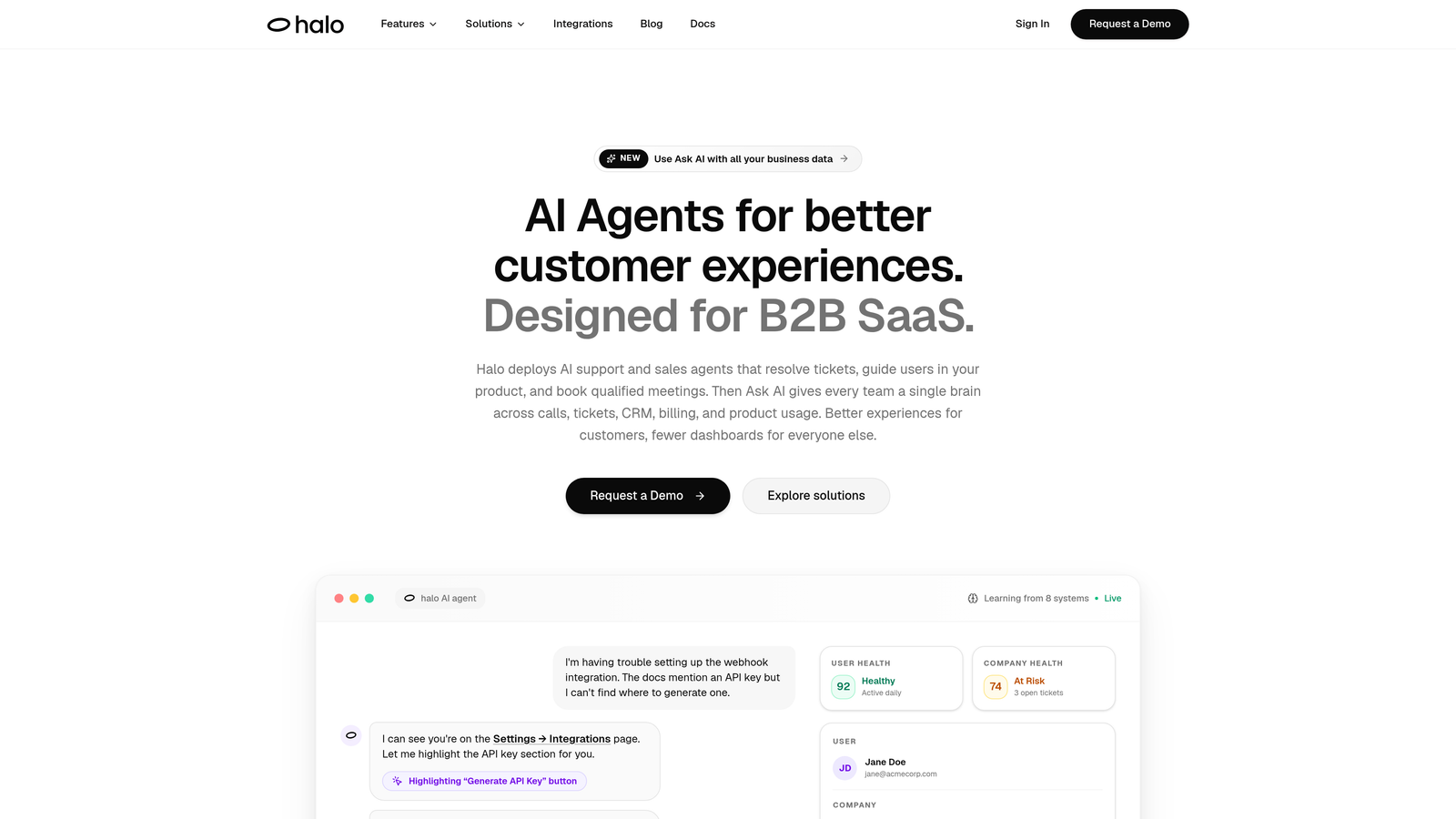
Halo AI is an AI-first customer support platform built specifically for B2B SaaS and platform businesses, not adapted from a general-purpose helpdesk.
Where This Tool Shines
Most AI support tools search your knowledge base and return the closest match. Halo goes further: its page-aware chat widget sees what the user sees, meaning the AI understands the exact screen context before generating a response. That's a meaningful difference when your product has complex workflows and users need guidance that's specific to where they are, not just what they asked.
Beyond ticket resolution, Halo's smart inbox surfaces business intelligence signals from support interactions, including customer health indicators, revenue anomalies, and early churn signals. For platform teams, that transforms support from a cost center into a source of actionable product and revenue intelligence.
Key Features
Page-Aware Chat Widget: The AI sees the user's current page context, enabling guidance that's specific to their exact product state rather than generic answers.
Autonomous Ticket Resolution: AI agents resolve tickets independently and hand off to human agents intelligently when complexity warrants it.
Auto Bug Ticket Creation: Automatically generates and routes bug reports to Linear or your issue tracker, closing the loop between support and engineering without manual effort.
Smart Inbox with Business Intelligence: Surfaces customer health signals, revenue anomalies, and churn indicators from within support interactions.
Deep Integration Stack: Connects natively to Linear, Slack, HubSpot, Intercom, Stripe, Zoom, PandaDoc, and Fathom, covering the full B2B platform stack.
Continuous Learning: The AI improves with every resolved interaction, compounding accuracy over time rather than staying static.
Best For
Platform teams that want AI-first support architecture rather than a chatbot layer on top of a legacy helpdesk. Particularly strong for product-led SaaS businesses where support context, product context, and customer health data need to work together. Also a natural fit for teams where engineering and support collaboration matters, given the Linear integration and auto bug creation.
Pricing
Visit haloagents.ai for current pricing plans. Halo is designed for B2B platform teams, so pricing reflects team and resolution-based models rather than per-seat helpdesk pricing.
2. Intercom Fin AI
Best for: Teams already invested in Intercom who want autonomous AI resolution without switching platforms.
Intercom Fin AI is Intercom's native AI agent, built directly into the Intercom messenger and designed to resolve customer questions autonomously.
Where This Tool Shines
Fin's biggest advantage is that it lives natively inside Intercom's messenger. There's no separate tool to configure, no additional integration to maintain, and no context lost between the AI layer and the human support layer. For teams already running Intercom as their primary support channel, Fin is the most frictionless path to AI-powered resolution.
Fin draws on your help center content and conversation history to answer questions, and when it reaches the edge of its knowledge, it hands off to a human agent cleanly. The usage-based pricing model, where you pay per resolution rather than per seat, also makes it straightforward to evaluate ROI.
Key Features
Native Messenger Integration: Fin operates inside Intercom's existing messenger, requiring no separate tool or integration management.
Knowledge Base Resolution: Answers questions using your help center content and historical conversation data.
Intelligent Human Handoff: Escalates to human agents when Fin can't confidently resolve, with full conversation context preserved.
Usage-Based Pricing: Charged per resolution, making cost directly tied to value delivered.
Omnichannel Coverage: Works across chat, email, and in-app messaging within the Intercom ecosystem.
Best For
Teams that are already deeply invested in Intercom and want to add autonomous resolution without a platform change. Less compelling if you're not on Intercom, since onboarding the full platform to access Fin carries a meaningful time and cost investment.
Pricing
Fin AI is charged per resolution; base Intercom plans start at mid-range pricing. Check intercom.com for current rates, as pricing is updated regularly.
3. Zendesk AI
Best for: Large support organizations that need AI layered across a mature, omnichannel helpdesk operation.
Zendesk AI brings intelligent triage, intent detection, macro suggestions, and an AI copilot for human agents into the world's most widely deployed helpdesk platform.
Where This Tool Shines
Zendesk's AI strengths are scale and breadth. For large support teams handling thousands of tickets across email, chat, voice, and social channels, the ability to automatically classify intent, predict CSAT scores, and route tickets with precision reduces the operational overhead that comes with volume. The agent copilot is particularly useful for teams with high agent turnover or complex knowledge bases, surfacing suggested responses and next-best-actions in real time.
The tradeoff is that Zendesk AI is built to assist and accelerate human agents rather than replace them autonomously. If your primary goal is deflection and autonomous resolution at scale, you may find Zendesk's AI layer more supportive than independently capable.
Key Features
AI Triage and Intent Classification: Automatically classifies incoming tickets by topic, intent, and sentiment at scale.
Agent Copilot: Surfaces suggested responses and next-best-action recommendations to human agents in real time.
Automated Routing: Routes tickets based on topic, sentiment, priority, and agent skill.
AI-Generated CSAT Predictions: Predicts customer satisfaction scores and flags quality assurance issues proactively.
Omnichannel Coverage: Spans email, chat, voice, social, and messaging channels in a unified workspace.
Best For
Enterprise and mid-market support teams already on Zendesk Suite who want AI enhancements without a platform change. Strong for organizations where agent efficiency and quality assurance are the primary goals. Less suited for lean teams seeking autonomous resolution without significant human agent infrastructure.
Pricing
AI features are included in higher Suite tiers or available as add-ons. Check zendesk.com for current plan details, as AI features and tier inclusions evolve frequently.
4. Freshdesk Freddy AI
Best for: Growing mid-market teams that want end-to-end AI coverage at more accessible pricing than enterprise alternatives.
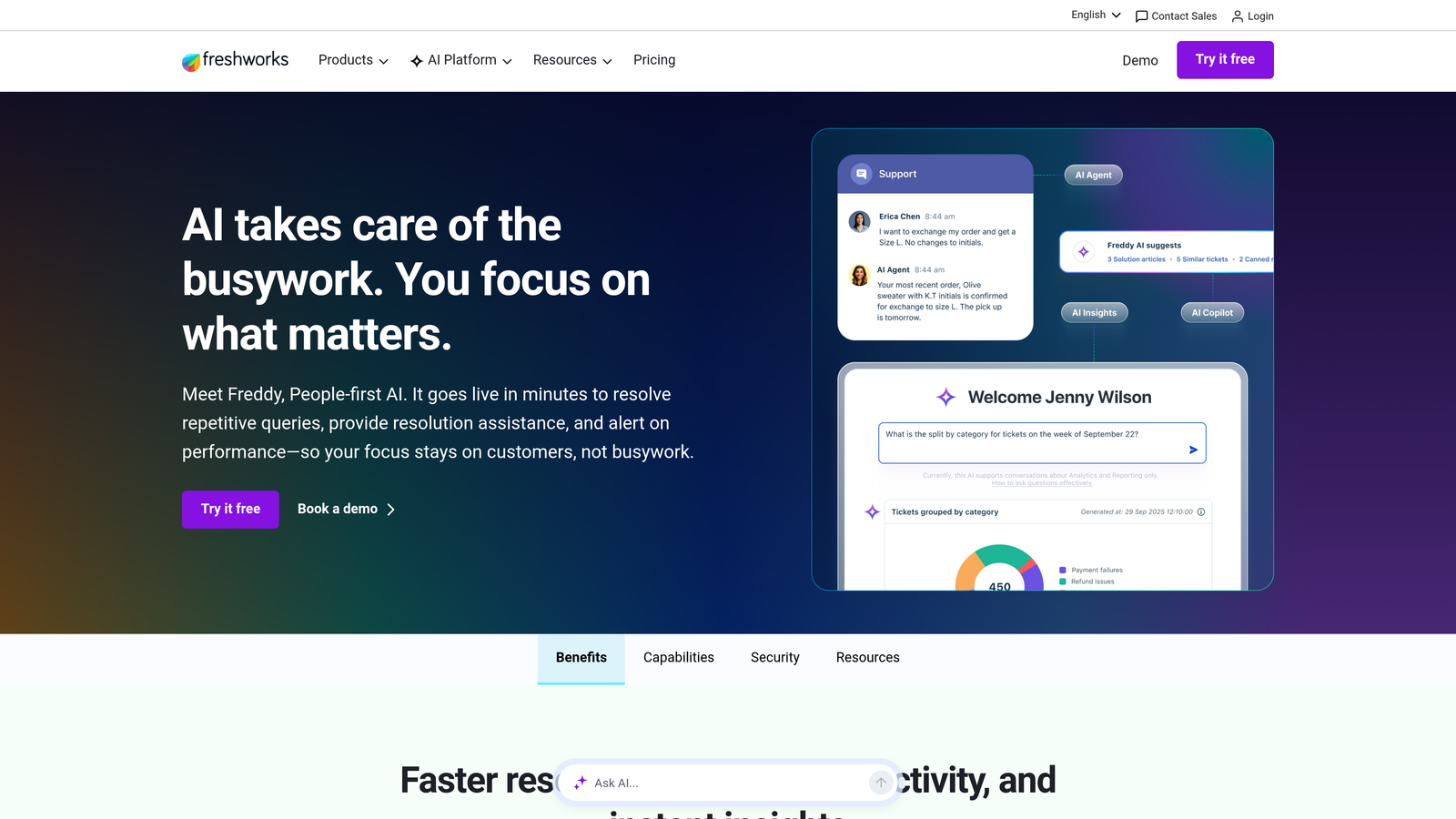
Freshdesk Freddy AI is Freshworks' AI layer covering self-service deflection, agent assistance, and analytics across their support ecosystem.
Where This Tool Shines
Freddy AI's strength is its coverage across the full support lifecycle within the Freshworks ecosystem. Freddy Self Service handles customer-facing deflection before tickets are created; Freddy Copilot assists agents during live interactions with suggested replies and conversation summaries; Freddy Insights surfaces analytics and anomaly detection for support managers. That's a complete AI stack, and it's available at pricing that mid-market teams can realistically access.
For teams already using Freshdesk, Freshchat, or Freshsales, Freddy operates natively across all three, which reduces the integration complexity that often comes with adding AI to a support stack.
Key Features
Freddy Self Service: Customer-facing AI bot that deflects common questions before they become tickets.
Freddy Copilot: Real-time agent assist with suggested replies, conversation summaries, and next-step guidance.
Freddy Insights: AI-powered analytics with anomaly detection for support operations and trends.
Native Freshworks Integration: Works across Freshdesk, Freshchat, and Freshsales without additional configuration.
Accessible Pricing: Free tier available with Freddy AI add-ons on paid plans, making it viable for teams not ready for enterprise contracts.
Best For
Mid-market and growing teams on the Freshworks ecosystem that want AI across deflection, agent assist, and analytics without the pricing structure of Zendesk or enterprise-only tools. Also a good fit for teams wanting to evaluate AI capabilities before committing to a full platform investment.
Pricing
Free tier available; Freddy AI add-ons on paid plans. Check freshworks.com for current pricing, as plan structures are updated regularly.
5. Tidio
Best for: Startups and smaller SaaS platforms that need fast AI deployment without heavy implementation lift.
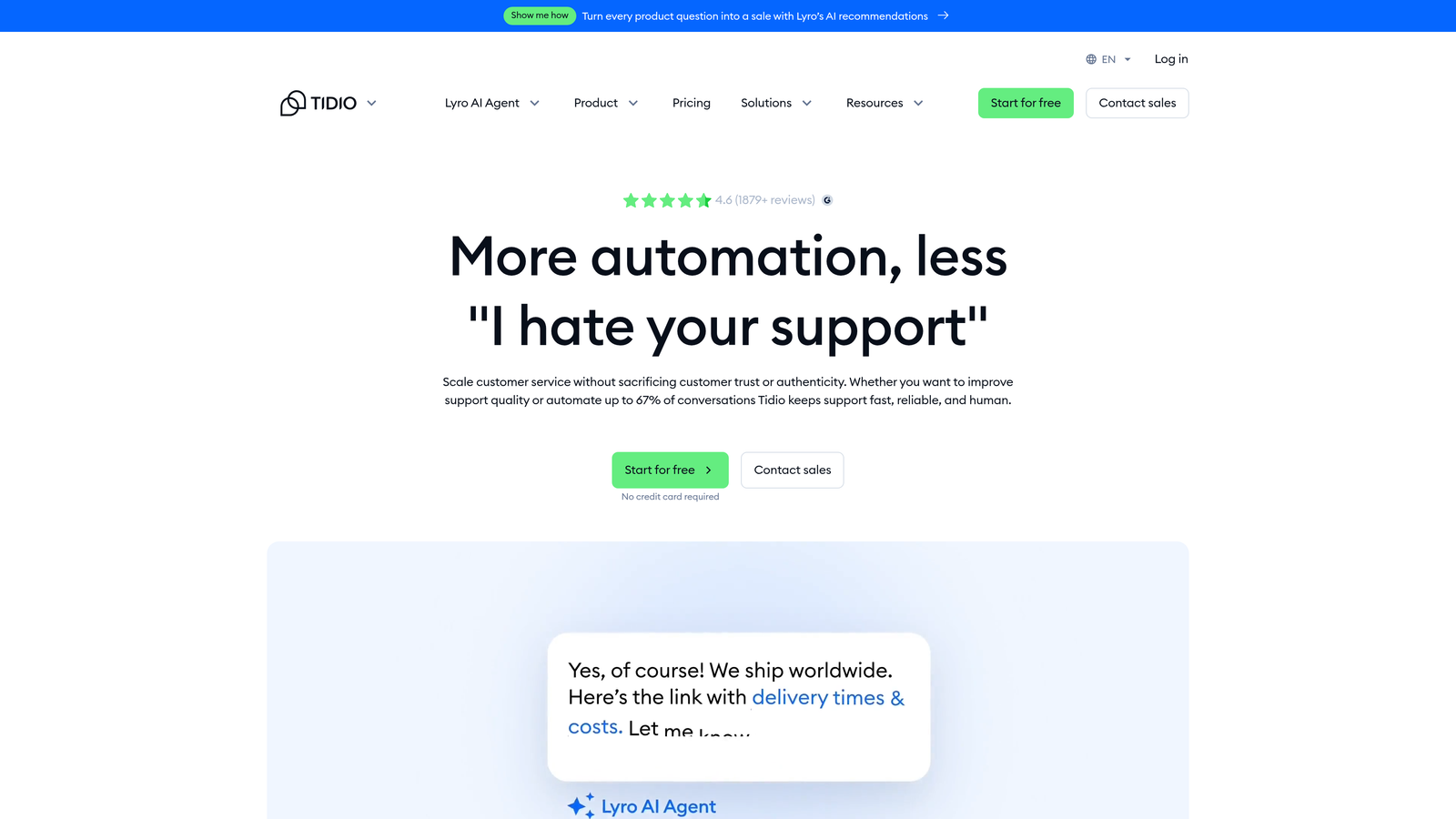
Tidio is a customer communication platform featuring Lyro, its AI chatbot designed for fast, low-code deployment at accessible pricing.
Where This Tool Shines
Tidio's primary advantage is speed to value. Lyro can be set up quickly using your existing content, handles common questions automatically, and falls back to live chat when it reaches the limits of what it can resolve. For startups or smaller platforms that need to stand up AI-assisted support without a dedicated implementation team, that low barrier to entry is genuinely valuable.
The visual flow builder also gives non-technical teams the ability to build custom conversation paths without engineering involvement, which matters when your support team is small and your engineering team has other priorities.
Key Features
Lyro AI Chatbot: Fast, low-code AI setup that handles common questions from your existing content automatically.
Live Chat Fallback: Seamlessly transfers to a human agent when Lyro reaches the edge of its capabilities.
Visual Flow Builder: Drag-and-drop conversation path builder for custom workflows without coding.
Common SaaS Integrations: Connects with Shopify, WordPress, and other widely used tools.
Free Tier Available: Entry-level access without upfront commitment, useful for evaluating fit before scaling.
Best For
Startups and smaller platforms that want to add AI-assisted support quickly and affordably. Less suited for complex B2B workflows, deep CRM integrations, or teams that need autonomous resolution at scale. Think of Tidio as a strong starting point that you may outgrow as your support complexity increases.
Pricing
Free tier available; Lyro AI is available on paid plans at accessible monthly rates. Check tidio.com for current plan details.
6. Drift (by Salesloft)
Best for: Platforms where support conversations frequently overlap with sales, upsell, and renewal outcomes.
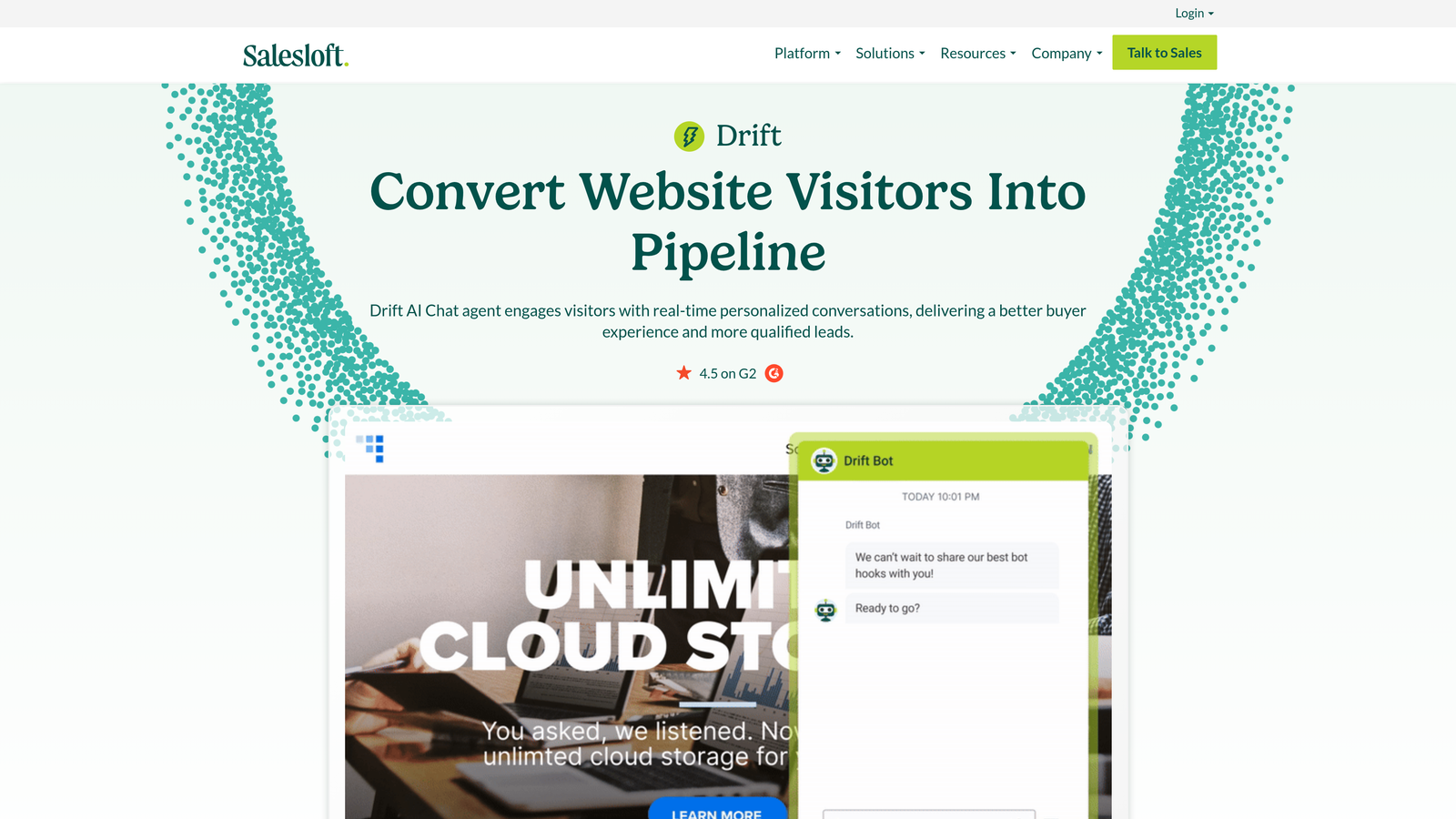
Drift is a conversational AI platform that intentionally blurs the boundary between support, sales qualification, and marketing engagement.
Where This Tool Shines
Drift's differentiation is its revenue orientation. Where most support tools are designed to resolve and close tickets, Drift is designed to identify intent signals within conversations and route them accordingly, whether that's to a support agent, an account executive, or an automated nurture flow. For platforms where a support interaction can become an upsell or renewal conversation, that context-aware routing is a genuine capability advantage.
Since the Salesloft acquisition, Drift's integration with Salesloft's revenue workflow tools has deepened, making it particularly compelling for revenue teams that want a single conversational layer across the customer lifecycle rather than separate tools for support and sales.
Key Features
Revenue-Oriented Conversations: AI handles support, sales qualification, and marketing engagement within a single conversation flow.
Buyer Intent Routing: Identifies intent signals and routes conversations to the right team or workflow automatically.
Account-Based Personalization: Tailors conversation experiences based on visitor identity and account data.
Salesloft Integration: Native integration with Salesloft for revenue team workflows, pipeline acceleration, and meeting scheduling.
Meeting Scheduling Built In: Converts support or sales conversations into booked meetings without leaving the chat.
Best For
Platforms where the line between support and revenue is intentionally blurred, particularly those with account-based sales motions, high-LTV customers, or renewal conversations that benefit from conversational context. Less suited for teams that need pure support resolution without a sales layer.
Pricing
Enterprise pricing; contact Drift or Salesloft directly for current rates. Pricing reflects the platform's enterprise and revenue-team positioning.
7. Kustomer
Best for: Platforms with complex, high-value customer relationships that require a unified timeline across every interaction.
Kustomer is a CRM-native customer service platform where AI operates across the full customer timeline, not just individual tickets.
Where This Tool Shines
Kustomer's architecture is fundamentally different from ticket-based helpdesks. Instead of treating each support interaction as an isolated ticket, Kustomer builds a continuous customer timeline that aggregates every touchpoint: purchases, past conversations, behavior signals, and more. AI then operates across that full context, which means routing, classification, and suggested responses are informed by the complete customer relationship rather than just the current message.
For platforms with high-LTV customers where relationship context matters, that's a meaningful operational difference. An AI that knows a customer has been active for three years, recently expanded their plan, and had a billing issue last month responds very differently than one that only sees the current ticket.
Key Features
CRM-Native Architecture: Every interaction lives in a unified customer timeline, giving AI and agents full relationship context.
AI Routing and Classification: Intelligent routing and suggested responses informed by the full customer history.
Omnichannel in One View: Email, chat, SMS, social, and voice all managed within a single unified workspace.
Proactive Outreach: Triggers outreach based on customer behavior signals before issues escalate.
Complex Workflow Automation: Handles multi-step support processes with conditional logic and automation.
Best For
Platforms with complex, high-LTV customer relationships where historical context meaningfully changes how support should be delivered. Strong for omnichannel operations that need a unified view across every channel. Enterprise-oriented pricing makes it less accessible for early-stage teams.
Pricing
Enterprise pricing; contact Kustomer directly for current plan details at kustomer.com.
8. Help Scout
Best for: Teams that want AI efficiency without sacrificing the human quality of their support experience.
Help Scout is a human-centered support platform that uses AI to assist agents rather than replace them, with features focused on speed and clarity for human-led support.
Where This Tool Shines
Help Scout's philosophy is deliberate: AI should make human agents faster and better, not remove them from the equation. That shows up in features like AI Summarize, which condenses long conversation threads so agents can get up to speed instantly, and AI Drafts, which generates reply suggestions that agents review and send rather than auto-sending without review. It's a considered approach that works well for teams where the quality and personal tone of support is a differentiator.
The Answers feature adds self-service capability by automatically searching your documentation to surface relevant content, but the overall product is optimized for teams that want AI as a productivity layer rather than an autonomous resolution engine.
Key Features
AI Summarize: Condenses long conversation threads into quick summaries so agents gain context without reading everything.
AI Drafts: Generates reply suggestions that agents review and approve before sending, keeping humans in control.
Answers: Self-service AI that searches your documentation automatically to surface relevant content for customers.
Unified Platform: Shared inbox, docs site, and live chat in one clean interface without tool sprawl.
Clean, Minimal UI: Designed for small-to-mid support teams that value simplicity and low onboarding overhead.
Best For
Small-to-mid support teams where human quality and relationship tone are core to the support experience. Strong for companies where autonomous resolution would feel off-brand. Not the right fit if deflection rates and autonomous resolution are the primary metrics you're optimizing for.
Pricing
Per-user monthly pricing; check helpscout.com for current plans. Generally accessible for small-to-mid teams compared to enterprise-tier alternatives.
9. Forethought
Best for: Enterprise teams that want AI capabilities layered onto an existing helpdesk without a platform migration.
Forethought is an AI platform designed to sit on top of existing helpdesks, adding intelligent triage, routing, and agent assist to Zendesk, Salesforce Service Cloud, ServiceNow, and others.
Where This Tool Shines
Forethought's core value proposition is stack-agnostic AI. If your organization has invested years in a helpdesk platform and can't realistically migrate, Forethought plugs in on top and adds AI capabilities without requiring you to touch your existing infrastructure. That's a genuinely different approach from most tools on this list, which assume you're either already on their platform or willing to switch.
The three-layer structure, Solve for self-service deflection, Triage for intelligent classification and routing, and Assist for agent support, gives enterprises a modular way to add AI where it's most needed rather than committing to a full platform overhaul.
Key Features
Helpdesk-Agnostic Architecture: Works on top of Zendesk, Salesforce Service Cloud, ServiceNow, and other major platforms without migration.
Triage AI: Classifies and routes incoming tickets with high accuracy based on intent and content.
Solve AI: Self-service deflection that intercepts common questions before they become tickets.
Assist AI: Surfaces relevant knowledge articles and suggested responses for agents during live interactions.
No Migration Required: Plugs into your existing stack, preserving existing workflows and data structures.
Best For
Enterprise teams on established helpdesk platforms that want AI capabilities without the disruption and cost of a full platform migration. Particularly strong for organizations on Zendesk, Salesforce, or ServiceNow where switching costs are prohibitive but AI gaps are real.
Pricing
Enterprise pricing; contact Forethought directly at forethought.ai for current rates.
Which Tool Is Right for Your Platform?
The right choice depends less on which tool has the most features and more on where you are in your support maturity and what your primary constraint actually is.
Here's a quick way to think through the decision:
Building AI-first from the ground up: Halo AI is built specifically for B2B SaaS platforms, with page-aware context, business intelligence signals, and deep integrations that go well beyond ticket resolution.
Already on Intercom and want to add AI: Fin AI is the lowest-friction path, operating natively inside the messenger you already use.
Large enterprise on Zendesk: Zendesk AI adds intelligent triage, agent copilot, and omnichannel AI without leaving the platform your team already knows.
Growing mid-market team watching budget: Freshdesk Freddy AI offers a complete AI stack at pricing that scales more accessibly than enterprise alternatives.
Startup that needs fast deployment: Tidio's Lyro gets you live quickly with minimal setup, giving you a starting point you can build from.
Support and sales overlap is real: Drift is the only tool on this list explicitly designed to convert support conversations into revenue outcomes.
High-LTV customers with complex histories: Kustomer's CRM-native timeline gives AI and agents the full relationship context that ticket-based tools miss.
Human-first support philosophy: Help Scout keeps humans in the loop while using AI to make them faster and more consistent.
Can't migrate your helpdesk: Forethought layers AI on top of what you already have, no migration required.
Your support team shouldn't scale linearly with your customer base. The best AI tools on this list let you resolve more tickets, guide users through complex workflows, and surface intelligence from every interaction, without adding headcount proportionally. See Halo in action and discover how continuous learning transforms every support interaction into smarter, faster support that compounds over time.