9 Best AI Customer Service Tools for Startups in 2026
This guide reviews the 9 best AI customer service tools for startups in 2026, helping early-stage teams deliver fast, high-quality support without the headcount. Each platform is evaluated on pricing, ease of setup, AI quality, and scalability—so startups can find the right solution whether they're serving their first 100 users or growing past 10,000.
 Matt PattoliFounder13 min read
Startups face a brutal support paradox: customers expect instant, high-quality responses, but early-stage teams rarely have the headcount to deliver them. AI customer service tools have become the practical solution, not just for cost savings, but for building scalable support infrastructure before you actually need it.
This list covers the best AI customer service platforms built for startup realities: tight budgets, small teams, fast product iteration, and the need to punch above your weight. Whether you're handling your first 100 users or scaling past 10,000, these tools offer the automation, intelligence, and flexibility to keep customers happy without burning out your team.
Each tool was evaluated on ease of setup, pricing transparency, AI quality, integration depth, and how well it fits the startup growth curve from seed stage through Series B and beyond.
1. Halo AI
Best for: B2B SaaS startups with complex products needing AI that learns continuously from real interactions
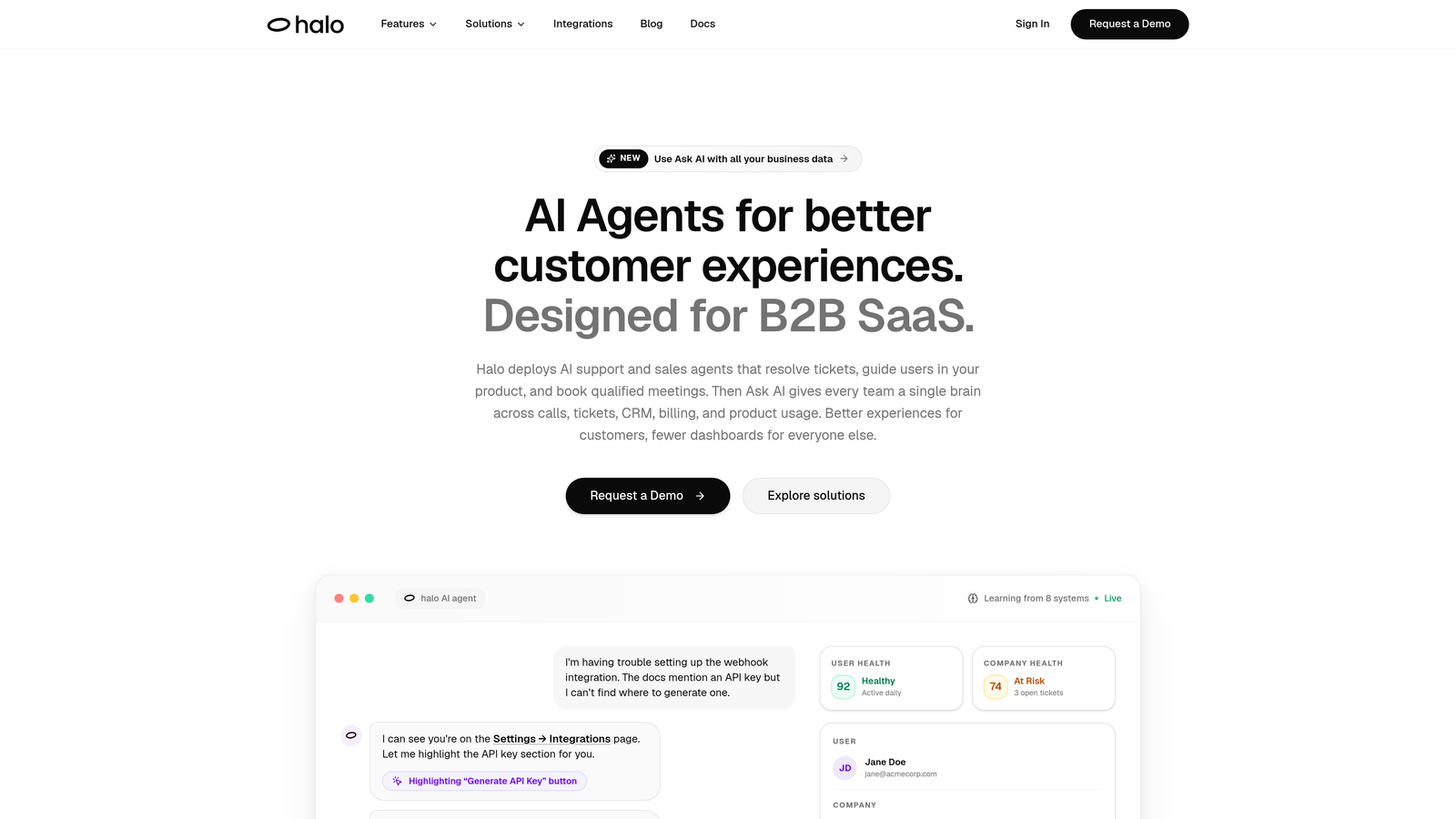
Halo AI is an AI-first customer support platform that deploys autonomous agents to resolve tickets, guide users through your product with page-aware context, and surface business intelligence from every support interaction.
Where This Tool Shines
What separates Halo from most tools on this list is its architecture. It wasn't built by adding AI onto a legacy helpdesk — it was designed AI-first from the ground up. That distinction matters more than it sounds: the system continuously learns from every interaction without requiring manual retraining, which means it gets smarter as your product evolves without someone on your team managing it.
The page-aware chat widget is particularly compelling for SaaS startups. Instead of generic FAQ responses, Halo's agent sees exactly what the user sees on screen and delivers contextual UI guidance. For technical products with complex onboarding, that's the difference between a user figuring something out and a user churning.
Key Features
Page-Aware Context: The chat agent sees what users see on screen, enabling step-by-step UI guidance rather than generic answers.
Continuous Learning: Improves autonomously from every resolved interaction without manual retraining or content updates.
Auto Bug Ticket Creation: Converts support issues into Linear tickets automatically, closing the loop between support and engineering.
Smart Inbox with Business Intelligence: Surfaces customer health signals, revenue intelligence, and anomaly detection from support conversation data.
Deep Integrations: Connects natively with Linear, Slack, HubSpot, Intercom, Stripe, Zoom, PandaDoc, and Fathom.
Live Agent Handoff: Seamlessly escalates complex or sensitive issues to human agents when needed.
Best For
B2B SaaS startups with technical products, complex onboarding flows, or fast-moving roadmaps that make manual knowledge base maintenance impractical. Particularly strong for teams that need support data to feed back into product and revenue decisions, not just ticket queues.
Pricing
Visit haloagents.ai for current pricing plans. Pricing details are best confirmed directly given how frequently SaaS plans evolve.
2. Intercom
Best for: Startups already in the Intercom ecosystem wanting AI layered into an established support and messaging platform
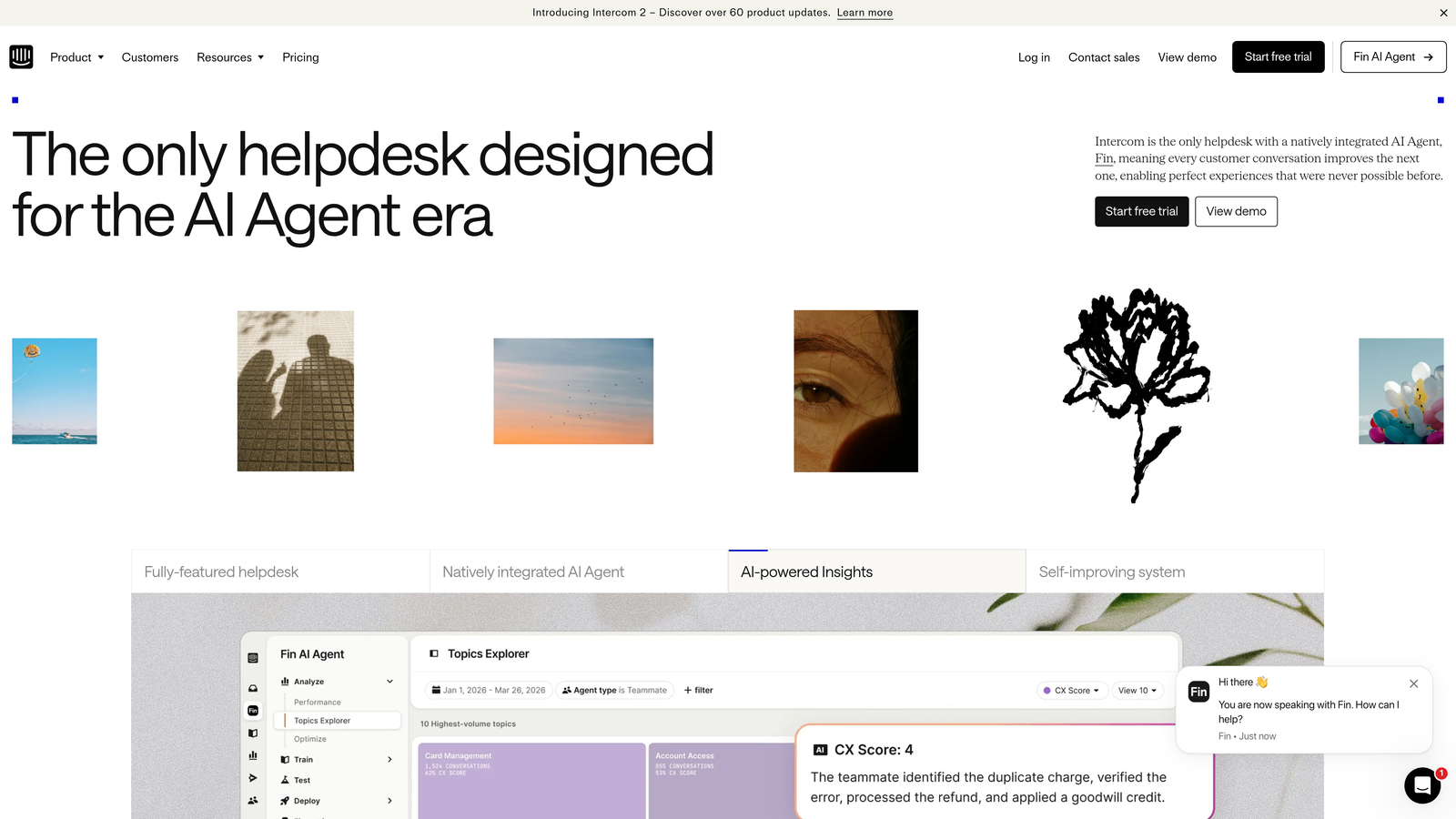
Intercom is a mature conversational support platform featuring Fin, its AI agent that resolves customer queries using your help center content, layered on top of a full-featured CRM and messaging suite.
Where This Tool Shines
Intercom's strength is breadth. It combines live chat, AI support, product tours, proactive messaging, and CRM functionality in a single platform. For startups that want to consolidate their customer communication stack early, that consolidation has real operational value.
Fin, Intercom's AI agent, is trained on your existing help center content and handles common queries without human intervention. It's particularly effective if you've already invested in building a solid knowledge base, since the AI quality scales directly with the quality of your documentation.
Key Features
Fin AI Agent: Powered by large language models and trained on your help content for autonomous query resolution.
Unified Inbox: Consolidates chat, email, and in-app messaging in one interface.
Product Tours: Proactive onboarding flows that reduce inbound support volume before it starts.
Early-Stage Startup Program: Qualifying early-stage companies can access the platform at reduced cost.
App Marketplace: Extensive third-party integrations across the startup tool stack.
Best For
Growth-stage startups already using Intercom for customer messaging who want to add AI resolution without switching platforms. Also a strong fit for teams that want product tours and proactive messaging alongside reactive support in a single tool.
Pricing
Pricing scales with seat count and AI resolution volume, which can become significant at scale. An early-stage startup program is available for qualifying companies. See intercom.com for current rates.
3. Freshdesk
Best for: Early-stage teams graduating from shared email inboxes who need structured ticketing with AI assistance
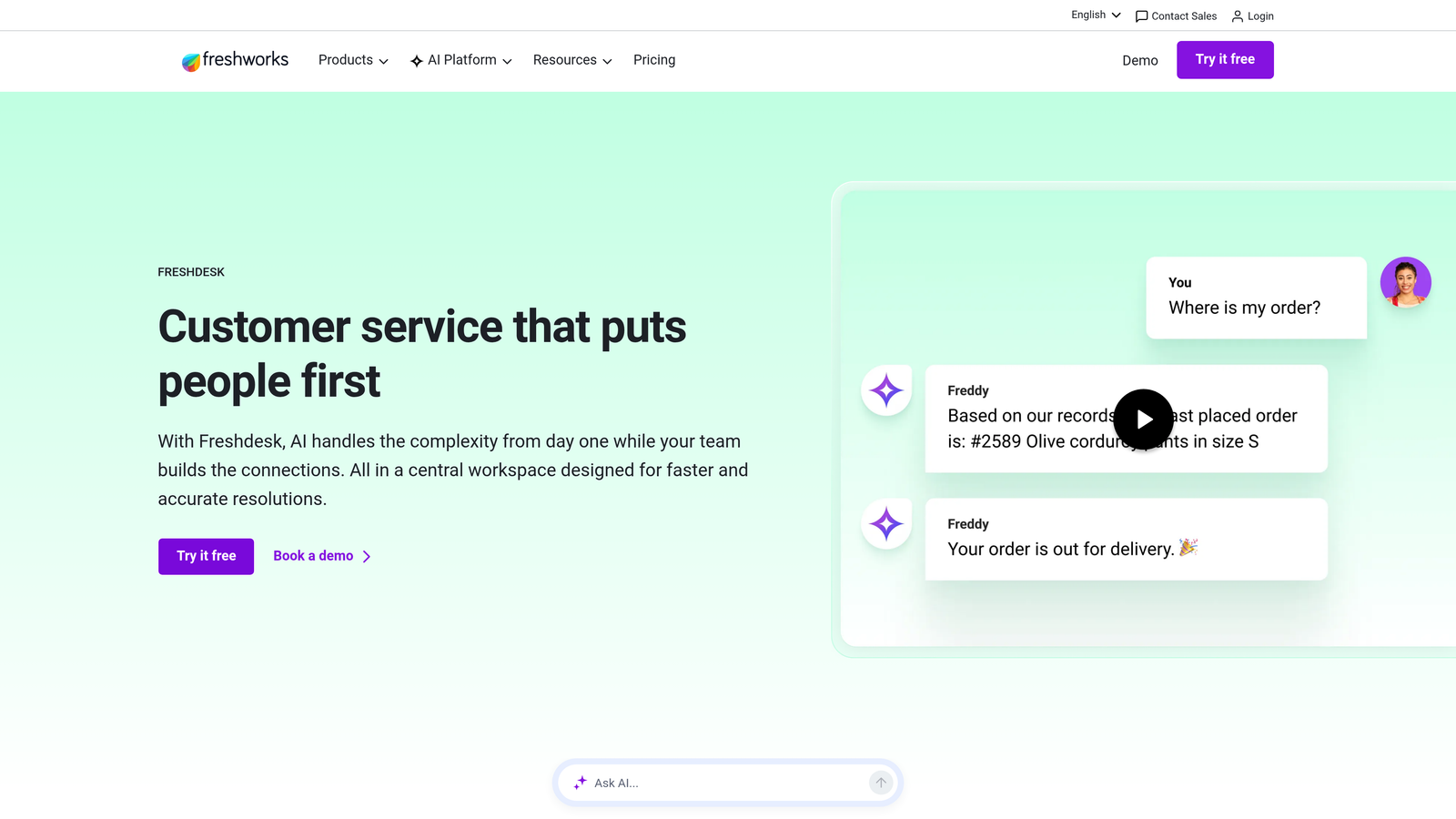
Freshdesk is a structured helpdesk platform with Freddy AI providing ticket automation, suggested responses, and self-service capabilities.
Where This Tool Shines
Freshdesk hits a practical sweet spot for startups moving past the "everyone watches a shared Gmail inbox" phase. It brings real helpdesk structure — SLA management, ticket routing, categorization — without the complexity and cost of enterprise platforms.
Freddy AI handles the repetitive cognitive work: categorizing incoming tickets, suggesting response copy, and flagging priority issues. It won't autonomously resolve complex queries the way more AI-native tools do, but for teams that still want humans in the loop on most interactions, that's actually a feature rather than a limitation.
Key Features
Freddy AI: Handles ticket categorization, tagging, and suggested responses to speed up agent workflows.
Freddy Self Service: AI-powered customer-facing bots for common query deflection.
Email-to-Ticket Workflow: Structured SLA management for teams coming from unstructured email support.
Free Plan: Available for small teams with limited agent seats.
Marketplace Integrations: Connects with popular startup tools across the stack.
Best For
Seed-stage startups with a small support team that needs structure and basic AI assistance rather than full autonomous resolution. Also a strong choice for teams that want a free tier to start and room to grow without switching platforms.
Pricing
Free plan available; paid plans start at accessible price points. Check freshdesk.com for current rates, as plan structures change regularly.
4. Zendesk
Best for: Startups anticipating enterprise-level complexity who want to build on infrastructure that scales to thousands of agents
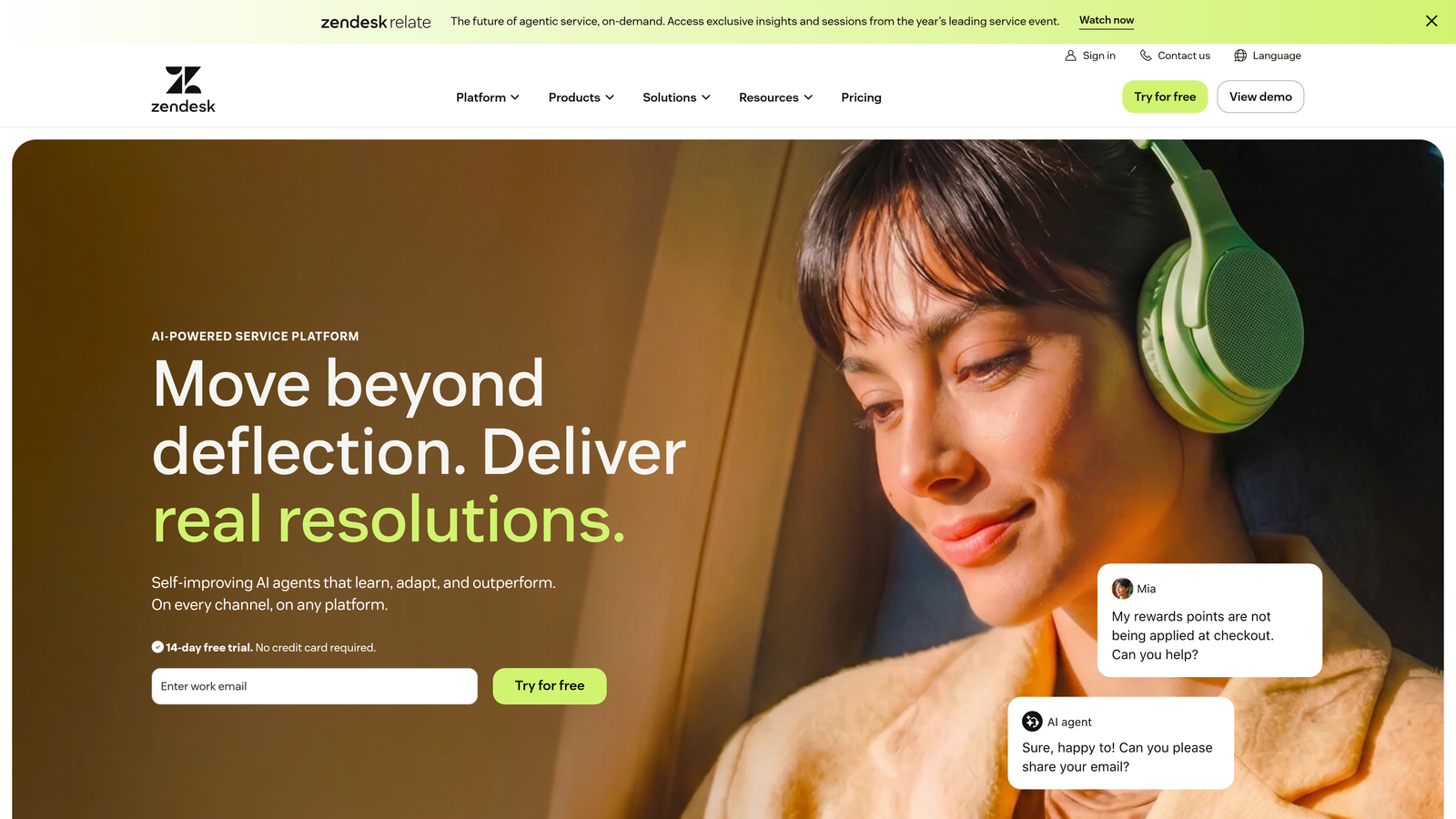
Zendesk is an enterprise-grade support platform with a dedicated startup program that gives early-stage companies access to its full AI feature set at significantly reduced cost.
Where This Tool Shines
Zendesk's primary advantage is its ceiling. If you're building a company that expects to have a large, complex support operation within a few years, starting on Zendesk means you won't outgrow your tooling and face a painful migration mid-growth. The startup program makes that bet financially accessible.
The AI capabilities — intelligent triage, intent detection, smart routing, and AI bots — are comprehensive, though they sit on top of a platform that was built for scale before it was built for simplicity. Expect a steeper setup curve than lighter alternatives on this list.
Key Features
Zendesk for Startups: Credits program for qualifying early-stage companies to access the full platform.
AI-Powered Triage: Intent detection and smart routing reduce manual ticket handling.
Omnichannel Support: Chat, email, voice, and social messaging in a unified platform.
Advanced Reporting: Comprehensive analytics dashboard for support performance tracking.
App Marketplace: The largest third-party integration marketplace in the category.
Best For
Funded startups with complex support needs or clear enterprise ambitions. The startup program makes it accessible early, but the platform's real value emerges at scale, making it a better fit for Series A and beyond than pre-seed teams.
Pricing
Suite plans with per-agent pricing; the startup program offers significant discounts for qualifying companies. See zendesk.com/startups for eligibility and current plan details.
5. Tidio
Best for: Early-stage consumer or e-commerce startups needing fast deployment and a genuinely usable free tier
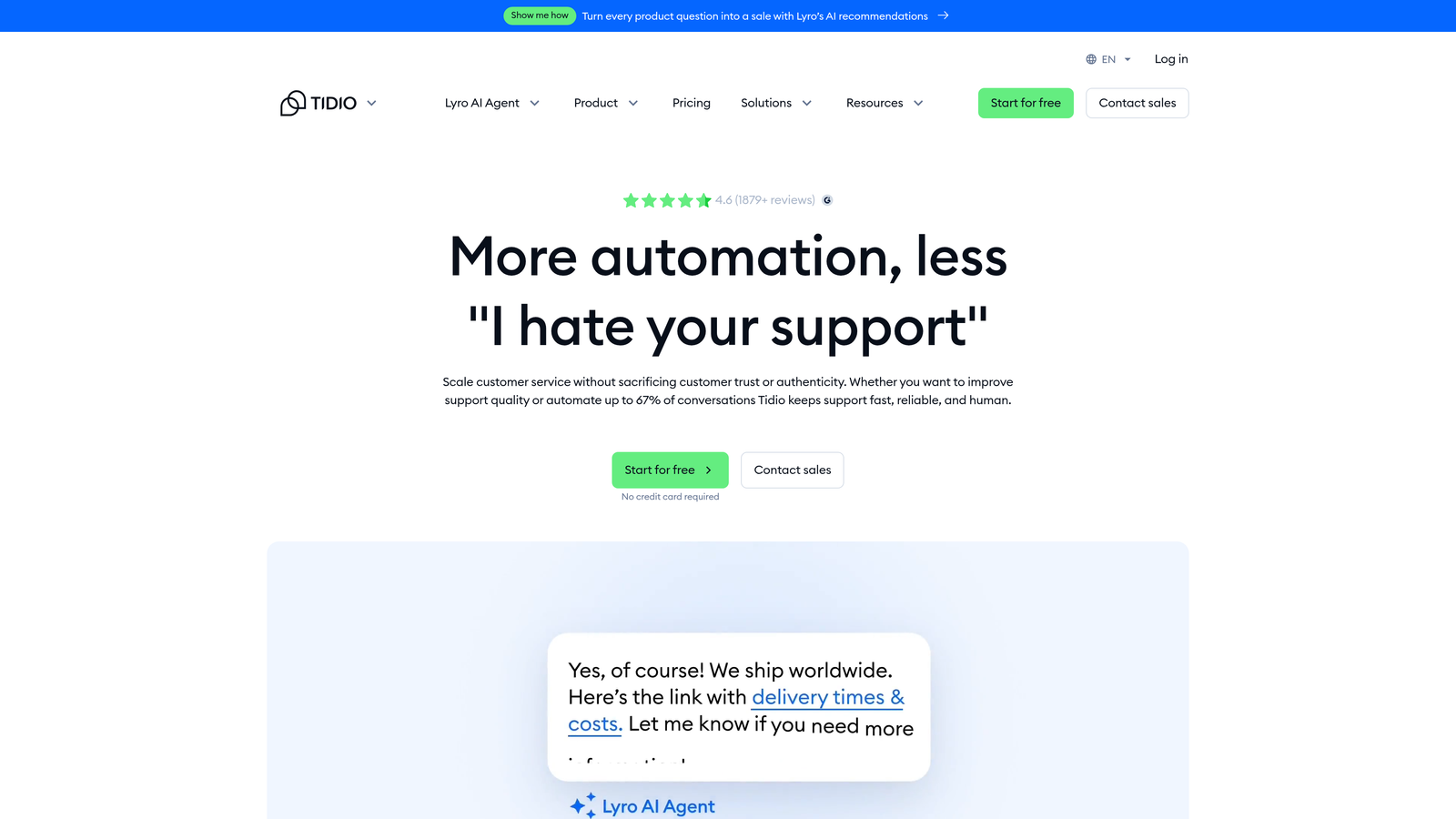
Tidio is a lightweight AI chat platform featuring Lyro, an AI agent that handles common customer queries autonomously using your existing help content.
Where This Tool Shines
Tidio's free tier is genuinely functional, which is rarer than it should be in this market. For a pre-revenue or early-revenue startup that needs live chat and basic AI without committing to a monthly bill, Tidio is one of the most practical starting points available.
Lyro, the AI agent, is straightforward to train using existing help content and handles repetitive queries well. It's not the most sophisticated AI on this list, but for startups with predictable, high-volume query patterns, such as shipping questions, account access, or basic product FAQs, it punches well above its price point.
Key Features
Lyro AI Agent: Autonomous query resolution trained on your help content with minimal setup.
Fast Deployment: Live chat widget installable in minutes, not days.
Free Tier: Meaningful functionality available without a paid plan.
Visual Chatbot Builder: Custom conversation flows without code.
E-Commerce Integrations: Native connections to Shopify, WordPress, and major e-commerce platforms.
Best For
Consumer startups, e-commerce brands, and early-stage teams that need live chat and basic AI deflection without budget commitment. Less suited for B2B SaaS with complex, context-dependent support queries.
Pricing
Free plan available; Lyro AI is priced per conversation resolved. See tidio.com for current rates and plan limits.
6. Crisp
Best for: Early-stage startups consolidating fragmented customer communication channels on a minimal budget
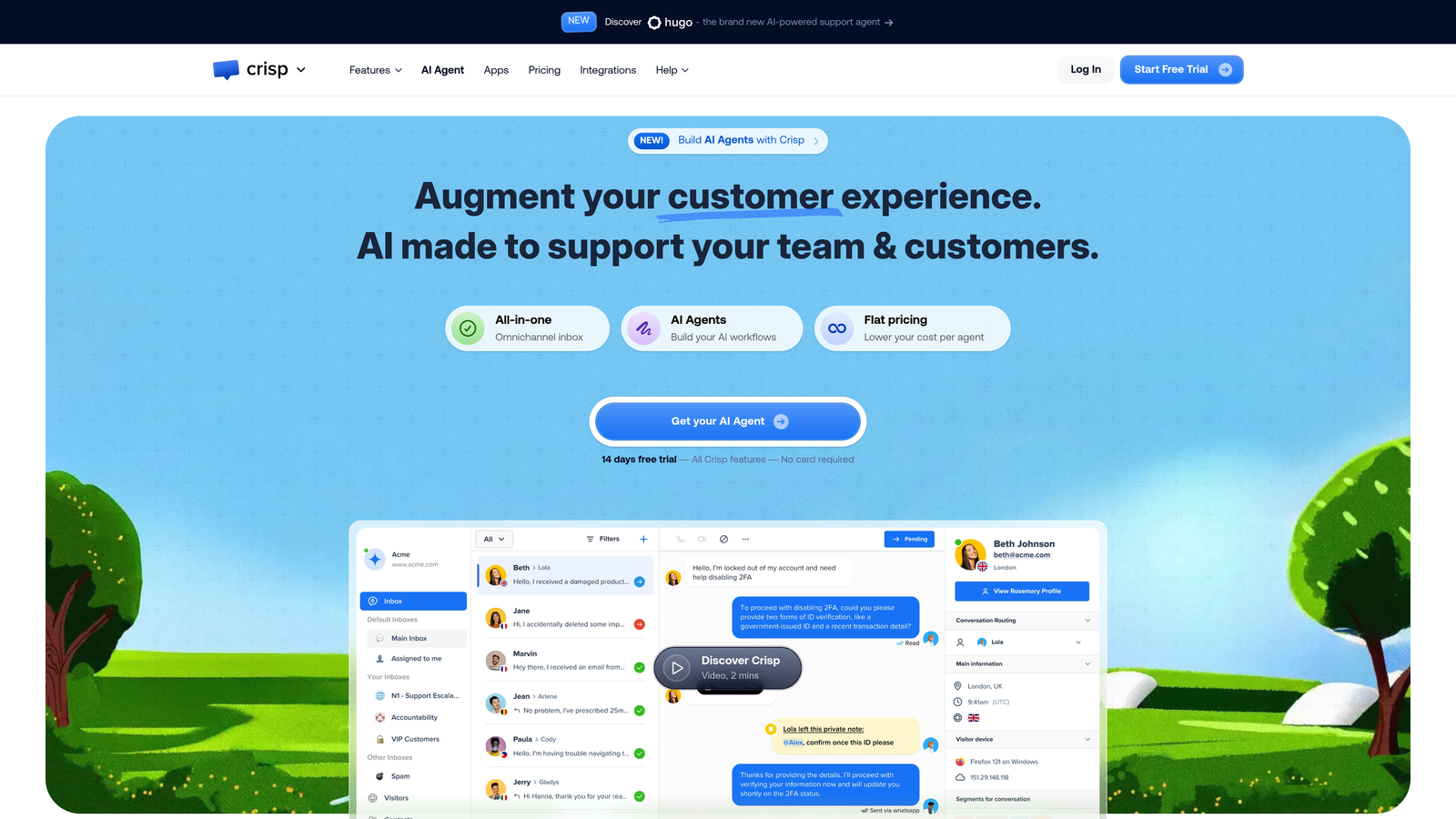
Crisp is a unified team inbox that consolidates chat, email, and social messaging in one interface, with AI-assisted reply suggestions and a no-code chatbot builder.
Where This Tool Shines
Crisp solves a real early-stage problem: customer messages arriving across five different channels with no unified view. By pulling live chat, email, Messenger, Instagram, and WhatsApp into a single inbox, it eliminates the context-switching that fragments small support teams.
The MagicReply AI feature suggests responses based on conversation history, which speeds up agent replies without requiring full automation. For teams that aren't ready to hand queries to an AI agent but want AI assistance in the workflow, that middle-ground approach is genuinely useful.
Key Features
Unified Inbox: Live chat, email, Messenger, Instagram, and WhatsApp consolidated in one view.
MagicReply AI: Suggests responses based on conversation history to speed up agent replies.
CrispyBird Chatbot Builder: No-code tool for building automated conversation flows.
Team Collaboration: Shared inbox with internal notes and assignment features.
Free Plan: Core features available without a paid subscription.
Best For
Pre-seed and seed-stage startups managing customer communication across multiple channels with a very small team. Strong value-to-cost ratio for teams that prioritize channel consolidation over sophisticated AI resolution.
Pricing
Free plan available; paid plans at startup-friendly price points. See crisp.chat for current plan details.
7. Drift (Salesloft)
Best for: Revenue-driven B2B startups where support conversations frequently overlap with sales opportunities
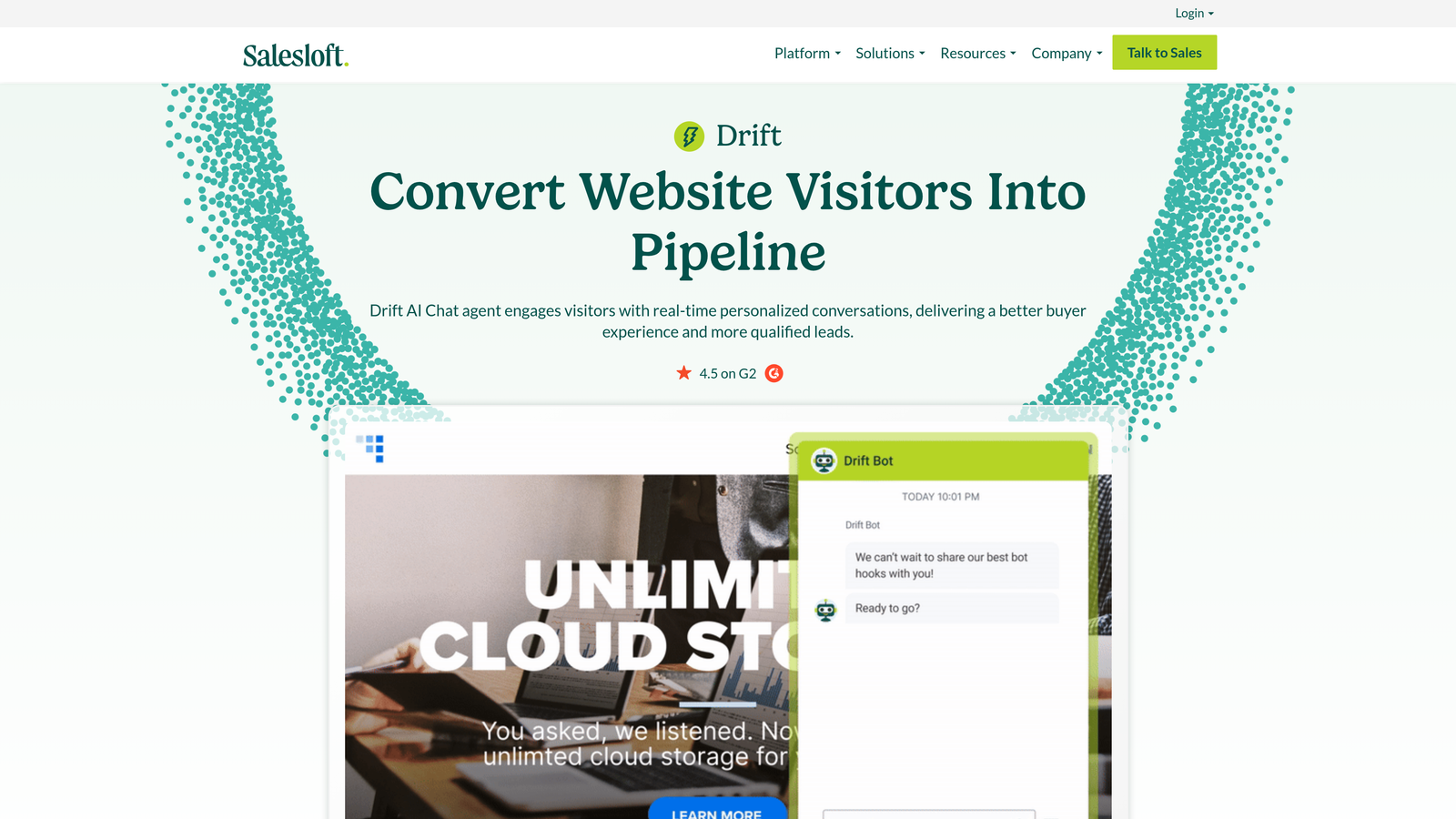
Drift, now part of Salesloft, is a conversational AI platform that bridges customer support and revenue generation, making it useful for B2B startups where the line between support and sales is deliberately blurred.
Where This Tool Shines
Drift's differentiation is its revenue orientation. Where most support tools treat conversations as tickets to close, Drift treats them as revenue opportunities to capture. AI chatbots qualify leads, route conversations to the right team, and can book meetings directly within the chat flow.
For B2B startups where a support conversation with a power user could become an upsell, or where a prospect's question could become a demo booking, that orientation matters. The Salesloft acquisition has deepened the revenue intelligence layer, making it a reasonable fit for sales-led growth companies.
Key Features
Lead-Qualifying AI Chatbots: Automatically qualify inbound conversations and route to the right team or rep.
Revenue Intelligence: Surfaces insights from customer conversation data to inform sales strategy.
Account-Based Targeting: Personalized experiences for high-value prospect accounts.
CRM Integrations: Native connections to Salesforce, HubSpot, and major CRM platforms.
In-Chat Meeting Scheduling: Converts conversations to booked meetings without leaving the chat window.
Best For
Funded B2B startups with a sales-led or product-led-sales motion where support and revenue generation overlap. The higher price point makes it less practical for pre-seed teams focused purely on support efficiency.
Pricing
Higher price point than most tools on this list. Best suited for funded startups with a clear revenue use case. See drift.com for current plan details.
8. Gorgias
Best for: E-commerce startups running on Shopify, WooCommerce, or BigCommerce who need order data inside every support conversation
Gorgias is an AI-powered support platform purpose-built for e-commerce, with deep integrations that pull live order data directly into every support ticket.
Where This Tool Shines
Gorgias solves a specific and painful problem: the support agent who has to tab between their helpdesk and Shopify admin to answer a single order status question. By surfacing live order data, shipping status, and customer history directly inside the ticket, it eliminates that friction entirely.
The AI auto-response capabilities are particularly effective for e-commerce because the query types are predictable. Order status, return requests, and tracking questions follow consistent patterns, and Gorgias's AI handles them well at volume. The per-ticket pricing model also aligns costs with actual support demand rather than seat count.
Key Features
Native E-Commerce Integrations: Deep connections to Shopify, WooCommerce, and BigCommerce with live order data in every ticket.
AI Auto-Responses: Handles order status, return, and shipping queries autonomously.
Per-Ticket Pricing: Scales with actual support volume rather than agent headcount.
Revenue Statistics: Shows the impact of support interactions on conversion and revenue.
Macros and Rules: Automation for high-volume repetitive query handling.
Best For
E-commerce startups with meaningful order volume and predictable, high-frequency support queries. Not the right fit for B2B SaaS or service businesses where order data integration isn't relevant.
Pricing
Per-ticket pricing model that scales with support volume rather than team size. See gorgias.com for current plan details and ticket bundle pricing.
9. Help Scout
Best for: Human-touch-first startups that want AI to assist agents rather than replace them
Help Scout is a customer-first support platform that uses AI to augment human agents, featuring AI Summarize, AI Drafts, and a Beacon widget for proactive in-product help.
Where This Tool Shines
Help Scout takes a deliberately different philosophical stance from most tools on this list. Rather than pushing toward full AI autonomy, it focuses on making human agents faster and more effective. AI Summarize condenses long conversation threads instantly, and AI Drafts suggests reply copy for agents to review before sending — keeping humans in control while removing the friction of starting from a blank page.
The Beacon widget deserves particular mention. It delivers in-product self-service help before a user ever creates a ticket, which is one of the most cost-effective support strategies available. Combined with the included Docs knowledge base, it gives startups the tools to deflect common queries through self-service without requiring a separate knowledge management platform.
Key Features
AI Summarize: Condenses long conversation threads instantly so agents can get up to speed without reading every message.
AI Drafts: Suggests reply copy for agents to review and send, reducing time-to-response without removing human judgment.
Beacon Widget: In-product self-service help that deflects tickets before they're created.
Docs Knowledge Base: Included in all plans — no separate platform needed for self-service content.
Human-Feeling Interface: Clean design that preserves brand warmth in customer interactions.
Best For
Startups where brand voice and relationship quality are core to the customer experience, and where full AI autonomy feels at odds with that brand. Strong fit for teams that want to scale support capacity without losing the human feel of their responses.
Pricing
Per-user pricing with startup-accessible plans. See helpscout.com for current rates and plan comparison.
Which Tool Is Right for Your Startup?
The honest answer is that the right tool depends less on feature lists and more on where you are in the growth curve and what kind of support experience you're trying to build.
Here's a quick way to think through the decision:
Pre-seed or seed on a tight budget: Start with Tidio or Crisp. Both have functional free tiers that let you get live chat and basic AI running without a monthly commitment.
Early-stage team needing structure: Freshdesk brings helpdesk discipline to teams graduating from shared inboxes, with AI assistance that keeps humans in control.
E-commerce startups: Gorgias is purpose-built for this use case. The Shopify integration alone justifies the evaluation.
B2B SaaS with a complex product: Halo AI's continuous learning architecture and page-aware context make it worth a close look, especially if you're tired of AI tools that require constant manual maintenance to stay accurate as your product evolves.
Teams already on Intercom: Fin is the natural next step if you're already in that ecosystem and want AI resolution without a platform switch.
Startups planning for enterprise scale: Zendesk's startup program is worth taking while it's available. The platform's ceiling is high enough that you won't outgrow it.
Revenue-driven B2B: Drift makes sense when support and sales genuinely overlap and you have the budget to support a higher price point.
Human-touch-first teams: Help Scout's AI-assists-humans model is the right fit when brand warmth is non-negotiable.
Before committing to any platform, ask four questions. Does this tool learn from your specific product context, or does it just query generic FAQs? Can it integrate with your existing stack, including your CRM, billing system, and project management tools? What happens when AI can't resolve an issue, and is the handoff to a human agent seamless? Will the pricing model still make sense at ten times your current support volume?
Your support team shouldn't scale linearly with your customer base. Let AI agents handle routine tickets, guide users through your product, and surface business intelligence while your team focuses on complex issues that need a human touch. See Halo in action and discover how continuous learning transforms every interaction into smarter, faster support.