9 Best AI Customer Service Tools with Free Trials in 2026
This guide reviews nine AI customer service platforms offering genuine free trials or meaningful free tiers, evaluated specifically for B2B SaaS and product-led teams. For each tool, you'll find a clear breakdown of what makes it distinct, who it's built for, and exactly what you can test before committing any budget or engineering time.
 Matt PattoliFounder13 min read
If you're evaluating AI customer service software, a free trial isn't a nice-to-have — it's essential. You need to see how the AI handles your actual tickets, your actual users, and your actual product before committing budget and engineering time to an integration. The problem is that most tools bury their trial terms, restrict key features during evaluation, or require a sales call just to get started.
This list cuts through that. We've identified nine AI customer service platforms offering genuine free trials or meaningful free tiers, evaluated specifically for B2B SaaS teams and product-led companies. Each entry covers what makes the tool distinct, who it's built for, and what you can realistically test before paying a cent.
Whether you're replacing a legacy helpdesk, layering AI on top of Zendesk, or building a support stack from scratch, this guide helps you evaluate quickly and choose confidently.
1. Halo AI
Best for: Product-led SaaS teams that want AI-first support with deep product and business context.
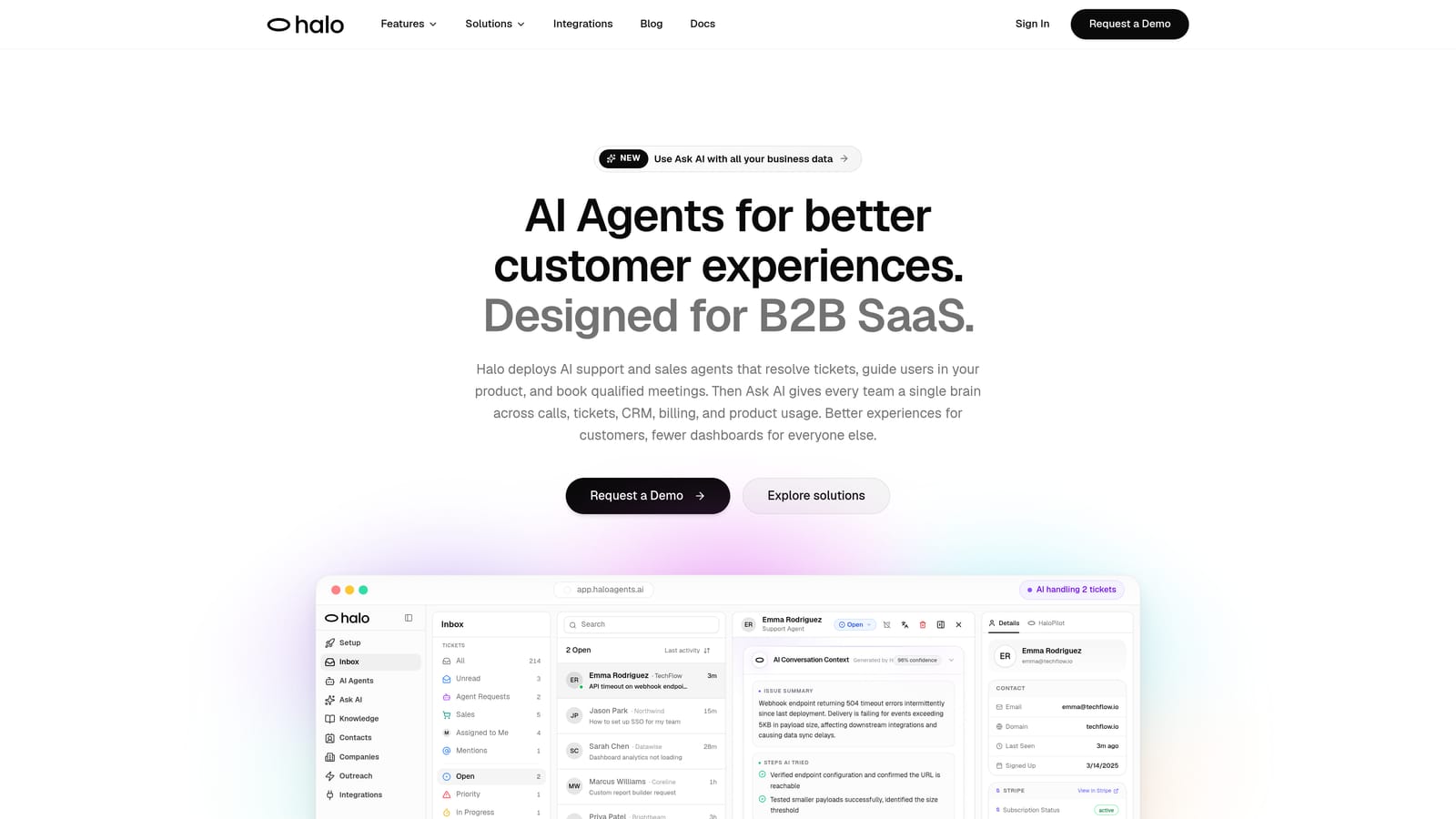
Halo AI is an AI-first customer support platform that deploys intelligent agents to resolve tickets, guide users through your product with page-aware context, and surface business intelligence — all while learning from every interaction.
Where This Tool Shines
Most AI support tools bolt AI onto an existing helpdesk. Halo was built the other way around: AI is the architecture, not a feature layer. The most distinctive capability is page-aware context. Halo's agents understand what page and UI state the user is currently on, which means they can provide guidance that's specific to what the user is actually seeing rather than generic documentation links.
Beyond resolution, Halo surfaces business intelligence from support interactions. The smart inbox doesn't just manage tickets — it detects customer health signals, flags anomalies, and surfaces revenue-relevant patterns. For SaaS teams, this transforms support from a cost center into a product intelligence channel.
Key Features
Page-Aware AI Agents: Agents understand the user's current UI context and deliver guidance specific to their exact location in your product.
Autonomous Ticket Resolution: AI handles routine tickets end-to-end with smart escalation to human agents when complexity warrants it.
Auto Bug Ticket Creation: Automatically identifies and routes bug reports to Linear or your issue tracker without manual triage.
Smart Inbox with Business Intelligence: Customer health signals, anomaly detection, and revenue intelligence surfaced directly from support interactions.
Native Integration Stack: Connects out of the box with Slack, HubSpot, Intercom, Stripe, Zoom, PandaDoc, Fathom, and Linear.
Best For
Product-led SaaS companies and B2B teams that want AI to do more than deflect tickets. If you need your support layer to connect to your CRM, product analytics, and engineering workflow simultaneously, Halo is built for exactly that use case. Particularly strong for teams scaling support without scaling headcount.
Pricing
Trial and demo access available at haloagents.ai. Verify current plan pricing directly on the site, as tiers may be updated.
2. Intercom
Best for: SaaS teams that want a mature, battle-tested conversational support platform with strong autonomous AI.
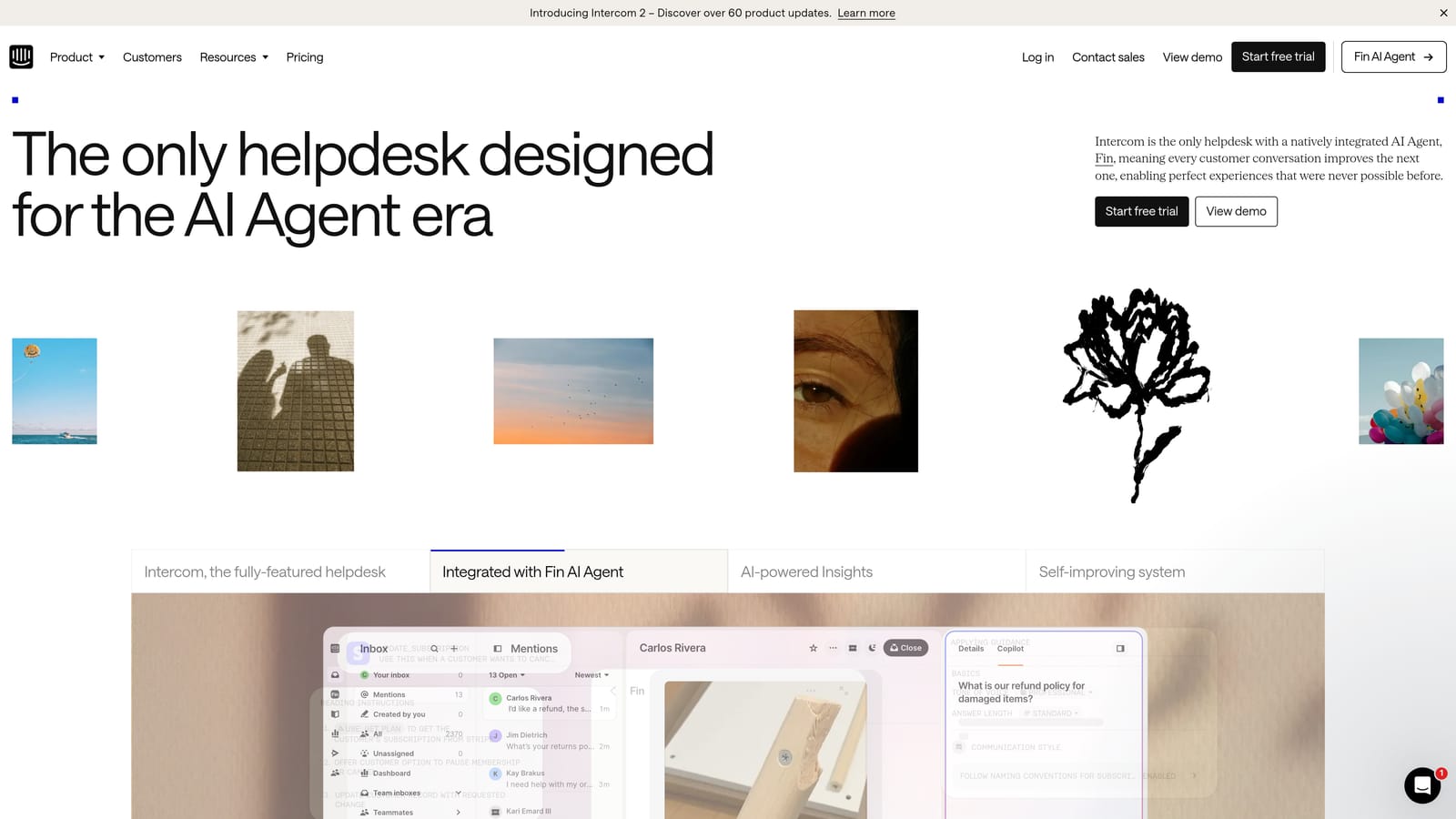
Intercom is a mature conversational support platform with Fin, its AI agent built to handle a significant share of support conversations autonomously.
Where This Tool Shines
Intercom has been in the SaaS support space long enough to have refined the details that matter: inbox management, routing logic, and the handoff between AI and human agents. Fin, its AI agent, is trained to resolve conversations rather than just respond to them, and it handles a meaningful share of inbound volume for teams that configure it well.
The platform's depth is also its complexity. Teams with sophisticated workflows benefit from Intercom's extensive app marketplace and routing capabilities. Teams wanting a leaner setup may find the configuration overhead significant.
Key Features
Fin AI Agent: Handles autonomous conversation resolution across chat and email channels with minimal setup.
AI Copilot: Assists human agents in real time with suggested responses and context during live conversations.
Unified Inbox: Consolidates email, chat, and in-app messaging into a single workflow for agents.
Workflow Automation: Powerful routing rules, assignment logic, and conversation tagging for complex support operations.
App Marketplace: Extensive integrations across CRM, analytics, and product tools.
Best For
SaaS teams with established support operations looking for a proven platform with strong AI capabilities. Particularly well-suited to companies that already have Intercom deployed and want to expand into AI-driven resolution rather than switch tools entirely.
Pricing
14-day free trial available. Paid plan pricing is published at intercom.com — note that Fin AI usage is often priced separately from base platform costs.
3. Freshdesk
Best for: Small to mid-size teams that want an accessible entry point into AI-assisted support with a usable free tier.
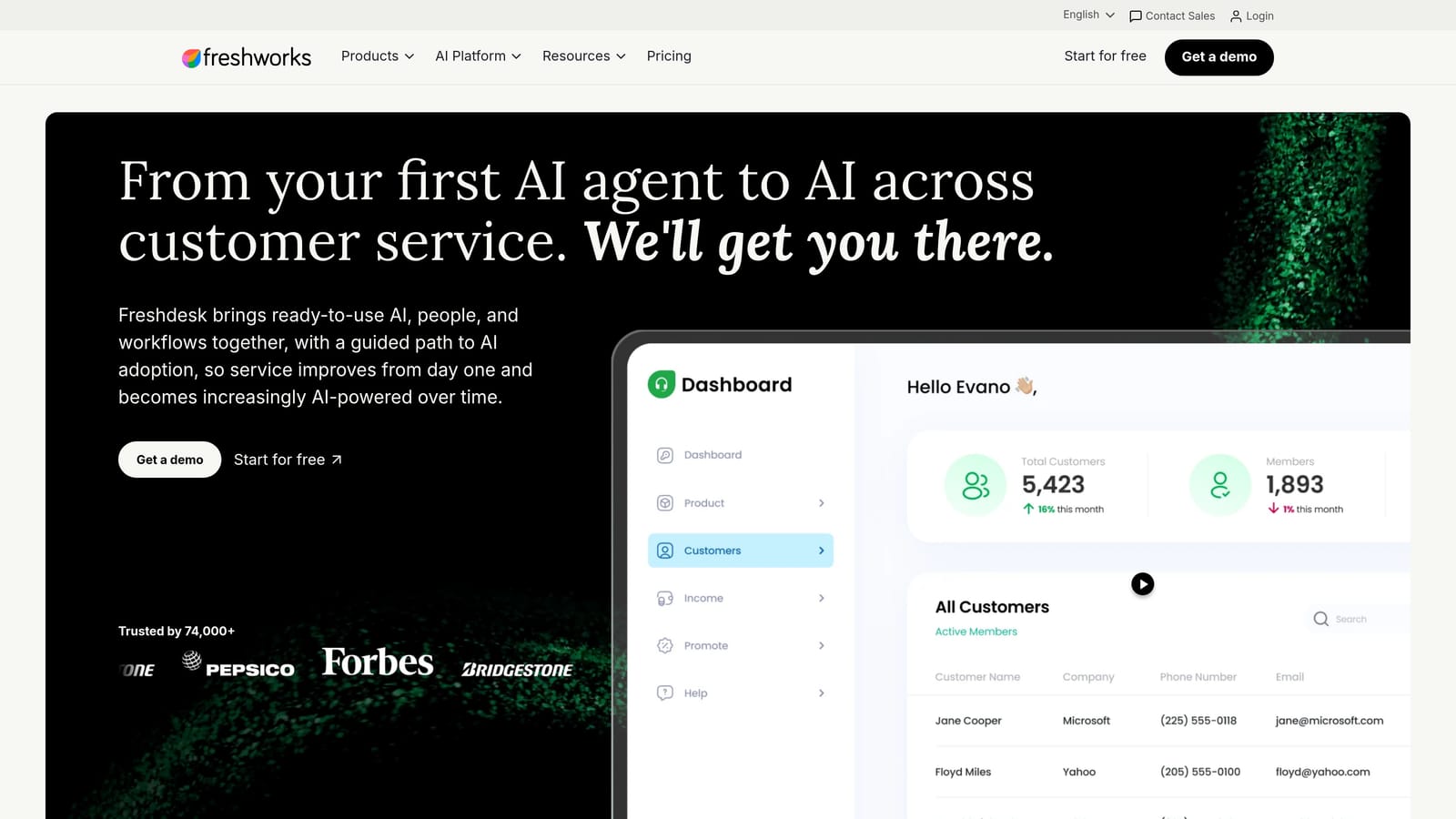
Freshdesk is a widely-used helpdesk platform with Freddy AI built in across free and paid tiers, making it one of the most accessible starting points for teams new to AI-assisted support.
Where This Tool Shines
The free plan is genuinely functional — not a stripped-down teaser. Small teams can handle real support volume on the free tier before deciding whether to upgrade for more AI capabilities. Freddy AI covers the foundational use cases: suggested replies, auto-triage, and basic bot flows that deflect common questions before they reach an agent.
Freshdesk's omnichannel coverage is also strong at its price point. Email, chat, phone, and social channels are supported across tiers, which reduces the need for additional tooling as your support operation grows.
Key Features
Freddy AI: Handles suggested replies, automatic ticket triage, and conversational bot flows for common questions.
Ticket Summarization: AI-generated summaries of long ticket threads available on higher tiers to speed up agent context-switching.
Omnichannel Support: Email, chat, phone, and social media channels unified in one platform.
Free Plan: Supports up to 10 agents with core helpdesk functionality and limited AI features included.
Marketplace Integrations: Connects with popular SaaS tools for CRM, billing, and project management.
Best For
Teams of 2-15 support agents who want to test AI-assisted support without upfront cost. Also a solid choice for teams migrating away from email-only support who want structured ticketing plus AI in a single platform.
Pricing
Free plan available for up to 10 agents. Paid plans with expanded Freddy AI capabilities start at a published rate on freshworks.com — verify current pricing at time of evaluation.
4. Zendesk
Best for: Enterprise teams with complex support operations that need deep configurability and compliance controls.
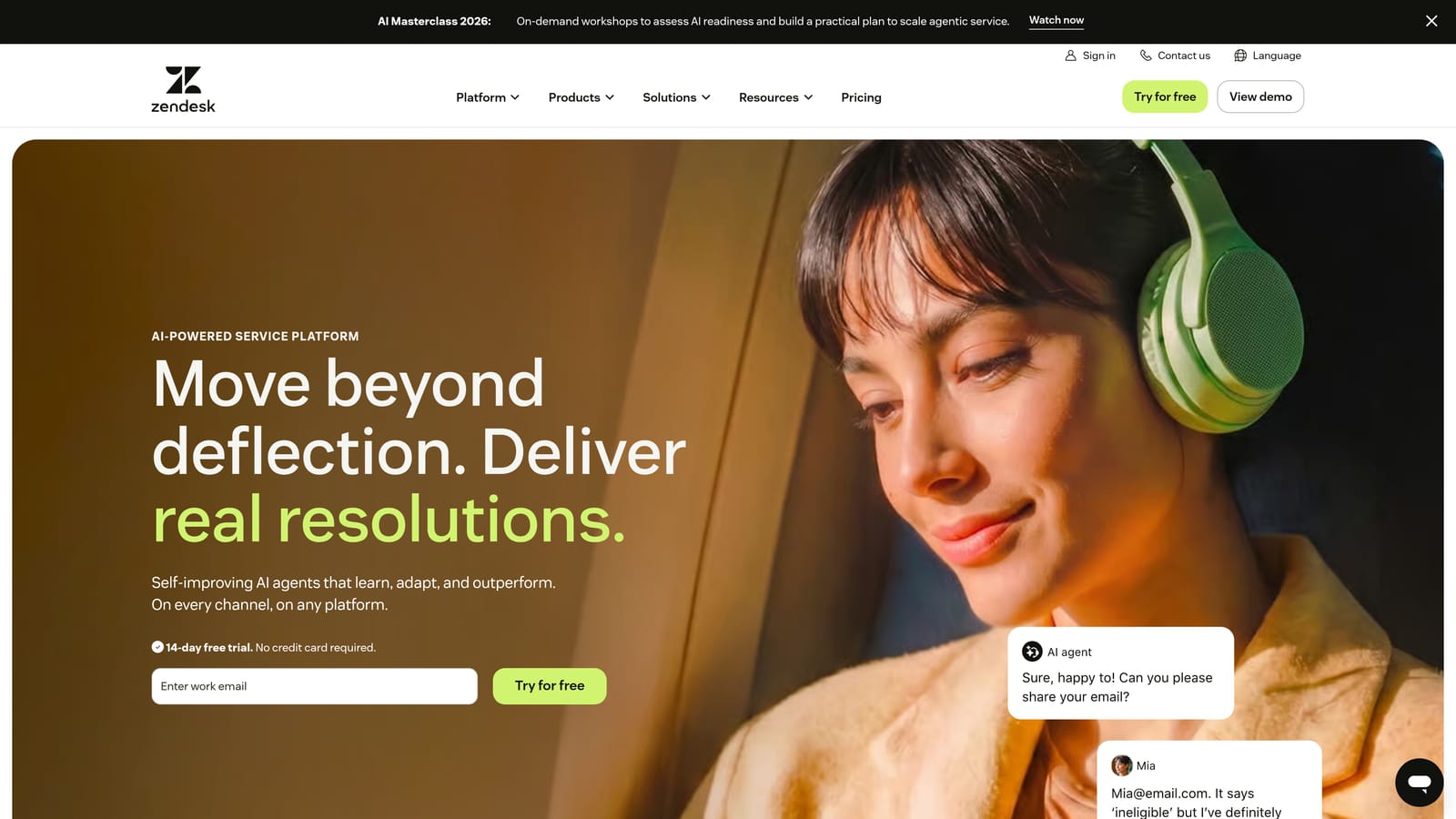
Zendesk is the incumbent enterprise helpdesk with Zendesk AI layered across its ticketing, routing, and bot infrastructure — powerful, but architecturally complex for teams wanting AI-first simplicity.
Where This Tool Shines
Zendesk's strength is breadth. The platform handles enormous ticket volume, supports sophisticated SLA management, and offers enterprise-grade security controls that regulated industries require. The 1,000+ integration marketplace means almost any tool in your stack has a connector.
The honest caveat: Zendesk AI feels like a layer added to an existing system rather than a native capability. Teams evaluating Zendesk specifically for AI-first support will likely find the setup more complex than platforms designed with AI at the core. It's a strong choice if you need enterprise infrastructure; less so if AI resolution is your primary goal.
Key Features
Zendesk AI Triage: Intelligent intent detection, macro suggestions, and automatic ticket categorization to reduce manual sorting.
AI-Powered Bots: Configurable bot builder for deflecting common questions before they reach agents.
SLA Management: Robust service level tracking with escalation rules and reporting.
1,000+ Integrations: Extensive marketplace covering CRM, analytics, e-commerce, and engineering tools.
Enterprise Compliance: SOC 2, GDPR, and HIPAA-ready configurations for regulated industries.
Best For
Enterprise support teams with 20+ agents, complex routing requirements, and existing Zendesk infrastructure. Less ideal for lean SaaS teams starting fresh who want AI-first architecture without the legacy overhead.
Pricing
14-day free trial available. Pricing is published at zendesk.com across Suite tiers — AI add-ons may be priced separately from base plans.
5. Tidio
Best for: Lean teams and SMBs that want fast deployment with minimal technical setup.
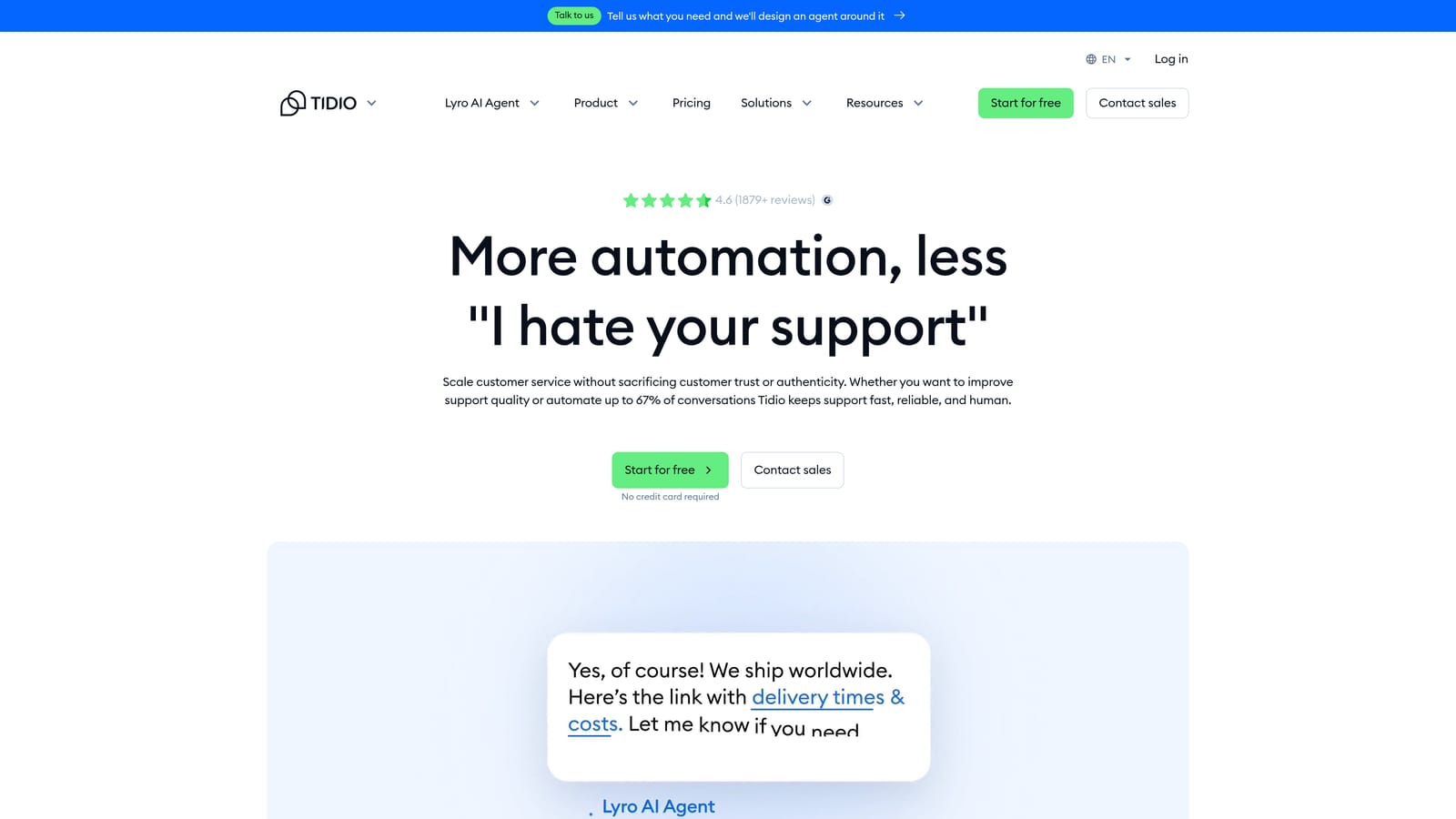
Tidio is a lightweight AI chat platform featuring Lyro, its conversational AI bot, designed for fast deployment with minimal configuration — popular with small teams that need something running quickly.
Where This Tool Shines
Tidio's setup time is genuinely fast. Teams can have Lyro handling conversations within hours rather than days, which makes it one of the easier platforms to evaluate meaningfully within a free trial window. The visual chatbot builder requires no coding, so non-technical teams can create and modify flows without engineering support.
The trade-off is depth. Tidio handles common, repetitive questions well, but complex B2B SaaS support scenarios — multi-step troubleshooting, account-specific context, integration-heavy workflows — tend to exceed what Lyro handles comfortably out of the box.
Key Features
Lyro AI Chatbot: Conversational AI that handles common questions autonomously based on your existing content and FAQs.
Visual Bot Builder: No-code flow creation for custom conversation paths without developer involvement.
Unified Inbox: Live chat, email, and Messenger conversations managed in a single interface.
Free Plan: Includes limited Lyro AI conversations per month — sufficient for initial evaluation.
Shopify and WordPress Integration: Fast deployment for e-commerce and content-driven sites.
Best For
SMBs, e-commerce teams, and early-stage startups with straightforward support needs. Less suited for B2B SaaS teams managing complex, multi-touchpoint customer relationships that require deep product context.
Pricing
Free plan available with limited monthly Lyro AI conversations. Paid tiers scale Lyro capacity and unlock additional features — current pricing at tidio.com.
6. Drift (Salesloft)
Best for: B2B revenue teams where customer conversations span both support and sales pipeline activity.
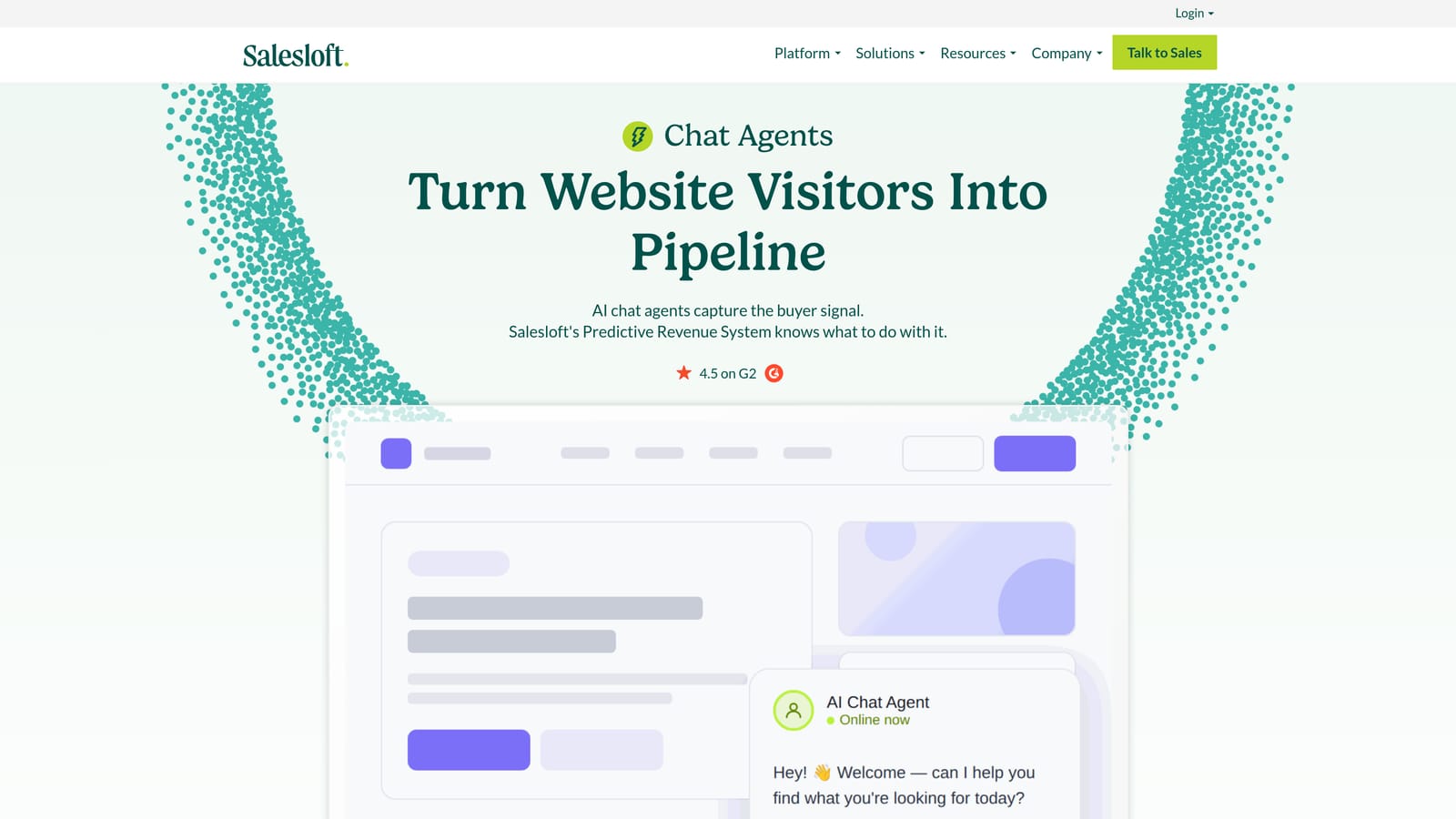
Drift, now part of Salesloft, is a conversational platform that blends support, marketing, and sales — built for B2B teams where customer conversations don't fit neatly into a single department.
Where This Tool Shines
Drift's differentiation is the overlap between support and revenue. For teams where the same chat widget handles both inbound support questions and high-intent prospect conversations, Drift's routing intelligence and CRM integrations make that overlap manageable. AI-powered qualification and meeting scheduling are baked in, not bolted on.
For teams that want pure support automation without the sales layer, Drift is likely more platform than you need. Its strength is precisely the blended use case — and if that's not your situation, simpler tools will serve you better.
Key Features
AI Chat Routing: Intelligently routes conversations based on visitor intent, account data, and defined rules.
Lead Qualification: Automated qualification flows that identify high-intent visitors and route them to sales.
Meeting Scheduling: Built-in calendar integration for booking demos directly from chat conversations.
CRM Integrations: Native connections with Salesforce, HubSpot, and Marketo for full pipeline visibility.
Unified Conversation View: Combined view of prospect and customer conversations with account context surfaced.
Best For
B2B companies where support and sales conversations share the same channel — particularly teams using Salesforce or HubSpot as their CRM and wanting chat to feed directly into pipeline reporting.
Pricing
Most plans are demo-first rather than self-serve trial. Pricing is available at drift.com — expect enterprise-oriented pricing for full AI capabilities.
7. Zoho Desk
Best for: Teams already using the Zoho ecosystem who want solid AI capabilities at a competitive price point.
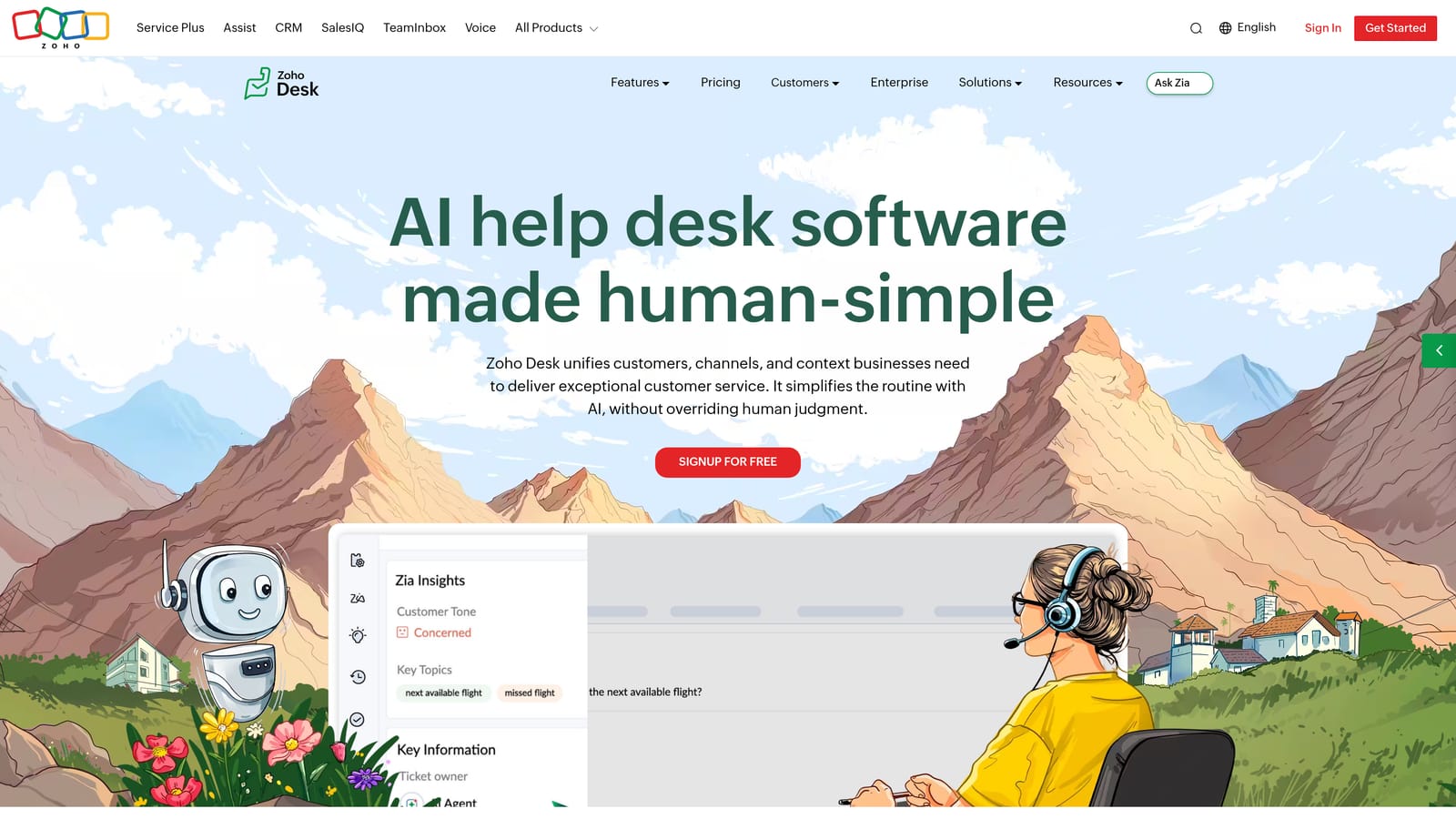
Zoho Desk is a helpdesk platform featuring Zia, Zoho's AI assistant, with sentiment analysis, ticket tagging, and anomaly detection built in — offering strong value for teams invested in the Zoho ecosystem.
Where This Tool Shines
Zia's anomaly detection is a genuinely useful capability that many platforms at this price point don't offer. When ticket volume spikes unexpectedly, Zia flags it early — giving support managers time to respond before SLAs are at risk. Combined with sentiment analysis, Zoho Desk gives teams a level of operational visibility that goes beyond basic ticket management.
The ecosystem integration is Zoho Desk's other major advantage. If you're already using Zoho CRM, Zoho Projects, or Zoho Analytics, the data sharing between products is seamless in a way that third-party integrations rarely replicate.
Key Features
Zia AI Assistant: Provides sentiment analysis, response suggestions, and automatic tag prediction to speed up agent workflows.
Ticket Volume Anomaly Detection: Flags unusual spikes in inbound volume before they escalate into SLA breaches.
Free Plan: Available for up to 3 agents with core helpdesk functionality included.
Zoho Ecosystem Integration: Deep, native connections with Zoho CRM, Projects, Analytics, and other Zoho products.
Multibrand and Multilingual Support: Manage multiple brands and languages from a single Zoho Desk instance.
Best For
Small to mid-size teams already using Zoho products, and teams that want AI-assisted support with operational intelligence (anomaly detection, sentiment analysis) at a mid-market price point.
Pricing
Free plan for up to 3 agents. Paid plans with Zia AI capabilities start at a published rate on zoho.com — verify current tier pricing before committing.
8. Help Scout
Best for: Teams where brand voice, empathy, and relationship quality are as important as resolution speed.
Help Scout is a support platform built around human-quality interactions, with AI tools designed to assist agents rather than replace them.
Where This Tool Shines
Help Scout's philosophy is different from most platforms on this list: AI is a tool for better human support, not a replacement for it. AI Drafts suggests replies based on conversation context, AI Summarize condenses long threads so agents can get up to speed instantly, and AI Answers in Docs deflects self-service questions before they become tickets. None of these features try to resolve conversations autonomously — they make agents faster and more consistent.
For teams where a generic or robotic response would actively damage the customer relationship, this approach is a feature, not a limitation. Help Scout's shared inbox also includes collision detection so two agents don't accidentally reply to the same conversation simultaneously.
Key Features
AI Drafts: Suggests agent replies based on conversation context and historical responses to maintain consistency.
AI Summarize: Condenses long conversation threads into quick summaries for faster agent context-switching.
AI Answers in Docs: Surfaces relevant documentation answers for self-service deflection before tickets are created.
Shared Inbox with Collision Detection: Prevents duplicate replies with real-time visibility into who's working on each conversation.
Beacon Chat Widget: Proactive messaging and embedded help for in-product support experiences.
Best For
Teams in industries where tone and relationship quality matter significantly: professional services, healthcare-adjacent SaaS, high-touch B2B, and companies with strong brand voice standards. Less suited for high-volume, automated-resolution use cases.
Pricing
15-day free trial available across all plans. Pricing is published at helpscout.com.
9. Kustomer
Best for: High-volume, multi-channel operations where rich customer history drives every support interaction.
Kustomer is a CRM-native support platform with AI automation across channels, built for teams managing complex, high-volume customer relationships where historical context is critical to resolution quality.
Where This Tool Shines
Kustomer's unified customer timeline is its defining feature. Every interaction across email, chat, SMS, voice, and social is surfaced in a single chronological view, with CRM data alongside it. Agents never start a conversation cold — they see the full picture before typing a word. For high-volume operations where context loss between channels is a real problem, this architecture makes a meaningful difference.
KIQ, Kustomer's AI agent, handles autonomous conversation resolution and routes complex issues to the right human with full context intact. The platform is well-suited to operations that have outgrown simpler helpdesks but need more CRM intelligence than traditional ticketing systems provide.
Key Features
Unified Customer Timeline: All interactions across every channel consolidated in a single chronological view per customer.
KIQ AI Agent: Handles autonomous conversation resolution with intelligent routing for complex escalations.
Omnichannel Coverage: Email, chat, SMS, voice, and social media managed from one platform.
AI Routing and Tagging: Automated conversation classification and assignment based on content and customer data.
Deep CRM Data Integration: Customer history, order data, and account attributes surfaced during every support interaction.
Best For
Mid-market to enterprise teams handling high conversation volume across multiple channels, particularly those where customer lifetime value makes rich historical context worth the platform investment. Less accessible for small teams or those wanting self-serve trial access.
Pricing
Kustomer typically requires a sales demo before trial access is granted. Pricing is available at kustomer.com — expect enterprise-tier investment for full platform capabilities.
Choosing the Right Tool for Your Team
The right AI customer service platform depends less on feature checklists and more on how your support operation actually works. Here's a quick framework for cutting through the options.
If you're a product-led SaaS team: Halo AI's page-aware context and business intelligence layer make it the strongest fit. The ability to connect support to your CRM, engineering workflow, and product analytics in one platform is genuinely differentiated for this use case.
If you need autonomous AI resolution at scale: Intercom's Fin agent has the most maturity here, with Kustomer worth evaluating if CRM context is equally important to resolution speed.
If budget is the primary constraint: Freshdesk's free plan and Zoho Desk's three-agent free tier are the most accessible starting points that still include meaningful AI capabilities.
If brand voice and human quality matter most: Help Scout's agent-assist approach is the right fit. It's the only platform on this list explicitly designed around augmenting human agents rather than replacing them.
If support and sales share the same conversation channel: Drift is the natural choice for B2B teams where chat handles both pipeline qualification and customer support simultaneously.
One final note on evaluation: whatever tool you trial, test it with your actual tickets and your actual edge cases. A free trial that only shows you the happy path isn't a real evaluation. The best platforms let you push them hard before you pay.
Your support team shouldn't scale linearly with your customer base. Let AI agents handle routine tickets, guide users through your product, and surface business intelligence while your team focuses on complex issues that need a human touch. See Halo in action and discover how continuous learning transforms every interaction into smarter, faster support.