9 Best AI Customer Service Platforms Reviewed for 2026
Comprehensive ai customer service platform reviews covering 9 top solutions for 2026, evaluating each on AI resolution quality, setup ease, integrations, and pricing to help B2B teams confidently choose between legacy helpdesks with bolt-on AI features and purpose-built autonomous platforms.
 Matt PattoliFounder13 min read
Choosing the right AI customer service platform has never been harder. The market is crowded with options ranging from bolt-on AI features layered onto legacy helpdesks to purpose-built AI-first platforms designed from the ground up with autonomous resolution in mind.
To help you cut through the noise, we evaluated each platform on AI resolution quality, ease of setup, integration depth, analytics capabilities, pricing transparency, and real-world suitability for B2B teams. Whether you're exploring ai support platform features for the first time or ready to graduate from basic customer service automation, this breakdown gives you the signal you need to make a confident decision.
Here are the top AI customer service platforms worth your attention in 2026.
1. Halo AI
Best for: B2B product teams that want AI-first intelligence, not an AI afterthought.
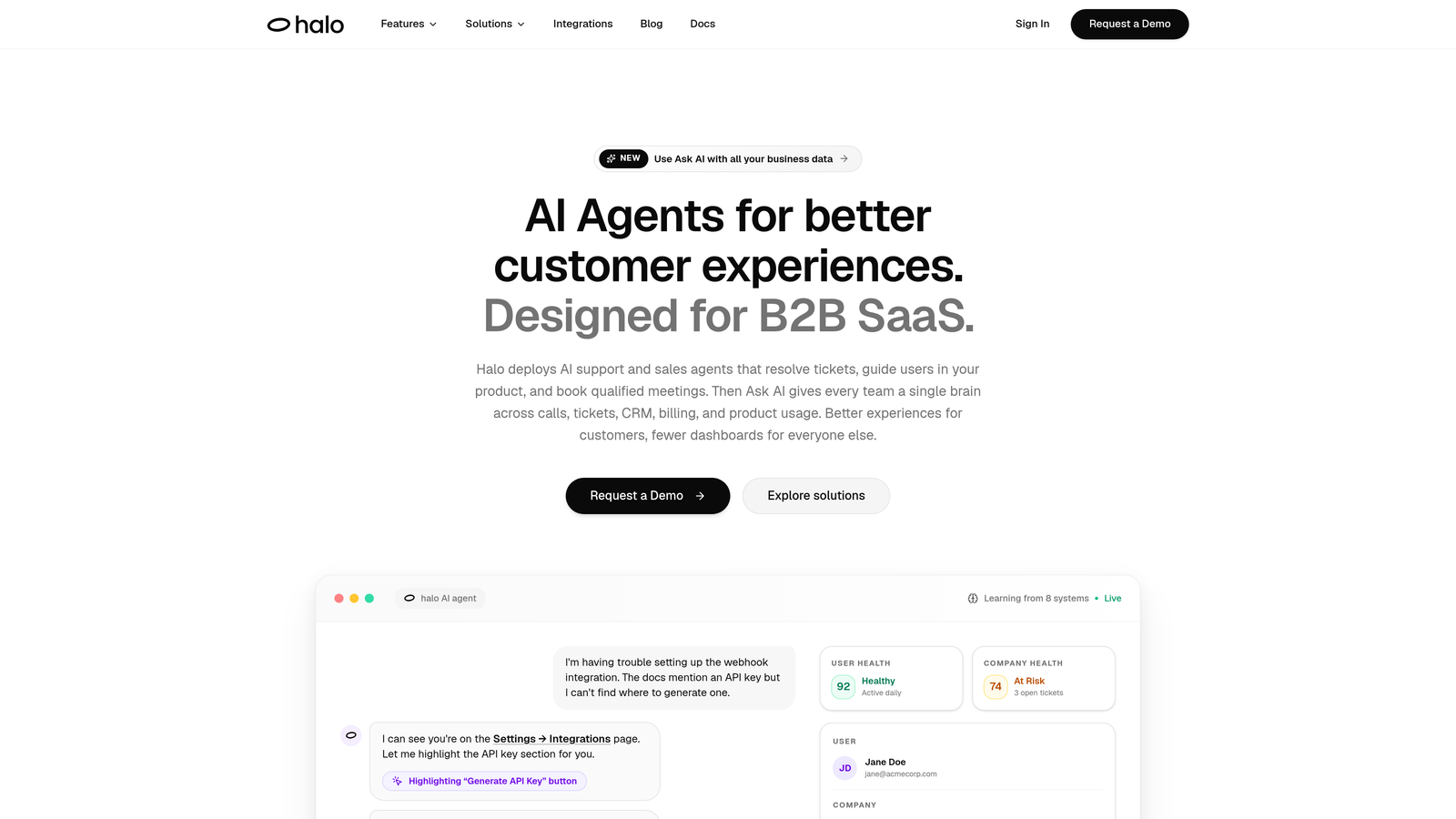
Halo AI is a purpose-built AI customer support platform that resolves tickets, guides users through your product visually, auto-creates bug reports, and surfaces business intelligence from every support interaction.
Where This Tool Shines
Most platforms treat AI as a filter in front of your human agents. Halo treats AI as the primary resolver, with humans stepping in for genuinely complex issues. That distinction matters enormously at scale. The platform learns continuously from every interaction, meaning resolution quality improves over time rather than plateauing after initial setup.
What genuinely sets Halo apart is its page-aware context engine. The AI doesn't just read a user's question; it understands what page they're on, what they're trying to do, and responds with visual, in-product guidance that matches their exact situation. For product-led B2B companies, this is a meaningful leap beyond generic chatbot responses.
Key Features
Page-Aware AI Agents: The AI sees what users see in your product, enabling contextual guidance and visual walkthroughs that generic bots simply cannot provide.
Auto Bug Ticket Creation: Integrates directly with Linear and other engineering tools to automatically generate bug reports from support patterns, closing the loop between support and product teams.
Smart Inbox with Business Intelligence: Goes beyond ticket management to surface customer health signals, revenue intelligence, and anomaly detection from support data.
Continuous Learning: Every resolved interaction trains the model, improving accuracy and resolution rates without manual retraining cycles.
Deep Integration Stack: Connects natively with Slack, HubSpot, Intercom, Stripe, Zoom, PandaDoc, and more, making it a central node in your business stack rather than an isolated support tool.
Best For
Halo is the strongest fit for B2B SaaS companies and product teams that need support AI to do more than deflect tickets. If you want your support layer to generate product insights, integrate with engineering workflows, and improve autonomously over time, this is built for that use case specifically.
Pricing
Contact for pricing. Halo is designed for B2B teams scaling support operations, so pricing is tailored to team size and resolution volume.
2. Intercom Fin
Best for: Existing Intercom customers wanting AI resolution without switching platforms.
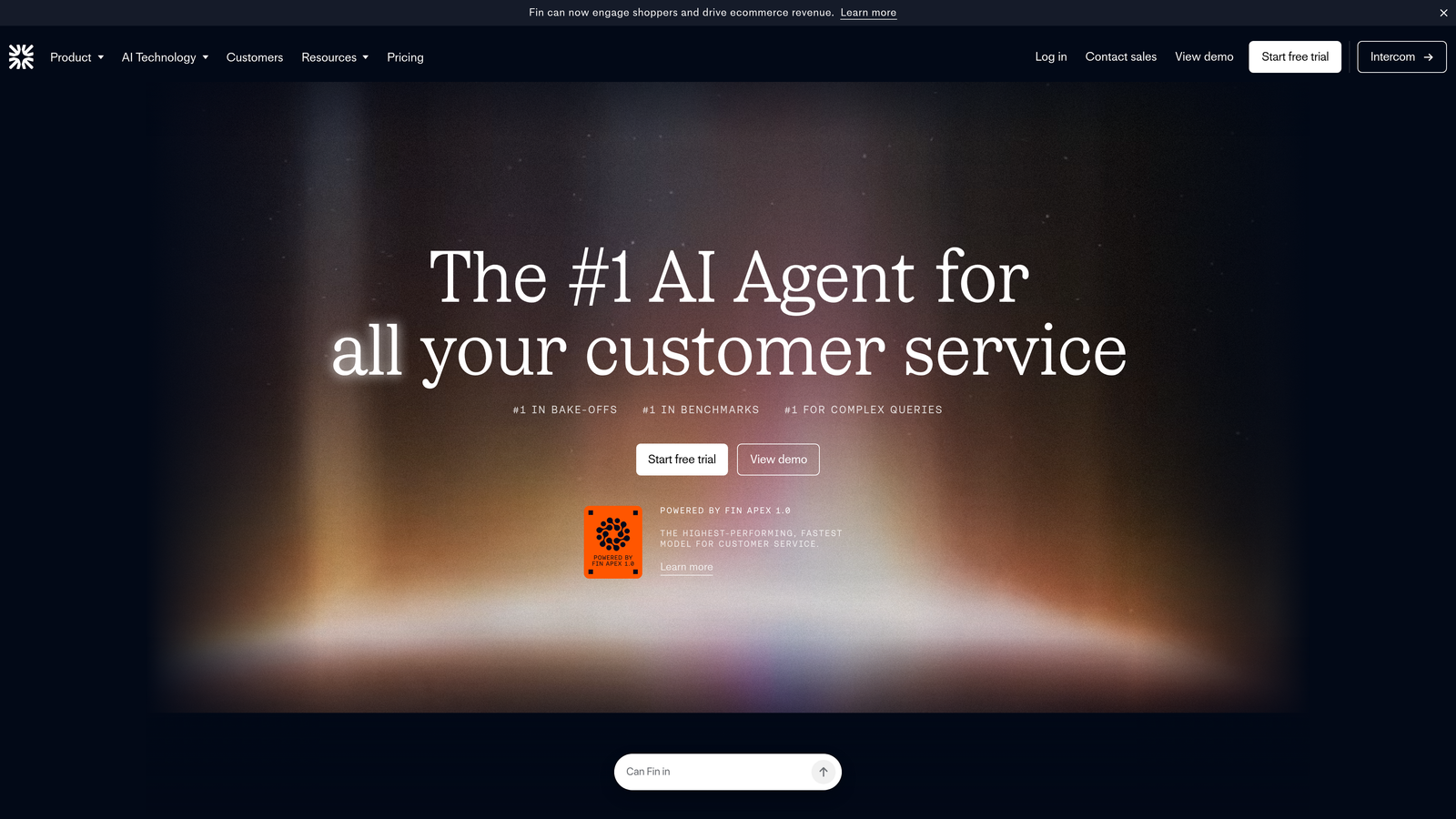
Intercom Fin is Intercom's native AI agent, trained on your help center content and conversation history to resolve customer questions within the Intercom ecosystem.
Where This Tool Shines
If your team is already deep in Intercom, Fin is the path of least resistance to AI resolution. Setup is relatively fast because it draws on content you've already created. The handoff experience is also polished: when Fin can't resolve an issue, it passes the full conversation context to a human agent seamlessly.
The trade-off is ecosystem lock-in. Fin is excellent within Intercom but doesn't extend meaningfully beyond it. Teams that need AI to integrate across their entire business stack will hit limits quickly.
Key Features
Help Center Training: Fin learns from your existing Intercom articles and past conversations, reducing the content preparation required to get started.
Native Messenger Integration: Works directly inside the Intercom messenger, inbox, and workflow tools without additional configuration.
Tone and Persona Customization: Lets you adjust Fin's communication style to match your brand voice.
Contextual Human Handoff: Transfers full conversation history to live agents so customers never have to repeat themselves.
Best For
Teams already using Intercom as their primary support and messaging platform who want to add AI resolution without migrating to a new system. Less ideal for teams needing cross-platform intelligence or engineering integrations.
Pricing
Fin charges per resolution, typically around $0.99 per resolved conversation, on top of your existing Intercom subscription. Costs can scale quickly at high volumes.
3. Zendesk AI
Best for: Large enterprise support teams with complex routing and compliance needs.
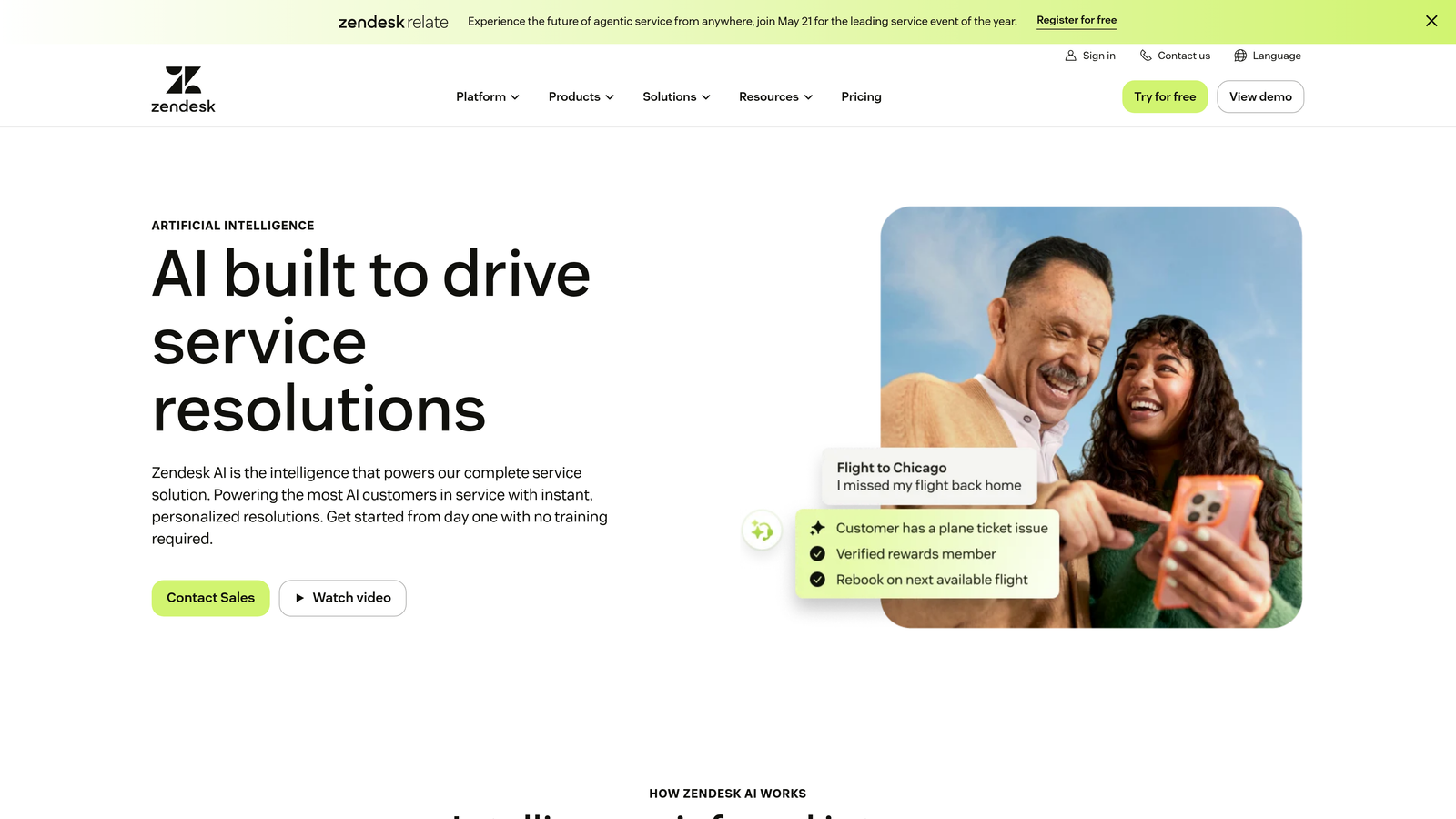
Zendesk AI is a suite of AI capabilities layered across the Zendesk platform, covering intelligent triage, generative replies, agent assist, and knowledge base management for enterprise-scale operations.
Where This Tool Shines
Zendesk's strength is breadth. The AI features touch every part of the support workflow: tickets are classified automatically on arrival, agents receive suggested replies in real time, and knowledge gaps are flagged proactively. For large teams managing thousands of tickets daily across multiple channels, that coverage is genuinely valuable.
The enterprise-grade security and compliance controls also matter for regulated industries. If your procurement team has a checklist of compliance requirements, Zendesk typically checks most of them.
Key Features
Intelligent Triage: Automatically classifies ticket intent, language, and sentiment to route issues to the right team or queue.
Generative AI Replies: Suggests complete draft responses for agents based on ticket content and knowledge base material.
Agent Assist: Surfaces relevant articles and macros in real time as agents work through tickets.
AI-Powered Knowledge Management: Identifies content gaps and flags articles that may need updating based on ticket patterns.
Best For
Enterprise support organizations with established Zendesk implementations, large agent teams, and compliance requirements. The AI features are additive to an existing Zendesk investment rather than a reason to choose Zendesk from scratch.
Pricing
AI features are included in Suite plans starting around $55 per agent per month. An advanced AI add-on is available for teams needing deeper capabilities beyond the base suite.
4. Freshdesk Freddy AI
Best for: Mid-market teams wanting AI-assisted support at competitive pricing within the Freshworks ecosystem.
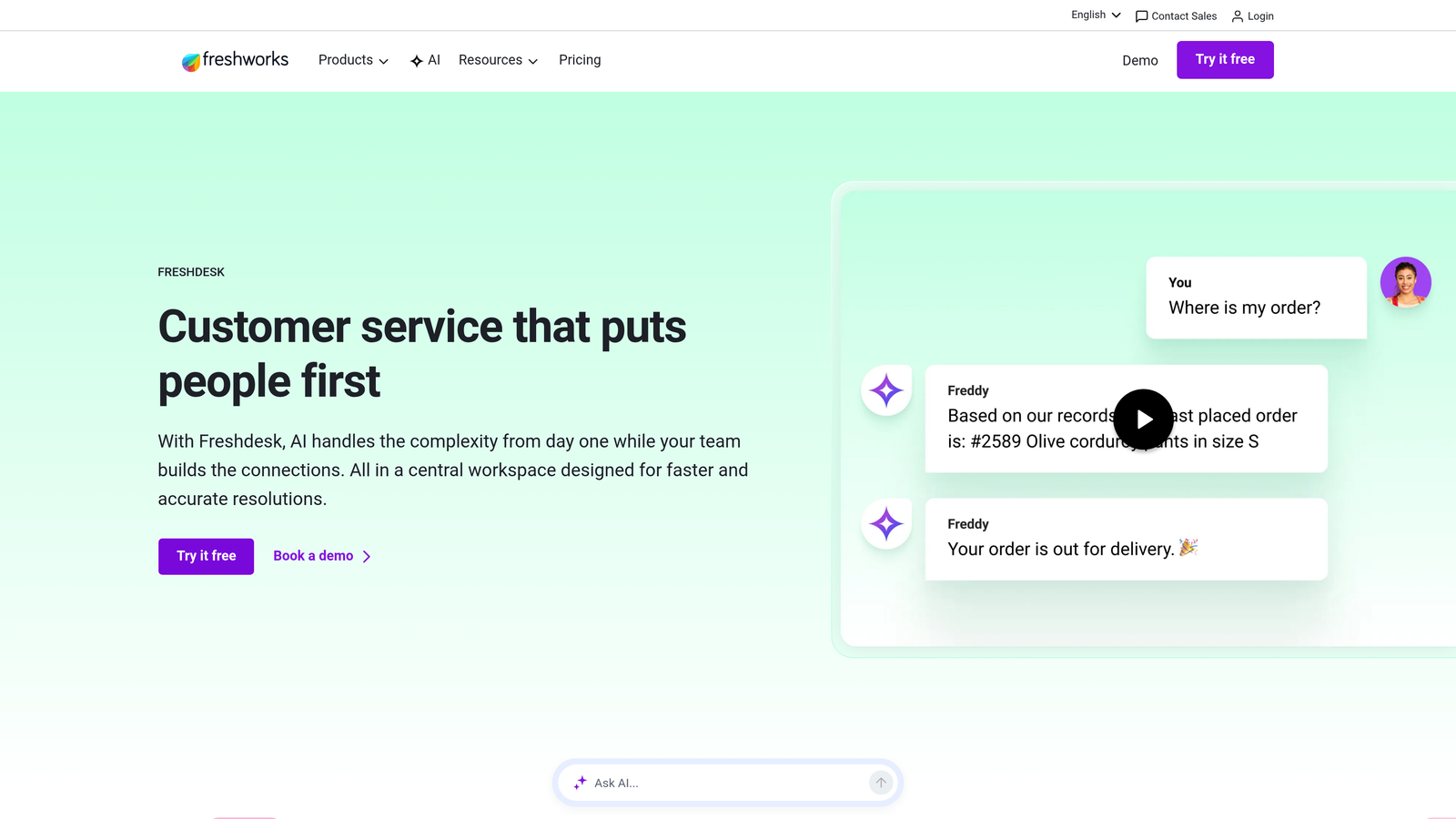
Freshdesk Freddy AI is Freshworks' embedded AI engine, offering agent copilot capabilities, self-service automation, and cross-suite data visibility at pricing that suits growing teams.
Where This Tool Shines
Freshdesk's value proposition is solid AI functionality without the enterprise price tag. Freddy AI handles agent-assist tasks well, including auto-generating responses and surfacing relevant knowledge base articles, making agents meaningfully faster without requiring a full AI-first architectural shift.
Teams already using Freshworks products across sales, marketing, and support benefit from a unified data view that competing point solutions can't easily replicate.
Key Features
Freddy AI Copilot: Assists agents with auto-generated response drafts and contextual knowledge suggestions during live ticket handling.
Self-Service Bots: Deploys AI-powered bots across web and messaging channels for first-contact resolution without agent involvement.
Unified Freshworks View: Connects support data with sales and marketing activity across the Freshworks suite for a fuller customer picture.
Accessible Pricing Tiers: AI features are bundled into mid-tier plans, avoiding the steep add-on costs common with enterprise alternatives.
Best For
Growing mid-market companies that want capable AI assistance without committing to enterprise-level spend, particularly those already using Freshworks products elsewhere in their business.
Pricing
Free tier available for basic use. The Pro plan with Freddy AI starts around $49 per agent per month, making it one of the more accessible options on this list.
5. Ada
Best for: Enterprise teams needing no-code AI automation across multiple channels with strict compliance requirements.
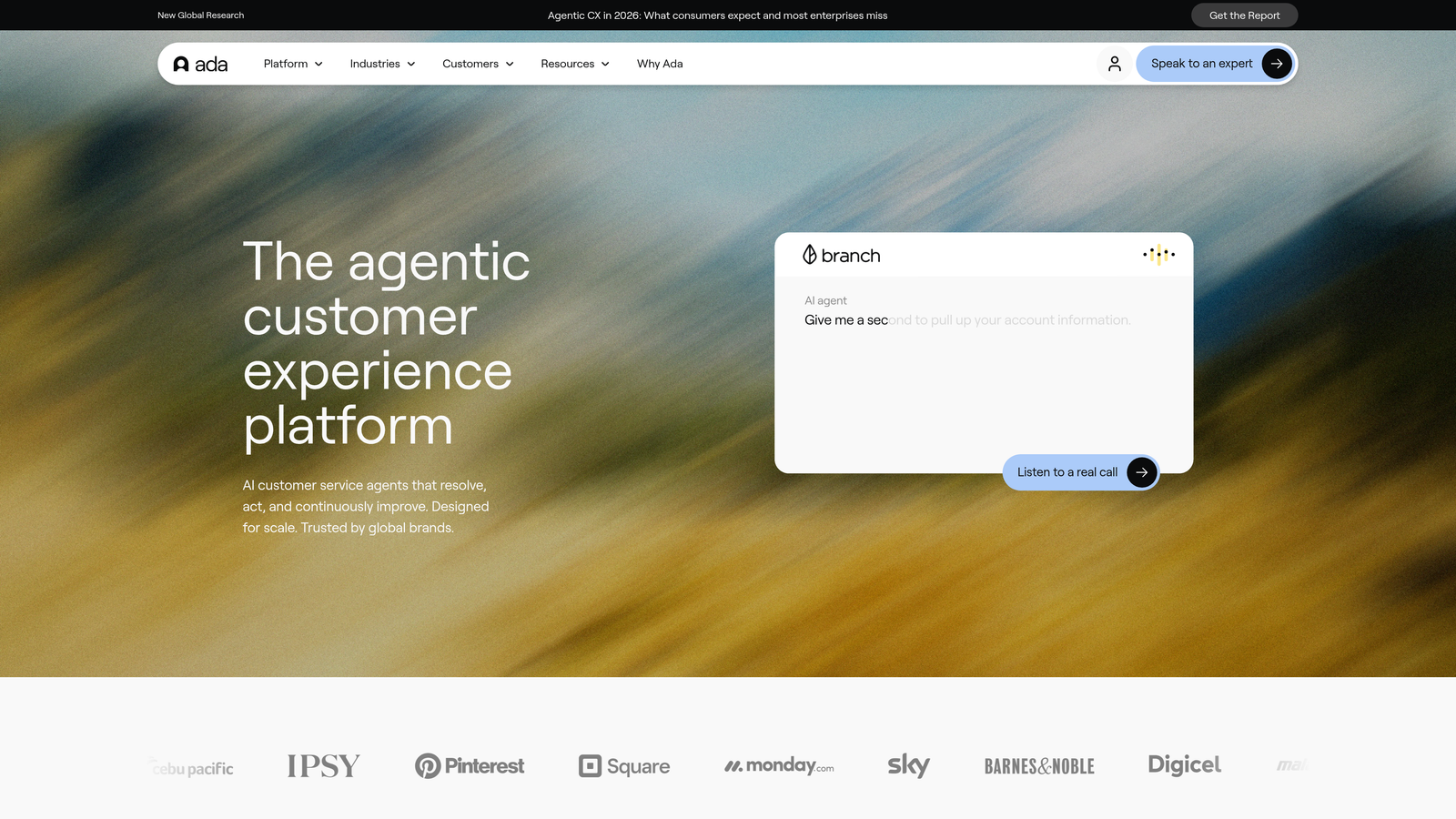
Ada is an enterprise AI automation platform built for customer service, featuring a no-code conversation builder and multi-channel deployment across web, mobile, social, SMS, and email.
Where This Tool Shines
Ada's no-code builder is genuinely powerful. Non-technical teams can design sophisticated conversation flows, set guardrails for brand-safe generative responses, and deploy across multiple channels without engineering involvement. That operational independence is a significant advantage for large support organizations with limited developer resources.
The enterprise compliance posture, including SOC 2 certification and HIPAA-eligible configurations, makes Ada a viable option for healthcare, financial services, and other regulated sectors where many AI platforms fall short.
Key Features
No-Code Automation Builder: Enables support teams to design complex, branching conversation flows without writing code.
Multi-Channel Deployment: Delivers consistent AI experiences across web, mobile apps, social platforms, SMS, and email from a single configuration.
Generative AI with Guardrails: Uses generative AI for natural responses while maintaining brand safety through configurable guardrails.
Enterprise Compliance: SOC 2 certified and HIPAA-eligible, addressing requirements that block many AI tools from regulated industry procurement.
Best For
Large enterprises with multi-channel support needs, compliance requirements, and non-technical teams who need to own and iterate on automation without depending on developers.
Pricing
Custom enterprise pricing. Contact Ada directly for quotes based on your channel footprint and resolution volume.
6. Tidio
Best for: Small businesses and e-commerce teams wanting fast, affordable AI chat automation.
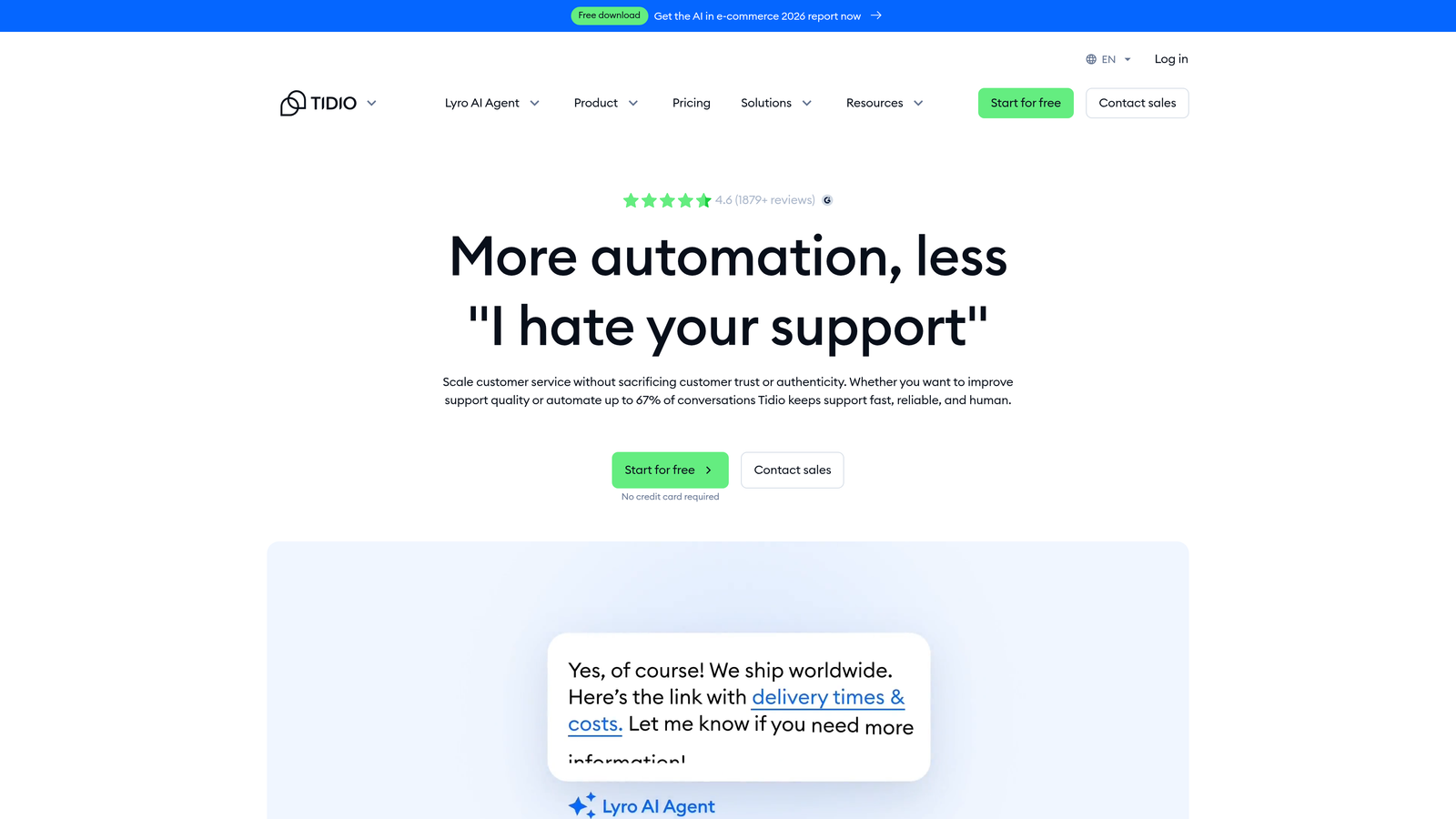
Tidio is an SMB-friendly AI chatbot and live chat platform featuring Lyro AI, designed for quick setup and accessible pricing with strong e-commerce integrations.
Where This Tool Shines
Tidio removes the friction that typically blocks small teams from deploying AI support. The Lyro AI chatbot trains on your existing FAQ content and help documentation, meaning you can go from signup to live AI conversations quickly without a complex onboarding process.
The combined live chat and AI bot in a single widget is a practical choice for small teams that don't want to manage separate tools for human and automated conversations.
Key Features
Lyro AI Chatbot: Trains on your FAQ and help content to answer customer questions autonomously with minimal setup time.
Pre-Built Templates: Offers ready-made chatbot flows for common use cases, reducing the time needed to build from scratch.
Unified Live Chat and AI: Combines human and AI chat in a single widget so agents can step in seamlessly when needed.
E-Commerce Integrations: Native integrations with Shopify, WooCommerce, and BigCommerce make it a natural fit for online retail teams.
Best For
Small businesses, e-commerce brands, and early-stage teams that need functional AI chat without enterprise complexity or budget. Not the right fit for B2B SaaS teams needing deep integrations or business intelligence.
Pricing
Free plan available for basic live chat. The Lyro AI add-on starts from around $39 per month, making it one of the most affordable AI chat options available.
7. Forethought
Best for: Support teams focused on intelligent triage, ticket deflection, and agent productivity at scale.
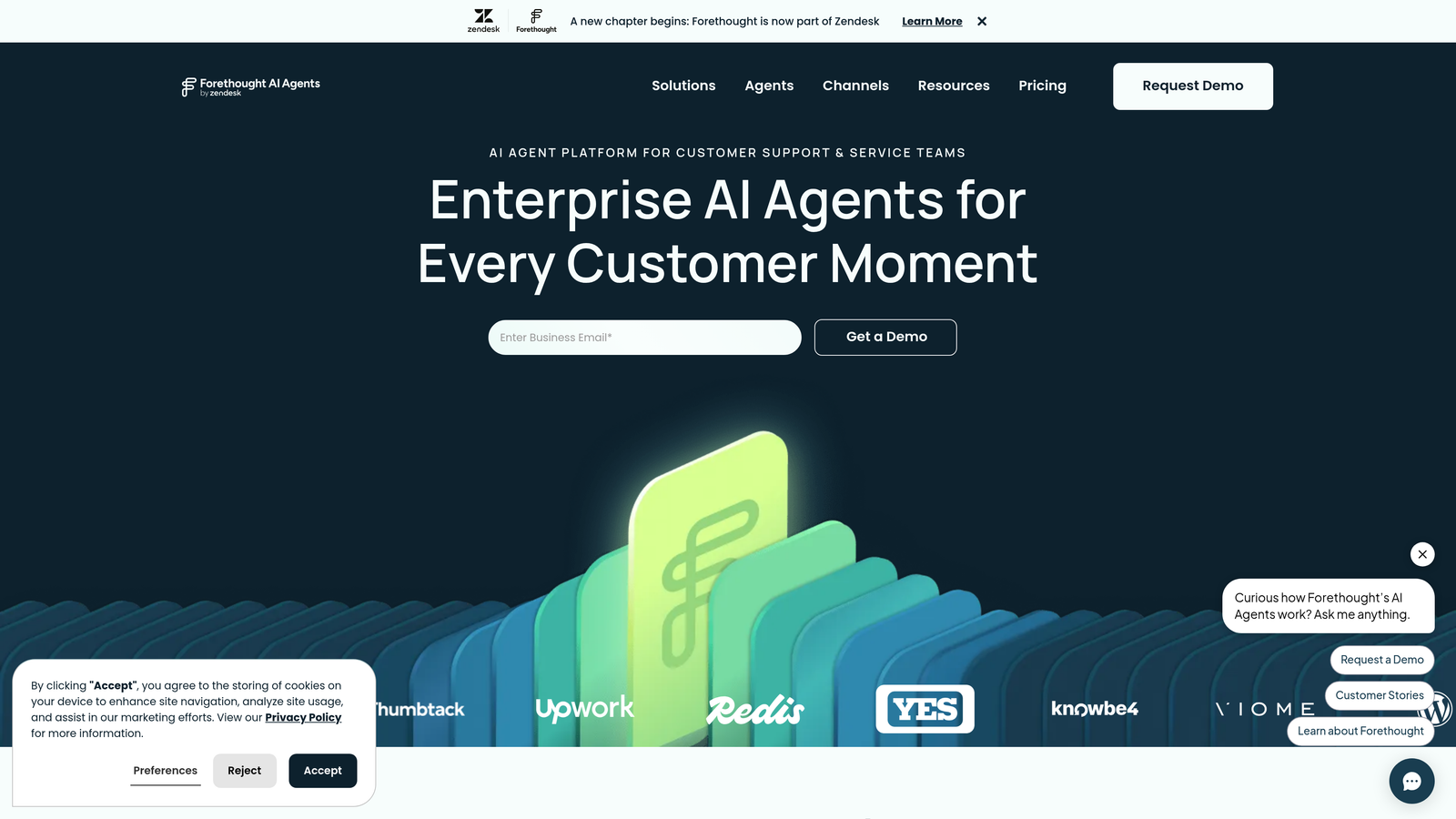
Forethought is an AI support platform built around SupportGPT technology, combining autonomous ticket resolution with smart triage and agent assist to reduce handle time and improve routing accuracy.
Where This Tool Shines
Forethought's triage engine is one of its strongest differentiators. Rather than treating all incoming tickets equally, it intelligently classifies, prioritizes, and routes issues before a human agent ever touches them. For high-volume support teams drowning in repetitive tickets, that upstream intelligence creates meaningful efficiency gains.
The SupportGPT layer adds generative resolution capability for common ticket types, handling straightforward questions autonomously while escalating complex or sensitive issues with full context intact.
Key Features
SupportGPT Resolution: Uses generative AI to autonomously resolve common ticket types based on your knowledge base and historical resolution data.
Intelligent Triage and Routing: Classifies and prioritizes incoming tickets automatically, directing them to the right queue or agent based on intent and urgency.
Agent Assist: Surfaces suggested responses and relevant knowledge articles in real time to help agents resolve tickets faster.
Workflow Automation: Automates repetitive ticket handling workflows to reduce manual processing for predictable issue types.
Best For
Mid-market to enterprise support teams with high ticket volumes and a strong focus on deflection rates, triage accuracy, and agent efficiency metrics.
Pricing
Custom pricing based on ticket volume. Contact Forethought directly for a quote tailored to your support operation's scale.
8. Kustomer
Best for: Teams that want CRM-native AI with full customer history context in every interaction.
Kustomer is a CRM-powered customer service platform with AI layered on a unified customer timeline, giving both AI agents and human agents complete interaction history across every channel and data source.
Where This Tool Shines
Most support platforms treat CRM data as something you integrate separately. Kustomer builds CRM capabilities directly into the platform, meaning every AI decision and agent response is informed by a complete picture of who the customer is, what they've purchased, and how they've interacted previously. That context depth is hard to replicate with bolt-on integrations.
The omnichannel coverage is also strong. Email, chat, social, SMS, and voice all feed into the same unified timeline, preventing the fragmented customer view that plagues teams using multiple disconnected tools.
Key Features
Unified Customer Timeline: Aggregates every interaction, transaction, and data point into a single customer view accessible to AI and human agents alike.
AI Classification and Routing: Automatically classifies incoming conversations and routes them based on customer history and issue type.
Built-In CRM: Eliminates the need for a separate customer data platform by housing CRM functionality natively within the support tool.
Omnichannel Support: Handles email, chat, social, SMS, and voice in one unified interface without requiring separate channel tools.
Best For
Customer-centric businesses where full interaction history and customer data context are critical to support quality, particularly in retail, e-commerce, and high-touch B2C environments.
Pricing
Enterprise plan starts around $89 per user per month. Pricing reflects the combined CRM and support platform capabilities bundled into a single product.
9. Drift (Salesloft)
Best for: Revenue-focused teams that want AI to handle both support and sales qualification in one flow.
Drift, now part of the Salesloft platform, is a conversational AI tool that sits at the intersection of customer support and sales engagement, combining automated support resolution with buyer intent detection and lead qualification.
Where This Tool Shines
Drift occupies a unique position on this list because it's not purely a support tool. It's built for teams where the line between support and sales is blurry, such as SaaS companies where prospects and customers often come through the same chat channel. The ability to qualify leads, book meetings, and route buyers to sales reps within the same conversation flow that handles support requests is genuinely differentiated.
For teams already using Salesloft for sales engagement, the integration creates a more connected revenue workflow than any standalone support platform can offer.
Key Features
Conversational AI for Support and Sales: Handles support queries and sales qualification within a single conversation flow, reducing the need for separate tools.
Meeting Booking and Lead Routing: Automatically books meetings and routes qualified leads to the right sales rep based on intent signals.
Buyer Intent Scoring: Detects engagement signals and buying intent to prioritize high-value conversations for human follow-up.
CRM and Sales Tool Integrations: Connects with CRMs and sales engagement platforms to keep revenue data synchronized across the stack.
Best For
B2B companies where support and sales overlap significantly, particularly those using Salesloft for outbound sales who want to unify inbound conversation handling under one platform.
Pricing
Custom pricing as part of the Salesloft platform. Contact Salesloft for bundled quotes that include Drift alongside other platform components.
Which Platform Is Right for Your Team?
The right choice depends heavily on where you sit in the market and what you need AI to actually do for your business.
If you're a B2B SaaS or product-led company that wants AI to resolve tickets, guide users through your product, flag bugs automatically, and surface intelligence about customer health and revenue signals, Halo AI is purpose-built for exactly that use case. It's the platform on this list that treats AI as the primary operator, not a feature bolted onto an existing helpdesk.
For teams already committed to specific ecosystems, the calculus shifts. Intercom Fin is the natural upgrade path for Intercom-heavy teams. Zendesk AI makes sense if you're enterprise-scale and deeply invested in the Zendesk suite. Freshdesk Freddy AI delivers solid AI assist at mid-market pricing for Freshworks customers. And Tidio remains the friendliest entry point for small businesses and e-commerce teams working with limited budgets.
Ada and Forethought are worth evaluating if enterprise compliance requirements or high-volume triage are your primary drivers. Kustomer shines when CRM-native context is non-negotiable. Drift is the outlier: best suited to teams where support and revenue generation genuinely overlap.
One practical recommendation: trial before you commit. Pricing models across this category vary significantly, from per-resolution billing to per-seat subscriptions to bundled suite pricing, making cost comparisons genuinely difficult without running real ticket volumes through each system.
Your support team shouldn't scale linearly with your customer base. Let AI agents handle routine tickets, guide users through your product, and surface business intelligence while your team focuses on complex issues that need a human touch. See Halo in action and discover how continuous learning transforms every interaction into smarter, faster support.