9 Best AI Customer Service Platforms Compared for 2026
This comprehensive guide has the leading ai customer service platforms compared across six critical dimensions — including AI resolution quality, integration depth, and pricing transparency — helping SaaS teams and enterprise operations identify the right solution for their specific needs and budget in 2026.
 Grant CooperFounder13 min read
Choosing the right AI customer service platform has never been more consequential — or more confusing. The market has exploded with options ranging from bolt-on chatbots layered onto legacy helpdesks to fully autonomous AI agents built from the ground up. For growing SaaS teams drowning in support tickets and enterprise operations looking to scale without ballooning headcount, the stakes are high and the differences between platforms are significant.
We evaluated the leading platforms across six key dimensions: AI resolution quality, integration depth, learning and improvement capabilities, deployment complexity, pricing transparency, and channel coverage. What follows are the top AI customer service platforms worth your attention in 2026, broken down so you can find the right fit for your team's specific needs and budget.
1. Halo AI
Best for: SaaS teams wanting an AI-first platform that learns continuously and delivers business intelligence beyond basic support.
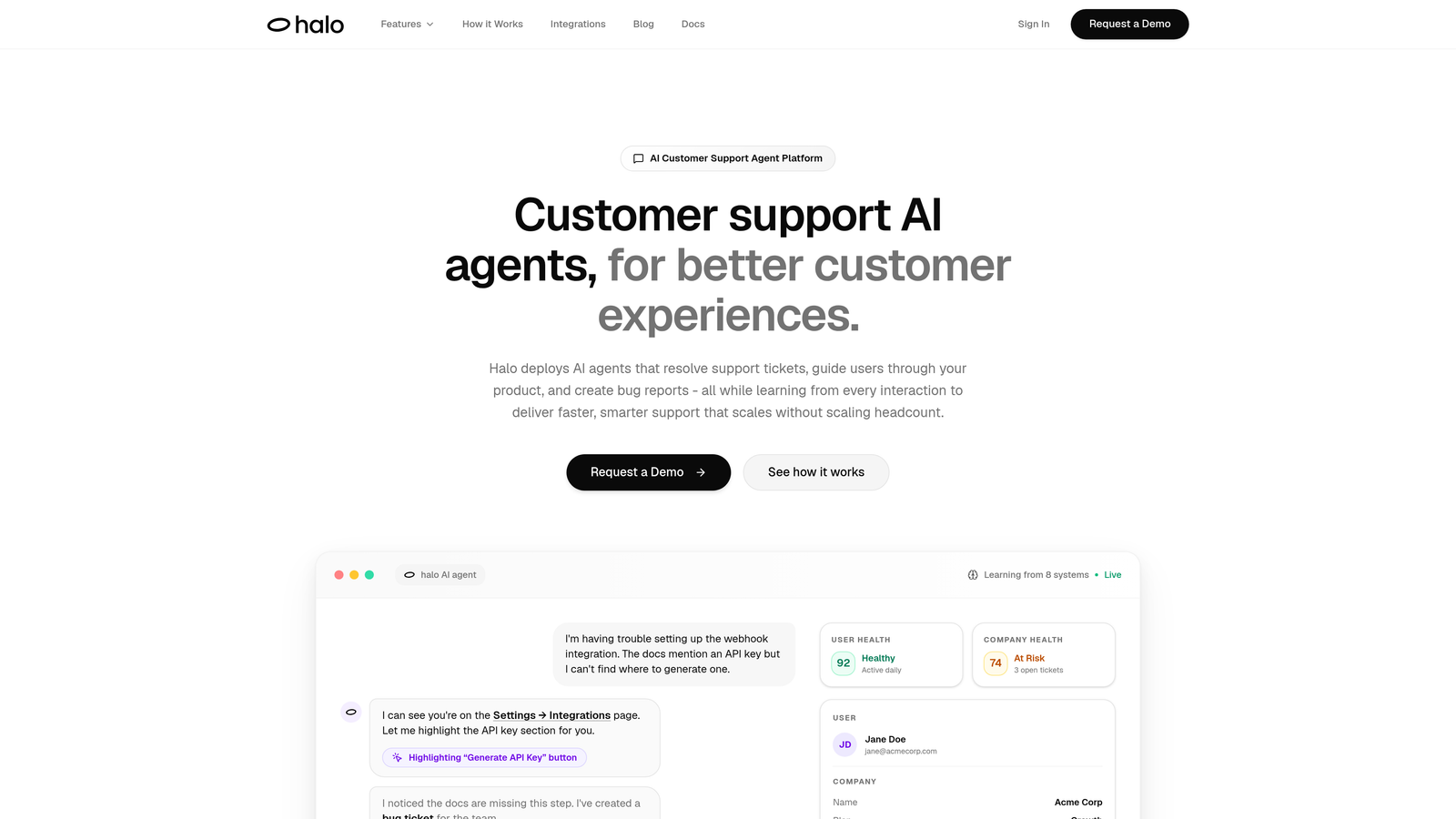
Halo AI is an AI-native customer support platform with autonomous agents that resolve tickets, guide users visually through your product, and surface business intelligence from every interaction.
Where This Tool Shines
What separates Halo from the crowded field is its page-aware architecture. The AI agent doesn't just respond to text queries — it sees what the user sees, providing contextual visual guidance based on exactly where someone is in your product. That's a meaningful leap beyond generic FAQ-matching chatbots.
The continuous learning engine is another genuine differentiator. Rather than requiring manual retraining cycles, Halo improves its resolution quality with every interaction. Over time, the platform doesn't just maintain performance — it compounds it. Combined with a smart inbox that surfaces customer health signals and anomaly detection, Halo positions support as a strategic intelligence layer, not just a cost center.
Key Features
Page-Aware AI Agents: The AI understands the user's current product context, delivering guidance that's relevant to exactly where they are rather than generic responses.
Continuous Learning: Every resolved ticket, escalation, and interaction feeds back into the model, steadily improving resolution accuracy without manual intervention.
Smart Inbox with Business Intelligence: Surfaces customer health signals, revenue intelligence, and anomaly detection alongside standard support metrics.
Auto Bug Ticket Creation: Automatically generates bug reports and routes them to Linear, Slack, or other dev tools, closing the loop between support and engineering.
Live Agent Handoff: Seamlessly escalates complex issues to human agents with full conversation context preserved, so nothing gets repeated.
Best For
Halo is purpose-built for B2B SaaS companies that want AI to do more than deflect tickets. If your team needs contextual product guidance, integration with your dev and revenue stack, and support intelligence that informs the whole business, Halo is worth a close look.
Pricing
Contact for pricing. Halo offers plans for growing SaaS teams through enterprise-level deployments, with scope based on team size and integration requirements.
2. Intercom Fin
Best for: Teams already on Intercom who want native AI resolution without switching platforms.
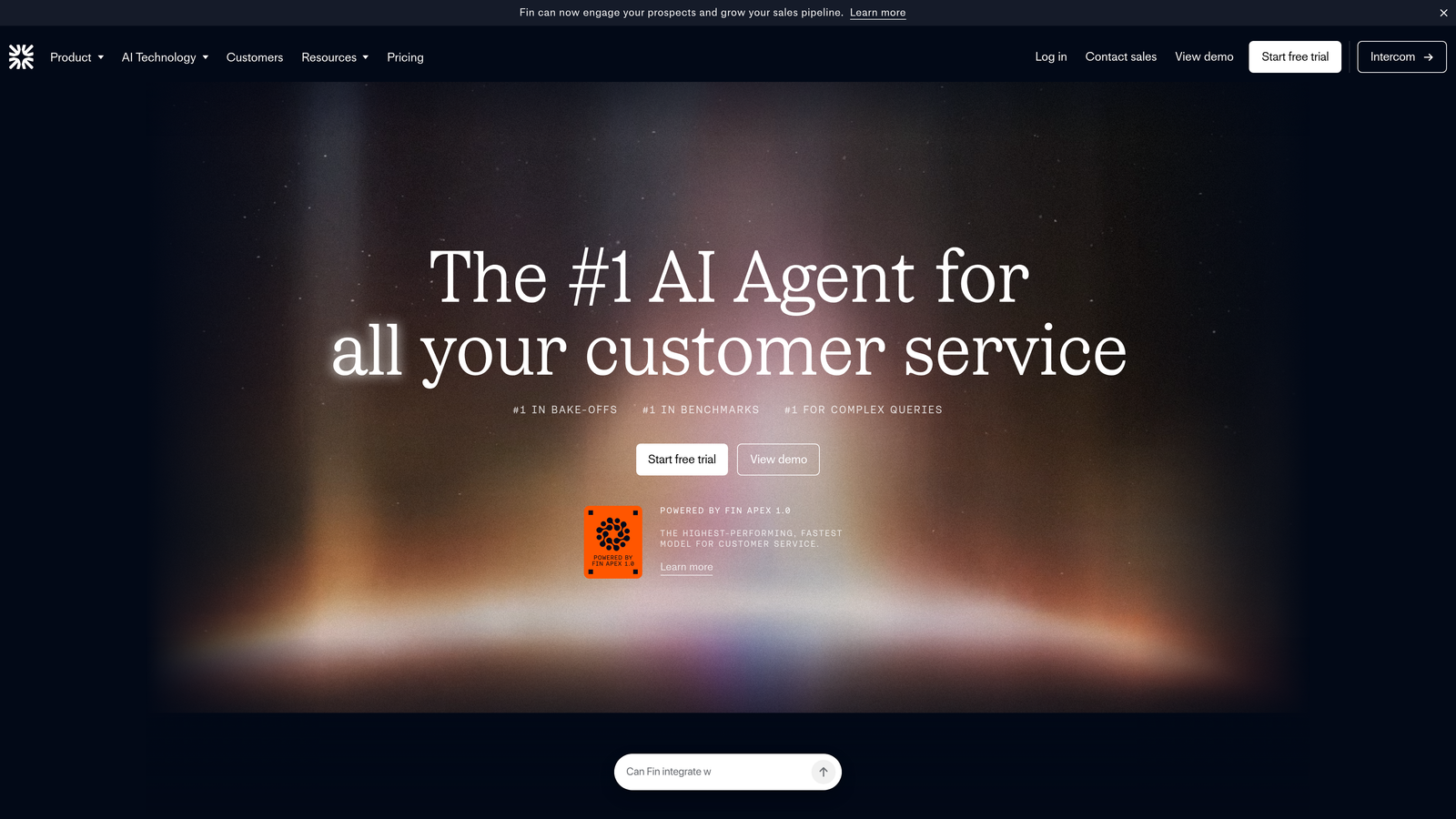
Intercom Fin is Intercom's native AI agent that resolves customer questions using your help center content and conversation history.
Where This Tool Shines
Fin's biggest advantage is how naturally it fits into the Intercom ecosystem. If your team already uses Intercom for conversations, Fin slots in without disruption. It draws directly from your existing help center articles and past conversations, which means deployment can be fast for teams with well-maintained content libraries.
The handoff experience is particularly smooth. When Fin can't resolve something, the transition to a human agent happens within the same messenger thread, preserving context and avoiding the jarring experience of being bounced between systems.
Key Features
Help Center Grounding: Answers are sourced directly from your Intercom articles and historical conversations, keeping responses accurate and on-brand.
Seamless Human Handoff: Escalations happen within the same messenger thread, maintaining full conversation context for the agent taking over.
Tone and Persona Customization: Adjust Fin's communication style to match your brand voice.
Usage-Based Pricing: You pay per successful resolution rather than a flat per-agent fee, which can be cost-effective at lower volumes.
Best For
Existing Intercom customers who want to add AI resolution quickly without a platform migration. Less ideal for teams outside the Intercom ecosystem or those needing deep product-context awareness.
Pricing
Starts at $0.99 per resolution on top of your existing Intercom subscription. Costs scale with resolution volume, so high-traffic teams should model this carefully.
3. Zendesk AI
Best for: Enterprise teams with established Zendesk workflows seeking AI-enhanced ticketing and agent productivity.
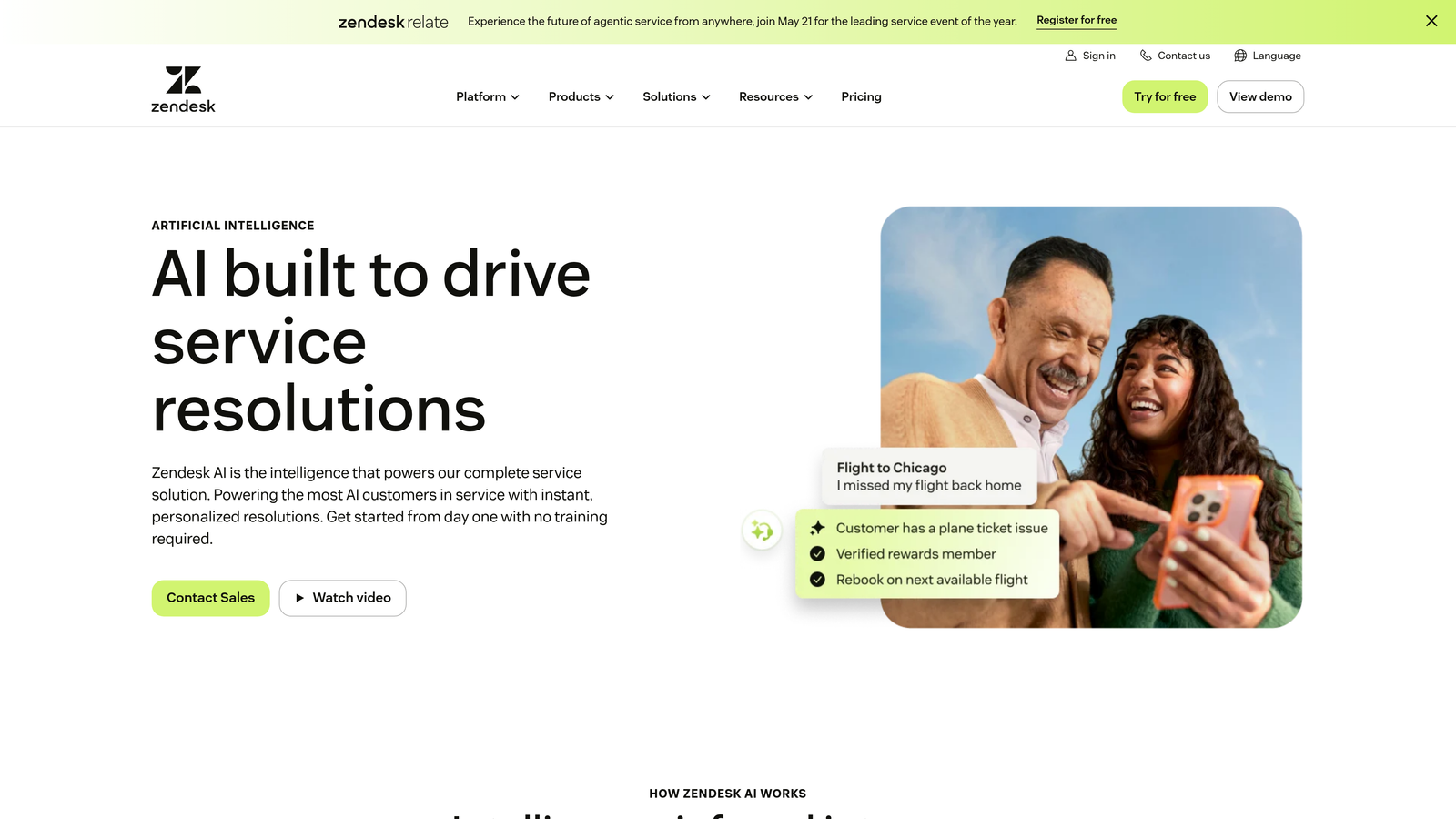
Zendesk AI is a suite of enterprise-grade AI capabilities layered into Zendesk's ticketing platform, covering everything from intelligent triage to generative agent assist.
Where This Tool Shines
Zendesk AI benefits from being pre-trained on an enormous dataset of customer service interactions. The intent detection and ticket routing are mature and reliable, making it a strong fit for high-volume operations where accurate triage is critical.
For agent productivity, the assist features are genuinely useful: suggested replies, knowledge surfacing, and ticket summaries reduce the cognitive load on human agents handling complex queues. Generative AI for tone adjustment is a nice touch for teams managing brand consistency across large agent teams.
Key Features
AI-Powered Intent Detection: Classifies and routes tickets based on content, reducing manual triage time significantly.
Agent Assist: Surfaces relevant knowledge articles and suggests replies in real time as agents work tickets.
Pre-Trained on CX Data: Zendesk's model benefits from training on billions of customer service interactions across industries.
Generative AI Summaries: Automatically summarizes long ticket threads and adjusts tone for outbound responses.
Advanced Analytics: Robust reporting on AI performance, resolution rates, and agent productivity.
Best For
Large enterprise teams already invested in the Zendesk ecosystem. The AI capabilities are most valuable when layered onto existing Zendesk workflows rather than as a standalone AI-first solution.
Pricing
AI features are included in Suite Professional at $115 per agent per month and above. An Advanced AI add-on is available for teams needing deeper capabilities.
4. Ada
Best for: High-volume brands needing omnichannel AI automation with strong multilingual support.
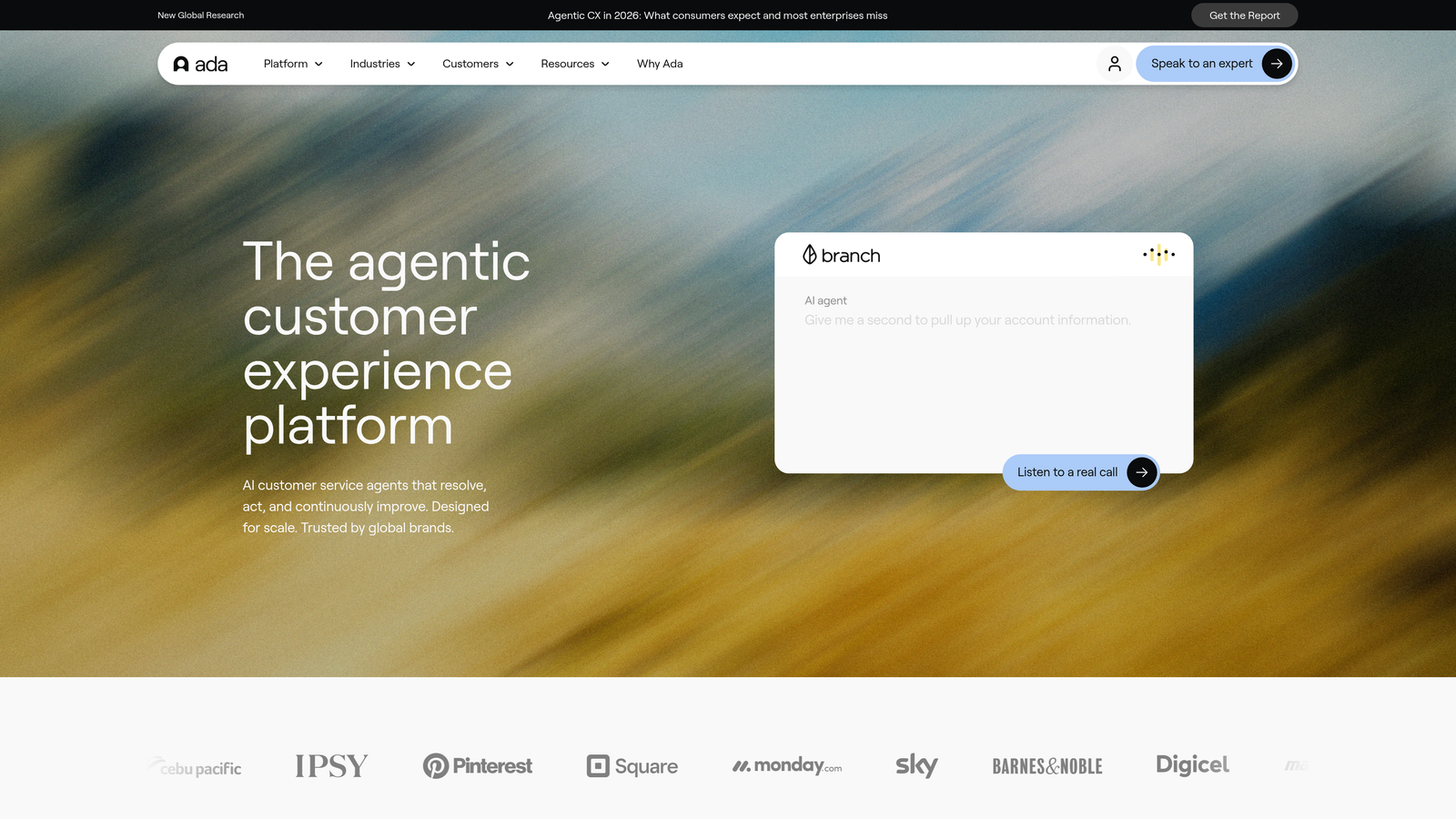
Ada is an AI-powered customer service automation platform built for scale, with no-code bot building and broad channel coverage across 50-plus languages.
Where This Tool Shines
Ada's no-code builder makes it accessible to support operations teams without engineering resources. The drag-and-drop conversation flow designer lets teams build and iterate on automated experiences quickly, which matters when customer needs evolve and you can't wait on a development queue.
For global brands, Ada's multilingual capabilities are a genuine differentiator. Supporting more than 50 languages out of the box removes a significant barrier for companies serving international customer bases across multiple channels simultaneously.
Key Features
No-Code Bot Builder: Drag-and-drop interface for building conversation flows without engineering involvement.
50+ Language Support: Native multilingual capabilities for global customer bases without requiring separate deployments per language.
Omnichannel Deployment: Consistent experience across web, mobile, social media, and SMS from a single platform.
Generative AI Responses: Grounded answers generated from your knowledge base for accurate, contextual replies.
CRM and Helpdesk Integrations: Connects with major platforms to pull customer data into conversations.
Best For
Mid-market to enterprise brands with global audiences and high support volumes across multiple channels. Ada works well for teams that prioritize operational independence from engineering for bot management.
Pricing
Custom pricing; typically positioned at mid-market to enterprise tiers. Contact Ada directly for a quote based on volume and channel requirements.
5. Freshdesk Freddy AI
Best for: Budget-conscious teams wanting AI-enhanced helpdesk capabilities without enterprise price tags.
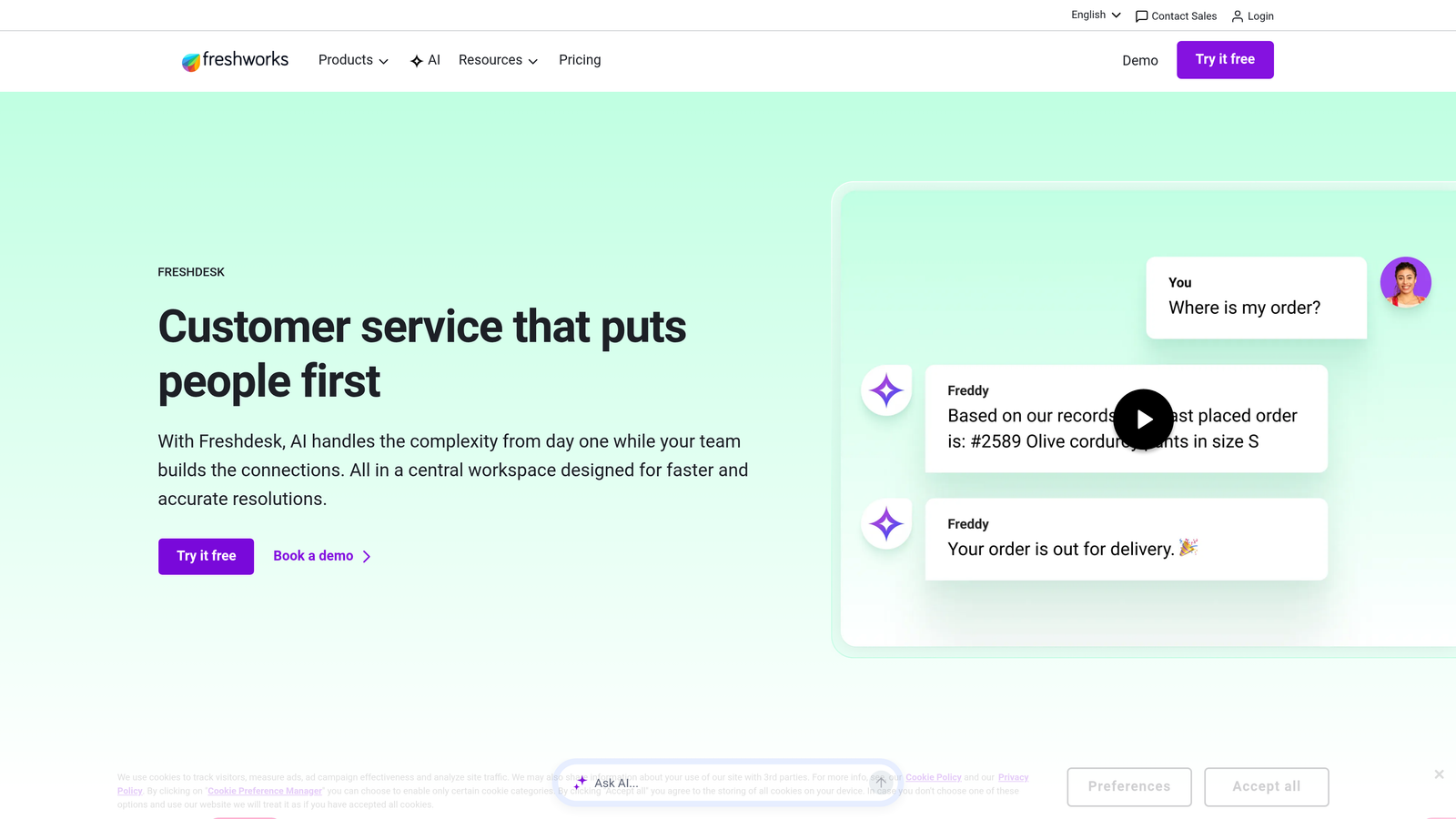
Freshdesk Freddy AI is Freshworks' embedded AI assistant that brings chatbot automation and agent productivity tools to one of the most accessible helpdesk platforms on the market.
Where This Tool Shines
Freshdesk's value proposition has always been strong per-dollar performance, and Freddy AI extends that tradition. The AI features are built into the existing Freshdesk interface rather than bolted on as a separate module, which keeps the learning curve manageable for teams already familiar with the platform.
The thank-you detector is a small but practically useful feature: it prevents resolved tickets from being inadvertently reopened when customers reply with a simple "thanks," which is a surprisingly common friction point in support operations.
Key Features
Freddy AI Chatbot: Handles automated customer responses using your knowledge base content before routing to human agents.
AI Ticket Field Suggestions: Recommends ticket categorization and canned responses to speed up agent workflows.
Thank You Detector: Prevents tickets from reopening when customers send simple acknowledgment replies after resolution.
Omnichannel Coverage: Supports email, chat, phone, and social from within a single platform.
Accessible Pricing: AI features available at price points well below enterprise alternatives.
Best For
Small to mid-sized teams that need solid AI-assisted support without committing to enterprise-level budgets. A good starting point for teams newer to AI-powered support operations.
Pricing
Free tier available. The Pro plan at $49 per agent per month includes Freddy AI features. One of the more accessible entry points in this comparison.
6. Tidio
Best for: Small businesses and e-commerce teams wanting simple AI chat automation with minimal setup.
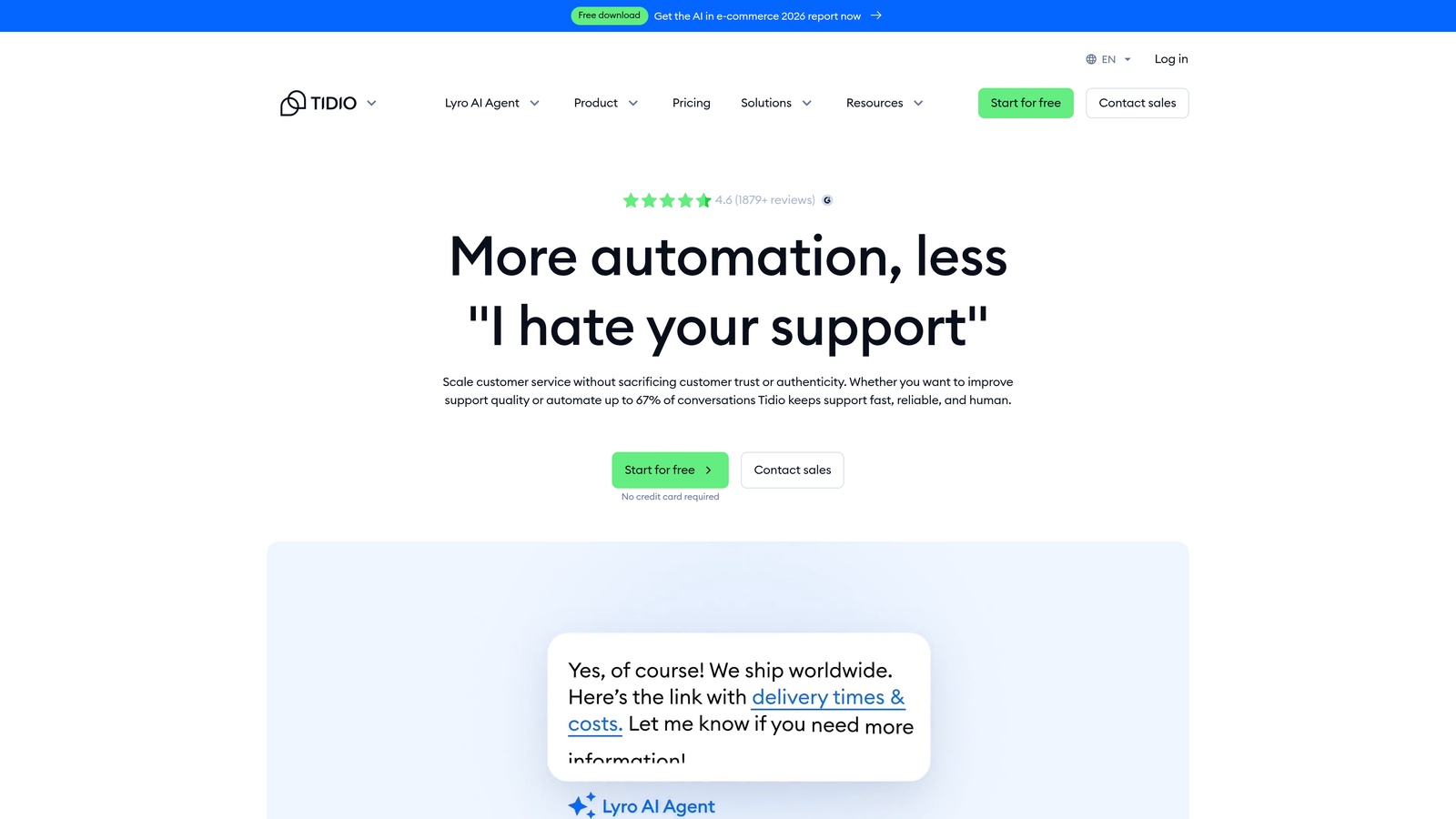
Tidio is a conversational AI platform designed for smaller teams, featuring the Lyro AI chatbot that learns from your existing FAQ and support content with very little configuration required.
Where This Tool Shines
Tidio's strength is simplicity. For small business owners and e-commerce operators who don't have a dedicated support team, Lyro provides meaningful automation coverage without requiring technical expertise to deploy. The native integrations with Shopify, WooCommerce, and WordPress mean setup is measured in hours, not weeks.
The combination of AI chatbot and live chat in a single interface is practical for teams where the same person often handles both. When Lyro can't resolve something, the handoff to a human agent is clean, and AI-suggested responses help agents reply faster even when they're handling conversations manually.
Key Features
Lyro AI Chatbot: Learns from your FAQ and support content to handle common questions automatically without manual flow building.
Visual Chatbot Builder: Drag-and-drop interface for creating custom conversation flows for specific scenarios.
E-Commerce Integrations: Native connections to Shopify, WooCommerce, and WordPress for context-aware support.
AI-Suggested Agent Responses: Helps live agents reply faster by surfacing relevant answers during conversations.
Visitor Tracking: Real-time visibility into who's on your site and what they're doing.
Best For
Small businesses, e-commerce stores, and early-stage teams that need practical AI support automation without complexity. Less suited for large enterprise operations or teams with complex multi-system integration requirements.
Pricing
Free plan available. Lyro AI starts at $39 per month for 50 conversations, with higher tiers available as volume grows.
7. Forethought
Best for: Support operations teams focused on optimizing ticket triage, resolution rates, and agent efficiency across the full support workflow.
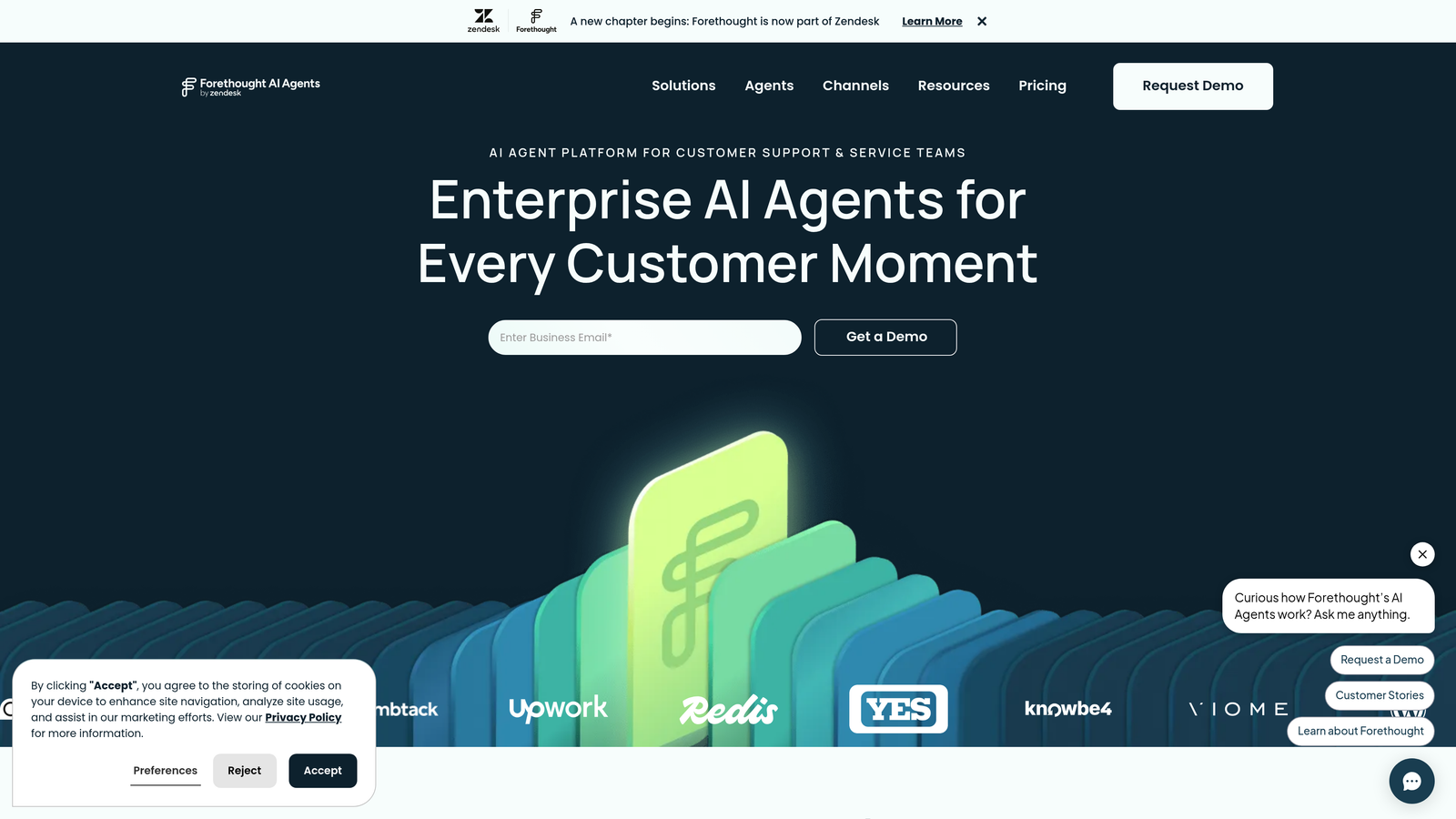
Forethought is an AI platform built specifically for support operations, with distinct modules covering triage, automated resolution, and agent assist working together across your existing helpdesk.
Where This Tool Shines
Forethought takes a workflow-first approach, which resonates with support operations leaders who think in terms of ticket lifecycle rather than just chatbot deflection. The modular structure means teams can adopt specific capabilities where they have the most pain without overhauling their entire stack.
The analytics layer is particularly well-developed for teams that need to demonstrate AI ROI internally. Tracking resolution rates, triage accuracy, and agent assist usage gives operations managers the data they need to justify and optimize AI investment over time.
Key Features
Triage (Ticket Classification): AI-powered intent detection and priority routing to get tickets to the right queue immediately.
Solve (Automated Resolution): Handles common inquiries end-to-end without agent involvement.
Assist (Agent Support): Surfaces relevant knowledge in real time as agents work, reducing handle time.
Workflow Automation: Connects AI capabilities across your existing helpdesk platform rather than replacing it.
Performance Analytics: Dedicated dashboard for tracking AI module performance and identifying optimization opportunities.
Best For
Mid-market and enterprise support operations teams that want structured AI capabilities layered onto an existing helpdesk investment. Works well for teams with a dedicated support ops function focused on continuous improvement.
Pricing
Custom pricing based on ticket volume and which modules are selected. Contact Forethought directly for a quote tailored to your operation's scope.
8. Cognigy
Best for: Enterprise contact centers needing sophisticated voice and chat AI with deep compliance requirements.
Cognigy is an enterprise conversational AI platform specializing in voice and chat automation for contact centers, with extensive customization and compliance capabilities built for regulated industries.
Where This Tool Shines
Cognigy is one of the few platforms in this comparison that treats voice as a first-class channel rather than an afterthought. For contact centers where a significant portion of interactions happen over the phone, the voice AI with natural language understanding is a meaningful capability that most chat-first platforms simply don't match.
The compliance and security posture is enterprise-grade: GDPR, SOC 2, and deep integration with established contact center infrastructure from Genesys, NICE, and Avaya. For organizations in regulated industries where compliance is non-negotiable, this matters considerably.
Key Features
Voice AI: Natural language understanding for phone-based support, handling complex multi-turn voice conversations.
Low-Code Conversation Designer: Build sophisticated dialogue flows for complex support scenarios without heavy engineering involvement.
Enterprise Compliance: GDPR and SOC 2 compliance with security architecture designed for regulated industries.
Contact Center Integrations: Deep integration with Genesys, NICE, Avaya, and other major contact center platforms.
100+ Language Support: Multilingual capabilities across more languages than most competitors in this space.
Best For
Large enterprises and contact centers with voice-heavy support operations, particularly in regulated industries like financial services, healthcare, or telecommunications where compliance requirements are stringent.
Pricing
Enterprise pricing with custom quotes. Contact Cognigy directly; pricing reflects the platform's enterprise positioning and typically involves multi-year agreements.
9. Kustomer
Best for: Customer-centric teams that want AI capabilities built on a unified CRM timeline rather than a traditional ticketing queue.
Kustomer is a CRM-native customer service platform with AI capabilities for classification, sentiment analysis, and automated responses, organized around a single unified customer timeline.
Where This Tool Shines
Kustomer's differentiator is its data model. Rather than treating each support interaction as an isolated ticket, the platform organizes everything around the customer: every email, chat, order, and social message lives in one chronological view. For agents handling complex, relationship-driven support, this context is invaluable.
The AI capabilities layer naturally onto this rich data foundation. Sentiment analysis and intent detection work better when the model has access to the full customer history rather than just the current interaction. For brands where customer relationships are long-term and context-heavy, this architecture makes a real difference.
Key Features
Unified Customer Timeline: All interactions across every channel in a single chronological view, giving agents complete context instantly.
AI Intent and Sentiment Detection: Classifies incoming messages and detects customer sentiment to prioritize and route appropriately.
Automated Workflows and Chatbot: Handles routine inquiries and triggers automated processes based on customer behavior and history.
CRM-Native Data Context: AI operates on rich customer data including purchase history, previous interactions, and lifecycle stage.
Omnichannel Support: Unified handling of email, chat, social, and SMS within the same customer timeline view.
Best For
Mid-market to enterprise brands where customer relationships are complex and context-rich, particularly in e-commerce, retail, and subscription businesses where purchase history and lifecycle data should inform every support interaction.
Pricing
Enterprise plan at $89 per user per month; Ultimate plan at $139 per user per month. Pricing reflects the combined CRM and support platform value rather than a standalone helpdesk.
Choosing the Right Platform for Your Team
The honest answer is that there's no single best AI customer service platform — there's the best platform for your specific situation. Here's how to think about the decision based on what matters most to your team.
Best for SaaS teams wanting AI-first architecture: Halo AI stands out for B2B SaaS companies that need more than ticket deflection. The page-aware context, continuous learning, and business intelligence capabilities make it the strongest choice for teams that want support to compound in value over time rather than just handle volume.
Best for enterprise contact centers: Cognigy is the clear choice for large organizations with voice-heavy operations and strict compliance requirements. If you're running a contact center at scale in a regulated industry, its depth in voice AI and enterprise integrations is hard to match.
Best for existing platform users: If you're already invested in Zendesk or Intercom, layering in Zendesk AI or Intercom Fin is the path of least resistance. You won't get the same AI-native depth, but deployment is fast and workflow disruption is minimal.
Best budget option: Freshdesk Freddy AI offers the most accessible entry point for teams with tighter budgets. The free tier and $49 per agent Pro plan deliver genuine AI value without enterprise price tags.
Best for e-commerce and small business: Tidio's simplicity and native e-commerce integrations make it the practical choice for smaller teams that need automation without complexity.
The broader trend worth noting: the platforms that will deliver the most value in 2026 and beyond are those that learn and improve autonomously. A platform that's equally capable on day one as it is a year later isn't truly intelligent — it's just automated. The real differentiator is continuous improvement from real interactions, and that's where purpose-built AI platforms have a structural advantage over legacy helpdesks with AI features bolted on.
Your support team shouldn't scale linearly with your customer base. Let AI agents handle routine tickets, guide users through your product, and surface business intelligence while your team focuses on complex issues that need a human touch. See Halo in action and discover how continuous learning transforms every interaction into smarter, faster support.