9 Best AI Customer Service Tools Reviewed for 2026
This in-depth guide cuts through vendor hype with honest ai customer service reviews of nine leading platforms for 2026, evaluating each tool on autonomous ticket resolution, live agent handoff, integrations, and real-world AI learning capabilities. Whether you're scaling a SaaS support team or replacing a legacy helpdesk, this breakdown helps you identify which solution best fits your team size, tech stack, and support goals.
 Grant CooperFounder14 min read
Choosing the right AI customer service platform is harder than it looks. Every vendor promises faster resolution times, happier customers, and a leaner support team — but the reality varies wildly depending on your stack, your team size, and how deeply the AI is actually integrated into the product versus bolted on as an afterthought.
This review covers nine AI customer service tools worth serious consideration in 2026. We evaluated each on core capabilities (autonomous ticket resolution, live agent handoff, integrations), ease of deployment, and how well the AI actually learns and improves over time. Whether you're migrating off a legacy helpdesk, scaling a SaaS support team, or looking to reduce ticket volume without sacrificing quality, here's an honest look at what each tool does well, where it falls short, and who it's best suited for.
1. Halo AI
Best for: B2B SaaS teams wanting autonomous resolution, page-aware guidance, and business intelligence from support data.
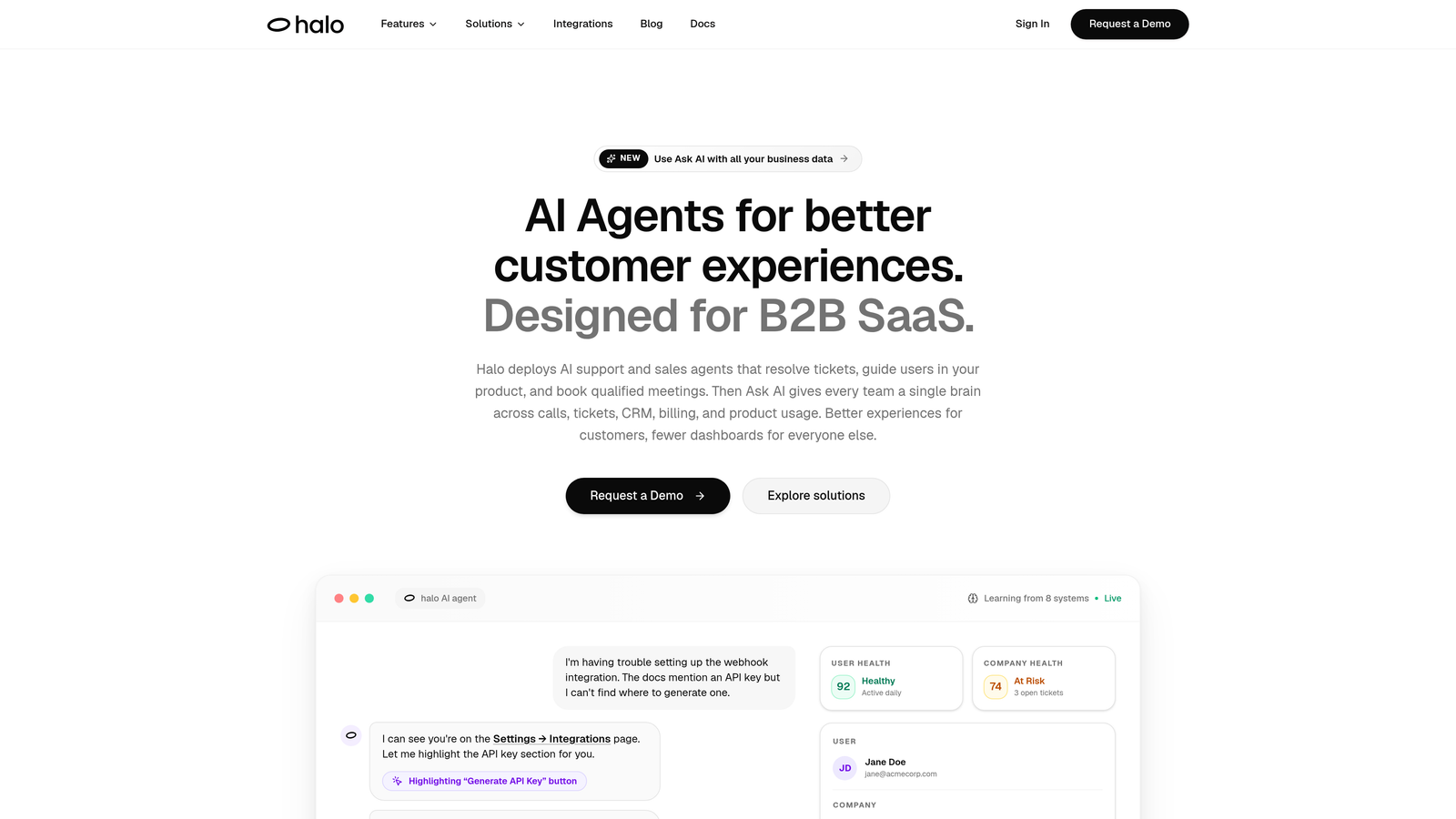
Halo AI is an AI-first customer support platform built specifically for B2B SaaS teams, deploying autonomous agents that resolve tickets, guide users through your product, and surface actionable business intelligence.
Where This Tool Shines
The clearest differentiator here is the page-aware chat widget. Unlike most support tools that only know what a user types, Halo's AI sees what the user is actually doing inside your product — the page they're on, the UI elements in front of them — and provides contextual, visual guidance accordingly. This is a meaningful step beyond generic FAQ deflection.
The platform is also genuinely AI-first, not a legacy helpdesk with an AI layer added. That architectural difference shows up in how the system learns: every resolved ticket, every escalation, every user interaction feeds back into the model. Over time, resolution quality improves without manual retraining. The auto bug ticket creation feature, which routes issues directly to Linear, is a practical touch that saves engineering teams real time.
Key Features
Page-Aware Chat Widget: The AI sees the user's current product context and delivers visual UI guidance, not just text responses.
Autonomous Ticket Resolution: AI agents handle tickets end-to-end, with intelligent escalation to live agents for complex or sensitive issues.
Auto Bug Ticket Creation: Automatically identifies and routes bug reports to engineering tools like Linear, closing the loop between support and product.
Smart Inbox with Business Intelligence: Goes beyond support metrics to surface customer health signals, revenue indicators, and anomaly detection.
Broad Integration Stack: Connects across Slack, HubSpot, Intercom, Stripe, Zoom, PandaDoc, and Fathom — covering the full B2B SaaS toolchain.
Best For
SaaS companies that want more than deflection from their AI investment. If your support team is also a source of product feedback, churn signals, and customer health data, Halo's business intelligence layer makes it genuinely useful beyond the ticket queue. Teams that need tight integration between support, product, and engineering will find the workflow connections particularly valuable.
Pricing
Check haloagents.ai for current pricing. Given the platform's B2B SaaS focus, it's worth requesting a demo to understand fit before evaluating cost.
2. Intercom Fin
Best for: Teams already on Intercom who want AI resolution without switching platforms.
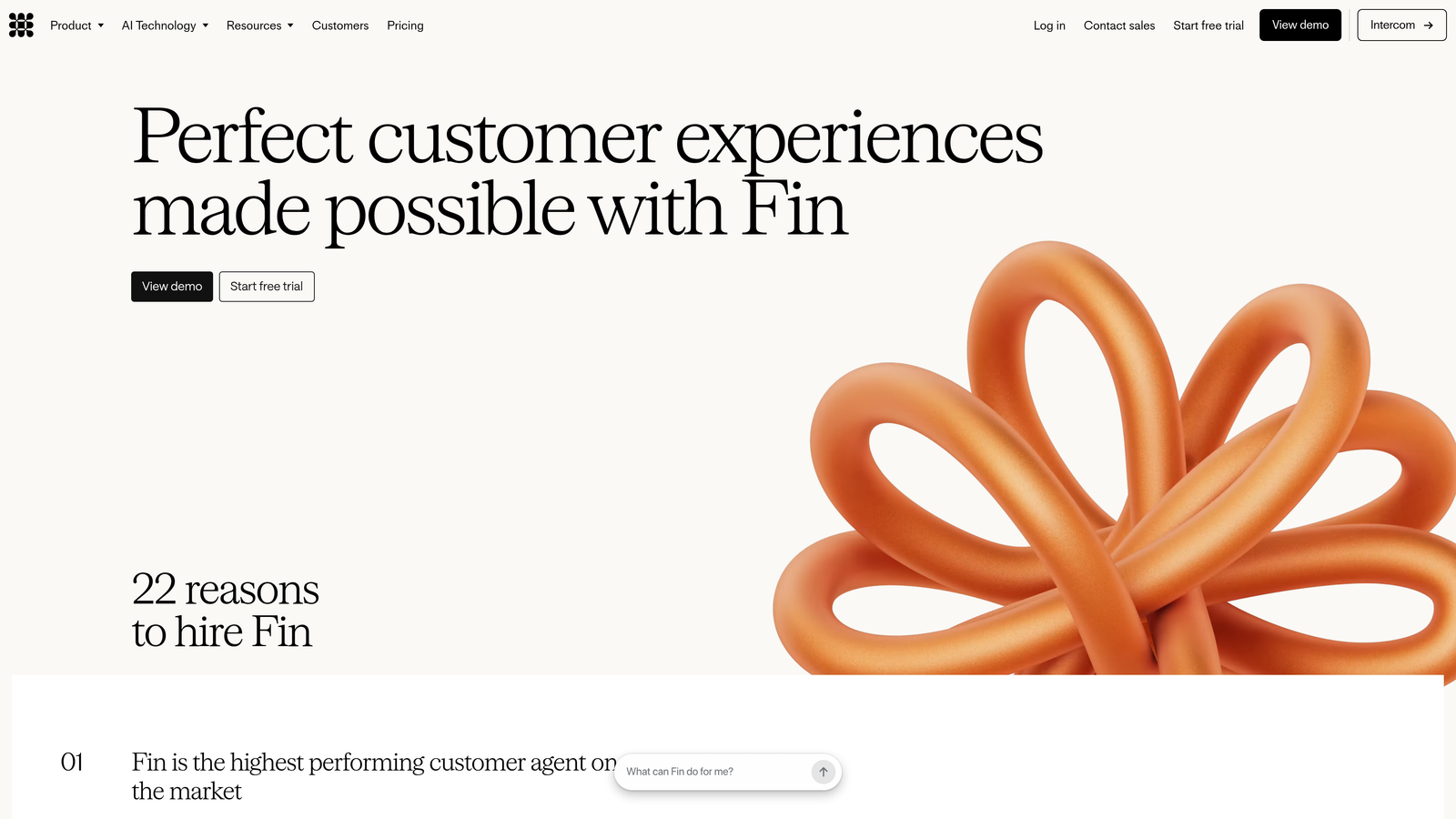
Intercom Fin is Intercom's LLM-powered AI agent that resolves customer queries by drawing on your existing help content and conversation history.
Where This Tool Shines
Fin's biggest advantage is how naturally it fits into the Intercom ecosystem. If your team is already using Intercom's inbox, messenger, and help center, deploying Fin requires minimal friction. It draws on your existing help articles and macros rather than requiring a separate knowledge base build, which means time-to-value is genuinely fast for established Intercom users.
The per-resolution pricing model is worth noting. Rather than charging per seat or per conversation, you pay for outcomes — which aligns incentives reasonably well. The Fin Insights dashboard gives visibility into what Fin is resolving, where it's failing, and where content gaps exist, making it easier to iterate on your help content over time.
Key Features
LLM-Powered Resolution: Uses large language models to answer queries from your help articles and conversation history, not just keyword matching.
Seamless Human Handoff: Escalates to live agents within Intercom's native inbox without any context loss.
Omnichannel Coverage: Works across chat, email, and in-product messaging within the Intercom platform.
Per-Resolution Pricing: Pay for successful outcomes rather than seats or conversation volume.
Fin Insights: Dashboard tracking resolution rates, failure points, and content gaps to guide ongoing improvement.
Best For
Companies already invested in the Intercom platform who want to add autonomous resolution without migrating to a new tool. Less compelling for teams not already on Intercom, since Fin's strengths are tightly coupled to the broader Intercom ecosystem.
Pricing
Per-resolution pricing on top of an existing Intercom subscription. Check intercom.com for current rates, as pricing tiers can change frequently.
3. Zendesk AI
Best for: Enterprise support teams with complex routing needs already operating on Zendesk Suite.
Zendesk AI layers intelligent triage, agent assist, and self-service automation across Zendesk's mature enterprise helpdesk platform.
Where This Tool Shines
Zendesk AI benefits from being embedded in one of the most feature-rich helpdesk platforms available. The intelligent triage capabilities — intent detection, sentiment analysis, language identification — are well-developed and handle high-volume routing scenarios effectively. For large teams managing thousands of tickets across multiple channels, the infrastructure is proven.
Agent Copilot is a practical productivity tool: suggested replies, ticket summaries, and next-step recommendations help agents move faster without removing them from the conversation. The generative AI features for knowledge base creation and gap identification are also genuinely useful for teams trying to scale self-service content without a dedicated writing resource.
Key Features
Intelligent Triage: Automatically detects intent, sentiment, and language to route tickets accurately at scale.
AI Agent for Self-Service: Handles common queries autonomously before they reach a human agent.
Agent Copilot: Provides suggested replies, ticket summaries, and recommended next steps to speed up human agents.
Generative AI for Knowledge Base: Helps create and identify gaps in help content using AI-assisted writing tools.
QA Automation: Automated quality assurance tools for monitoring and improving support interactions at scale.
Best For
Enterprise teams with established Zendesk deployments who want to layer AI capabilities onto existing workflows. The platform can feel heavyweight for smaller teams, and the AI add-on costs stack up quickly. Best suited to organizations where Zendesk is already the system of record.
Pricing
AI features are available on Zendesk Suite plans, with advanced AI as an additional paid add-on. Check zendesk.com for current pricing, as tier structures have evolved.
4. Freshdesk Freddy AI
Best for: SMBs and growing teams on the Freshworks suite looking for an affordable AI entry point.
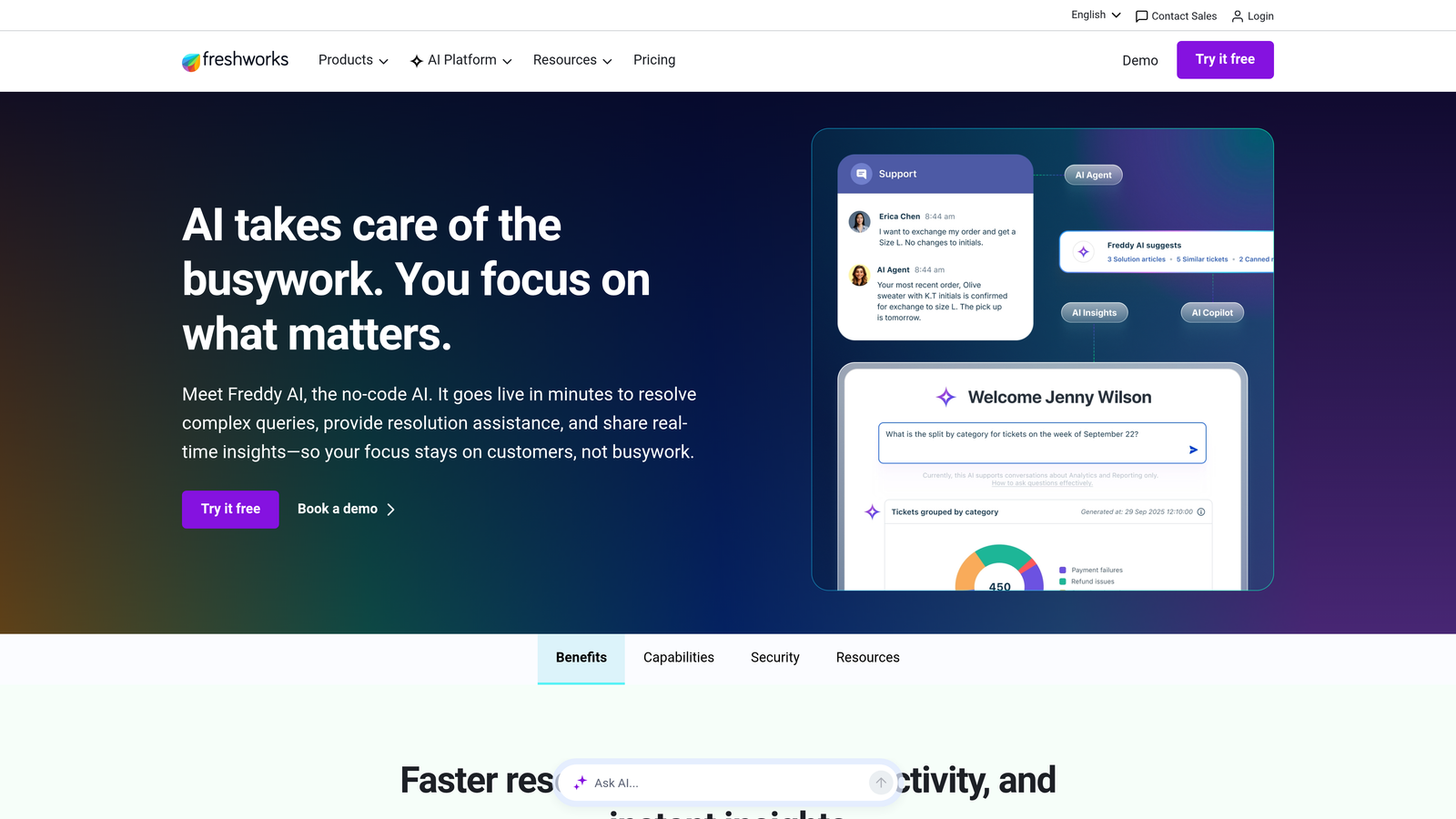
Freshdesk Freddy AI is Freshworks' AI layer spanning self-service bots, agent productivity tools, and support analytics across its product suite.
Where This Tool Shines
Freddy AI's strength is breadth at a competitive price point. The three-pillar structure — Self Service for automated resolution, Copilot for agent assist, and Insights for analytics — covers the core AI use cases without requiring separate tools or significant additional investment. For teams already on Freshdesk or Freshchat, the native integration means relatively smooth deployment.
Freddy Insights is a particularly underrated feature. AI-driven anomaly detection for support operations — flagging unusual ticket spikes, sentiment shifts, or resolution rate drops — gives support managers early warning signals that would otherwise require manual monitoring or custom reporting.
Key Features
Freddy Self Service: AI bot that handles common queries autonomously before they reach an agent.
Freddy Copilot: Suggested replies, ticket summaries, and agent assist to improve human agent productivity.
Freddy Insights: AI-driven analytics with anomaly detection for support operations monitoring.
Native Suite Integration: Works seamlessly across Freshdesk, Freshchat, and Freshservice without additional configuration.
Accessible Pricing: More affordable entry point compared to enterprise-tier competitors like Zendesk or Kustomer.
Best For
SMBs and mid-market teams on the Freshworks ecosystem who want solid AI capabilities without enterprise pricing. Less suited to teams with complex, technical B2B support needs where deeper AI learning and context-awareness matter more.
Pricing
Freddy Copilot is available on higher-tier Freshworks plans; pricing varies by product. Check freshworks.com for current plan details.
5. Tidio Lyro
Best for: Small businesses and e-commerce teams needing fast, low-effort AI deployment for common queries.
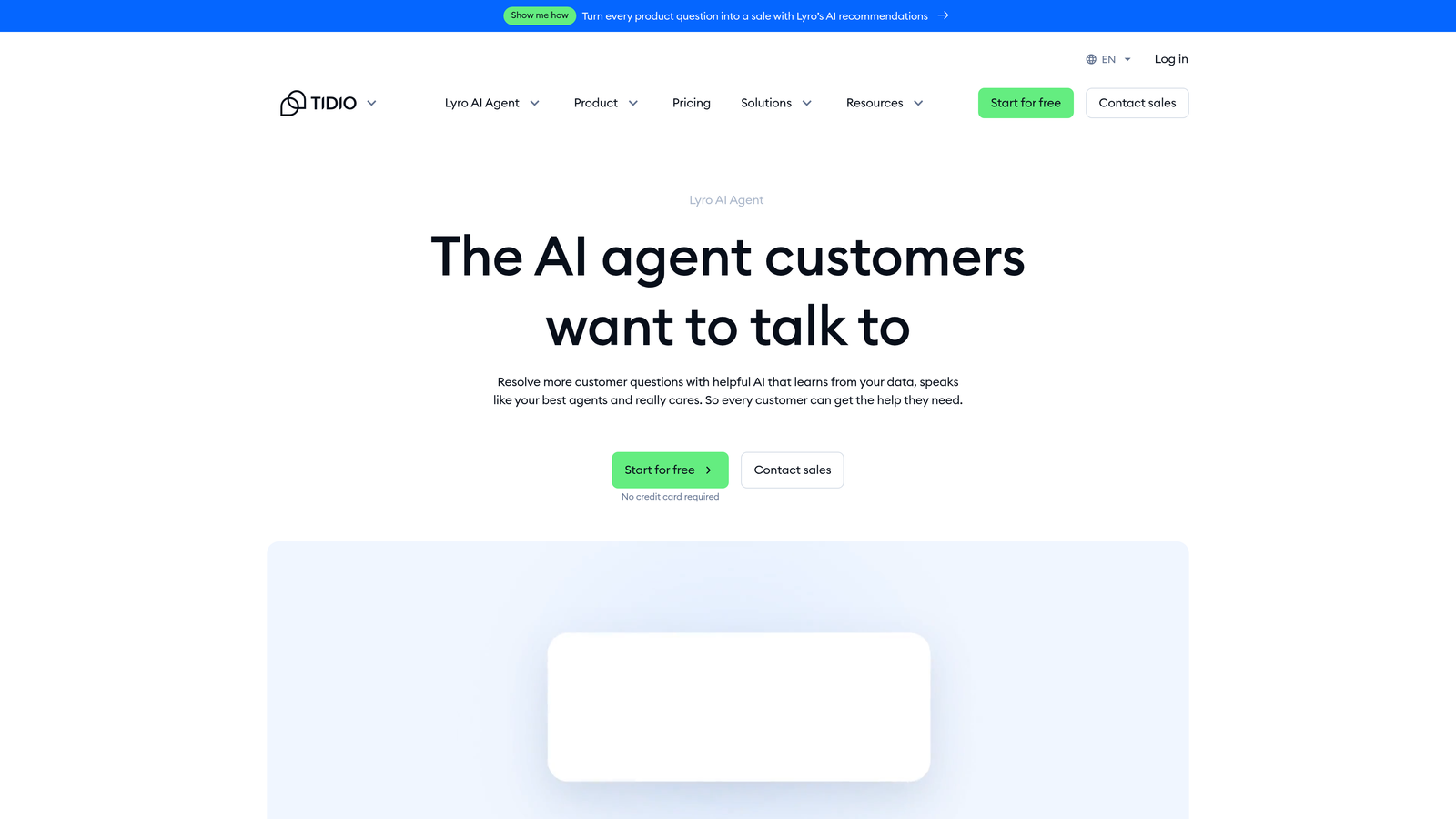
Tidio Lyro is a conversational AI trained on your existing help content to handle repetitive customer questions automatically with minimal setup overhead.
Where This Tool Shines
Lyro's main selling point is simplicity. It trains on your existing FAQ and help content without requiring engineering resources or lengthy implementation projects. For a small team that needs to deflect common questions quickly, the time-to-deployment is genuinely fast compared to more complex platforms.
The escalation flow to live chat is clean and reliable, which matters more than it might seem. Many AI tools handle the autonomous resolution piece reasonably well but fumble the handoff — leaving customers repeating themselves or waiting in limbo. Lyro's conversation analytics also help teams understand exactly what's being resolved versus what's being escalated, making it easy to identify content gaps.
Key Features
Fast Content Training: Trains on existing FAQ and help documentation without requiring technical setup.
Autonomous Query Handling: Resolves repetitive questions independently, escalating to live chat when needed.
Simple Deployment: No engineering resources required — accessible for non-technical teams.
Multi-Channel Coverage: Works across website chat and email channels.
Conversation Analytics: Tracks resolution vs. escalation rates to surface content gaps and improvement opportunities.
Best For
Small businesses, e-commerce brands, and teams with straightforward, high-repetition support queries. Less suited to complex B2B SaaS support workflows where context-awareness, deep integrations, and continuous learning from nuanced interactions matter more.
Pricing
Lyro is available on paid Tidio plans with conversation-based pricing. Check tidio.com for current plan details and conversation volume limits.
6. Kustomer
Best for: High-volume B2C brands needing AI with full customer history context across every channel.
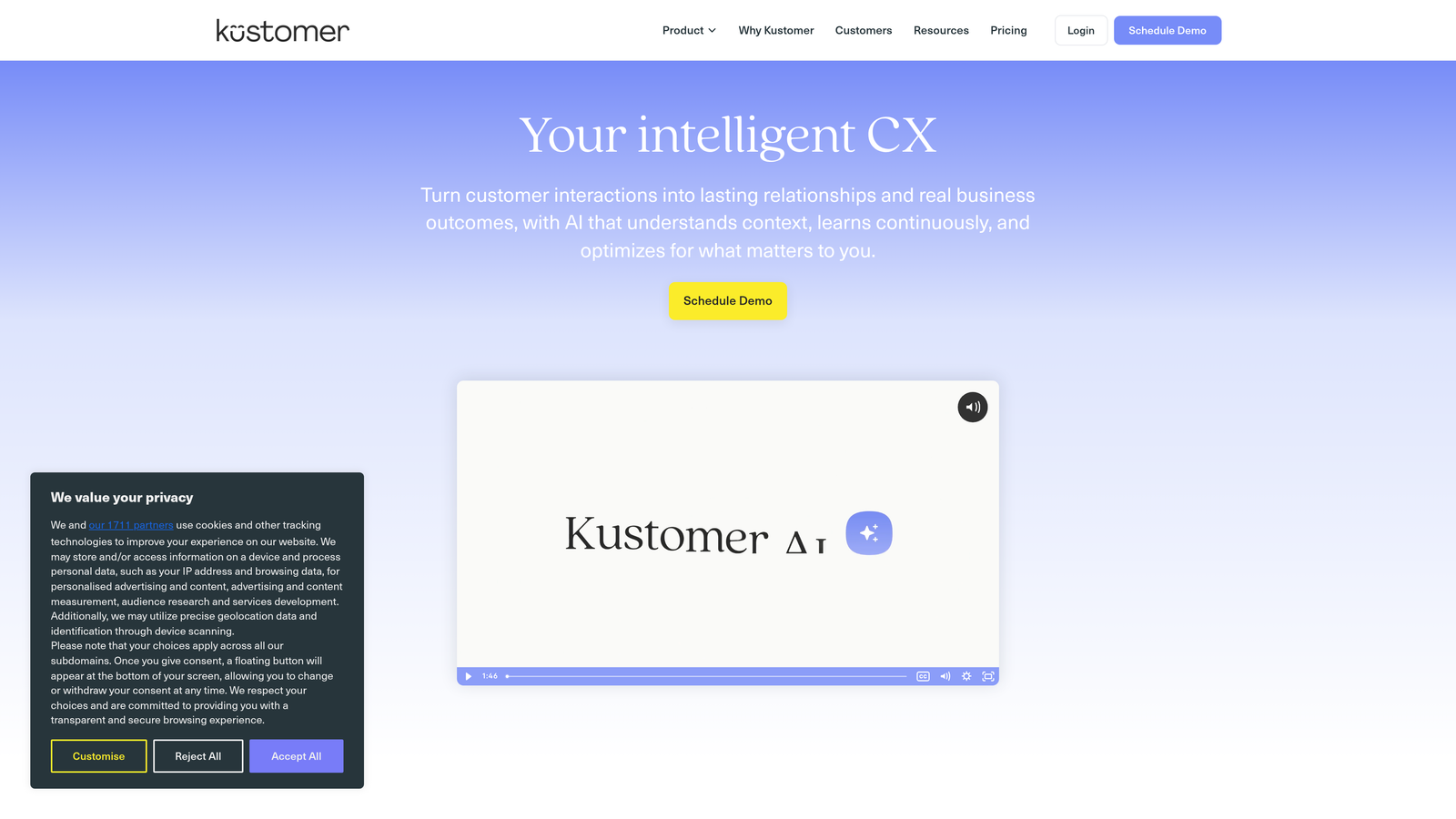
Kustomer is a CRM-native customer service platform where AI operates with complete visibility into each customer's history across every channel and interaction.
Where This Tool Shines
Kustomer's core differentiator is the unified customer timeline. Before the AI responds to anything, it has access to the full history of that customer's interactions — purchases, previous conversations, support tickets, and channel activity — all in one view. This context depth is difficult to replicate with tools that treat each conversation in isolation.
For high-volume B2C brands where customer history is complex and interactions span multiple channels, that context makes AI routing, deflection, and agent assist meaningfully more accurate. The omnichannel architecture — chat, email, SMS, social, voice — is genuinely unified rather than bolted together from separate products.
Key Features
Unified Customer Timeline: AI has full cross-channel customer history before responding, enabling genuinely contextual interactions.
AI Routing and Deflection: Intelligent routing and self-service deflection powered by complete customer data.
Omnichannel by Design: Chat, email, SMS, social, and voice in a single unified platform.
Proactive Outreach Automation: Triggers proactive customer communication based on customer data signals.
Agent Assist: AI-powered suggestions and context surfacing within the agent workspace.
Best For
High-volume B2C brands with complex customer histories and omnichannel support needs. The implementation complexity and enterprise pricing make it less practical for smaller teams or companies with simpler support workflows.
Pricing
Enterprise pricing; contact Kustomer for a quote. Check kustomer.com for current plan information.
7. Drift (Salesloft)
Best for: B2B revenue teams where support conversations and sales qualification happen in the same channel.
Drift, now part of Salesloft, offers AI-powered conversations that blend sales qualification and customer support for B2B companies where those functions overlap.
Where This Tool Shines
Drift occupies a distinct category: it's not a pure support tool, and it's not a pure sales tool. For B2B companies where website visitors might be existing customers with support questions or new prospects with buying intent, Drift's AI can handle both flows within the same conversation. Playbooks route conversations based on visitor intent and account data, which is useful when your CRM knows who's on the page.
The meeting scheduling and sales handoff built into the conversation flow is a practical feature for revenue teams. Rather than support conversations dead-ending in a ticket queue, high-intent conversations can transition directly into a sales meeting booking. That said, teams looking for a dedicated support tool with deep ticket resolution capabilities may find Drift's focus on pipeline generation a distraction.
Key Features
Blended AI Conversations: Handles support queries and sales qualification within the same conversation flow.
Intent-Based Playbooks: Routes conversations based on visitor intent, account data, and CRM signals.
CRM-Personalized Responses: Uses CRM data to deliver context-aware, account-specific responses.
Meeting Scheduling: Built-in calendar booking and sales handoff within the conversation.
Revenue Team Integration: Designed to connect support and sales workflows rather than siloing them.
Best For
B2B companies where support and pipeline overlap — particularly those with account-based sales motions and website traffic from a mix of prospects and existing customers. Less suited to teams needing dedicated, high-volume ticket resolution as the primary use case.
Pricing
Enterprise pricing; contact Salesloft for current rates. Check salesloft.com for more information.
8. Help Scout
Best for: Teams that want AI to make agents faster without removing humans from the conversation.
Help Scout is a human-first support platform with AI assist features designed to amplify agent productivity rather than replace agents entirely.
Where This Tool Shines
Help Scout takes a deliberately different philosophy from most tools on this list. Rather than maximizing deflection and autonomous resolution, the focus is on making human agents better and faster. AI Drafts generates reply suggestions for agents to review and edit. AI Summarize condenses long conversation threads into quick context. The AI is a productivity layer, not a replacement layer.
This approach resonates with teams where support quality and relationship continuity matter more than deflection volume — think professional services, high-touch SaaS, or any context where customers expect a human response. The Beacon embeddable widget and Docs knowledge base with AI-powered search cover self-service needs without pushing the product into full autonomous territory.
Key Features
AI Drafts: Generates reply suggestions for agents to review, edit, and send — keeping humans in control.
AI Summarize: Condenses long conversation threads into quick context summaries for faster agent onboarding.
Beacon Widget: Embeddable help widget combining self-service search and live chat.
Docs Knowledge Base: Integrated knowledge base with AI-powered search for self-service deflection.
Agent-Empowering Design: Intentionally keeps human agents central rather than automating them out.
Best For
Teams that prioritize support quality and human relationships over deflection metrics. Particularly well-suited to high-touch SaaS, professional services, and companies where customers expect and value a human response. Not the right fit for teams whose primary goal is autonomous ticket resolution at scale.
Pricing
Per-user, per-month pricing with AI features available on higher tiers. Check helpscout.com for current plan details.
9. Gorgias
Best for: E-commerce brands on Shopify and other commerce platforms needing AI that can take action on orders.
Gorgias is an AI-powered helpdesk built specifically for e-commerce, with deep integrations into Shopify and other commerce platforms that allow the AI to act on orders — not just respond to questions about them.
Where This Tool Shines
Most support AI can answer the question "Where's my order?" Gorgias can actually do something about it. The AI has direct access to order data and can issue refunds, update subscriptions, and cancel orders autonomously — which is a meaningful capability difference for high-volume e-commerce support where the same transactional queries repeat hundreds of times per day.
The Shopify, Magento, and BigCommerce integrations are deep rather than surface-level. AI responses are informed by real order context, not just help article content. The revenue statistics feature, which tracks the impact of support interactions on sales, is also a useful signal for e-commerce teams evaluating support ROI beyond ticket deflection.
Key Features
Order Action Capabilities: AI can issue refunds, cancel orders, and update subscriptions — not just answer questions about them.
Deep Commerce Integration: Native Shopify, Magento, and BigCommerce integration gives AI full order context before responding.
High-Volume Query Automation: Automates order status, returns, and shipping queries at scale.
Revenue Impact Tracking: Tracks how support interactions influence sales, connecting support to revenue outcomes.
Omnichannel Inbox: Email, chat, SMS, and social in a single unified inbox.
Best For
E-commerce brands, particularly those on Shopify, with high volumes of transactional support queries. The depth of commerce platform integration makes Gorgias genuinely powerful in that context. It's a poor fit for SaaS or B2B support teams, where the e-commerce-specific features simply don't apply.
Pricing
Per-ticket pricing model with plans that scale with ticket volume. Check gorgias.com for current plan details.
Which Tool Is Right for Your Team?
The right choice here depends heavily on your context, not just feature checklists. Here's a practical breakdown by use case.
For B2B SaaS teams that want genuine AI autonomy, continuous learning, and business intelligence beyond the ticket queue, Halo AI is the strongest purpose-built option. The page-aware context, auto bug routing, and smart inbox analytics address pain points that most support tools don't touch.
If you're already deeply embedded in Intercom or Zendesk, Intercom Fin and Zendesk AI are the lowest-friction paths to adding AI resolution — the integration advantage is real, even if the AI capabilities are more tightly coupled to those ecosystems.
For budget-conscious SMBs on the Freshworks suite, Freddy AI delivers solid coverage across self-service, agent assist, and analytics at a more accessible price point. Tidio Lyro is the right call for small teams and e-commerce brands with high-repetition queries and no appetite for complex implementation.
Gorgias is the clear choice for e-commerce, full stop. If you're on Shopify and your support queue is dominated by order and returns queries, nothing else on this list matches its depth of commerce integration.
Help Scout suits teams where human relationships are the point — where quality and continuity matter more than deflection volume. And Drift (Salesloft) fits B2B revenue teams where support and pipeline blur together.
Your support team shouldn't scale linearly with your customer base. Let AI agents handle routine tickets, guide users through your product, and surface business intelligence while your team focuses on complex issues that need a human touch. See Halo in action and discover how continuous learning transforms every interaction into smarter, faster support.