9 Best AI Customer Service Software for Startups in 2026
Choosing the right AI customer service software for startups means finding tools that deliver genuine automation and product-aware support at a scale and price lean teams can actually use. This guide evaluates 9 top platforms — from AI-first helpdesks to lightweight chatbots — on AI quality, integration depth, setup ease, and pricing transparency, so startups at any stage can find the right fit.
 Grant CooperFounder13 min read
Startups face a unique support paradox: customers expect fast, high-quality responses, but lean teams can't staff a full support operation. AI customer service software bridges that gap, automating ticket resolution, guiding users through your product, and escalating only what truly needs a human.
But not every AI support tool is built with startups in mind. Some are enterprise-first platforms with pricing and complexity to match. Others are lightweight chatbots that can't handle real product questions.
This list focuses on tools that deliver genuine AI capability at startup-friendly scale, whether you're a 5-person team handling your first support volume spike or a Series B company trying to keep pace with growth without adding headcount. We've evaluated each tool on AI quality, integration depth, ease of setup, and pricing transparency.
1. Halo AI
Best for: B2B SaaS startups that need an AI-first support platform with deep product integration
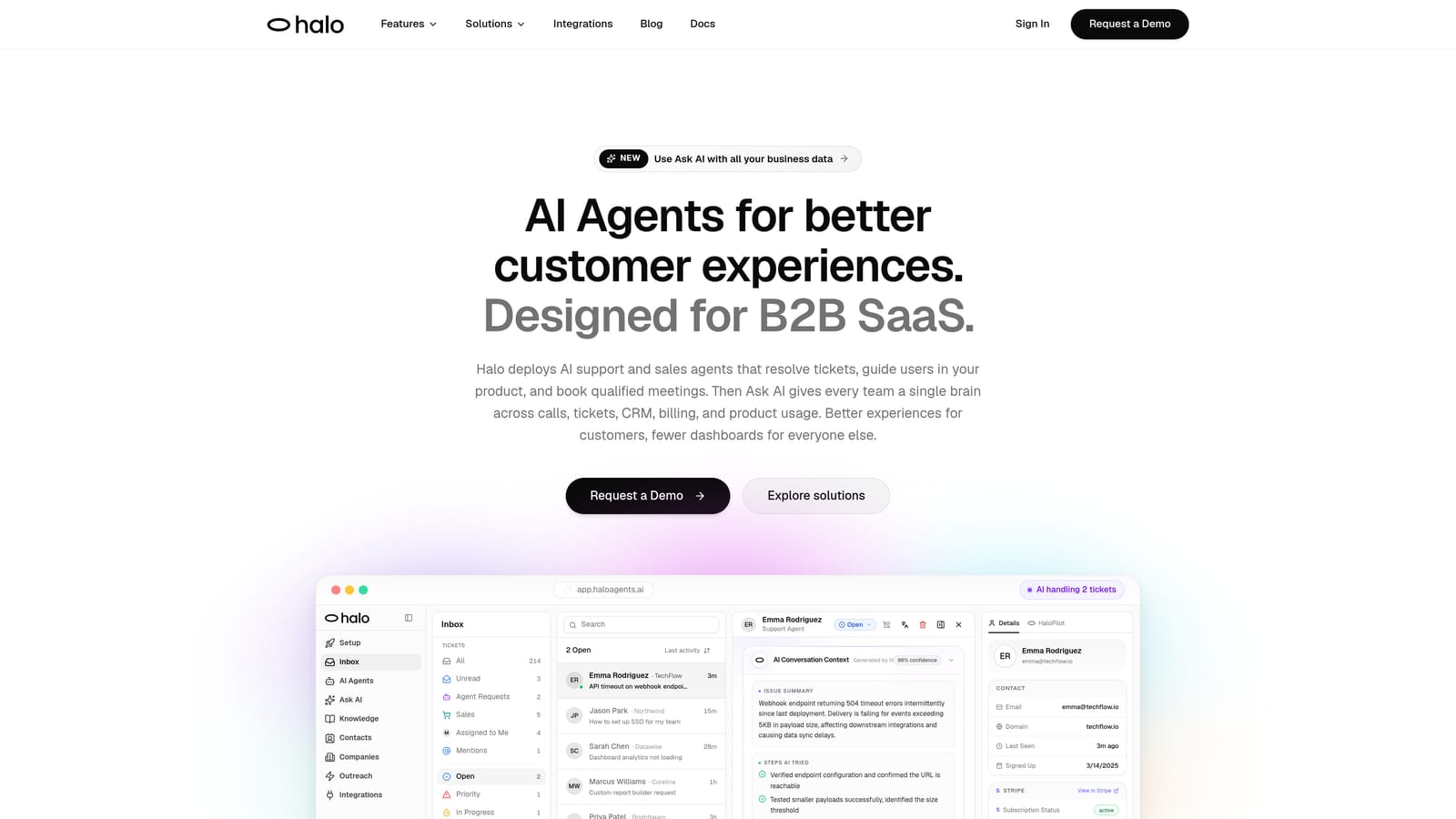
Halo AI is an AI-first customer support platform built specifically for B2B SaaS teams who want autonomous ticket resolution without the enterprise price tag.
Where This Tool Shines
What sets Halo apart from most tools on this list is its architecture. Rather than layering AI onto an existing helpdesk, Halo was built AI-first from the ground up. The page-aware chat widget is a standout feature: the AI actually sees what the user sees on screen, giving it the context to guide users through specific product steps rather than serving up generic help docs.
Halo also learns continuously from every resolved ticket, which means the system gets meaningfully smarter over time rather than staying static. For startups dealing with evolving products and shifting support patterns, that compound improvement is genuinely valuable.
Key Features
Page-Aware Chat Widget: The AI understands the user's current screen context, enabling precise, step-by-step product guidance instead of generic responses.
Continuous Learning: Every resolved ticket feeds back into the model, improving accuracy and resolution rates with each interaction.
Autonomous Bug Ticket Creation: When the AI detects a bug or product issue, it automatically creates a structured ticket in Linear, closing the loop between support and engineering.
Smart Inbox with Business Intelligence: Beyond ticket management, the inbox surfaces customer health signals, revenue anomalies, and other business intelligence signals that most support tools completely ignore.
Live Agent Handoff: Seamless escalation to human agents when conversations require it, with full context preserved so agents aren't starting from scratch.
Deep Integrations: Connects natively with Slack, HubSpot, Intercom, Stripe, Zoom, PandaDoc, Fathom, and Linear, covering the core stack most B2B SaaS startups already run.
Best For
B2B SaaS startups and growth-stage teams that want AI agents to handle routine tickets autonomously, guide users through complex product workflows, and surface business intelligence signals without adding headcount. Particularly strong for teams already using Linear for engineering and HubSpot for CRM.
Pricing
Contact for pricing. Halo is designed for B2B SaaS startups and growth teams, so pricing is structured around business needs rather than a one-size-fits-all per-agent model.
2. Intercom
Best for: Teams already using Intercom's messaging suite who want to add AI on top
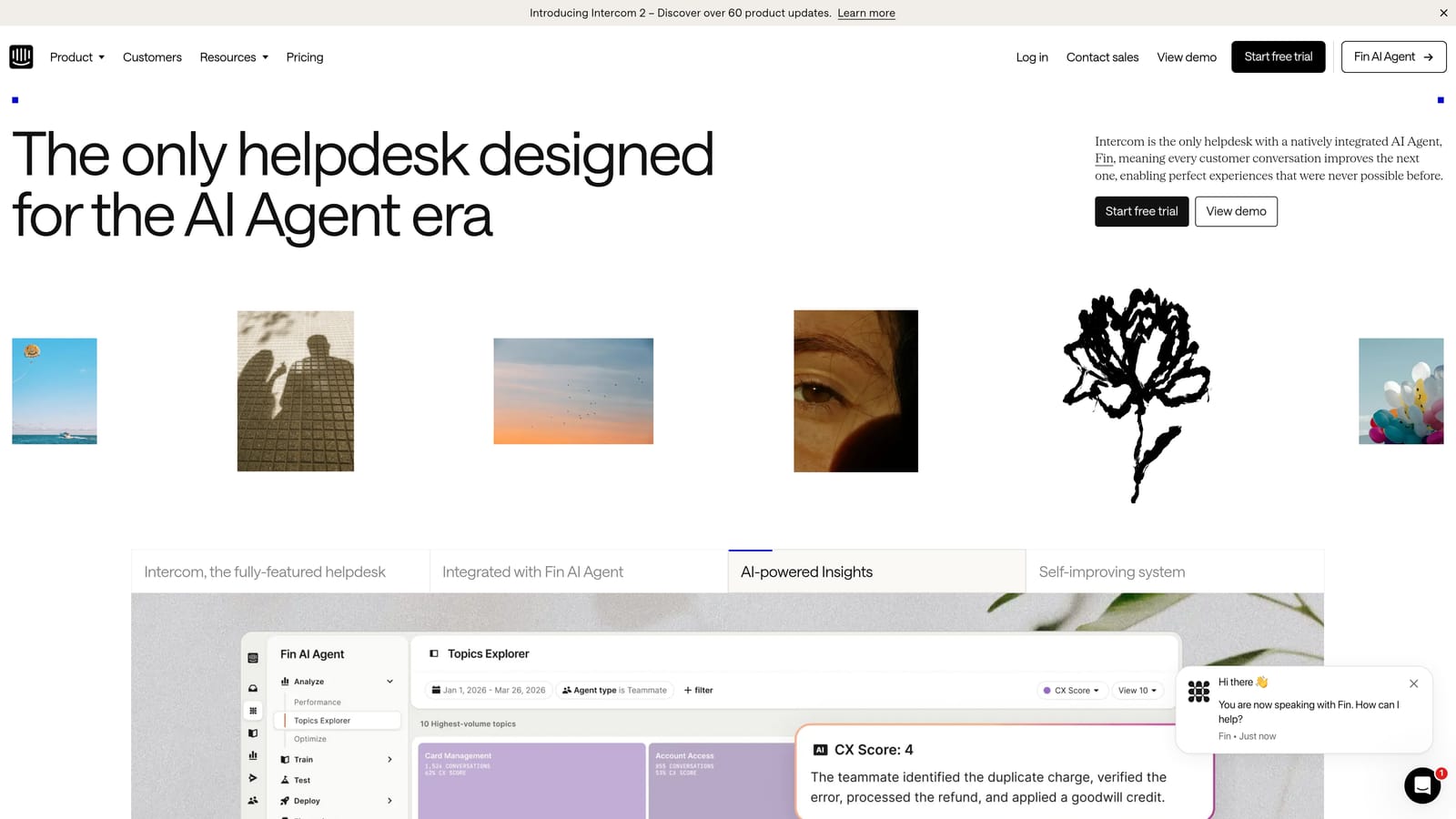
Intercom is a mature customer messaging platform with Fin, its LLM-powered AI agent, layered on top of its existing product suite.
Where This Tool Shines
Fin is one of the more capable AI agents in this category. It uses large language models to answer questions directly from your help content, handling multi-turn conversations reasonably well. If your team already lives in Intercom for customer messaging, adding Fin is a natural extension rather than a platform change.
The omnichannel coverage is also solid. Chat, email, and in-app messaging all flow through a single inbox, and agents get AI-powered conversation summaries and suggested replies to speed up their own responses.
Key Features
Fin AI Agent: LLM-powered agent that answers questions from your help content with genuine conversational ability.
Omnichannel Messaging: Chat, email, and in-app support unified in a single platform.
AI Conversation Summaries: Automatically condenses long threads so agents can get up to speed instantly.
Suggested Replies: AI-generated response suggestions for human agents handling escalated conversations.
Integration Marketplace: Broad library of third-party integrations for connecting to your existing stack.
Best For
Startups already invested in the Intercom ecosystem who want to add AI resolution without switching platforms. Also a strong fit for product-led growth teams that rely heavily on in-app messaging as a support channel.
Pricing
Starts at approximately $39/month for small teams. Fin AI usage adds per-resolution fees on top of base plan costs, so total spend can climb quickly with volume. Worth modeling your expected resolution volume before committing.
3. Freshdesk
Best for: Startups moving off email-only support who want an accessible, full-featured helpdesk
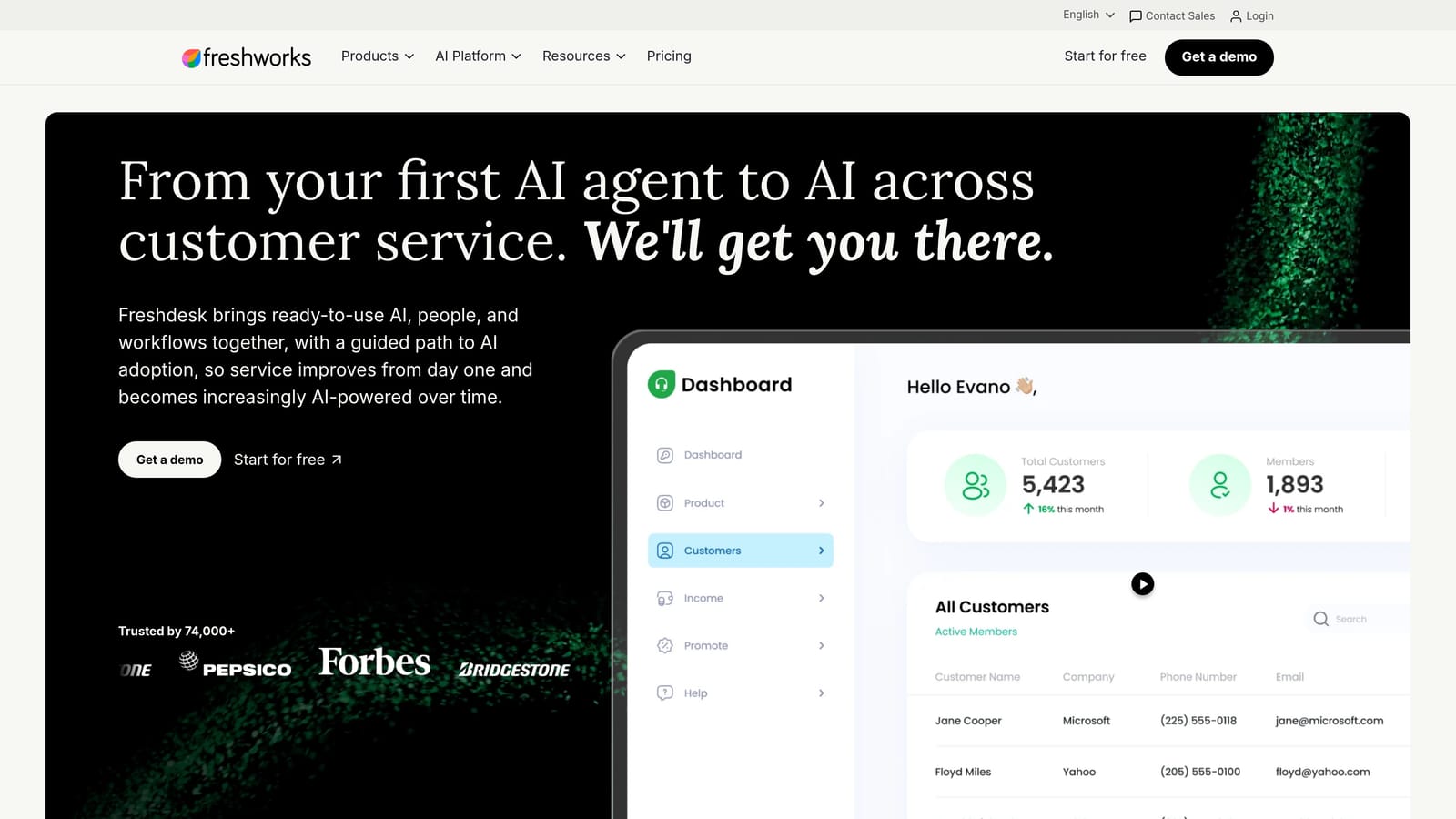
Freshdesk is a full-featured helpdesk platform from Freshworks with Freddy AI embedded across ticketing, routing, and self-service.
Where This Tool Shines
Freshdesk's biggest advantage for early-stage teams is its free tier, which supports up to 10 agents. That's meaningful runway before you're paying anything. The platform is also genuinely easy to set up compared to Zendesk, making it a common choice for teams that don't have a dedicated ops person to configure complex workflows.
Freddy AI handles the core automation tasks well: suggested replies, ticket summarization, and auto-routing. It's not the most sophisticated AI on this list, but it covers the high-frequency tasks that eat up agent time.
Key Features
Freddy AI: Handles suggested replies, auto-routing, and ticket summarization across your support queue.
Free Tier: Supports up to 10 agents at no cost, making it one of the most accessible starting points on this list.
Freddy Copilot: Agent assist add-on that provides real-time suggestions and productivity tools for human agents.
Freddy Insights: Analytics add-on for tracking support trends, team performance, and customer satisfaction.
Omnichannel Support: Email, chat, phone, and social channels managed from a single interface.
Best For
Early-stage startups that need a real helpdesk without the cost of Zendesk, and teams upgrading from shared inboxes or email-only support. Also a solid choice for startups already using other Freshworks products like Freshsales.
Pricing
Free tier available for up to 10 agents. Paid plans start at approximately $15/agent/month. Freddy Copilot and Freddy Insights are priced as separate add-ons, so factor those in if you want the full AI feature set.
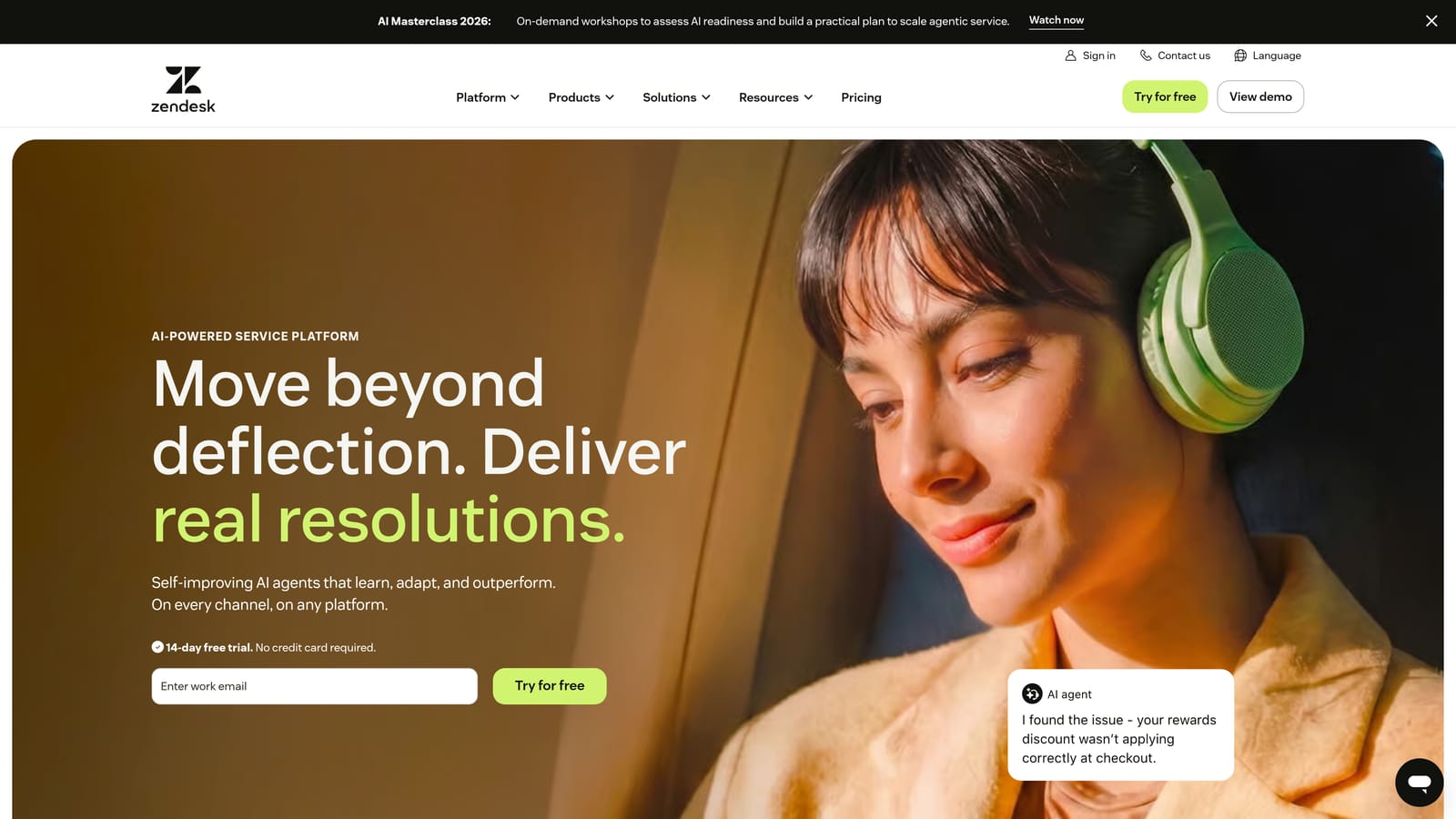
4. Zendesk
Best for: Startups with complex support workflows that plan to scale into mid-market
Zendesk is the market-leading helpdesk platform with a deep AI automation layer built on top of its enterprise-grade ticketing infrastructure.
Where This Tool Shines
Zendesk's depth is both its strength and its challenge for startups. The AI triage, routing, and automated reply capabilities are genuinely powerful, and the integration marketplace is the broadest in the category. If you're building toward a complex support operation with multiple channels, custom workflows, and detailed reporting requirements, Zendesk scales there reliably.
The Agent Copilot feature is particularly useful for teams handling nuanced conversations, providing real-time suggestions during live interactions rather than just pre-ticket automation.
Key Features
AI Triage and Routing: Intelligently categorizes and routes incoming tickets based on intent, priority, and content.
Automated Replies: AI-generated responses for common questions, reducing first-response time significantly.
Agent Copilot: Real-time AI suggestions for human agents during live conversations.
Integration Marketplace: One of the largest third-party integration libraries in the helpdesk category.
Reporting and Analytics: Robust dashboards for tracking support performance, SLA compliance, and team metrics.
Best For
Startups that are already at meaningful scale or have complex, multi-channel support requirements. Best suited for teams that anticipate growing into mid-market and want a platform that won't require a migration in 18 months.
Pricing
Starts at approximately $55/agent/month, with enterprise plans considerably higher. Pricing has increased in recent years, making it less accessible for very early-stage teams. Budget carefully if you're pre-Series A.
5. Tidio
Best for: SMB and e-commerce startups that need fast, no-code AI chat setup
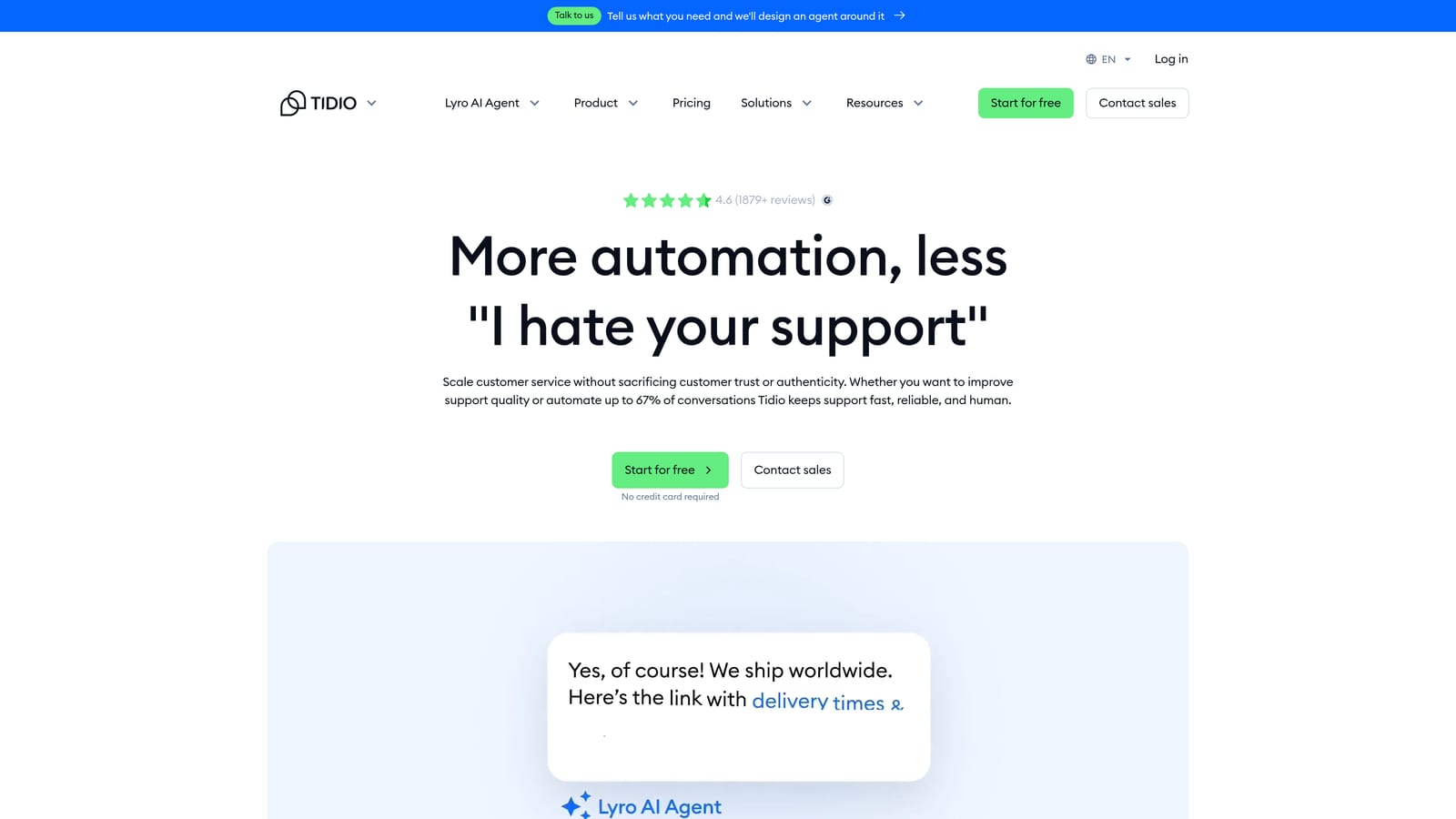
Tidio is a lightweight live chat and AI chatbot platform popular with SMBs and e-commerce startups, with Lyro AI handling common questions with minimal configuration.
Where This Tool Shines
Tidio's strongest selling point is speed-to-value. You can have Lyro AI answering common questions in hours, not days. There's no complex configuration, no dedicated ops setup required. For a small team that needs to stop answering the same five questions manually, Tidio gets the job done quickly.
The pricing is also genuinely startup-friendly at entry level. The free tier covers basic live chat, and Lyro AI plans are accessible for teams with modest support volume.
Key Features
Lyro AI: Conversational AI chatbot that handles FAQ-style questions using your existing help content.
No-Code Setup: Visual configuration with minimal technical requirements, enabling fast deployment.
Live Chat Integration: Combines AI automation with human live chat in a single interface.
Visitor Tracking: Basic analytics on visitor behavior and conversation outcomes.
Multi-Channel: Covers live chat, email, and Facebook Messenger from one dashboard.
Best For
E-commerce startups, consumer apps, and SMBs with high volumes of repetitive questions. Less suited for complex B2B SaaS support scenarios where questions require deep product knowledge or multi-turn reasoning.
Pricing
Free tier available. Lyro AI plans start at approximately $29/month, making it one of the more affordable entry points for AI-powered chat on this list.
6. Gorgias
Best for: E-commerce startups, particularly Shopify merchants needing order-aware AI support
Gorgias is a purpose-built AI customer support platform for e-commerce, with deep Shopify integration that lets AI reference live order data when resolving tickets.

Where This Tool Shines
Gorgias occupies a very specific niche and executes it exceptionally well. When a customer asks about their order status, a return, or a refund, the AI can pull live order data from Shopify and resolve the issue autonomously. That level of integration is genuinely useful for DTC brands where the majority of support volume is transactional.
The ticket-based pricing model is also worth noting. You pay per resolved ticket rather than per agent, which aligns costs with actual support activity rather than team size.
Key Features
Shopify Integration: Deep, native connection to Shopify order data, giving the AI full context for every customer inquiry.
Autonomous Returns and Refunds: AI can handle return requests and issue refunds without human intervention, within defined rules.
Ticket-Based Pricing: Pay per resolved ticket rather than per agent seat, which can be more predictable for growing teams.
Revenue Attribution: Tracks revenue influenced by support conversations, connecting support activity to business outcomes.
Multi-Channel: Email, chat, social media, and SMS support from a unified inbox.
Best For
DTC e-commerce startups and Shopify merchants where a large percentage of support volume is order-related. Not a strong fit for B2B SaaS teams, as the platform is purpose-built around e-commerce workflows.
Pricing
Starts at approximately $10/month for 50 tickets, scaling with ticket volume. The per-ticket model makes it easy to predict costs as you grow, though high-volume merchants should model total cost carefully.
7. Help Scout
Best for: Founder-led teams that want AI productivity assistance without full automation
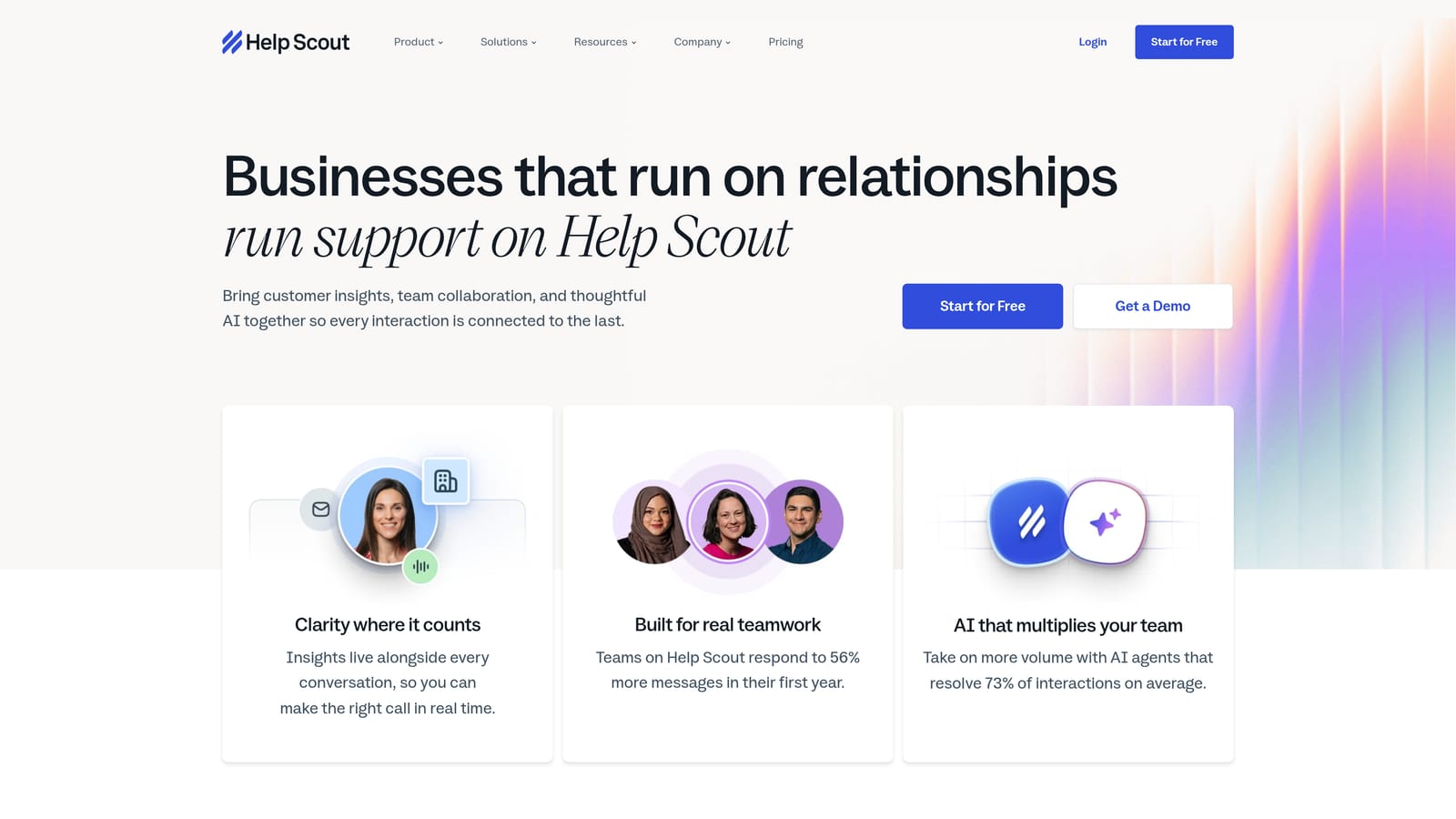
Help Scout is a clean, inbox-style helpdesk that positions AI as a productivity layer for human agents rather than a replacement for them.
Where This Tool Shines
Help Scout's philosophy is refreshingly honest: it's built for teams that care deeply about the quality of customer relationships and want AI to make their agents faster, not invisible. The interface feels like a well-organized email inbox rather than a complex enterprise system, which reduces onboarding friction considerably.
The startup pricing program is a genuine differentiator for early-stage companies. Help Scout has historically offered discounted access for startups, making it accessible at a stage where budget is tight.
Key Features
AI Drafts: Generates reply suggestions for agents to review and send, combining AI speed with human judgment.
AI Summarize: Condenses long conversation threads instantly so agents can catch up without reading every message.
AI Answers: Self-service bot powered by your help documentation for common questions.
Startup Pricing Program: Discounted access for early-stage companies, reducing the cost barrier for pre-revenue or early-revenue teams.
Clean Interface: Inbox-style design that minimizes training time and feels familiar to anyone comfortable with email.
Best For
Founder-led teams and small support teams that prioritize relationship quality and want AI to assist rather than fully automate. Also a strong fit for companies with a brand voice that requires human review before sending responses.
Pricing
Starts at approximately $22/user/month. A startup discount program is available for qualifying early-stage companies, which can meaningfully reduce the entry cost.
8. Drift (Salesloft)
Best for: B2B startups where sales and support conversations overlap significantly
Drift is a conversational AI platform that blends sales qualification and customer support in a single interface, now integrated into the Salesloft sales engagement platform.
Where This Tool Shines
Drift occupies an interesting position: it's not a pure support tool, but for B2B startups where the line between sales and support is genuinely blurry, that hybrid approach is useful. The AI can qualify an inbound lead and route a support question simultaneously, which reduces the need for separate tools during the early stages when every conversation matters.
The Bionic Chatbots feature, which combines AI reasoning with human-defined playbooks, gives teams more control over how conversations are handled without requiring full manual scripting.
Key Features
Dual-Purpose AI: Qualifies inbound leads and routes support conversations from the same interface.
Bionic Chatbots: Combines AI reasoning with human-defined conversation playbooks for more controlled automation.
Meeting Scheduling: Built-in calendar integration lets prospects and customers book meetings directly from chat.
Salesloft Integration: As part of Salesloft, Drift connects support and sales conversation data with broader sales engagement workflows.
Conversation Routing: Intelligent routing based on visitor intent, account data, and conversation context.
Best For
B2B startups with an account-based sales motion where support and sales conversations frequently overlap. Less suited for high-volume transactional support scenarios or teams that need a dedicated helpdesk rather than a conversational layer.
Pricing
Custom pricing. Drift is generally positioned at mid-market and above, so early-stage startups should request a quote and evaluate carefully against budget constraints.
9. Zoho Desk
Best for: Budget-conscious startups, especially those already using Zoho CRM
Zoho Desk is a broad-featured helpdesk with the Zia AI assistant embedded throughout, offering some of the most competitive pricing in the category.
Where This Tool Shines
For startups where budget is the primary constraint, Zoho Desk is hard to beat on price. The free tier supports up to three agents, and paid plans start at approximately $7/agent/month, well below most competitors. The Zia AI assistant goes beyond basic automation, offering sentiment analysis and anomaly detection that some pricier tools don't include at comparable tiers.
The integration with Zoho CRM is seamless for teams already in the Zoho ecosystem. If you're running sales on Zoho CRM and support on Zoho Desk, the shared data layer creates a unified customer view without additional configuration.
Key Features
Zia AI Assistant: Provides sentiment analysis, anomaly detection, and reply suggestions across your support queue.
Zoho Ecosystem Integration: Native, deep integration with Zoho CRM and the broader Zoho product suite.
Multi-Channel Support: Email, chat, phone, social media, and a self-service portal all managed from one platform.
Workflow Automation: Rule-based automation for ticket routing, escalation triggers, and SLA management.
Free Tier: Supports up to three agents at no cost, providing a genuine starting point for very small teams.
Best For
Budget-first startups, teams already using Zoho CRM or other Zoho products, and companies that need solid multi-channel coverage without enterprise pricing. The value proposition is strongest within the Zoho ecosystem.
Pricing
Free tier available for up to three agents. Paid plans start at approximately $7/agent/month, making Zoho Desk one of the most affordable full-featured options on this list.
Which Tool Is Right for Your Startup?
The right AI customer service tool depends almost entirely on your startup's specific context. Here's a quick guide by archetype to help you narrow it down.
B2B SaaS startups: Halo AI is purpose-built for this use case. The page-aware context, continuous learning, Linear integration, and business intelligence signals address the specific challenges of SaaS support in a way that generic helpdesks don't. If you're evaluating multiple options, it's worth seeing it in action before defaulting to a legacy platform.
E-commerce and Shopify merchants: Gorgias is the clear choice. The order-aware AI automation is genuinely differentiated for transactional support, and the ticket-based pricing aligns well with e-commerce volume patterns.
Product-led growth teams: Intercom's combination of in-app messaging and Fin AI works well for PLG motions where the product itself is the primary support surface. Teams already using Intercom for onboarding and engagement should evaluate Fin before switching platforms.
Budget-first or early-stage teams: Freshdesk's free tier or Zoho Desk's low per-agent pricing offer the most accessible starting points. Help Scout is worth considering if relationship quality matters more than full automation.
Your support team shouldn't scale linearly with your customer base. Let AI agents handle routine tickets, guide users through your product, and surface business intelligence while your team focuses on complex issues that need a human touch. See Halo in action and discover how continuous learning transforms every interaction into smarter, faster support.