9 Best AI Customer Service Software Options in 2026
This guide evaluates nine of the strongest AI customer service software options available in 2026, comparing platforms on automation depth, integration breadth, deployment ease, and scalability for B2B SaaS teams. Whether you're augmenting an existing helpdesk or building an AI-first support operation from scratch, these picks help you find the right fit.
 Grant CooperFounder13 min read
AI customer service software has moved well beyond simple chatbots. Today's platforms can resolve tickets autonomously, guide users through complex workflows, detect churn signals, and hand off seamlessly to human agents — all without scaling headcount. But with dozens of options on the market, choosing the right one depends heavily on your stack, team size, and support complexity.
This guide covers nine of the strongest AI customer service platforms available in 2026, evaluated on automation depth, integration breadth, ease of deployment, and how well they scale with growing B2B SaaS teams. Whether you're replacing a legacy helpdesk, augmenting an existing Zendesk or Intercom setup, or building an AI-first support operation from scratch, this list will help you find the right fit.
1. Halo AI
Best for: B2B SaaS teams wanting AI-first support with built-in business intelligence
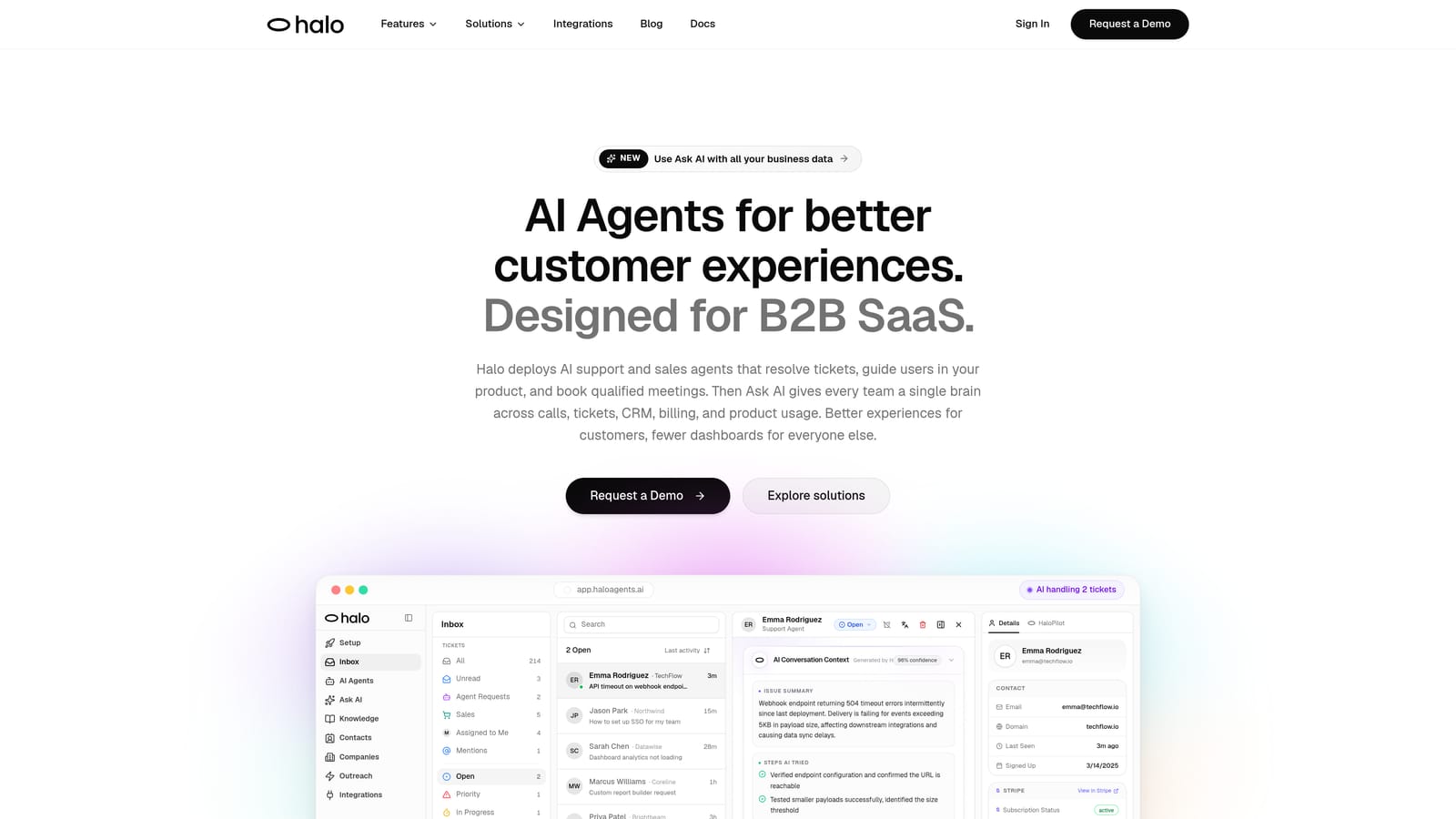
Halo AI is an AI-first customer support platform built specifically for B2B SaaS teams, deploying intelligent agents that resolve tickets, guide users, and surface business intelligence — all from a single platform.
Where This Tool Shines
What separates Halo from most platforms on this list is its architecture. Rather than bolting AI onto an existing helpdesk, Halo was built with AI as the core. That distinction matters in practice: the system learns continuously from every interaction, improving resolution quality over time rather than staying static.
The page-aware chat widget is a standout feature. The AI sees what the user sees on the page, enabling contextual guidance that goes far beyond generic knowledge base responses. Combined with the smart inbox's business intelligence layer, Halo turns support interactions into a source of product and revenue insight — something most support platforms don't even attempt.
Key Features
Page-Aware Chat Widget: The AI reads the user's current page context to deliver relevant, specific guidance rather than generic answers.
Autonomous Ticket Resolution: AI agents handle tickets end-to-end with continuous learning built in, improving with every resolved interaction.
Auto Bug Ticket Creation: Support issues are automatically converted into bug tickets routed directly to Linear or GitHub, closing the loop between support and engineering.
Smart Inbox with Business Intelligence: Surfaces customer health signals, revenue anomalies, and churn indicators alongside standard support metrics.
Live Agent Handoff: Escalates complex issues to human agents with full conversation context preserved, so nothing gets lost in the transition.
Broad Integration Stack: Connects natively with Linear, Slack, HubSpot, Intercom, Stripe, Zoom, PandaDoc, and Fathom.
Best For
Halo is best suited for B2B SaaS companies and product-led growth teams that want support to do more than deflect tickets. If you want your support data to inform your product roadmap, flag revenue risk, and integrate with your full business stack, Halo is built for exactly that use case.
Pricing
Contact Halo AI for pricing. Given the platform's enterprise-grade feature depth and integration breadth, expect custom pricing based on usage and team size.
2. Intercom
Best for: SaaS teams wanting AI resolution built into a unified communications platform
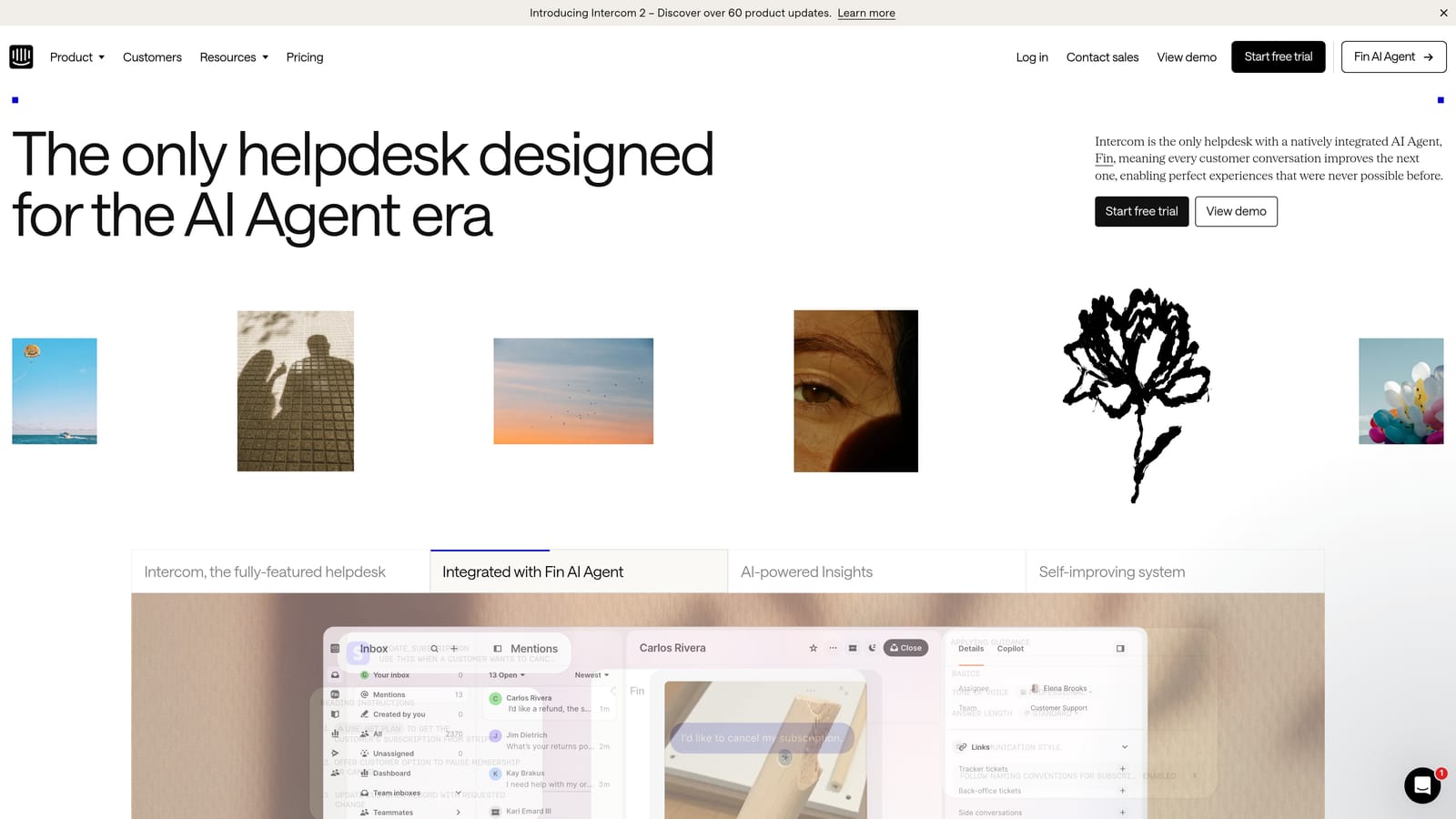
Intercom is a mature AI-assisted messaging and support platform featuring Fin, its LLM-powered AI agent, designed for SaaS companies that want strong conversation resolution within a unified customer communications hub.
Where This Tool Shines
Intercom's strength is its breadth. It handles sales, marketing, and support conversations in one place, making it a natural fit for teams already using Intercom across multiple functions. Fin, its AI agent, handles autonomous ticket resolution for common SaaS queries and has improved significantly since its initial launch.
The AI Copilot feature assists live agents with response drafting and summarization, which helps teams that handle a mix of simple and complex tickets. The unified inbox across chat, email, and social keeps everything in one place without requiring separate tools.
Key Features
Fin AI Agent: LLM-powered autonomous resolution for common support queries, trained on your help center content.
AI Copilot: Assists human agents with response drafting, summarization, and next-step suggestions.
Unified Inbox: Consolidates chat, email, and social support channels into a single workspace.
Knowledge Base Integration: Fin draws directly from your help center, making content quality a key factor in resolution performance.
Usage-Based Fin Pricing: Fin AI is charged per resolution, giving teams flexibility but requiring careful volume monitoring at scale.
Best For
Teams already embedded in the Intercom ecosystem will get the most value here. If you're using Intercom for sales and marketing conversations, adding Fin for support resolution is a natural extension rather than a new platform decision.
Pricing
Starts at $29/seat/month for the base platform. Fin AI is charged per resolution, so costs scale with usage volume.
3. Zendesk AI
Best for: Large support teams with existing Zendesk infrastructure seeking AI augmentation
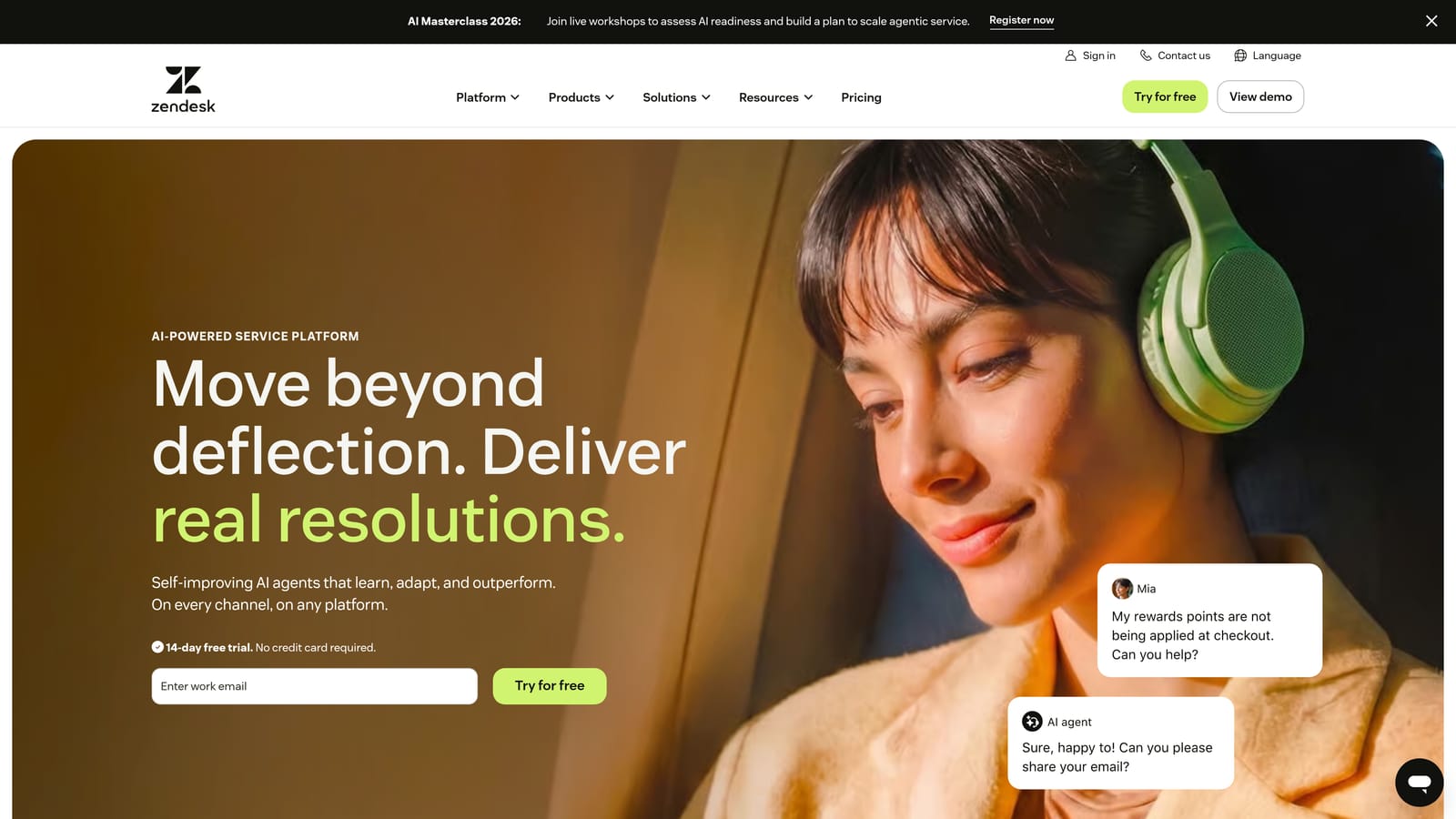
Zendesk AI is enterprise-grade AI layered onto the Zendesk Suite, offering intelligent triage, agent copilot capabilities, and automated responses for teams already invested in the Zendesk ecosystem.
Where This Tool Shines
Zendesk's AI is an augmentation layer, not a replacement architecture. For teams with years of Zendesk data, workflows, and integrations, that's actually an advantage: the AI can be activated without migrating platforms or retraining staff on new systems.
The intelligent triage and routing capabilities are particularly strong for high-volume support orgs. Tickets get classified, prioritized, and routed before agents touch them, which reduces manual queue management significantly. Enterprise compliance, security controls, and SLA management remain Zendesk's core differentiators for regulated industries.
Key Features
Intelligent Triage and Routing: AI classifies and routes incoming tickets based on intent, sentiment, and priority before agents engage.
AI Agent (formerly Answer Bot): Self-service deflection for common queries, drawing from your knowledge base.
Agent Copilot: Assists human agents with response drafting and ticket summarization.
Advanced Analytics: Reporting and performance dashboards for support operations at scale.
Enterprise Compliance: Security, SLA management, and governance controls suited for regulated industries.
Best For
Zendesk AI makes the most sense for enterprises already running Zendesk Suite who want to add AI capabilities without switching platforms. Teams evaluating Zendesk from scratch should weigh the add-on pricing structure carefully against AI-native alternatives.
Pricing
Suite plans start at $55/agent/month. AI features are available as add-ons, so total cost depends on which AI capabilities you activate.
4. Freshdesk Freddy AI
Best for: SMBs and growing teams wanting accessible AI support without enterprise pricing
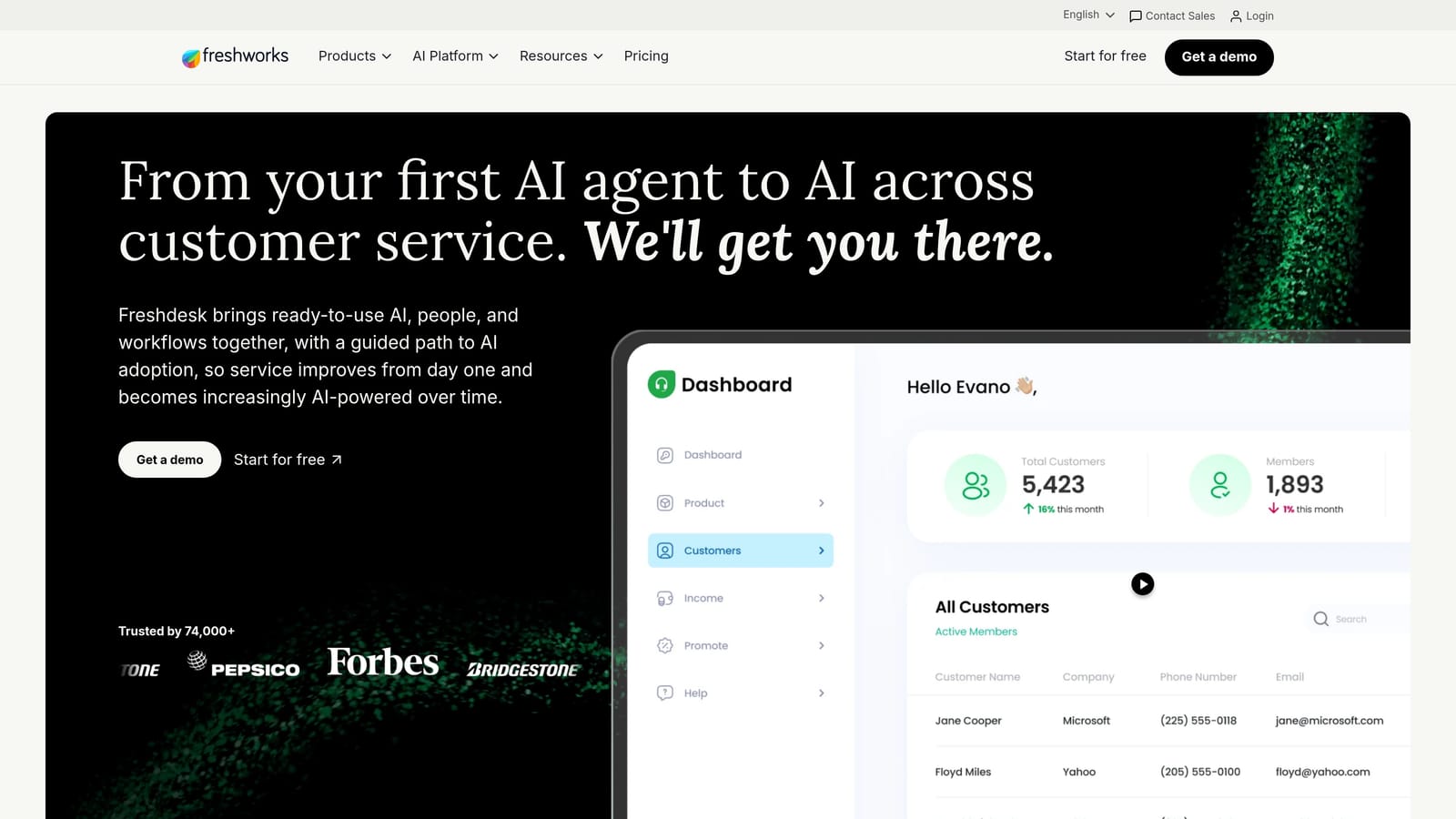
Freshdesk Freddy AI is Freshworks' AI layer across the Freshdesk support platform, combining self-service bots, agent assist, and analytics at pricing that works for smaller teams.
Where This Tool Shines
Freddy AI spans three distinct functions: self-service deflection, agent assistance, and analytics. That breadth at Freshdesk's price point makes it one of the more accessible options on this list for teams that don't need enterprise-grade complexity but do need real AI capabilities.
The cross-suite integration across Freshdesk, Freshchat, and Freshsales is valuable for teams using multiple Freshworks products. Freddy Insights adds anomaly detection to the analytics layer, giving ops teams early warning signals without requiring a separate analytics tool.
Key Features
Freddy Self Service: AI-powered bot for ticket deflection, trained on your knowledge base content.
Freddy Copilot: Agent assist for response drafting and ticket summarization.
Freddy Insights: AI-powered analytics with anomaly detection and performance signals.
Omnichannel Support: Handles email, chat, phone, and social channels from a unified workspace.
Cross-Suite AI: Freddy capabilities extend across Freshdesk, Freshchat, and Freshsales for teams using the full Freshworks stack.
Best For
SMBs and growing teams that want meaningful AI capabilities without Zendesk or Salesforce pricing. Also a strong fit for teams already using other Freshworks products who want to consolidate their stack.
Pricing
Free plan available. Paid plans start at $15/agent/month. Freddy AI is available as an add-on, with pricing depending on which Freddy modules you enable.
5. Tidio
Best for: Small businesses and e-commerce teams needing fast, no-code AI deployment
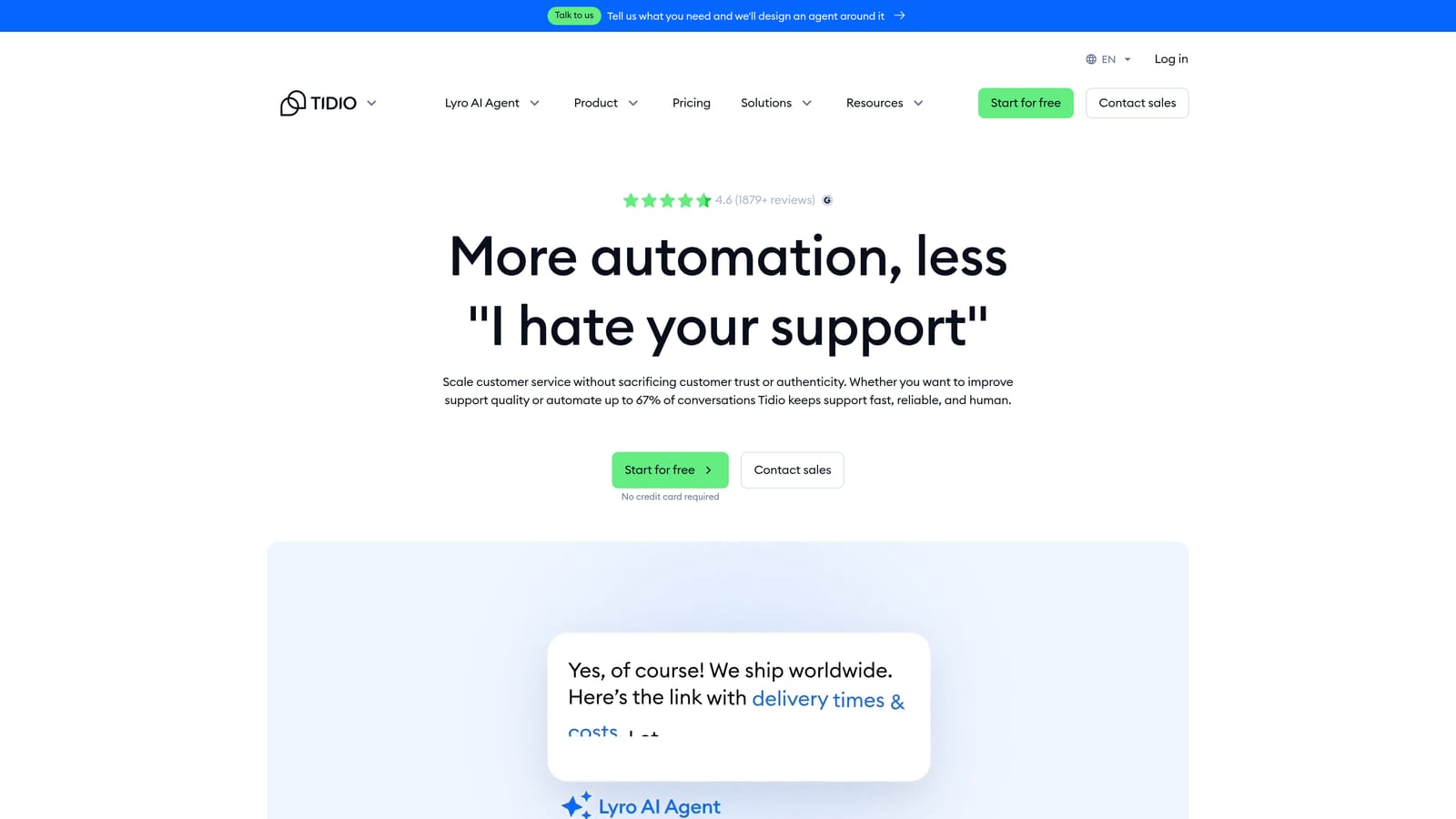
Tidio is a lightweight AI customer service platform built around Lyro, its AI chatbot powered by Claude from Anthropic, designed for rapid deployment without technical overhead.
Where This Tool Shines
Tidio's primary advantage is speed of deployment. No-code setup and native integrations with Shopify, WordPress, and WooCommerce mean an e-commerce team can have Lyro handling conversations within hours, not weeks. For small businesses that need AI support without a dedicated ops team to configure it, that simplicity is genuinely valuable.
Lyro handles automated conversation management for common queries, with live chat fallback to human agents when needed. Visitor analytics and behavior tracking add a layer of insight that helps small teams understand what their customers are asking about before they even submit a ticket.
Key Features
Lyro AI Chatbot: Automated conversation handling powered by Claude, trained on your support content.
No-Code Setup: Integrates with Shopify, WordPress, and WooCommerce without developer involvement.
Live Chat Fallback: Seamlessly hands off to human agents when Lyro reaches its limits.
Visitor Analytics: Tracks visitor behavior and conversation patterns to surface common issues.
Email and Social Support: Extends beyond chat to email and social channel management.
Best For
Small businesses and e-commerce teams that need fast, affordable AI support without complex configuration. Tidio is less suited for B2B SaaS teams with complex technical support workflows or enterprise compliance requirements.
Pricing
Free plan available. Lyro AI starts at $29/month, making it one of the more affordable AI-powered options on this list.
6. Kustomer
Best for: High-volume consumer brands wanting CRM-native support organized around the customer timeline
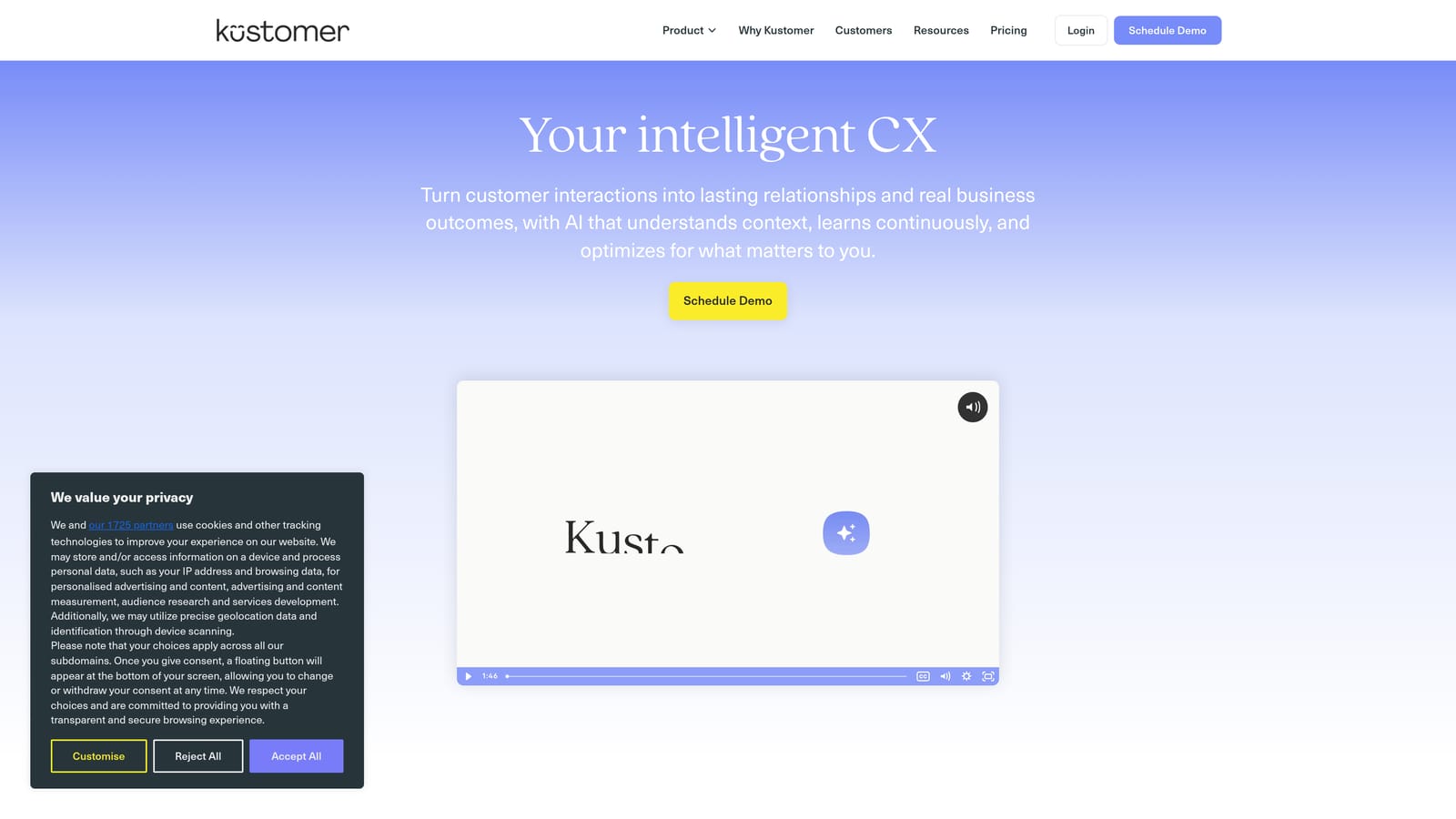
Kustomer is a CRM-native customer service platform that organizes support around the full customer timeline rather than individual tickets, with AI automation for routing, macros, and self-service.
Where This Tool Shines
Kustomer's core model is fundamentally different from ticket-centric platforms. Every interaction is organized around the customer's full history, giving agents immediate context without digging through separate systems. For high-volume consumer brands handling repeat customers, that timeline view significantly changes how agents approach each conversation.
AI automation handles routing, macro suggestions, and common query deflection, reducing manual triage for large teams. The deep CRM data integration means AI routing decisions are informed by customer history, purchase data, and interaction patterns rather than just the content of the current message. Note for enterprise buyers: Kustomer was acquired by Meta in 2022 and subsequently sold to a private equity group, so ownership stability is worth factoring into long-term platform decisions.
Key Features
Unified Customer Timeline: All interactions across every channel organized chronologically around the customer, not the ticket.
AI-Powered Routing: Conversation classification and routing based on intent and customer data.
Automated Workflows: Macro suggestions and workflow automation for repetitive support tasks.
Self-Service AI: Deflects common queries before they reach the agent queue.
Deep CRM Integration: Support decisions informed by full customer data, not just the current conversation.
Best For
High-volume consumer brands, DTC retailers, and subscription businesses with complex customer histories. Less suited for pure B2B SaaS teams with technical support needs and smaller customer volumes.
Pricing
Enterprise pricing. Contact Kustomer directly for a quote based on your team size and usage requirements.
7. Forethought
Best for: Support ops teams optimizing existing Zendesk or Salesforce workflows with AI triage
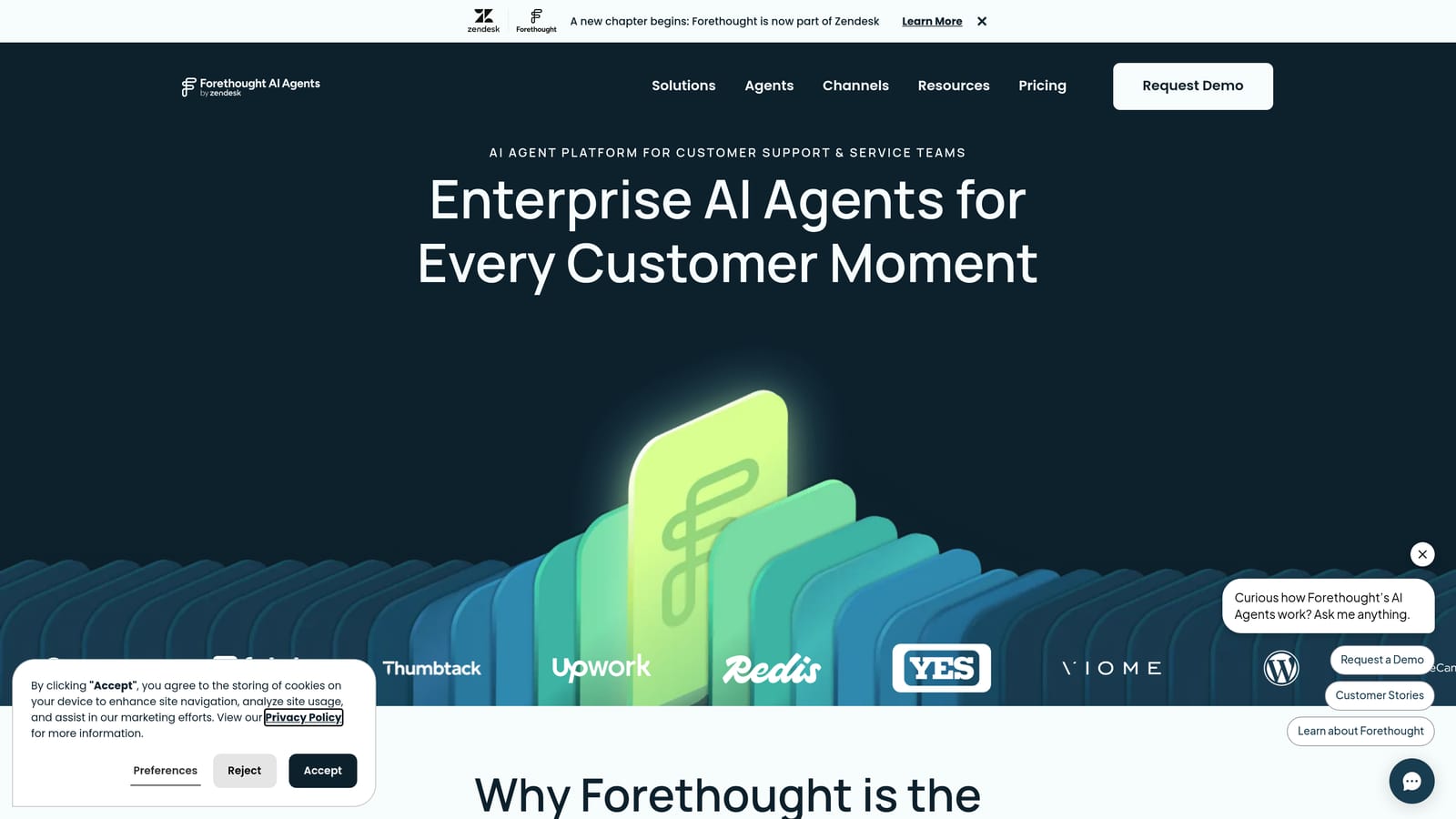
Forethought is an AI triage and deflection platform designed to layer on top of existing helpdesks, predicting ticket intent and routing before agents are ever involved.
Where This Tool Shines
Forethought takes a different approach from most platforms on this list: rather than replacing your helpdesk, it makes your existing one smarter. The Solve AI module handles autonomous resolution of common tickets, while Triage AI predicts intent and routes tickets intelligently before any human sees them. For teams with mature Zendesk or Salesforce setups that want AI augmentation without platform migration, this is a compelling model.
The Discover AI module adds a knowledge gap identification layer, surfacing where your help content is falling short based on actual ticket patterns. That feedback loop helps support ops teams continuously improve deflection rates without guessing what to document next.
Key Features
Solve AI: Autonomous resolution of common tickets without agent involvement.
Triage AI: Intent prediction and intelligent routing before tickets reach the agent queue.
Assist AI: Agent copilot for suggested responses and next-step guidance.
Discover AI: Analytics module that identifies knowledge gaps and content opportunities from ticket patterns.
Native Integrations: Connects directly with Zendesk, Salesforce Service Cloud, and ServiceNow.
Best For
Enterprise support operations teams running Zendesk, Salesforce, or ServiceNow who want to add sophisticated AI triage and deflection without changing their core platform. Not the right fit for teams looking to replace their helpdesk entirely.
Pricing
Enterprise pricing. Contact Forethought for a quote based on ticket volume and integration requirements.
8. Help Scout
Best for: Small SaaS teams and startups wanting a clean, simple support tool with light AI assist
Help Scout is a human-first support platform with AI assist features added, offering a clean email-centric interface that prioritizes simplicity over automation depth.
Where This Tool Shines
Help Scout's value proposition is clarity. The shared inbox is straightforward, the learning curve is minimal, and the pricing is transparent. For small SaaS teams that don't need complex AI automation but do want AI to help agents work faster, Help Scout's AI Summarize and AI Drafts features hit the right level of assistance without overwhelming the workflow.
AI Answers extends that assistance to customers through knowledge base self-service, deflecting common questions before they reach the inbox. It's worth being clear: Help Scout is not an AI-first platform. AI is supplementary here, not the core. Teams that want deep autonomous resolution should look elsewhere on this list.
Key Features
AI Summarize: Instantly condenses long ticket threads so agents get context without reading every message.
AI Drafts: Suggests response drafts for agents to review, edit, and send.
AI Answers: Knowledge base self-service powered by AI for common customer queries.
Shared Inbox with Collision Detection: Prevents two agents from responding to the same ticket simultaneously.
Docs Knowledge Base: Clean help center builder with AI-enhanced search for customers.
Best For
Early-stage startups and small SaaS teams that want a clean, reliable support inbox with helpful AI assist features. Teams expecting deep autonomous resolution or complex routing will find Help Scout's AI capabilities too limited.
Pricing
Starts at $22/user/month. Pricing is transparent and predictable, which is a genuine advantage for budget-conscious teams.
9. Salesforce Service Cloud Einstein
Best for: Large enterprises already on Salesforce CRM needing deep AI across case management
Salesforce Service Cloud Einstein is an enterprise AI customer service platform deeply embedded in the Salesforce ecosystem, with Einstein AI spanning case management, routing, knowledge, and agent copilot.
Where This Tool Shines
For enterprises already running Salesforce CRM, Service Cloud Einstein removes the integration overhead that makes AI support tools complex to deploy. Einstein AI has direct access to the full Salesforce data model: customer records, sales history, account health, and service interactions all inform routing and agent assist decisions in real time.
Einstein Copilot for Service brings generative AI into the agent workflow, drafting responses and summarizing cases using the full context of the customer relationship rather than just the current ticket. Einstein Case Classification handles AI-powered routing and prioritization at scale, which is where the platform's enterprise architecture becomes a genuine advantage over lighter-weight tools.
Key Features
Einstein Copilot for Service: Generative AI agent assist that draws on full Salesforce CRM context for response drafting and case summarization.
Einstein Case Classification: AI-powered routing and prioritization based on case content and customer data.
Einstein Article Recommendations: Surfaces relevant knowledge base articles to agents and customers in real time.
Unified Salesforce Data: Support decisions informed by CRM, sales, and service data in a single platform.
Enterprise Compliance and Governance: Security controls, audit trails, and governance features for regulated industries.
Best For
Large enterprises already invested in the Salesforce ecosystem. For teams not already on Salesforce, the implementation complexity and pricing make this a difficult choice to justify against more focused alternatives.
Pricing
Starts at $25/user/month for base Service Cloud. Einstein AI features are available on higher tiers, so the effective cost for full AI capabilities is considerably higher.
Which Tool Is Right for Your Team
The right AI customer service platform depends less on which tool has the most features and more on where you're starting from and where you want to go.
If you're a B2B SaaS team building an AI-first support operation, Halo AI is the strongest fit. The page-aware context, continuous learning architecture, auto bug ticket creation, and business intelligence layer go well beyond ticket deflection. It's built for teams that want support to inform product decisions and surface revenue signals, not just reduce queue volume.
If you're augmenting an existing enterprise helpdesk, the right choice depends on your stack. Zendesk AI works well for teams already deep in the Zendesk ecosystem. Forethought is the better pick if you want sophisticated AI triage layered on top of Zendesk or Salesforce without replacing either. Salesforce Service Cloud Einstein is the obvious choice for enterprises already running Salesforce CRM.
For SMBs and growing teams that need accessible pricing, Freshdesk Freddy AI offers strong capabilities at a lower cost of entry. Help Scout is the right call for small teams that want simplicity and clean AI assist without complex configuration.
For e-commerce and small business use cases, Tidio's no-code setup and Lyro AI make it the fastest path to automated customer conversations. Kustomer is the better fit for high-volume consumer brands that need CRM-native support organized around customer history.
Your support team shouldn't scale linearly with your customer base. Let AI agents handle routine tickets, guide users through your product, and surface business intelligence while your team focuses on complex issues that need a human touch. See Halo in action and discover how continuous learning transforms every interaction into smarter, faster support.