9 Best AI Customer Service Software Packages in 2026
AI customer service software packages have evolved far beyond basic chatbots into full-stack support systems capable of autonomous ticket resolution, deep integrations, and actionable business intelligence. This guide reviews the nine strongest platforms available in 2026, evaluated on autonomy depth, scalability, and real-world fit for B2B SaaS teams of every size.
 Matt PattoliFounder13 min read
The old helpdesk model, where agents manually triage every ticket, is breaking under the volume demands of modern SaaS businesses. AI customer service software packages have matured from simple chatbots into full-stack support systems that resolve tickets autonomously, surface business intelligence, and hand off to humans only when it truly matters.
This list covers nine of the strongest AI customer service platforms available in 2026, evaluated on autonomy depth, integration breadth, ease of deployment, and how well each tool scales without scaling headcount. Whether you're running a lean startup or managing enterprise support at scale, there's a package here built for your situation.
Selection criteria: genuine AI-first architecture rather than bolt-on automation, meaningful integrations, transparent pricing, and real-world utility for B2B SaaS and product teams. Pricing figures are directional and should be verified against each tool's current pricing page before making decisions.
1. Halo AI
Best for: B2B SaaS teams that need autonomous ticket resolution with business intelligence built in
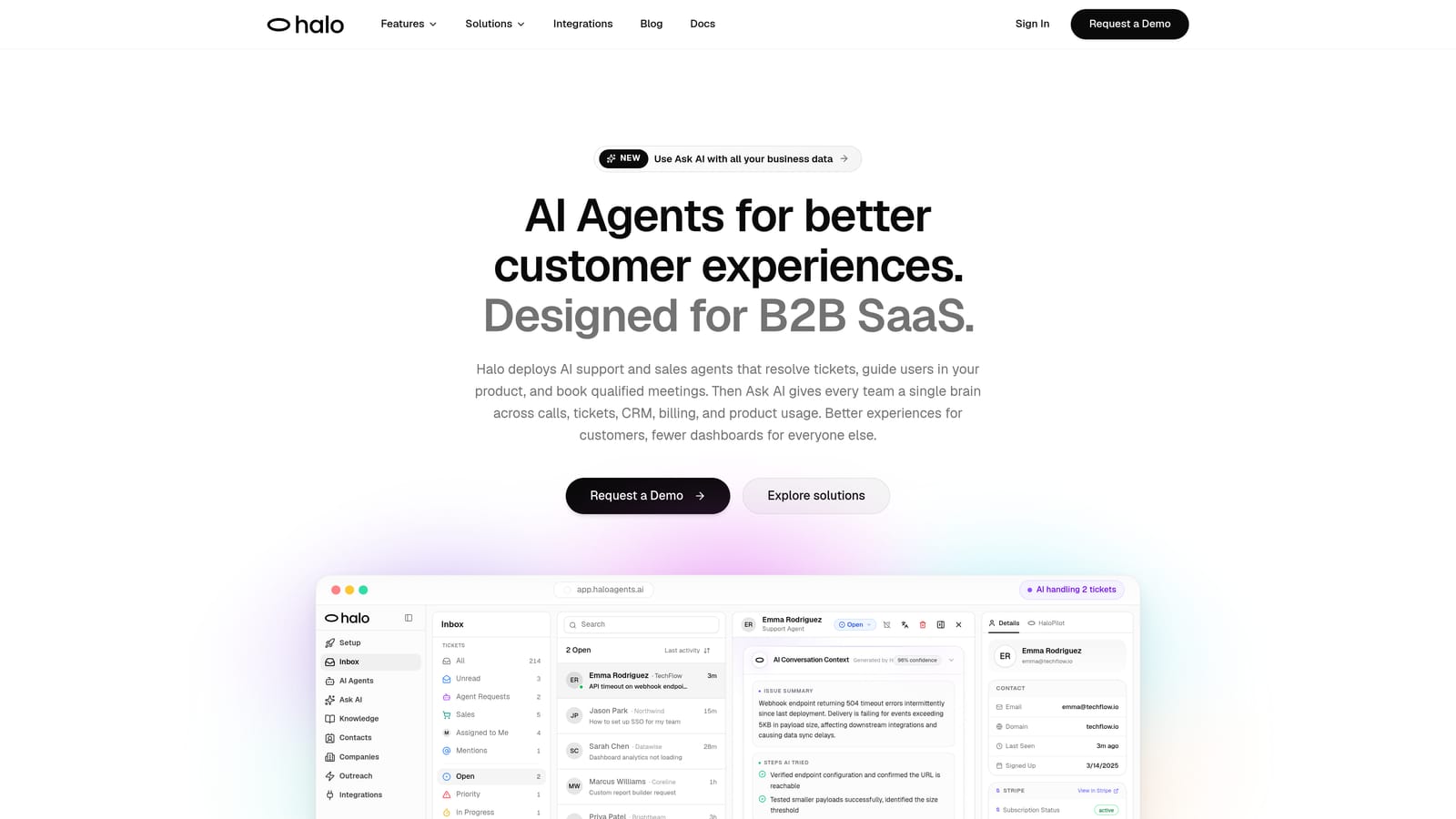
Halo AI is an AI-first customer support platform that deploys intelligent agents to resolve tickets autonomously, guide users visually through your product, and surface business intelligence — all while learning from every interaction.
Where This Tool Shines
What separates Halo from the AI-layered helpdesks on this list is the architecture. It was built AI-first, without legacy ticketing infrastructure underneath. That means the AI isn't fighting against a decade-old data model to do its job. Every resolved interaction feeds back into the system, making it progressively smarter over time rather than static.
The page-aware chat widget is a standout capability. The AI sees what the user sees on screen, enabling contextual visual guidance rather than generic help center links. Combined with the smart inbox that surfaces customer health signals, revenue anomalies, and churn indicators, Halo provides intelligence that extends well beyond support into broader business awareness.
Key Features
Page-Aware Chat Widget: The AI sees the user's current screen context, enabling precise visual guidance rather than generic responses.
Autonomous Ticket Resolution: Resolves support tickets end-to-end with intelligent escalation to live agents when complexity warrants it.
Smart Inbox with Business Intelligence: Surfaces customer health signals, revenue anomalies, and churn indicators directly from support data.
Auto Bug Ticket Creation: Converts user-reported issues into structured bug reports automatically, reducing manual work for product and engineering teams.
Full Business Stack Integrations: Connects to Linear, Slack, HubSpot, Intercom, Stripe, Zoom, PandaDoc, and Fathom for cross-functional context.
Best For
B2B SaaS companies and product teams that want autonomous support from day one, particularly those frustrated with bolt-on AI that inherits the limitations of legacy helpdesk architecture. Also a strong fit for teams that want support data to feed broader business intelligence rather than living in a silo.
Pricing
Pricing is not publicly listed. Contact Halo directly for a quote, which is typical for AI-first platforms with enterprise-adjacent feature depth.
2. Intercom (Fin AI)
Best for: Teams already using Intercom as their primary support and messaging channel
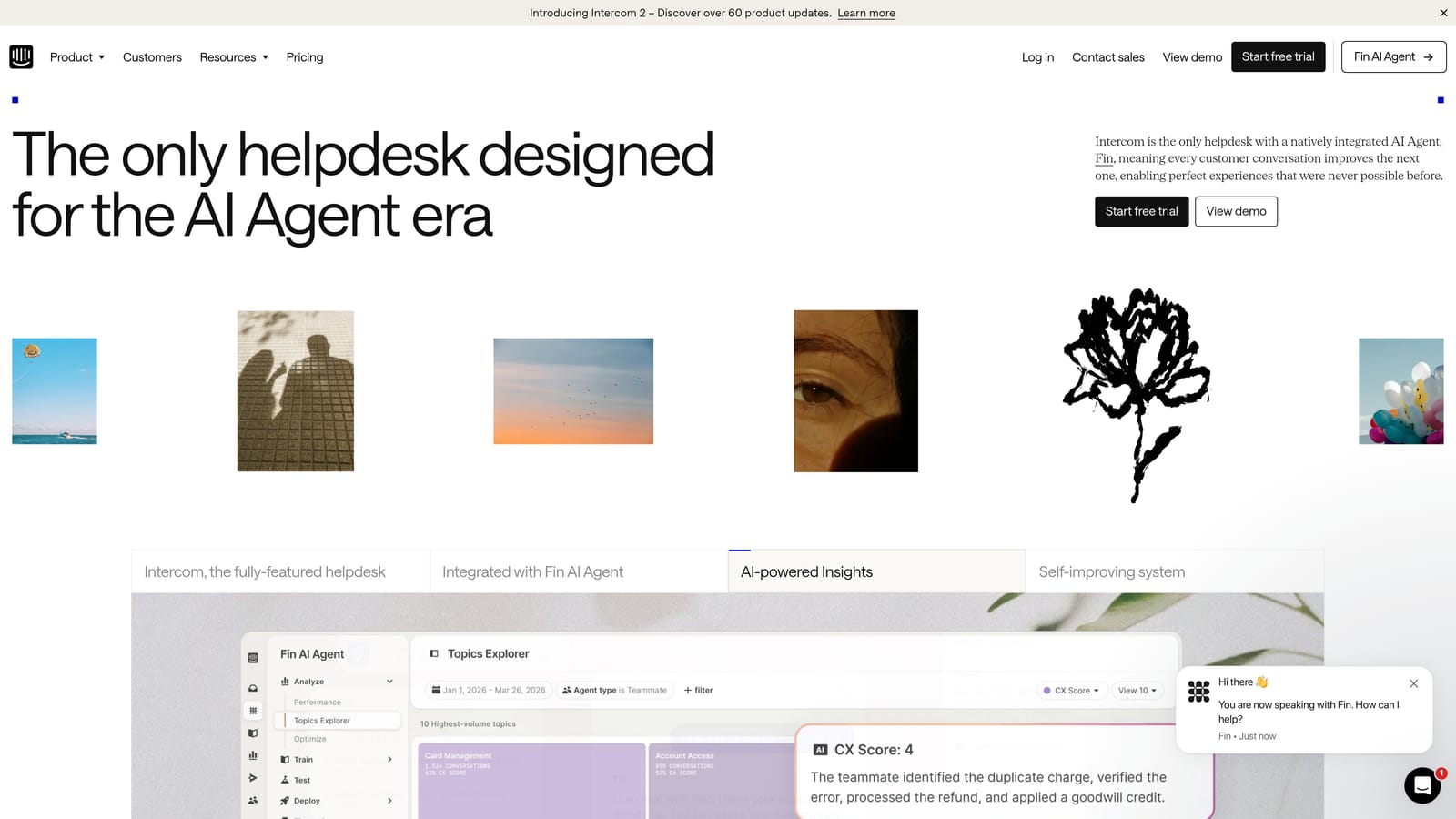
Intercom is a customer communications platform whose Fin AI agent resolves common queries from help center content and hands off to human agents within the same conversation interface.
Where This Tool Shines
Fin's greatest strength is how naturally it fits into an existing Intercom workflow. If your team already lives in the Intercom inbox, adding Fin doesn't require a new platform or a new process. The AI trains on your existing help center content, and handoffs to human agents happen within the same conversation thread with no context loss.
The usage-based pricing model, charged per resolution, also makes it easy to evaluate ROI directly. You pay for outcomes rather than seats, which aligns incentives reasonably well for support teams focused on deflection rates.
Key Features
Fin AI Agent: Trained on your help center content to resolve common queries without human intervention.
Native Messenger Integration: Operates within Intercom's existing messenger and inbox, requiring no separate interface.
Seamless Human Handoff: Escalates to human agents within the same conversation thread, preserving full context.
Usage-Based Pricing: Charged per resolution rather than per seat, making cost tracking straightforward.
Ecosystem Depth: Strong for teams that use Intercom for sales, onboarding, and support in a unified workflow.
Best For
Companies already invested in the Intercom ecosystem that want to add AI resolution capabilities without changing platforms. Less suited to teams looking for cross-stack business intelligence or AI that operates outside the Intercom environment.
Pricing
Fin AI is charged per resolution on top of base Intercom plans. Base plans start at approximately $39 per seat per month. Verify current pricing at intercom.com before purchasing.
3. Zendesk AI
Best for: Large support organizations with complex ticket routing and existing Zendesk infrastructure
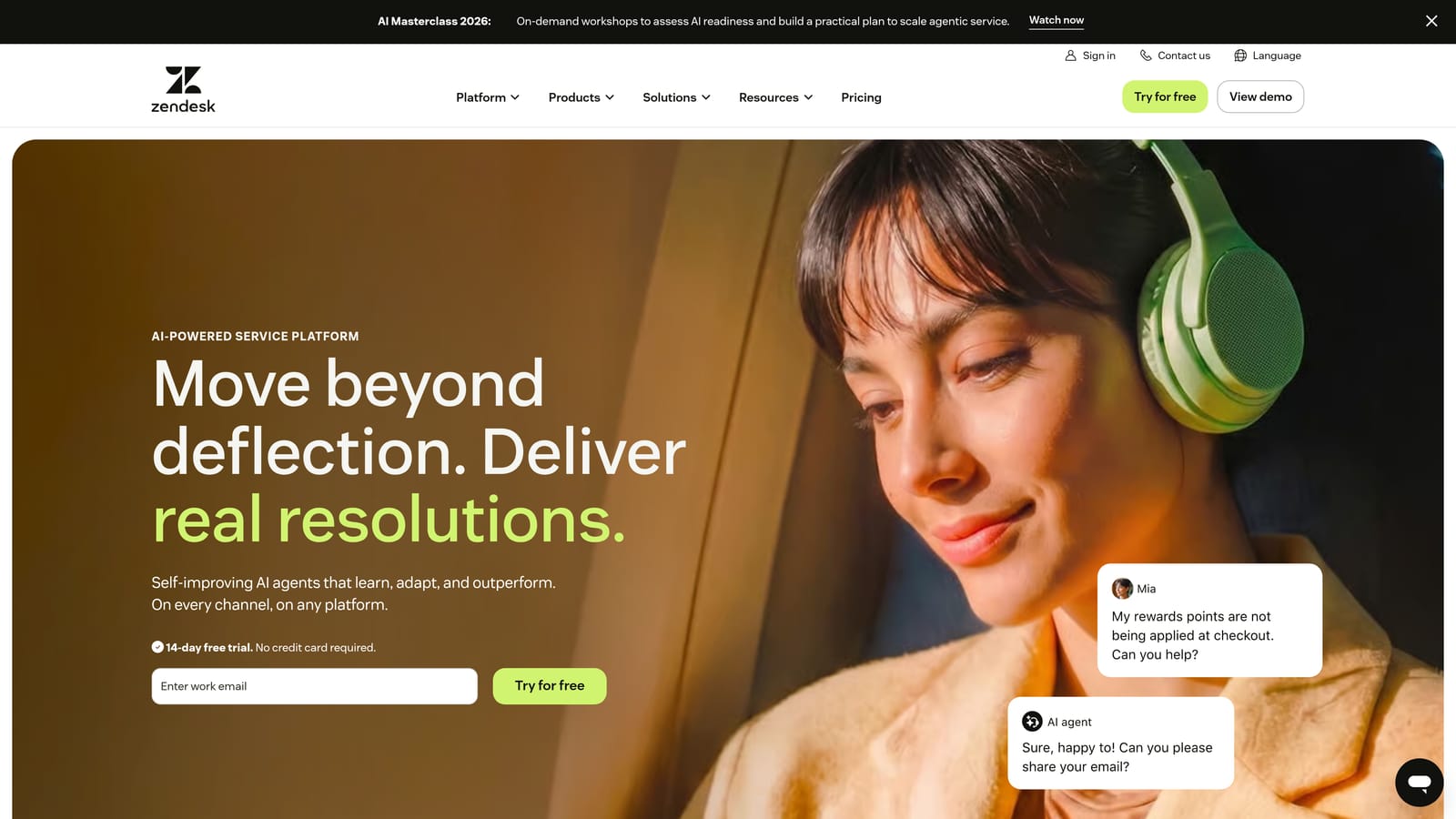
Zendesk layers intent detection, intelligent triage, agent assist, and a generative AI bot onto its mature enterprise ticketing infrastructure.
Where This Tool Shines
Zendesk's AI suite benefits from years of enterprise helpdesk data and deeply configurable routing logic. For large support organizations with complex tier structures, regional routing, and strict SLA requirements, the underlying infrastructure is genuinely hard to match. The Agent Copilot provides in-context response suggestions that help agents move faster without removing human judgment from the loop.
The tradeoff is configuration complexity. Zendesk AI is powerful, but it's layered onto a legacy ticketing architecture. Teams sometimes find that the AI capabilities require significant setup to work well, particularly if existing workflows have accumulated years of technical debt.
Key Features
Intelligent Triage: Detects intent and sentiment automatically to route tickets to the right team or workflow.
Agent Copilot: Provides in-context response suggestions to human agents during live ticket handling.
Generative AI Bot: Handles self-service deflection using your knowledge base and help center content.
Deep Routing Logic: Highly configurable ticket routing for complex multi-tier support organizations.
Suite Integration: AI features available across Suite Professional and above, with some as add-ons.
Best For
Enterprise support teams already on Zendesk that want to add AI capabilities without migrating platforms. Also suitable for organizations with complex routing requirements that benefit from Zendesk's mature configuration options.
Pricing
Suite Professional starts at approximately $115 per agent per month. AI features are included in some tiers and available as add-ons in others. Verify current pricing at zendesk.com.
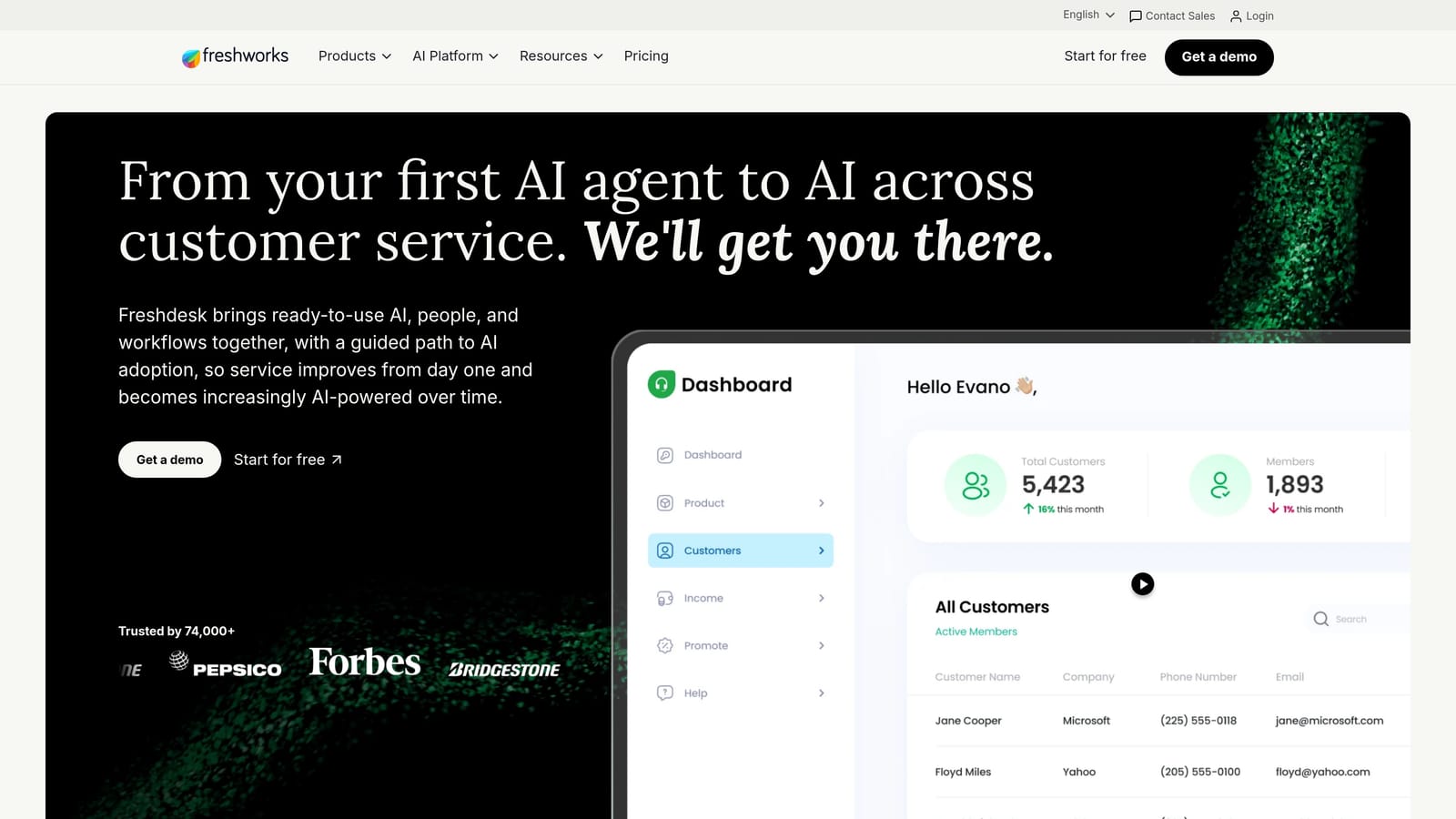
4. Freshdesk Freddy AI
Best for: Growing teams in the Freshworks ecosystem looking for accessible AI at a competitive price point
Freshdesk offers Freddy AI as a layered intelligence system spanning self-service deflection, agent assist, and analytics insights across the Freshworks product suite.
Where This Tool Shines
Freddy AI's appeal is its breadth across the Freshworks ecosystem. If your team uses Freshdesk for support, Freshsales for CRM, and Freshservice for ITSM, Freddy provides a consistent AI layer across all three rather than requiring separate tools. Freddy Insights adds anomaly detection and analytics that surface patterns in support data without requiring a dedicated analyst.
The pricing is also notably more accessible than Zendesk at comparable feature levels, which makes Freshdesk Freddy a practical choice for mid-market teams that want real AI capability without enterprise-tier spend.
Key Features
Freddy Self Service: AI-powered bot for deflection trained on your knowledge base and support documentation.
Freddy Copilot: Agent assist for drafting replies, summarizing threads, and suggesting next-best actions.
Freddy Insights: Analytics and anomaly detection across support data to surface trends and issues.
Cross-Product Coverage: Spans Freshdesk, Freshsales, and Freshservice for teams using multiple Freshworks products.
Competitive Pricing: Generally more affordable than enterprise alternatives at equivalent feature levels.
Best For
SMB and mid-market teams already in the Freshworks ecosystem, or those evaluating Freshworks as a more affordable alternative to Zendesk. Strong fit for teams that want AI across support, CRM, and ITSM from a single vendor.
Pricing
Freddy Copilot is available as an add-on from approximately $29 per agent per month. Freddy Self Service bots are included in higher-tier plans. Verify current pricing at freshdesk.com.
5. Tidio (Lyro AI)
Best for: SMBs and e-commerce teams that need fast, no-code AI deployment with a free entry point
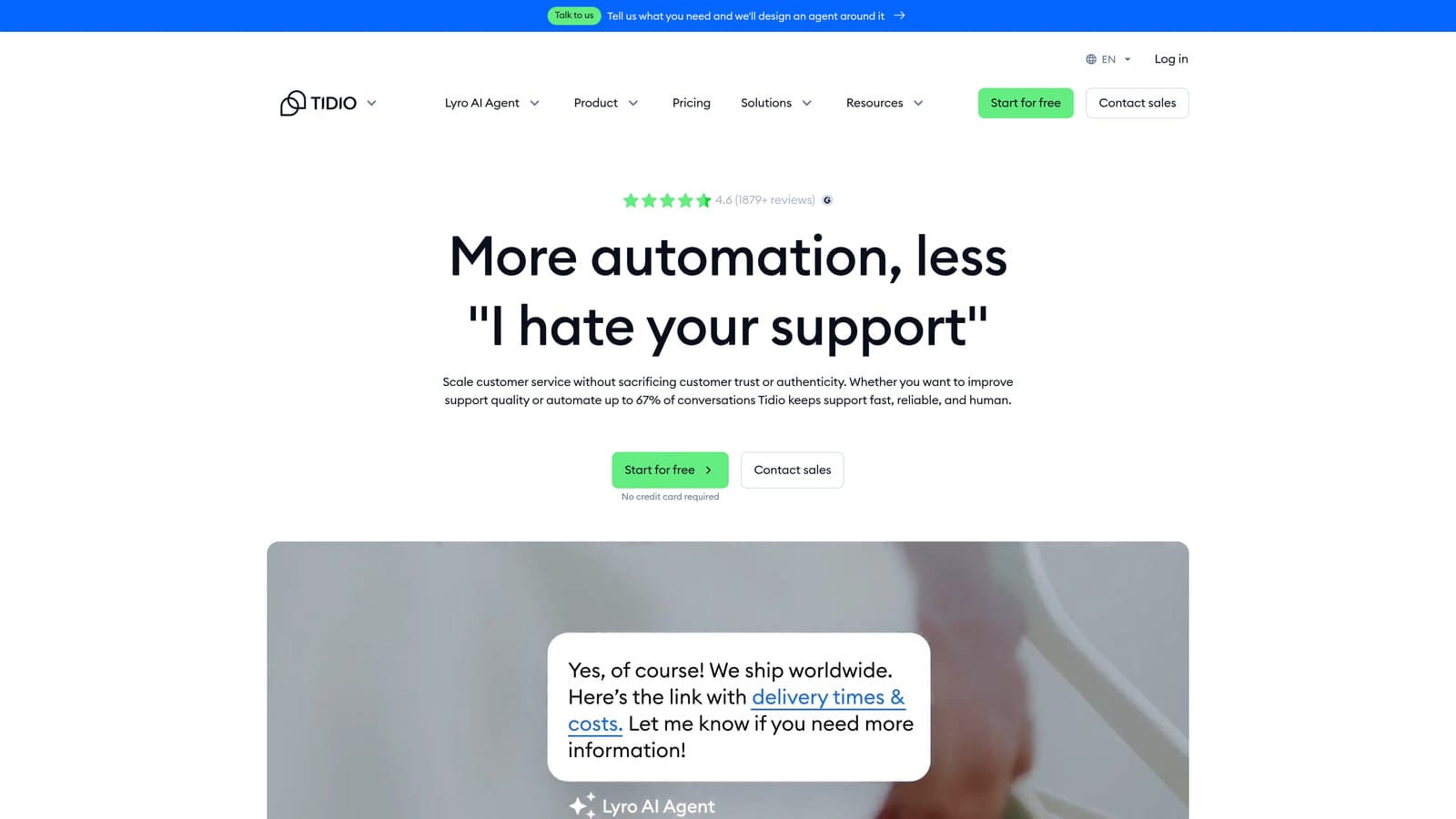
Tidio is a live chat and AI platform whose Lyro agent is trained on your own support content, designed for fast deployment by non-technical teams.
Where This Tool Shines
Lyro's setup speed is genuinely impressive for teams without technical resources. Point it at your FAQ and support documentation, and it's operational quickly, no developer required. For e-commerce and transactional support scenarios where questions are relatively predictable, Lyro handles a meaningful portion of volume without much configuration overhead.
The free tier also lowers the barrier to testing AI support meaningfully. Teams can validate the concept and measure deflection rates before committing to a paid plan, which is a practical advantage for budget-conscious teams.
Key Features
Lyro AI Agent: Conversational AI trained on your FAQ and support documentation for immediate deployment.
No-Code Setup: Designed for non-technical teams with minimal configuration required to go live.
Live Chat Foundation: Built on Tidio's live chat roots with AI layered on top for a hybrid approach.
Free Tier: Available with limited monthly conversations for teams that want to test before committing.
Volume-Based Scaling: Paid plans scale by conversation volume rather than per seat.
Best For
SMBs and e-commerce businesses that need fast, accessible AI support without technical resources. Less suited to complex B2B SaaS environments that require deep integrations, custom escalation logic, or business intelligence beyond basic deflection.
Pricing
A free tier is available with limited monthly conversations. Paid Lyro plans start at approximately $29 per month and scale by conversation volume. Verify current pricing at tidio.com.
6. Drift (Salesloft)
Best for: B2B teams where support conversations frequently surface buying signals or pipeline opportunities
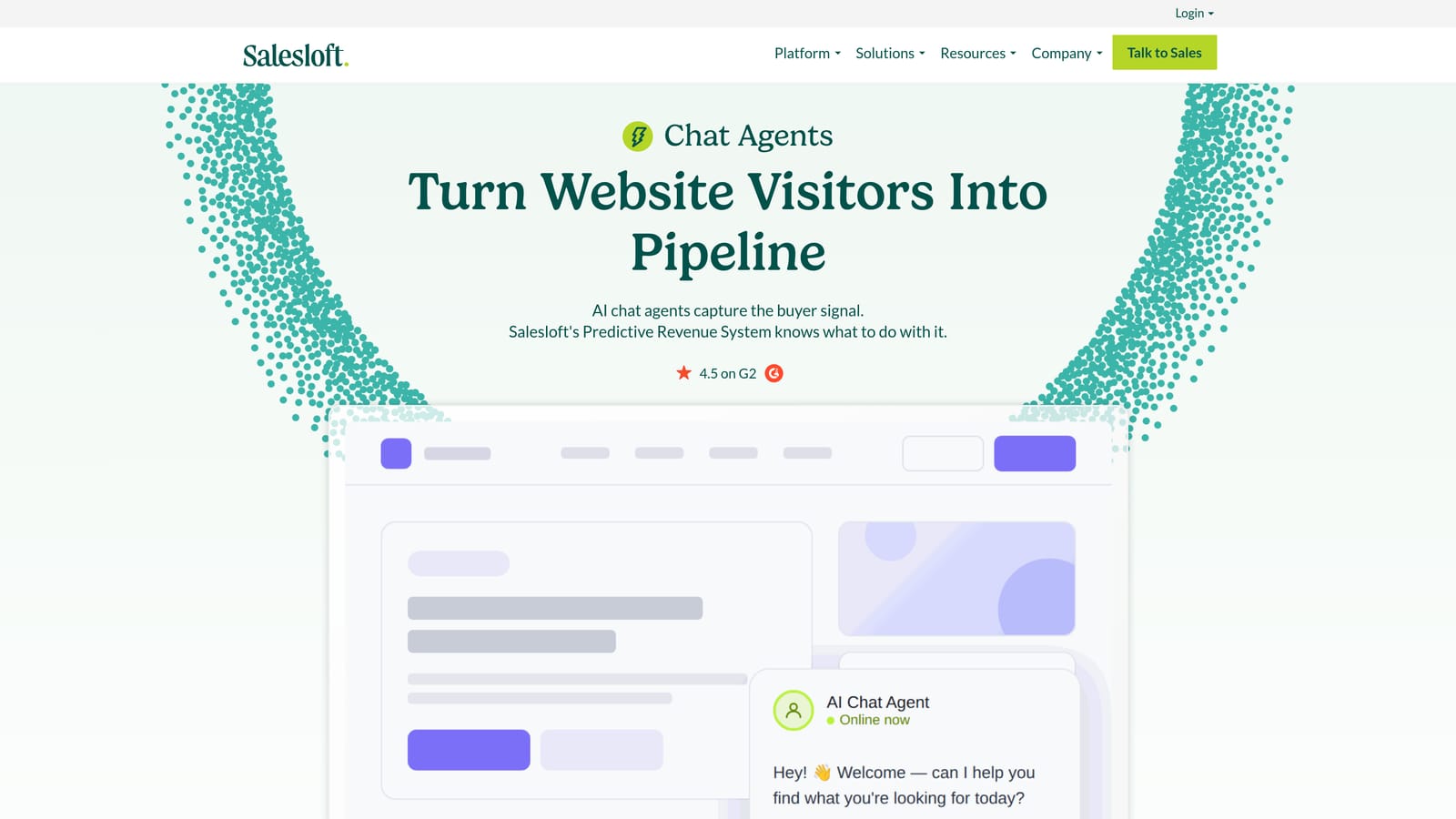
Drift, now part of the Salesloft revenue platform, blends conversational AI across support and sales interactions with strong account-based intent signal integration.
Where This Tool Shines
Drift's core strength has always been the intersection of support and revenue. When a high-value account visits your pricing page at 11pm and asks a product question, Drift can recognize the account, route accordingly, and flag the conversation for the right sales rep, all automatically. That kind of intent-aware routing is genuinely useful for B2B companies where support and sales boundaries blur regularly.
The integration into Salesloft's broader revenue intelligence platform adds another layer of context for teams that use Salesloft for their entire go-to-market motion. The tradeoff is that Drift is primarily a revenue tool with support capabilities, not the other way around.
Key Features
Conversational AI with ABM Integration: Routes conversations based on account identity and intent signals from your ABM stack.
Support and Sales Blending: Handles both support queries and sales conversations within a single interface.
Salesloft Platform Integration: Connects to Salesloft's revenue intelligence and sequencing tools for full go-to-market context.
Account-Tier Routing: AI routing logic based on account tier, intent signals, and engagement history.
Pipeline-Focused Design: Built for teams where every customer conversation is also a potential revenue signal.
Best For
Account-based B2B companies using Salesloft where support and sales conversations overlap significantly. Less suited to pure support use cases where deep ticket resolution and business intelligence are the primary requirements.
Pricing
Enterprise pricing. Contact Drift or Salesloft directly for a quote.
7. Kustomer
Best for: High-volume omnichannel operations that need a unified customer timeline across every channel
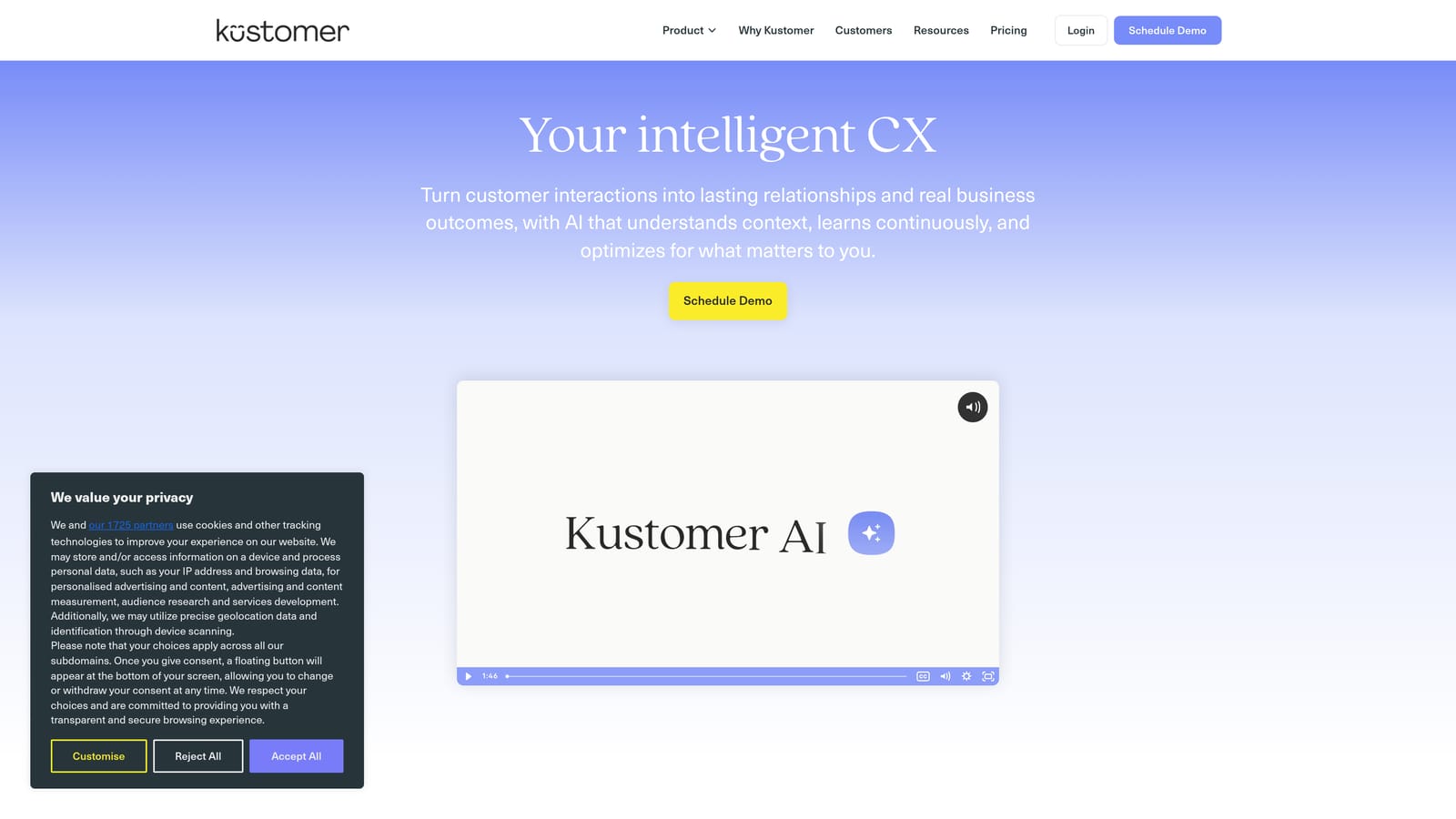
Kustomer is a CRM-native customer service platform that unifies email, chat, social, SMS, and voice into a single customer timeline, with AI automation for routing and self-service.
Where This Tool Shines
Kustomer's CRM-native data model is its defining feature. Rather than treating each support ticket as an isolated event, Kustomer builds a complete customer timeline that gives agents full context before they type a single word. For high-volume operations where agents handle dozens of interactions daily, that context efficiency adds up quickly.
The omnichannel unification is also genuinely comprehensive. Teams managing support across email, chat, social, SMS, and voice simultaneously will find Kustomer's single-timeline approach meaningfully reduces the context-switching that drains agent productivity.
Key Features
Unified Omnichannel Timeline: Consolidates email, chat, social, SMS, and voice into a single customer view.
CRM-Native Data Model: Full customer context available to agents before and during every interaction.
AI Routing and Automation: Intelligent routing, macros, and self-service automation powered by AI.
High-Volume Design: Architecture built for large support operations with significant daily interaction volumes.
Omnichannel Self-Service: AI-powered self-service that works consistently across all supported channels.
Best For
D2C brands and larger organizations managing high-volume, omnichannel support operations. The implementation complexity and enterprise pricing make it better suited to teams with dedicated support ops resources than lean startup environments.
Pricing
Enterprise per-agent pricing. Contact Kustomer directly for a quote.
8. Forethought
Best for: Enterprise teams that need AI capabilities without migrating off their existing helpdesk
Forethought specializes in AI that layers on top of existing helpdesks like Zendesk and Salesforce Service Cloud, adding triage, deflection, and agent assist without requiring a platform migration.
Where This Tool Shines
Forethought solves a real enterprise problem: the helpdesk migration that will never happen. Large organizations with years of ticket history, custom integrations, and established workflows in Zendesk or Salesforce Service Cloud often can't justify ripping out their foundation, even if the AI capabilities of newer platforms are more impressive. Forethought adds meaningful AI intelligence on top of what's already there.
The triage and deflection capabilities are solid, and the agent assist layer helps human agents respond faster without requiring them to change their primary tool. For teams locked into existing helpdesk contracts, this is a pragmatic path to AI capability.
Key Features
AI Triage and Deflection: Adds intelligent triage and self-service deflection on top of your existing helpdesk.
Broad Helpdesk Compatibility: Works with Zendesk, Salesforce Service Cloud, and ServiceNow without platform migration.
Agent Assist: In-context response suggestions for human agents within their existing helpdesk interface.
No Migration Required: Designed specifically for teams with locked-in helpdesk infrastructure.
Enterprise Architecture: Built for large organizations with complex existing support stacks.
Best For
Enterprise teams with established helpdesk investments that want to add AI capabilities without a platform change. The quality of results depends significantly on the structure and quality of the underlying helpdesk data.
Pricing
Enterprise pricing. Contact Forethought directly for a quote.
9. Help Scout
Best for: SMBs and teams that want AI assistance without removing the human voice from support
Help Scout takes a human-first approach to AI, using it as a quiet assistant that helps agents draft replies and summarize threads without displacing the human judgment behind each response.
Where This Tool Shines
Help Scout's philosophy is intentional: AI should make human agents faster and better, not replace them. For companies where brand voice, relationship quality, and nuanced communication are central to the support experience, that constraint is a feature rather than a limitation. The AI Drafts capability suggests replies in your brand's voice, which agents can review and send, rather than firing off autonomous responses.
The pricing transparency is also worth noting. Help Scout publishes clear per-user pricing that's accessible to SMBs, which is refreshingly straightforward in a category where enterprise-only pricing is common.
Key Features
AI Summarize: Condenses long conversation threads so agents can get up to speed instantly without reading every message.
AI Drafts: Suggests replies in your brand's voice for agents to review and send, not replace.
Beacon Widget: Embeddable help widget for self-service that connects to your knowledge base.
Transparent Pricing: Clear per-user pricing accessible to SMBs without enterprise negotiation.
Human-First Design: AI intentionally positioned as an assistant, preserving human judgment in every interaction.
Best For
SMBs, agencies, and teams where relationship quality and brand voice matter more than autonomous resolution volume. Not the right fit for high-volume B2B SaaS operations that need AI to resolve tickets end-to-end without human involvement.
Pricing
Standard plans start at approximately $22 per user per month, with higher tiers including additional AI features. Verify current pricing at helpscout.com.
Which AI Customer Service Package Is Right for You?
The right choice depends heavily on where you sit on two axes: how much autonomy you want the AI to have, and how deeply you need it to integrate with your broader business stack.
If you want an AI-first platform with autonomous ticket resolution, business intelligence, and cross-stack integrations built in from the ground up, Halo AI is the strongest option on this list. It's designed specifically for B2B SaaS teams that want support to do more than deflect tickets, surfacing customer health signals, revenue anomalies, and churn indicators that inform decisions beyond the support queue.
For enterprise depth on existing Zendesk infrastructure, Zendesk AI adds meaningful capability without a migration. For budget-conscious scaling in the Freshworks ecosystem, Freshdesk Freddy delivers solid AI at a more accessible price point. Teams where support and sales conversations blur will find Drift's revenue-aware routing genuinely useful. And for companies where human voice and relationship quality are non-negotiable, Help Scout's intentionally limited AI assist strikes the right balance.
A few practical notes for evaluation: verify all pricing directly with each vendor before making decisions, as AI platform pricing changes frequently. Run pilots on real ticket volume rather than demos, because deflection rates in controlled environments rarely match live performance. And pay attention to the learning loop: static AI that doesn't improve from resolved interactions will plateau quickly as your product and customer base evolve.
Your support team shouldn't scale linearly with your customer base. Let AI agents handle routine tickets, guide users through your product, and surface business intelligence while your team focuses on complex issues that need a human touch. See Halo in action and discover how continuous learning transforms every interaction into smarter, faster support.