9 Best AI Customer Service Software Plans Compared for 2026
This comprehensive comparison of ai customer service software plans evaluates nine leading platforms across pricing models, tier structures, and feature sets to help teams find the right fit. From per-resolution billing to agent-seat pricing, the guide covers options for startups through enterprise organizations managing millions of support interactions annually.
 Grant CooperFounder14 min read
Choosing the right AI customer service software isn't just about features. It's about finding a plan that fits your team size, ticket volume, and growth trajectory. With dozens of platforms now offering AI-powered support automation, the pricing landscape has become genuinely complex. Some charge per resolution, others per agent seat, and a few bundle AI capabilities into enterprise-only tiers that feel like an afterthought.
This guide breaks down nine leading AI customer service platforms, comparing their plan structures, what you actually get at each tier, and which pricing model makes the most sense for different teams. Whether you're a startup handling a few hundred tickets a month or an enterprise managing millions of interactions, here are the top tools worth evaluating.
1. Halo AI
Best for: B2B SaaS teams wanting AI-native support that learns, guides, and generates business intelligence
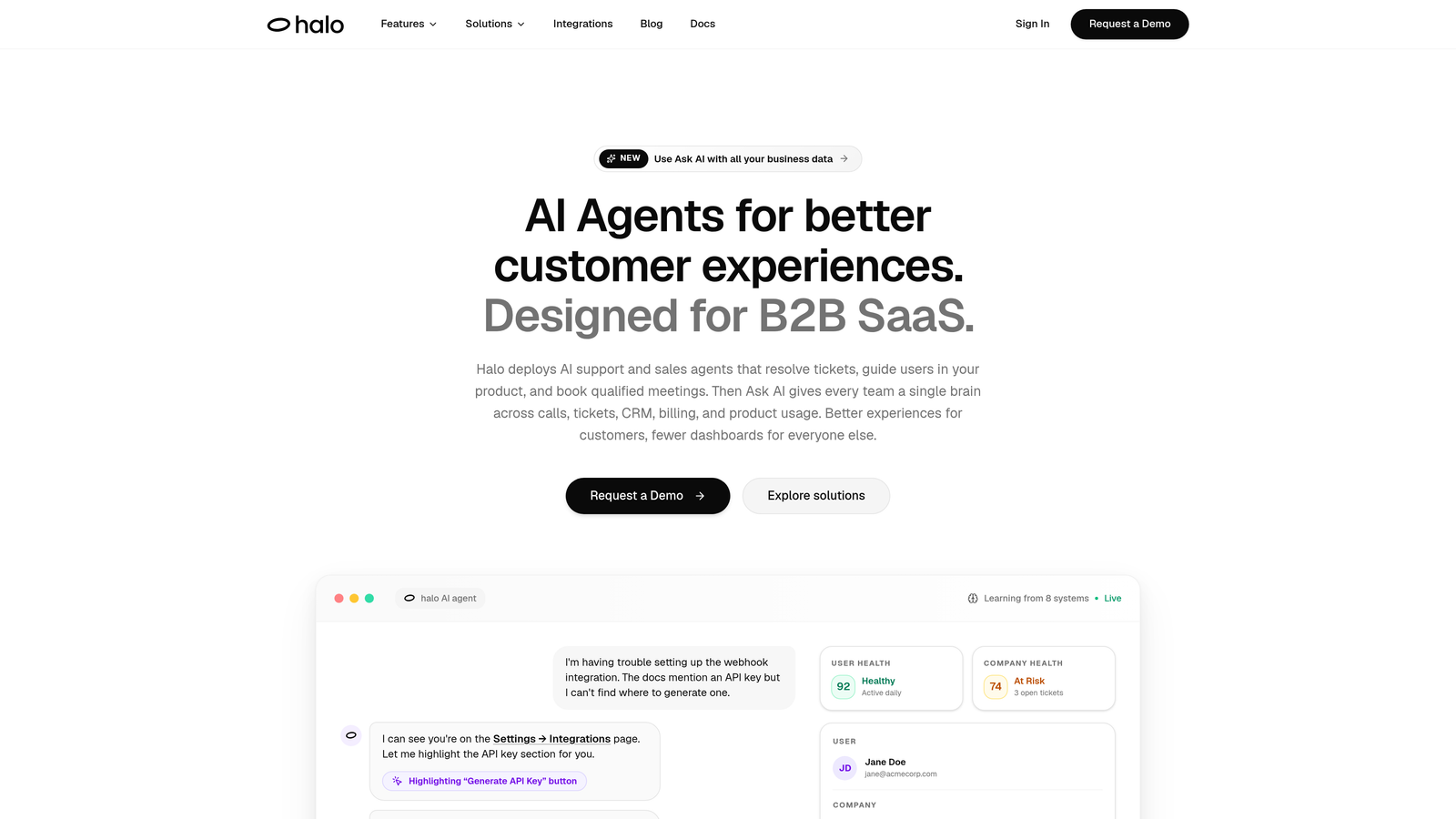
Halo AI is an AI-native customer support platform that deploys intelligent agents to resolve tickets, guide users with page-aware context, and surface business intelligence continuously from every interaction.
Where This Tool Shines
Most AI support tools are bolt-ons. They sit on top of an existing helpdesk and add a chatbot layer. Halo is built AI-first, which means the intelligence isn't an add-on feature you unlock at a higher tier. It's the foundation. Every resolved ticket, every user interaction, every escalation feeds back into the system to make future responses smarter.
The page-aware chat widget is particularly distinctive. Rather than giving generic answers, Halo's AI can see what a user is actually looking at on screen and provide visual, contextual guidance. That's a meaningful step beyond keyword-matching bots, especially for product-led SaaS companies where users need help navigating complex interfaces.
Key Features
AI-Native Architecture: Continuous learning from every interaction means the system improves over time without manual retraining cycles.
Page-Aware Chat Widget: The AI understands what users see on screen, enabling visual UI guidance rather than generic FAQ responses.
Smart Inbox with Business Intelligence: Goes beyond support metrics to surface customer health signals, anomaly detection, and revenue intelligence from support conversations.
Auto Bug Ticket Creation and Live Agent Handoff: Automatically logs bugs to development tools and escalates complex issues to human agents without friction.
Deep Integrations: Connects natively with Linear, Slack, HubSpot, Intercom, Stripe, Zoom, PandaDoc, and Fathom, linking support data to your entire business stack.
Best For
B2B SaaS companies and product teams that want support automation with genuine intelligence, not just rule-based chatbots. Particularly strong for teams already using Slack, HubSpot, or Linear who want support data to flow into their existing workflows. Also well-suited for teams that want to scale support capacity without proportionally scaling headcount.
Pricing
Contact for pricing. Plans are designed to scale without scaling headcount, with a structure built around your team's volume and use case rather than a rigid per-seat model.
2. Zendesk AI
Best for: Established support teams already using Zendesk Suite who want to add AI capabilities
Zendesk AI is an advanced AI layer built on top of Zendesk's established customer service suite, including AI agents, intelligent triage, and agent copilot tools.

Where This Tool Shines
If your team is already embedded in the Zendesk ecosystem, the AI add-on is a natural extension. It integrates directly with your existing ticket workflows, macros, and knowledge base without requiring migration or significant re-configuration. The breadth of the Zendesk marketplace also means you can layer additional integrations as needed.
The outcome-based pricing option for AI agent resolutions is worth noting. For teams with predictable, high-volume ticket categories, paying per successful resolution can offer a cleaner ROI calculation than a flat add-on fee. That said, the layered pricing structure (Suite plan plus Advanced AI add-on) has drawn some criticism from users who feel core AI should be included.
Key Features
Advanced AI Add-On: Includes AI agents, intelligent triage, and an agent copilot that assists human reps with context and suggested actions.
AI Ticket Summarization: Automatically summarizes long ticket threads so agents can get up to speed instantly.
Generative AI for Knowledge Base: Helps support teams create and expand knowledge base content using AI-assisted writing.
Outcome-Based Pricing Option: Pay per successful AI resolution rather than a flat monthly fee, giving teams flexibility in how they budget.
Zendesk Marketplace: Access to hundreds of third-party integrations built specifically for the Zendesk ecosystem.
Best For
Mid-market and enterprise teams with existing Zendesk investments who want to incrementally add AI without changing their core helpdesk. Less ideal for teams starting fresh who want an AI-first architecture from day one.
Pricing
Suite plans start at $55/agent/month; the Advanced AI add-on is an additional cost. Verify current pricing and tier details directly on Zendesk's website, as pricing changes frequently.
3. Intercom Fin
Best for: Teams that want usage-based pricing tied directly to AI resolution outcomes
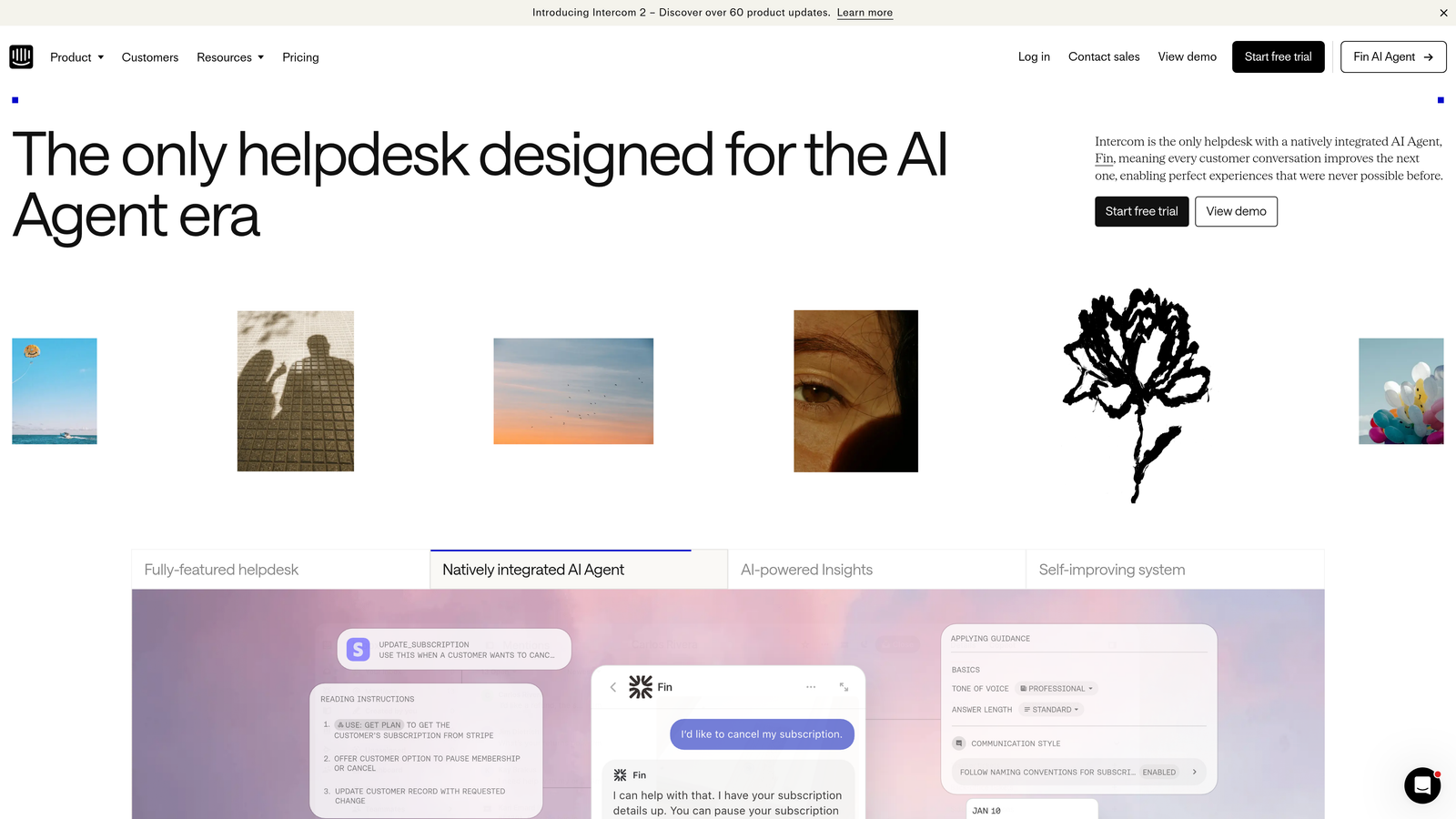
Intercom Fin is a conversational AI agent built into Intercom's customer messaging platform, using a per-resolution model where you pay only when AI successfully resolves a conversation.
Where This Tool Shines
Fin pioneered the per-resolution pricing model in the AI support space, and it remains one of the most compelling value propositions for teams that want clear ROI accountability. If Fin doesn't resolve a conversation, you don't pay for that resolution. That alignment between cost and outcome is genuinely appealing for teams skeptical of AI overpromising.
The AI is trained on your help center content, past conversations, and custom knowledge sources, which means it gets contextually relevant faster than generic bots. Multilingual support and customizable tone also make it viable for international support teams.
Key Features
Per-Resolution Pricing: You only pay when Fin successfully resolves a customer conversation without human intervention.
Custom Training Sources: Fin learns from your help center, past conversations, and custom content you upload, improving relevance over time.
Multilingual Support: Handles customer conversations across multiple languages without separate configuration.
Customizable AI Personality: Adjust tone and communication style to match your brand voice.
Resolution Rate Reporting: Built-in analytics show exactly how Fin is performing and where it's falling short.
Best For
Teams already on Intercom who want to automate a significant portion of inbound conversations. The per-resolution model works well at moderate volumes but should be modeled carefully at high scale, where per-resolution costs can accumulate quickly.
Pricing
Intercom plans start at $29/seat/month; Fin AI resolutions are priced separately per resolution. Check Intercom's website for current per-resolution rates, as these are subject to change.
4. Freshdesk Freddy AI
Best for: Budget-conscious teams wanting accessible AI features without enterprise pricing
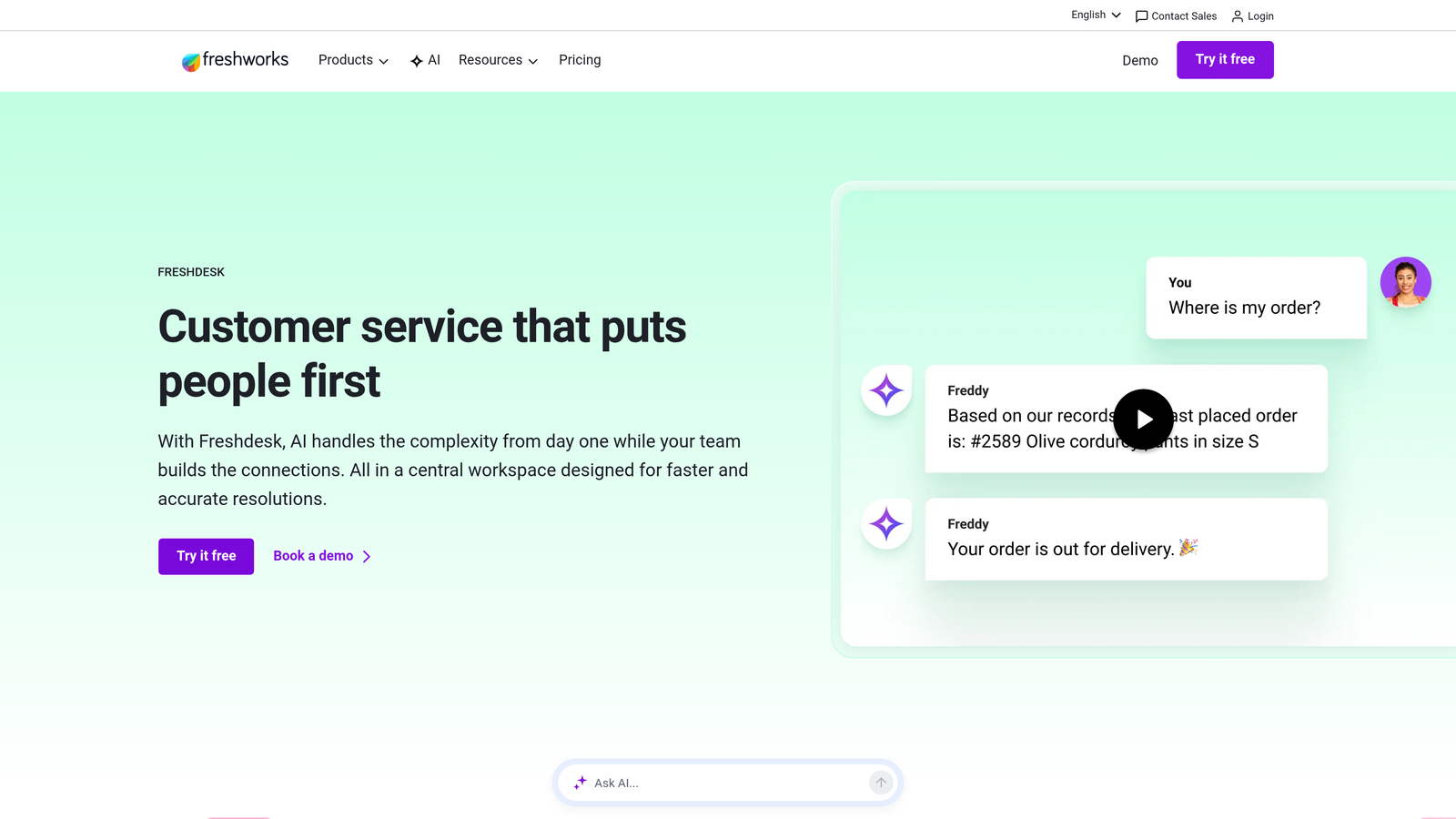
Freshdesk Freddy AI is a suite of AI-powered features embedded across Freshdesk's helpdesk tiers, offering chatbot automation, agent assist, and AI-driven insights with a free plan entry point.
Where This Tool Shines
Freshdesk has done a solid job of making AI accessible at lower price points. While enterprise platforms gate their AI features behind premium tiers, Freddy AI capabilities are available across multiple Freshdesk plans, making it one of the more accessible options for growing teams. The free plan gives smaller teams a genuine taste of AI-assisted support before committing.
Freddy Copilot, the agent-side AI assistant, is particularly useful for teams dealing with high variation in ticket types. It surfaces suggested responses and relevant knowledge base articles in real time, reducing the cognitive load on agents handling unfamiliar issues.
Key Features
Freddy AI Agent: Handles automated customer conversations across channels, resolving common queries without human involvement.
Freddy Copilot: Assists human agents with response suggestions, ticket summaries, and knowledge base recommendations.
Sentiment Analysis: Automatically detects customer sentiment to help agents prioritize and adjust their approach.
Omnichannel Support: Covers email, chat, phone, and social channels within a single platform.
Free Plan Availability: Entry-level access with basic features, making it viable for very small teams or those testing AI support for the first time.
Best For
Small to mid-sized teams that need solid omnichannel helpdesk functionality with AI features at accessible price points. A strong choice for teams moving off spreadsheets or basic email inboxes who want AI without enterprise-level investment.
Pricing
Free plan available; paid plans start at $15/agent/month, with AI features varying by tier. Verify current plan details on Freshworks' website.
5. Ada
Best for: Enterprise teams prioritizing high automated resolution rates across multiple channels
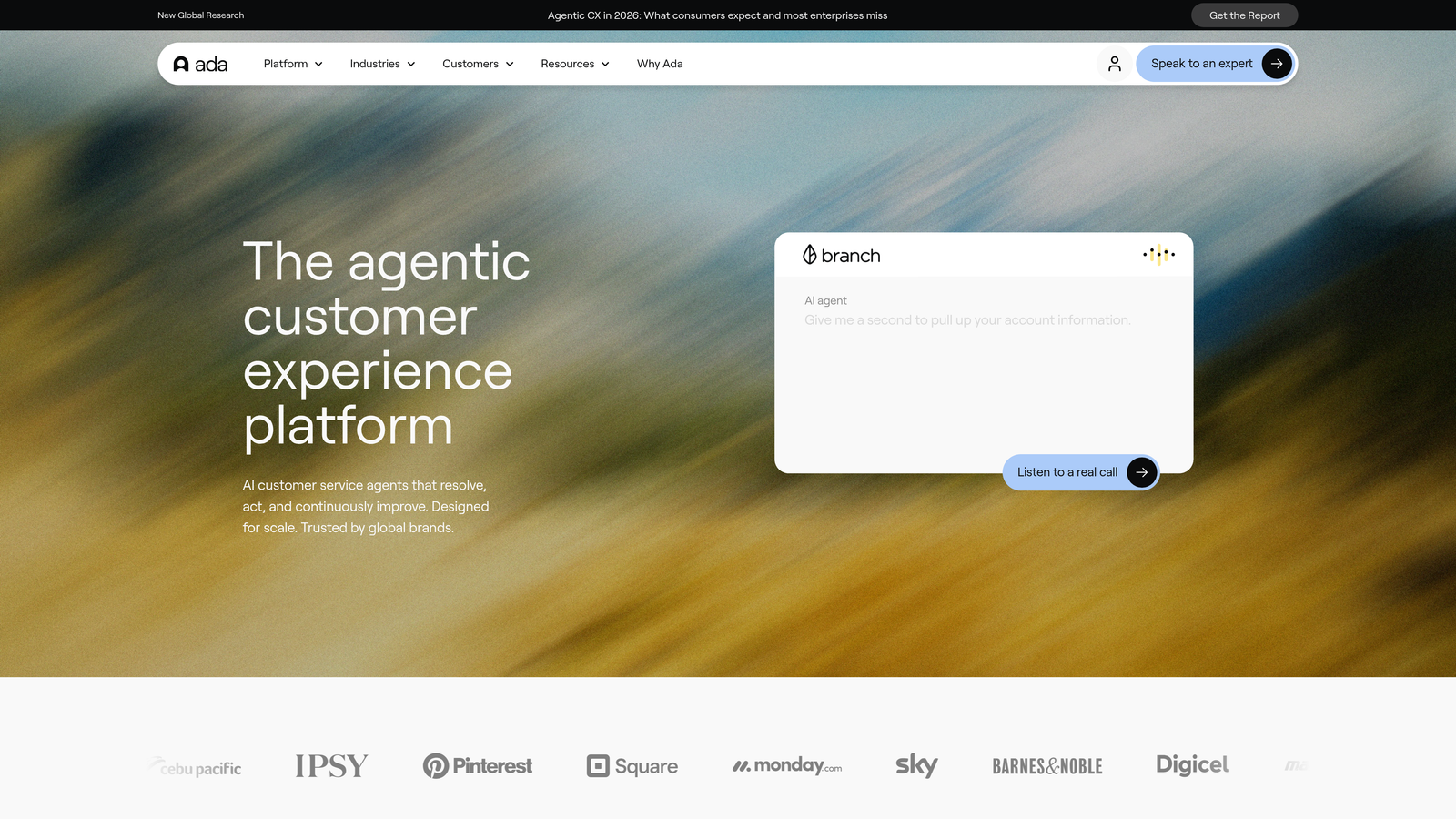
Ada is an enterprise-focused AI agent platform designed for high-volume automated customer service across web, mobile, social, and voice channels.
Where This Tool Shines
Ada is purpose-built for scale. The platform's reasoning engine is designed to handle multi-step customer queries that would trip up simpler rule-based bots, making it effective for support environments where customer questions are complex or require multiple data lookups. The no-code builder also means support teams can manage and update AI flows without involving engineering.
The omnichannel reach is genuinely broad. Unlike platforms that handle chat well but treat voice as an afterthought, Ada's architecture was designed to operate consistently across channels, which matters for enterprises with diverse customer touchpoints.
Key Features
Purpose-Built AI Agent: Focused on maximizing automated resolution rates rather than being a general-purpose support tool.
Multi-Step Reasoning Engine: Handles complex, multi-turn customer queries that require understanding context across a conversation.
No-Code Platform: Support teams can build, test, and modify AI agent flows without engineering support.
Omnichannel Deployment: Web, SMS, social, and voice covered under a single platform architecture.
CRM and Helpdesk Integrations: Connects with major CRMs and helpdesk platforms to pull customer data into conversations.
Best For
Enterprise support teams with high ticket volumes and complex routing needs who need a dedicated AI agent platform rather than an add-on to an existing helpdesk. The custom pricing model reflects its enterprise focus.
Pricing
Custom enterprise pricing. Contact Ada directly for a quote based on your volume and channel requirements.
6. Tidio
Best for: Small businesses and e-commerce stores wanting affordable AI chat with transparent pricing
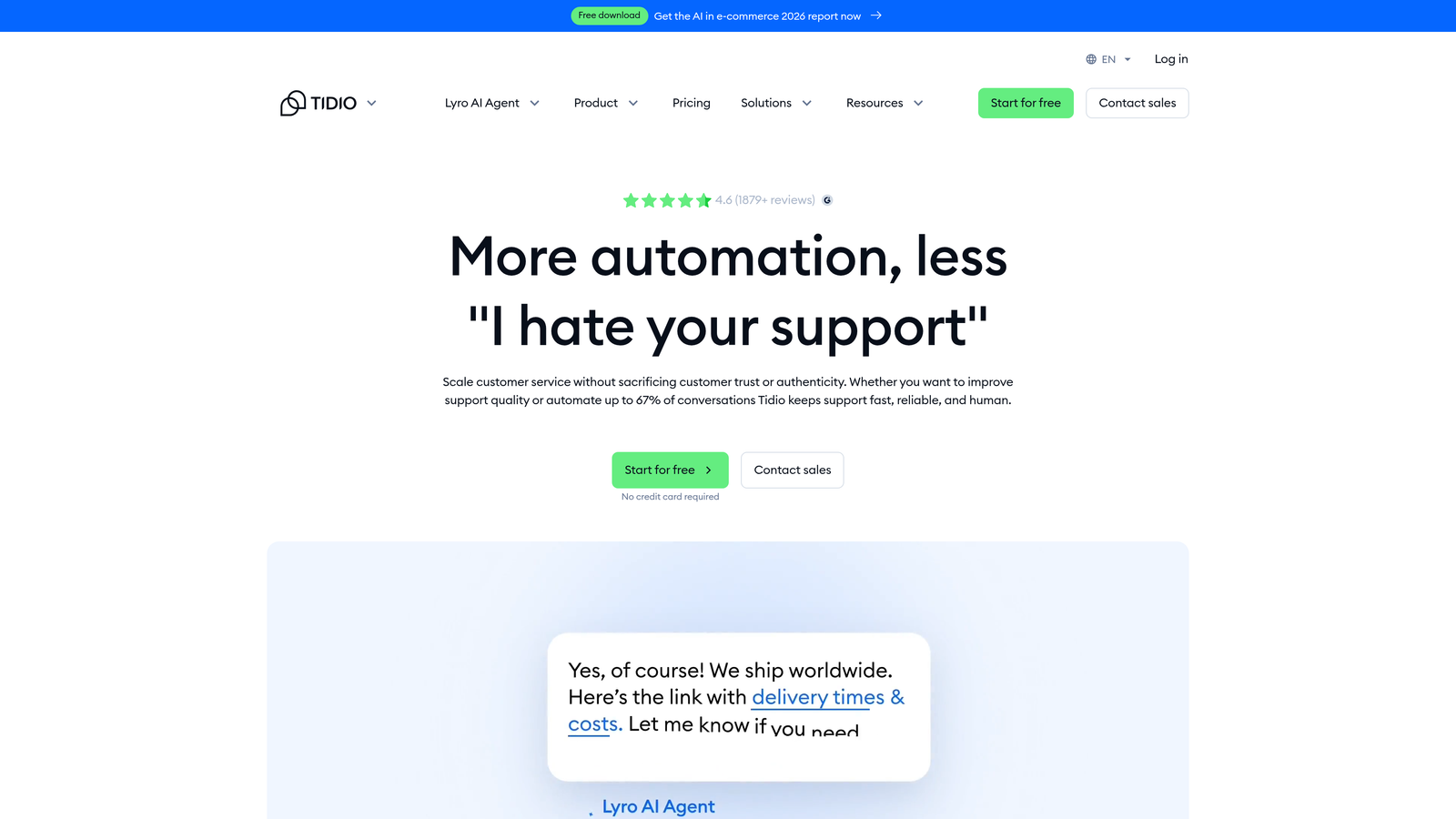
Tidio is an affordable AI chatbot and live chat platform targeting small businesses and e-commerce stores, featuring the Lyro AI assistant with transparent, low-entry pricing.
Where This Tool Shines
Tidio's strength is accessibility. For small businesses that find enterprise AI platforms overkill, Tidio offers a practical, affordable entry point with enough AI capability to meaningfully reduce support volume. Lyro learns from your FAQ and support content, which means setup time is relatively short compared to platforms requiring extensive training.
The e-commerce integrations are a genuine differentiator for Shopify and WordPress users. Tidio plugs into product catalogs, order data, and customer records to give the AI enough context to answer purchase-related questions accurately, which is exactly what small e-commerce teams need.
Key Features
Lyro AI Chatbot: Learns from your FAQ content and support history to handle common customer questions automatically.
Visual Chatbot Builder: Drag-and-drop flow builder for creating custom conversation paths without code.
E-Commerce Integrations: Native connections to Shopify, WordPress, and other e-commerce platforms with access to order and product data.
AI-Powered Reply Suggestions: Assists live agents with suggested responses during active conversations.
Visitor Tracking and Analytics: Dashboard showing visitor behavior and chatbot performance metrics.
Best For
Small business owners and e-commerce teams who need an affordable, easy-to-deploy AI chat solution. Not designed for complex enterprise routing or deep CRM integration, but highly effective within its target segment.
Pricing
Free plan with limited AI conversations; paid plans start at $29/month. Verify current pricing and conversation limits on Tidio's website.
7. Salesforce Einstein for Service
Best for: Organizations deeply invested in the Salesforce ecosystem wanting unified AI across service, sales, and marketing
Salesforce Einstein for Service is AI embedded within Salesforce Service Cloud, offering AI-powered case management, chatbots, and agent assistance for teams already on the Salesforce platform.
Where This Tool Shines
The core advantage here is data unification. Because Salesforce holds CRM, sales, and marketing data in a single platform, Einstein for Service can bring that full customer context into every support interaction. An agent handling a billing complaint can immediately see purchase history, recent sales conversations, and marketing touchpoints without switching tools.
Einstein Copilot extends this by giving agents a conversational AI interface inside Service Cloud, allowing them to ask questions, pull records, and get recommendations through natural language rather than manual navigation. For complex enterprise support environments, that contextual depth is hard to replicate.
Key Features
Einstein AI Bots: Natural language chatbots that can pull live Salesforce data into customer conversations.
AI-Powered Case Classification and Routing: Automatically categorizes and routes incoming cases based on content and intent.
Agent Assist: Surfaces recommended responses and relevant knowledge articles to agents in real time.
Unified Data Across Salesforce Clouds: Support AI draws on sales, marketing, and service data simultaneously.
Einstein Copilot: Conversational AI interface within Service Cloud for agent productivity.
Best For
Enterprises already using Salesforce CRM and Service Cloud who want AI capabilities without introducing a separate platform. The value proposition depends heavily on existing Salesforce investment; for teams not on Salesforce, the cost and complexity are difficult to justify.
Pricing
Service Cloud starts at $25/user/month; Einstein AI features require higher tiers or add-ons. Verify current pricing and feature availability on Salesforce's website.
8. HubSpot Service Hub with Breeze AI
Best for: Teams using HubSpot CRM who want support, sales, and marketing AI in a unified platform
HubSpot Service Hub with Breeze AI is a CRM-connected customer service platform with AI chatbot and agent tools bundled into Service Hub plans, offering a unified view of customer interactions across marketing, sales, and support.
Where This Tool Shines
HubSpot's biggest advantage is its CRM foundation. Every support interaction is tied to a contact record that already contains marketing and sales history, which means support agents have context that typically requires expensive integrations to achieve in other platforms. For teams that grew up on HubSpot, adding Service Hub is a natural extension rather than a new tool to learn.
Breeze AI adds automation and intelligence across the Service Hub, from ticket routing to knowledge base suggestions. The free tools available at the entry level also make HubSpot one of the more accessible starting points for teams not ready to commit to a full paid plan.
Key Features
Breeze AI Chatbot: Automates customer conversations using data from the HubSpot CRM for personalized, context-aware responses.
AI-Powered Ticket Routing: Automatically prioritizes and routes tickets based on content, urgency, and customer data.
Knowledge Base with AI Content Suggestions: Helps teams build and maintain self-service content with AI-assisted writing.
Unified CRM Data: Support interactions sit alongside marketing and sales data, giving a complete customer picture.
Free Tools: Basic ticketing and live chat available without a paid plan, with AI features unlocking at higher tiers.
Best For
Growing B2B teams already using HubSpot for marketing and sales who want to bring support into the same ecosystem. Less compelling for teams not on HubSpot, where the CRM switching cost makes the platform harder to justify on support features alone.
Pricing
Free tools available; Service Hub Starter begins at $20/month/seat. Verify current pricing and AI feature availability by tier on HubSpot's website.
9. Forethought
Best for: Mid-market and enterprise teams with complex ticket triage and routing requirements
Forethought is an AI platform specializing in intelligent ticket triage, classification, and automated resolution for support teams with sophisticated routing needs.
Where This Tool Shines
Forethought's differentiation is in triage intelligence. Where many AI support tools focus on deflection through chatbots, Forethought goes deep on what happens to tickets once they enter your system. Its intent detection and classification engine can categorize tickets with nuance, routing them to the right team or triggering the right automation before a human agent ever touches them.
The Assist tool is worth highlighting for teams that want to augment rather than replace agents. It surfaces real-time recommendations during live ticket handling, giving agents the right information at the right moment without requiring them to search for it manually.
Key Features
AI Ticket Triage: Intent detection and classification that routes tickets accurately based on meaning, not just keywords.
Solve AI Agent: Handles automated resolution of common, repeatable queries without human intervention.
Assist Tool: Provides real-time recommendations to human agents during active ticket handling.
Helpdesk Integrations: Works alongside Zendesk, Salesforce, and other major helpdesks rather than replacing them.
AI Performance Analytics: Dashboard showing triage accuracy, resolution rates, and areas for improvement.
Best For
Mid-market and enterprise support teams with complex, high-volume ticket environments where accurate routing and triage are as important as deflection. Works well as a layer on top of existing helpdesks rather than a standalone platform.
Pricing
Custom pricing based on volume and selected modules. Contact Forethought directly for a quote tailored to your team's needs.
How to Pick the Right Plan for Your Team
The honest answer is that the "best" AI customer service platform depends almost entirely on where you are today and where you're going. There's no universal winner across these nine tools. But there are clear patterns that point toward the right choice for different situations.
If you're starting fresh and want AI-native architecture: Halo AI is the strongest option for B2B SaaS teams that want intelligence built in from the ground up, not bolted on. The page-aware context, continuous learning, and business intelligence capabilities go beyond what most traditional helpdesks offer even with AI add-ons.
If you're already on Zendesk or Intercom: Zendesk AI and Intercom Fin are natural extensions. Evaluate whether the per-resolution model (Fin) or the add-on model (Zendesk) aligns better with your ticket volume and budget predictability.
If budget is the primary constraint: Freshdesk Freddy AI and Tidio offer the most accessible entry points, with free plans that let you test before committing. Tidio is better suited for e-commerce; Freshdesk scales better for B2B helpdesk needs.
If you're enterprise with complex routing needs: Ada and Forethought operate at a different level of sophistication. Ada excels at omnichannel automated resolution at scale; Forethought is the stronger choice when triage and classification accuracy is the core problem.
If you're already in Salesforce or HubSpot: Einstein for Service and HubSpot Service Hub with Breeze AI make sense primarily because of the CRM data unification advantage. Outside of those ecosystems, the switching cost is hard to justify on support features alone.
One final note on pricing across all these platforms: AI customer service software pricing changes frequently, and the numbers shared here are starting points rather than definitive figures. Always verify current pricing directly with each vendor before making a decision.
Your support team shouldn't scale linearly with your customer base. AI agents can handle routine tickets, guide users through your product, and surface business intelligence while your team focuses on complex issues that genuinely need a human touch. See Halo in action and discover how continuous learning transforms every interaction into smarter, faster support.