9 Best AI Customer Service Software Tools Reviewed for 2026
This comprehensive guide to ai customer service software reviews evaluates nine leading platforms for 2026, comparing automation depth, integration flexibility, and deployment ease to help B2B SaaS teams choose between AI-first solutions and legacy helpdesk upgrades. Whether building a support stack from scratch or enhancing existing tools like Zendesk or Intercom, the review covers autonomous ticket resolution, intelligent routing, and business intelligence capabilities across today's top options.
 Grant CooperFounder14 min read
AI customer service software has moved well beyond simple chatbots. Today's platforms can resolve tickets autonomously, detect customer health signals, route complex issues to human agents, and integrate with your entire business stack — all without scaling headcount. But with dozens of options on the market, the differences between tools matter enormously.
Some bolt AI onto legacy helpdesk infrastructure; others are built AI-first from the ground up. Some excel at deflection volume; others prioritize conversation quality and business intelligence. This list reviews nine of the best AI customer service software platforms available in 2026, evaluated on automation depth, integration flexibility, ease of deployment, and real-world value for B2B SaaS teams.
Whether you're replacing an aging helpdesk, layering AI onto Zendesk or Intercom, or building a support stack from scratch, this guide will help you find the right fit. For a broader look at the category, see our overview of customer support AI benefits.
1. Halo AI
Best for: B2B SaaS teams wanting an AI-first support platform with business intelligence built in.
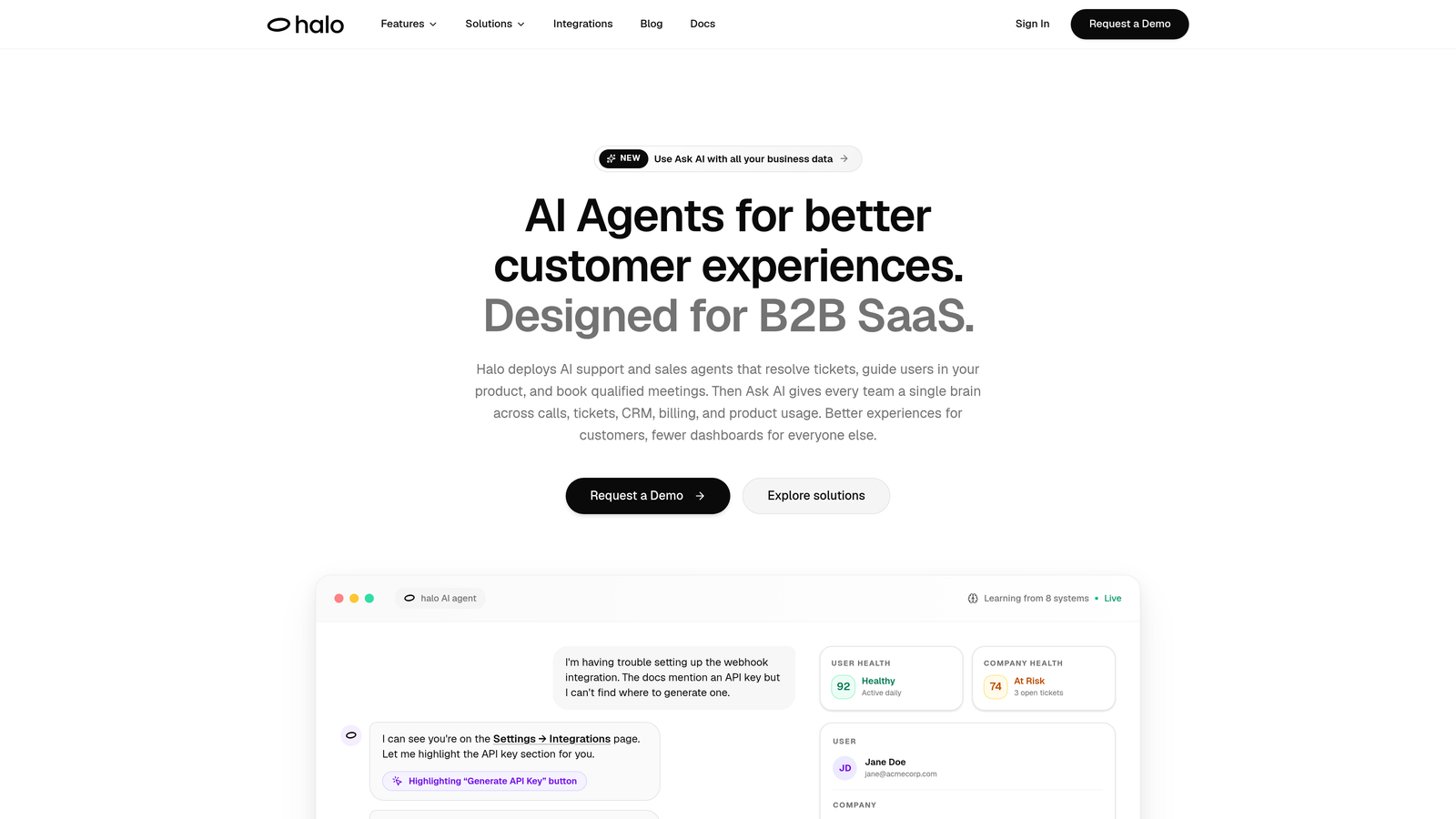
Halo AI is an AI-first customer support platform built specifically for B2B SaaS teams that want autonomous ticket resolution without the overhead of a legacy helpdesk.
Where This Tool Shines
What sets Halo apart from most tools on this list is its architecture. Rather than layering AI features onto an existing helpdesk, Halo is built AI-first from the ground up. That distinction matters: the AI isn't an add-on trying to retrofit intelligence into old workflows, it's the core of how the platform operates.
The page-aware chat widget is particularly notable. The AI sees what the user sees on screen, giving it the contextual awareness to guide users through your product visually rather than just responding to text queries. For SaaS products with complex workflows, this is a meaningful differentiator that most competitors simply don't offer.
Key Features
Page-Aware Chat Widget: The AI understands which page or product area the user is on, enabling contextual guidance that feels genuinely helpful rather than generic.
Autonomous Ticket Resolution with Human Handoff: AI agents handle routine tickets end-to-end and escalate complex issues to human agents with full context preserved.
Auto Bug Ticket Creation: Automatically generates bug reports and routes them directly to Linear, closing the loop between support and engineering without manual steps.
Smart Inbox with Business Intelligence: Goes beyond support metrics to surface customer health signals, revenue intelligence, and anomaly detection — turning your support queue into a source of strategic insight.
Deep Integration Stack: Connects natively with Linear, Slack, HubSpot, Intercom, Stripe, Zoom, PandaDoc, and Fathom, so the AI operates across your entire business stack rather than in a silo.
Continuous Learning: The platform learns from every resolved interaction, improving resolution quality over time without manual retraining.
Best For
Halo is the strongest fit for B2B SaaS product teams and customer success organizations that want AI to do more than deflect tickets. If you need support intelligence to feed back into product decisions, customer health monitoring, or revenue signals, Halo's business intelligence layer makes it a genuinely different kind of platform. Teams without an existing legacy helpdesk will find the AI-first architecture particularly clean to deploy.
Pricing
Contact Halo AI directly for pricing. The platform is enterprise and B2B SaaS focused, so pricing is structured around team needs rather than a self-serve tier.
2. Intercom
Best for: Teams already invested in the Intercom ecosystem who want autonomous AI layered onto conversational support.
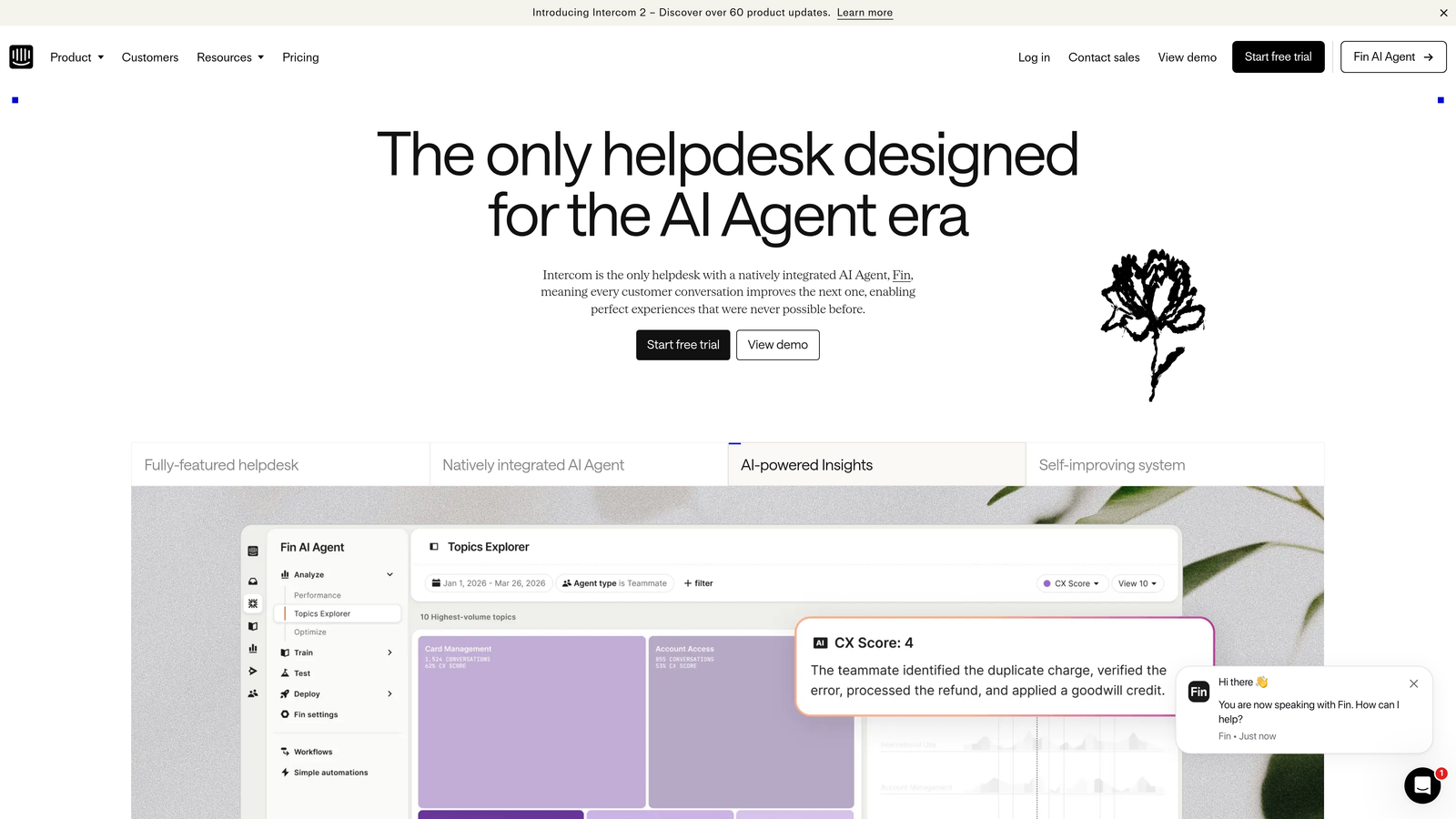
Intercom is an established conversational support platform with a capable AI agent, Fin, built on large language models and trained on your existing help content.
Where This Tool Shines
Intercom's Fin AI agent has matured considerably since its launch and now handles a meaningful portion of common queries autonomously, pulling answers from your help center without human involvement. For teams with well-maintained help documentation, the setup-to-resolution ratio is strong.
The platform's omnichannel presence is one of its genuine strengths. Web, mobile, email, and social all flow into a single inbox, and the AI-assisted agent tools like conversation summaries and suggested replies help human agents move faster when escalations do come through.
Key Features
Fin AI Agent: Resolves common customer queries autonomously using your help center content as its knowledge base.
Omnichannel Messaging: Unified inbox across web, mobile, email, and social channels.
AI-Assisted Agent Tools: Suggested replies and conversation summaries help human agents handle escalations efficiently.
Integration Marketplace: Extensive library of third-party integrations for common SaaS tools.
Reporting and CSAT Tracking: Detailed analytics on resolution rates, response times, and customer satisfaction scores.
Best For
Teams already using Intercom for customer messaging who want to add autonomous resolution without migrating platforms. Also a strong fit for product-led growth companies that want AI support woven into the in-app experience.
Pricing
Plans start at approximately $39 per month. Fin AI resolutions are billed per resolution on higher-tier plans, so costs can scale with volume. Verify current pricing at Intercom's website.
3. Zendesk AI
Best for: Large enterprise support organizations with complex workflows already running on Zendesk.
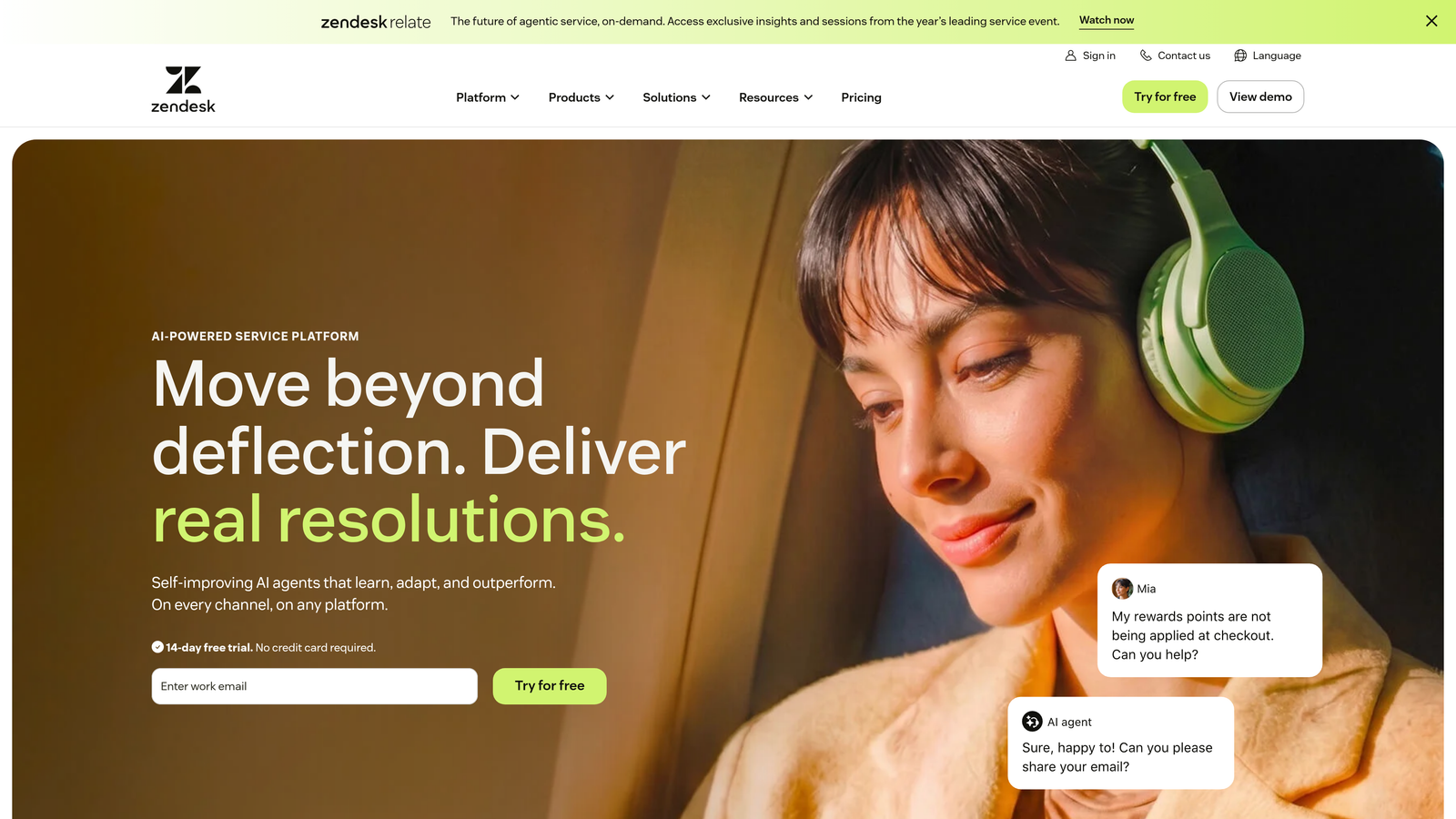
Zendesk is an enterprise helpdesk platform with AI layered across ticket triage, intelligent routing, agent copilot functionality, and automated responses within the Zendesk Suite.
Where This Tool Shines
Zendesk's AI layer is most powerful for organizations that have already built substantial workflows on the platform. Intelligent triage, routing based on intent and sentiment, and the agent copilot for suggested replies all work within the existing Zendesk environment, which means the learning curve for teams already using Zendesk is relatively low.
For enterprise support orgs managing high ticket volumes with complex SLA requirements, Zendesk's combination of mature workflow tooling and AI assistance is hard to match. The tradeoff is that the AI is additive to the existing infrastructure rather than transformative — it enhances what's already there.
Key Features
Intelligent Ticket Triage and Routing: Automatically categorizes and routes tickets based on detected intent and customer sentiment.
Agent Copilot: Provides suggested replies and next-best-action recommendations to help agents respond faster.
Automated Ticket Summarization: Condenses ticket history for faster agent handoffs and context switching.
Advanced Analytics and SLA Management: Comprehensive reporting tools with SLA tracking and compliance monitoring.
Enterprise Security and Compliance: Robust access controls, audit logging, and compliance certifications for regulated industries.
Best For
Enterprise support teams with existing Zendesk investments, complex routing requirements, and compliance needs. Less ideal for teams starting from scratch who want an AI-native experience rather than AI bolted onto legacy infrastructure.
Pricing
Suite plans start at approximately $55 per agent per month. AI features are available on higher-tier plans or as add-ons. Pricing scales significantly at enterprise volumes.
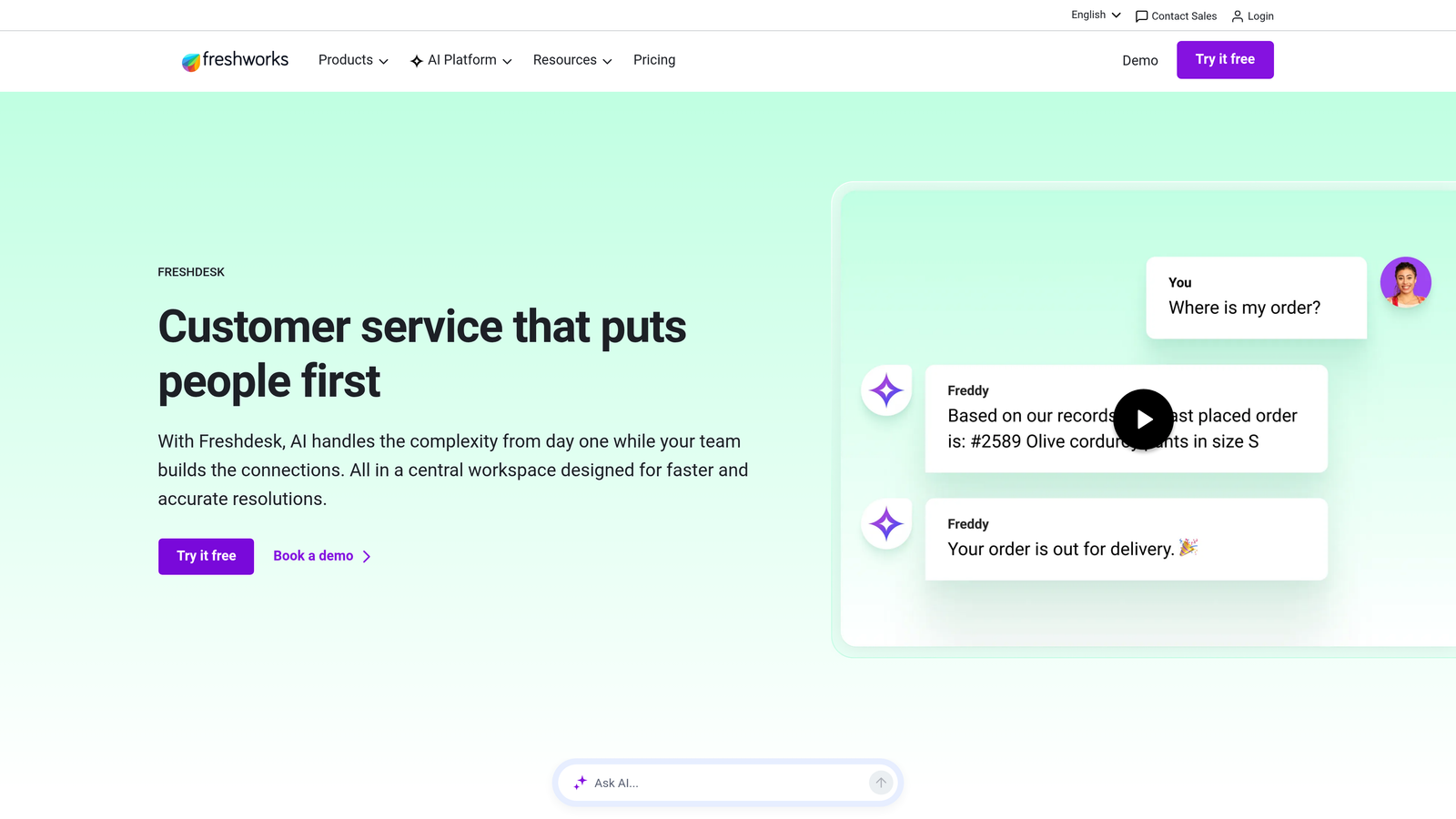
4. Freshdesk (Freddy AI)
Best for: SMBs and growing teams wanting affordable AI-assisted support across a unified helpdesk and CRM stack.
Freshdesk is an SMB-friendly helpdesk platform with Freddy AI providing both agent copilot assistance and autonomous self-service deflection across chat and email channels.
Where This Tool Shines
Freshdesk's strength is accessibility. The pricing is competitive, the setup is approachable for teams without dedicated IT resources, and the Freddy AI layer covers both agent assistance and autonomous customer-facing deflection without requiring separate tools. For smaller teams, the all-in-one nature of the Freshworks suite is genuinely appealing.
The integration across Freshdesk, Freshchat, and Freshsales means customer context flows between support, messaging, and sales without custom connectors. For teams that want a self-contained stack, this cohesion is a real advantage.
Key Features
Freddy Copilot: Assists agents with reply suggestions, ticket summaries, and recommended next actions.
Freddy Self Service: Handles autonomous customer queries across chat and email without agent involvement.
Freshworks Suite Integration: Native data sharing across Freshdesk, Freshchat, and Freshsales for unified customer context.
Multi-Channel Support: Covers email, chat, phone, and social from a single platform.
Competitive Pricing: Accessible entry points make AI-assisted support viable for smaller teams.
Best For
SMBs and mid-market teams looking for an affordable, all-in-one support stack with AI features. Teams already using other Freshworks products will find the integration particularly seamless.
Pricing
Free plan available. Paid plans start at approximately $15 per agent per month. Freddy AI capabilities are available as an add-on on higher-tier plans.
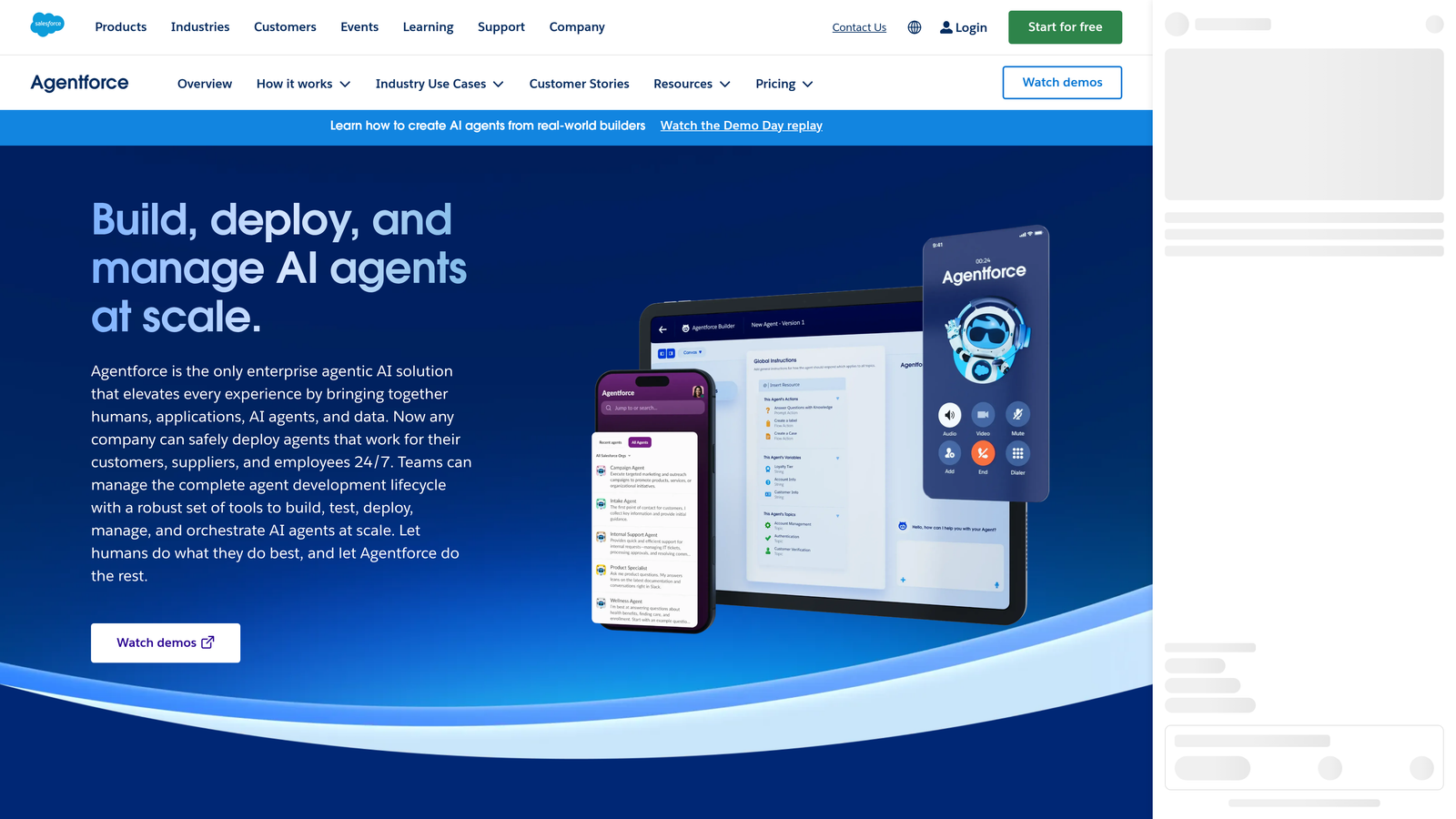
5. Salesforce Agentforce
Best for: Enterprises where Salesforce is the system of record and deep CRM context is essential for support quality.
Salesforce Agentforce is Salesforce's autonomous AI agent platform for customer service, built natively into Service Cloud with access to the full Salesforce data model for highly personalized support interactions.
Where This Tool Shines
The defining advantage of Agentforce is data depth. Because it operates natively within Salesforce, AI agents have access to the full customer record: purchase history, open opportunities, service cases, and marketing interactions. That context enables a level of personalization in automated responses that tools without CRM access simply cannot match.
The no-code agent builder, which uses natural language instructions to configure agent behavior, lowers the technical barrier for non-engineering teams. That said, meaningful implementation still requires Salesforce expertise, and the overall cost and complexity are genuine considerations for teams not already on the Salesforce platform.
Key Features
Full Salesforce Data Access: AI agents operate with complete CRM context, including customer history, open cases, and account data.
No-Code Agent Builder: Configure agent behavior using natural language instructions without writing code.
Cross-Cloud Integration: Native connections to Sales Cloud, Marketing Cloud, and Data Cloud for unified operations.
Einstein AI: Powers predictions, recommendations, and next-best-action suggestions throughout the platform.
Enterprise Governance: Robust compliance controls, audit trails, and security certifications for regulated industries.
Best For
Large enterprises where Salesforce is the primary system of record and support quality depends on rich CRM context. Not recommended for teams without existing Salesforce infrastructure, given the implementation complexity and cost.
Pricing
Agentforce starts at approximately $2 per conversation. A Salesforce Service Cloud subscription is required. Total cost of ownership at scale warrants careful evaluation.
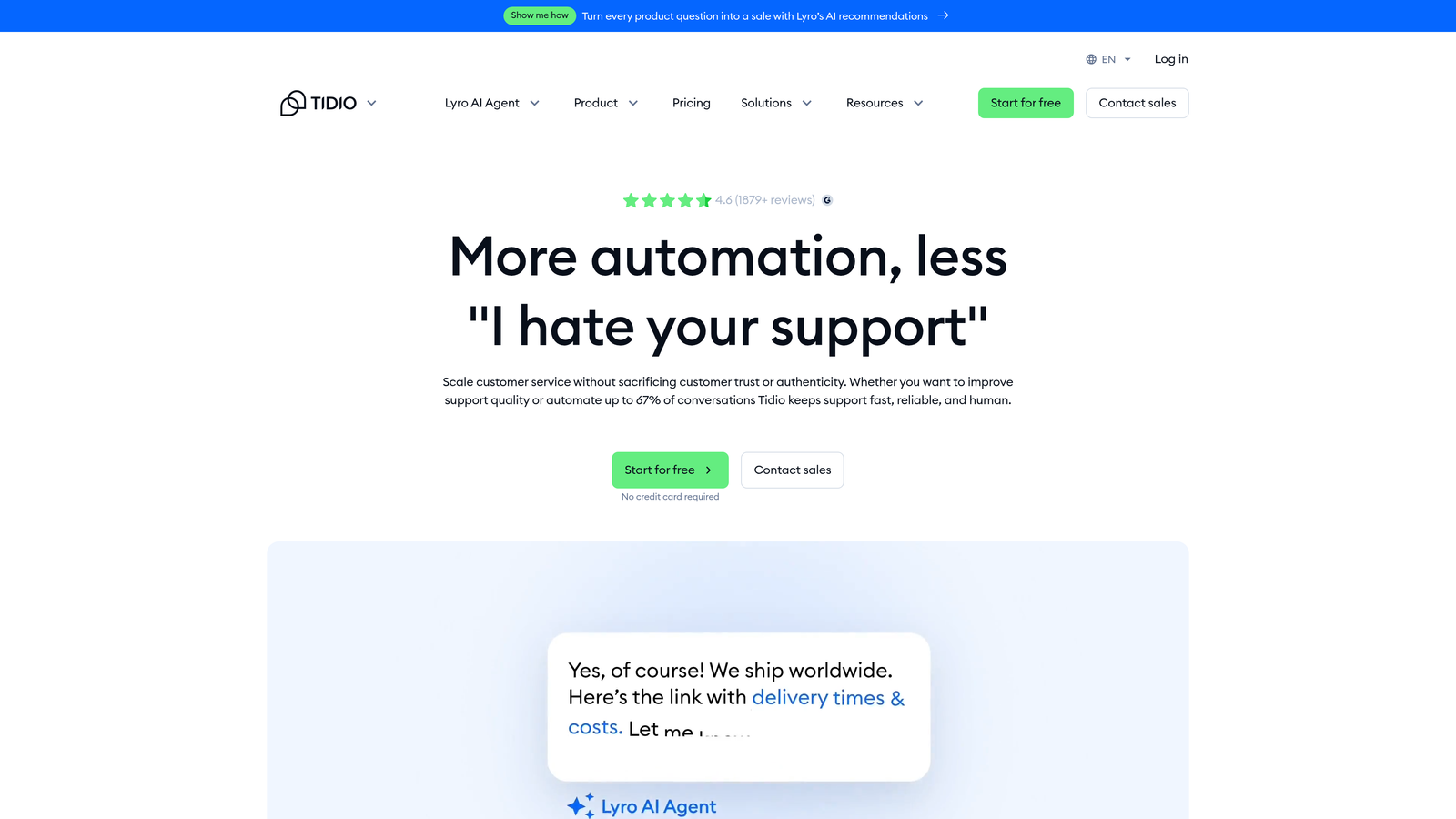
6. Tidio
Best for: E-commerce businesses and small teams wanting fast AI chatbot deployment with minimal technical setup.
Tidio is a live chat and AI chatbot platform popular with e-commerce businesses, featuring the Lyro AI chatbot for automated query resolution with a notably fast setup process.
Where This Tool Shines
Tidio's appeal is speed and simplicity. The Lyro AI chatbot can be live and handling customer queries quickly, with no technical expertise required for setup. For small e-commerce teams or businesses without dedicated support staff, that low barrier to entry is significant.
The native integrations with Shopify and WooCommerce give Tidio a natural advantage in retail contexts, where order status, product questions, and returns make up the bulk of support volume. Proactive chat triggers based on visitor behavior add a sales-assist dimension that many pure support tools lack.
Key Features
Lyro AI Chatbot: Handles common customer queries autonomously with fast deployment and minimal configuration.
E-Commerce Integrations: Native connections to Shopify and WooCommerce for order and product context.
Unified Inbox: Live chat, email, and Facebook Messenger in a single view.
Visitor Tracking and Proactive Triggers: Initiates conversations based on visitor behavior to reduce abandonment and assist purchases.
No Technical Setup Required: Designed for non-technical teams to deploy and manage independently.
Best For
Small e-commerce businesses and consumer-facing teams wanting affordable, fast-to-deploy AI chat. Less suited for complex B2B SaaS support workflows or teams needing deep integration with a broader business stack.
Pricing
Free plan available. Lyro AI starts at approximately $29 per month. Pricing is accessible for small teams and scales with usage volume.
7. Kustomer
Best for: High-volume consumer support operations that need a full customer timeline alongside AI automation.
Kustomer is a CRM-native customer service platform with AI features built on top of a complete customer interaction timeline, designed for consumer support teams handling significant ticket volume.
Where This Tool Shines
Kustomer's core differentiator is the unified customer timeline. Every interaction, across every channel, is consolidated into a single chronological view of the customer relationship. AI features like automated responses, intelligent routing, and sentiment analysis all operate with that full history as context, which meaningfully improves the quality of both automated and agent-assisted responses.
For consumer brands managing thousands of interactions daily, the combination of CRM depth and AI automation reduces the repetitive work agents face while maintaining the contextual awareness needed for quality responses. The workflow automation layer handles repetitive processes without requiring custom development.
Key Features
Full Customer Timeline CRM: Every interaction across all channels consolidated into one chronological customer view.
AI-Powered Automated Responses: Handles common queries autonomously with access to complete customer history.
Conversation Summaries and Sentiment Analysis: Helps agents quickly understand context and customer emotional state before responding.
Omnichannel Support: Email, chat, social, and voice all managed from a single platform.
Workflow Automation: Automates repetitive support processes without requiring engineering resources.
Best For
High-volume consumer support teams, particularly in retail, subscription businesses, and consumer apps. Less commonly used in pure B2B SaaS contexts where the CRM-native approach may overlap with existing tools like Salesforce or HubSpot.
Pricing
Enterprise pricing model. Plans start around $89 per agent per month. Best suited for teams with sufficient volume to justify the investment relative to lighter-weight alternatives.
8. Help Scout
Best for: Teams where support quality and human connection are core brand values, not just a cost center.
Help Scout is a human-first customer support platform with AI features designed deliberately to assist agents rather than replace them, favored by teams where support quality is a genuine differentiator.
Where This Tool Shines
Help Scout occupies a distinct philosophical position in this market: it believes human support is worth preserving. The AI tools here are assistive by design. AI Assist drafts replies for agents to review and send; AI Summarize condenses long threads so agents can get up to speed quickly. The AI accelerates humans rather than replacing them.
For teams where brand voice, relationship depth, and response quality matter more than deflection rate, this approach is genuinely valuable. The clean, distraction-free interface also reduces cognitive load for agents handling complex or emotionally charged conversations.
Key Features
AI Assist: Drafts reply suggestions for agents to review, edit, and send — keeping humans in control of every response.
AI Summarize: Instantly condenses long email threads so agents can context-switch without reading through entire histories.
Shared Inbox: Clean, focused interface designed to reduce distraction and support high-quality agent work.
Docs Knowledge Base: Built-in knowledge base with AI-powered search to surface relevant articles for both agents and customers.
Beacon Widget: In-app help widget for proactive messaging and self-service article delivery.
Best For
Smaller teams and companies where the human touch in support is a deliberate brand choice. Particularly well suited to professional services, SaaS companies with high-touch customer relationships, and teams where support quality directly impacts retention.
Pricing
Plans start at approximately $22 per user per month. AI features are included on Standard and Plus plans without requiring a separate add-on purchase.
9. Ada
Best for: Enterprise teams needing high-volume automated self-service with multilingual support and strong security requirements.
Ada is an enterprise AI self-service platform focused on high-volume automated resolution, with a no-code agent builder, broad multilingual capabilities, and strong security credentials for global customer bases.
Where This Tool Shines
Ada has built a strong track record with large consumer brands and telecoms that need to deflect significant query volume across multiple languages and geographies. The no-code agent builder makes it accessible for non-technical teams to configure and iterate on agent behavior without engineering involvement, which is a meaningful operational advantage at scale.
The platform's integration layer connects with major helpdesks including Zendesk and Salesforce, so Ada can function as the self-service front end without requiring a full platform migration. For organizations with existing helpdesk investments, this layered approach can deliver automation benefits without disrupting established workflows.
Key Features
No-Code Agent Builder: Allows non-technical teams to build, configure, and iterate on AI agents using visual tools.
Multilingual Support: Strong performance across multiple languages, making it viable for global customer bases.
Helpdesk Integrations: Connects with Zendesk, Salesforce, and other major platforms to layer self-service onto existing infrastructure.
Advanced Analytics: Detailed reporting on deflection rates, resolution quality, and conversation drop-off points.
Enterprise Security and Compliance: SSO, role-based access controls, and compliance certifications for regulated industries.
Best For
Large enterprises and global consumer brands with high query volumes, multilingual requirements, and strict security standards. Ada is most compelling when deployed at scale; smaller teams may find the enterprise pricing difficult to justify relative to lighter-weight alternatives.
Pricing
Enterprise pricing model. Contact Ada directly for a custom quote. Pricing reflects the enterprise positioning and scales with deployment size and resolution volume.
Which Tool Is Right for Your Team?
The right AI customer service platform depends on where you are, what you're optimizing for, and how you think about the role of support in your business.
If you're a B2B SaaS team that wants AI-first architecture, business intelligence beyond support metrics, and deep integration with your entire product and revenue stack, Halo AI is purpose-built for exactly that context. The page-aware widget and smart inbox with customer health signals give it capabilities that most tools on this list simply don't offer.
For teams already deeply invested in Intercom, Zendesk, or Salesforce, the AI layers within those platforms are the path of least resistance. They won't transform your support architecture, but they will meaningfully improve efficiency within workflows you've already built.
If budget is the primary constraint, Freshdesk's Freddy AI offers a credible combination of agent assistance and autonomous deflection at a price point accessible to smaller teams. Tidio fills a similar role for e-commerce businesses specifically.
Help Scout stands apart for teams where human support quality is a deliberate brand choice rather than a problem to automate away. And Ada is the strongest option for global enterprises needing multilingual, high-volume deflection with strict compliance requirements.
Your support team shouldn't scale linearly with your customer base. Let AI agents handle routine tickets, guide users through your product, and surface business intelligence while your team focuses on complex issues that need a human touch. See Halo in action and discover how continuous learning transforms every interaction into smarter, faster support.