9 Best AI Customer Service Solutions Compared in 2026
This ai customer service solutions comparison evaluates nine leading platforms across critical criteria including AI autonomy, context awareness, and integration capabilities, helping B2B SaaS teams identify which tools are purpose-built for intelligent support versus those simply layering AI onto legacy infrastructure.
 Matt PattoliFounder13 min read
AI customer service has quietly crossed a threshold. For B2B SaaS teams, it's no longer a competitive advantage to offer AI-powered support — it's table stakes. The real question now is which kind of AI you're deploying. Some platforms bolt AI features onto legacy helpdesk infrastructure that was never designed for it. Others were built AI-first from day one, with autonomy and context-awareness baked into the core architecture. That distinction matters more than any feature checklist.
To help you cut through the noise, we evaluated nine tools across the criteria that actually matter for product-led B2B teams: depth of AI autonomy, context awareness, integration ecosystem, continuous learning capability, human escalation quality, and business intelligence output. Whether you're running a lean support team or scaling a complex multi-product operation, there's a meaningful difference in what these platforms can do for you.
If you're exploring the broader landscape first, our guides to automated customer support and AI support agents cover the foundational concepts worth understanding before committing to a platform.
Here are the top AI customer service solutions worth considering in 2026.
1. Halo AI
Best for: B2B SaaS product teams that need autonomous, context-aware AI support with business intelligence built in.
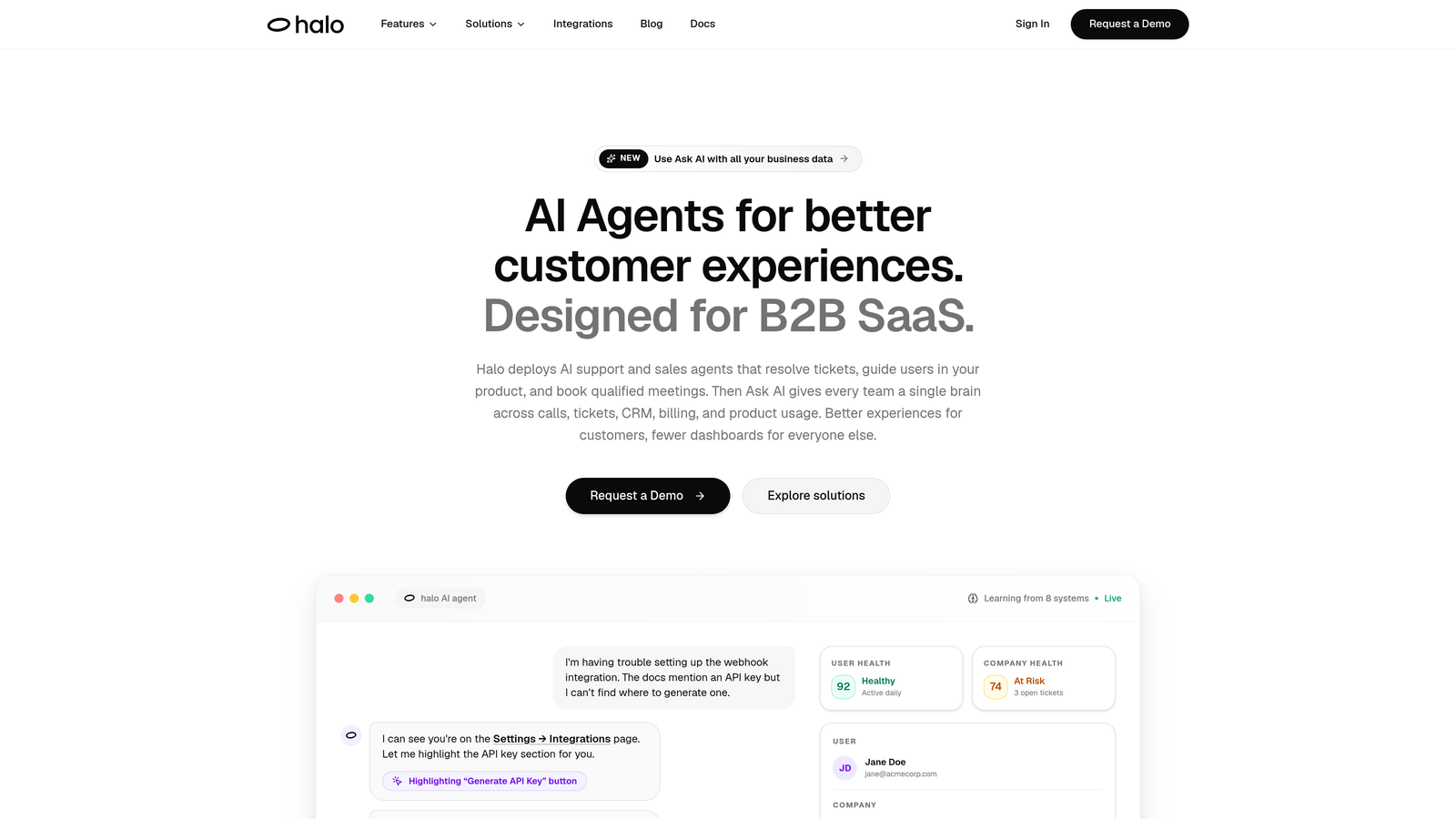
Halo AI is an AI-first customer support platform built specifically for B2B SaaS teams, deploying intelligent agents that resolve tickets end-to-end while continuously learning from every interaction.
Where This Tool Shines
Most support tools know what page a user is on. Halo AI actually sees what the user sees. Its page-aware chat widget understands the user's current context within your product, enabling visual UI guidance that goes well beyond generic FAQ responses. That's a meaningful difference when your users are stuck mid-workflow and need precise, in-context help.
The other standout is the smart inbox. Rather than just surfacing ticket volume metrics, Halo surfaces customer health signals, revenue intelligence, and anomaly detection — turning your support queue into a genuine source of business intelligence. For product teams that want to understand what's breaking before it becomes a churn signal, this is genuinely useful.
Key Features
Page-Aware Chat Widget: The AI sees what your user sees and delivers visual UI guidance tailored to their exact location in your product.
Intelligent AI Agents: Resolve tickets end-to-end with continuous learning that improves with every interaction, not just every model update.
Auto Bug Ticket Creation: Automatically creates bug reports in Linear when users surface product issues, closing the loop between support and engineering.
Smart Inbox with Business Intelligence: Surfaces customer health signals, revenue intelligence, and anomaly detection beyond standard support analytics.
Live Agent Handoff: Escalates to human agents with full context preservation so customers never have to repeat themselves.
Native Integrations: Connects natively with Linear, Slack, HubSpot, Intercom, Stripe, Zoom, PandaDoc, and Fathom — the actual stack B2B SaaS teams run on.
Best For
Halo AI is purpose-built for B2B SaaS product teams who want AI that does more than deflect tickets. If your support team is also expected to surface product insights, flag at-risk accounts, and coordinate with engineering, Halo's architecture is designed for exactly that workflow. It's particularly strong for teams that have outgrown basic helpdesks but don't want to bolt AI onto infrastructure that wasn't designed for it.
Pricing
Visit haloagents.ai for current pricing plans. The platform is built for B2B SaaS teams and pricing reflects the depth of AI capability offered.
2. Intercom
Best for: Teams already embedded in the Intercom ecosystem who want a capable AI agent with strong in-app messenger UX.
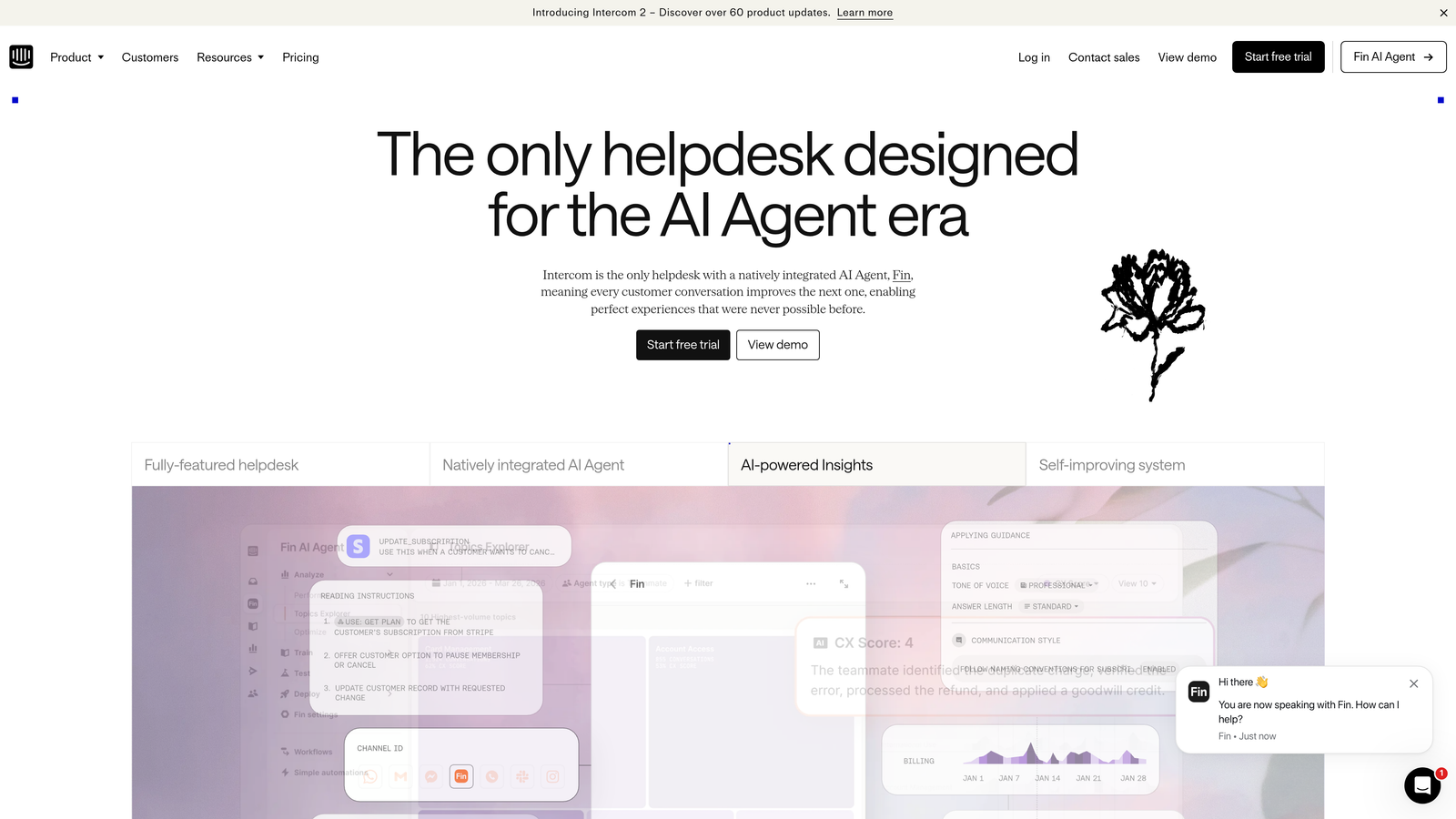
Intercom is a leading conversational support platform featuring Fin, its AI agent built on large language models, capable of handling a meaningful portion of support queries autonomously.
Where This Tool Shines
Intercom's Fin AI agent is one of the more mature AI agents in the market, and its in-app messenger UX remains a benchmark for conversational support design. If your customers already interact with you through the Intercom widget, Fin extends that experience naturally without requiring a platform change.
The AI Copilot feature is also worth noting for teams that blend automated and human support. It provides real-time suggestions to live agents, reducing resolution time and helping newer team members respond with confidence.
Key Features
Fin AI Agent: Handles autonomous query resolution across a meaningful share of incoming support volume using large language models.
AI Copilot: Provides real-time assistance and suggestions to human agents during live conversations.
In-App Messenger: A polished, highly customizable chat UX that sets a high bar for in-product support experiences.
App Marketplace: Hundreds of integrations covering CRM, billing, analytics, and more.
Proactive Support and Product Tours: Enables outbound messaging and in-app onboarding flows alongside reactive support.
Best For
Teams already using Intercom for customer communication who want to layer in AI without switching platforms. Also strong for product-led growth companies where in-app messaging and onboarding are central to the customer experience.
Pricing
Tiered plans with AI features typically available at higher tiers. Pricing can scale significantly for larger teams. Check intercom.com for current pricing.
3. Zendesk AI
Best for: Large enterprises with complex support workflows that need mature, compliance-grade helpdesk infrastructure with AI layered in.
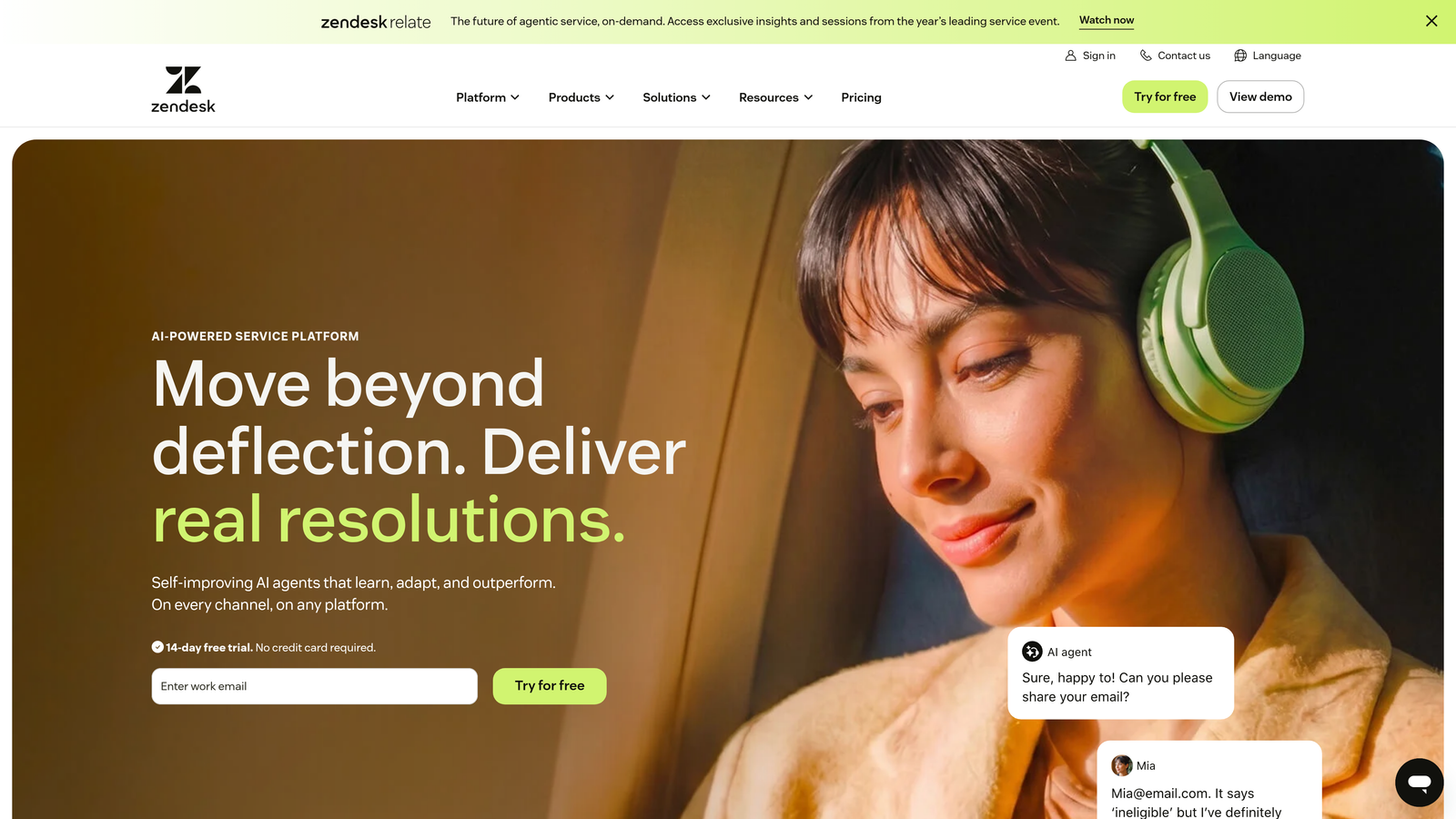
Zendesk AI is the AI layer built into Zendesk's established enterprise helpdesk platform, covering ticket deflection, intelligent triage, routing, and agent assist across one of the most extensive support ecosystems available.
Where This Tool Shines
Zendesk's strength has always been its enterprise-grade infrastructure. The AI features — including AI Agents for ticket deflection and intelligent routing — are built on top of a platform that handles compliance, security, and complex workflow requirements at scale. For organizations where audit trails and data governance are non-negotiable, that foundation matters.
The breadth of Zendesk's integration marketplace is also a genuine advantage. If your support stack involves tools that most platforms don't natively connect with, Zendesk's ecosystem likely has a path to integration.
Key Features
AI Agents: Autonomous ticket deflection handling common queries before they reach human agents.
Intelligent Triage and Routing: AI-powered classification that routes tickets to the right team or agent automatically.
Agent Suggestions: AI-powered knowledge recommendations surfaced to agents during live interactions.
Enterprise Compliance: Mature security, data governance, and compliance features suited to regulated industries.
Extensive Integration Marketplace: Thousands of integrations covering virtually every enterprise tool category.
Best For
Large enterprises and established mid-market companies with complex support operations, compliance requirements, and teams that already have Zendesk embedded in their workflows. Less suited to lean startups looking for fast, AI-native iteration.
Pricing
Suite plans with AI features available at higher tiers. Enterprise pricing applies for advanced capabilities. Check zendesk.com for current pricing.
4. Freshdesk Freddy AI
Best for: SMBs and growing teams that want structured helpdesk functionality with AI capabilities at accessible price points.
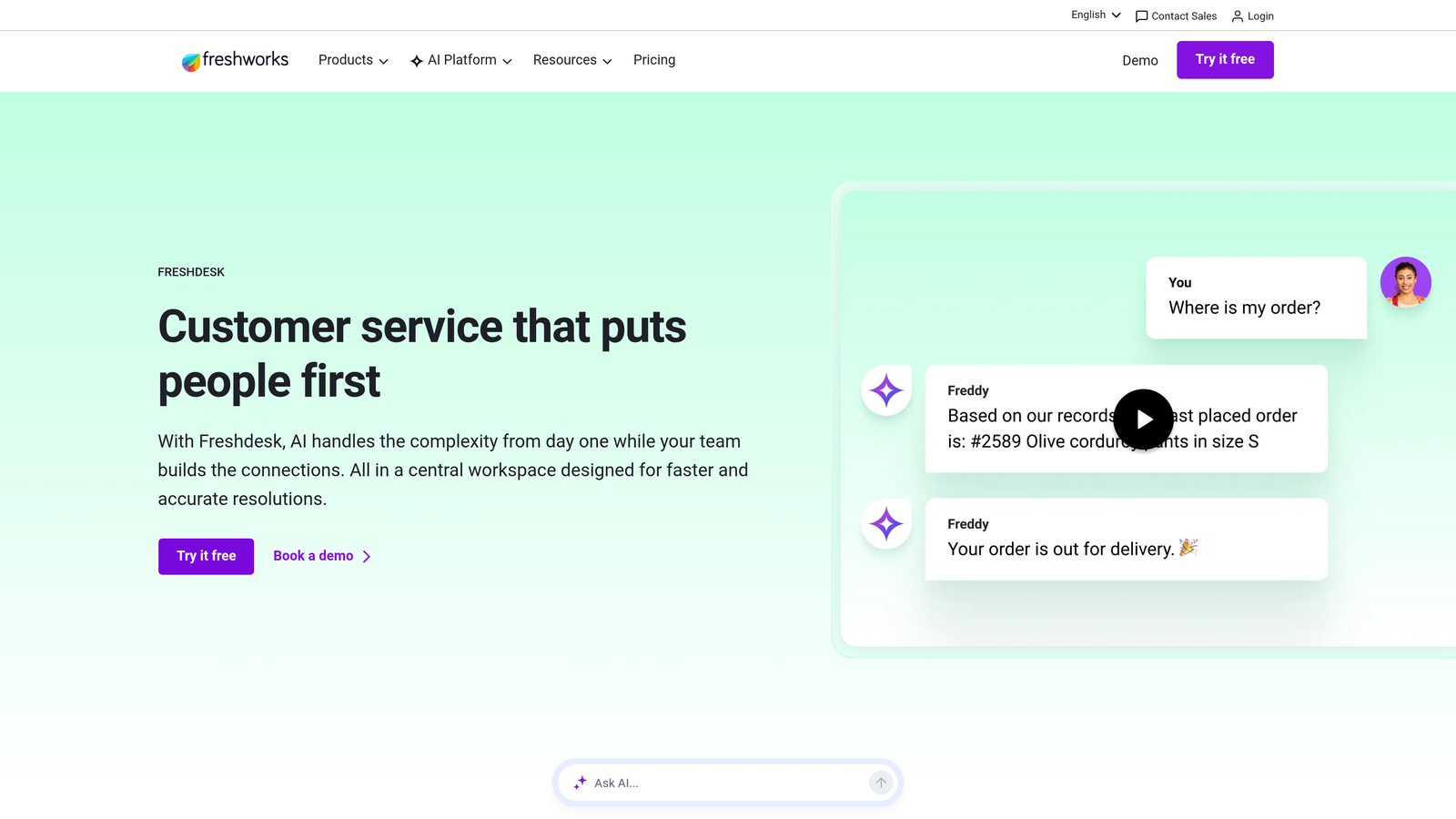
Freshdesk's Freddy AI spans self-service bots, agent copilot capabilities, and analytics insights, making it one of the more accessible AI helpdesk options for teams not ready for enterprise pricing.
Where This Tool Shines
Freshdesk's value proposition is clear: structured helpdesk functionality with AI features that don't require an enterprise budget. Freddy AI is split across three distinct layers — self-service, agent assist, and analytics — giving teams flexibility in how deeply they engage with AI automation without overhauling their entire workflow.
For teams already using other Freshworks products, the suite play is compelling. Freshdesk integrates naturally with Freshsales and Freshservice, enabling a more connected view of the customer across sales, support, and IT.
Key Features
Freddy Self Service: AI-powered ticket deflection bot that handles common queries before they reach agents.
Freddy Copilot: Agent assist features including suggested responses and auto-triage.
Freddy Insights: AI-driven analytics that surface patterns and recommendations from support data.
Freshworks Suite Integration: Native connections to Freshsales and Freshservice for a unified view across the customer lifecycle.
Accessible Pricing: More affordable entry points than Zendesk or Intercom for teams with tighter budgets.
Best For
SMBs and growing teams that need a reliable helpdesk with AI features but aren't ready for enterprise-tier pricing. Also strong for organizations already using the broader Freshworks product suite.
Pricing
Freddy AI is available as an add-on to base Freshdesk plans. Check freshworks.com for current pricing.
5. Salesforce Einstein for Service
Best for: Enterprise teams already operating within the Salesforce ecosystem who want AI deeply integrated with CRM data.
Salesforce Einstein for Service is the AI layer within Service Cloud, using deep CRM data to power intelligent case classification, knowledge recommendations, and the newer Agentforce autonomous agent workflows.
Where This Tool Shines
The core advantage here is CRM data depth. Because Einstein operates within the Salesforce data model, its AI recommendations are informed by the full customer record: purchase history, account health, open opportunities, and previous interactions across every touchpoint. That context produces more relevant suggestions than AI operating on support data alone.
Agentforce, Salesforce's newer autonomous agent capability, extends this further by enabling more complex, multi-step AI workflows within the Service Cloud environment. For enterprises already committed to Salesforce, it's a natural evolution of their existing investment.
Key Features
Einstein Case Classification: Automated ticket routing based on AI analysis of case content and historical patterns.
Einstein Article Recommendations: Surfaces relevant knowledge base content to agents and customers in real time.
Agentforce: Enables more autonomous AI agent workflows within the Salesforce environment.
Full CRM Data Integration: AI recommendations informed by the complete Salesforce customer record.
Enterprise Compliance and Governance: Data governance features suited to regulated industries and large organizations.
Best For
Enterprise support teams whose operations are already centered on Salesforce. The value is directly proportional to how deeply embedded the organization is in the Salesforce ecosystem — it's less compelling as a standalone purchase.
Pricing
Enterprise pricing; requires existing Salesforce licensing. Check salesforce.com for current pricing.
6. Tidio
Best for: SMB e-commerce teams that need fast, no-code AI chatbot deployment with native Shopify and WooCommerce integrations.
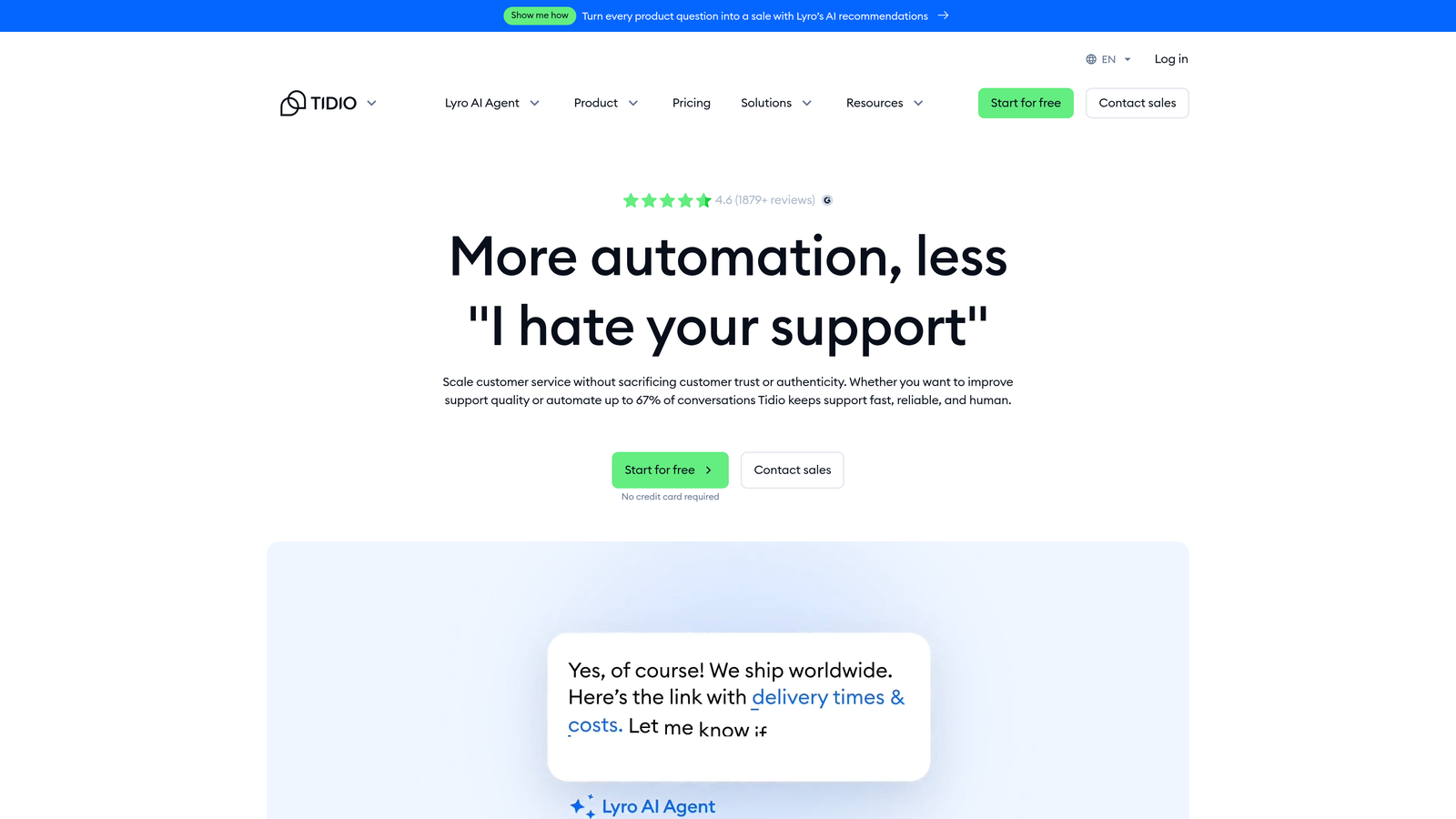
Tidio is a lightweight AI customer service platform featuring Lyro, its conversational AI chatbot, designed for quick deployment without technical resources.
Where This Tool Shines
Tidio's defining characteristic is speed to value. Lyro can be deployed without engineering involvement, making it accessible to small teams that don't have developers available to configure a support platform. For e-commerce businesses where support volume spikes around promotions and seasonal events, that fast setup matters.
The native integrations with Shopify, WooCommerce, and Wix are genuinely useful for e-commerce operators. Rather than building custom connections, teams can get AI-assisted support live within their existing storefront environment quickly.
Key Features
Lyro AI Chatbot: Conversational AI with fast no-code deployment and automatic learning from your FAQ content.
E-Commerce Integrations: Native connections to Shopify, WooCommerce, and Wix for storefront-native support.
Live Chat Fallback: Seamless handoff to human agents when Lyro reaches the limits of its capability.
Multi-Channel Support: Email and Messenger channel coverage alongside live chat.
Free Tier: Available for small teams testing the platform before committing to a paid plan.
Best For
SMB e-commerce teams on Shopify or WooCommerce that want AI-assisted chat without a complex implementation. Less suited to B2B SaaS teams with complex product support needs or deep integration requirements.
Pricing
Free tier available; paid plans are priced for SMB budgets. Check tidio.com for current pricing.
7. Kustomer
Best for: High-volume omnichannel support teams that need a unified customer timeline across every communication channel.
Kustomer is a CRM-native customer service platform that unifies every customer interaction across email, chat, SMS, social, and voice into a single timeline, with AI automation layered throughout.
Where This Tool Shines
Kustomer's unified timeline is its most distinctive feature. Rather than treating each channel as a separate queue, Kustomer assembles the full customer history into a single view — every conversation, order, and interaction regardless of channel. For support teams managing high volumes across multiple touchpoints, that context dramatically reduces the time agents spend piecing together what happened before.
The CRM-native architecture also means AI routing and classification decisions are informed by customer history, not just the content of the current ticket. That produces more relevant triage outcomes for complex support environments.
Key Features
Unified Customer Timeline: Every support interaction across all channels assembled into a single customer view.
AI-Powered Routing and Classification: Automated triage informed by full customer history and conversation content.
Omnichannel Coverage: Email, chat, SMS, social media, and voice in a single platform.
CRM-Native Architecture: Customer data and support history integrated by design, not by integration.
Workflow Automation: Automation for repetitive support processes across any channel.
Best For
Mid-market and enterprise teams running high-volume omnichannel support who need a unified customer view. Particularly strong for businesses where customers reach out across many different channels and agent context is critical to resolution quality.
Pricing
Per-agent pricing with mid-market positioning. Check kustomer.com for current pricing.
8. Help Scout
Best for: Teams that want AI to augment agents rather than replace them, with a clean, minimal UX that prioritizes genuine customer relationships.
Help Scout is a human-centric support platform that uses AI to make agents faster and more effective, rather than positioning AI as the primary resolution mechanism.
Where This Tool Shines
Help Scout's philosophy is deliberately different from the full-automation approach. AI Summarize, AI Drafts, and AI Assist are all designed to reduce the cognitive load on human agents — giving them instant context, suggested responses, and writing improvements — without removing them from the conversation. For teams where relationship quality is a differentiator, that's an intentional choice worth respecting.
The platform's clean, minimal design also reduces the onboarding friction that plagues more complex helpdesks. Teams that have struggled with Zendesk or Freshdesk complexity often find Help Scout significantly easier to operate at scale.
Key Features
AI Summarize: Instant conversation summaries that give agents full context before they respond.
AI Drafts: Suggested responses generated from conversation context and knowledge base content.
AI Assist: In-editor writing improvements for agents composing responses.
Beacon Widget: In-app self-service for customers seeking help without opening a ticket.
Team Collaboration Features: Clean shared inbox with strong internal note and assignment workflows.
Best For
Small to mid-sized teams where human relationships are central to the support experience, and where the goal is making agents better rather than replacing them. Also a strong fit for teams that have found enterprise helpdesks overcomplicated for their actual needs.
Pricing
Per-user pricing accessible for small and mid-sized teams. Check helpscout.com for current pricing.
9. Drift (Salesloft)
Best for: Revenue-focused teams where support and sales pipeline overlap, and AI needs to handle both query resolution and lead qualification.
Drift, now part of Salesloft, is a conversational AI platform that bridges customer support and revenue acceleration within a single conversational flow.
Where This Tool Shines
Drift occupies a unique position in this comparison: it's the only platform explicitly designed to serve both support and sales within the same conversation. If a visitor asks a product question and shows buying intent, Drift can qualify the opportunity, book a meeting, and route to the right sales rep — all without a human stepping in. For revenue teams where the line between support and pipeline is blurry, that's a meaningful capability.
The integration with Salesloft's broader sales engagement platform also gives revenue teams a unified view of how support interactions connect to pipeline progression and deal outcomes.
Key Features
Dual-Purpose AI Chatbot: Handles support queries and sales qualification within the same conversational flow.
Meeting Booking Automation: Integrated calendar booking that routes qualified prospects directly to sales calendars.
Salesloft Integration: Native connection to Salesloft's sales engagement platform for unified revenue workflows.
Conversational Landing Pages and ABM Targeting: Personalized conversational experiences for account-based marketing campaigns.
Revenue Intelligence Reporting: Analytics that connect support interactions to sales outcomes and pipeline data.
Best For
Enterprise and mid-market revenue teams where support and sales functions overlap significantly, and where the value of a conversation is measured in pipeline as much as resolution rate. Less suited to pure support teams without a sales use case to justify the investment.
Pricing
Higher-end pricing with enterprise and mid-market focus. Check drift.com for current pricing.
Which Tool Is Right for Your Team?
The AI customer service landscape in 2026 has matured to the point where there's a genuinely strong option for almost every use case and budget. The challenge isn't finding a capable tool — it's matching the right architecture to your actual support needs.
Here's a quick guide to help you narrow it down:
For B2B SaaS teams that want AI-first architecture with business intelligence: Halo AI is purpose-built for this use case, with page-aware context, continuous learning, and native integrations with the tools product teams actually use.
For teams already embedded in Intercom's ecosystem: Fin AI is a natural extension of what you already have, without requiring a platform change.
For large enterprises with complex compliance requirements: Zendesk AI or Salesforce Einstein for Service, depending on whether your team lives in Salesforce or a standalone helpdesk.
For SMBs that want accessible AI without enterprise pricing: Freshdesk Freddy AI offers a solid balance of structure and AI capability at a reasonable cost.
For e-commerce teams on Shopify or WooCommerce: Tidio's Lyro chatbot provides fast, no-code deployment with the right native integrations.
For revenue teams where support and pipeline overlap: Drift within the Salesloft ecosystem handles both functions in a single conversational flow.
For teams that prioritize agent augmentation over full automation: Help Scout's human-centric approach keeps agents in the loop with AI making them faster, not redundant.
Your support team shouldn't scale linearly with your customer base. Let AI agents handle routine tickets, guide users through your product, and surface business intelligence while your team focuses on complex issues that need a human touch. See Halo in action and discover how continuous learning transforms every interaction into smarter, faster support.
If you're still exploring your options, our guides on Intercom alternatives and a broader chatbot software comparison cover additional context to help you make the right call.