9 Best AI Customer Service Tools Compared for 2026
This ai customer service tools comparison evaluates nine leading platforms across automation depth, integrations, and live agent handoff quality to help B2B teams find the right fit—whether they need a fully autonomous AI agent, an AI layer for an existing helpdesk, or a simple FAQ chatbot.
 Matt PattoliFounder13 min read
Customer support expectations have shifted dramatically. B2B buyers now expect fast, accurate, and context-aware responses at any hour, and support teams are under pressure to deliver that without endlessly growing headcount. AI customer service tools have become the practical answer, but the market is crowded and the differences between platforms are significant.
Choosing the right tool depends on what you actually need: a purpose-built AI agent that resolves tickets end-to-end, an AI layer bolted onto your existing helpdesk, or a lightweight chatbot for FAQ deflection. Get that wrong and you'll spend months configuring a tool that was never built for your use case.
This comparison covers all three categories, evaluating each platform on automation depth, integration breadth, learning capability, live agent handoff quality, and analytics. Whether you're exploring AI-first customer support for the first time or looking to upgrade from a traditional helpdesk, this breakdown will help you find the right fit. We also cover what makes modern AI support agents fundamentally different from older chatbot approaches, so you can evaluate platforms with a clearer lens.
1. Halo AI
Best for: B2B SaaS teams that need an AI-first support platform with product-aware intelligence and business context.
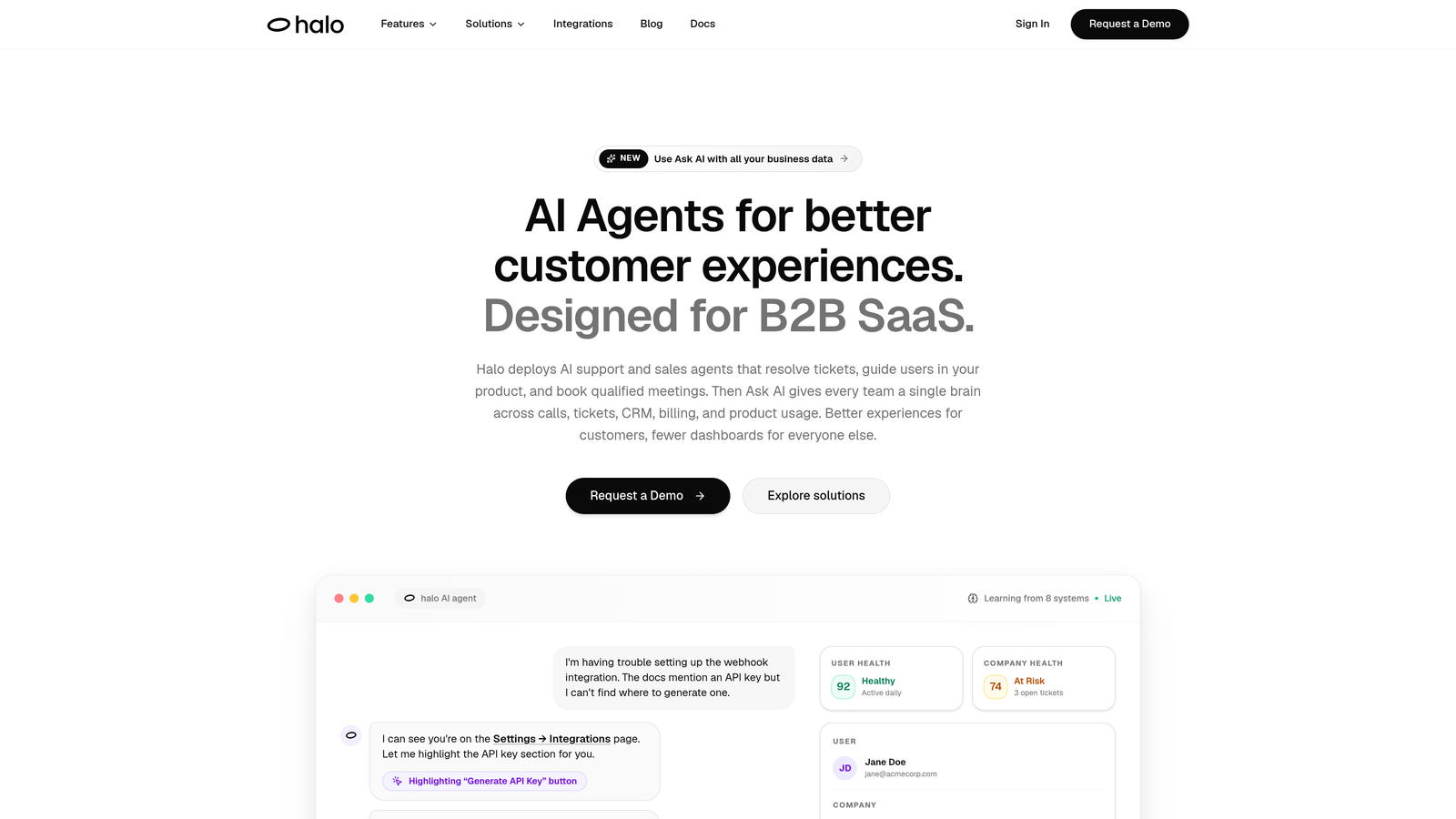
Halo AI is a purpose-built AI customer support platform designed from the ground up for B2B SaaS teams, not a helpdesk with AI features added on top.
Where This Tool Shines
Halo's most distinctive capability is its page-aware context. The chat widget actually sees what the user sees on screen, which means the AI agent can provide precise, in-product guidance rather than generic help center responses. This is a meaningful difference when your users are stuck on a specific workflow or confused by a particular UI state.
Beyond ticket resolution, Halo surfaces business intelligence signals that most support tools ignore entirely. The smart inbox highlights customer health indicators, revenue anomalies, and churn signals, turning your support queue into a source of strategic insight rather than just a to-do list.
Key Features
Page-Aware Chat Widget: The AI sees the user's current screen context, enabling precise in-product guidance that generic chatbots cannot replicate.
End-to-End Ticket Resolution: AI agents handle tickets autonomously from first contact through resolution, with continuous learning from every interaction to improve over time.
Auto Bug Ticket Creation: When users report issues, Halo automatically creates and routes bug tickets to Linear or your preferred issue tracker, closing the loop between support and engineering.
Smart Inbox with Business Intelligence: Goes beyond standard support analytics to surface customer health signals, revenue anomalies, and churn indicators directly in the inbox view.
Live Agent Handoff: Complex issues escalate to human agents with full conversation context preserved, so customers never have to repeat themselves.
Broad Integration Stack: Connects with Linear, Slack, HubSpot, Stripe, Zoom, PandaDoc, Fathom, and Intercom, making it compatible with most B2B SaaS toolchains.
Best For
B2B SaaS companies that want an AI-first support platform rather than an AI-enhanced helpdesk. Particularly strong for product-led growth teams where in-product guidance, bug reporting, and customer health visibility are all part of the support function.
Pricing
Contact for pricing. Halo is positioned for B2B SaaS teams and offers custom plans based on team size and use case. Visit haloagents.ai to get started.
2. Intercom
Best for: Teams that want a mature messaging platform with a capable AI agent and strong developer ecosystem.
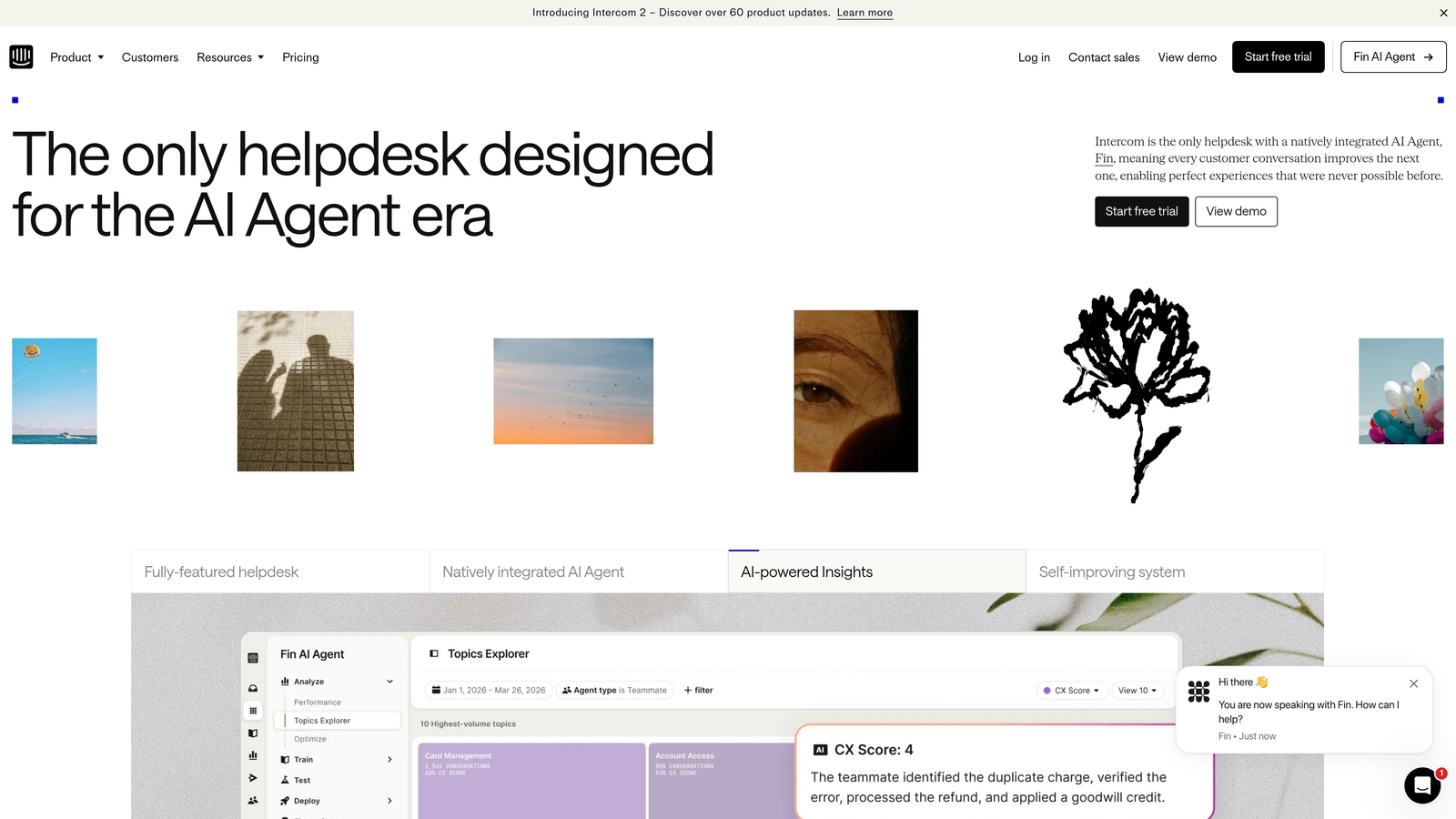
Intercom is one of the most established customer messaging platforms, and its Fin AI agent has become a serious front-line support tool built on large language models.
Where This Tool Shines
Fin is trained on your knowledge base and handles a meaningful portion of incoming queries without human involvement. Intercom's strength is the combination of a polished in-app messenger, robust conversation routing, and a developer ecosystem that has been built out over many years.
For teams that already live in Intercom and want to add AI without switching platforms, Fin is a natural upgrade path. The transition is relatively smooth because the underlying infrastructure is already in place.
Key Features
Fin AI Agent: Trained on your knowledge base to handle front-line queries with conversational accuracy using large language model capabilities.
Conversation Routing and Inbox Management: Sophisticated routing logic ensures queries reach the right team or agent based on topic, priority, or customer segment.
In-App Messenger: A polished, customizable messenger with one of the strongest developer ecosystems in the category.
Extensive Third-Party Integrations: Connects with a wide range of CRM, marketing, and product analytics tools.
AI-Assisted Reply Suggestions: Helps human agents respond faster with AI-generated draft replies based on conversation context.
Best For
Teams already using Intercom that want to layer in AI without a platform migration. Also strong for product-focused companies that need a sophisticated in-app messaging experience alongside AI automation.
Pricing
Seat-based pricing with AI features available on higher-tier plans. Pricing can scale significantly for larger teams. Check intercom.com for current rates.
3. Zendesk AI
Best for: Enterprise teams with existing Zendesk infrastructure looking to add AI-powered triage and automation.
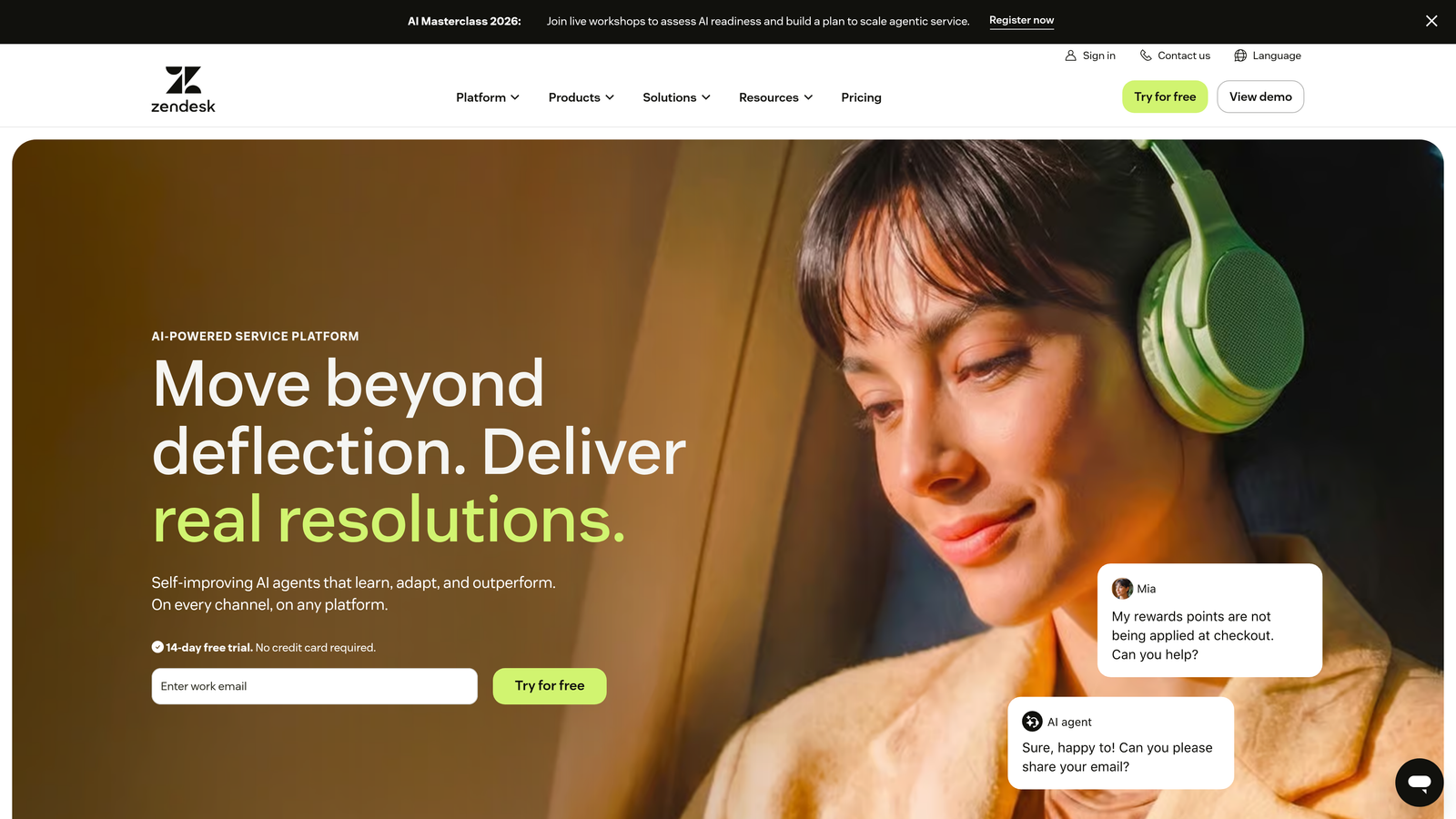
Zendesk AI layers generative AI capabilities across the company's established ticket management system, adding intelligent triage, routing, and reply generation to an already mature platform.
Where This Tool Shines
Zendesk's core advantage is the depth of its existing infrastructure. The app marketplace has over a thousand integrations, the reporting and analytics capabilities are enterprise-grade, and the ticket workflow customization is among the most flexible in the market.
For organizations that have already standardized on Zendesk, the AI features represent a meaningful productivity upgrade without requiring a platform change. The AI works across email, chat, voice, and social channels, which is important for teams managing high-volume, multi-channel support.
Key Features
Intelligent Ticket Triage: Automatically categorizes, prioritizes, and routes incoming tickets based on content and intent.
AI-Generated Reply Suggestions: Recommends responses and macros to help agents resolve tickets faster without starting from scratch.
Large App Marketplace: Access to over a thousand integrations covering virtually every business tool category.
Advanced Reporting and Analytics: Detailed dashboards covering ticket volume, resolution time, CSAT, and agent performance.
Multi-Channel AI Coverage: AI features apply across email, chat, voice, and social, not just one channel.
Best For
Mid-market and enterprise organizations already using Zendesk, or those with complex multi-channel support operations that need enterprise-grade workflow customization and reporting.
Pricing
Tiered plans with AI features requiring Suite Professional or Enterprise tiers. Check zendesk.com for current pricing details.
4. Freshdesk (Freddy AI)
Best for: SMBs and growing teams that want omnichannel helpdesk capabilities with accessible AI features at a competitive price point.
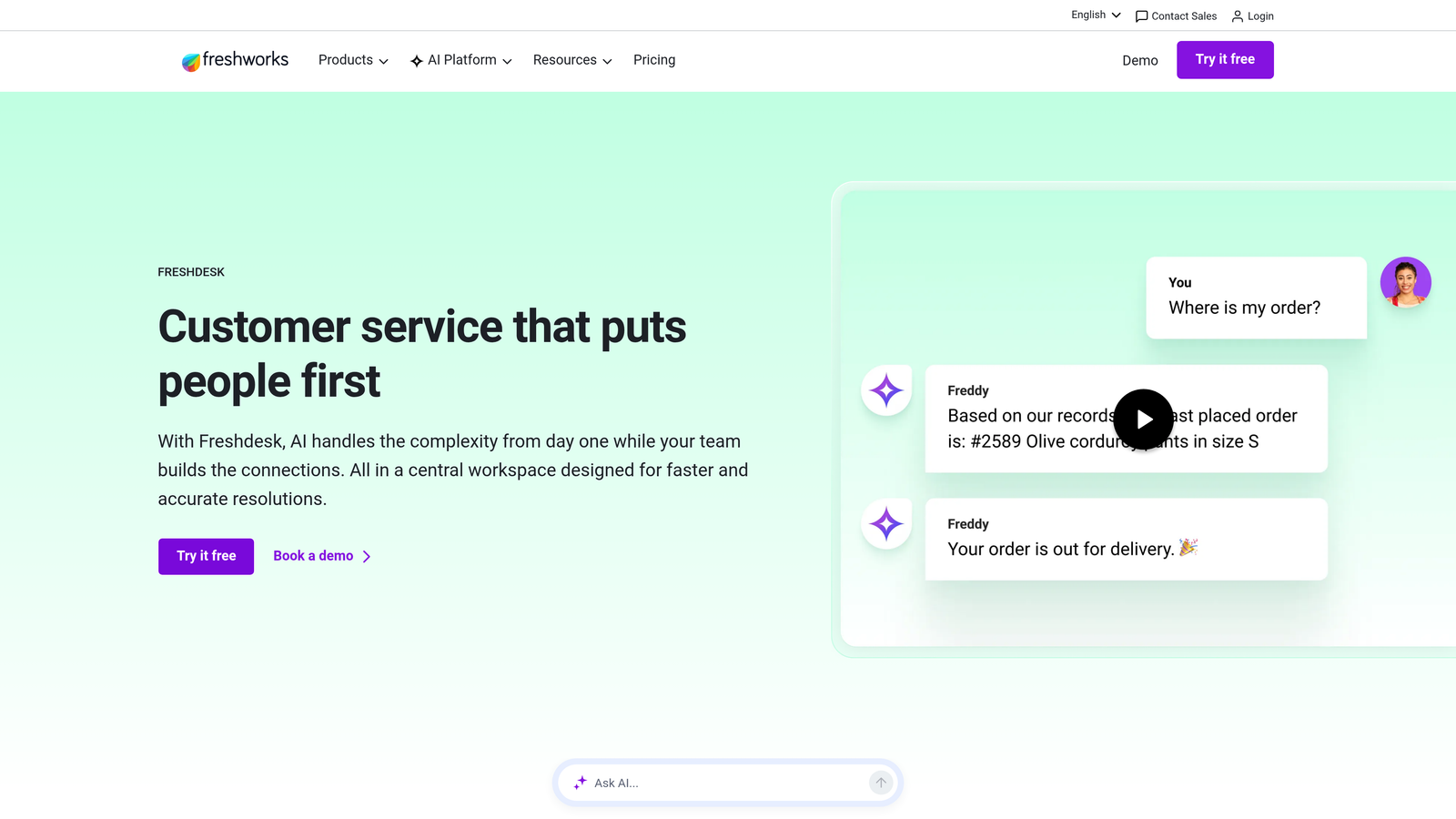
Freshdesk embeds Freddy AI across the Freshworks product suite, handling ticket summarization, suggested responses, and customer-facing chatbot automation.
Where This Tool Shines
Freshdesk's biggest advantage is the combination of omnichannel support and accessible pricing. Email, chat, phone, and social are all covered in a single platform, which removes the need to stitch together multiple tools for smaller teams managing diverse support channels.
Freddy AI's ticket summarization feature is particularly useful for agents who need to quickly catch up on long conversation threads. It won't match the autonomous resolution depth of AI-first platforms, but it meaningfully accelerates human agent workflows.
Key Features
Freddy AI for Agent Assist: Summarizes tickets, suggests responses, and recommends next actions to help human agents work faster.
Omnichannel Support: Unified inbox covering email, chat, phone, and social media channels.
Freddy Self Service: Customer-facing AI chatbot for deflecting common queries before they reach a human agent.
SMB-Accessible Pricing: One of the more affordable platforms in this comparison, with a free plan available for small teams.
Native Freshworks Integration: Connects seamlessly with Freshsales and Freshchat for teams using the broader Freshworks ecosystem.
Best For
SMBs and growing teams that need a capable omnichannel helpdesk with AI assist features at a price point that doesn't require enterprise budgets. Also a good fit for teams already using other Freshworks products.
Pricing
Free plan available for small teams; paid plans start at competitive SMB rates. Check freshdesk.com for current pricing.
5. Tidio
Best for: E-commerce and SMB teams that need a fast-to-deploy AI chatbot with minimal configuration overhead.
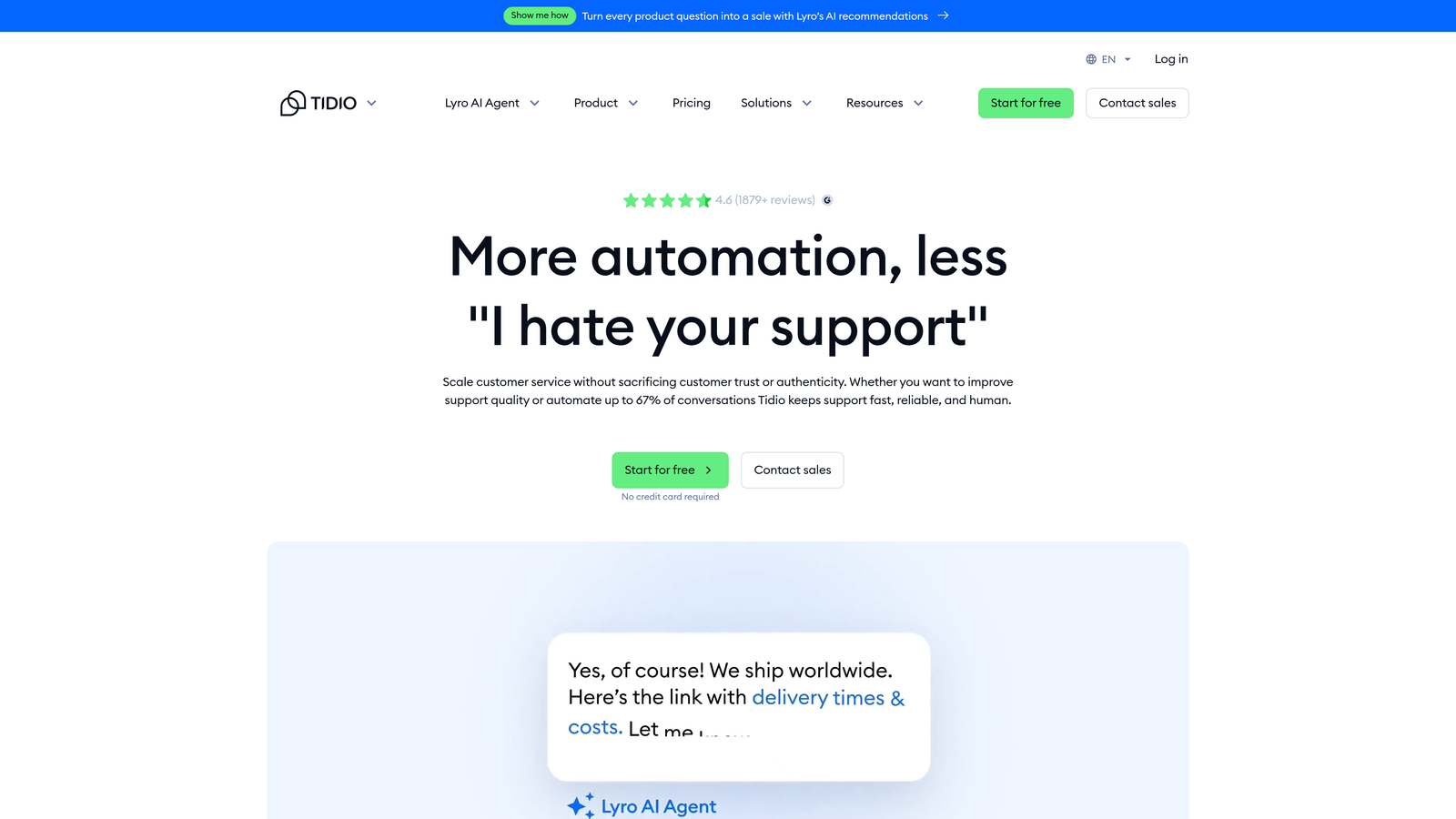
Tidio is a lightweight AI customer service tool built around Lyro, its conversational AI chatbot, designed to get teams live quickly without complex setup.
Where This Tool Shines
Speed of deployment is Tidio's defining advantage. Teams can go from sign-up to a live AI chatbot in hours, not weeks. For e-commerce businesses that need to handle common product, shipping, and returns queries without building out a full support infrastructure, Tidio hits a practical sweet spot.
The unified inbox combining live chat and AI chat in a single view keeps things simple for small teams that don't need the complexity of enterprise helpdesk workflows.
Key Features
Lyro AI Chatbot: Handles common customer queries conversationally using AI trained on your support content.
Rapid Deployment: Can be configured and live within hours with minimal technical setup required.
Unified Inbox: Combines live chat and AI-handled conversations in a single interface for easy management.
E-Commerce Integrations: Native connections with Shopify and WooCommerce for order and product context.
Accessible Pricing: Free tier available with Lyro AI on paid plans, making it approachable for early-stage teams.
Best For
E-commerce businesses and small teams that prioritize fast deployment and simplicity over deep enterprise features. Not the right fit for teams that need complex routing logic, business intelligence, or advanced integrations.
Pricing
Free plan available; Lyro AI is included on paid plans. Check tidio.com for current rates.
6. Drift (Salesloft)
Best for: B2B revenue teams where sales qualification and customer support conversations overlap in the same channel.
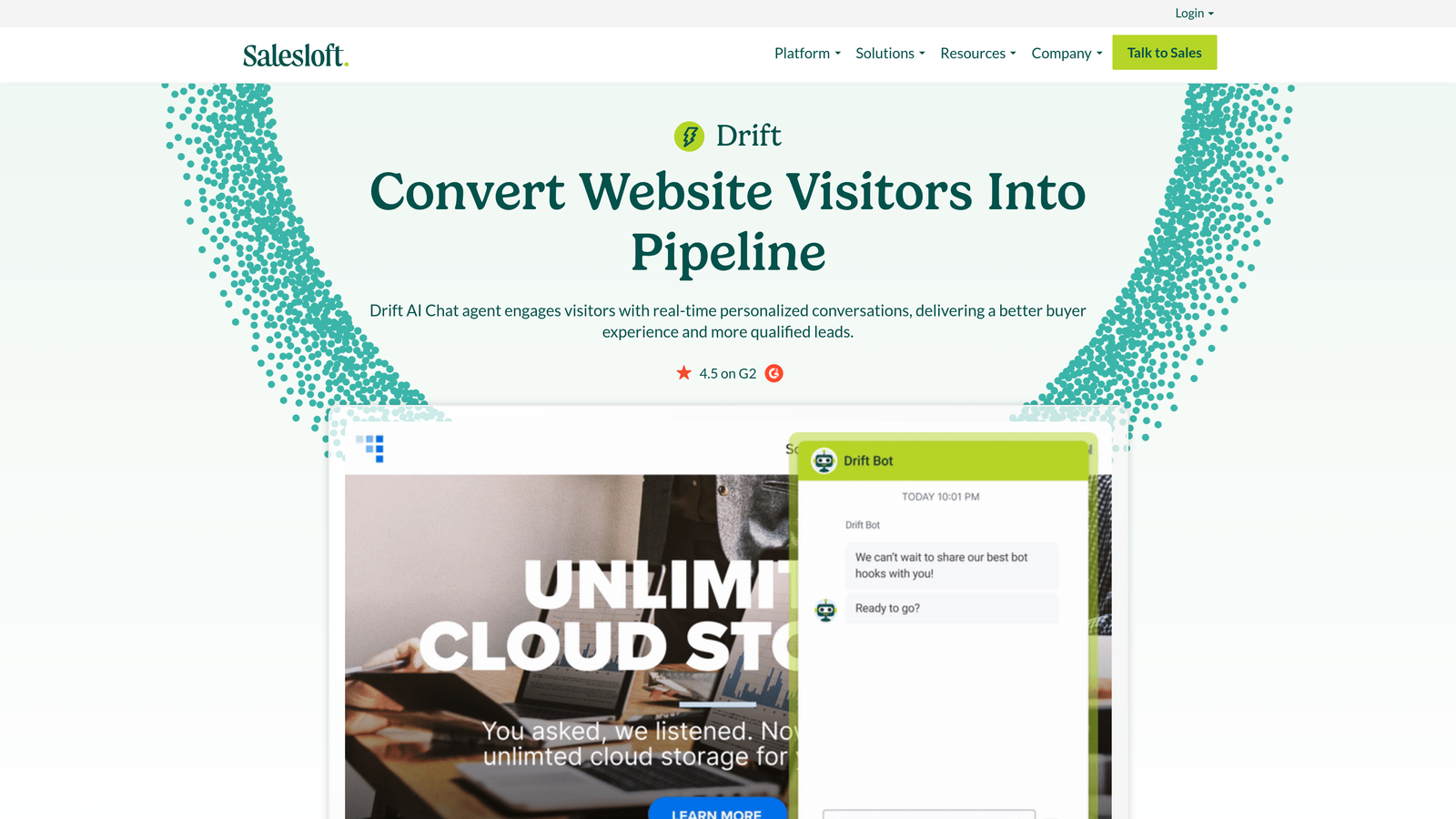
Drift, now part of Salesloft, is a conversational AI platform built for companies where the line between support and sales is intentionally blurred.
Where This Tool Shines
Drift's core differentiator is that it handles sales qualification and support simultaneously. A visitor asking a product question can be qualified, routed to a sales rep, and have a meeting booked in the same conversation thread. For B2B companies with high-intent inbound traffic, this is a genuinely useful capability.
The revenue-focused analytics also set Drift apart from pure support tools. Reporting connects conversation activity to pipeline and revenue outcomes, which matters for teams that view their chat channel as a growth lever rather than just a cost center.
Key Features
Unified Sales and Support AI: Handles support queries and lead qualification in the same conversation flow without requiring handoffs between separate tools.
Intelligent Meeting Booking: Automatically schedules meetings with sales reps based on conversation context and lead qualification signals.
Personalized Conversation Playbooks: Different conversation flows trigger based on visitor segment, account size, or page behavior.
CRM Integrations: Native connections with Salesforce, HubSpot, and other major CRM platforms.
Revenue-Focused Analytics: Reporting ties conversation activity to pipeline and revenue outcomes beyond standard support metrics.
Best For
B2B companies with significant inbound traffic where support and sales conversations naturally intersect. Less suited for teams focused purely on support efficiency without a sales qualification component.
Pricing
Enterprise pricing model. Contact Drift or Salesloft directly for current rates at drift.com.
7. Ada
Best for: Large enterprise teams that need a no-code AI agent builder with strong multilingual capabilities and brand customization at scale.
Ada is an enterprise-grade AI agent platform used by large global brands that need consistent, brand-controlled AI experiences across multiple languages and regions.
Where This Tool Shines
Ada's no-code builder allows non-technical teams to design and deploy AI conversation flows without engineering involvement. This is a meaningful advantage for large organizations where moving fast on AI initiatives often stalls because of engineering bottlenecks.
The multilingual capabilities are genuinely strong. For companies supporting customers across multiple countries and languages, Ada handles the complexity of maintaining consistent brand voice and accurate responses across locales, which is a hard problem that lighter-weight tools don't address well.
Key Features
No-Code AI Agent Builder: Visual conversation design interface that lets non-technical teams build and iterate on AI flows without developer support.
Robust Multilingual Support: Handles customer interactions across multiple languages for global enterprise deployments.
Brand-Controlled AI Personas: Customizable tone, personality, and response style to match enterprise brand standards.
Enterprise System Integrations: Deep connections with major CRM and helpdesk platforms used in large organizations.
Advanced AI Performance Analytics: Detailed reporting on AI resolution rates, escalation patterns, and conversation quality.
Best For
Large enterprise organizations with global customer bases, high ticket volumes, and specific brand consistency requirements. Requires meaningful configuration investment to unlock full value, so it's not the right fit for small teams or quick deployments.
Pricing
Custom enterprise pricing. Contact Ada directly at ada.cx for current rates.
8. Kustomer
Best for: Teams that need deep customer context, including full order and interaction history, alongside AI-assisted conversation automation.
Kustomer, owned by Meta, combines a unified customer timeline with AI-assisted support automation, sitting at the intersection of CRM and helpdesk.
Where This Tool Shines
The unified customer timeline is Kustomer's standout feature. Every interaction, order, transaction, and support conversation is visible in a single view, which means agents and AI alike have full context before responding. This eliminates the frustrating experience where customers have to re-explain their situation every time they contact support.
For teams managing high-volume support in industries where customer history deeply shapes each interaction, such as e-commerce, retail, or subscription services, this context-first approach delivers real efficiency gains.
Key Features
Unified Customer Timeline: All interactions, orders, and transactions consolidated in a single view for complete customer context.
AI-Assisted Replies with Full Context: AI-generated response suggestions informed by the customer's complete history, not just the current conversation.
Omnichannel Support: Handles chat, email, SMS, and social media conversations from a single platform.
Workflow Automation with Business Rules: Flexible automation engine for routing, tagging, and escalating conversations based on custom logic.
CRM-Level Customer Data: Combines support tooling with CRM-depth customer records for a more complete operational picture.
Best For
Mid-market and enterprise teams in industries where customer history is central to every support interaction. Particularly strong for e-commerce and subscription businesses managing complex customer relationships across multiple touchpoints.
Pricing
Per-seat enterprise pricing. Check kustomer.com for current rates.
9. Chatbase
Best for: Startups and small teams that need a fast, low-cost AI chatbot trained on their own documentation with minimal setup.
Chatbase is a lightweight AI chatbot builder that trains on your uploaded documents and embeds as a chat widget on any website, with almost no configuration required.
Where This Tool Shines
Chatbase removes nearly all the friction from getting an AI chatbot live. Upload your PDFs, help docs, or point it at your website, and you have a trained chatbot ready to embed in a matter of minutes. For teams that need basic FAQ deflection without a significant time or budget investment, it delivers on that promise effectively.
The simplicity is also the limitation. Chatbase is a knowledge-base-trained bot, not an agentic AI platform. It handles common questions well but isn't designed for complex ticket workflows, live agent handoffs, or business intelligence signals.
Key Features
Document-Trained AI Chatbot: Train the bot on uploaded PDFs, help docs, or website content without any coding or AI expertise required.
Embeddable Chat Widget: Simple embed code works on any website or web application.
No-Code Knowledge Base Ingestion: Add and update training content through a simple interface without developer involvement.
Basic Conversation Analytics: Track common questions, conversation volume, and basic performance metrics.
API Access for Custom Integrations: Higher-tier plans include API access for teams that want to connect Chatbase to other systems.
Best For
Startups, small teams, and individual creators who need a simple AI chatbot for FAQ deflection on a limited budget. Not suited for teams that need autonomous ticket resolution, complex routing, or enterprise-grade integrations.
Pricing
Free tier available; paid plans scale by message volume. Check chatbase.co for current rates.
Which Tool Is the Right Fit for Your Team?
The honest answer is that the best AI customer service tool depends entirely on what problem you're actually solving. These platforms are not interchangeable, and picking the wrong category is a more expensive mistake than picking the wrong vendor within the right category.
Here's a quick way to think about it by use case:
If you need an AI-first platform for B2B SaaS: Halo AI is built specifically for this. Page-aware context, continuous learning, business intelligence signals, and deep integrations make it the strongest fit for product-led SaaS teams that want support to do more than resolve tickets.
If you're already on an established helpdesk: Zendesk AI and Freshdesk Freddy AI are the natural upgrade paths. You get AI features without migrating your existing workflows. Intercom is the right choice if your team is messenger-centric and values a strong developer ecosystem.
If support and sales are the same conversation: Drift makes sense for B2B revenue teams where qualification and support happen in the same channel.
If you need enterprise scale with global reach: Ada handles multilingual, high-volume deployments with brand-controlled AI personas. Kustomer is the better fit when deep customer history and CRM-level context are central to every interaction.
If you need something live today on a limited budget: Tidio and Chatbase both get you there fast. They're not built for complex workflows, but they handle FAQ deflection well for small teams with straightforward needs.
Your support team shouldn't scale linearly with your customer base. Let AI agents handle routine tickets, guide users through your product, and surface business intelligence while your team focuses on complex issues that need a human touch. See Halo in action and discover how continuous learning transforms every interaction into smarter, faster support.