9 Best AI Customer Service Use Cases (With the Tools That Power Them) in 2026
This guide explores the most impactful AI customer service use cases in 2026, from autonomous ticket resolution and proactive churn detection to intelligent routing and visual UI guidance, pairing each use case with the specific tools best equipped to handle it. Whether you're looking to reduce support volume or surface revenue signals from customer conversations, this breakdown helps you match the right AI capability to your actual business need.
 Matt PattoliFounder13 min read
AI customer service has moved well beyond basic chatbots. Today's AI-powered support systems resolve tickets autonomously, guide users through complex workflows, detect bugs before they escalate, and surface revenue signals buried in support conversations — all without adding headcount.
But "AI customer service" means different things depending on what problem you're solving. Automated ticket resolution looks nothing like proactive churn detection. Visual UI guidance is a completely different capability than intelligent routing.
This guide breaks down the most impactful AI customer service use cases in 2026 and pairs each with the tools best equipped to handle them — so you can match capability to need rather than buying a platform and hoping it covers your priorities.
1. Halo AI
Best for: AI-first ticket resolution, page-aware visual guidance, and business intelligence from support data
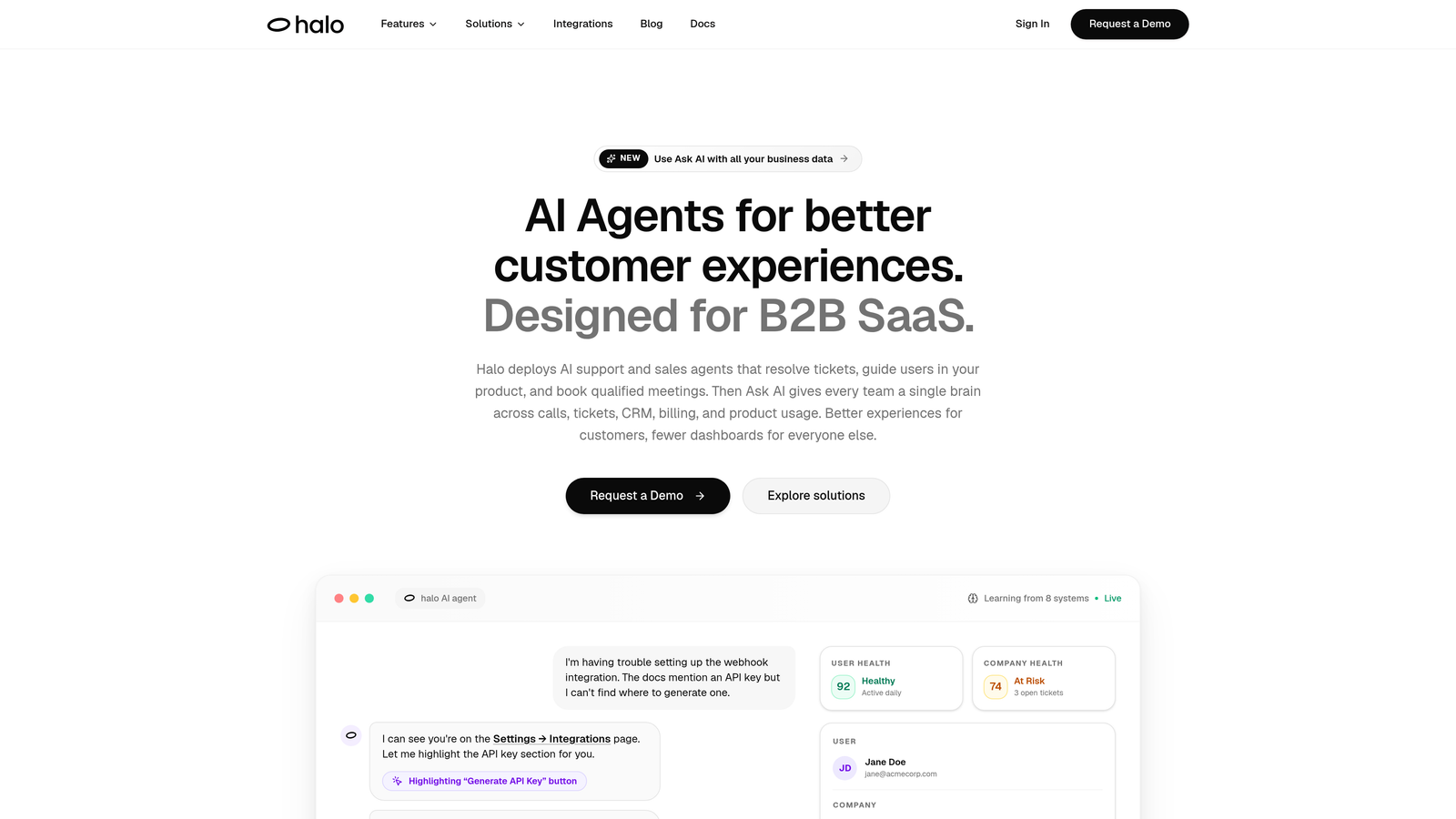
Halo AI is an AI-first customer support platform built for autonomous resolution, contextual user guidance, and cross-stack business intelligence.
Where This Tool Shines
Most AI support tools are helpdesks with AI bolted on afterward. Halo was built the other way around: intelligence is the foundation, not a feature layer. That architectural difference shows up in capabilities that are genuinely difficult for legacy platforms to replicate, particularly the page-aware context engine that sees exactly what a user is looking at and provides step-by-step UI guidance accordingly.
The other standout capability is what Halo does with support data beyond support. The smart inbox surfaces customer health signals, revenue intelligence, and anomaly detection — turning your ticket queue into a business intelligence layer. For SaaS teams that want their support operation to contribute to retention and revenue conversations, that's a meaningful shift from treating support as a cost center.
Key Features
Page-Aware Chat Widget: The AI sees what the user sees on any given page and delivers contextual, step-by-step UI guidance rather than generic help center links.
Autonomous Ticket Resolution: AI agents handle the full ticket lifecycle for common query types, with continuous learning from every interaction to improve resolution accuracy over time.
Auto Bug Ticket Creation: Detects patterns across tickets that indicate product bugs and automatically creates tickets in Linear — closing the loop between support and engineering without manual triage.
Smart Inbox with Business Intelligence: Surfaces customer health signals, revenue intelligence, and anomaly detection beyond standard support metrics.
Live Agent Handoff: Escalates to human agents with full context preserved — no customer repeats themselves, no agent starts from scratch.
Deep Integrations: Connects with Linear, Slack, HubSpot, Intercom, Stripe, Zoom, PandaDoc, and Fathom for a genuinely connected support stack.
Best For
B2B SaaS teams that need more than ticket deflection: product teams that want faster bug reporting loops, support operations that need to surface churn signals, and growing companies that want AI to scale their support without scaling their headcount proportionally.
Pricing
Subscription model with a free trial available. Visit haloagents.ai for current pricing details.
2. Intercom (Fin AI)
Best for: AI-native resolution for teams already running on the Intercom ecosystem
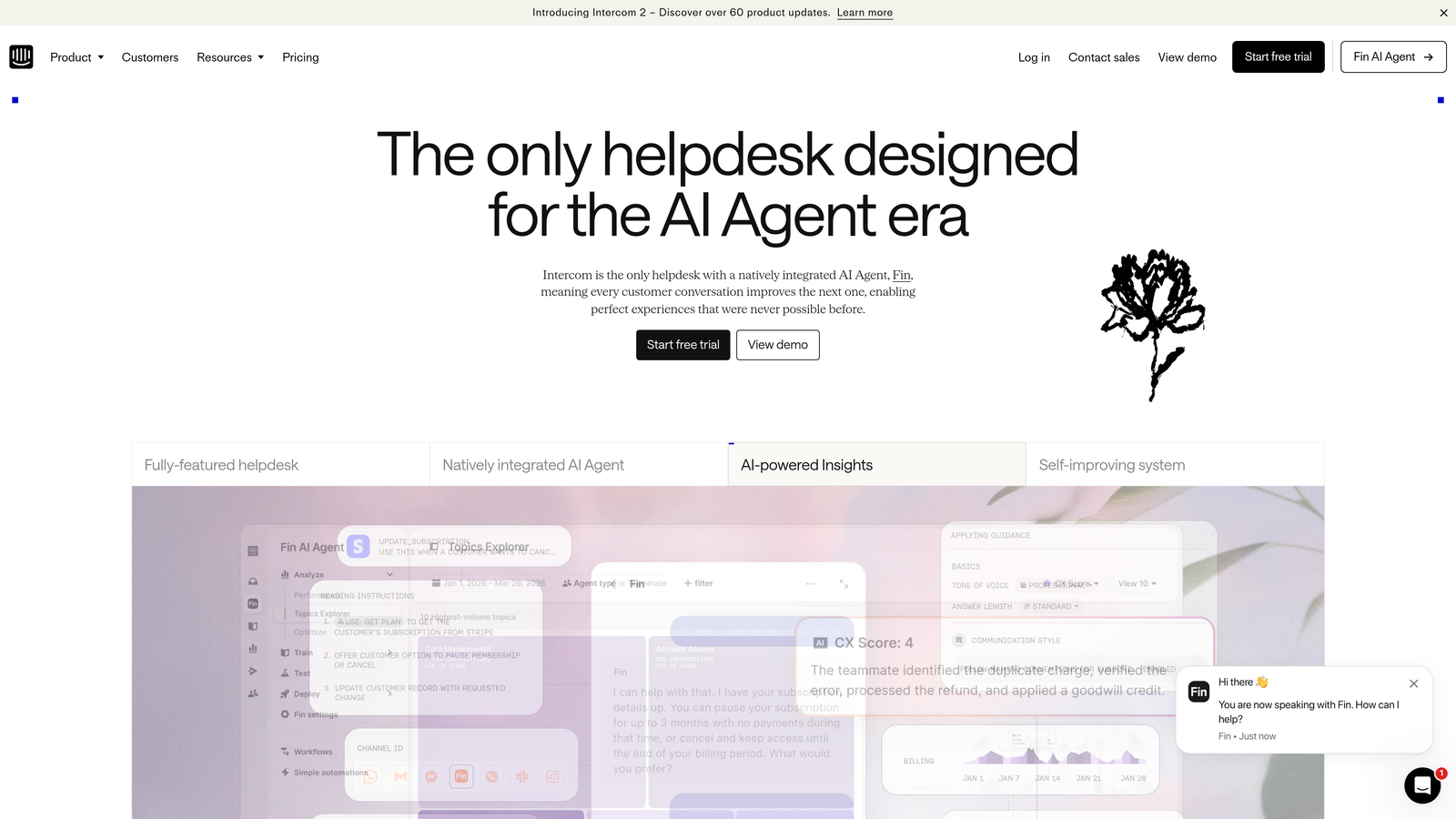
Intercom is a conversational support platform whose Fin AI agent handles multi-step resolution natively within the Intercom messenger experience.
Where This Tool Shines
Fin's biggest advantage is how seamlessly it fits inside an existing Intercom workflow. If your team already lives in Intercom, deploying Fin doesn't require rearchitecting anything. It accesses your help center content, handles multi-step conversations, and hands off to human agents within the same interface — no context switching, no migration overhead.
Fin is particularly well-suited for product-led growth SaaS companies where the support experience lives inside the product itself. The messenger-native format means users never leave their workflow to get help, which tends to improve both resolution rates and customer satisfaction.
Key Features
Fin AI Agent: Resolves conversations natively within Intercom messenger, handling complex multi-step queries without human involvement.
Help Center Integration: Accesses and synthesizes help center content to answer nuanced questions, not just surface links.
Seamless Human Handoff: Transfers to live agents within the same interface when Fin reaches its resolution limits, preserving conversation context.
Usage-Based Model: Pricing scales with resolution volume rather than seat count, which works well for teams with variable support loads.
Best For
Companies already using Intercom as their primary support and messaging layer who want to add AI resolution without platform migration or significant technical lift.
Pricing
Usage-based add-on on top of existing Intercom plans. Intercom base plans start at approximately $39/month; Fin pricing scales with conversation volume.
3. Zendesk AI
Best for: Enterprise-grade AI triage, routing, and resolution for teams deeply invested in the Zendesk Suite
Zendesk AI is an enterprise-grade intelligence layer built natively into the Zendesk Suite, covering triage, routing, automated resolution, and agent assist.
Where This Tool Shines
Zendesk AI's strength is depth of integration with the Zendesk workflow engine. Intelligent triage classifies tickets by intent, sentiment, and language before they reach a human agent — which means routing decisions are made on actual context rather than keyword matching. For high-volume enterprise operations, that accuracy compounds quickly across thousands of tickets.
The agent assist layer is also worth noting. Suggested replies and next-action recommendations surface in real time as agents work tickets, reducing handle time without removing the human from the loop. For teams that aren't ready to go fully autonomous, this hybrid approach is a practical middle ground.
Key Features
Intelligent Triage and Routing: Classifies tickets by intent, sentiment, and language, then routes to the appropriate queue or agent automatically.
AI Agents: Handles automated resolution for common ticket types without agent involvement.
Suggested Replies: Surfaces recommended responses and next actions to human agents during live ticket handling.
Native Workflow Integration: Connects directly to Zendesk's existing automation rules, macros, and reporting infrastructure.
Best For
Enterprise support teams already running Zendesk Suite who want AI capabilities without adding a separate tool or managing a parallel integration layer.
Pricing
AI features are included in Zendesk Suite plans. Suite starts at approximately $55/agent/month, with enterprise tiers above that.
4. Freshdesk Freddy AI
Best for: Omnichannel support automation across the Freshworks ecosystem
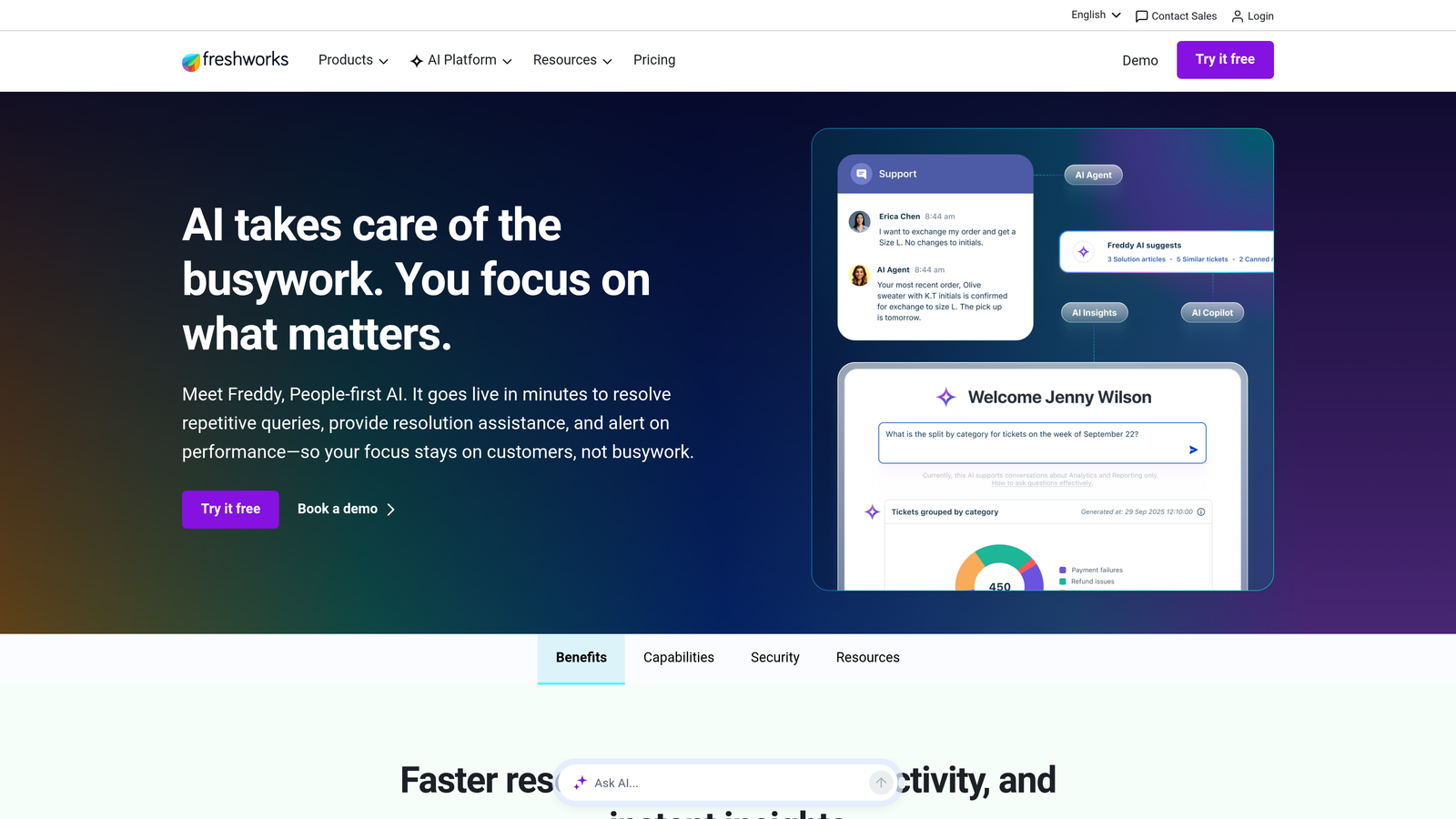
Freshdesk Freddy AI is an AI layer spanning Freshdesk, Freshchat, and Freshsales for unified automation across email, chat, social, and phone channels.
Where This Tool Shines
Freddy AI's value proposition is breadth across the Freshworks suite. Rather than a single AI capability bolted onto a helpdesk, Freddy spans three distinct functions — self-service resolution, agent copilot, and analytics — across every channel Freshworks supports. For mid-market teams that want AI to work across their entire support operation without stitching together multiple vendors, that unified approach reduces complexity significantly.
The Freddy Copilot capability is particularly useful for teams transitioning toward AI-assisted workflows. Real-time knowledge surfacing and response suggestions let agents move faster without fully automating the customer interaction — a natural stepping stone before moving to fully autonomous resolution.
Key Features
Freddy Self Service: Bot-based autonomous resolution for common queries across chat and messaging channels.
Freddy Copilot: Real-time agent assist with knowledge surfacing, suggested responses, and contextual guidance during live tickets.
Freddy Insights: AI-driven analytics and reporting that surfaces patterns across ticket volume, resolution rates, and agent performance.
Omnichannel Coverage: Spans email, chat, social media, and phone from a single AI layer.
Best For
Mid-market teams already using Freshworks products who want to activate AI across their full support operation without adding external tools or managing separate integrations.
Pricing
Freddy AI is available as an add-on on Freshdesk Growth and above. Growth plans start at approximately $15/agent/month.
5. Forethought
Best for: AI-augmented agent workflows focused on triage, knowledge surfacing, and assisted resolution
Forethought is an AI platform designed to enhance human agents through intelligent triage, real-time knowledge surfacing, and autonomous handling of straightforward queries.
Where This Tool Shines
Forethought takes a deliberately agent-centric approach. Rather than positioning AI as a replacement for human support, it's built to make every agent faster and more accurate. The Triage module classifies and routes tickets before agents ever see them; the Assist module surfaces relevant articles and suggested responses as tickets are being worked. The result is reduced handle time without removing human judgment from complex interactions.
For teams that have had mixed results with fully autonomous AI — where edge cases and escalations create more work than they save — Forethought's augmentation model is a more controlled path to AI-driven efficiency. It integrates cleanly with Zendesk, Salesforce Service Cloud, and Freshdesk, so it layers onto existing infrastructure rather than replacing it.
Key Features
Triage Module: Classifies and routes incoming tickets by intent and urgency before agents engage, reducing manual sorting overhead.
Assist Module: Surfaces relevant knowledge articles and suggested responses to agents in real time during active ticket handling.
Solve Module: Handles straightforward, high-confidence queries autonomously without agent involvement.
Multi-Platform Integration: Connects with Zendesk, Salesforce Service Cloud, and Freshdesk for data ingestion and workflow integration.
Best For
Enterprise support teams that want AI to augment agent performance rather than replace agents outright, particularly those running complex support operations where human judgment remains critical.
Pricing
Enterprise pricing model. Contact Forethought directly for a quote based on team size and use case.
6. Tidio
Best for: SMBs and e-commerce teams that need accessible AI chat automation without technical complexity
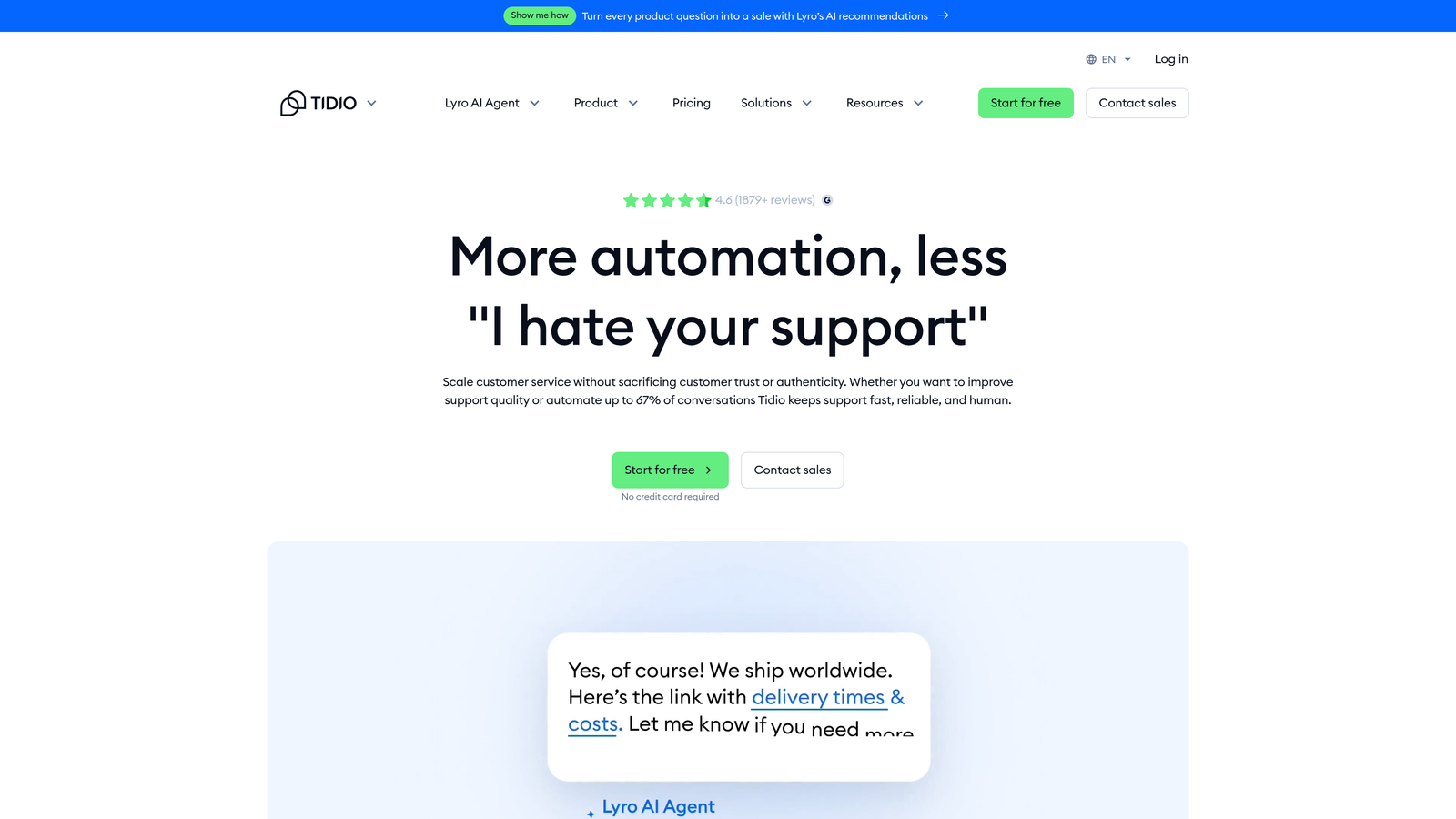
Tidio is an AI customer service platform featuring Lyro AI, designed for small and mid-sized businesses that need conversational automation without a dedicated technical team to configure it.
Where This Tool Shines
Tidio's defining characteristic is accessibility. Most enterprise AI support tools require significant configuration, integration work, and ongoing management. Lyro AI is designed to be operational quickly with minimal setup — which matters enormously for small teams where the person setting up the support tool is also handling support tickets, marketing, and three other things simultaneously.
The live chat fallback is a thoughtful design choice: when Lyro reaches the edge of what it can confidently resolve, it transfers to a human agent rather than giving a poor automated response. For SMBs where customer relationships are personal and high-stakes, that graceful degradation protects the customer experience.
Key Features
Lyro AI: Handles common customer queries conversationally with minimal configuration required from non-technical teams.
Low-Code Setup: Designed for teams without dedicated technical resources — most configurations are visual and template-driven.
E-Commerce Integrations: Native integrations with Shopify, WordPress, Wix, and Magento for order and product context.
Live Chat Fallback: Automatically transfers to a human agent when AI confidence drops below resolution threshold.
Best For
Small to mid-sized e-commerce businesses and SaaS startups that need AI-powered chat automation without the implementation overhead or pricing of enterprise platforms.
Pricing
Free plan available. Lyro AI starts at approximately $29/month, making it one of the more accessible entry points in the market.
7. Assembled
Best for: AI-driven workforce management, volume forecasting, and staffing optimization for support teams
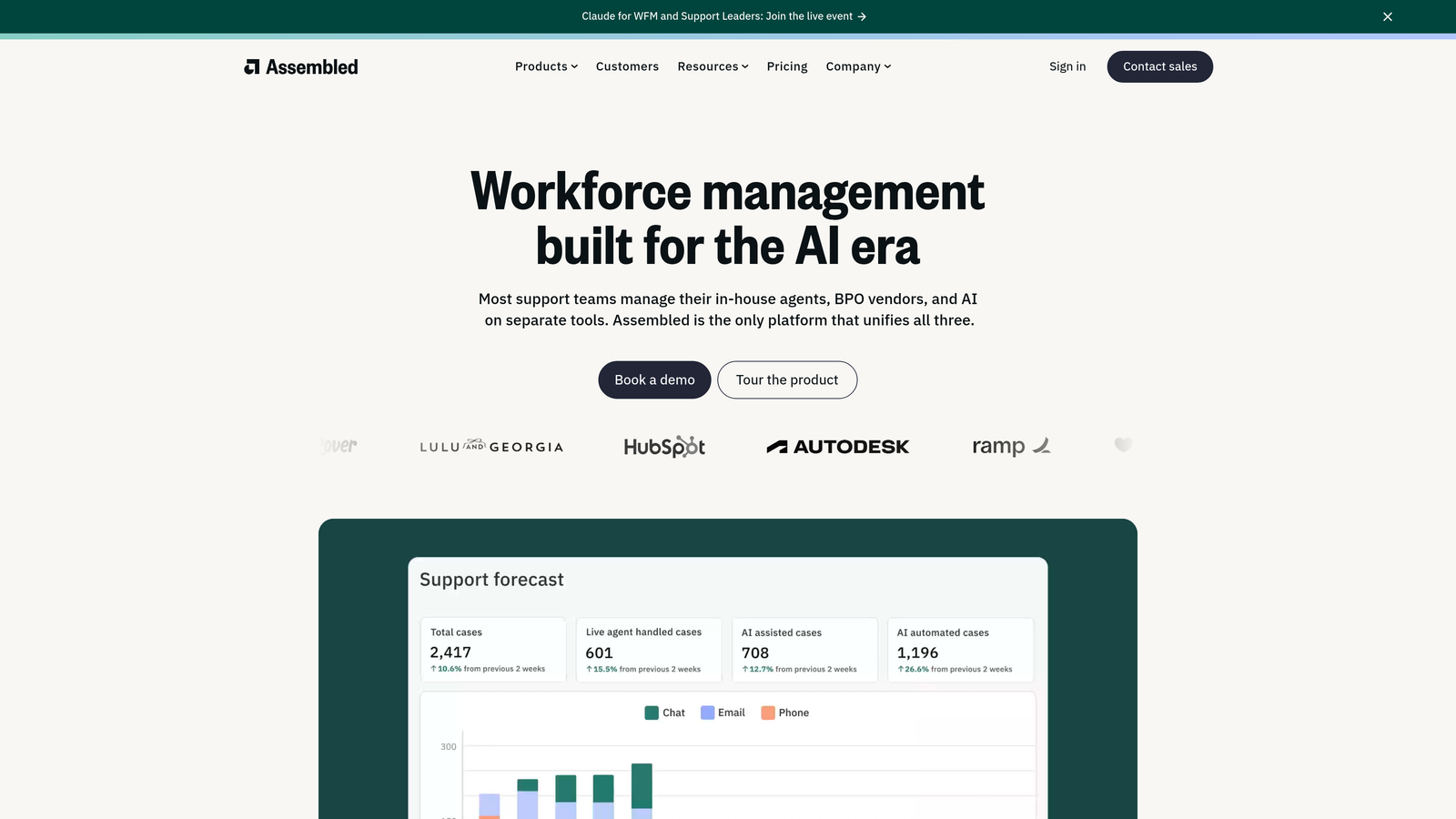
Assembled is an AI-enhanced workforce management platform that forecasts support volume, automates scheduling recommendations, and tracks real-time team adherence.
Where This Tool Shines
Assembled addresses a use case that most AI customer service tools ignore entirely: the operational layer underneath ticket resolution. Knowing that AI will handle 40% of your tickets is useful — but you still need to staff correctly for the 60% that reach humans, and that staffing math changes constantly based on seasonal patterns, product launches, and channel mix shifts.
Assembled's AI forecasting models learn from historical ticket patterns to predict volume across channels and time periods, then translate those predictions into concrete scheduling recommendations. For distributed support teams across multiple time zones, real-time adherence tracking adds another layer of operational visibility that's difficult to maintain manually.
Key Features
AI Volume Forecasting: Predicts ticket volume across channels and time periods based on historical patterns and trend analysis.
Automated Scheduling Recommendations: Translates volume forecasts into staffing recommendations that match agent availability to predicted demand.
Real-Time Adherence Tracking: Monitors whether distributed teams are following scheduled coverage in real time.
Helpdesk Integrations: Connects with Zendesk, Salesforce, and Intercom to ingest ticket data for forecasting accuracy.
Best For
Mid-market to enterprise support operations with distributed teams where staffing inefficiency and over- or under-coverage represent meaningful cost and quality problems.
Pricing
Mid-market to enterprise pricing. Contact Assembled directly for a quote based on team size and operational complexity.
8. Gorgias
Best for: E-commerce brands that need AI to resolve order, return, and shipping queries connected directly to order management systems
Gorgias is an e-commerce-native AI customer service platform with deep order management integrations that enable autonomous resolution of transactional support queries.
Where This Tool Shines
The majority of support tickets for e-commerce brands fall into a handful of predictable categories: where's my order, how do I return this, when will this ship. Gorgias is built specifically to handle those queries autonomously by connecting directly to Shopify, BigCommerce, and Magento — so the AI can pull live order data and resolve the query without any agent involvement.
The revenue statistics tied to support interactions are a genuinely useful addition. Gorgias surfaces upsell and cross-sell opportunities within support conversations, which reframes customer service from a pure cost center into a revenue-contributing channel. For DTC brands where customer lifetime value is the primary metric, that visibility matters.
Key Features
Native E-Commerce Integrations: Deep connections with Shopify, BigCommerce, and Magento for real-time order data access during AI resolution.
Autonomous Order Query Resolution: Handles order status, return initiation, and shipping queries without agent involvement by reading live order data.
Revenue Attribution: Ties support interactions to revenue outcomes, surfacing upsell and cross-sell visibility within the support layer.
Omnichannel Coverage: Manages email, chat, SMS, and social media from a single platform.
Best For
Direct-to-consumer e-commerce brands, particularly those on Shopify, where a large proportion of support volume consists of transactional order management queries.
Pricing
Starts at approximately $10/month for small stores, with pricing scaling based on ticket volume as the operation grows.
9. Drift (Salesloft)
Best for: B2B companies where support and sales overlap, and buying intent signals need to reach sales reps in real time
Drift is a conversational AI platform, now part of Salesloft, that identifies buying intent within support and website conversations and routes high-intent visitors to sales in real time.
Where This Tool Shines
Drift occupies a distinct category: the intersection of support and sales. In B2B SaaS, a support conversation and a buying conversation can look nearly identical at the start. A prospect asking detailed questions about an integration or pricing edge case is often closer to a purchase decision than they appear. Drift's AI is trained to detect those intent signals and route accordingly — getting the right conversation to a sales rep before the moment passes.
The conversational landing pages and playbooks extend this logic to the website layer. Rather than routing all inbound traffic through a generic chat widget, Drift lets teams configure specific conversational flows for different buyer segments and use cases, which can meaningfully improve conversion rates on high-intent traffic.
Key Features
Buying Intent Detection: AI identifies intent signals within support and website conversations and flags high-intent visitors for sales routing.
Real-Time Sales Routing: Connects high-intent visitors to available sales reps in real time, reducing response latency for warm leads.
Conversational Playbooks: Pre-built and customizable conversation flows for common support-to-sales journeys and buyer segments.
CRM Integrations: Connects with Salesforce, HubSpot, and Marketo for lead data synchronization and attribution tracking.
Best For
B2B SaaS and technology companies where the support team regularly interacts with prospects, and where converting those conversations into pipeline is a meaningful revenue lever.
Pricing
Enterprise pricing model following the Salesloft acquisition. Contact Salesloft directly for current Drift packaging and pricing.
Matching the Right Tool to Your Situation
The right AI customer service tool isn't the one with the longest feature list. It's the one that addresses the use case that's costing you the most right now. Here's a quick orientation by situation:
Autonomous ticket resolution with business intelligence: Halo AI — particularly if page-aware context and integrations with Linear, Slack, HubSpot, and Stripe matter to your stack.
Already on Intercom: Intercom Fin for native AI resolution without any platform migration.
Enterprise Zendesk operation: Zendesk AI for deep native routing, triage, and agent assist within existing workflows.
Freshworks ecosystem: Freddy AI for omnichannel automation across every Freshworks product you're already using.
Agent-assist focus: Forethought for knowledge augmentation and triage without removing human judgment from complex tickets.
SMB or e-commerce on a budget: Tidio for accessible AI chat automation with minimal setup overhead.
Workforce management: Assembled for volume forecasting and staffing optimization as a complement to your resolution tools.
E-commerce revenue support: Gorgias for order-connected AI resolution on Shopify and BigCommerce.
Sales-support overlap: Drift/Salesloft for intent-driven routing in B2B environments where support conversations convert to pipeline.
If you're not sure where to start, autonomous ticket resolution typically delivers the fastest measurable ROI — and it creates the foundation every other use case builds on. Your support team shouldn't scale linearly with your customer base. Let AI agents handle routine tickets, guide users through your product, and surface business intelligence while your team focuses on complex issues that need a human touch. See Halo in action and discover how continuous learning transforms every interaction into smarter, faster support.