10 Best AI Customer Support Agent Software in 2026
This comprehensive guide evaluates the 10 best AI customer support agent software platforms in 2026, comparing autonomous resolution capabilities, learning mechanisms, integration depth, and pricing to help businesses move beyond basic chatbot deflection toward intelligent agents that genuinely resolve issues, take action, and continuously improve with every customer interaction.
 Matt PattoliFounder14 min read
Customer support has crossed a threshold. The old model of routing tickets, writing macros, and hiring more agents every time your user base grows is giving way to something fundamentally different: AI agents that don't just deflect FAQs but actually resolve issues, take actions, and get smarter with every conversation.
The market has matured quickly. What started as basic chatbot deflection has evolved into autonomous agents capable of multi-step reasoning, real-time context awareness, and genuine business intelligence. Choosing the right platform now means evaluating more than just "can it answer questions?" You need to ask: does it learn over time, does it integrate deeply with your stack, can it take action rather than just respond, and what does it actually cost?
We evaluated these tools based on autonomous resolution capabilities, learning and improvement mechanisms, integration depth, analytics and intelligence features, and pricing transparency. Whether you're a SaaS startup looking for fast deployment or an enterprise scaling a global support operation, here are the top AI customer support agent platforms worth your attention.
1. Halo AI
Best for: B2B SaaS product teams wanting AI-native support with deep business intelligence
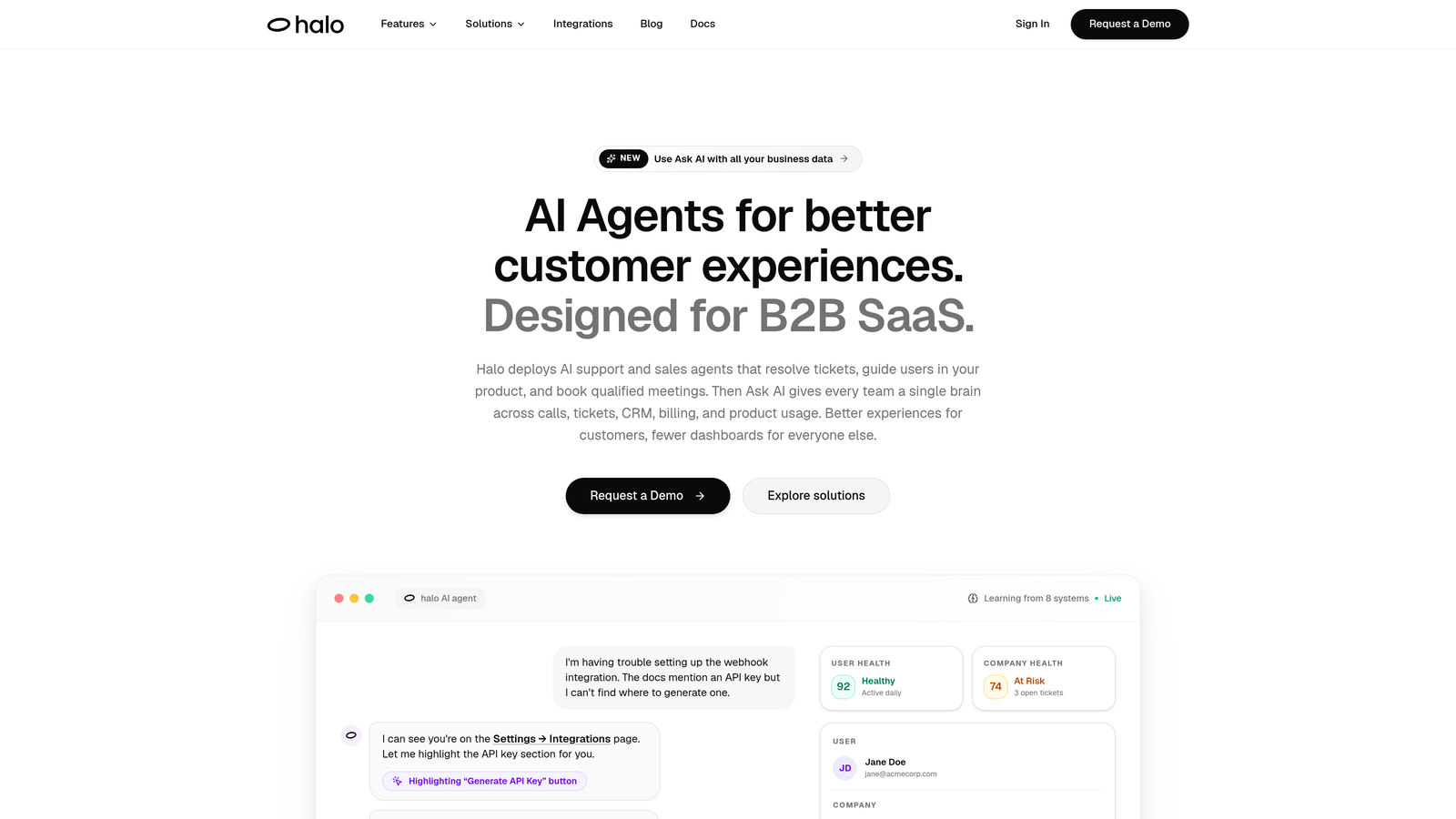
Halo AI is an AI-native customer support platform that deploys autonomous agents to resolve tickets, guide users with page-aware context, and surface business intelligence from every interaction.
Where This Tool Shines
What sets Halo apart from most tools on this list is its architecture. This isn't AI bolted onto a legacy helpdesk; it's built AI-first from the ground up. The page-aware chat widget is a standout capability: Halo's agent actually sees what the user sees on screen, enabling it to provide contextual UI guidance rather than generic help center responses. That's a meaningful difference when your users are stuck mid-workflow.
The continuous learning engine means the system improves with every resolved ticket, not just during initial setup. Combine that with a smart inbox that delivers business intelligence analytics, and Halo starts functioning less like a support tool and more like a product intelligence layer. It can surface churn signals, flag recurring product issues, and auto-create bug tickets in Linear without anyone lifting a finger.
Key Features
Page-Aware Chat Widget: The AI agent sees the user's current page context, enabling precise visual UI guidance rather than generic answers.
Continuous Learning: Every interaction trains the model, so resolution quality compounds over time without manual retraining.
Auto Bug Ticket Creation: Automatically identifies and logs product bugs into your development workflow, connecting support to engineering seamlessly.
Smart Inbox with BI Analytics: Goes beyond ticket management to surface customer health signals, revenue intelligence, and product feedback trends.
Deep Integration Stack: Native connections to Linear, Slack, HubSpot, Intercom, Stripe, Zoom, PandaDoc, and Fathom for true cross-system automation.
Intelligent Live Agent Handoff: Complex or sensitive issues escalate to human agents with full context preserved, so nothing falls through the cracks.
Best For
Halo is best suited for B2B SaaS companies and product teams that want more than ticket deflection. If you need support that connects to your entire business stack, learns autonomously, and generates intelligence beyond "how many tickets did we close," this is the platform built for that ambition.
Pricing
Contact for pricing. Halo is designed to scale with B2B SaaS teams of all sizes, from growth-stage startups to larger product organizations.
2. Intercom Fin
Best for: Teams already using Intercom who want native AI resolution without switching platforms
Intercom Fin is Intercom's GPT-4-powered AI agent that resolves customer questions using your existing help center content and conversation history.
Where This Tool Shines
Fin's biggest advantage is how seamlessly it fits into the Intercom ecosystem. If your team is already living in Intercom's inbox, deploying Fin requires minimal lift. It draws answers from your help center, past conversations, and custom content sources, which means setup time is short and the AI starts with relevant context from day one.
The Fin AI Copilot feature is worth noting for teams with hybrid human-AI workflows. It assists live agents in real time with suggested responses and knowledge lookups, making it useful even when full automation isn't appropriate.
Key Features
Native Intercom Integration: Works directly within Intercom Messenger and the shared inbox without additional configuration layers.
Multi-Source Knowledge: Answers sourced from help center articles, past conversations, and custom content for broad coverage.
Fin AI Copilot: Real-time assistance for human agents handling complex tickets, surfacing relevant knowledge on demand.
Customizable Persona: Tone and personality settings let you align the AI agent with your brand voice.
Resolution Rate Reporting: Built-in analytics show exactly what percentage of conversations Fin resolves without human intervention.
Best For
Intercom Fin is ideal for companies already invested in the Intercom platform who want to layer AI resolution on top of their existing workflows. It's less compelling if you're not already an Intercom customer, given the dependency on their broader plan structure.
Pricing
Fin charges $0.99 per resolution. Intercom base plans are required separately, so total cost depends heavily on your existing Intercom tier and resolution volume.
3. Zendesk AI Agents
Best for: Enterprises running large-scale support operations within the Zendesk ecosystem
Zendesk AI Agents is the AI automation layer built into Zendesk Suite, pre-trained on an extensive dataset of customer service interactions for fast deployment.
Where This Tool Shines
Zendesk's scale advantage is real. The AI agents benefit from training on an enormous volume of customer service data, which gives them a head start on understanding common support patterns across industries. For teams already running Zendesk at scale, the native integration means no additional infrastructure to manage.
Automated triage, tagging, and routing are particularly strong here. High-volume support teams often spend significant agent time just categorizing and assigning tickets; Zendesk AI handles this automatically, freeing agents for resolution work.
Key Features
Pre-Trained on Scale: Trained on billions of customer service interactions, giving it strong out-of-the-box understanding of support language and intent.
Automated Triage and Routing: Classifies, tags, and routes tickets automatically based on content and priority signals.
Generative AI Replies: Produces knowledge-base-grounded responses for common queries without agent involvement.
Agent Assist Tools: Surfaces relevant articles and suggested replies to help human agents resolve tickets faster.
Suite-Native: Fully embedded in the Zendesk Suite, with no separate platform to manage or integrate.
Best For
Zendesk AI Agents work best for mid-market and enterprise teams with established Zendesk deployments and high ticket volumes. Teams not already on Zendesk should weigh the platform investment carefully before choosing this path.
Pricing
Core AI features are included in Zendesk Suite plans. Advanced AI capabilities are available as paid add-ons; pricing varies by tier and usage.
4. Ada
Best for: Enterprise brands needing multilingual, omnichannel AI support at global scale
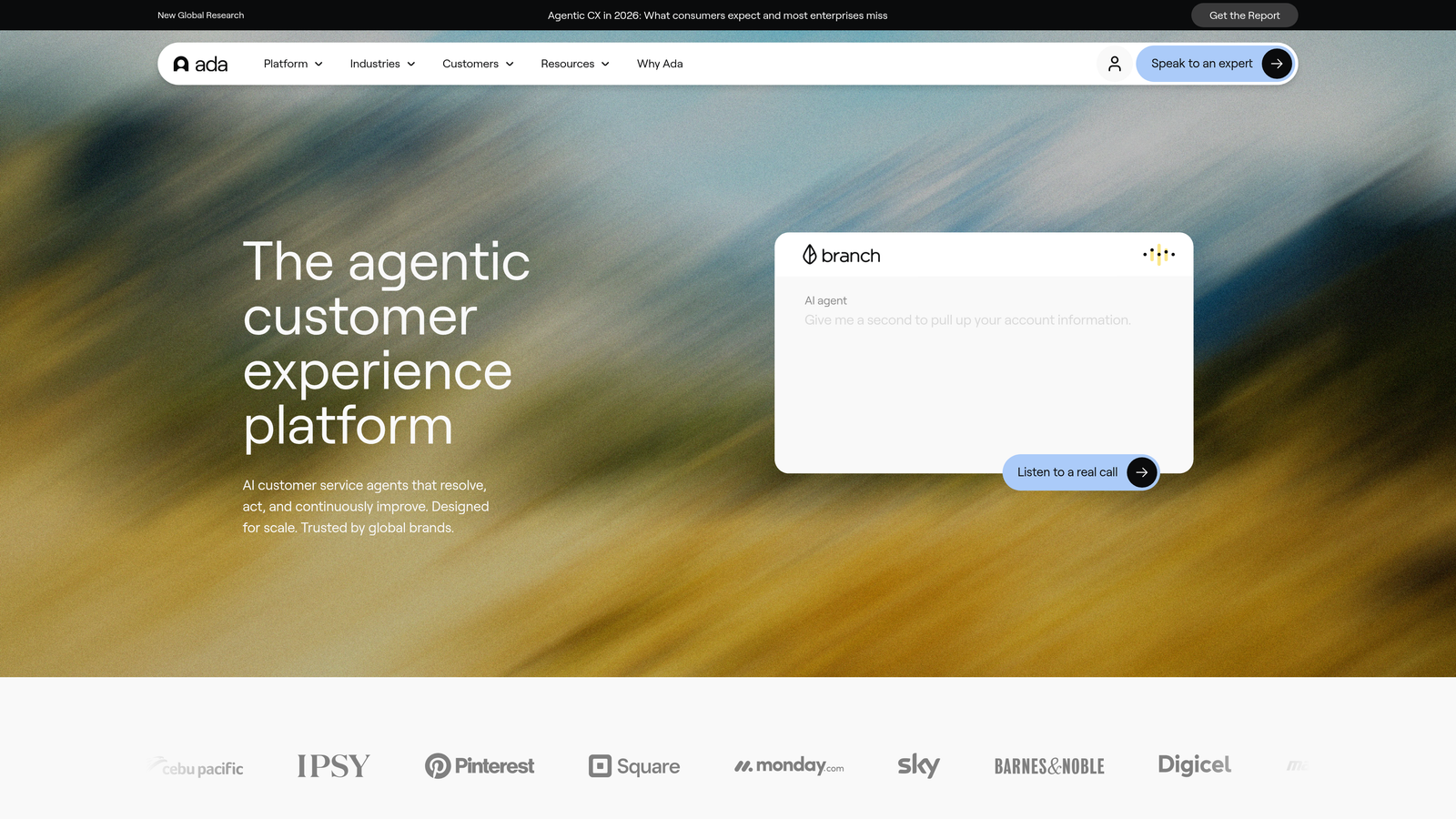
Ada is an enterprise-grade AI agent platform that automates customer support across channels and languages using a no-code builder and AI reasoning engine.
Where This Tool Shines
Ada's multilingual capabilities are among the strongest in this category, with support for over 50 languages and solid accuracy across all of them. For global brands managing support in multiple markets, this removes the need to build and maintain separate flows for each language.
The no-code builder makes it accessible to support operations teams who don't have engineering resources to spare. Combined with Ada's AI reasoning engine, which handles complex multi-step queries rather than just single-turn FAQ responses, it punches above its weight for non-technical teams.
Key Features
No-Code Automation Builder: Build and iterate on conversation flows without engineering involvement.
50+ Language Support: Multilingual accuracy across major and secondary languages for global support operations.
Omnichannel Reach: Deploys across web, mobile, social, SMS, and voice from a single platform.
AI Reasoning Engine: Handles multi-step, context-dependent queries beyond simple FAQ matching.
CRM Integrations: Native connections to Salesforce, Zendesk, and other major CRM and helpdesk platforms.
Best For
Ada is built for enterprise brands with global customer bases, complex support workflows, and a need for omnichannel coverage. It's likely overbuilt for small teams or companies with straightforward, single-channel support needs.
Pricing
Custom enterprise pricing. Contact Ada directly for a quote based on your volume and channel requirements.
5. Freshdesk Freddy AI
Best for: SMBs and mid-market teams in the Freshworks ecosystem seeking affordable AI automation
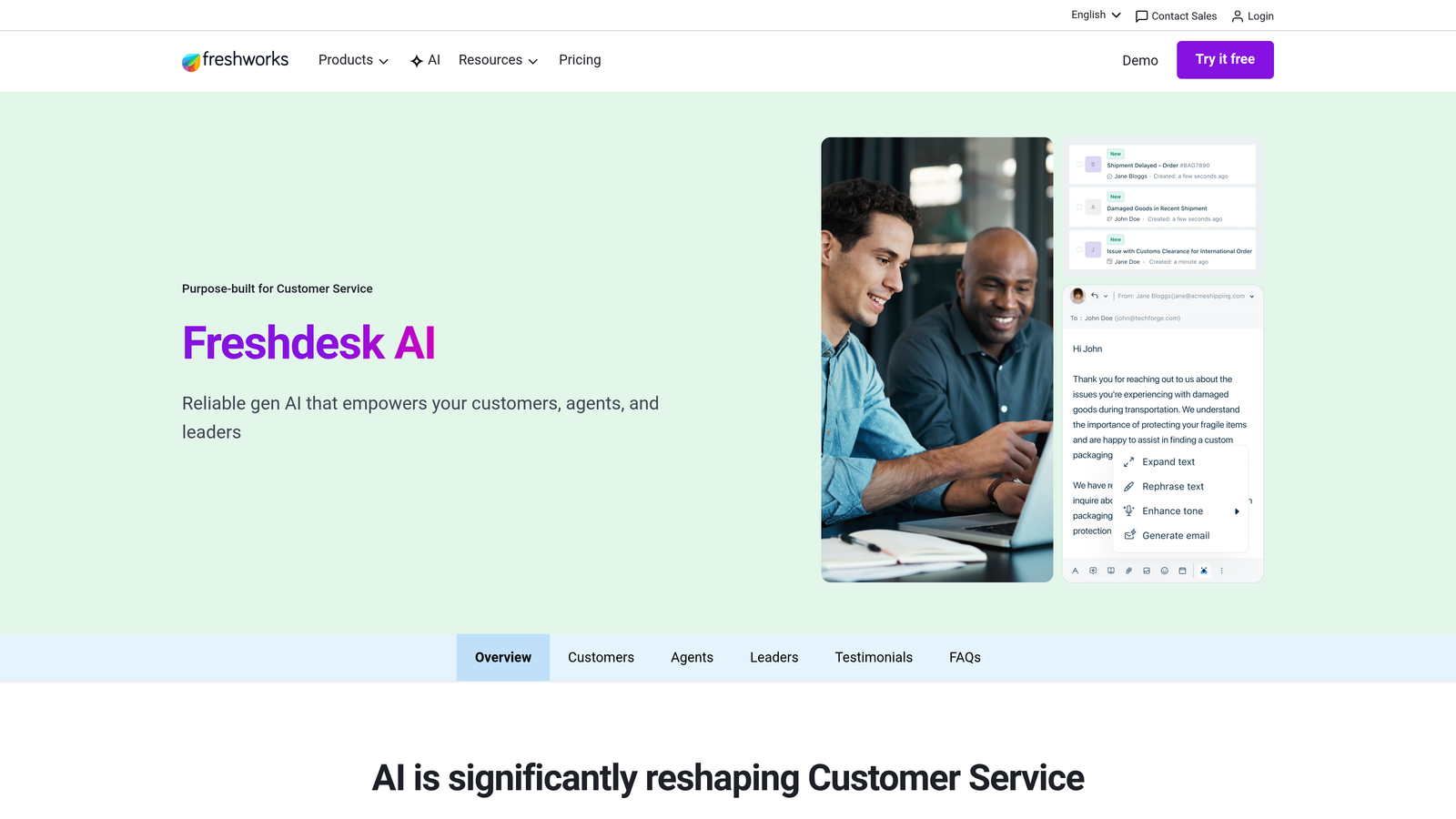
Freshdesk Freddy AI is Freshworks' AI layer for Freshdesk that automates responses, assists agents with suggestions, and handles routine tickets within the Freshworks suite.
Where This Tool Shines
Freddy AI's pricing accessibility is a genuine differentiator. While many enterprise AI support platforms require custom quotes and significant investment, Freddy AI is included in Freshdesk's Pro and Enterprise plans at a price point that smaller teams can actually budget for. That makes it a practical entry point for companies moving from manual support to AI-assisted workflows.
The sentiment analysis and thank-you detector features are small but meaningful touches. Automatically filtering out "thanks, resolved!" replies from your open ticket queue sounds minor until you're managing hundreds of tickets a day.
Key Features
AI Auto-Responses: Automatically responds to common ticket types without agent involvement.
Canned Response Suggestions: Recommends relevant responses to human agents in real time, speeding up resolution.
Freshworks Suite Integration: Tight native connections across Freshdesk, Freshchat, and Freshsales for unified customer data.
Sentiment Analysis: Detects customer tone and flags tickets that need priority human attention.
Thank-You Detector: Identifies and auto-closes tickets where customers have confirmed resolution, reducing queue noise.
Best For
Freddy AI is the right call for SMBs and growing teams already using or considering Freshdesk who want AI capabilities without enterprise-level pricing. It's less suited for teams needing deep customization or AI-native architectures outside the Freshworks ecosystem.
Pricing
AI features included in Freshdesk Pro and Enterprise plans. Freshdesk starts at $15 per agent per month, making it one of the more accessible options on this list.
6. Forethought
Best for: Support teams prioritizing intelligent triage and agent assist alongside AI resolution
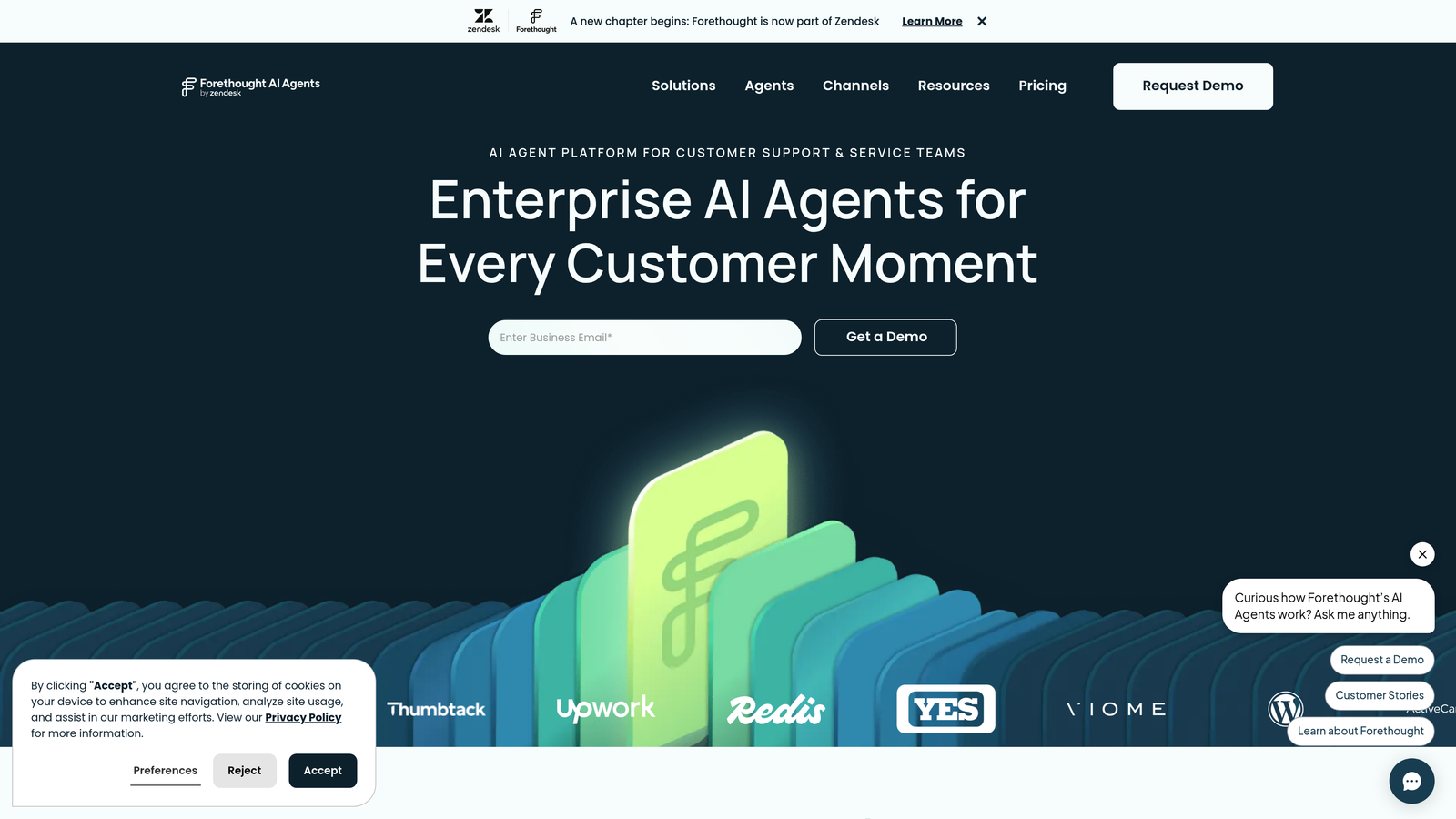
Forethought is an AI support platform powered by its proprietary SupportGPT models, focused on intelligent ticket triage, automated resolution, and real-time agent assistance.
Where This Tool Shines
Forethought's triage capabilities are notably strong. Rather than treating all incoming tickets equally, its AI automatically categorizes, prioritizes, and routes tickets based on content and urgency signals. For teams with high inbound volume and varied request types, this kind of intelligent sorting can meaningfully reduce time-to-resolution across the board.
The SupportGPT models are purpose-built for customer support use cases, which gives Forethought a focused edge compared to general-purpose LLM implementations. It also works well as a layer on top of your existing helpdesk rather than requiring a full platform migration.
Key Features
SupportGPT Models: Proprietary generative AI trained specifically for customer support workflows, not adapted from general-purpose models.
Intelligent Triage: Automatically categorizes, prioritizes, and routes tickets based on content analysis.
Workflow Automation: Handles common request types end-to-end without agent involvement.
Real-Time Agent Assist: Surfaces relevant knowledge and suggested responses to human agents during live ticket handling.
Broad Helpdesk Compatibility: Integrates with Zendesk, Salesforce, Freshdesk, and other major platforms.
Best For
Forethought suits mid-market and enterprise support teams that want to enhance an existing helpdesk with AI triage and resolution rather than replace their current platform entirely.
Pricing
Custom pricing based on ticket volume. Contact Forethought directly for a quote tailored to your support scale.
7. Tidio
Best for: Small businesses and e-commerce stores wanting affordable, fast-to-deploy AI support
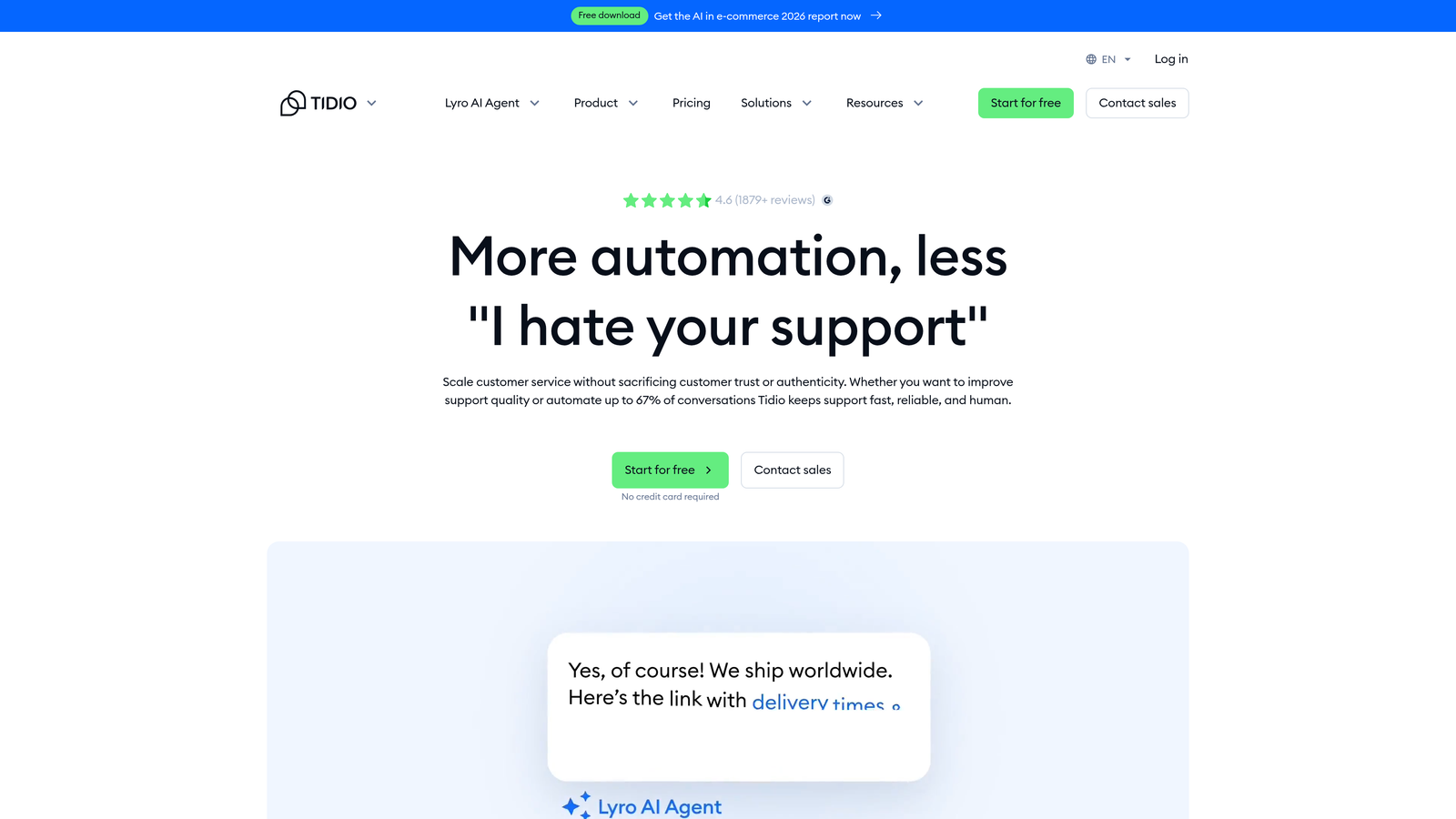
Tidio is a live chat and AI chatbot platform featuring its Lyro AI agent, designed for small businesses and e-commerce teams that need quick setup and accessible pricing.
Where This Tool Shines
Tidio's appeal is simplicity. You can have a functional AI support widget live on your site within an hour, trained on your existing FAQ content or knowledge base. For small teams without dedicated support operations, that speed-to-value is genuinely compelling.
The combination of live chat and AI in a single widget is well-executed. Agents and the Lyro AI agent share the same interface, making handoffs between automated and human support feel natural rather than disruptive to the customer experience.
Key Features
Lyro AI Agent: Trained on your FAQ and knowledge base content to handle common queries automatically.
Visual Flow Builder: Drag-and-drop interface for building custom conversation flows without code.
E-Commerce Integrations: Native connections to Shopify, WooCommerce, and WordPress for product and order context.
Unified Chat Interface: Live chat and AI chatbot in a single widget for seamless agent-AI collaboration.
No-Code Setup: Deploy and configure without engineering resources.
Best For
Tidio is purpose-built for small businesses, e-commerce stores, and early-stage teams. Companies with complex B2B support workflows or enterprise integration requirements will quickly outgrow its capabilities.
Pricing
Free plan available. Lyro AI starts at $39 per month, making it one of the most affordable AI support options on this list.
8. Cognigy
Best for: Large contact centers needing enterprise-grade voice and chat AI agent orchestration
Cognigy is an enterprise conversational AI platform specializing in both voice and chat AI agents for large-scale contact center and customer service operations.
Where This Tool Shines
Cognigy's defining strength is its voice AI capability. Most platforms on this list are chat-first with voice as an afterthought; Cognigy treats voice as a first-class channel. For contact centers handling significant phone support volume, this is a meaningful differentiator that can extend AI resolution beyond digital channels.
The low-code conversation design studio and enterprise-grade orchestration layer make it suitable for complex, multi-department deployments where conversation flows need to be precise, auditable, and scalable across thousands of concurrent sessions.
Key Features
Voice AI Agents: Full-featured AI agents for phone-based support, not just chat, enabling contact center-wide automation.
Low-Code Design Studio: Visual conversation design environment for building and managing complex AI agent flows.
Enterprise Scalability: Handles high-volume, multi-channel deployments with robust orchestration infrastructure.
Contact Center Platform Integrations: Native connections to Genesys, NICE, Avaya, and other major contact center platforms.
Multilingual NLU Engine: Natural language understanding across multiple languages for international support operations.
Best For
Cognigy is built for large enterprises and contact centers with significant phone support volume, complex conversation requirements, and existing investments in major contact center platforms. It's overspecified for SaaS product teams or digital-first support operations.
Pricing
Enterprise pricing only. Contact Cognigy for a custom quote based on your deployment scale and channel requirements.
9. Ultimate (Zendesk)
Best for: Teams wanting flexible, helpdesk-agnostic AI automation with strong multilingual support
Ultimate is an AI agent platform, now part of Zendesk, that offers no-code dialogue building and automation across multiple support platforms with strong multilingual capabilities.
Where This Tool Shines
Ultimate's heritage as a helpdesk-agnostic platform gives it flexibility that pure Zendesk-native tools lack. Even post-acquisition, it maintains compatibility across Zendesk, Salesforce, Freshdesk, and other platforms, making it a viable option for teams that aren't locked into a single helpdesk ecosystem.
The 100+ language support and backend action capabilities stand out. Ultimate can do more than answer questions: it can look up order status, process refunds, and update account records via backend integrations, which pushes it closer to genuinely agentic behavior rather than just conversational AI.
Key Features
No-Code Dialogue Builder: Build custom AI agent conversation flows without engineering involvement.
Multi-Platform Compatibility: Works across Zendesk, Salesforce, Freshdesk, and other helpdesk platforms.
100+ Language Support: Broad multilingual coverage for international support operations.
Backend Action Integrations: Connects to backend systems to take actions like refunds, order lookups, and account updates.
Resolution Analytics Dashboard: Tracks AI resolution rates and conversation outcomes across channels.
Best For
Ultimate suits mid-market and enterprise teams that need helpdesk flexibility, strong multilingual support, and AI agents capable of taking backend actions. Its Zendesk ownership may influence roadmap direction over time, worth monitoring for teams on other platforms.
Pricing
Custom pricing. Available through Zendesk or as a standalone product; contact for a quote based on your use case and volume.
10. Kastro
Best for: Startups and small SaaS teams wanting fast, lightweight AI support without enterprise overhead
Kastro is a lightweight, AI-first support widget designed for early-stage teams that want knowledge-base-powered AI responses deployed quickly and affordably.
Where This Tool Shines
Kastro's pitch is speed and simplicity. You can connect your documentation, deploy the widget, and have an AI agent answering questions in minutes. For founders and small teams who need something functional immediately without a lengthy procurement or implementation process, that friction-free experience is genuinely valuable.
The clean, minimalist interface is a deliberate design choice that tends to work well for SaaS products where a polished user experience matters. It doesn't try to do everything; it focuses on doing one thing well: getting users to answers quickly.
Key Features
Fast Deployment: Deploy a functional AI support widget in minutes, not weeks, with minimal configuration.
Automatic Knowledge Base Training: Connects to your docs and trains the AI agent automatically without manual content entry.
Minimalist Chat Interface: Clean, distraction-free design that integrates smoothly into SaaS product UIs.
Human Handoff: Escalates to a human agent when the AI cannot resolve a query, with context preserved.
Startup-Friendly Pricing: Accessible cost structure designed for teams that aren't yet at enterprise scale.
Best For
Kastro is the right fit for early-stage startups and small SaaS teams that need AI support live quickly without enterprise complexity or budget. Teams with more advanced integration needs or high ticket volumes will want to consider more robust platforms as they scale.
Pricing
Free tier available. Paid plans start at approximately $35 per month, making it one of the most accessible options for budget-conscious teams.
Which AI Support Platform Is Right for You?
The best AI customer support agent software depends on where you are, what you're building, and how you define "good support" for your customers.
Best for SaaS product teams: Halo AI is the clear choice for B2B SaaS companies that want AI-native support with page-aware context, continuous learning, and business intelligence baked in. It's built for teams who see support as a product function, not just a cost center.
Best for enterprise and contact centers: Ada handles global scale and multilingual complexity well, while Cognigy is the go-to for organizations with significant phone support volume. Zendesk AI Agents and Ultimate are strong choices for enterprises already committed to those ecosystems.
Best for SMBs and mid-market: Freshdesk Freddy AI offers the best balance of capability and cost for teams in the Freshworks ecosystem. Forethought is worth evaluating for teams that want intelligent triage without a full platform switch.
Best budget option: Tidio and Kastro both offer free tiers and paid plans under $40 per month, making them practical starting points for small teams and early-stage companies.
Your support team shouldn't scale linearly with your customer base. AI agents can handle routine tickets, guide users through your product in real time, and surface business intelligence that helps your entire organization, not just support. See Halo in action and discover how continuous learning transforms every interaction into smarter, faster support that compounds over time.