AI Customer Support Benefits: What Changes When Your Support Team Stops Drowning
Discover the practical ai customer support benefits that B2B SaaS teams are experiencing today, from eliminating repetitive ticket queues and enabling 24/7 global coverage to freeing skilled agents to focus on complex, high-value customer issues that actually require human judgment.
 Matt PattoliFounder13 min read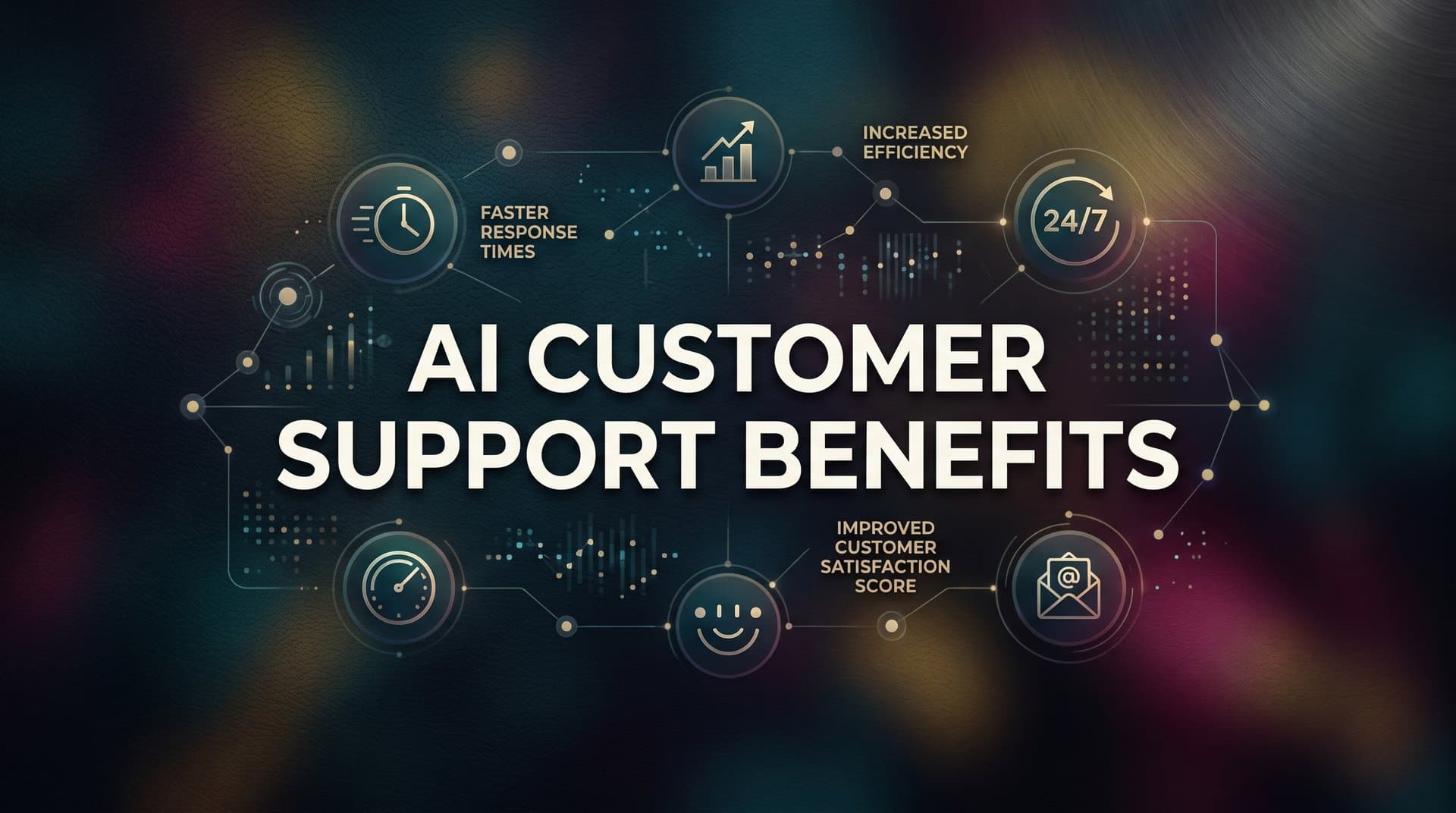
Picture your support team on a Monday morning. The queue has 200 tickets. Half of them are some variation of "how do I reset my password," "why was I charged twice," or "where do I find the export button." Your best agents, the ones who genuinely understand your product and your customers, are spending their morning answering the same questions they answered last Monday. And the Monday before that.
Meanwhile, a customer in Singapore submitted a billing question at 11pm their time and is now waiting for someone in your US office to clock in. Another customer gave up after 45 minutes and started Googling your competitor.
This isn't a hypothetical. It's the operational reality for a large portion of B2B SaaS support teams right now. And it's exactly the problem that AI customer support was designed to address, not in a vague, futuristic sense, but in a practical, deployable sense that teams are acting on today.
The conversation around AI in customer support has generated plenty of hype, but the actual benefits are more grounded than the marketing suggests. They're about speed, scale, intelligence, and the structural shift that happens when your team stops spending the majority of its time on work that doesn't require human judgment. This article walks through those benefits concretely, without the superlatives, so you can evaluate what actually changes when AI enters your support workflow.
The Repetition Problem AI Was Built to Solve
If you've spent any time looking at support ticket data, you'll recognize a familiar pattern. The volume of unique issues is genuinely long, but the high-frequency core is surprisingly narrow. Password resets. Billing questions. "How do I do X in the product?" requests. Navigation confusion. These aren't complex problems requiring deep product knowledge or careful relationship management. They're procedural. They have known answers. And they consume a disproportionate amount of your team's time relative to their actual complexity.
This is the repetition problem. It's not that support teams are inefficient. It's that the nature of inbound support volume creates a structural mismatch between where agent time goes and where it would be most valuable.
AI agents are particularly well-suited to this category of work. They can recognize a password reset request, pull the relevant account information, walk the user through the process, and close the ticket without any human involvement. They can handle billing inquiries by connecting to your payment system, retrieving the relevant data, and explaining the charge. They can answer "how do I export my data?" with step-by-step guidance tailored to the user's current plan and product version.
The result isn't just faster ticket resolution for those specific cases. It's a fundamental reallocation of your human team's attention. When AI handles the high-volume, low-complexity tier autonomously, your agents are freed to focus on the tickets that actually require them: escalations with emotional stakes, complex technical investigations, enterprise accounts with nuanced needs, situations where reading between the lines matters.
That shift has a real effect on team morale that often goes underappreciated in the ROI conversation. Support burnout is frequently driven not by the volume of hard problems but by the relentless repetition of easy ones. Agents who spend their days doing genuinely interesting, judgment-intensive work tend to stay longer and perform better than those grinding through the same FAQ queue day after day.
The framing here matters. Introducing AI support for SaaS teams isn't about replacing your support team. It's about changing what that team spends its time on. And that change has cascading effects on output quality, agent retention, and ultimately the experience your customers receive on the issues that are hardest to resolve.
Speed and Availability: Support That Doesn't Clock Out
In B2B SaaS, your customers aren't confined to a single time zone or a standard business day. A customer in London hits a billing issue at 8am their time, which is 3am Eastern. An enterprise account in Tokyo encounters a configuration problem on a Friday afternoon, which lands in your queue over the weekend. The expectation that support should be available and responsive has quietly become a baseline requirement, not a differentiator.
The wait-time problem is more consequential than it might appear on the surface. In customer experience research, the relationship between response time and satisfaction is well-documented: longer waits consistently correlate with lower satisfaction scores and elevated churn risk, particularly in B2B contexts where the stakes of a support interaction are higher. A customer waiting hours for a simple answer isn't just frustrated. They're forming a judgment about your product and your company's reliability.
AI agents respond instantly. Not "within a few minutes" instantly. Immediately, at any hour, regardless of queue volume. A customer submitting a question at 2am on a Sunday gets the same quality response as one submitting at 2pm on a Tuesday. There's no degradation in response quality during a product launch surge, no slower-than-usual replies on a holiday weekend, no "we're experiencing higher than normal volume" message that customers have learned to distrust.
This consistency matters beyond the individual interaction. When customers know they can get a reliable answer quickly, they're less likely to escalate minor friction into a larger complaint. They're less likely to start evaluating alternatives out of frustration. They're more likely to stay engaged with your product rather than abandoning a workflow because they hit a wall and couldn't get help.
For global B2B teams specifically, 24/7 AI coverage effectively eliminates the time-zone support gap without requiring overnight staffing or expensive regional support hires. The economics of that alone are significant for growing companies trying to serve international customers without building out a follow-the-sun support model.
It's worth being clear about what "instant" means in practice. The AI isn't just sending an auto-reply acknowledgment. It's engaging with the actual question, providing a substantive answer, and in many cases resolving the issue entirely. That's a qualitatively different experience from "we've received your message and will respond within 24 hours."
Scaling Without Headcount: The Economics of AI Support
Here's the scaling problem that every growing SaaS company eventually confronts. You add customers. Support volume goes up. You hire more agents. Those agents need management, onboarding, tooling, and benefits. Your cost base grows in rough proportion to your customer base, which puts pressure on margins precisely at the moment you're trying to demonstrate unit economics to investors or hit profitability targets.
Traditional support scaling is essentially linear. Double your customers, roughly double your support costs. It's a model that works when you're small, but it becomes increasingly difficult to sustain as you grow. And it creates a compounding problem: the bigger you get, the harder it is to maintain quality while managing cost.
AI breaks that linear relationship. When a significant portion of your inbound tickets are resolved autonomously by AI agents, volume growth doesn't translate directly into headcount growth. You can handle more tickets without scaling headcount, or handle substantially more tickets with a modest team increase, rather than scaling agents in lockstep with customers.
The cost-per-ticket dynamic shifts meaningfully in this model. AI-resolved tickets cost a fraction of human-resolved tickets once the system is deployed and learning. As the AI handles a larger share of inbound volume, the average cost per ticket across your entire support operation decreases. That's a structural improvement in your support economics, not just a temporary efficiency gain.
The scaling benefit is particularly visible during the moments that stress support operations most: product launches, major feature releases, pricing changes, or seasonal spikes. These events predictably generate ticket surges. Without AI, managing those surges means either emergency hiring (slow and expensive), asking your existing team to absorb the volume (which degrades quality and burns people out), or letting response times slip (which damages customer satisfaction at exactly the moment you're trying to make a good impression).
With AI handling the high-volume tier, surges become manageable. The AI absorbs the volume increase while your human team maintains its focus on escalations and complex cases. Service levels stay consistent. Your team doesn't go into crisis mode every time you ship something significant.
For product teams evaluating AI support tools, this is one of the most concrete and quantifiable benefits to model. The question isn't just "what does this cost?" but "what does it cost compared to the alternative of hiring to meet the same volume?" Understanding the true per-agent cost of traditional support makes this comparison much clearer.
Context-Aware Intelligence: Beyond Keyword Matching
There's a reason early chatbots developed a reputation for being frustrating rather than helpful. They operated on keyword matching: if the user's message contained certain words, the bot returned a pre-written response. This worked for the simplest possible cases and failed almost everywhere else. Ask a question in slightly different words, and the bot would return something irrelevant. Provide context about what you'd already tried, and the bot would ignore it. End up in a different part of the product than the documentation assumed, and the guidance would be wrong.
Modern AI support agents work differently, and the architectural difference matters a great deal in practice.
Context awareness means the AI understands more than just the words in a message. It knows what page the user is currently on. It has access to their account history, their plan tier, the actions they've already taken in the session. It can see whether they've submitted related tickets before. This context changes what the right answer actually is. A user asking "how do I set up an integration?" on the integrations configuration page needs different guidance than a user asking the same question on the dashboard. A user who's already tried the standard troubleshooting steps needs a different response than one who hasn't.
Page-aware AI takes this further. Rather than sending a link to a documentation article and hoping the user can find the relevant section, a context-aware support agent can provide step-by-step visual guidance tied to exactly where the user is in the product. "Click the gear icon in the top right of the panel you're currently on, then select 'Integrations' from the dropdown" is a more useful response than "see our documentation on integrations." The specificity of the guidance reflects the specificity of the user's situation.
This is one of the genuine differentiators between modern AI support and the FAQ-based systems many teams are still running. A static FAQ doesn't know where you are. It doesn't know what you've tried. It doesn't learn from the interactions it has. It returns the same answer to the same keyword regardless of context.
Continuous learning compounds this advantage over time. An AI support agent that learns from every interaction gets better at handling edge cases, recognizes new patterns as your product evolves, and improves its resolution rate without requiring manual updates to a knowledge base. The system becomes more capable the more it's used, which is the opposite of a static documentation set that becomes outdated the moment you ship a new feature.
The Intelligence Layer: Support Data as a Business Signal
Here's an insight that most support operations are sitting on without realizing it: your ticket queue is one of the richest sources of product intelligence in your entire company. Every ticket is a signal. A customer asking the same question repeatedly is telling you something about your onboarding. A cluster of billing confusion tickets after a pricing change is telling you something about your communication. A surge in "how do I do X" questions about a specific feature is telling you something about your UX.
The problem is that in traditional support operations, this intelligence is trapped in individual tickets, processed by individual agents, and rarely synthesized into actionable patterns that reach the teams who could act on them. Product teams don't see the support queue. Engineering teams get vague reports of "users are confused about the settings page." Revenue teams don't know which accounts are showing frustration patterns that might indicate churn risk.
AI systems that analyze ticket data at scale can surface these patterns systematically. Instead of relying on a support manager to notice that a certain type of question has been coming up more frequently, AI-powered support analytics can identify the trend, quantify it, and flag it for the relevant team. That's a qualitatively different relationship between support data and business decision-making.
Customer health signals are particularly valuable in B2B SaaS. An account that has submitted multiple frustrated tickets in a short window, or that has been asking questions indicating they're not successfully using a core feature, is showing early signs of churn risk. A customer success team with visibility into those signals can intervene proactively, before the customer has already made a decision, rather than reactively after a cancellation notice arrives.
The bug detection use case is worth highlighting specifically. When a user reports something that looks like a bug, the typical path in a traditional support operation is: agent recognizes it, writes a summary, passes it to engineering through some informal channel, engineering asks clarifying questions, eventually a ticket gets created with incomplete information. That process is slow and lossy.
AI agents that can automatically detect bug patterns from support conversations and create structured, detailed bug tickets for engineering teams compress that cycle significantly. Engineering gets a properly formatted report with reproduction steps, account context, and frequency data, rather than a vague "a user said the export button doesn't work sometimes." That's a direct improvement in how quickly real product issues get addressed.
Human + AI: Where the Handoff Actually Matters
The most effective AI support implementations aren't trying to automate everything. That's an important distinction to make clearly, because the fear that AI will attempt to handle every conversation regardless of complexity is a real concern among support leaders, and it's a legitimate one.
The right model is a thoughtful division of labor. AI handles the high-volume, well-defined, procedural tier autonomously. For conversations that exceed those parameters, whether because of emotional stakes, technical complexity, account sensitivity, or ambiguity, there's a clear escalation path to a human agent. Understanding the difference between AI and human agents helps teams design that division of labor effectively.
The quality of the handoff is where many AI support implementations succeed or fail. A poor handoff means the customer has to repeat everything they've already said to a new agent who has no context. That experience is worse than just having a human handle it from the start, and it's one of the legitimate criticisms of early chatbot implementations.
A well-designed handoff looks different. When the AI escalates to a human agent, it passes the full conversation history, the solutions already attempted, the account context it gathered, and its assessment of why escalation was triggered. The human agent receives a briefed situation, not a cold start. They can begin from where the AI left off rather than spending the first several minutes gathering information the AI already collected.
This changes the experience for both the customer and the agent. The customer doesn't feel like they're starting over. The agent can engage immediately with the substance of the problem rather than the mechanics of understanding it. Time-to-resolution on escalated tickets decreases, not because the AI solved the hard problem, but because it did the preparatory work that would otherwise fall to the human.
The net result is a support operation where every customer segment gets a better experience. Customers with simple questions get instant answers. Customers with complex problems get faster, better-informed human support. That's not a tradeoff between efficiency and quality. It's an improvement on both dimensions simultaneously.
Putting It All Together
The ai customer support benefits described throughout this article aren't independent. They compound. Faster response times improve customer satisfaction, which reduces churn pressure. Better use of agent time improves morale and retention, which improves the quality of human support on complex issues. Richer support data feeds better product decisions, which reduces the volume of confusion-driven tickets. Smarter AI over time handles more edge cases autonomously, which improves the economics further.
What changes when your support team stops drowning isn't just the queue length. It's the entire operational posture of your support function, from a reactive cost center fielding repetitive questions to an intelligent layer that resolves issues instantly, surfaces business signals, and deploys human judgment where it genuinely matters.
Teams that make this shift now aren't just solving a current operational problem. They're building a structural advantage in customer experience that compounds as their AI system learns and their human team focuses on higher-value work. The gap between teams operating this way and teams still running traditional support models will widen over time, not narrow.
Your support team shouldn't scale linearly with your customer base. Let AI agents handle routine tickets, guide users through your product, and surface business intelligence while your team focuses on complex issues that need a human touch. See Halo in action and discover how continuous learning transforms every interaction into smarter, faster support.