10 Best AI Customer Support Tools for Enterprises in 2026
This guide evaluates the 10 best AI customer support tools for enterprises in 2026, comparing platforms based on AI sophistication, scalability, security, and integration depth. As legacy helpdesk systems struggle to meet rising customer expectations and ticket volumes, these agentic AI solutions offer end-to-end ticket resolution and predictive analytics to help enterprise support teams reduce costs while improving outcomes.
 Matt PattoliFounder13 min read
Enterprise support teams are caught in a difficult bind: customer expectations keep rising, ticket volumes keep growing, and the pressure to control costs never lets up. Legacy helpdesk systems and first-generation chatbots weren't designed for this reality. They deflect when they should resolve, and they generate noise when teams need signal.
The good news is that AI-powered support platforms have matured considerably. Agentic AI that resolves tickets end-to-end, predictive analytics that surface issues before they escalate, and deep integrations with enterprise tech stacks are now table stakes for serious contenders in this space.
We evaluated these platforms based on AI sophistication, scalability, integration depth, security and compliance posture, analytics capabilities, and total cost of ownership. Here are the top tools worth evaluating in 2026.
1. Halo AI
Best for: B2B SaaS teams that want an AI-first support platform with deep product and business system integration.
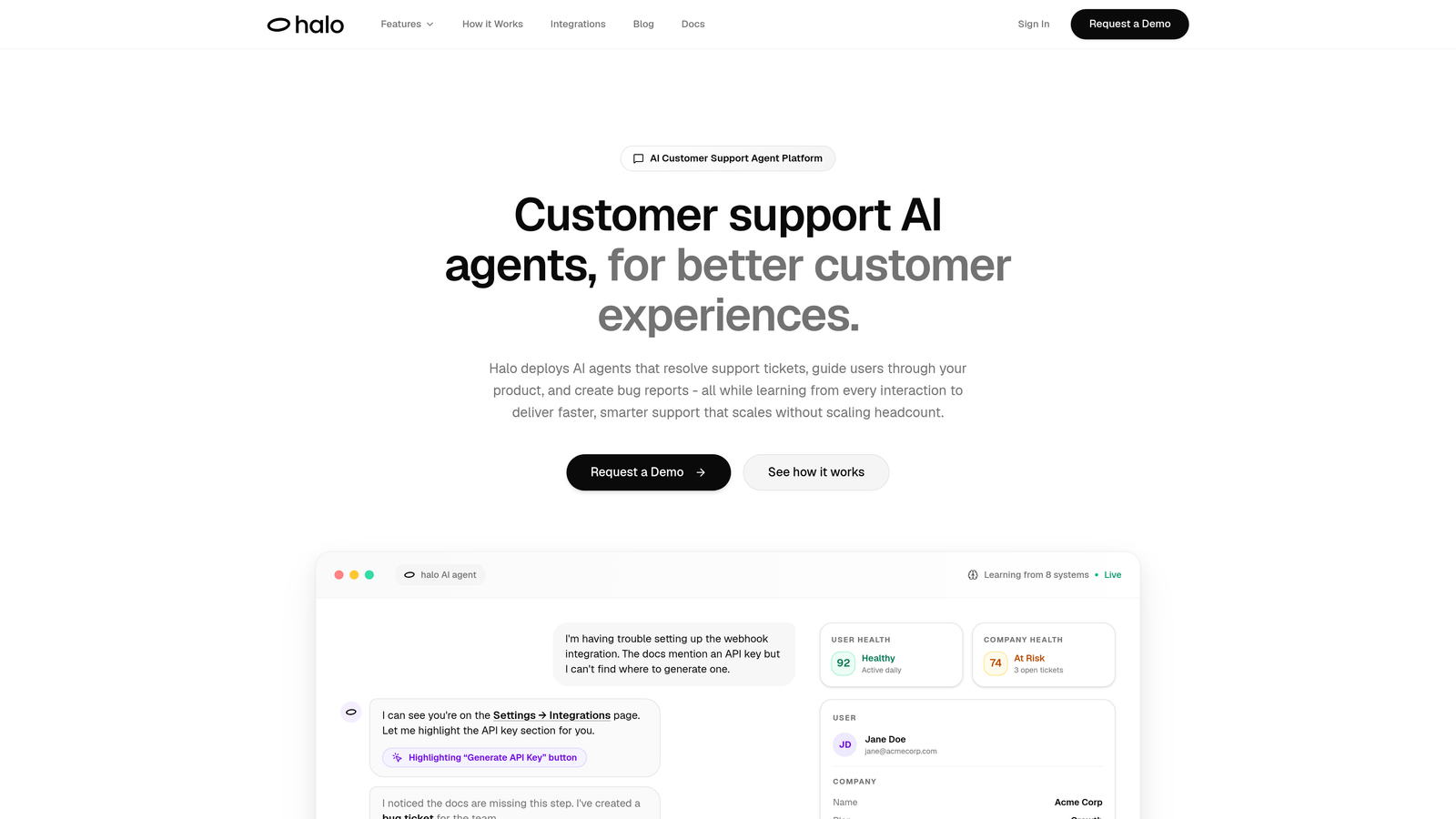
Halo AI is an AI-native customer support platform that deploys intelligent agents capable of resolving tickets, guiding users through products with page-aware context, and surfacing business intelligence from every interaction.
Where This Tool Shines
Halo's most distinctive capability is page-aware context: the AI agent actually sees what a user is looking at inside your product, enabling it to give precise, step-by-step visual guidance rather than generic answers. This closes the gap between support and product adoption in a way that most platforms simply can't replicate.
Beyond resolution, Halo is built to generate intelligence. Its smart inbox doesn't just organize tickets; it surfaces customer health signals, revenue anomalies, and patterns that would otherwise stay buried in support data. For product and customer success teams, this turns the support layer into a strategic information source.
Key Features
Page-Aware AI Agents: Agents understand the exact page and UI context a user is on, enabling precise in-product guidance rather than generic documentation links.
Continuous Learning: The platform learns from every interaction, progressively improving resolution quality without requiring manual retraining cycles.
Smart Inbox with Business Intelligence: Aggregates support data into actionable signals including customer health scores, anomaly detection, and revenue intelligence.
Auto Bug Ticket Creation: Automatically generates structured bug reports and routes them to Linear, Slack, or engineering tools when issues are detected.
Live Agent Handoff: Complex issues escalate to human agents with full conversation context preserved, so customers never have to repeat themselves.
Best For
B2B SaaS companies and product teams that want AI support tightly integrated with their product experience, engineering workflows, and business stack. Particularly strong for teams using Intercom, HubSpot, Slack, Linear, Stripe, or Zoom who want a unified intelligence layer across all of them.
Pricing
Contact for enterprise pricing. Custom plans are structured around ticket volume and integration requirements rather than per-seat fees.
2. Zendesk AI
Best for: Enterprises already invested in the Zendesk ecosystem looking to add AI capabilities to an established workflow.
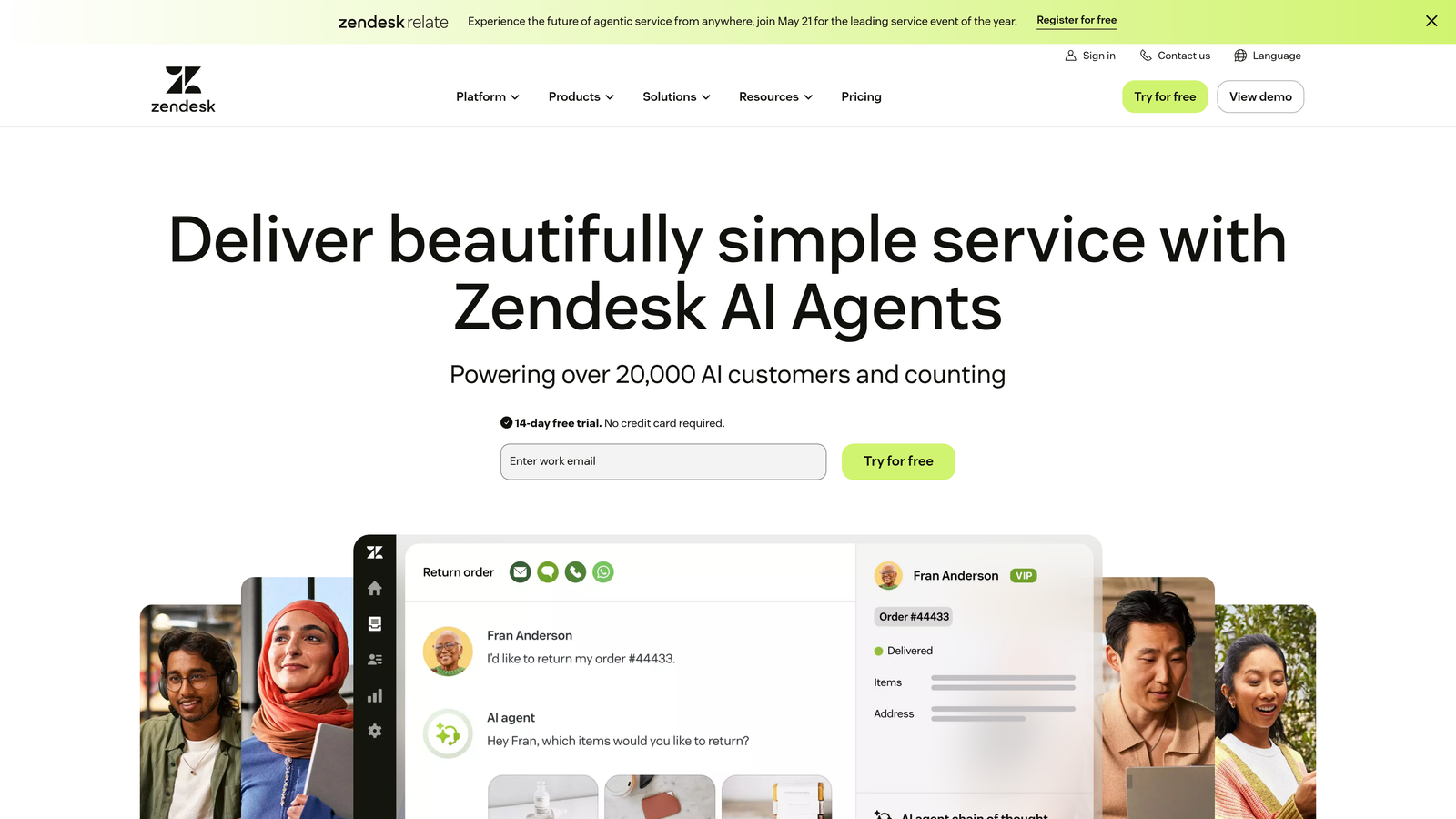
Zendesk AI layers intelligent automation across the Zendesk support suite, drawing on an extensive history of real customer service interactions to power bots, agent assist, and automated triage.
Where This Tool Shines
Zendesk's AI benefits from scale. The models are trained on a large volume of real support interactions, which gives them a practical grounding that purpose-built models sometimes lack. For teams already running Zendesk, the AI capabilities slot in without requiring a platform migration.
The agent copilot is a standout feature for hybrid teams: it surfaces relevant knowledge articles, suggests responses, and summarizes long ticket threads in real time, keeping human agents faster and more consistent without removing them from the loop.
Key Features
AI Agents: Trained on billions of real customer service interactions for broad topic coverage and natural conversation.
Intelligent Triage: Automatically classifies tickets by intent, language, and sentiment to route them correctly from the start.
Agent Copilot: Surfaces relevant knowledge and suggests draft responses to help human agents work faster.
Generative AI for Knowledge Base: Creates and summarizes knowledge base articles to keep self-service content current.
Enterprise Compliance: SOC 2 and GDPR compliance with robust admin controls for enterprise governance.
Best For
Mid-to-large enterprises already running Zendesk as their primary helpdesk who want to augment existing workflows with AI rather than replace the platform entirely.
Pricing
Suite Enterprise starts at $150/agent/month. AI add-on pricing is separate and varies based on usage and features selected.
3. Intercom Fin
Best for: Teams that want a high-resolution-rate AI agent tightly integrated with a conversational messaging platform.
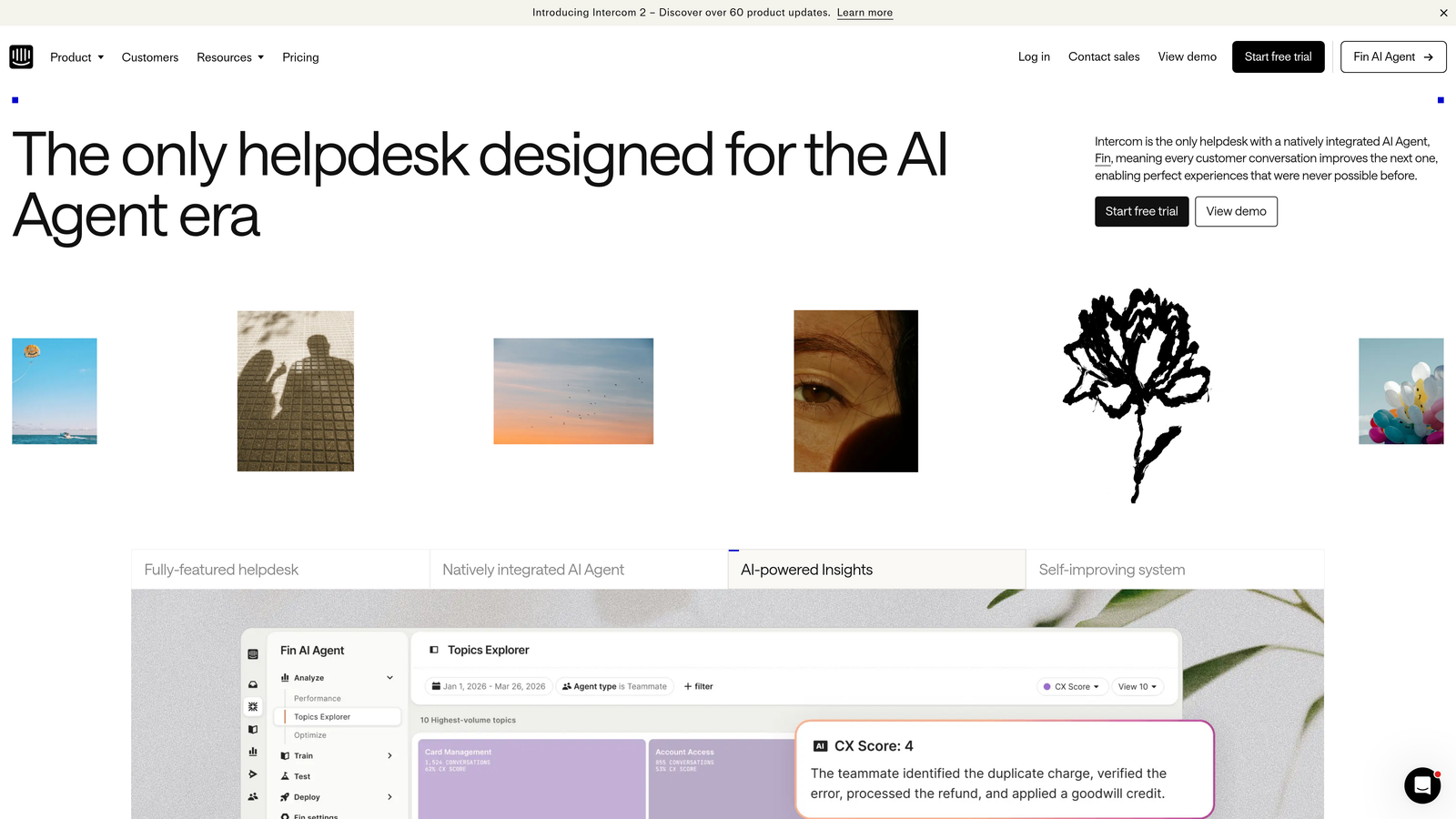
Intercom Fin is a conversational AI agent built into the Intercom platform, designed to resolve support questions end-to-end using your existing knowledge base and support content.
Where This Tool Shines
Fin's approach to grounding is worth noting: it sources answers exclusively from your content, which reduces hallucination risk compared to AI agents that draw on general model knowledge. For enterprises in regulated industries where accuracy is non-negotiable, this is a meaningful architectural choice.
The handoff experience is also well-executed. When Fin can't resolve an issue, it passes the conversation to a human agent with full context intact, so the customer experience stays smooth across the transition. This makes it effective for hybrid support models where AI handles volume and humans handle complexity.
Key Features
End-to-End Resolution: Fin handles complete support conversations autonomously, not just initial deflection.
Content-Grounded Answers: Sources responses exclusively from your knowledge base to minimize inaccurate or fabricated answers.
Contextual Handoff: Passes full conversation history to human agents when escalation is needed.
Multilingual Support: Handles conversations across dozens of languages without separate configuration per language.
Custom AI Workflows: Supports complex resolution paths with configurable actions and integrations.
Best For
Businesses already using Intercom for customer messaging that want to add autonomous resolution without switching platforms. Also strong for teams with well-maintained knowledge bases where content-grounded AI performs best.
Pricing
Fin is charged per resolution rather than per seat. Platform plans start at $29/seat/month, with Fin pricing layered on top based on volume.
4. Salesforce Einstein Service Cloud
Best for: Enterprises running Salesforce CRM who want AI support deeply integrated with customer data and the broader Salesforce ecosystem.
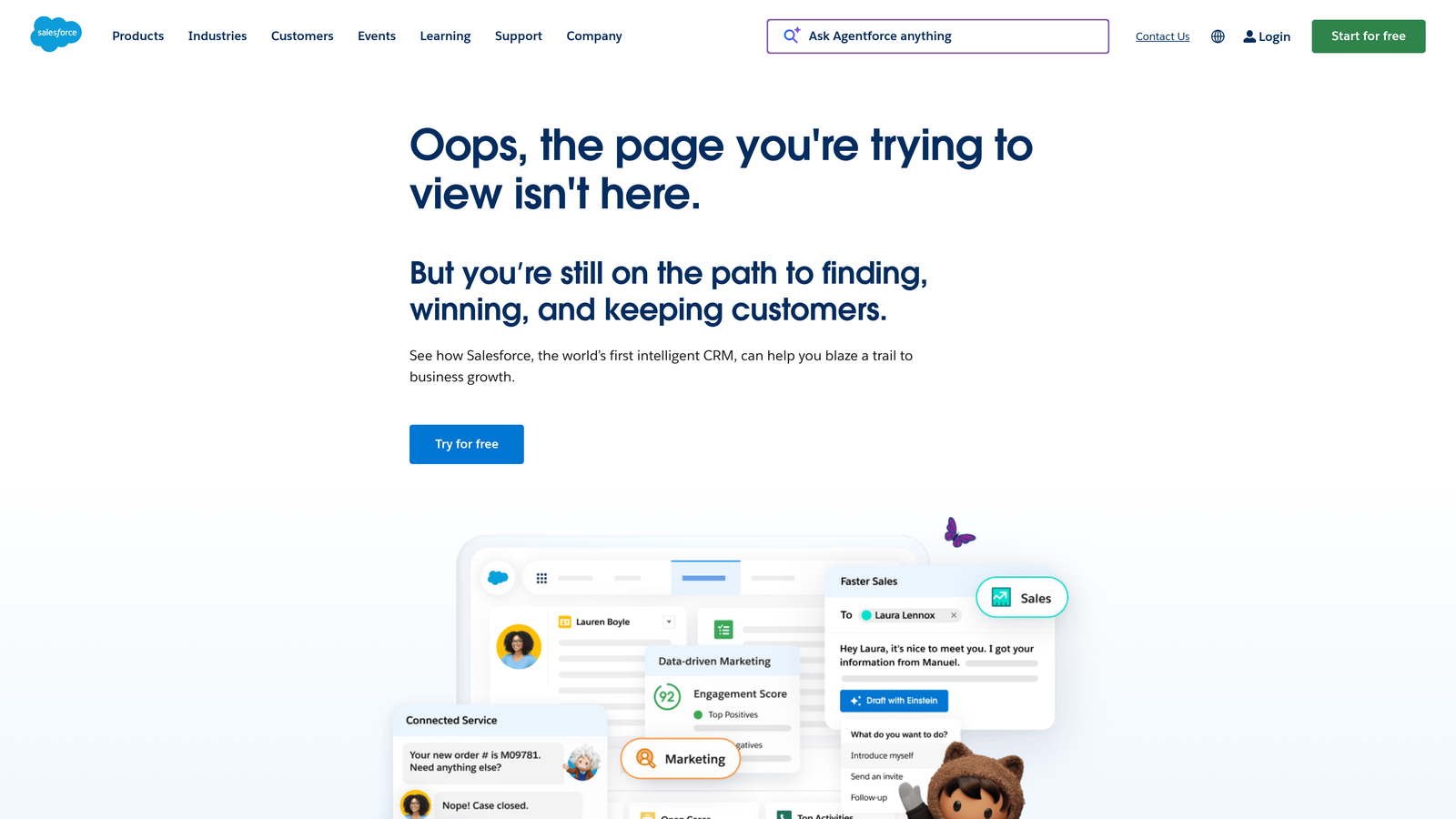
Salesforce Einstein Service Cloud is an AI-powered service layer within the Salesforce platform that unifies CRM data, case management, and autonomous AI agents for enterprise-scale support.
Where This Tool Shines
The core advantage here is CRM depth. Einstein agents have access to full Salesforce customer profiles, purchase history, open opportunities, and service history, which enables genuinely personalized support at scale. For B2B enterprises where support and sales are tightly connected, this integration removes the silos that typically degrade the customer experience.
Omnichannel coverage is also comprehensive: email, chat, phone, social, and messaging all flow through a unified interface, giving agents a single view regardless of where a conversation started.
Key Features
CRM-Connected AI Bots: Einstein agents access full Salesforce customer profiles for context-aware, personalized responses.
Predictive Case Routing: AI classifies and routes cases based on predicted complexity, priority, and best-fit agent.
Real-Time Agent Assist: Surfaces response suggestions and relevant knowledge during live interactions.
Omnichannel Unification: Manages email, chat, phone, social, and messaging from a single workspace.
Cross-Cloud Integration: Deep connectivity with Sales Cloud, Marketing Cloud, and Data Cloud for a unified customer record.
Best For
Large enterprises already standardized on Salesforce where support needs to share data with sales and marketing. Less suitable for teams outside the Salesforce ecosystem given the complexity and cost of implementation.
Pricing
Enterprise edition starts at $165/user/month. Einstein AI add-ons are priced separately, making total cost of ownership highly variable depending on feature selection.
5. Ada
Best for: High-volume enterprises needing multilingual automated resolution without heavy engineering involvement.
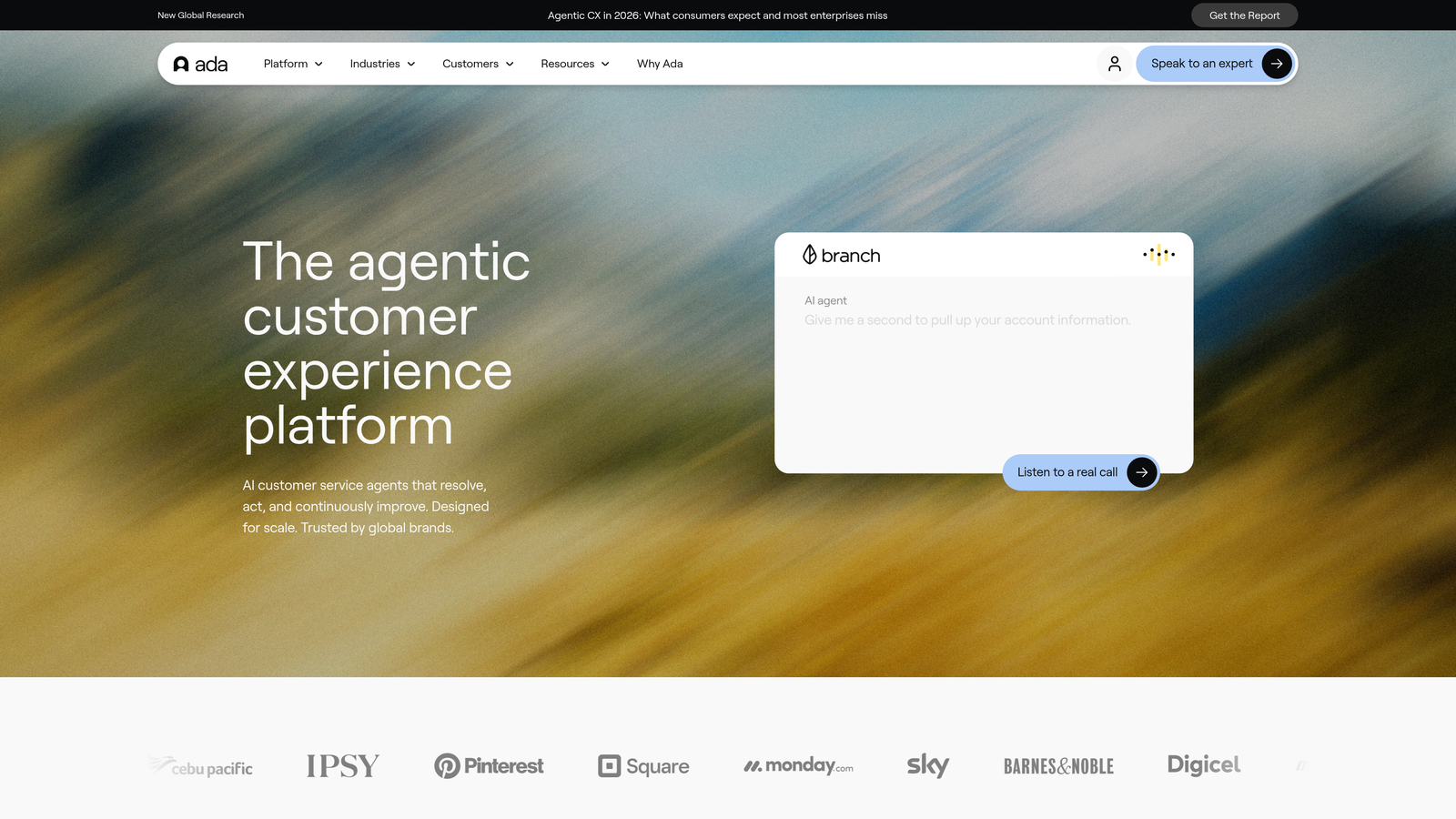
Ada is an AI-first customer service automation platform built for enterprises that need to handle large volumes of support interactions across multiple languages and channels.
Where This Tool Shines
Ada's no-code builder is genuinely accessible for non-technical teams. Support operations managers can build, test, and iterate on AI workflows without filing engineering tickets, which dramatically shortens the time between identifying an automation opportunity and deploying it.
Multilingual capability is another area where Ada stands out. Support for 50-plus languages with nuanced, localized responses makes it a strong option for global enterprises where one-size-fits-all language handling creates friction.
Key Features
Autonomous Multi-Step Resolution: AI agent handles complex, multi-turn conversations end-to-end without human intervention.
50+ Language Support: Delivers nuanced, localized responses across a broad range of languages.
No-Code Workflow Builder: Non-technical teams can build and manage AI automation without engineering resources.
Broad Integrations: Connects to major CRMs, helpdesks, and e-commerce platforms out of the box.
Enterprise Analytics: Performance dashboards track automation rates, resolution quality, and optimization opportunities.
Best For
Global enterprises with high ticket volumes and multilingual customer bases, especially those with lean technical teams who need to move quickly on automation without engineering dependencies.
Pricing
Custom enterprise pricing based on resolution volume and channel configuration. Contact Ada's sales team for a quote.
6. Freshdesk Freddy AI
Best for: Mid-market and enterprise teams seeking strong AI capabilities at a more accessible price point than legacy enterprise platforms.
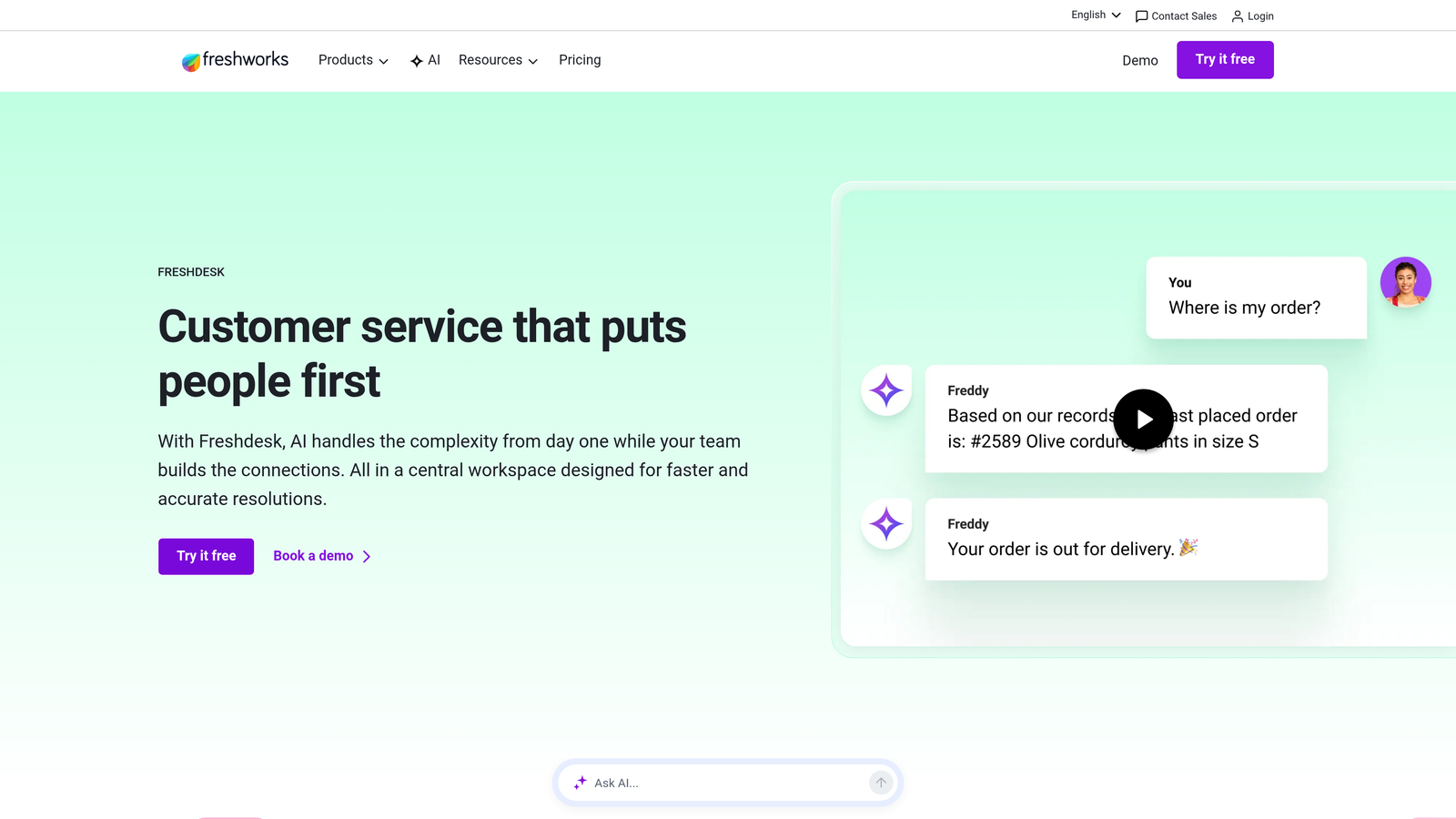
Freshdesk Freddy AI embeds AI capabilities across the Freshworks customer service suite, covering automated resolution, agent assistance, and analytics within a competitively priced platform.
Where This Tool Shines
Freddy AI's value proposition is breadth at a reasonable cost. It covers the full support workflow from triage to resolution to post-ticket analytics without requiring separate add-on purchases for each capability. For organizations managing budget scrutiny alongside digital transformation, this is a meaningful differentiator.
The native integration across Freshworks' broader product line (including Freshchat, Freshcaller, and Freshservice) means teams that use multiple Freshworks products get a genuinely unified AI layer rather than a patchwork of disconnected tools.
Key Features
Freddy AI Agent: Handles automated ticket resolution across email, chat, and messaging channels.
Ticket Summarization: AI generates concise summaries of long ticket threads so agents can get up to speed instantly.
Auto-Triage: Intent detection and priority assignment happen automatically as tickets arrive.
Suggested Responses: AI drafts response options for agents to review, edit, and send.
Cross-Channel Coverage: AI capabilities extend across ticketing, live chat, phone, and field service.
Best For
Growing enterprises and mid-market companies that want comprehensive AI support capabilities without the cost structure of Salesforce or Zendesk. Also a natural fit for teams already using Freshworks products.
Pricing
Enterprise plan starts at $79/agent/month. Freddy AI features are included in higher-tier plans without a separate add-on purchase.
7. Cognigy
Best for: Enterprise contact centers that need sophisticated voice AI and deep customization for complex, regulated environments.
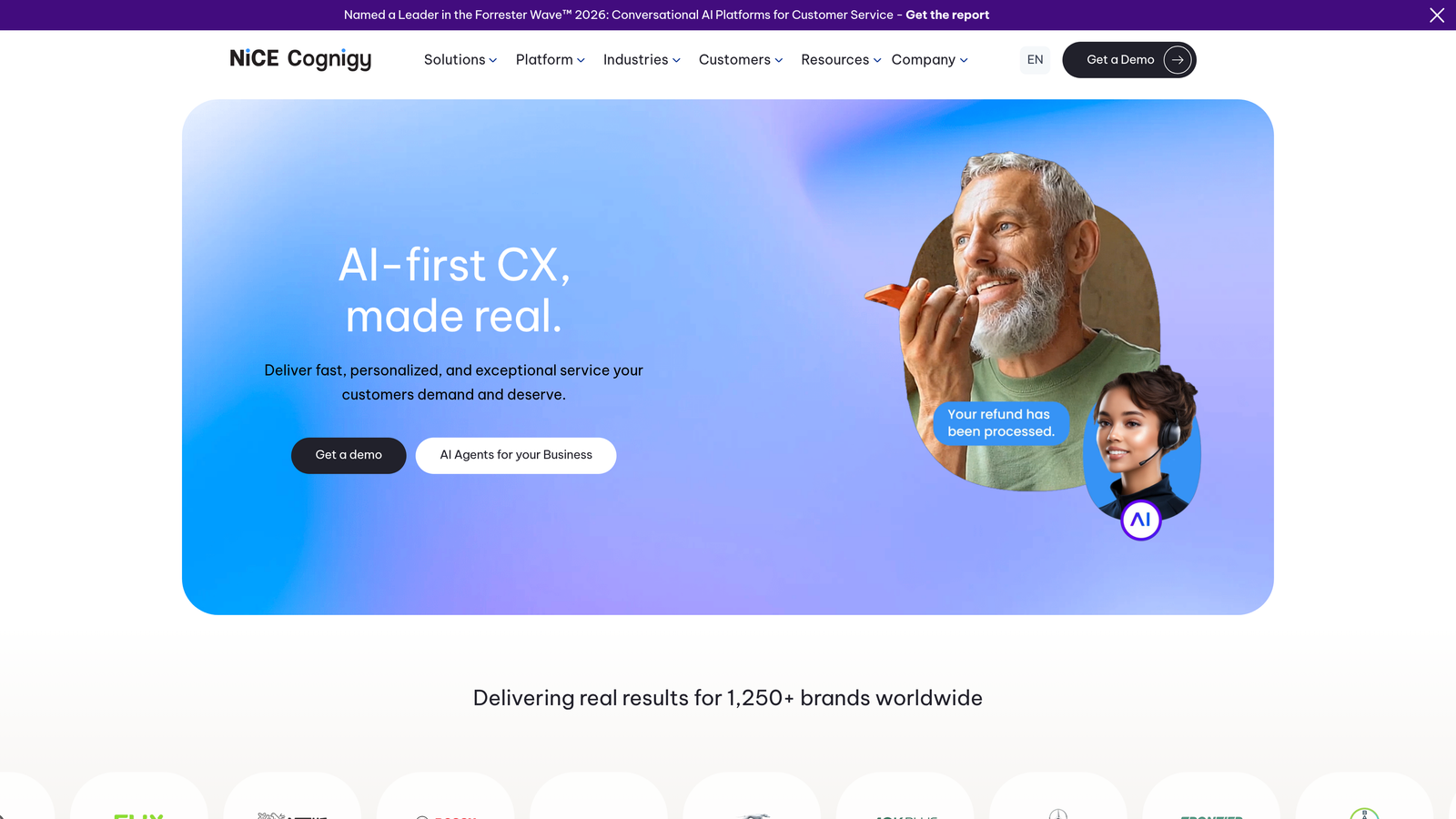
Cognigy is an enterprise conversational AI platform specializing in both voice and digital support channels, built for organizations with complex contact center infrastructure and strict compliance requirements.
Where This Tool Shines
Voice AI is where Cognigy genuinely differentiates. Most AI support platforms are optimized for text-based channels; Cognigy brings comparable sophistication to phone-based support, enabling natural, multi-turn voice conversations that go well beyond traditional IVR menus.
The LLM-agnostic architecture is also notable for enterprises that have strong opinions about which AI models they want to use or need to avoid for compliance reasons. Teams can swap or combine models without rebuilding their conversation flows.
Key Features
Advanced Voice AI: Natural conversation capabilities for phone-based support, replacing rigid IVR systems with intelligent dialogue.
Low-Code Conversation Studio: Visual design environment for building complex, branching conversation workflows.
LLM-Agnostic Architecture: Supports multiple AI models, allowing enterprises to choose or combine models based on requirements.
Contact Center Integrations: Native integrations with Genesys, NICE, Avaya, and other enterprise contact center platforms.
Flexible Deployment: On-premise and private cloud options for organizations with strict data residency or compliance needs.
Best For
Large enterprises running traditional contact center infrastructure who need to modernize voice and digital channels simultaneously, particularly in regulated industries like financial services, healthcare, or telecommunications.
Pricing
Custom enterprise pricing. Contact Cognigy's sales team for a quote based on deployment model and channel configuration.
8. Forethought
Best for: Teams that want to add intelligent AI triage and resolution on top of an existing helpdesk without replacing it.
Forethought is an AI platform focused on intelligent ticket triage, routing, and resolution that layers on top of existing helpdesk systems to improve support efficiency without requiring a platform migration.
Where This Tool Shines
Forethought's layered approach is its core strategic advantage. Rather than asking enterprises to rip and replace their existing Zendesk or Salesforce setup, it integrates as an intelligence layer that makes those systems smarter. This dramatically lowers deployment risk and shortens time to value.
The Discover module is particularly useful for support operations leaders: it analyzes ticket data to identify which types of requests have the highest automation potential, giving teams a data-driven roadmap for expanding AI coverage rather than guessing where to focus next.
Key Features
AI Triage (Triage): Predicts intent and priority instantly as tickets arrive, routing them to the right queue or agent.
Autonomous Resolution (Solve): AI agent handles common support requests end-to-end without human involvement.
Agent Assist (Assist): Surfaces relevant knowledge and suggests responses in real time during live agent interactions.
Automation Discovery (Discover): Analyzes support data to identify the highest-value automation opportunities.
Helpdesk-Agnostic Integration: Layers on top of Zendesk, Salesforce, and other major helpdesk platforms.
Best For
Enterprises with significant existing investment in Zendesk, Salesforce, or similar platforms who want to add AI capabilities incrementally without committing to a full platform replacement.
Pricing
Custom pricing based on ticket volume. Tiered plans are available; contact Forethought for a quote.
9. Kustomer
Best for: Consumer-facing enterprises that need a unified customer timeline with AI automation built on rich CRM context.
Kustomer is a CRM-native customer service platform, now part of Meta, that provides a unified view of every customer interaction alongside AI automation for personalized support at scale.
Where This Tool Shines
The unified customer timeline is Kustomer's defining feature. Every email, chat, social message, purchase, and previous support interaction is aggregated into a single chronological view. AI agents and human agents alike operate with full context, which enables the kind of personalized, non-repetitive support experiences that drive customer satisfaction.
Sentiment analysis and customer satisfaction prediction add a proactive dimension: teams can identify at-risk customers before they churn rather than reacting after the fact.
Key Features
Unified Customer Timeline: Aggregates all interactions, transactions, and history into a single customer view accessible to both AI and human agents.
CRM-Contextual AI Chatbots: Bots leverage full customer history for personalized, relevant responses.
Automated Workflows: Handles routing, tagging, follow-ups, and escalations automatically based on configurable rules.
Omnichannel Coverage: Supports social, messaging apps, email, and live chat from a unified workspace.
Predictive Analytics: Sentiment analysis and satisfaction prediction help teams identify and address at-risk customers proactively.
Best For
High-volume consumer businesses, particularly in e-commerce, retail, and subscription services, where personalized support at scale and omnichannel coverage are top priorities.
Pricing
Enterprise plan starts at $89/user/month. AI features are available in higher-tier plans.
10. Ultimate (by Zendesk)
Best for: Enterprises that want to build sophisticated AI support bots without engineering resources, especially within the Zendesk ecosystem.
Ultimate is a no-code AI automation platform acquired by Zendesk, enabling enterprises to design and deploy support bots across channels without writing code or involving engineering teams.
Where This Tool Shines
Ultimate's no-code conversation designer makes it genuinely accessible for support operations and content teams. The drag-and-drop dialogue builder allows non-technical users to create sophisticated, branching conversation flows with backend integrations for personalized, action-oriented resolutions.
For organizations already in the Zendesk ecosystem, Ultimate now integrates natively, effectively extending Zendesk's AI capabilities with a more flexible conversation design layer. Teams that need more control over bot behavior than Zendesk's native AI offers will find Ultimate's builder gives them that granularity.
Key Features
No-Code Bot Builder: Drag-and-drop interface for building AI-powered support workflows without engineering involvement.
Dialogue Designer: Visual conversation flow builder with support for complex branching logic.
Backend Integrations: Connects to CRMs, order management, and other systems for personalized, action-oriented bot responses.
Automation Analytics: Dashboards track automation rates, deflection, and bot performance over time.
Flexible Deployment: Native Zendesk integration with standalone deployment options for non-Zendesk environments.
Best For
Enterprises using Zendesk that want more control over conversation design than Zendesk's native AI provides, or teams with complex bot workflows that require a dedicated visual builder.
Pricing
Custom pricing. Now bundled within Zendesk's AI offerings for existing Zendesk customers; standalone pricing available for non-Zendesk deployments.
Which Platform Is Right for Your Enterprise?
The right choice depends heavily on where your team sits today and where your biggest gaps are. Here's a quick way to orient your evaluation:
If you want AI-first architecture with product and business intelligence: Halo AI is built from the ground up for this. Page-aware agents, continuous learning, and a smart inbox that surfaces revenue signals make it the strongest option for B2B SaaS teams that want support to be a strategic asset, not just a cost center.
If you're deeply invested in an existing ecosystem: Zendesk AI, Salesforce Einstein, or Freshdesk Freddy AI will let you add AI capabilities without a platform migration. The trade-off is that you're adding intelligence to a system not originally designed for it.
If global scale and multilingual coverage are the priority: Ada's 50-plus language support and no-code builder make it a strong contender for multinational enterprises with lean technical teams.
If voice and contact center modernization are the focus: Cognigy is in a category of its own for organizations that need sophisticated phone AI alongside digital channels.
If you want to layer AI on top of what you already have: Forethought's approach of augmenting existing helpdesks is lower risk and faster to deploy than a full platform switch.
Your support team shouldn't scale linearly with your customer base. Let AI agents handle routine tickets, guide users through your product, and surface business intelligence while your team focuses on complex issues that need a human touch. See Halo in action and discover how continuous learning transforms every interaction into smarter, faster support.