9 Best AI Customer Support Tools for SaaS Companies in 2026
This guide reviews the 9 best AI customer support for SaaS companies tools in 2026, evaluating each on depth of AI capability, integration ecosystem, and ability to handle technical use cases at scale. Whether you're a lean startup or a growing B2B platform, it pinpoints the right fit to resolve tickets autonomously, reduce churn, and feed product intelligence back to your team.
 Grant CooperFounder13 min read
SaaS support teams face a challenge that generic helpdesks weren't designed to solve. Your users are technical, your product ships updates constantly, and a single frustrating support interaction can be the nudge that sends a customer toward a competitor. Traditional ticketing systems handle the mechanics of support; they don't understand your product, learn from your conversations, or tell you when a customer is quietly heading for the exit.
AI customer support platforms purpose-built for SaaS change that equation. The best ones resolve tickets autonomously, guide users through complex workflows inside your product, surface churn signals before they escalate, and feed product intelligence back to your team — all without adding headcount.
This list covers the top AI customer support tools for SaaS companies in 2026. We evaluated each on depth of AI capability (not just a chatbot bolted onto a ticketing system), integration ecosystem, ability to handle technical SaaS use cases, and how well each scales alongside a growing product. Whether you're a lean startup or a scaling B2B platform, there's a fit here.
1. Halo AI
Best for: SaaS product teams that want an AI-first support platform, not an AI add-on
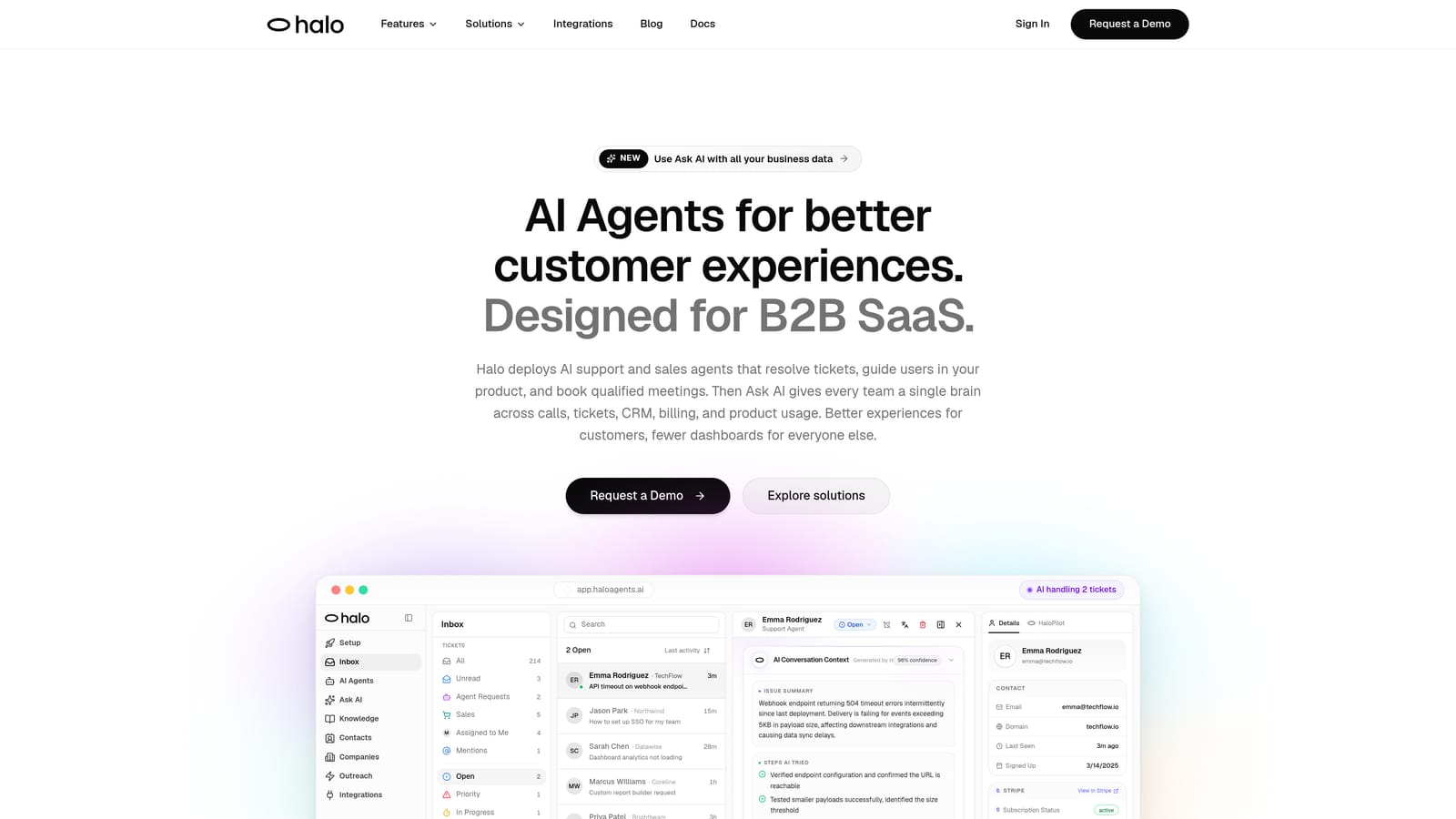
Halo AI is an AI-first customer support platform built specifically for SaaS companies, deploying autonomous agents that resolve tickets, guide users visually inside your product, and surface business intelligence across your entire customer base.
Where This Tool Shines
Halo's most distinctive capability is its page-aware context. Unlike tools that only read what a user types, Halo's chat widget understands what the user is actually looking at inside your product — the specific page, the UI state, the workflow they're in. That context lets Halo provide guidance that's genuinely relevant rather than generic FAQ responses.
The other standout is what Halo does with support data beyond the ticket. Its smart inbox surfaces churn signals, anomaly detection, and revenue intelligence as a byproduct of every support interaction. Your team doesn't just resolve tickets; they get a continuous read on customer health across the entire base.
Key Features
Page-Aware AI Agents: Halo's widget understands what users are looking at in your product, enabling contextual visual guidance rather than generic answers.
Autonomous Ticket Resolution with Continuous Learning: AI agents resolve tickets independently and improve with every interaction, getting smarter about your product over time.
Auto Bug Ticket Creation: When users report issues, Halo automatically creates and routes bug tickets to Linear or your engineering tools — no manual triage required.
Smart Inbox with Business Intelligence: Churn signals, anomaly detection, and revenue intelligence surface directly from support data, giving your team visibility beyond ticket metrics.
Live Agent Handoff: Complex escalations route smoothly to human agents with full conversation context preserved.
Deep Integration Ecosystem: Connects with Linear, Slack, HubSpot, Intercom, Stripe, Zoom, PandaDoc, and Fathom — your entire business stack, not just the helpdesk.
Best For
B2B SaaS product teams that want an AI-first architecture rather than AI layered onto a legacy helpdesk. Particularly well-suited for companies where support quality directly impacts retention and where the team needs product intelligence, not just ticket resolution metrics.
Pricing
Contact for pricing. Halo is designed for B2B SaaS teams and offers custom plans based on usage and team size. Visit haloagents.ai for details.
2. Intercom
Best for: Teams already invested in the Intercom ecosystem seeking autonomous AI resolution
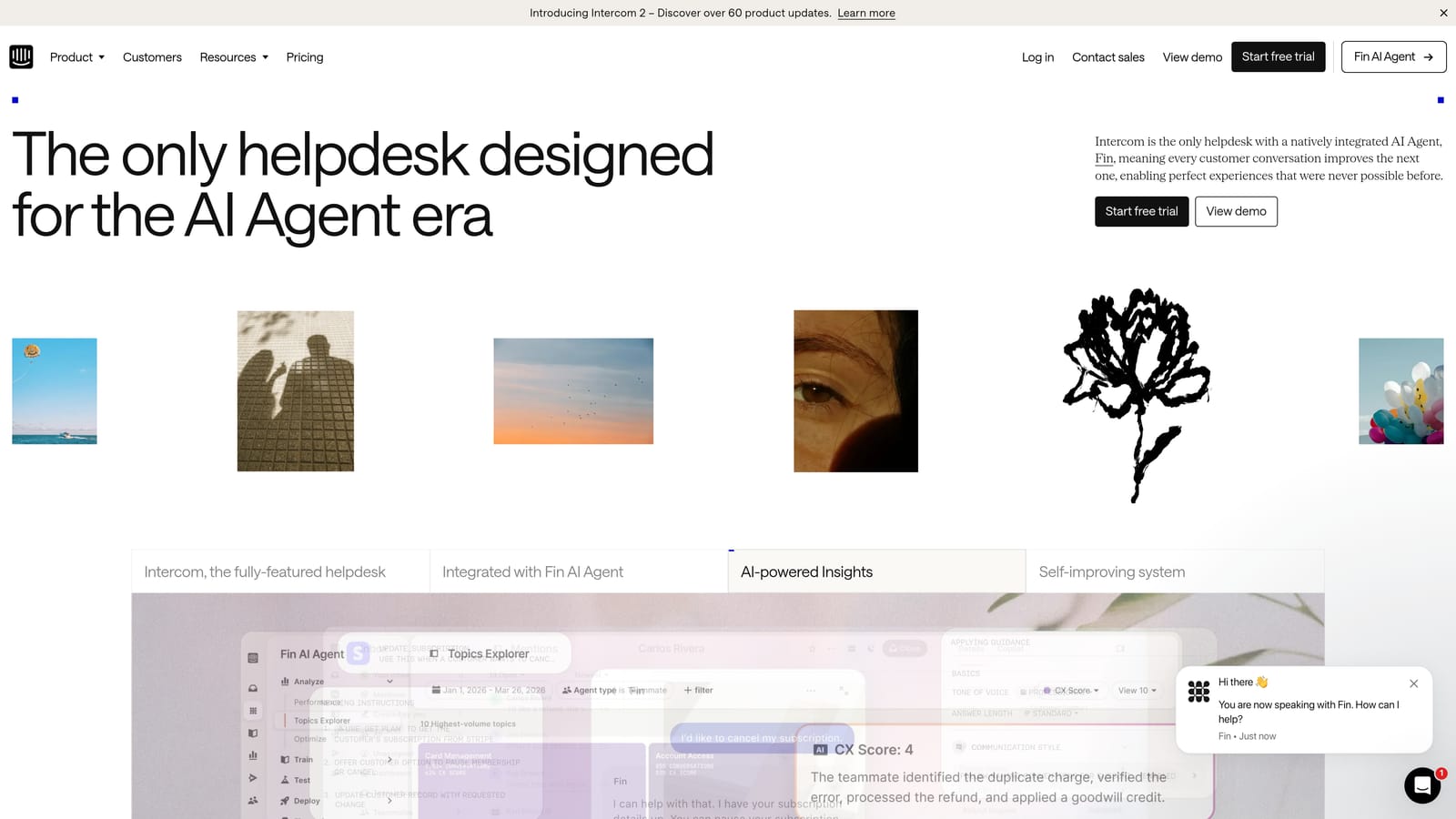
Intercom is a mature customer messaging platform with Fin, its AI agent, layered on top of a robust live chat and unified inbox system.
Where This Tool Shines
Fin, Intercom's AI agent, is trained directly on your help center content and can autonomously handle a meaningful portion of inbound queries without human involvement. For teams with a well-maintained knowledge base, the deflection impact can be significant from day one.
Intercom's strength is also its breadth. Beyond AI resolution, you get behavioral segmentation, product tours, in-app messaging, and a large app marketplace — making it a genuine customer engagement platform, not just a support tool.
Key Features
Fin AI Agent: Trained on help center content for autonomous resolution of common queries without agent involvement.
Unified Inbox: Combines chat, email, and in-app messaging into a single workspace for support teams.
Customer Data Platform: Behavioral segmentation and customer data management built directly into the platform.
Product Tours and In-App Messaging: Onboarding and user education tools alongside support capabilities.
Extensive App Marketplace: Hundreds of integrations and a robust API for custom connections.
Best For
SaaS teams already using Intercom for messaging and customer communication who want to add autonomous AI resolution without migrating to a new platform. Less ideal as a first choice if you're starting fresh and want the deepest AI-first architecture.
Pricing
Starter plans from approximately $39/month; AI features are available on higher tiers. Pricing has shifted notably in recent years, so check intercom.com for current rates.
3. Zendesk AI
Best for: Large support operations that need enterprise-grade helpdesk with AI layered in
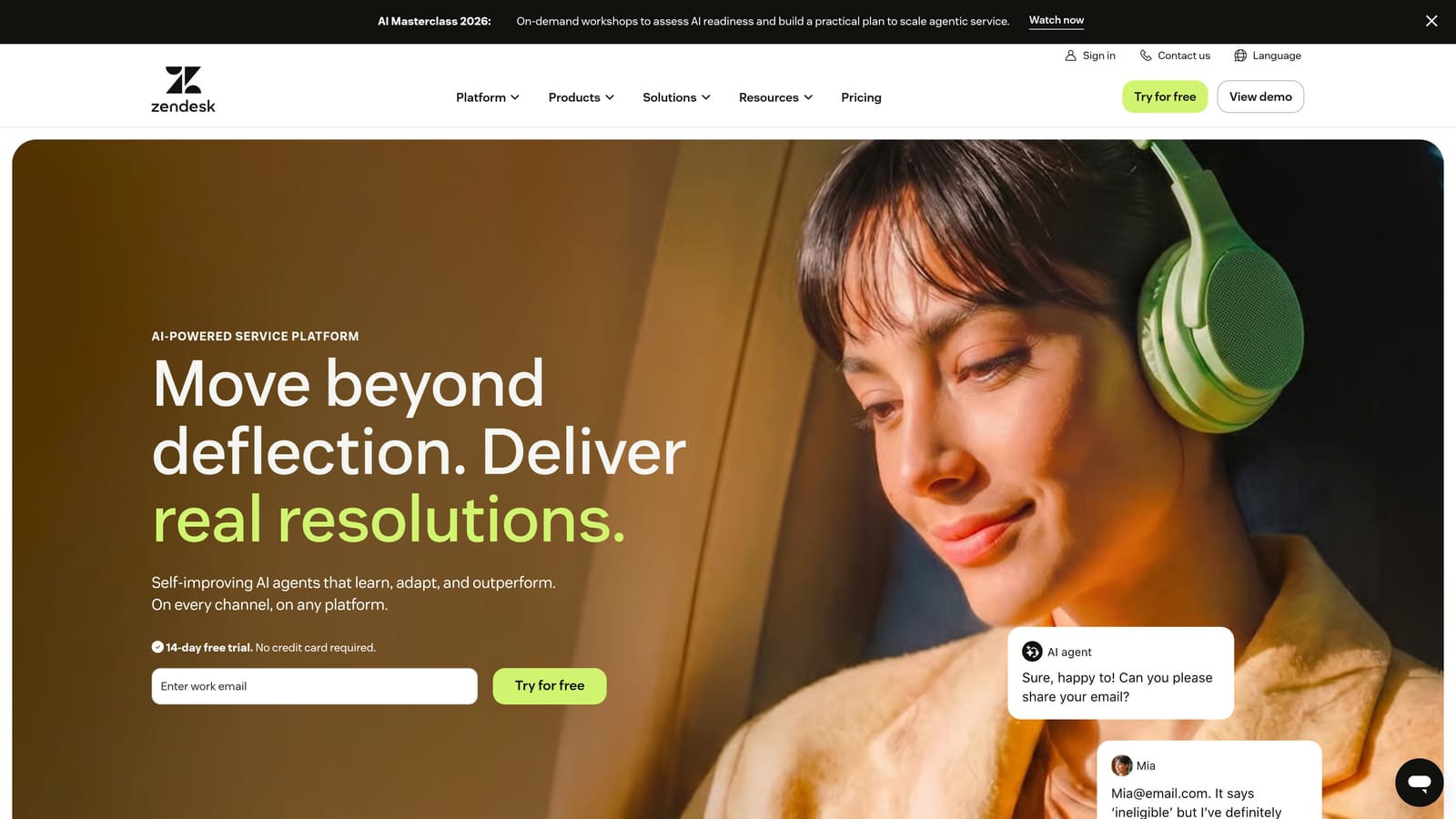
Zendesk is the dominant enterprise helpdesk platform, with AI triage, intelligent routing, and generative AI responses now built into its Suite.
Where This Tool Shines
Zendesk's scale is its primary advantage. If you're running a large support operation with hundreds of agents, complex SLA requirements, and strict compliance needs, Zendesk has the infrastructure to match. Its reporting capabilities are deep, and its integration marketplace is one of the largest in the category.
The AI additions — including generative reply drafts and intelligent ticket routing — meaningfully reduce agent workload. That said, these are AI features added to an existing architecture, which means the configuration overhead can be substantial compared to AI-native platforms.
Key Features
AI-Powered Triage and Routing: Automatically classifies and routes incoming tickets based on intent, priority, and agent skills.
Generative AI for Agents: AI-drafted replies and ticket summarization to accelerate agent response times.
Advanced Reporting and SLA Management: Deep analytics and service level tracking built for large operations.
Extensive Integration Marketplace: Thousands of integrations covering virtually every business tool category.
Enterprise Security and Compliance: Strong compliance certifications and data governance features for regulated industries.
Best For
Larger SaaS companies with established support operations, dedicated admin resources, and enterprise compliance requirements. Early-stage startups often find Zendesk's complexity and cost harder to justify relative to more focused alternatives.
Pricing
Suite plans start from approximately $55/agent/month; advanced AI features are on higher tiers. See zendesk.com for current pricing.
4. Freshdesk (Freddy AI)
Best for: Growing SaaS teams wanting a cost-effective Zendesk alternative with solid AI capabilities
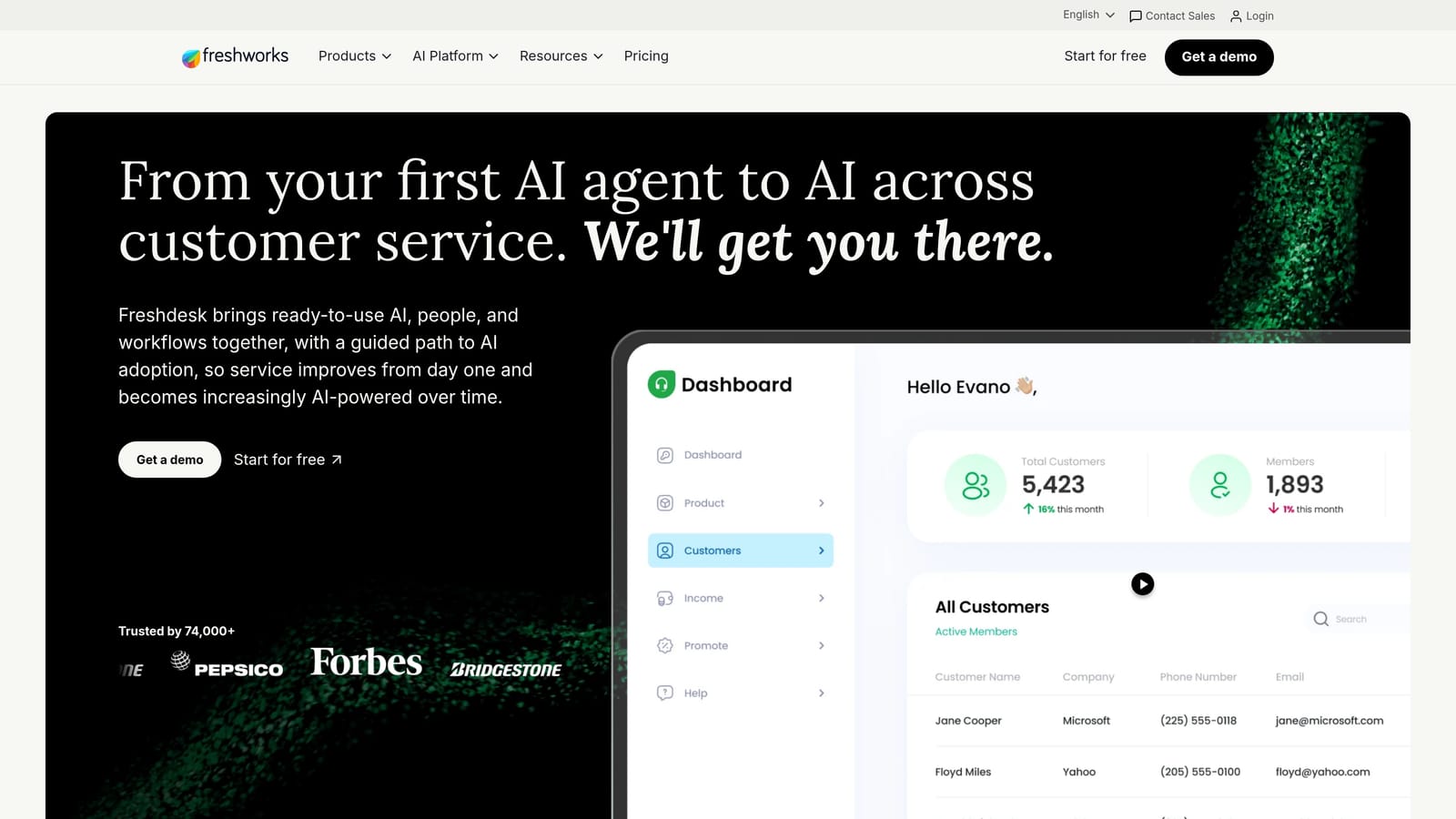
Freshdesk is Freshworks' helpdesk platform, with Freddy AI handling ticket classification, self-service bots, and agent assistance across the support workflow.
Where This Tool Shines
Freshdesk's value proposition is straightforward: comparable core functionality to Zendesk at a lower price point, with Freddy AI adding meaningful automation without requiring a large implementation budget. For SMB and mid-market SaaS companies, that trade-off often makes a lot of sense.
Freddy AI handles the fundamentals well — ticket classification, suggested responses, and self-service bot flows for deflecting common queries. It won't match the depth of a purpose-built AI-first platform, but it covers the essentials without heavy configuration overhead.
Key Features
Freddy AI Ticket Classification: Automatically categorizes and routes incoming tickets to reduce manual triage.
AI-Suggested Responses: Agent assist that surfaces relevant replies and knowledge base articles during ticket handling.
Self-Service Bot Builder: No-code bot creation for deflecting common queries before they reach an agent.
Omnichannel Support: Handles email, chat, phone, and social channels from a single platform.
Competitive Pricing: More accessible pricing tiers than comparable enterprise alternatives, with a free tier for small teams.
Best For
SMB and mid-market SaaS companies looking for a solid, affordable helpdesk with AI capabilities built in. Teams that want to avoid the cost and complexity of enterprise platforms without sacrificing core functionality.
Pricing
Free tier available; paid plans from approximately $15/agent/month, with Freddy AI features on higher tiers. See freshdesk.com for current pricing.
5. Tidio
Best for: Early-stage SaaS teams wanting fast AI chatbot deployment with minimal setup
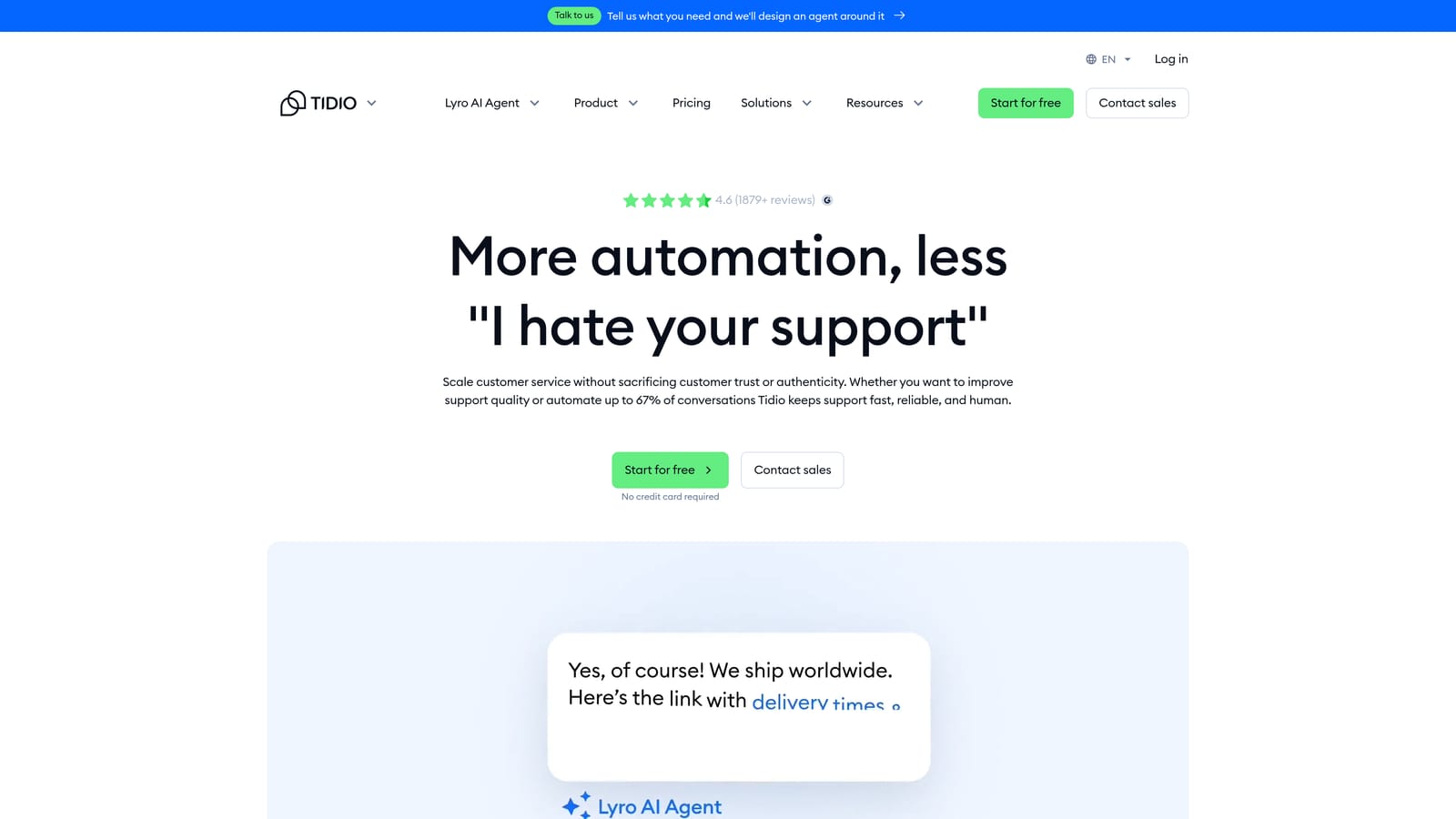
Tidio is an accessible AI chat platform featuring Lyro, its conversational AI chatbot, designed for fast deployment without heavy implementation requirements.
Where This Tool Shines
Tidio's biggest advantage is speed to value. If you need AI-powered deflection running quickly without a lengthy implementation project, Lyro can be up and handling FAQ-style queries in a short time. For early-stage companies fielding repetitive inbound questions, that immediacy matters.
The trade-off is depth. Lyro handles common query resolution well, but complex multi-step technical SaaS support scenarios are better served by platforms with more sophisticated AI architectures. Tidio is a strong starting point, not necessarily a long-term platform for scaling SaaS operations.
Key Features
Lyro AI Chatbot: Conversational AI for autonomous resolution of FAQ and common support queries.
Quick Setup with Pre-Built Flows: Pre-configured conversation flows reduce implementation time significantly.
Live Chat with Agent Takeover: Smooth handoff from Lyro to a human agent when queries exceed AI capability.
SaaS and E-Commerce Integrations: Connects with common platforms and tools used by early-stage teams.
Accessible Pricing: Affordable tiers designed for startups and small teams with limited support budgets.
Best For
Early-stage SaaS teams that need immediate AI deflection for common queries without a large implementation investment. Companies that have outgrown basic helpdesks will likely need to evaluate more capable platforms as they scale.
Pricing
Free plan available; Lyro AI from approximately $29/month. See tidio.com for current pricing.
6. Forethought
Best for: Teams with established helpdesk operations that want AI efficiency gains without platform migration
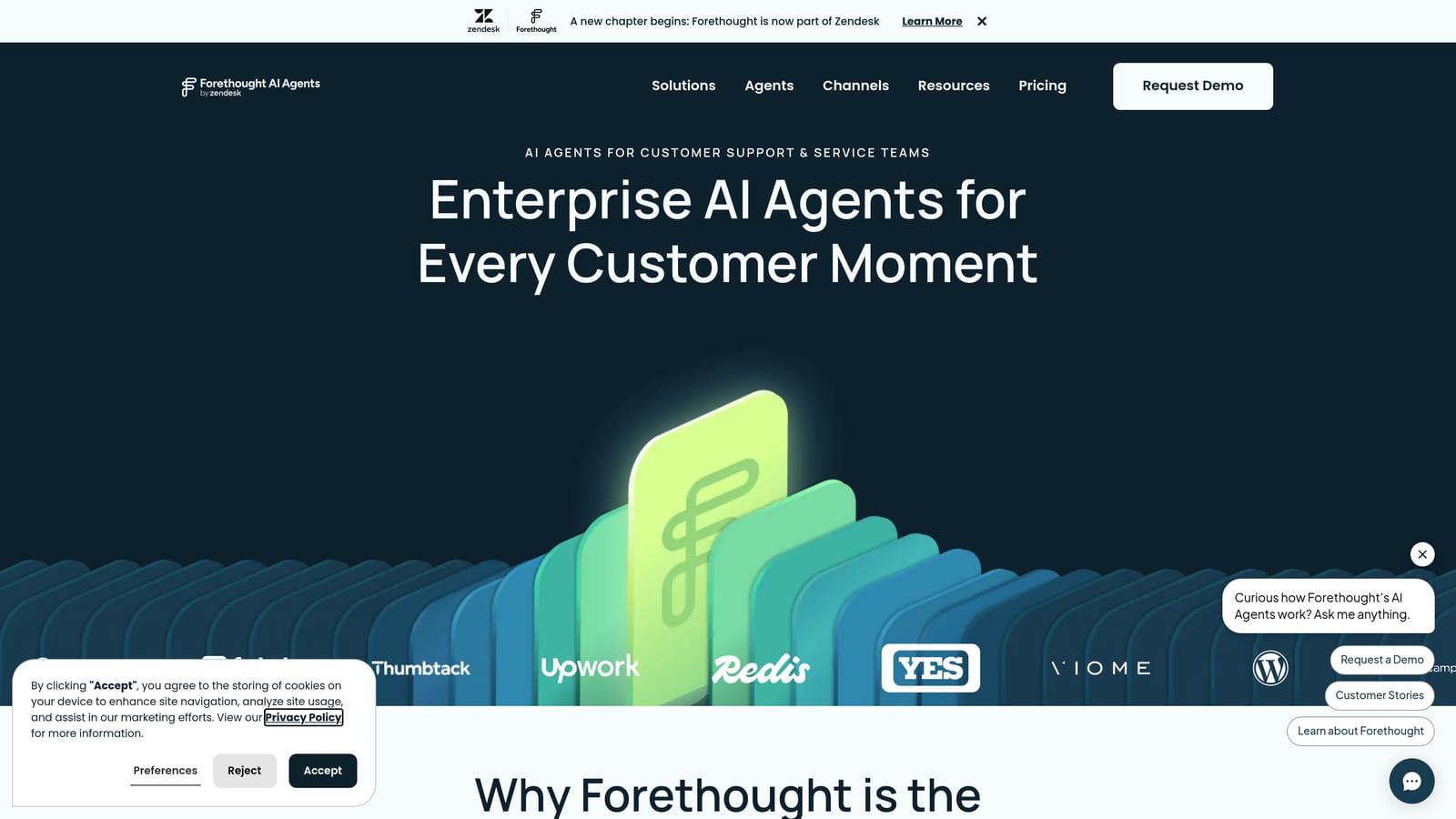
Forethought is an AI layer designed to enhance existing helpdesk workflows, adding intelligent triage, routing, and agent suggestions on top of platforms like Zendesk and Salesforce Service Cloud.
Where This Tool Shines
Forethought's positioning is deliberate: it doesn't try to replace your helpdesk. Instead, it makes your existing platform significantly smarter. For teams that have invested heavily in Zendesk or Salesforce workflows and aren't ready to migrate, Forethought can add meaningful AI capability without disrupting established processes.
Autoflows, Forethought's autonomous resolution feature, handles common queries end-to-end while agents focus on complex issues. The analytics layer tracks deflection rates and efficiency gains, giving support leaders clear visibility into AI impact.
Key Features
AI Triage and Intelligent Routing: Classifies and routes tickets across your existing helpdesk infrastructure automatically.
Suggested Responses and Knowledge Retrieval: Surfaces relevant answers and documentation to agents during ticket handling.
Autoflows for Autonomous Resolution: Handles common queries end-to-end without agent involvement.
Helpdesk Compatibility: Works alongside Zendesk, Salesforce Service Cloud, and other established platforms.
Deflection and Efficiency Analytics: Tracks AI impact on deflection rates and agent productivity over time.
Best For
SaaS companies with mature support operations on existing enterprise helpdesks who want AI efficiency gains without a full platform migration. Less suited for teams starting fresh or those wanting a unified AI-first architecture.
Pricing
Custom pricing. Contact Forethought directly for a quote based on your team size and use case.
7. Kustomer
Best for: SaaS companies with high-touch, relationship-heavy customer bases needing a CRM-native support platform
Kustomer is a CRM-native support platform that builds a complete customer timeline and applies AI across that full history for routing, sentiment analysis, and automation.
Where This Tool Shines
Kustomer's differentiation is its customer data depth. Rather than treating each ticket as an isolated event, Kustomer builds a unified timeline of every interaction a customer has had — across channels, over time — and applies AI across that full context. For support teams where understanding a customer's history is critical to resolution quality, that's a meaningful advantage.
The built-in CRM also reduces dependency on separate tools, which simplifies the stack for teams managing complex customer relationships alongside support operations.
Key Features
Unified Customer Timeline: Complete interaction history across all channels in a single customer view, accessible during every support interaction.
AI-Powered Routing and Sentiment Analysis: Routes tickets and flags sentiment signals based on customer data and conversation analysis.
Omnichannel Support: Handles all channels — email, chat, phone, social — with a consistent single-customer view.
Data-Triggered Automation: Workflows triggered by customer behavior and data signals, not just ticket events.
Built-In CRM: Reduces the need for a separate CRM tool for teams managing support and relationship data together.
Best For
SaaS companies with high-touch or relationship-heavy customer bases, particularly those in B2B segments where account history significantly influences support quality. Less suited for high-volume, transactional support operations.
Pricing
Enterprise pricing. Contact Kustomer directly for current rates based on your team and usage requirements.
8. Drift (Salesloft)
Best for: PLG SaaS companies where inbound conversations span both support and sales pipeline
Drift, now part of Salesloft, is a conversational AI platform that handles both support and sales conversations, making it particularly relevant for product-led growth SaaS companies.
Where This Tool Shines
Drift's core insight is that for PLG SaaS companies, the line between a support query and a sales conversation is often blurry. A user asking "how do I do X?" might be a customer who needs help or a prospect evaluating whether your product fits their workflow. Drift's AI routes conversations intelligently based on intent, sending support queries to agents and sales opportunities to revenue teams.
The integration with Salesloft's revenue platform means Drift is genuinely connected to the full revenue motion, not just support operations — which is a meaningful differentiator for teams that want to capture pipeline from inbound conversations.
Key Features
Conversational AI for Support and Sales: Handles both support resolution and sales qualification within a single platform.
Intent-Based Routing: Routes conversations to support agents or sales reps based on detected intent rather than manual triage.
Playbook-Based Automation: Pre-built conversation flows for common support and sales scenarios.
CRM and Revenue Tool Integration: Deep integration with CRM platforms and the Salesloft revenue suite.
Account-Based Targeting: Identifies and prioritizes conversations from target accounts for enterprise SaaS go-to-market teams.
Best For
PLG SaaS companies and enterprise SaaS teams running account-based motions where inbound conversations can be support queries or revenue opportunities. Less suited for teams that want a dedicated, deep AI support platform without the sales layer.
Pricing
Custom pricing. Contact Salesloft directly for current Drift pricing and packaging.
9. Help Scout
Best for: Teams where the quality of human connection is a deliberate competitive differentiator
Help Scout is a human-first support platform with AI assist features — AI Summarize, AI Drafts, and AI Answers — designed to make agents faster without removing the human element from support.
Where This Tool Shines
Help Scout's philosophy is intentionally different from the autonomous AI resolution approach. Rather than trying to deflect as many tickets as possible to AI, Help Scout focuses on making human agents faster, more informed, and more effective. AI Summarize gives agents instant context on a conversation; AI Drafts accelerates reply composition; AI Answers handles self-service via Docs.
For SaaS companies where brand differentiation is built on exceptional human support quality — not just resolution speed — that philosophy is a genuine fit rather than a compromise.
Key Features
AI Summarize: Instantly surfaces key context from long or complex conversations so agents can respond quickly without reading every message.
AI Drafts: Generates reply drafts for agents to review and send, reducing composition time without removing human judgment.
AI Answers: Self-service resolution via Help Scout Docs, handling common queries before they reach an agent.
Shared Inbox with Clean UX: A minimal, well-designed inbox that keeps agent workflows simple and focused.
Customer Satisfaction Ratings and Reporting: Built-in CSAT tracking and reporting to monitor support quality over time.
Best For
SaaS teams where relationship quality and human connection are brand differentiators, and where fully autonomous AI resolution isn't the primary goal. Also a good fit for smaller teams that want clean, simple tooling without the overhead of enterprise platforms.
Pricing
From approximately $22/user/month. See helpscout.com for current pricing and plan details.
Which Tool Is Right for Your SaaS Team?
The right choice depends on where you are in your growth journey and what you actually need from AI support. Here's a quick framework to cut through the noise.
If you're building an AI-first support operation and want the deepest autonomous resolution, page-aware product guidance, and business intelligence from your support data, Halo AI is the purpose-built choice. It's designed specifically for SaaS product teams, not adapted from a legacy helpdesk architecture.
If you're already deep in the Intercom ecosystem, Fin AI gives you meaningful autonomous resolution without a migration project. If you're running a large enterprise support operation with complex compliance requirements, Zendesk AI has the infrastructure to match. For growing teams watching their budget, Freshdesk with Freddy AI offers solid core capabilities at a more accessible price point.
Early-stage teams that need something running quickly should look at Tidio. Teams with established Zendesk or Salesforce workflows that want AI efficiency gains without migrating will find Forethought's layered approach appealing. Kustomer suits relationship-heavy B2B SaaS accounts; Drift makes sense for PLG companies where support and sales conversations blur; Help Scout fits teams where human connection is a deliberate brand choice.
One principle holds across all of them: your support team shouldn't scale linearly with your customer base. The platforms on this list exist to break that constraint. The question is which one matches your product, your team, and where you're headed.
If you want to see what an AI-first architecture looks like in practice, See Halo in action and discover how continuous learning transforms every support interaction into smarter, faster resolution — without adding headcount to keep up with growth.