9 Best AI Customer Support Tools for SaaS Products in 2026
As SaaS products grow, ticket volume quickly outpaces hiring capacity — making AI customer support tools a strategic necessity. This guide ranks the 9 best AI customer support tools for SaaS products in 2026, evaluating each on autonomous resolution, SaaS stack integration depth, and the ability to scale support quality without scaling headcount.
 Grant CooperFounder13 min read
SaaS teams face a brutal support paradox: as your product grows, ticket volume scales faster than your team can hire. You can't just throw more people at the problem — and you shouldn't have to. AI customer support tools have matured significantly, and today's platforms don't just deflect tickets. They resolve them, surface product insights, and hand off seamlessly to human agents when complexity demands it.
This list covers the top AI customer support tools built with SaaS products in mind. We evaluated each on autonomous resolution capability, integration depth with common SaaS stacks, context-awareness, and how well it scales without scaling headcount.
Whether you're running a lean startup support operation or managing a high-volume enterprise helpdesk, there's a tool here that fits. Halo AI leads the list because it's the most purpose-built for SaaS — but every tool earns its spot.
1. Halo AI
Best for: SaaS teams wanting full autonomous resolution, business intelligence, and deep product integration
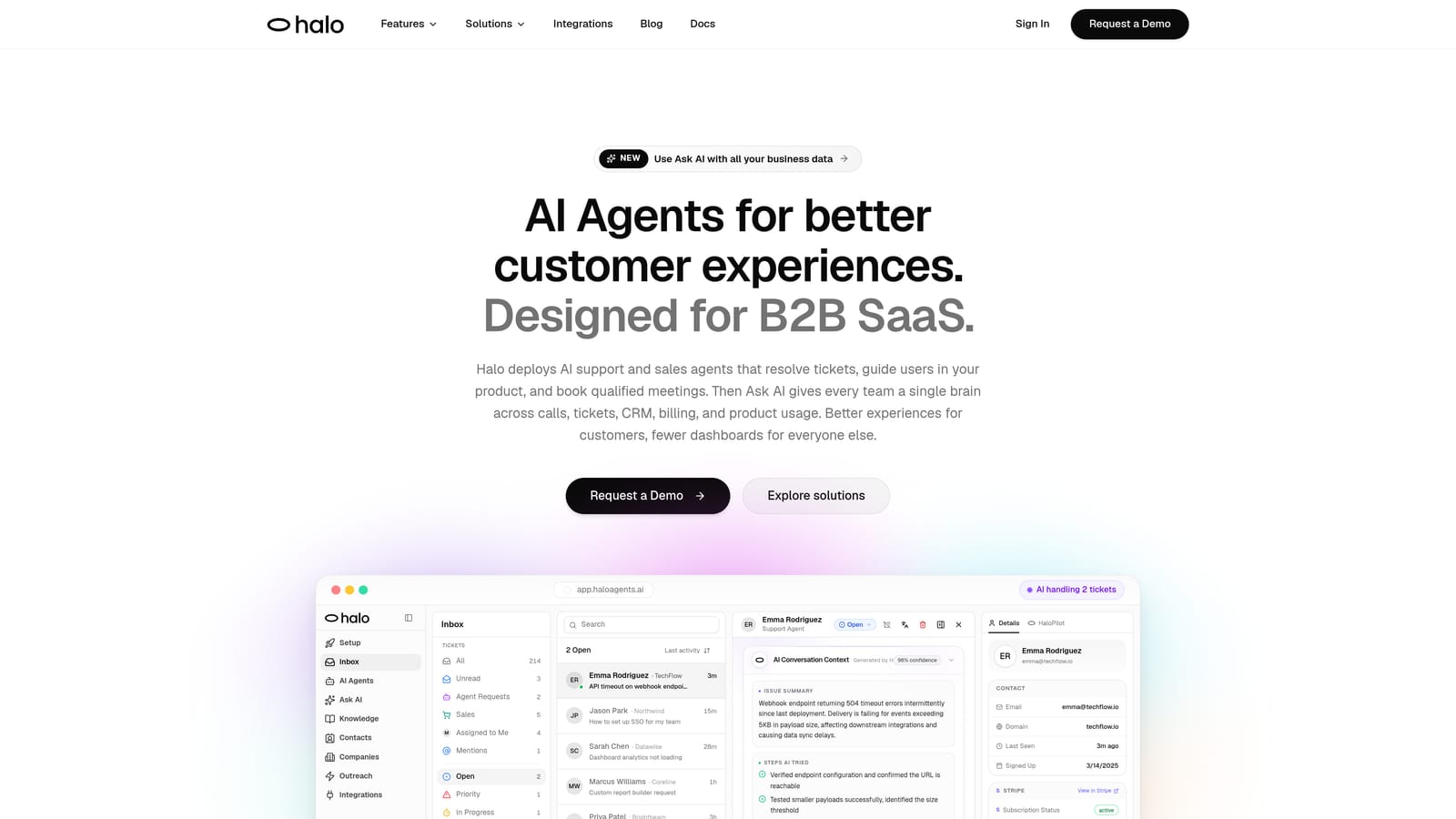
Halo AI is an AI-first customer support platform built specifically for SaaS products — not a bolt-on to an existing helpdesk, but a ground-up architecture designed around how SaaS support actually works.
Where This Tool Shines
What separates Halo from most tools on this list is its page-awareness. The chat widget doesn't just know what a user typed — it sees what they're looking at in your product, enabling contextual UI guidance that meets users exactly where they are. That's a meaningful difference when your support tickets frequently involve in-product confusion rather than simple FAQ lookups.
Halo also treats support as a source of business intelligence, not just a cost center. The smart inbox surfaces customer health signals, revenue anomalies, and product insights alongside ticket data — giving your team visibility that most helpdesks simply don't provide. And because it learns from every resolved interaction, the system gets measurably smarter over time.
Key Features
Page-Aware Chat Widget: Sees what the user sees in your product and delivers contextual UI guidance, not generic answers.
Intelligent AI Agents: Autonomous ticket resolution with continuous learning built into every interaction.
Smart Inbox with Business Intelligence: Surfaces customer health signals, revenue anomalies, and product trends alongside support tickets.
Auto Bug Ticket Creation: Automatically routes bug reports directly to Linear or your project management tool of choice.
Live Agent Handoff: Escalates to human agents with full conversation context preserved — no starting over.
Deep Integrations: Connects to Linear, Slack, HubSpot, Intercom, Stripe, Zoom, PandaDoc, and Fathom.
Best For
B2B SaaS product teams that want AI handling the full support lifecycle — from first contact to bug triage to business insight — without stitching together multiple tools. Particularly strong for teams whose support tickets frequently involve in-product context or require routing to engineering.
Pricing
Contact for pricing. A demo is available at haloagents.ai.
2. Intercom (Fin AI)
Best for: Teams already invested in the Intercom ecosystem wanting autonomous resolution
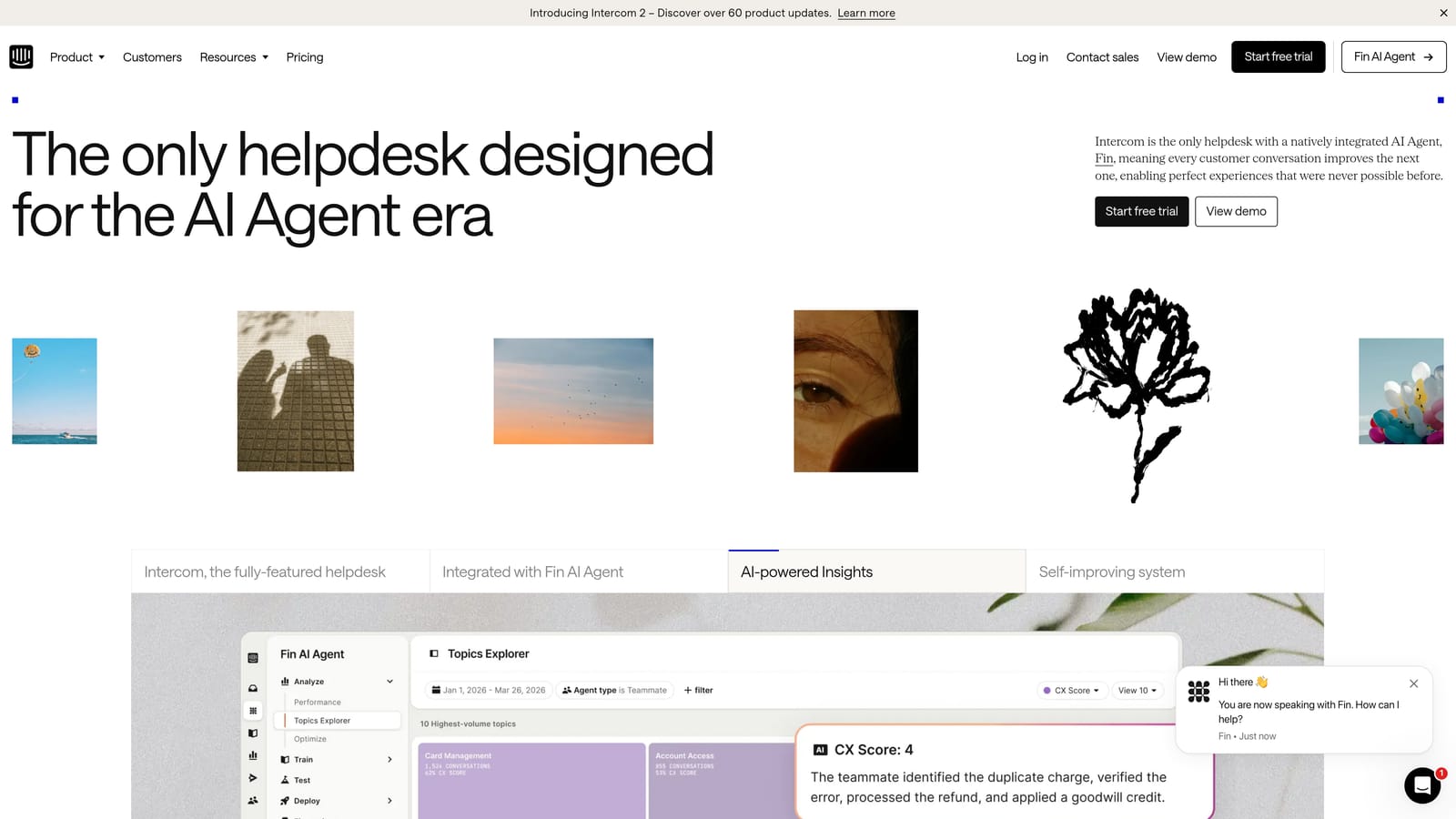
Intercom is a well-established customer messaging platform, and their Fin AI agent brings autonomous support resolution natively into the Intercom messenger and inbox experience.
Where This Tool Shines
If your team already runs on Intercom, Fin is the path of least resistance to meaningful AI resolution. It works directly within the messenger your customers already use and draws on your existing help center content to resolve queries without requiring a separate knowledge base migration.
The usage-based pricing model is worth noting: you pay per resolution rather than per seat, which aligns cost directly with outcomes. For teams with variable support volume, that structure can be more predictable than flat per-agent pricing.
Key Features
Fin AI Agent: Resolves customer queries autonomously within Intercom's existing messenger interface.
Usage-Based Pricing: Pay per resolution rather than per seat, tying cost to actual outcomes.
Human Handoff: Smooth escalation to the human inbox when Fin cannot resolve a query.
Multilingual Support: Handles queries across multiple languages out of the box.
Help Center Integration: Draws directly from your existing Intercom articles and content.
Best For
SaaS teams already using Intercom as their primary support and messaging layer who want to add autonomous AI resolution without switching platforms or managing a separate AI tool.
Pricing
Usage-based per resolution; Intercom base plans vary by tier. See intercom.com/pricing for current details.
3. Zendesk AI
Best for: Enterprise SaaS teams with compliance requirements and established Zendesk environments
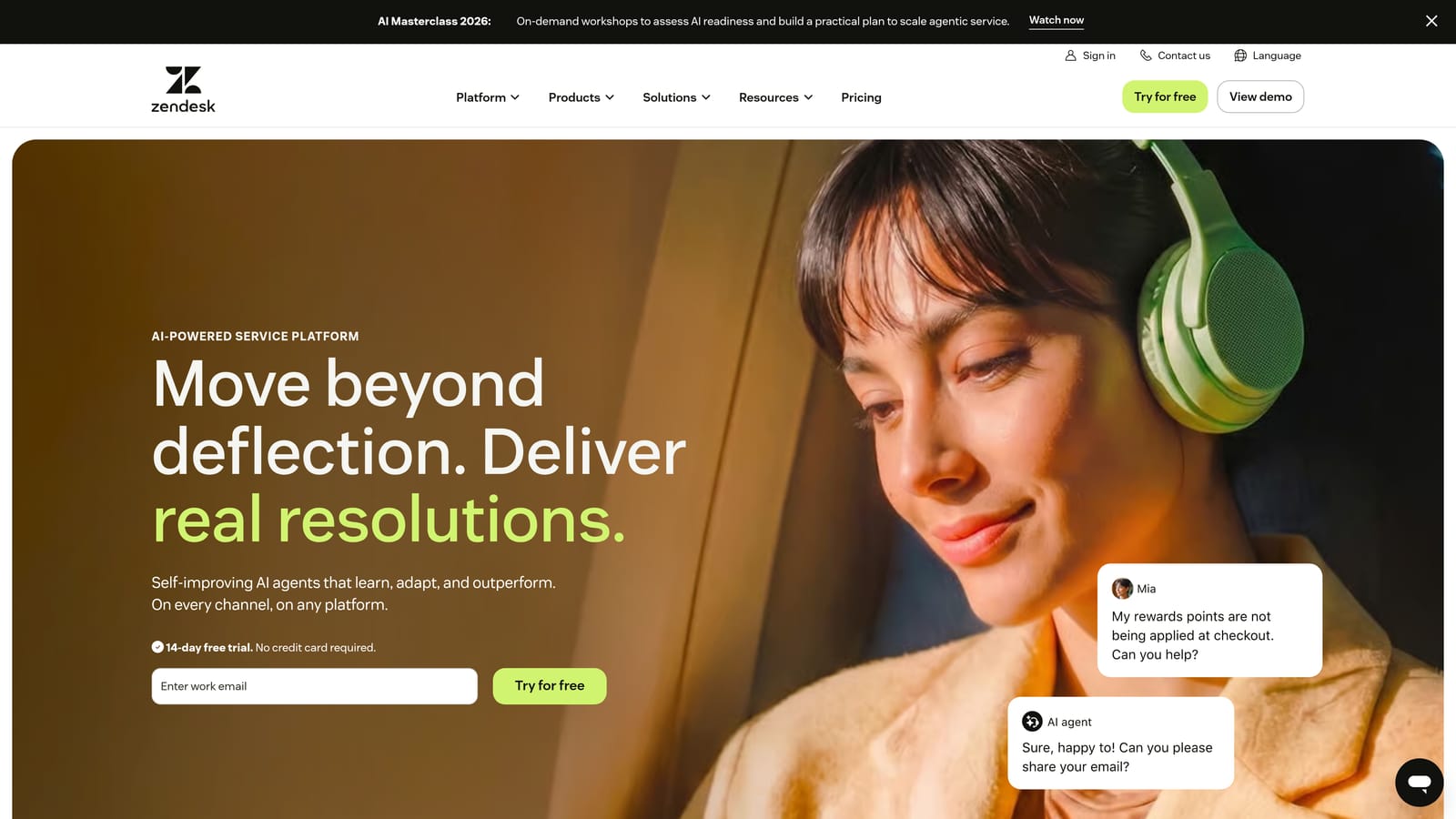
Zendesk is one of the largest helpdesk platforms globally, and their AI layer adds automated triage, AI agents, and agent-assist capabilities on top of an already mature enterprise foundation.
Where This Tool Shines
Zendesk AI's strength is the breadth of what it covers. From intelligent triage and auto-tagging on the way in, to Agent Copilot suggestions during live tickets, to a robust analytics suite on the back end, it touches every stage of the support workflow. For enterprise teams that have already standardized on Zendesk, adding AI doesn't require a platform change.
The compliance and security posture is also a genuine differentiator. Enterprise SaaS companies in regulated industries — fintech, healthcare tech, legal tech — often have requirements that rule out newer platforms. Zendesk's enterprise-grade certifications and audit capabilities address that directly.
Key Features
AI Agents: Automated ticket deflection and resolution, formerly known as Answer Bot, now significantly more capable.
Intelligent Triage: Auto-tagging, smart routing, and priority scoring to get tickets to the right place faster.
Agent Copilot: Suggested replies and next-best-action recommendations surfaced to human agents in real time.
Advanced Analytics: Comprehensive reporting suite for volume trends, CSAT, and resolution metrics.
Enterprise Compliance: Security certifications and compliance features suited to regulated industries.
Best For
Mid-market to enterprise SaaS companies with existing Zendesk investments, compliance requirements, or support teams large enough to benefit from agent-assist features at scale.
Pricing
Suite plans start at varying tiers; AI features are available on higher-tier plans. See zendesk.com/pricing for current details.
4. Freshdesk Freddy AI
Best for: SMB and growth-stage SaaS teams wanting omnichannel AI at a competitive price point
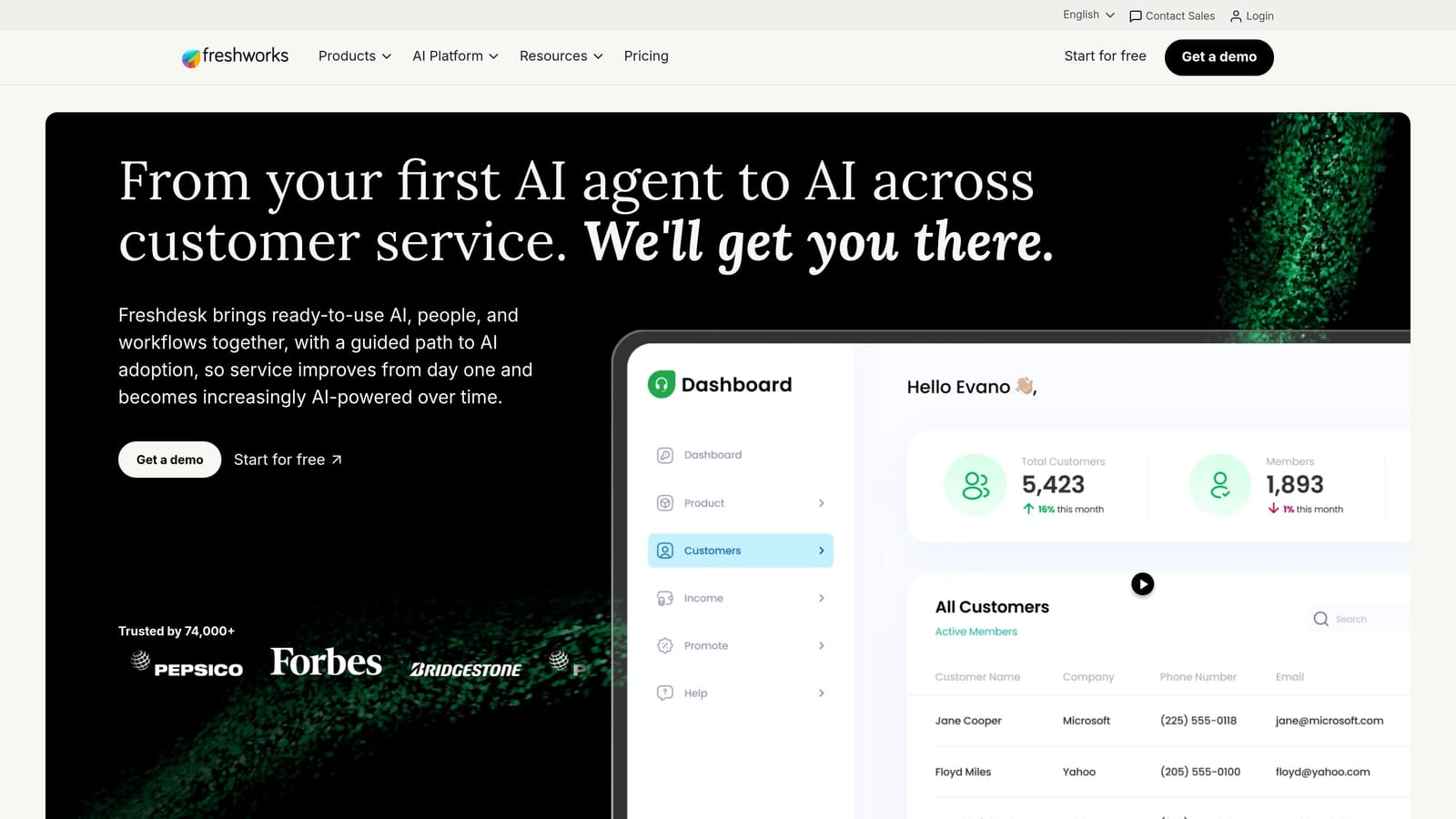
Freshdesk by Freshworks embeds Freddy AI across its entire support suite, covering self-service, agent assist, and analytics in one package without the enterprise price tag.
Where This Tool Shines
Freddy AI is notable for how much it covers under a single umbrella. Rather than buying AI features as expensive add-ons, Freshdesk bundles self-service chatbots, real-time agent assist, and AI-powered analytics into a coherent platform. For growing SaaS teams watching their tooling budget carefully, that breadth-to-cost ratio is genuinely competitive.
The omnichannel coverage also matters here. Freshdesk handles email, chat, phone, and social from one inbox, and Freddy's AI capabilities extend across all those channels rather than being limited to chat only.
Key Features
Freddy Self Service: AI chatbot that deflects common queries across channels before they reach an agent.
Freddy Copilot: Real-time agent assist with suggested responses and conversation summaries.
Freddy Insights: AI-powered analytics that surface support trends and anomalies automatically.
Omnichannel Coverage: Unified inbox across email, chat, phone, and social channels.
Competitive Pricing: Free plan available; paid plans are priced accessibly relative to enterprise alternatives.
Best For
SMB and growth-stage SaaS teams that need omnichannel support coverage with AI capabilities but aren't ready to commit to enterprise-tier pricing. Also strong for teams migrating away from Zendesk looking for a cost-effective alternative.
Pricing
Free plan available; paid plans scale at SMB-friendly rates. See freshworks.com/freshdesk/pricing for current tiers.
5. Tidio
Best for: Early-stage SaaS startups needing fast AI coverage with minimal setup
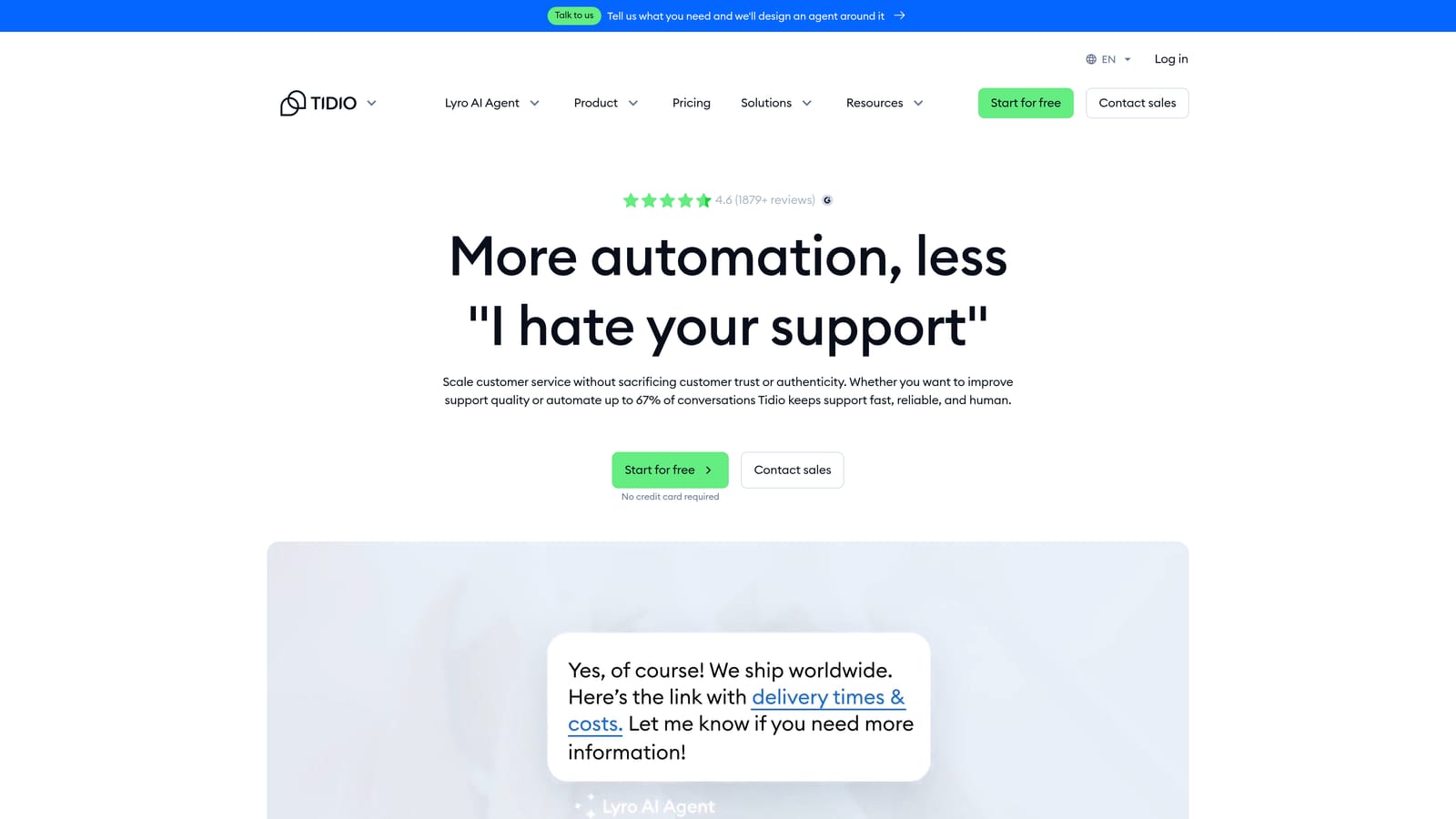
Tidio combines live chat with Lyro AI, an AI agent built to handle common customer questions autonomously from day one — with a deployment timeline measured in hours, not weeks.
Where This Tool Shines
Tidio's primary advantage is speed. If your startup needs AI support coverage quickly — without a lengthy implementation or a dedicated ops resource to configure it — Lyro AI can be live and resolving queries faster than most alternatives on this list. That matters when you're a small team and every day of manual ticket handling is a day your founders or engineers are pulled into support.
The visual chatbot flow builder also gives non-technical team members control over conversation paths without requiring developer involvement, which is a practical consideration for lean teams.
Key Features
Lyro AI Agent: Autonomous query resolution handling common questions from the moment it's deployed.
Fast Deployment: Typically live within hours, with minimal configuration required.
Live Chat Fallback: Smooth handoff to a human agent when Lyro cannot resolve a query.
Email and Messenger Integration: Extends beyond chat to cover additional channels.
Visual Flow Builder: Lets non-technical team members create custom conversation paths without code.
Best For
Early-stage SaaS startups and small teams that need AI support coverage fast, without the budget or bandwidth for a complex implementation. Also useful as a first step toward AI support before graduating to a more feature-rich platform.
Pricing
Free plan available; Lyro AI is on paid plans. See tidio.com/pricing for current details.
6. Forethought
Best for: Teams wanting AI triage and resolution layered on top of an existing helpdesk like Zendesk or Salesforce
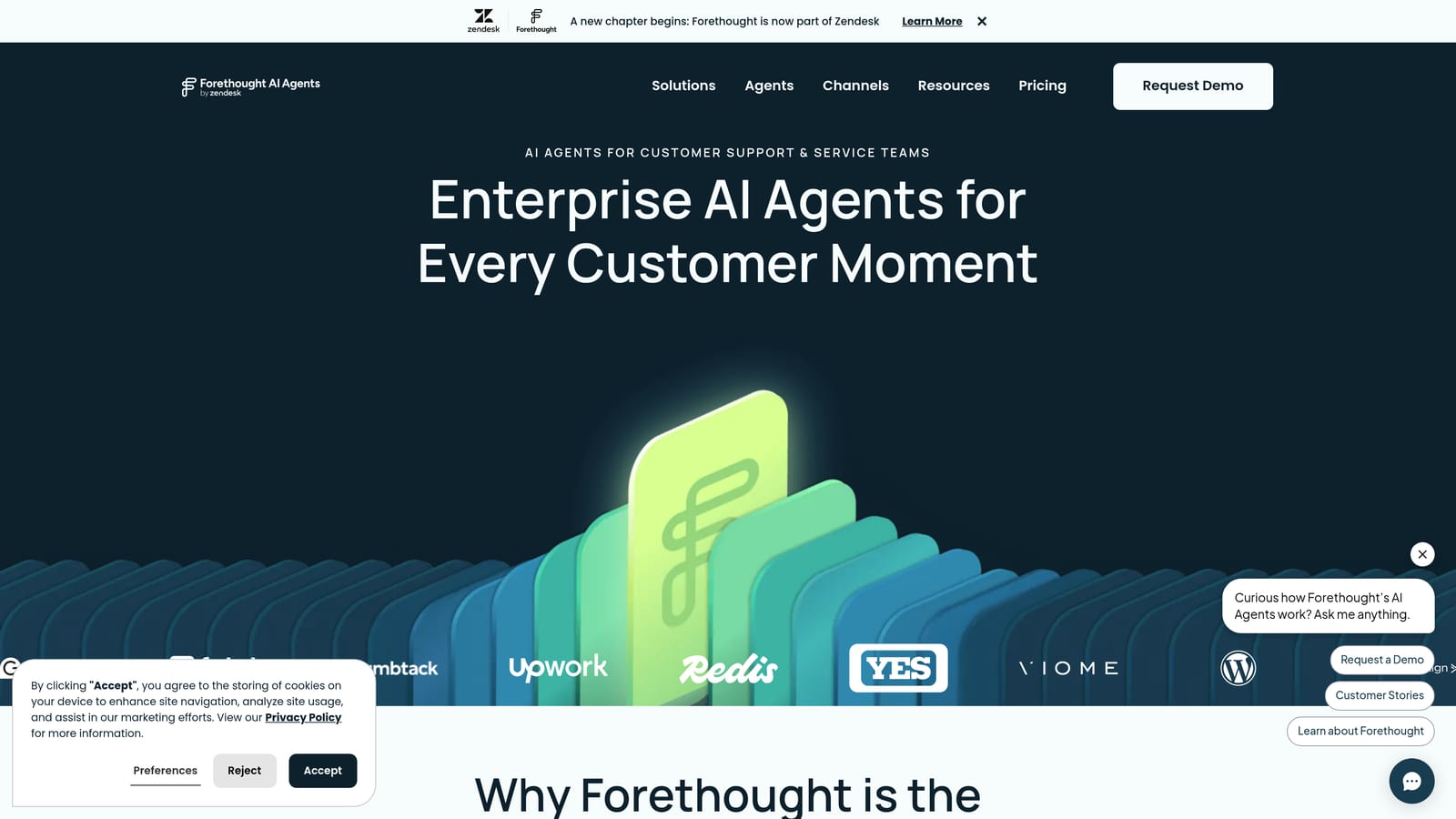
Forethought is an AI platform focused specifically on support workflow intelligence — triage, routing, and resolution — designed to sit on top of your existing helpdesk rather than replace it.
Where This Tool Shines
Forethought's architecture is its defining characteristic. If you've invested heavily in Zendesk or Salesforce Service Cloud and aren't ready to migrate, Forethought adds a meaningful AI layer without requiring a platform switch. It handles the intelligent work — classifying tickets, routing them correctly, resolving what it can — while your existing helpdesk handles storage and agent workflows.
The Discover module is particularly useful for SaaS product teams: it identifies top ticket drivers and knowledge gaps, giving product and engineering visibility into what's actually breaking or confusing users at scale.
Key Features
Solve: AI agent for autonomous ticket resolution on top of your existing helpdesk.
Triage: Intelligent auto-tagging, routing, and priority assignment before tickets reach agents.
Assist: Agent-facing AI that surfaces relevant knowledge articles and context during live tickets.
Discover: Analytics module identifying top ticket drivers and knowledge gaps across your support volume.
Helpdesk Compatibility: Designed to layer on Zendesk, Salesforce Service Cloud, and similar platforms.
Best For
Mid-market and enterprise SaaS teams with existing Zendesk or Salesforce investments who want to add AI intelligence without a platform migration. Strong fit when intelligent triage and routing are the primary pain points.
Pricing
Enterprise pricing model; contact Forethought directly at forethought.ai for a quote.
7. Kustomer
Best for: SaaS teams where support and customer success functions overlap significantly
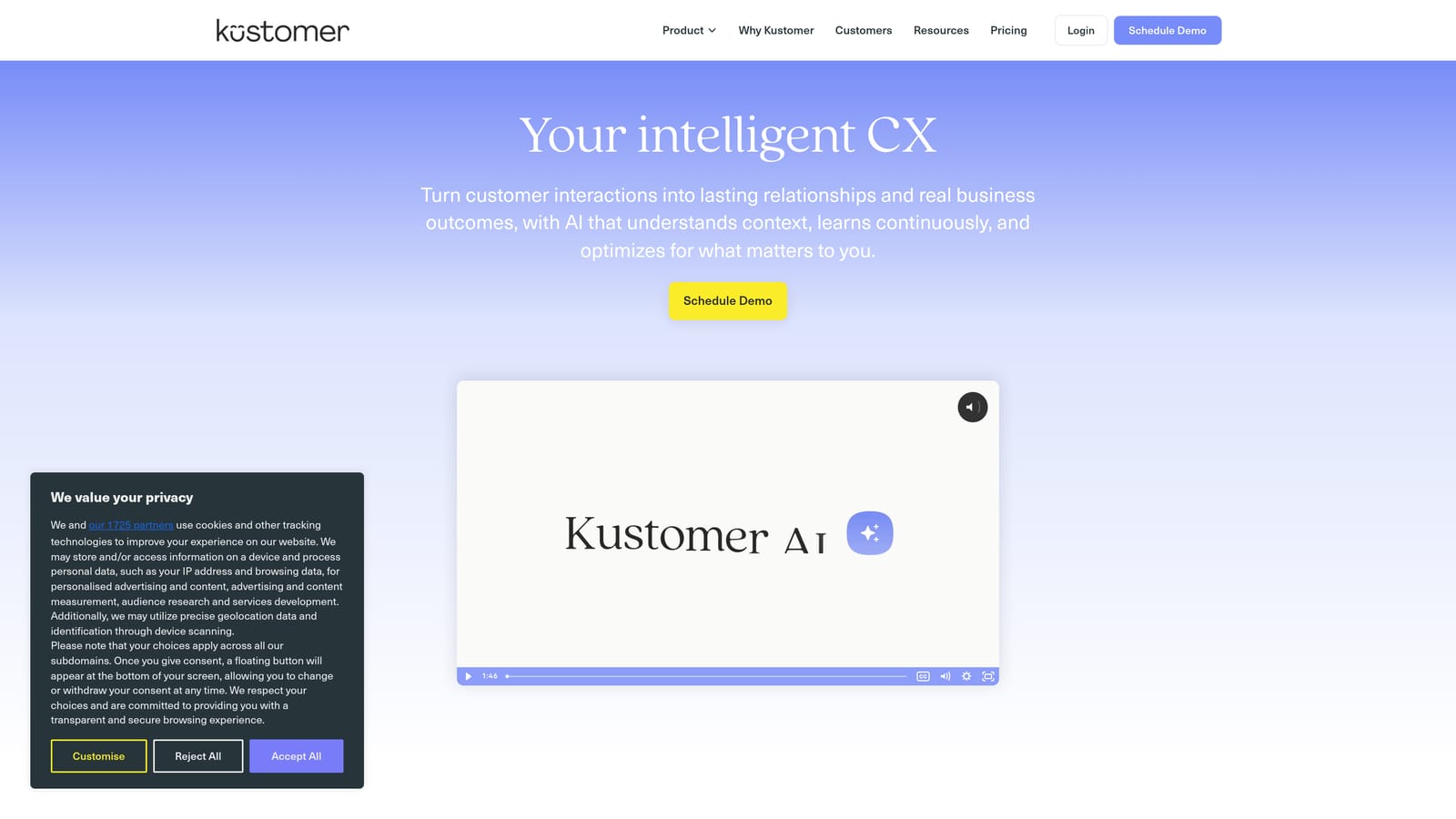
Kustomer is a CRM-native customer service platform that builds AI automation into a unified customer timeline, bridging the gap between support and customer success in a way most helpdesks don't.
Where This Tool Shines
Kustomer's differentiator is context depth. Because it's CRM-native, every support interaction sits alongside the full customer history — purchases, previous conversations, account status, lifecycle stage. Agents and AI alike have access to that context before they respond, which changes the quality of support meaningfully for B2B SaaS where customer relationships are long-term and high-value.
For SaaS companies where the line between support and customer success is blurry — where a support ticket might actually be a churn signal — Kustomer's unified timeline makes those connections visible in a way a traditional helpdesk doesn't.
Key Features
Unified Customer Timeline: Aggregates all interactions, purchases, and account history in one view.
AI-Powered Routing: Intelligent conversation routing and suggested responses based on full customer context.
Omnichannel Inbox: Handles email, chat, SMS, social, and voice from a single interface.
CRM-Native Architecture: Customer context is always visible to both AI and human agents.
Automation Workflows: Handles repetitive support tasks and routing logic without manual configuration.
Best For
B2B SaaS companies where support teams and customer success teams share responsibility for accounts, and where customer context — not just ticket content — determines the right response.
Pricing
Enterprise plans; see kustomer.com/pricing for current details.
8. Help Scout
Best for: SaaS teams that prioritize relationship quality and want AI as an assistant, not a replacement
Help Scout is a human-centric support platform that has added AI features thoughtfully — drafting replies, summarizing threads, improving tone — without repositioning itself as an autonomous resolution engine.
Where This Tool Shines
Help Scout's philosophy is worth stating plainly: AI here is an assistant to your human agents, not a replacement for them. If your SaaS product serves customers who expect a high-touch, relationship-driven support experience — and where an impersonal bot response would actively damage trust — Help Scout's approach is the right fit.
The AI features are genuinely useful without being the product's centerpiece. AI Drafts speeds up response time, AI Summarize helps agents catch up on long threads quickly, and AI Assist cleans up tone and clarity before sending. These are practical time-savers that don't change the fundamental character of the interaction.
Key Features
AI Drafts: Generates reply drafts for agents to review, edit, and send — keeping humans in the loop.
AI Summarize: Condenses long conversation threads into quick summaries for faster agent context.
AI Assist: Improves agent-written replies for tone, clarity, and completeness before sending.
Docs Knowledge Base: Built-in knowledge base with AI-powered search for self-service.
Shared Inbox: Collision detection and internal notes keep team coordination clean.
Best For
SaaS teams where support quality and relationship depth matter more than deflection rates — particularly companies with high-value accounts, complex products, or customers who explicitly prefer human interaction.
Pricing
Plans start at a monthly per-user rate. See helpscout.com/pricing for current details.
9. Drift (Salesloft)
Best for: PLG SaaS teams where support and revenue qualification happen in the same conversation
Drift, now part of Salesloft, is a conversational AI platform that handles both support queries and sales qualification — a relevant combination for SaaS teams running product-led growth motions where the line between a support question and a sales opportunity is thin.
Where This Tool Shines
Drift's unique position is that it doesn't treat support and sales as separate channels. An inbound chat might be a billing question, a feature request, or a buying signal — and Drift's AI can route accordingly in real time based on visitor intent. For PLG SaaS companies where free users convert to paid through in-product behavior, that kind of intelligent routing has direct revenue implications.
The integration with Salesloft's sales engagement platform also means that when a support conversation reveals a sales opportunity, the handoff to a sales rep can happen with full conversation context rather than starting cold.
Key Features
Conversational AI Bot: Handles support and sales qualification queries simultaneously within a single interface.
Intent-Based Routing: Routes conversations to support or sales in real time based on detected visitor intent.
Account-Based Targeting: Personalizes conversations for target accounts in enterprise SaaS GTM motions.
Salesloft Integration: Full integration with Salesloft's sales engagement platform for seamless handoffs.
Meeting Scheduling: Pipeline qualification and meeting booking built directly into the conversation flow.
Best For
PLG SaaS companies where support and revenue motions overlap, particularly those with a significant volume of inbound chat from prospects who may be current users with questions or potential buyers evaluating the product.
Pricing
Premium plans; contact Drift or Salesloft directly at drift.com for current pricing.
Which Tool Is Right for Your SaaS Team?
The honest answer is that the best tool depends on where you are, what you've already built, and what kind of support experience you want to deliver.
Here's a quick way to think through it:
Halo AI is the strongest choice for SaaS teams that want genuine autonomous resolution with page-aware context, business intelligence baked in, and integrations that span the full SaaS stack — without stitching together multiple platforms to get there.
Intercom Fin makes the most sense if you're already running on Intercom and want to add autonomous AI without changing anything else. Zendesk AI is the right call for enterprise teams with compliance requirements and existing Zendesk infrastructure. Freshdesk Freddy delivers strong omnichannel AI at a price point that works for growing teams watching their budget.
Tidio is the fastest path to AI coverage for early-stage startups. Forethought is purpose-built for teams that want AI intelligence layered on top of Zendesk or Salesforce without migrating. Kustomer shines when support and customer success share responsibility for accounts. Help Scout is the right fit when relationship quality matters more than deflection rate. And Drift belongs on the shortlist for any PLG team where support conversations and sales conversations happen in the same place.
Your support team shouldn't scale linearly with your customer base. Let AI agents handle routine tickets, guide users through your product, and surface business intelligence while your team focuses on complex issues that need a human touch. See Halo in action and discover how continuous learning transforms every interaction into smarter, faster support.