9 Best AI Customer Support Platforms Reviewed for 2026
Comprehensive ai customer support platform reviews covering nine leading solutions evaluated across AI accuracy, integration depth, pricing transparency, and scalability to help B2B teams identify the right tool for deflecting tickets, accelerating resolution times, and building smarter support operations in 2026.
 Grant CooperFounder13 min read
Choosing an AI customer support platform is one of the highest-impact decisions a B2B team can make right now. The right tool deflects tickets, accelerates resolution times, and surfaces business intelligence you'd otherwise miss. The wrong one just adds another dashboard nobody checks.
With dozens of vendors claiming autonomous resolution rates and AI-powered everything, cutting through the noise takes real effort. We evaluated nine leading platforms across criteria that actually matter: AI accuracy and learning capabilities, integration depth with existing tech stacks, ease of deployment, pricing transparency, and how well each tool scales from startup to enterprise.
Whether you're replacing a legacy helpdesk, augmenting your current Zendesk or Intercom setup, or building an AI-first support operation from scratch, here are the top AI customer support platforms worth your attention in 2026.
1. Halo AI
Best for: B2B SaaS teams wanting an AI-first platform that resolves tickets, guides users, and surfaces business intelligence.
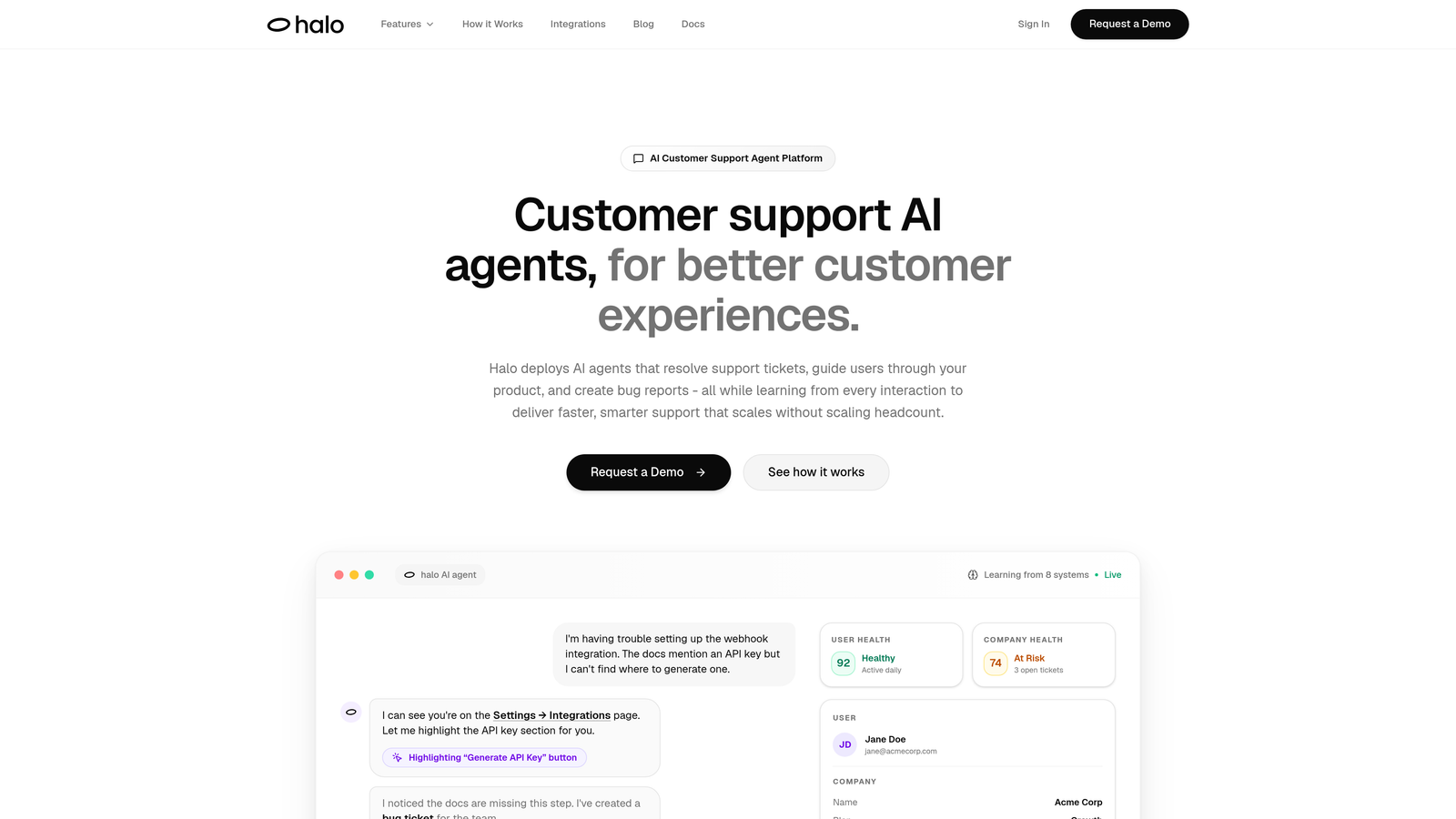
Halo AI is an AI-first customer support platform that deploys autonomous agents to resolve tickets, guide users with page-aware visual context, create bug reports, and surface business intelligence — learning continuously from every interaction.
Where This Tool Shines
What separates Halo from most platforms on this list is its architecture. It wasn't built as an AI layer bolted onto a legacy ticketing system. The AI is the foundation, which means every feature — from ticket resolution to bug reporting to business analytics — is designed around autonomous operation rather than agent assistance.
The page-aware chat widget is a standout capability. It sees what your users see in real time, allowing it to provide contextual UI guidance rather than generic help center responses. For SaaS products with complex interfaces, this distinction matters considerably.
Key Features
Page-Aware Chat Widget: Understands the user's current context within your product and delivers visual UI guidance specific to what they're looking at.
Autonomous Ticket Resolution: AI agents resolve support tickets end-to-end, with continuous learning from every interaction to improve accuracy over time.
Auto Bug Ticket Creation: Automatically identifies and logs bug reports with direct Linear integration, removing manual steps from your engineering workflow.
Smart Inbox with Business Intelligence: Goes beyond support metrics to surface customer health signals, revenue intelligence, and anomaly detection — connecting support data to business outcomes.
Deep Business Stack Integrations: Connects to Slack, HubSpot, Intercom, Stripe, Zoom, PandaDoc, Fathom, and Linear, making it a connective layer across your entire operation rather than an isolated support tool.
Best For
B2B SaaS companies and product teams building AI-first support operations. Particularly strong for teams already using Linear for engineering, HubSpot for CRM, and Stripe for billing, where Halo's integration depth creates genuine cross-functional value beyond the support queue.
Pricing
Contact for pricing; usage-based model available. The shift away from per-seat pricing reflects the platform's focus on autonomous resolution rather than agent headcount.
2. Intercom Fin
Best for: Teams already on Intercom who want native AI resolution without switching platforms.
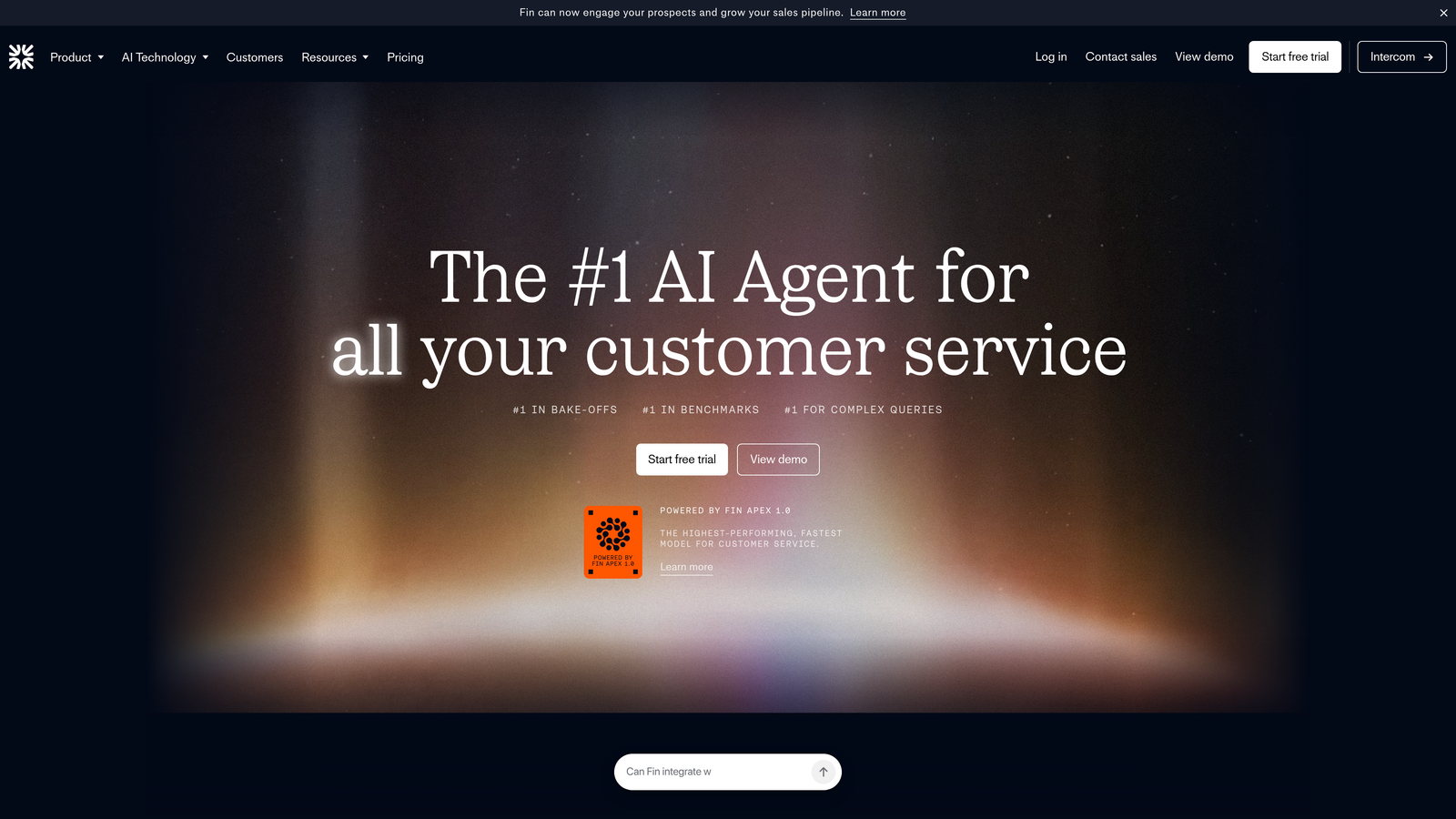
Intercom Fin is Intercom's native AI agent, designed to resolve conversations using your help center content and conversation history within the existing Intercom ecosystem.
Where This Tool Shines
If your team is already embedded in Intercom's messenger and inbox, Fin is the path of least resistance to AI-powered resolution. Setup is fast, and because it trains on your existing help articles and past conversations, it can reach a useful baseline quickly without significant configuration overhead.
The per-resolution pricing model is worth noting. It aligns cost directly with value delivered, which makes budgeting more predictable than traditional per-seat models — though it can become expensive at scale if resolution rates are high.
Key Features
Native Intercom Integration: Operates directly within Intercom's messenger, inbox, and help center without additional setup or middleware.
Conversation-Trained AI: Learns from existing help articles and historical conversation data to build contextual response capability.
Customizable Tone and Persona: Allows teams to adjust Fin's communication style to match brand voice.
Human Handoff with Context: Transfers conversations to live agents with full conversation history intact.
Per-Resolution Pricing: Charges based on successful resolutions rather than seats, aligning cost with outcomes.
Best For
Companies already invested in the Intercom platform who want to add AI resolution without migrating infrastructure. Less compelling for teams not already on Intercom, where the ecosystem lock-in becomes a cost rather than a benefit.
Pricing
Starts at $0.99 per resolution on top of an existing Intercom subscription. Total cost depends heavily on conversation volume and resolution rates.
3. Zendesk AI
Best for: Enterprise teams needing omnichannel AI support across email, chat, voice, and social at scale.
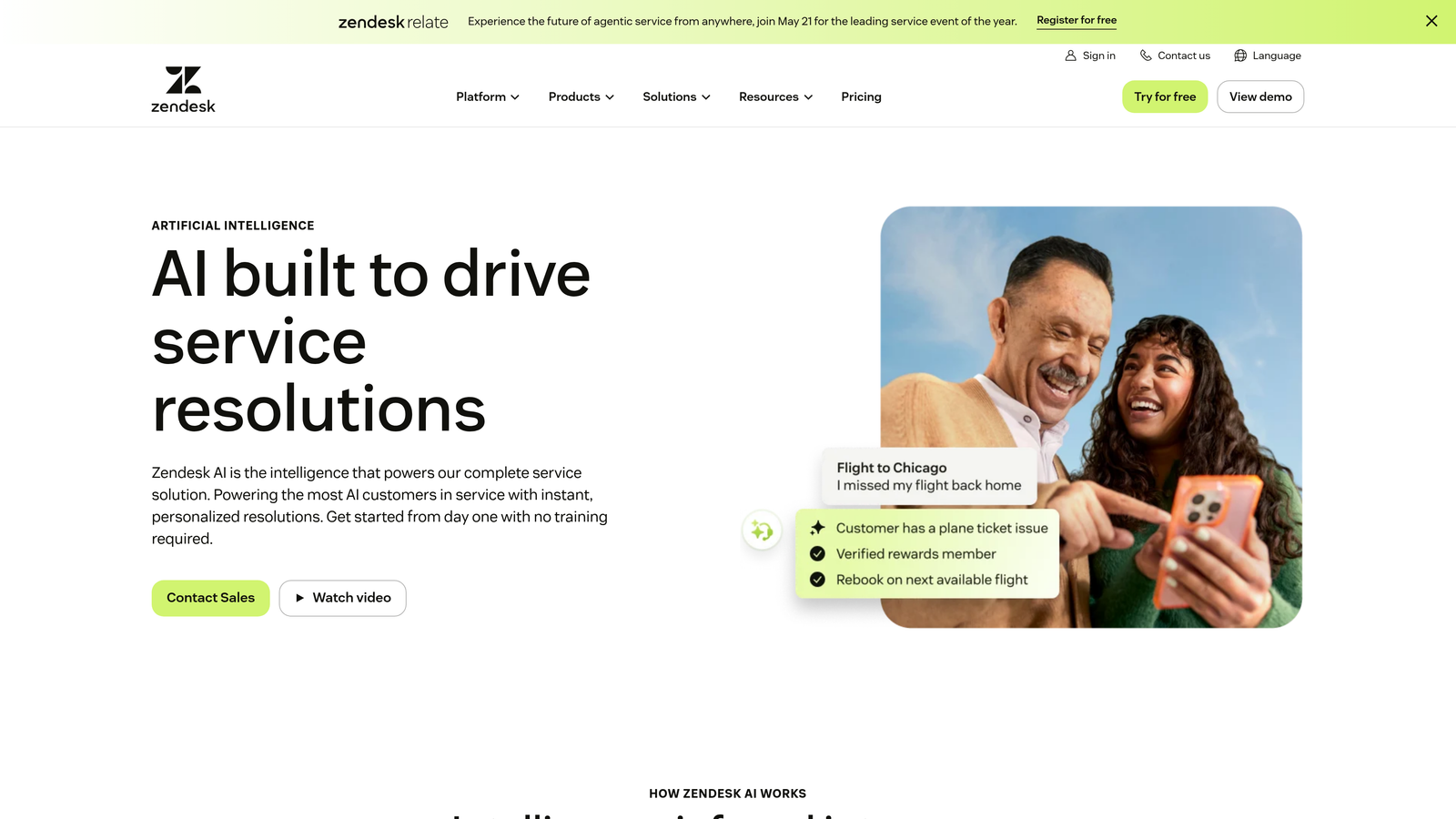
Zendesk AI is the enterprise-grade AI layer built into the Zendesk Suite, offering intelligent ticket routing, agent assistance, and automated responses across every major channel.
Where This Tool Shines
Zendesk's primary advantage is breadth. The platform covers more channels, more integrations, and more enterprise compliance requirements than almost any competitor. Its AI has been trained on a massive dataset of customer service interactions, which gives it strong baseline performance across common support scenarios.
The agent copilot functionality is genuinely useful for teams that aren't ready for full automation. It surfaces suggested responses and next-best actions without removing human judgment from the equation, making it a practical middle ground for teams transitioning to AI-assisted workflows.
Key Features
Intelligent Triage and Routing: AI-powered ticket classification and routing that reduces manual sorting and improves first-assignment accuracy.
Agent Copilot: Provides agents with suggested responses, next-best actions, and relevant knowledge base content in real time.
Omnichannel Coverage: Unified support across email, chat, voice, social, and messaging channels from a single platform.
Marketplace Integrations: Access to over 1,500 apps and integrations through the Zendesk marketplace.
Interaction-Trained AI: Model trained on billions of customer service data points for strong out-of-the-box accuracy.
Best For
Enterprise organizations with complex, multi-channel support operations and existing Zendesk investments. The platform's depth rewards teams with the resources to configure and maintain it properly. Smaller teams may find the cost-to-value ratio less favorable.
Pricing
Suite plans start around $55 per agent per month with AI included; the Advanced AI add-on carries additional cost. Enterprise pricing requires direct engagement.
4. Freshdesk Freddy AI
Best for: Budget-conscious teams wanting AI-assisted support with a free starting tier.
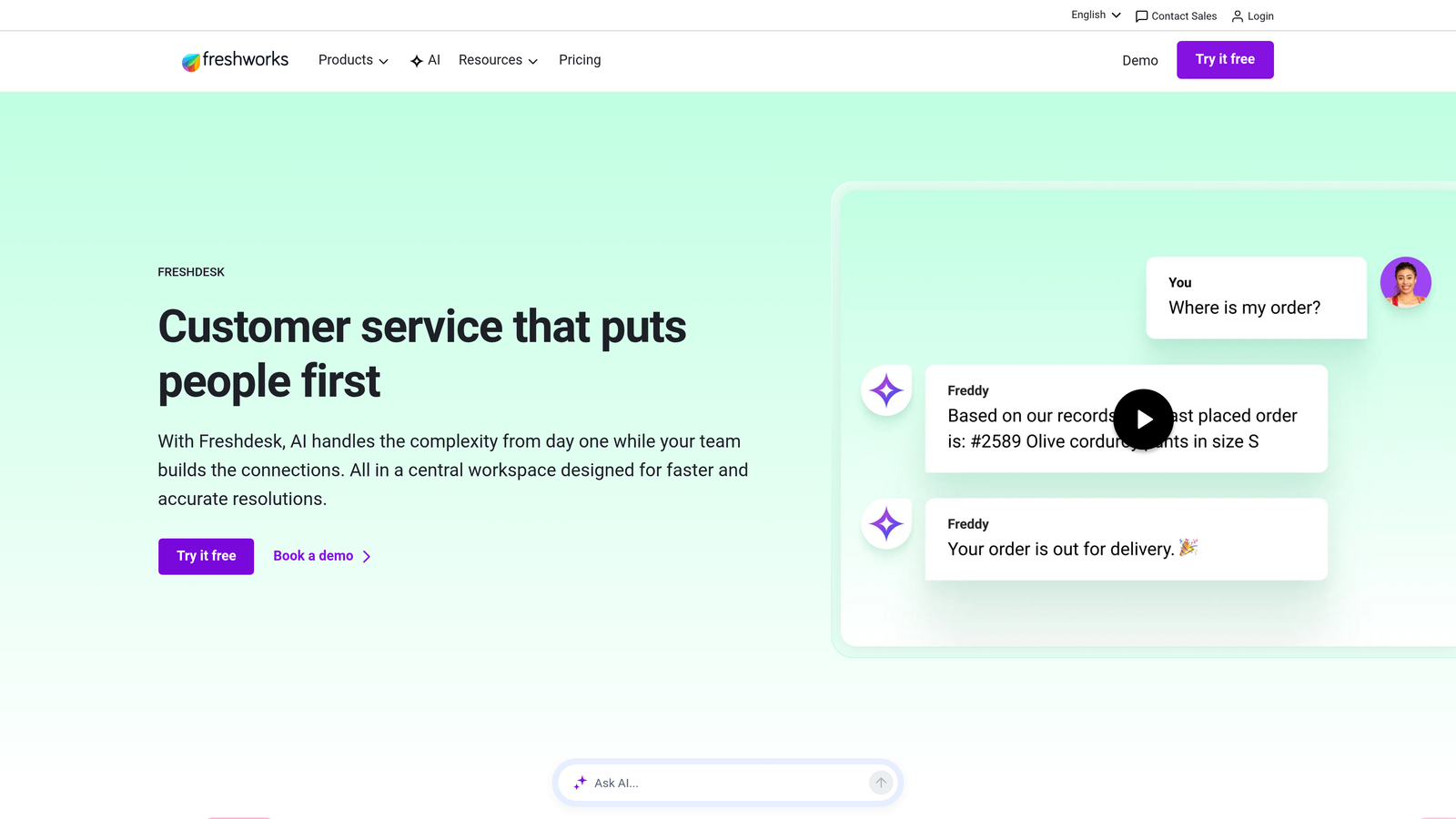
Freshdesk Freddy AI is Freshworks' AI assistant for Freshdesk, offering chatbot automation, agent assist, and AI-powered insights within a platform known for accessible pricing and a genuine free tier.
Where This Tool Shines
Freshdesk's strongest card is accessibility. The free tier supports up to 10 agents, making it one of the few platforms where a small team can actually evaluate AI-assisted support without a procurement process. Freddy AI's agent assist features are practical and well-integrated into the core inbox experience.
For teams already using other Freshworks products like Freshsales or Freshservice, the unified suite approach reduces integration complexity and data fragmentation across the customer lifecycle.
Key Features
Freddy AI Chatbot: Handles automated self-service conversations, deflecting routine queries before they reach the agent queue.
Agent Assist: Surfaces response suggestions and canned replies to speed up agent handling time.
Free Plan: Supports up to 10 agents with core helpdesk functionality at no cost.
Freshworks Suite Integration: Connects natively with Freshsales CRM, Freshservice ITSM, and Freshmarketer for a unified customer view.
Multichannel Support: Covers email, phone, chat, and social channels from a single inbox.
Best For
Small to mid-sized teams prioritizing cost efficiency, particularly those already in the Freshworks ecosystem. Freddy AI's more advanced capabilities are gated behind higher pricing tiers, so teams expecting sophisticated autonomous resolution should evaluate those tier requirements carefully before committing.
Pricing
Free tier available for up to 10 agents; paid plans from $15 per agent per month. Freddy AI features are available on higher tiers.
5. Ada
Best for: Enterprise teams needing highly customizable, multilingual AI agents across global markets.
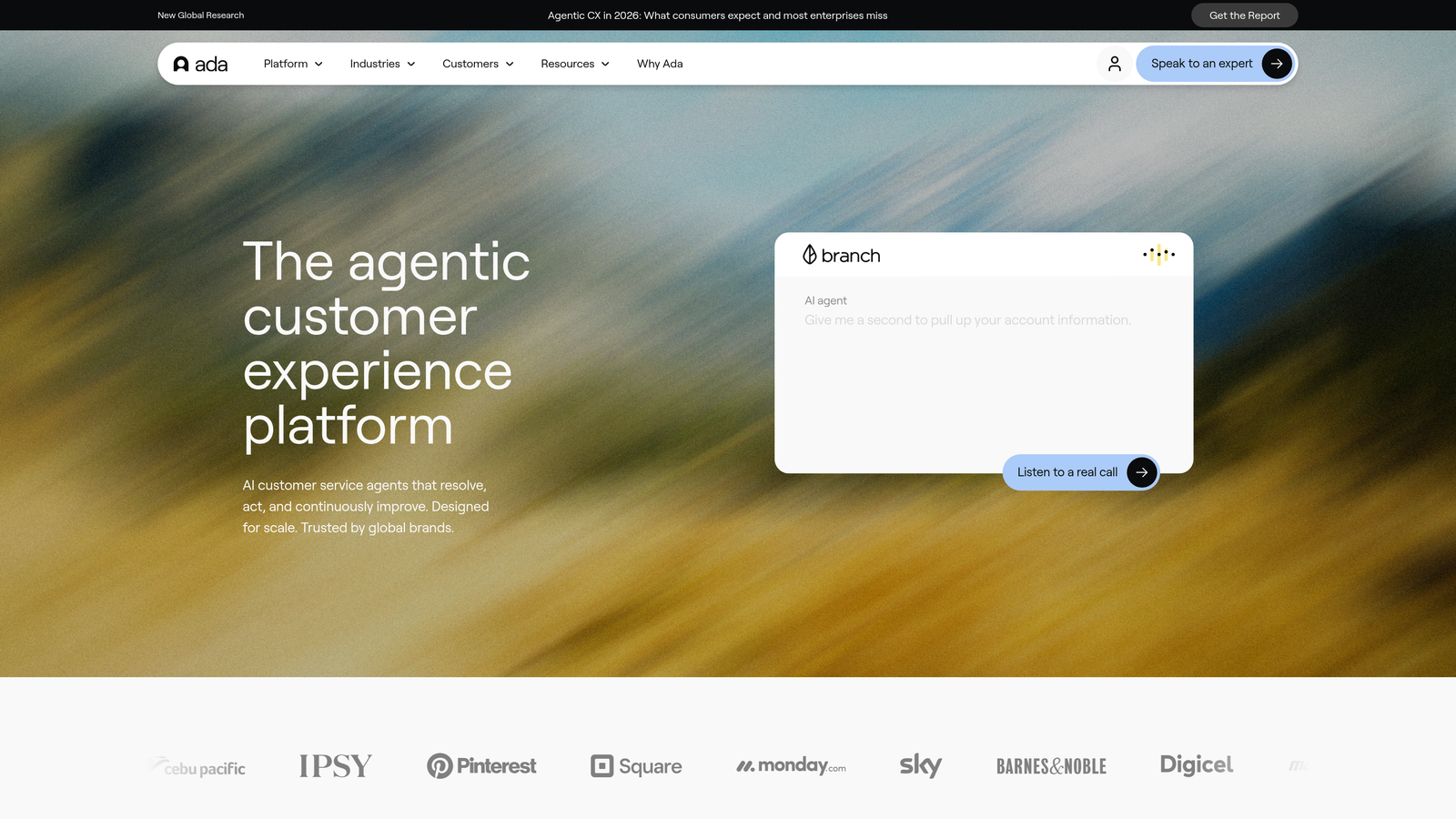
Ada is an enterprise AI customer service automation platform focused on building customizable, multilingual AI agents that operate across web, mobile, social, and messaging channels.
Where This Tool Shines
Ada's no-code builder genuinely lowers the barrier to building sophisticated conversational flows. Non-technical teams can construct complex multi-step interactions without engineering involvement, which matters significantly for organizations where IT bandwidth is constrained.
The multilingual capability across 50+ languages is a meaningful differentiator for companies operating across multiple regions. Building and maintaining separate localized support workflows is a real operational burden, and Ada's approach reduces that overhead substantially.
Key Features
No-Code AI Agent Builder: Drag-and-drop workflow builder enables non-technical teams to create and modify AI agent behavior without engineering support.
Multilingual Support: Operates across 50+ languages, enabling consistent support experiences for global customer bases.
Omnichannel Deployment: Deploys across web, mobile, social, SMS, and email from a single configuration.
CRM Integrations: Native integrations with Zendesk, Salesforce, and major CRM platforms for data continuity.
Enterprise Security and Compliance: Built-in controls for enterprise security requirements, data governance, and compliance frameworks.
Best For
Large enterprises with global customer bases, complex compliance requirements, and teams that need to build and iterate on AI agent workflows without heavy technical involvement. Custom pricing makes it less accessible for smaller organizations.
Pricing
Custom enterprise pricing; contact Ada directly for a quote. Not designed for self-serve or small team adoption.
6. Tidio
Best for: Small businesses and e-commerce teams wanting combined live chat and AI in a single affordable widget.
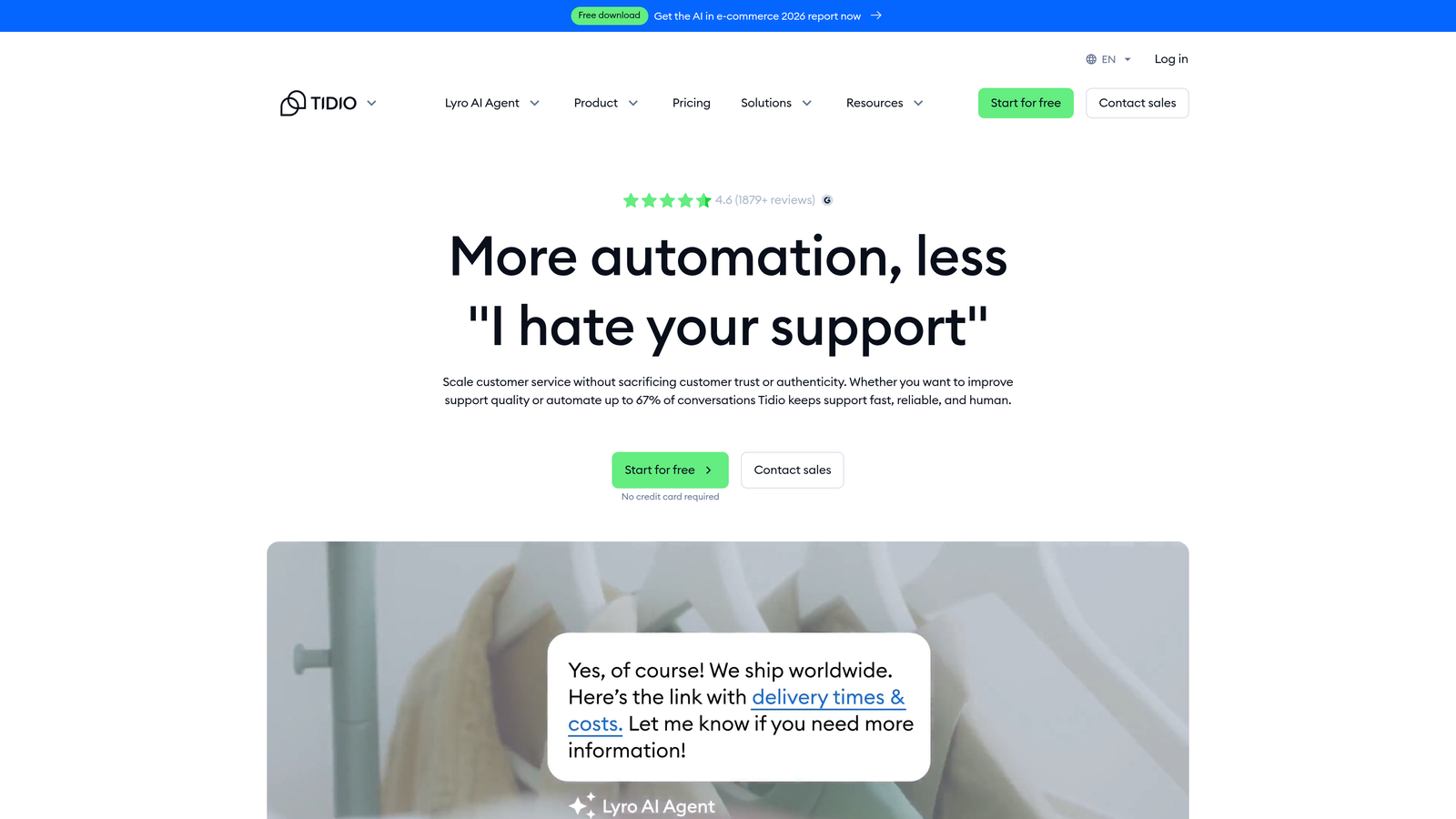
Tidio is an AI-powered live chat and chatbot platform designed primarily for small businesses and e-commerce, featuring the Lyro AI conversational agent for automated customer interactions.
Where This Tool Shines
Tidio's value proposition is simplicity and speed. Installation takes minutes, the visual chatbot builder requires no technical background, and the combined live chat and AI widget means teams don't need to manage separate tools for human and automated interactions.
The native integrations with Shopify, WooCommerce, and WordPress make it a natural fit for e-commerce teams. Lyro AI handles common purchase, shipping, and return queries well, reducing the volume of repetitive questions that small support teams handle daily.
Key Features
Lyro AI Chatbot: Conversational AI agent that handles automated customer interactions with natural language understanding.
Visual Chatbot Builder: Template-based builder with drag-and-drop interface for non-technical setup.
E-Commerce Integrations: Native connections to Shopify, WooCommerce, and WordPress for seamless store integration.
Unified Live Chat and AI: Single widget handles both automated and human conversations without switching tools.
Free Plan: Basic chatbot functionality available at no cost for teams getting started.
Best For
Small businesses and e-commerce operators with straightforward support needs and limited budgets. Not designed for complex B2B support workflows or enterprise-scale deployments where deeper integrations and advanced AI capabilities are required.
Pricing
Free plan available; paid plans from $29 per month. Lyro AI add-on from $39 per month, billed separately.
7. Forethought
Best for: Teams wanting to add generative AI intelligence on top of existing Zendesk, Salesforce, or ServiceNow deployments.
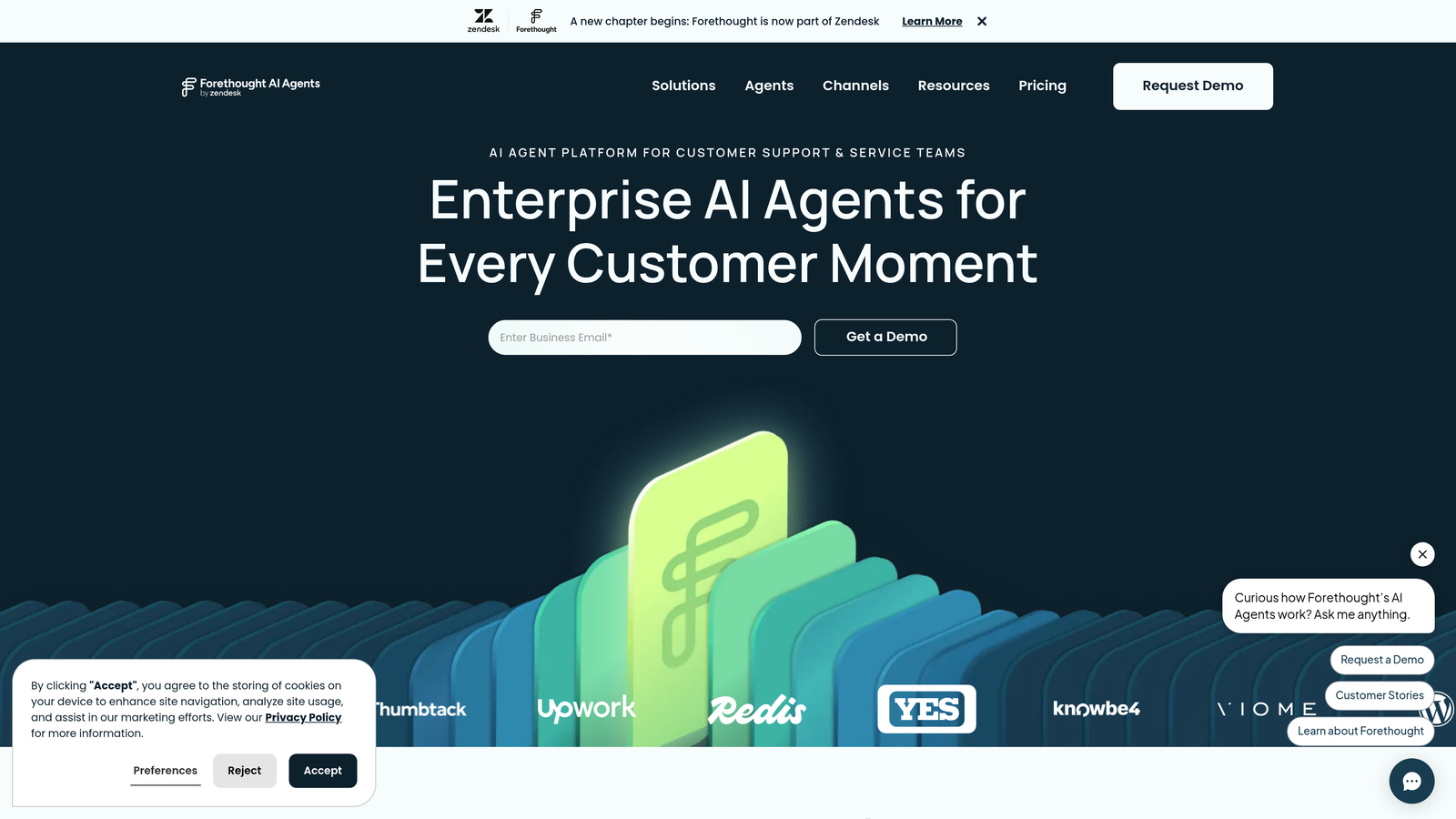
Forethought is an AI platform that layers on top of existing helpdesks to provide intelligent triage, automated resolution, and agent assist powered by generative AI trained on your own data.
Where This Tool Shines
Forethought's positioning as a layer rather than a replacement is its core strategic advantage. For organizations with significant investment in Zendesk, Salesforce Service Cloud, or ServiceNow, ripping and replacing infrastructure is rarely viable. Forethought enhances those platforms rather than competing with them.
SupportGPT, its generative AI engine, trains on your specific data rather than generic support content, which typically produces more accurate and contextually appropriate responses than models trained on broad datasets alone.
Key Features
SupportGPT: Generative AI response engine trained on your proprietary support data, knowledge base, and conversation history.
Intelligent Triage: Routes tickets by intent, sentiment, and urgency rather than simple keyword matching.
Helpdesk Layer Architecture: Works on top of Zendesk, Salesforce Service Cloud, and ServiceNow without replacing existing infrastructure.
Autoflows: Multi-step automated ticket resolution for common, predictable support scenarios.
Analytics Dashboard: Tracks deflection rates, CSAT scores, and resolution metrics with actionable reporting.
Best For
Mid-market and enterprise teams with existing helpdesk investments they want to enhance rather than replace. Strong fit for organizations where the primary goal is improving resolution rates and triage accuracy without a platform migration.
Pricing
Custom pricing based on conversation volume; contact Forethought directly for a quote. No self-serve pricing published.
8. Kustomer
Best for: Teams wanting CRM-native customer service with a unified customer timeline across every channel.
Kustomer is a CRM-native customer service platform that unifies every customer interaction into a single timeline, with AI capabilities for automated responses, classification, and agent assistance.
Where This Tool Shines
Kustomer's differentiator is its data model. Rather than treating each support ticket as an isolated event, it builds a continuous customer timeline that shows every interaction across every channel in chronological order. For agents handling complex, multi-touch customer relationships, this context is genuinely valuable.
The CRM-native architecture means customer data isn't siloed in a separate system. Support agents can see purchase history, previous interactions, and account status without switching tools, which reduces handle time and improves the quality of responses.
Key Features
Unified Customer Timeline: Every interaction across all channels displayed in a single, chronological view per customer.
AI Classification and Routing: Automated ticket classification, priority routing, and suggested responses powered by AI.
CRM-Native Architecture: Built-in customer data management eliminates the need for a separate CRM integration.
Omnichannel Inbox: Handles email, chat, social, SMS, and voice from a unified agent interface.
Workflow Automation: Business rules engine for automating repetitive processes and routing logic.
Best For
Customer-focused teams where relationship context matters as much as ticket resolution speed. Strong fit for B2C companies with high-value, repeat customers. The enterprise pricing point makes it less accessible for early-stage teams.
Pricing
Enterprise plans starting around $89 per user per month. Pricing reflects the platform's positioning as a premium, full-featured CRM and support solution.
9. Help Scout
Best for: Small, collaborative teams wanting a clean, human-centered inbox with emerging AI assistance features.
Help Scout is a human-centered support platform built around a shared inbox and knowledge base, with emerging AI features for draft generation, conversation summaries, and smart suggestions.
Where This Tool Shines
Help Scout earns consistent praise for its clean, intuitive interface and the speed at which small teams can get productive. There's no configuration maze to navigate, no complex routing logic to build before you can start answering tickets. That simplicity is genuinely valuable for teams that want to focus on customer relationships rather than platform management.
The AI draft and summary features are well-integrated without feeling forced. They assist agents rather than attempting full autonomy, which aligns with Help Scout's philosophy of keeping humans central to the support experience.
Key Features
AI Drafts: Generates reply suggestions based on knowledge base content and conversation context to speed up agent response time.
AI Conversation Summaries: Automatically summarizes long conversations so agents can get up to speed quickly without reading entire threads.
Shared Inbox: Clean, collaborative inbox designed for small teams with visibility and assignment features built in.
Docs Knowledge Base: Integrated knowledge base with Beacon widget for in-product self-service.
Transparent Per-User Pricing: Clear, published pricing with no enterprise quote requirements for standard plans.
Best For
Small to mid-sized teams that prioritize simplicity, clean UX, and transparent pricing over advanced AI autonomy. Not the right fit for teams needing full ticket automation, deep business stack integrations, or enterprise-scale AI capabilities.
Pricing
Standard plan at $22 per user per month; Plus plan at $44 per user per month. Pricing is published and straightforward with no hidden tiers.
How to Pick the Right AI Support Platform for Your Team
After reviewing nine platforms, the most important question isn't "which tool has the most features?" It's "what kind of AI support operation are you building, and how far are you from that today?"
If you're an enterprise team with deep Zendesk or Salesforce investment, Forethought or Zendesk AI's native capabilities are logical starting points. They enhance what you have rather than requiring a migration. If you're a small e-commerce team needing fast setup and low cost, Tidio or Help Scout will get you productive quickly without overwhelming your team.
For B2B SaaS teams building an AI-first support operation from the ground up, the calculus is different. You want a platform whose AI architecture is the foundation, not a retrofit. You want integrations that connect support to engineering, sales, and billing. And you want business intelligence that goes beyond ticket deflection rates to surface churn signals, product friction, and revenue impact.
A few standouts worth highlighting:
Best for AI-first architecture: Halo AI, with page-aware context, continuous learning, and business intelligence built into the core platform.
Best for existing Intercom users: Intercom Fin, with native integration and per-resolution pricing that aligns cost with outcomes.
Best for enterprise omnichannel scale: Zendesk AI, with the broadest channel coverage and integration marketplace.
Best for budget-conscious teams: Freshdesk Freddy AI or Help Scout, both offering transparent pricing and accessible starting tiers.
Your support team shouldn't scale linearly with your customer base. Let AI agents handle routine tickets, guide users through your product, and surface business intelligence while your team focuses on complex issues that need a human touch. See Halo in action and discover how continuous learning transforms every interaction into smarter, faster support.