9 Best AI Customer Support Software Tools Compared for 2026
This ai customer support software comparison evaluates nine leading platforms across AI autonomy, integration depth, analytics, and pricing to help B2B teams reduce ticket resolution times and support costs without scaling headcount. Whether you're replacing a legacy helpdesk or augmenting existing tools like Zendesk or Intercom, this guide matches each solution to specific team needs and operational requirements.
 Grant CooperFounder13 min read
B2B teams are under real pressure right now: resolve tickets faster, reduce support costs, and scale without proportionally growing headcount. AI customer support software has matured enough to genuinely help with all three, but the market has become crowded fast. Some tools are AI layers bolted onto legacy helpdesks. Others are purpose-built, AI-first platforms that learn continuously and integrate across your entire business stack.
This comparison cuts through the noise. We evaluated nine leading tools across key criteria: AI autonomy, integration depth, contextual awareness, analytics quality, and pricing transparency. Whether you're migrating away from a manual helpdesk, augmenting an existing Zendesk or Intercom setup, or building a support operation from scratch, this guide will help you match the right tool to your team's actual needs. For deeper background on making this shift, see our guide to customer support AI benefits.
1. Halo AI
Best for: B2B SaaS teams that want an AI-first support platform with business intelligence built in.
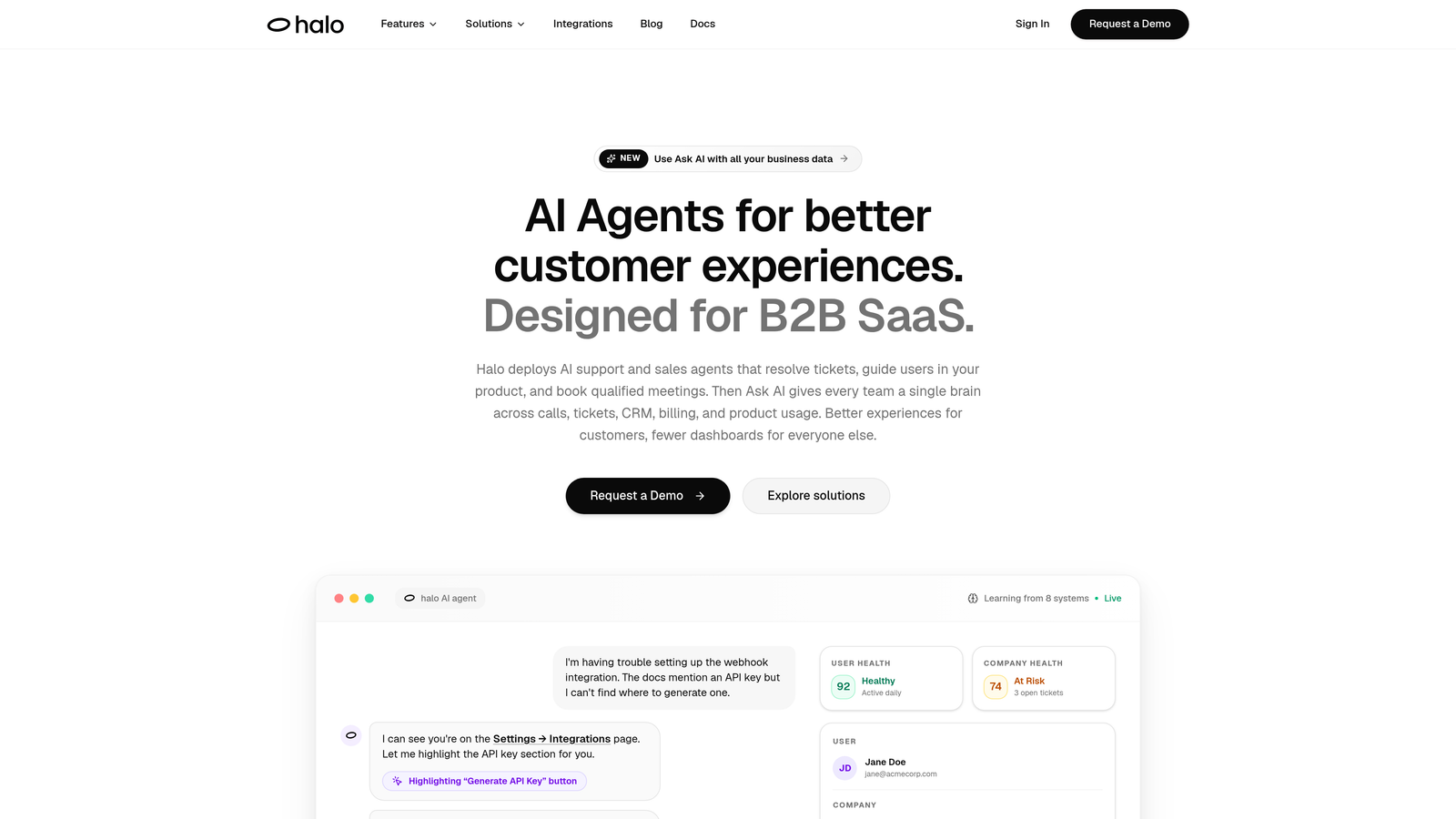
Halo AI is an AI-first customer support platform built specifically for B2B SaaS teams who need more than ticket deflection.
Where This Tool Shines
Halo isn't an AI layer dropped onto an existing helpdesk. It's built from the ground up around autonomous agents that learn from every resolved interaction, meaning the system gets measurably smarter over time without requiring manual retraining.
What genuinely sets Halo apart is its page-aware context. The AI sees exactly what the user sees in your product, enabling it to provide visual UI guidance rather than generic text responses. Combined with a smart inbox that surfaces customer health signals, revenue anomalies, and churn indicators, Halo turns your support operation into a source of real business intelligence, not just a cost center.
Key Features
Page-Aware Chat Widget: The AI understands which page a user is on and can guide them visually through your product interface, not just point them to documentation.
Autonomous Ticket Resolution: Agents resolve tickets independently and continuously learn from each interaction to handle similar issues more effectively over time.
Auto Bug Ticket Creation: When users report technical issues, Halo automatically creates and routes bug tickets to Linear or connected project management tools, closing the loop between support and engineering.
Smart Inbox with Business Intelligence: The inbox surfaces customer health signals, revenue anomalies, and churn indicators, giving support and success teams visibility they'd otherwise miss.
Live Agent Handoff: When issues require human judgment, Halo hands off to live agents with full context preserved, so customers never have to repeat themselves.
Deep Integrations: Connects natively with Linear, Slack, HubSpot, Intercom, Stripe, Zoom, PandaDoc, and Fathom.
Best For
B2B SaaS companies building or scaling a support operation that needs to do more than deflect tickets. Especially valuable for product-led growth teams where support, engineering, and customer success need to share context and move quickly.
Pricing
Visit haloagents.ai for current pricing plans. Pricing is not published here to ensure you see the most accurate and up-to-date information directly from the source.
2. Intercom
Best for: Teams wanting a mature, all-in-one messaging platform with a capable AI agent built in.
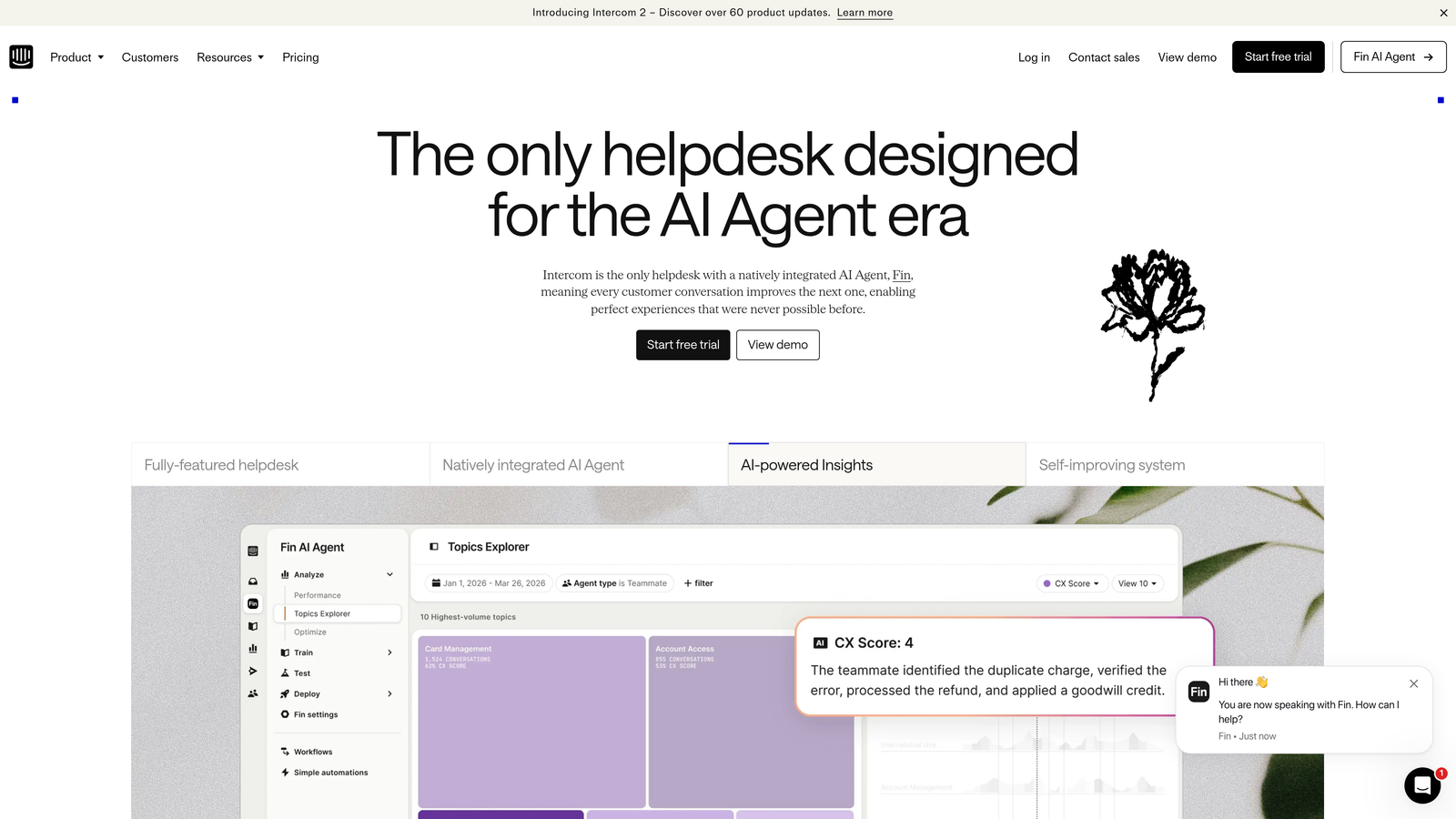
Intercom is a well-established customer messaging platform with Fin, its LLM-powered AI agent, integrated into a robust omnichannel inbox.
Where This Tool Shines
Intercom has spent years building out its platform, and it shows. The combination of Fin AI, a polished shared inbox, and one of the largest app marketplaces in the category makes it a genuinely capable all-in-one solution for teams that want to consolidate their messaging, support, and onboarding tooling in one place.
Fin handles autonomous query resolution across common support topics, and the surrounding platform offers strong customer onboarding and success tooling that goes beyond pure ticket management. For teams that have already built workflows around Intercom, the AI layer integrates naturally without requiring a rip-and-replace migration.
Key Features
Fin AI Agent: Handles common queries autonomously using large language models, with customizable escalation rules when it can't resolve an issue.
Omnichannel Inbox: Manages conversations across email, live chat, and social channels from a single unified workspace.
Extensive App Marketplace: Hundreds of integrations available, covering CRM, analytics, e-commerce, and more.
Customer Onboarding Tooling: Product tours, checklists, and in-app messaging make it useful beyond reactive support.
Customizable Workflows: Automation rules and routing logic can be configured without engineering involvement.
Best For
Teams that want a proven, all-in-one platform with strong brand recognition and an established integration ecosystem. Particularly well-suited for SaaS companies that use Intercom for both support and customer success communications.
Pricing
Tiered pricing that can scale significantly at higher volumes. Verify current plans and Fin AI pricing directly at intercom.com.
3. Zendesk AI
Best for: Enterprise teams that need AI triage and agent assist on top of deep ticketing infrastructure.
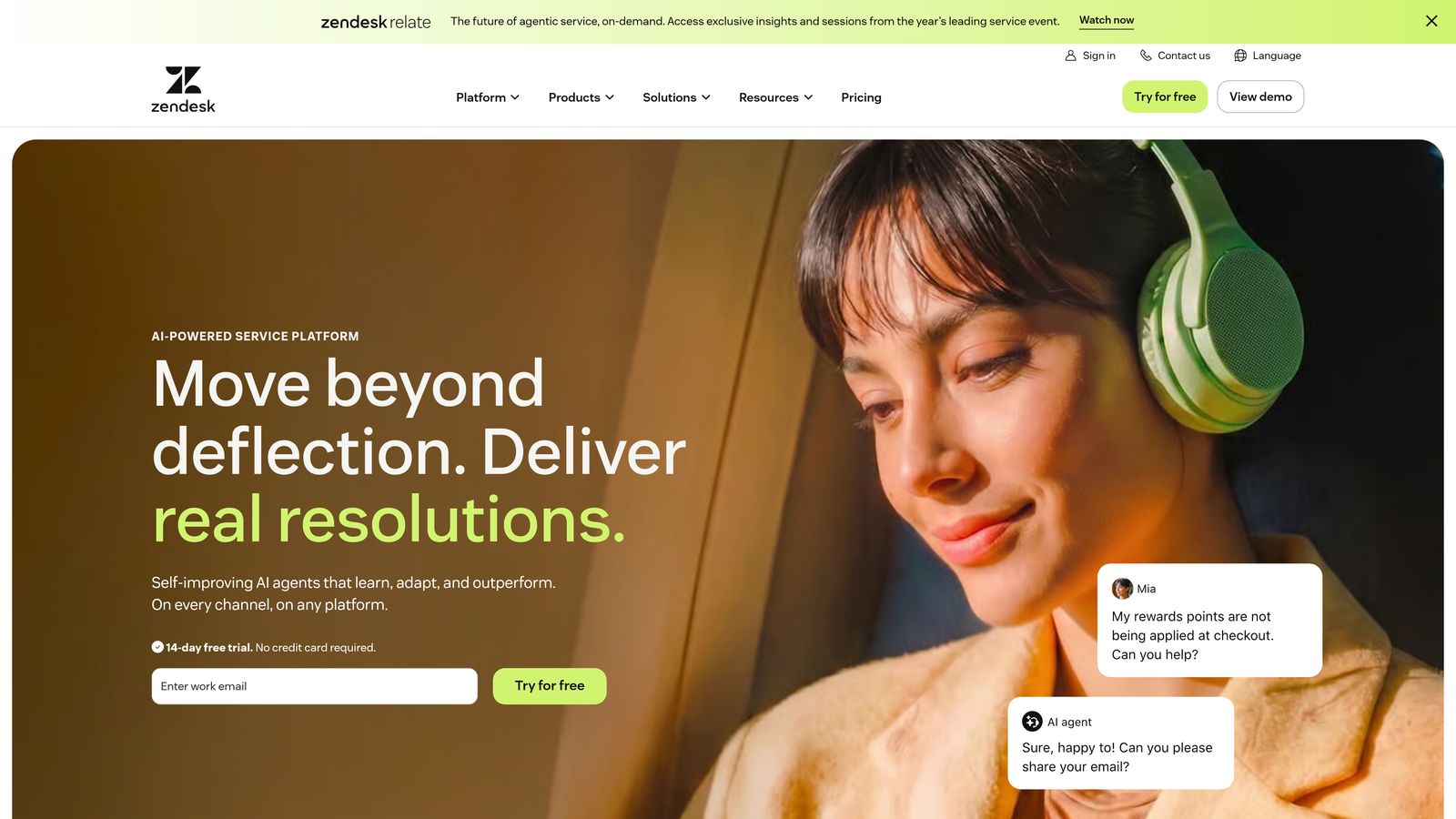
Zendesk is the industry-standard enterprise helpdesk, now with AI triage, intent detection, agent copilot, and automated routing built into its established ticketing infrastructure.
Where This Tool Shines
Zendesk's strength has always been its enterprise-grade ticketing infrastructure, and its AI capabilities are a meaningful addition to that foundation. Intelligent triage, automated routing, and an agent copilot that surfaces relevant knowledge base articles can meaningfully reduce handle time for high-volume support teams.
For organizations already invested in Zendesk, adopting its AI features is the path of least resistance. There's no migration required, compliance certifications are already in place, and the SLA management and reporting infrastructure your team relies on stays intact.
Key Features
Intelligent Triage: Automatically classifies and routes incoming tickets based on intent, sentiment, and priority signals.
Agent Copilot: Surfaces relevant knowledge base content and suggested macros to agents during live conversations.
Intent Detection and Sentiment Analysis: Adds context to every ticket so agents can prioritize appropriately.
Enterprise SLA Management: Robust reporting and SLA tracking built for large, complex support organizations.
Security and Compliance: Strong certifications and data governance features that enterprise procurement teams expect.
Best For
Large enterprises with established Zendesk deployments that want to layer AI capabilities onto existing workflows without platform migration. Also a strong choice for regulated industries where compliance certifications are non-negotiable.
Pricing
Tiered plans with AI features available at higher tiers. Verify current pricing and AI feature availability at zendesk.com.
4. Freshdesk Freddy AI
Best for: SMBs and growing teams that want AI-assisted support at competitive pricing within the Freshworks ecosystem.
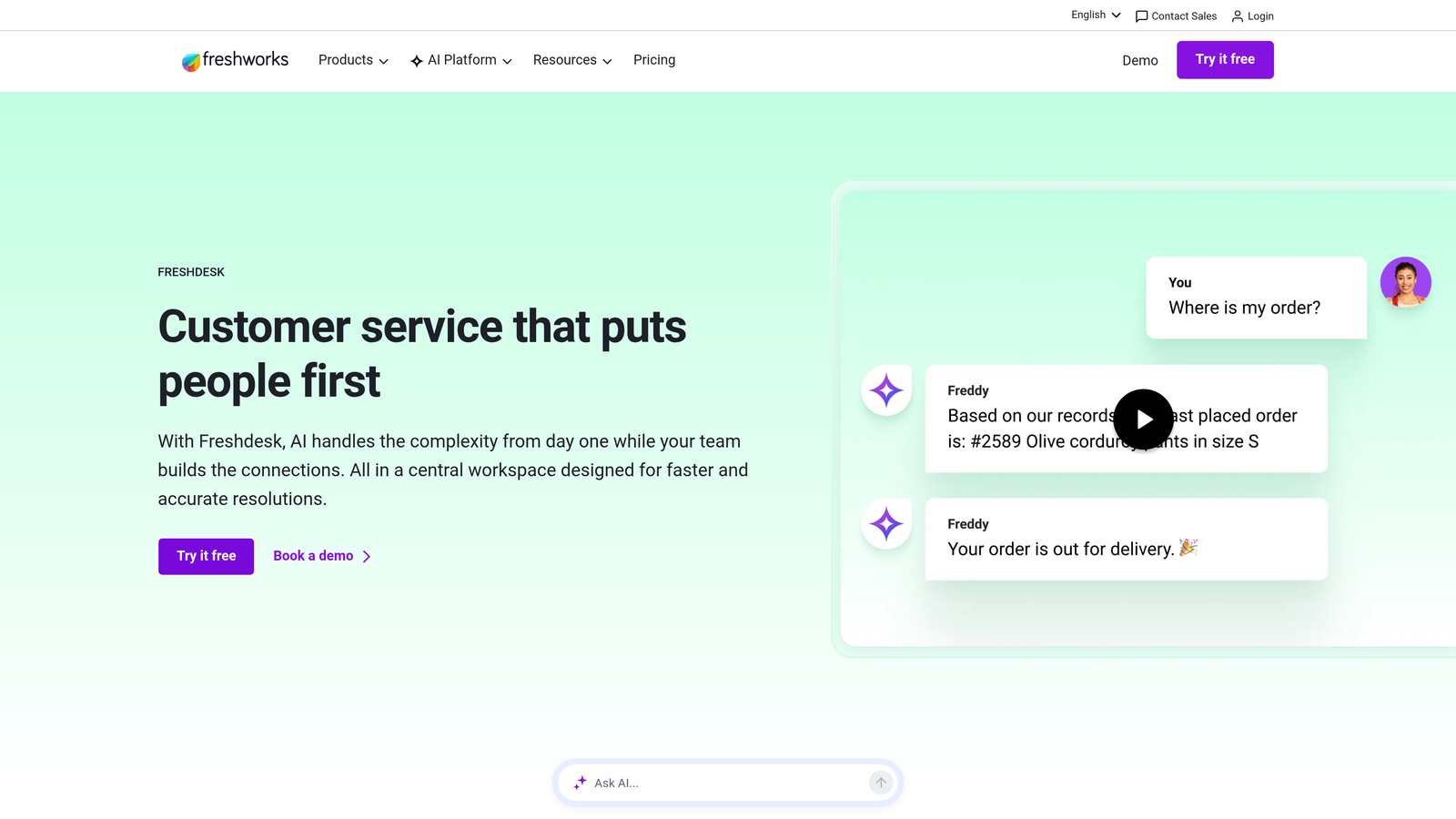
Freshdesk brings AI to its helpdesk suite through Freddy, covering self-service deflection, agent assist, and analytics in a package priced for teams that can't justify enterprise-tier costs.
Where This Tool Shines
Freddy AI is structured into three distinct layers: self-service deflection before tickets are created, in-conversation agent assistance, and post-interaction analytics. This modular approach means teams can adopt the capabilities that matter most without paying for features they won't use.
Freshdesk also benefits from sitting inside the broader Freshworks ecosystem. Teams using Freshsales for CRM or Freshservice for IT support get natural data sharing across those platforms, which reduces the integration work that typically falls on engineering teams.
Key Features
Freddy Self Service: Deflects common queries before they reach agents through AI-powered self-service flows.
Freddy Copilot: Assists agents during live conversations with suggested responses and relevant knowledge content.
Freddy Insights: Analyzes support data to surface trends, anomalies, and performance insights for team leads.
Freshworks Ecosystem Integration: Native data sharing with Freshsales, Freshservice, and other Freshworks products.
Competitive SMB Pricing: Positioned as a more accessible alternative to enterprise-tier platforms like Zendesk.
Best For
SMBs and mid-market teams that are already in the Freshworks ecosystem, or those looking for a cost-effective entry point into AI-assisted support without committing to enterprise-level contracts.
Pricing
Tiered plans with a free tier available for small teams. Verify current Freddy AI feature availability and pricing at freshworks.com.
5. Tidio
Best for: E-commerce and small business teams that need live chat with AI fallback and fast time-to-value.
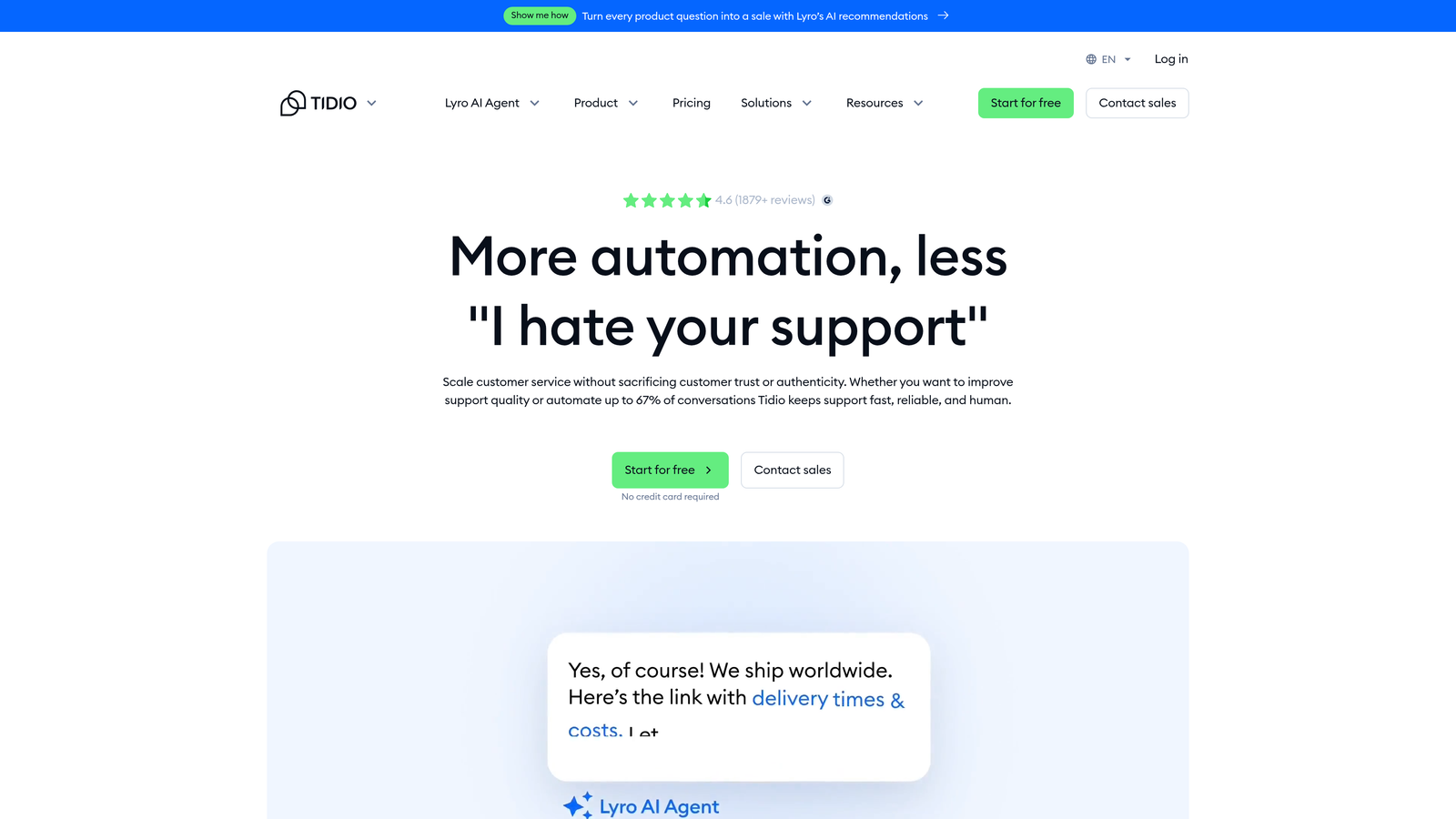
Tidio is a fast-to-deploy AI chat platform with its Lyro AI chatbot, built for teams that need to be live quickly without a complex implementation project.
Where This Tool Shines
Tidio's biggest advantage is speed. Teams can typically have it live within hours, not weeks, which makes it particularly appealing for small businesses and e-commerce operators who need immediate coverage without dedicated technical resources.
Lyro AI is trained on your own content, so responses stay relevant to your specific products and policies rather than relying on generic knowledge. The live chat fallback ensures no conversation gets dropped when Lyro reaches its limits, which is a practical safeguard for teams without 24/7 human coverage.
Key Features
Lyro AI Chatbot: Trained on your own content to handle customer queries with relevant, brand-specific responses.
Shopify and WooCommerce Integrations: Native e-commerce platform integrations that pull in order and product data automatically.
Live Chat Fallback: Seamlessly hands conversations to human agents when AI reaches its resolution limits.
Fast Onboarding: Designed to be operational within hours, not days, with minimal technical setup required.
Free Tier: Accessible entry point for small teams testing AI chat before committing to a paid plan.
Best For
Small e-commerce businesses, DTC brands, and early-stage companies that need live chat with AI assistance quickly and don't have the budget or technical resources for enterprise-grade implementations.
Pricing
Free tier available; paid plans are accessible for small teams. Verify current pricing and plan limits at tidio.com.
6. Drift (Salesloft)
Best for: B2B teams where support and sales pipeline overlap frequently and need a unified conversation platform.
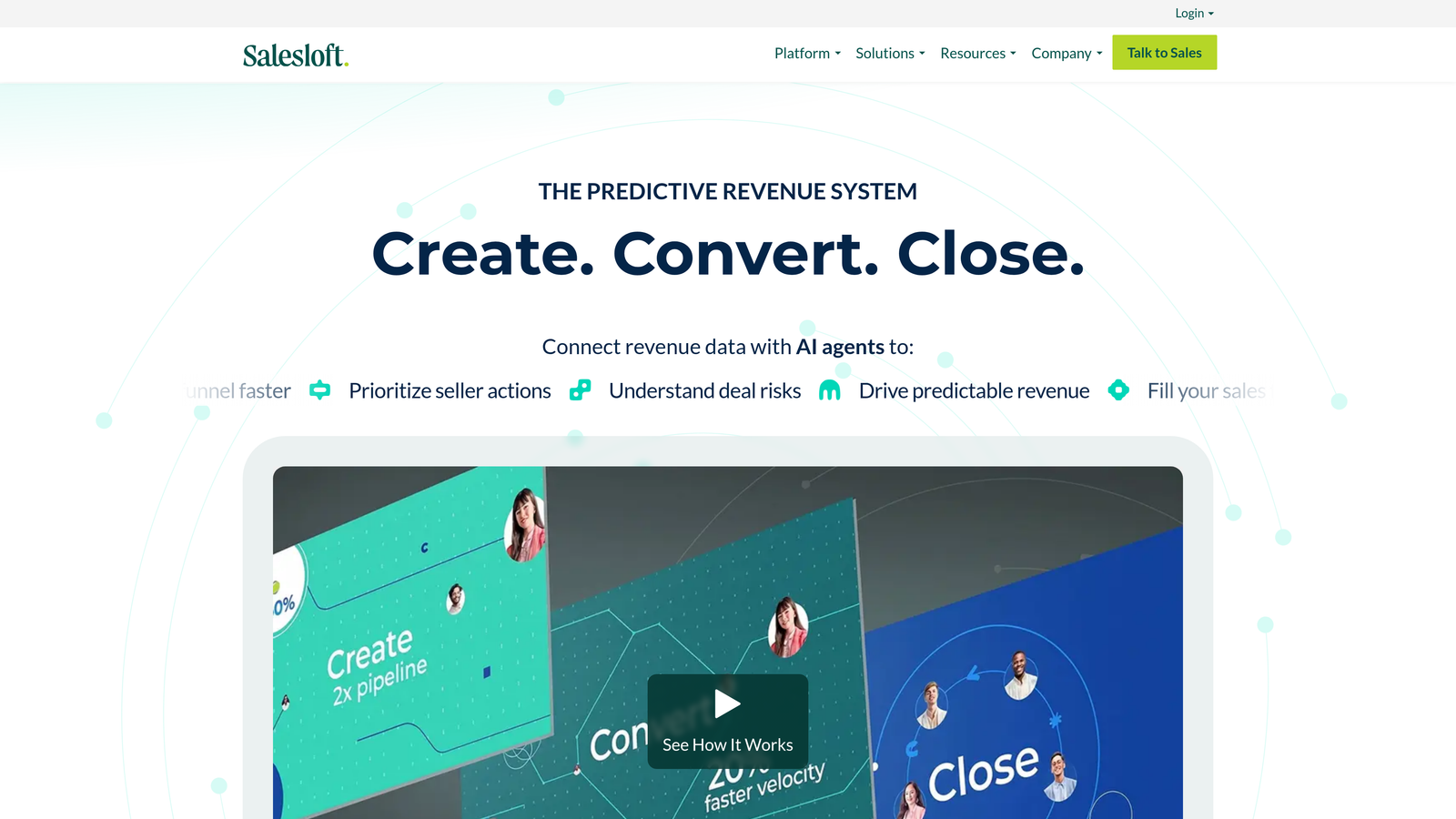
Drift, now part of Salesloft, is a revenue conversation platform that blends AI-powered support with sales qualification in a single interface.
Where This Tool Shines
Drift's positioning has always been at the intersection of support and sales, and its integration into Salesloft has deepened that focus. For B2B teams where inbound conversations can be both support requests and sales opportunities, having a single AI-powered bot handle both qualification and resolution flows reduces handoff friction considerably.
The account-based marketing integrations are a genuine differentiator. Drift can recognize target accounts visiting your site and route them appropriately, which is a capability that pure support platforms typically don't offer. For revenue-focused teams, this means support conversations become part of the pipeline intelligence picture.
Key Features
AI Chatbot for Support and Sales: Handles both support resolution and sales qualification flows within a single conversation interface.
ABM Integrations: Recognizes target accounts and routes conversations based on account-based marketing logic.
Conversational Landing Pages and Meeting Booking: Turns high-intent conversations directly into booked meetings without human intervention.
Revenue Intelligence Reporting: Surfaces insights across both support and sales conversations for leadership visibility.
Salesloft Platform Integration: Connects natively with Salesloft's broader sales engagement tools for teams already using that ecosystem.
Best For
B2B companies with active inbound sales motion where support and pipeline conversations frequently overlap. Particularly strong for teams already using Salesloft for sales engagement who want to unify their conversation strategy.
Pricing
Enterprise-oriented pricing. Verify current plans and package structures at salesloft.com.
7. Kustomer
Best for: High-volume consumer brands that need a CRM-native support platform with omnichannel AI automation.
Kustomer is a CRM-native customer support platform, now owned by Meta, that gives agents a unified customer timeline and uses AI to automate workflows across complex, omnichannel environments.
Where This Tool Shines
Kustomer's core architectural decision, building support on top of a CRM rather than a ticketing system, gives it a meaningful advantage in high-volume consumer environments. Agents see a full customer timeline across every channel and interaction, which reduces the time spent reconstructing context before responding.
The AI-powered workflow automation handles repetitive routing and classification tasks that would otherwise consume significant agent time. For DTC brands and consumer apps handling large volumes across email, chat, social, SMS, and voice simultaneously, this combination of unified context and automation can meaningfully improve operational efficiency.
Key Features
Unified Customer Timeline: Every interaction across all channels is visible in a single chronological view per customer.
AI-Powered Workflow Automation: Automates routing, classification, and repetitive task handling across high-volume queues.
True Omnichannel Coverage: Manages email, live chat, social, SMS, and voice from a single platform.
CRM-Native Architecture: Support data lives alongside full customer history rather than in a separate ticketing silo.
Meta Ecosystem Connections: Integrations with Meta platforms for brands with significant social commerce presence.
Best For
DTC brands, consumer apps, and marketplace businesses handling high volumes of customer interactions across multiple channels, particularly those where customer history and context are critical to resolution quality.
Pricing
Verify current pricing and Meta ecosystem integration details at kustomer.com.
8. Help Scout
Best for: Teams that prioritize relationship-driven support and want AI to assist agents rather than replace them.
Help Scout is a deliberately human-first support platform that uses AI to make agents more effective, without pushing aggressive bot-first deflection flows.
Where This Tool Shines
Help Scout has built its identity around the belief that great customer support is fundamentally human, and its AI implementation reflects that philosophy. Rather than routing customers through bot flows before they can reach a person, Help Scout's AI works behind the scenes: drafting replies, summarizing long threads, and surfacing suggested responses so agents can move faster without sacrificing quality.
The shared inbox UX is consistently praised for being clean and intuitive, which matters more than it might seem. When agents actually enjoy using a tool, adoption stays high and quality stays consistent. For customer-experience-focused teams where relationship quality is a competitive differentiator, Help Scout's approach is a genuine fit.
Key Features
AI Drafting and Suggested Replies: Generates draft responses for agents to review and send, reducing composition time without removing human judgment.
Thread Summarization: Automatically summarizes long conversation threads so agents can get up to speed instantly.
Beacon Widget: Provides in-product contextual help to users without requiring them to open a separate support channel.
Collaborative Shared Inbox: Clean, intuitive team inbox designed for collaboration rather than individual ticket ownership.
No Aggressive Bot Flows: Deliberately avoids forcing customers through chatbot deflection before they can access human support.
Best For
SMBs, agencies, and customer-experience-focused teams where relationship quality matters as much as resolution speed. A strong choice for teams that have had negative experiences with bot-heavy platforms and want AI that augments rather than replaces their people.
Pricing
Transparent tiered pricing that is generally accessible for SMB budgets. Verify current plans at helpscout.com.
9. Forethought
Best for: Enterprise teams that want AI triage and resolution on top of existing helpdesks without platform migration.
Forethought is an AI layer that sits on top of established helpdesks like Zendesk, Salesforce Service Cloud, and ServiceNow, adding intelligent triage, routing, and resolution without requiring organizations to abandon their existing infrastructure.
Where This Tool Shines
Forethought's value proposition is clear and specific: if you've invested heavily in an enterprise helpdesk and aren't ready to migrate, Forethought adds meaningful AI capabilities without disrupting what's already working. Its modular structure, separate products for triage, agent assist, and self-service resolution, means teams can adopt incrementally rather than all at once.
The explainability features are worth highlighting. Forethought shows agents why the AI made a particular routing decision, which builds trust and helps teams identify where the model needs improvement. For enterprise buyers who need to justify AI decisions to compliance or leadership teams, this transparency is a meaningful differentiator.
Key Features
Triage Module: AI-powered ticket routing and prioritization that classifies incoming tickets before agents touch them.
Assist Module: Agent copilot that surfaces relevant knowledge and context during live ticket resolution.
Solve Module: Autonomous self-service resolution for common queries, deflecting tickets before they enter the queue.
Explainability Features: Shows agents the reasoning behind AI routing decisions, supporting trust and continuous improvement.
Deep Helpdesk Integrations: Native integrations with Zendesk, Salesforce Service Cloud, and ServiceNow.
Best For
Enterprise organizations with significant existing investment in Zendesk, Salesforce, or ServiceNow that want to add AI capabilities without a platform migration. Particularly valuable for teams where AI decision transparency is required for compliance or internal governance reasons.
Pricing
Enterprise pricing model. Verify current plans and supported integrations at forethought.ai.
Which Tool Is Right for Your Team?
The right AI customer support tool depends less on feature lists and more on your team's actual situation: your existing stack, your volume, your budget, and whether you need AI to augment your agents or operate autonomously at scale.
Here's a quick guide by use case to help you narrow it down:
AI-first platform with business intelligence: Halo AI is the clear choice for B2B SaaS teams that want more than ticket deflection, particularly where support data should feed into customer health and revenue signals.
Enterprise helpdesk with AI triage: Zendesk AI makes the most sense for large organizations already on Zendesk that need AI capabilities without disrupting established workflows.
All-in-one messaging maturity: Intercom is a strong fit for teams that want a proven, polished platform with Fin AI, strong onboarding tooling, and a large integration marketplace.
SMB budget-friendly option: Freshdesk Freddy AI offers a capable, modular AI layer at pricing that makes sense for growing teams not yet ready for enterprise contracts.
E-commerce quick-start: Tidio gets you live fast with Shopify and WooCommerce integrations and a free tier that lets you test before committing.
Sales and support in one flow: Drift, now part of Salesloft, is the right call for B2B teams where inbound conversations are both support requests and pipeline opportunities.
CRM-native consumer brand: Kustomer suits high-volume DTC and consumer app teams where unified customer history and omnichannel coverage are non-negotiable.
Human-first relationship support: Help Scout is built for teams where relationship quality is the product, and AI should assist agents rather than replace them.
AI augmentation on your existing stack: Forethought is purpose-built for enterprise teams that want intelligent triage and resolution without migrating away from Zendesk, Salesforce, or ServiceNow.
Your support team shouldn't scale linearly with your customer base. Let AI agents handle routine tickets, guide users through your product, and surface business intelligence while your team focuses on complex issues that need a human touch. See Halo in action and discover how continuous learning transforms every interaction into smarter, faster support.