9 Best AI Customer Support Software Options by Cost in 2026
AI customer support software cost is rarely straightforward — most platforms layer base fees, per-seat charges, and AI add-ons that make honest comparisons difficult. This guide breaks down nine leading platforms with transparent pricing context to help startups and scaling B2B teams find the right tool for their budget and support volume.
 Matt PattoliFounder13 min read
When evaluating AI customer support software, cost is rarely what it appears on the pricing page. Most platforms layer base fees, per-seat charges, conversation limits, and AI add-ons in ways that make honest comparisons genuinely difficult. A tool that looks affordable at first glance can quickly become expensive once you factor in the features your team actually needs.
This guide cuts through that complexity by breaking down nine leading platforms with transparent pricing context, so you can match the right tool to your budget and support volume. Whether you're a lean startup looking for an affordable entry point or a scaling B2B team that needs enterprise-grade AI with deep integrations, there's a meaningful cost difference between platforms that look similar on the surface.
We've evaluated each tool on pricing model, what's included at each tier, and where hidden costs tend to emerge. Tools are ordered starting with our top recommendation for B2B teams, followed by strong alternatives across different budget ranges.
1. Halo AI
Best for: B2B SaaS teams needing an AI-first support platform with deep integrations and business intelligence
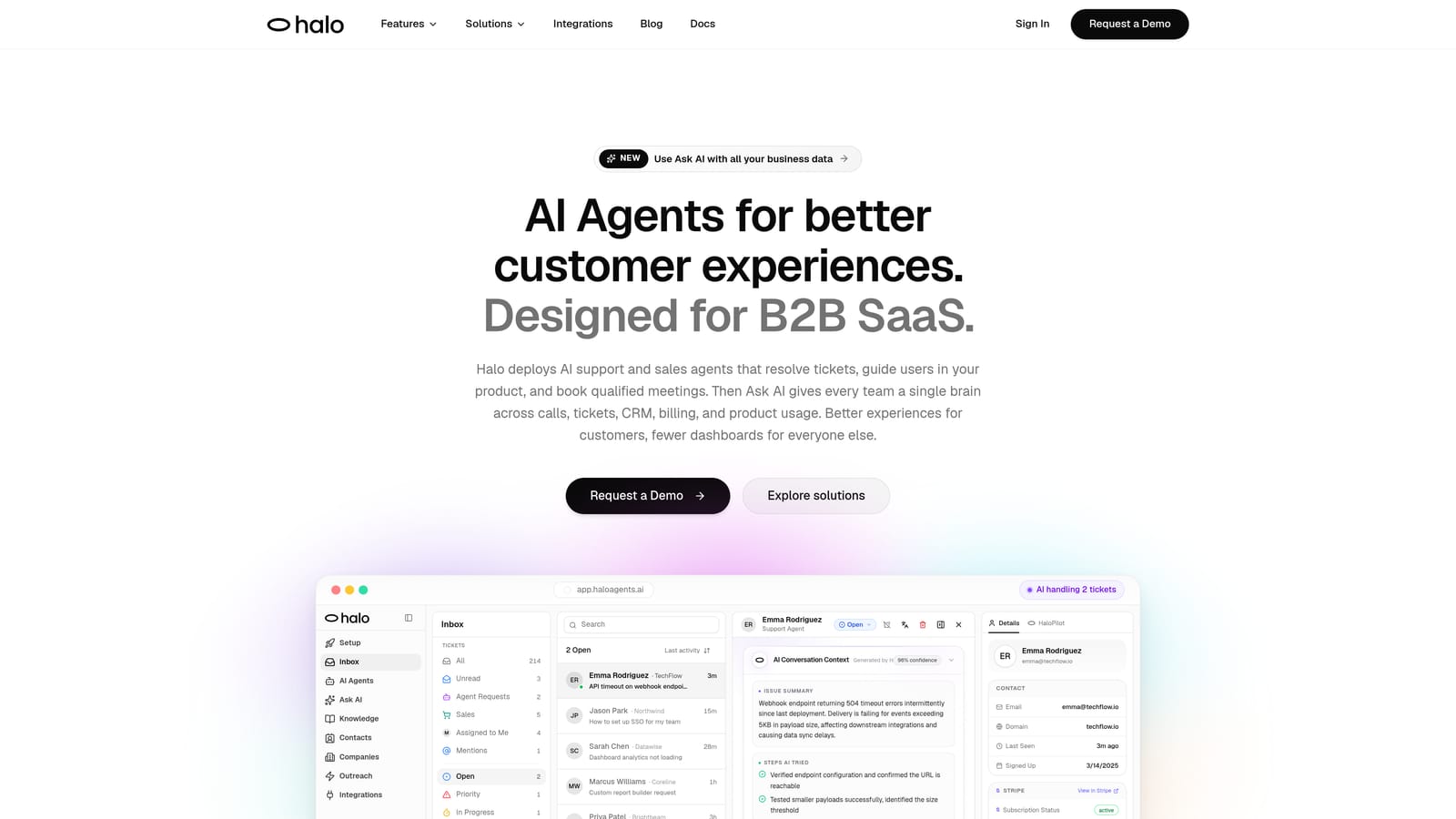
Halo AI is an AI-first customer support platform built to resolve tickets autonomously while continuously learning from every interaction.
Where This Tool Shines
Unlike most competitors that bolt AI onto an existing helpdesk, Halo is built AI-first from the ground up. That architectural difference matters: the platform doesn't just suggest replies or deflect tickets, it resolves them autonomously and gets smarter with each interaction. For B2B SaaS teams where support quality directly impacts retention, that continuous learning loop is a genuine differentiator.
What sets Halo apart from a cost perspective is what's included beyond basic ticket resolution. The smart inbox delivers business intelligence, including customer health signals, anomaly detection, and revenue intelligence, turning your support queue into a strategic data source rather than a cost center.
Key Features
Intelligent AI Agents: Resolve tickets autonomously and learn from every interaction to improve over time without manual retraining.
Page-Aware Chat Widget: Sees exactly what the user sees on screen, enabling visual UI guidance that's contextually relevant rather than generic.
Smart Inbox with BI Analytics: Surfaces customer health signals, anomaly detection, and revenue intelligence directly from support data.
Auto Bug Ticket Creation: Automatically routes bug reports to engineering via Linear integration, closing the loop between support and product teams.
Live Agent Handoff: Escalates complex issues to human agents with full context preserved, so customers never have to repeat themselves.
Deep Integration Stack: Connects to Slack, HubSpot, Intercom, Stripe, Zoom, PandaDoc, and Fathom for a unified view of the customer relationship.
Best For
B2B SaaS companies and product teams that want AI to handle the full support lifecycle, not just deflect simple queries. Particularly strong for teams that need support data to inform product decisions and customer success strategies, and those looking to replace a traditional helpdesk with a purpose-built AI platform.
Pricing
Contact Halo directly for current pricing. The platform positions as a premium AI-first alternative to traditional helpdesks, with pricing reflecting the depth of automation and business intelligence included.
2. Intercom
Best for: Teams wanting mature messaging infrastructure with autonomous AI resolution layered on top
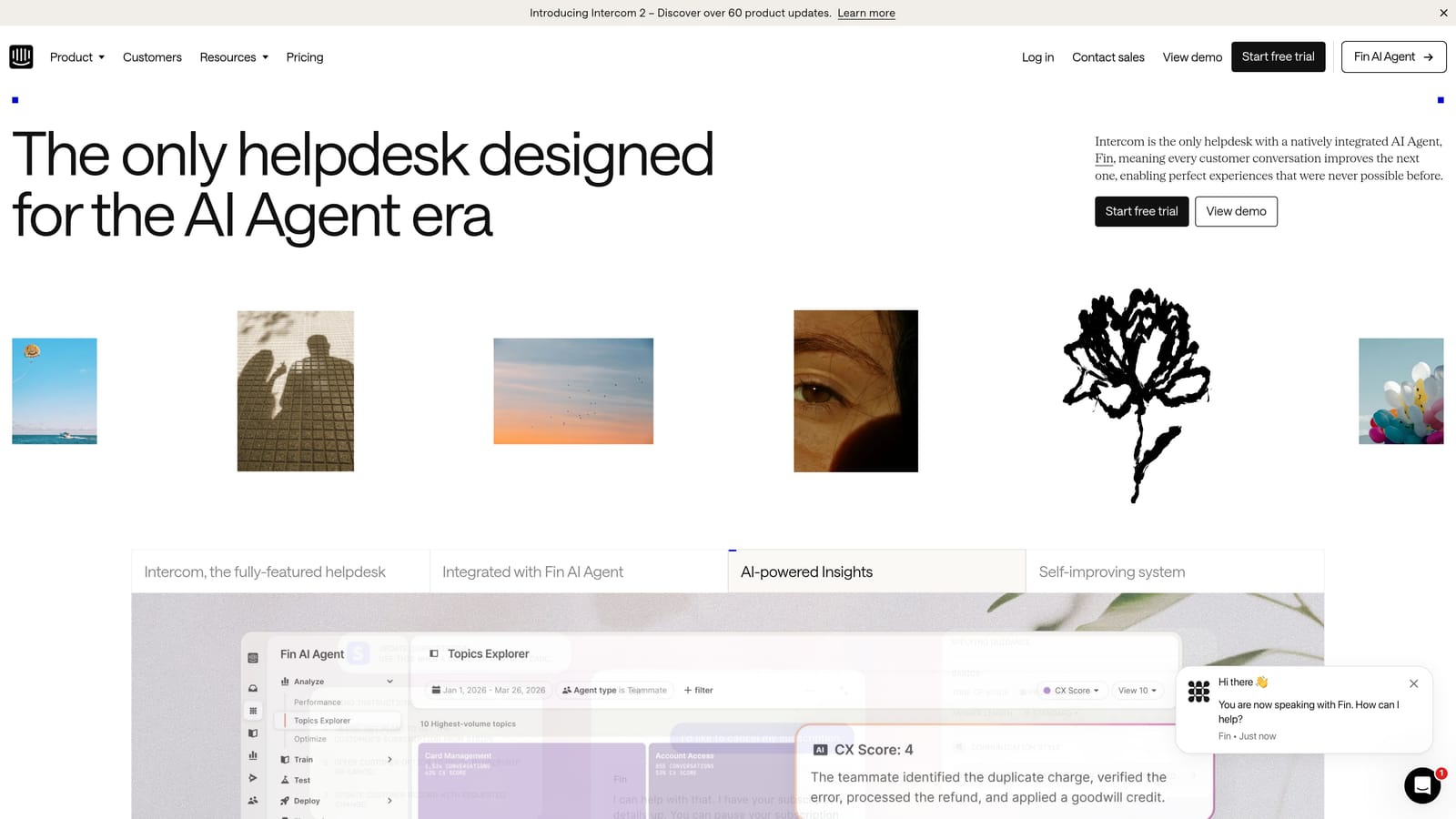
Intercom is a mature messaging and support platform with its Fin AI agent enabling autonomous ticket resolution on top of a well-established base product.
Where This Tool Shines
Intercom has been building in-app messaging and support infrastructure for years, and that foundation shows. The platform excels at in-app onboarding flows, proactive messaging, and omnichannel inbox management. Fin AI, its autonomous agent, sits on top of this infrastructure and handles resolution for questions it can confidently answer.
The tradeoff worth understanding is the pricing model. Intercom uses per-resolution pricing for Fin AI on top of the base subscription, which can align cost to value at lower volumes but becomes unpredictable as support volume scales. Teams should model their expected resolution volume carefully before committing.
Key Features
Fin AI Agent: Handles autonomous resolution with per-resolved-conversation pricing, making cost directly tied to AI performance.
Omnichannel Inbox: Manages chat, email, and social conversations in a unified workspace.
In-App Messaging and Onboarding: Strong tooling for proactive user communication and product tours.
App Marketplace: Extensive integration ecosystem with hundreds of third-party connections.
Best For
Mid-market SaaS teams that want strong in-app messaging alongside AI support, and where support volume is predictable enough to model per-resolution costs accurately. Less ideal for high-volume teams where per-resolution fees could accumulate significantly.
Pricing
Base plans typically start around $39/seat/month (Starter tier); Fin AI resolution fees are charged separately per resolved conversation. Verify current rates at intercom.com as pricing structures in this category shift frequently.
3. Zendesk AI
Best for: Enterprise teams needing robust reporting, compliance, and a proven helpdesk foundation with AI layered in
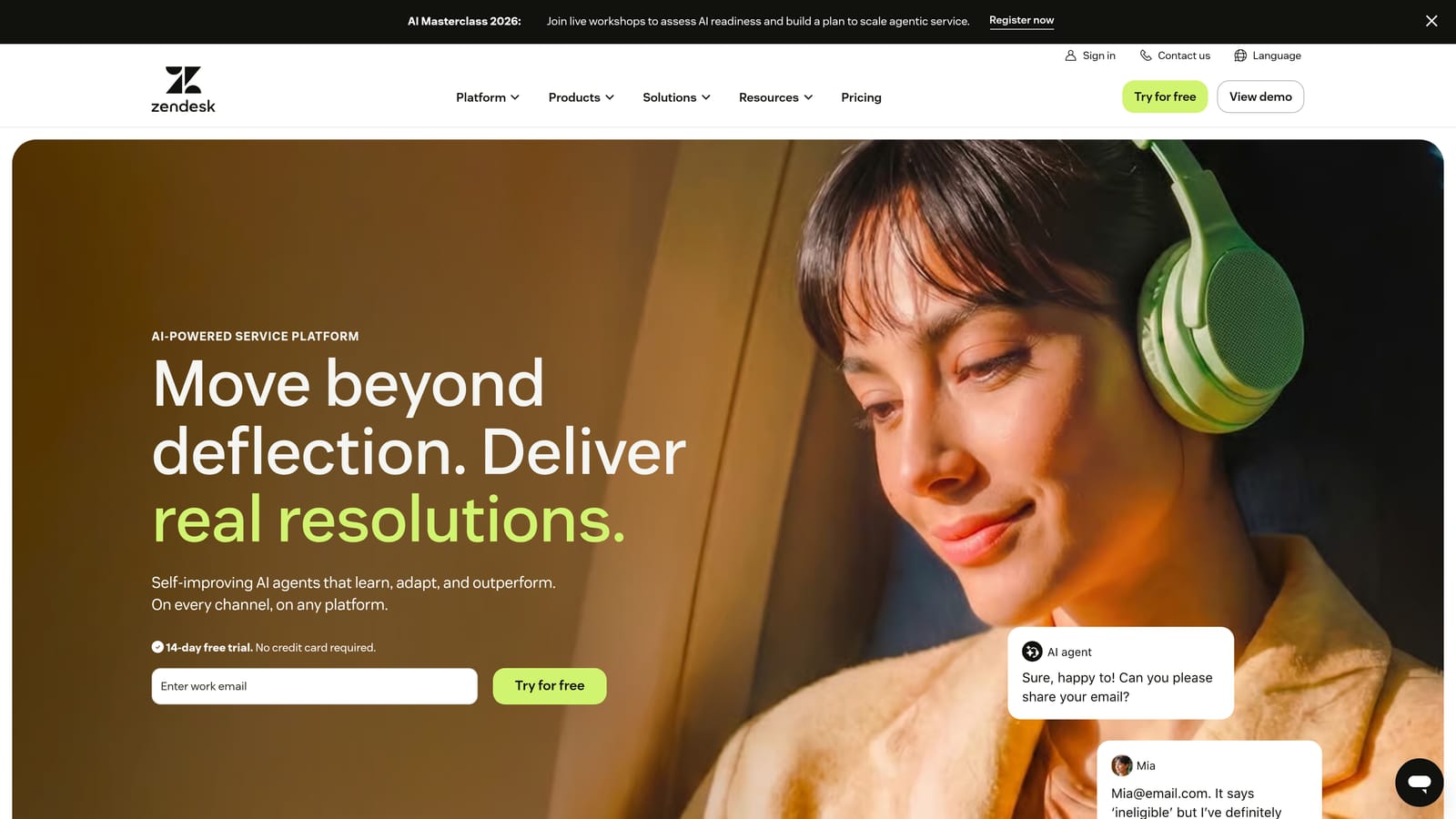
Zendesk is an enterprise helpdesk platform with AI Agents and AI-powered automation built into its Suite plans, backed by one of the largest integration ecosystems in the category.
Where This Tool Shines
Zendesk's strength is its maturity. The reporting and analytics capabilities are among the most robust available, and the integration ecosystem of over 1,000 apps means it connects to virtually any tool in your stack. For enterprise teams with complex workflows, SLA requirements, and compliance needs, that depth is genuinely valuable.
The cost complexity is worth flagging upfront. Advanced AI features, including intelligent triage and intent detection, are often available as add-ons or reserved for higher-tier plans. Teams evaluating Zendesk should map their feature requirements to specific tiers carefully, as the base price can look attractive while required features push the actual cost significantly higher.
Key Features
AI Agents: Automated deflection for common queries, formerly known as Answer Bot, with improved autonomous capabilities on higher tiers.
Advanced AI Add-On: Intelligent triage, intent detection, and sentiment analysis for more sophisticated automation.
Reporting and Analytics: One of the most comprehensive dashboards in the category, with customizable metrics and SLA tracking.
Integration Ecosystem: Over 1,000 app integrations covering virtually every business function.
Best For
Large enterprise support teams with complex workflows, strict SLA requirements, and the budget to match. Organizations already invested in the Zendesk ecosystem will find the most value. Smaller teams may find the pricing structure and complexity difficult to justify.
Pricing
Suite plans historically range from around $55 to $150+/agent/month, with Advanced AI available as an add-on or on higher tiers. Verify current plans at zendesk.com before budgeting.
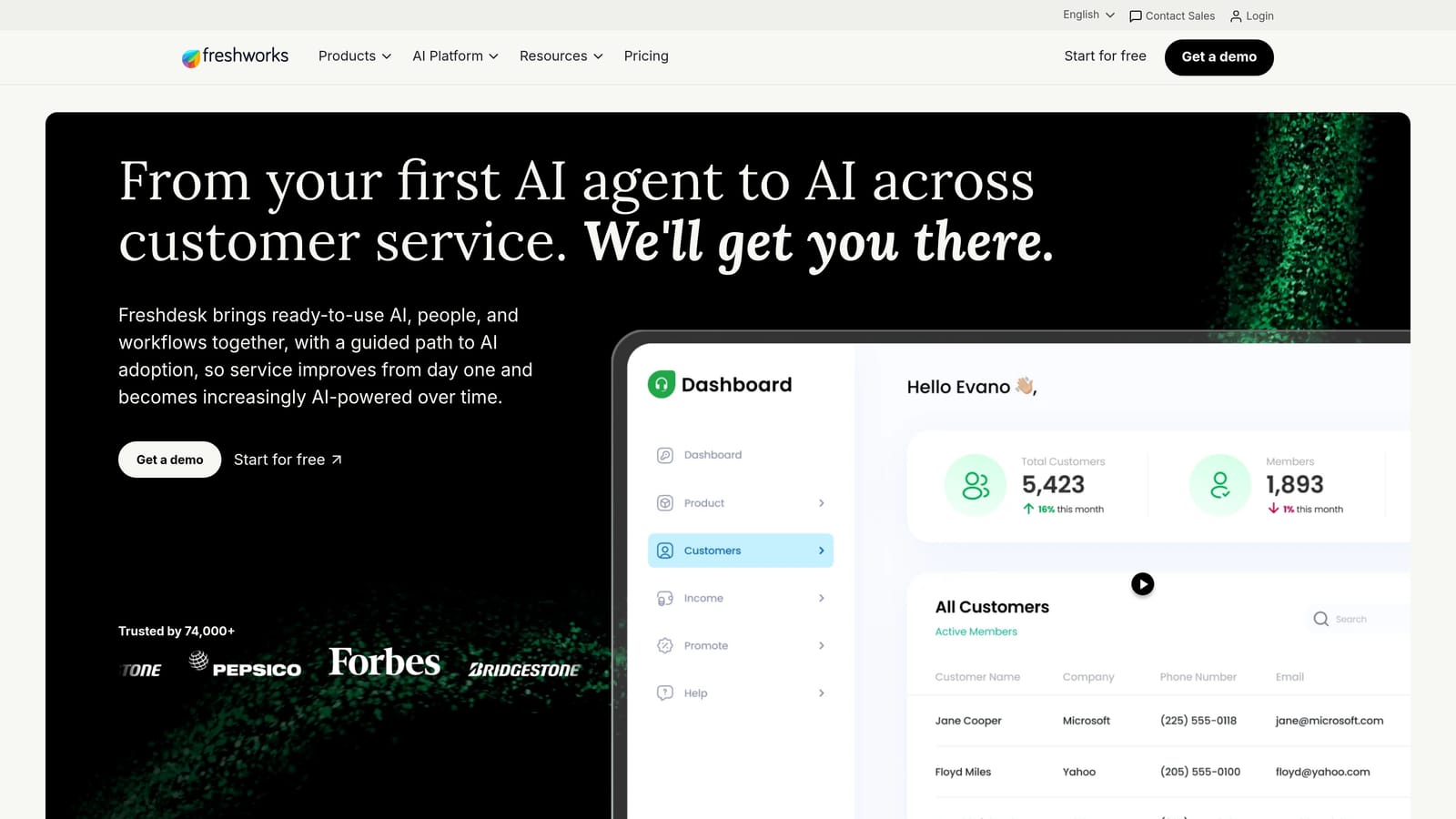
4. Freshdesk (Freddy AI)
Best for: Budget-conscious teams wanting solid helpdesk functionality with AI features that scale by tier
Freshdesk is a cost-competitive helpdesk with Freddy AI built into mid and upper tiers, frequently positioned as a more affordable alternative to Zendesk.
Where This Tool Shines
Freshdesk's pricing structure is one of its most compelling attributes. The entry point is genuinely low, and AI capabilities scale progressively through the tier structure rather than requiring a significant jump to unlock basic automation. For teams that want to grow into AI features without committing to enterprise pricing upfront, this graduated approach works well.
Freddy AI covers suggested replies, auto-triage, and self-service capabilities, with Freddy Copilot and Freddy Insights available on higher tiers for more sophisticated automation and analytics. It's a solid foundation, though teams with complex AI requirements may find the capabilities less deep than dedicated AI-first platforms.
Key Features
Freddy AI: Handles suggested replies, auto-triage, and self-service deflection, scaling in sophistication across plan tiers.
Freddy Copilot and Insights: Available on Pro and Enterprise tiers for enhanced agent assistance and analytics.
Omnichannel Support: Manages email, chat, phone, and social in a unified inbox.
Free Plan: Available for small teams with limited agents, providing a genuine no-cost entry point.
Best For
Small to mid-size teams looking for cost-effective helpdesk functionality with a clear upgrade path as AI needs grow. Also a natural fit for teams already using other Freshworks products like Freshsales or Freshservice.
Pricing
Growth plans typically start around $15/agent/month, Pro around $49/agent/month, and Enterprise around $79/agent/month, with AI features scaling by tier. Verify current plans at freshworks.com.
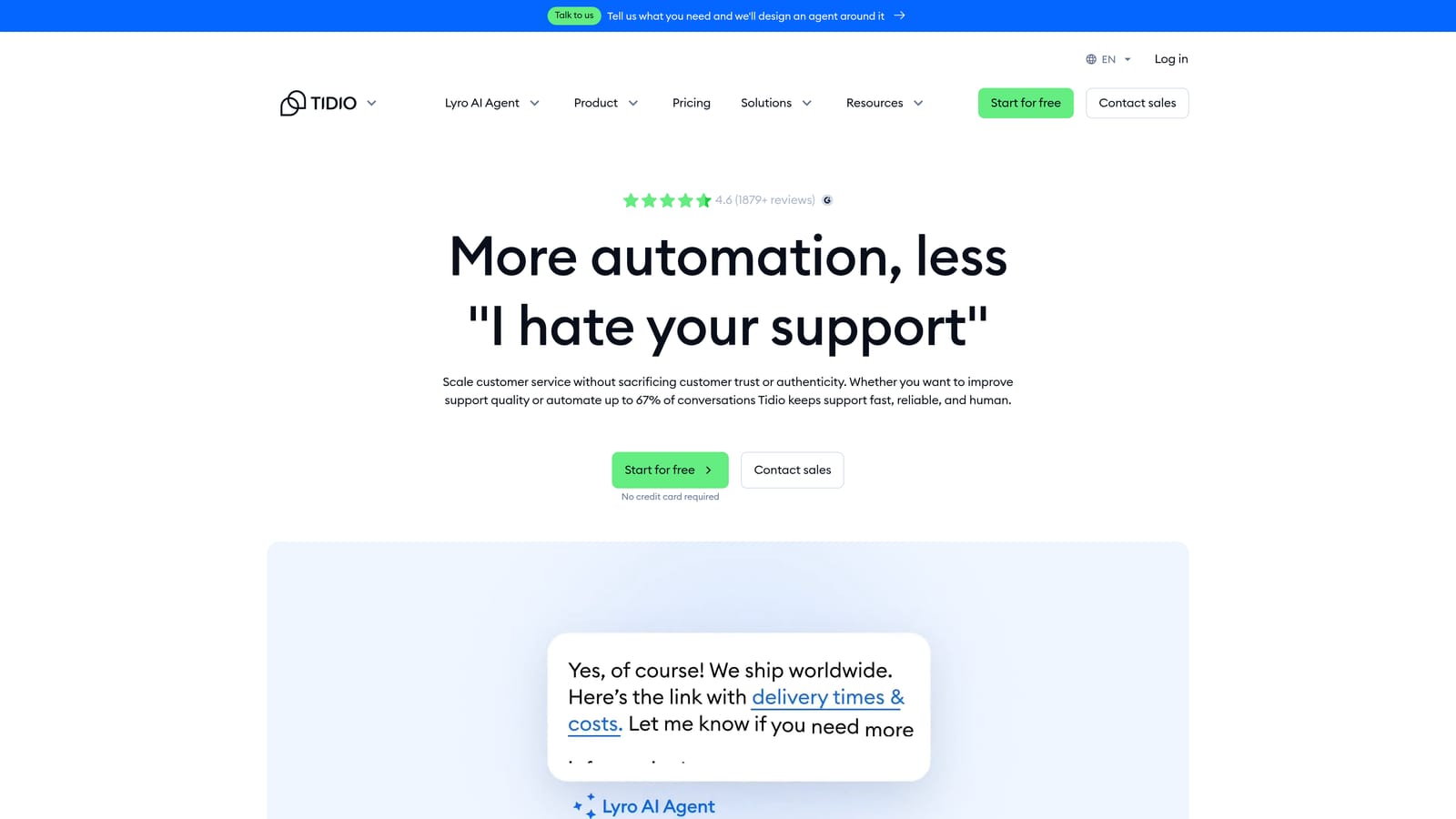
5. Tidio
Best for: Small businesses and e-commerce teams wanting affordable AI chat without enterprise complexity
Tidio is an affordable AI chat and support platform with its Lyro AI chatbot designed for small businesses and e-commerce teams that need automation without a steep learning curve.
Where This Tool Shines
Tidio's entry point is one of the most accessible in the market, including a free plan that lets small teams get started without any upfront commitment. The Lyro AI chatbot handles automated customer conversations effectively for common use cases, and the live chat and email inbox integration keeps things simple for small support teams.
The platform's e-commerce integrations with Shopify and WooCommerce make it particularly well-suited for DTC brands. That said, Tidio is built for simplicity, and teams with complex B2B support workflows or enterprise integration requirements will likely outgrow it.
Key Features
Lyro AI Chatbot: Handles automated customer conversations for common queries, reducing the volume reaching human agents.
Live Chat and Email Inbox: Unified workspace for managing customer conversations across channels.
Free Plan: Available with limited conversation volume, making it a genuine zero-cost starting point.
E-Commerce Integrations: Native connections to Shopify and WooCommerce for order and customer data context.
Best For
Small businesses, DTC e-commerce brands, and early-stage startups that need affordable AI chat without enterprise complexity. Not well-suited for B2B SaaS teams with complex support workflows or deep integration requirements.
Pricing
Free plan available; paid plans typically start around $29/month, with Lyro AI included or as an add-on depending on the plan tier. Verify current pricing at tidio.com.
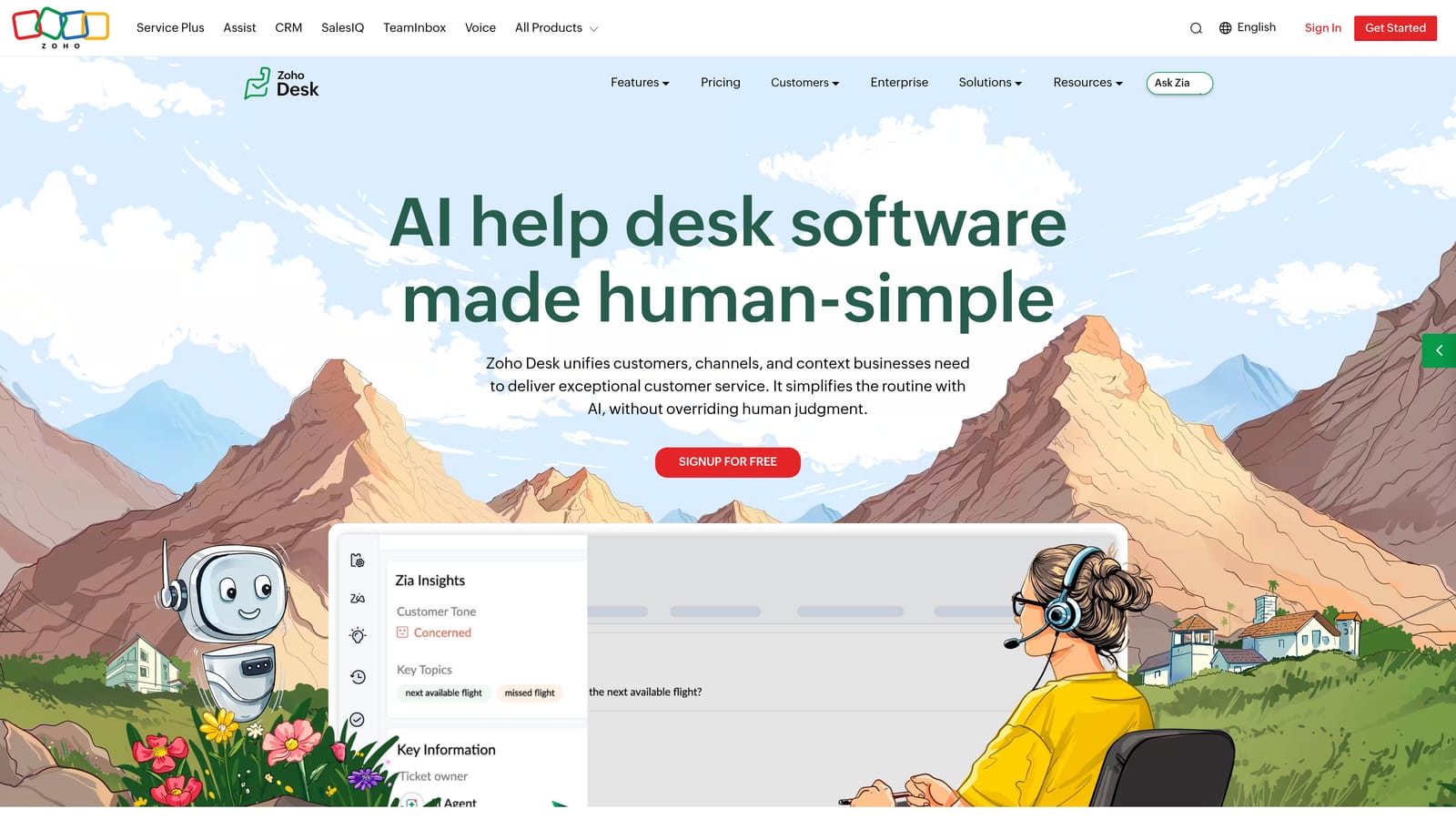
6. Zoho Desk + Zia
Best for: Teams already using Zoho CRM or other Zoho products who want tightly integrated support with AI
Zoho Desk is a full-featured helpdesk with the Zia AI assistant, priced competitively and offering exceptional value for teams embedded in the broader Zoho ecosystem.
Where This Tool Shines
If your team already uses Zoho CRM, Zoho Analytics, or other Zoho products, Desk integrates natively across the suite in ways that third-party tools simply can't replicate. The data flows between products, the pricing is unified, and the learning curve is lower for teams already familiar with the Zoho interface.
Zia AI brings sentiment analysis, tag suggestions, and anomaly alerts to the support workflow, and the overall pricing structure is among the most competitive in the category for the feature set delivered. The tradeoff is that Zoho's interface and ecosystem can feel more complex than purpose-built alternatives for teams starting fresh.
Key Features
Zia AI Assistant: Provides sentiment analysis, tag suggestions, and anomaly alerts to help agents prioritize and respond more effectively.
Multichannel Support: Handles email, chat, social, and phone in a unified workspace.
Zoho Ecosystem Integration: Deep native connections to Zoho CRM, Analytics, and Campaigns for a unified customer view.
Workflow Automation and SLA Management: Robust automation tools for routing, escalation, and compliance tracking.
Best For
Teams already using Zoho CRM or other Zoho products who want to consolidate their stack. Also a strong choice for mid-market teams seeking competitive per-seat pricing with solid AI features on Professional and Enterprise tiers.
Pricing
Standard plans typically start around $14/agent/month, Professional around $23/agent/month, and Enterprise around $40/agent/month, with Zia available on Professional and above. Verify at zoho.com.
7. Help Scout
Best for: Small to mid-size teams that value pricing transparency and don't want separate AI add-on fees
Help Scout is a simple, human-feeling support platform with AI drafting and summarization tools included in standard plans, with no separate AI surcharges.
Where This Tool Shines
Help Scout's most distinctive quality in a market full of opaque pricing is its transparency. AI Summarize and AI Assist features are included in plans without requiring an additional AI tier or add-on purchase. For teams that have been burned by unexpected charges on other platforms, that flat-rate simplicity is genuinely refreshing.
The platform prioritizes a human-feeling support experience over automation depth, which suits teams where agent quality matters as much as deflection rate. It's not trying to replace human agents with AI; it's making human agents faster and more effective.
Key Features
AI Summarize and AI Assist: Included in all plans, providing conversation summarization and AI-generated draft replies without extra fees.
Shared Inbox, Docs, and Live Chat: Core support channels unified in a single platform without add-on pricing for each channel.
Transparent Flat Per-User Pricing: No AI surcharges, no surprise add-ons, what you see on the pricing page is what you pay.
Beacon Chat Widget: In-app support widget for embedding help directly in your product.
Best For
Small to mid-size teams that want clean, straightforward support tooling with AI assistance included. Particularly well-suited for teams that prioritize agent experience and pricing predictability over deep automation or autonomous resolution.
Pricing
Standard plans typically start around $22/user/month, Plus around $44/user/month, with AI features included at both tiers. Verify current pricing at helpscout.com.
8. Kustomer
Best for: High-volume support teams that want to replace both their helpdesk and CRM with a single AI-native platform
Kustomer is a CRM-native customer support platform with AI built around full customer timelines, designed for teams that need to consolidate their support and CRM stack.
Where This Tool Shines
Kustomer's core premise is that support and CRM data shouldn't live in separate systems. By unifying the full customer timeline across all touchpoints, agents have complete context for every conversation without toggling between tools. For high-volume teams handling complex customer relationships, that unified view meaningfully improves response quality and speed.
The per-seat cost is higher than most helpdesk alternatives, but the value calculation changes when you factor in the CRM it replaces. Teams that would otherwise pay for both a helpdesk and a CRM may find the combined cost comparable or even favorable.
Key Features
Unified Customer Timeline: Aggregates every interaction across channels into a single customer view accessible to every agent.
AI-Powered Routing and Suggested Replies: Automates ticket routing and surfaces reply suggestions based on full customer context.
CRM Replacement: Eliminates the need for a separate CRM tool for support-focused teams.
Omnichannel Support: Handles high-volume D2C and B2B support across email, chat, social, and voice.
Best For
High-volume support teams, particularly in D2C or omnichannel environments, that want to consolidate helpdesk and CRM into a single platform. The higher per-seat cost makes most sense when replacing two separate tools.
Pricing
Enterprise pricing typically starts around $89/user/month with AI features included. Verify current plans at kustomer.com.
9. Drift (Salesloft)
Best for: B2B revenue teams where support conversations feed pipeline and sales qualification
Drift, now part of Salesloft, is an AI conversation platform that blends support and sales, best suited for B2B teams where inbound conversations are as much a revenue opportunity as a support need.
Where This Tool Shines
Drift occupies a distinct position in this list because it's not a pure support tool. It's designed for B2B teams where the line between support and sales is intentionally blurred. AI-powered routing and qualification help ensure that high-intent buyers reach the right person quickly, while conversational landing pages and meeting scheduling remove friction from the buying process.
For teams where support conversations regularly surface upsell opportunities or where inbound chat is a meaningful pipeline source, Drift's approach makes sense. For teams that need straightforward ticket resolution at scale, it's probably not the right fit.
Key Features
AI-Powered Chat Routing and Qualification: Routes conversations based on intent, company, and buyer signals rather than simple queue logic.
Conversational Landing Pages and Meeting Scheduling: Converts chat interactions into booked meetings directly within the conversation.
Intent-Based Routing: Directs buyers to the right sales or support resource based on behavioral signals.
ABM Integrations: Connects to 6sense, Demandbase, and Salesforce for account-based engagement across the revenue team.
Best For
B2B revenue teams where support and sales overlap significantly. Best suited for organizations where Drift's Salesloft integration creates a unified go-to-market motion. Not recommended as a primary support platform for teams focused on ticket resolution volume.
Pricing
Custom enterprise pricing with no publicly listed rates. Contact Drift or Salesloft directly for a quote at drift.com.
Which Tool Fits Your Budget and Use Case
The right AI customer support platform depends heavily on where you are in your growth journey and what you actually need AI to do. Here's a quick-reference breakdown by use case and budget tier.
For B2B SaaS teams that want AI-first architecture with business intelligence: Halo AI is the standout choice. It's the only platform in this list built AI-first from the ground up, with continuous learning, page-aware context, and a smart inbox that surfaces revenue signals beyond basic support metrics.
For enterprise teams with complex workflows and deep reporting needs: Zendesk remains the established choice, though budget carefully for AI add-ons. Kustomer is worth evaluating if you're also replacing a CRM.
For mid-market teams watching per-seat costs: Freshdesk offers a strong feature-to-price ratio with a clear AI upgrade path. Zoho Desk is the better choice if you're already in the Zoho ecosystem.
For small teams and startups with tight budgets: Tidio and Help Scout both offer accessible entry points. Help Scout's transparent AI-included pricing makes budgeting predictable. Tidio's free plan makes it the lowest-risk starting point.
For B2B revenue teams blending support and sales: Drift is the specialized choice, though it functions more as a pipeline tool than a support platform.
Your support team shouldn't scale linearly with your customer base. Let AI agents handle routine tickets, guide users through your product, and surface business intelligence while your team focuses on complex issues that need a human touch. See Halo in action and discover how continuous learning transforms every interaction into smarter, faster support.