9 Best AI Customer Support Software for SaaS in 2026
This guide evaluates the 9 best AI customer support software for SaaS platforms in 2026, helping technical teams move beyond basic chatbots to intelligent agents that genuinely resolve tickets, integrate with developer stacks, and handle the high-volume, complexity-driven demands unique to SaaS support environments.
 Matt PattoliFounder15 min read
SaaS support is a different animal. Your customers aren't just frustrated—they're often technically sophisticated, mid-workflow, and expecting answers that go beyond "have you tried turning it off and on again." Ticket volumes spike with every product release, onboarding questions pile up before new users ever reach their "aha moment," and the idea of hiring your way out of the problem stops making sense once you've done the math.
The good news is that AI-powered support tools have come a long way. We're no longer talking about clunky rule-based chatbots that deflect tickets into the void. Today's best platforms deploy intelligent agents that genuinely resolve issues, understand product context, integrate with your dev stack, and even surface business intelligence from support conversations. The shift from deflection to resolution is real, and it changes what you should be looking for when evaluating tools.
The tools below were selected based on AI resolution capabilities, SaaS-specific features like product-aware context and developer tool integrations, ease of deployment, analytics depth, and pricing transparency. Whether you're a lean startup or a scaling B2B team, this list covers the full spectrum. If you're exploring the broader space of customer service automation or looking specifically for an AI support agent built for SaaS workflows, here's where to start.
1. Halo AI
Best for: B2B SaaS teams that want an AI-first platform built around resolution, not deflection
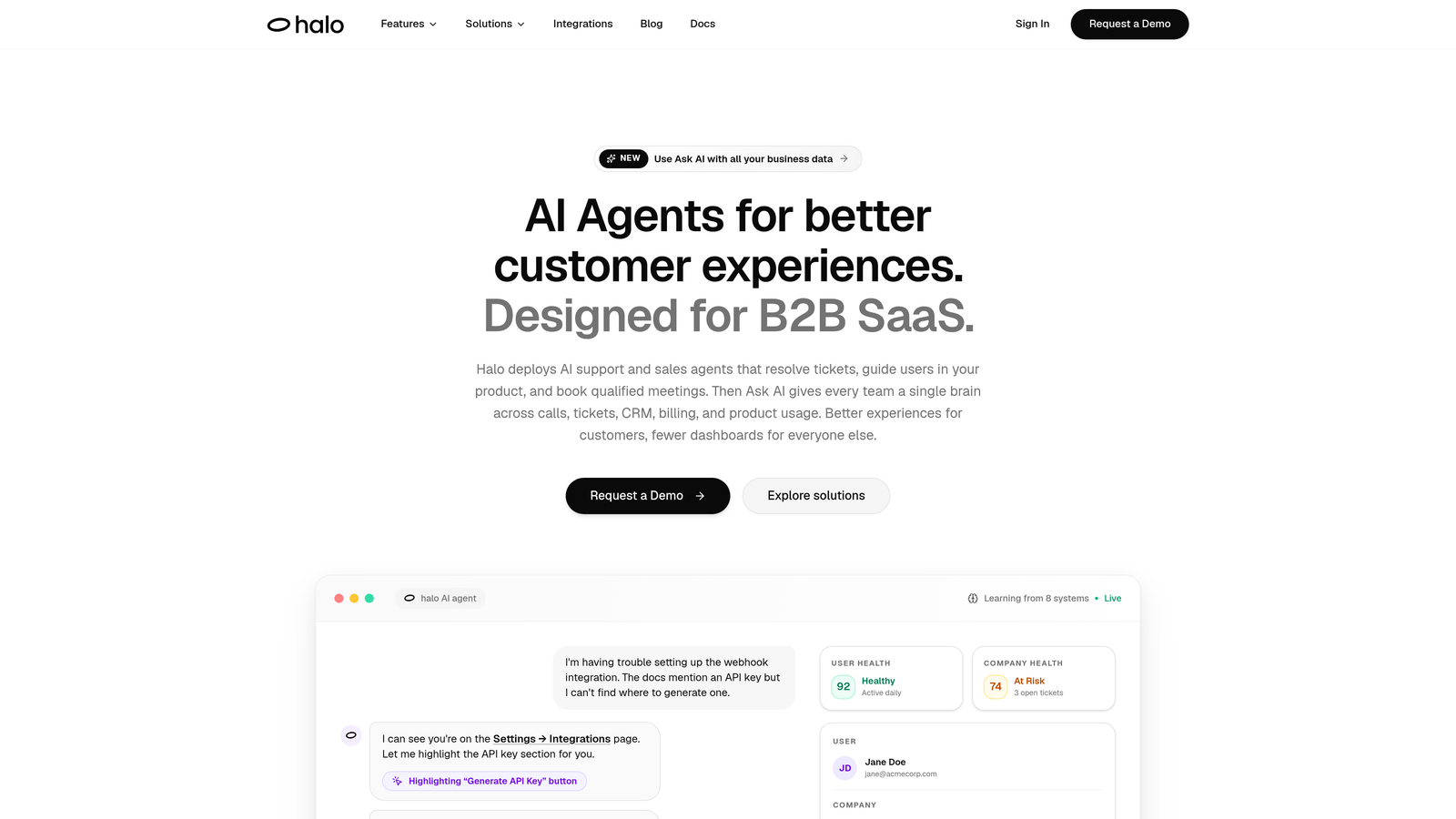
Halo AI is an AI-first customer support platform that deploys intelligent agents to resolve tickets, guide users through your product with page-aware context, and surface actionable business intelligence from every support interaction.
Where This Tool Shines
Most AI support tools are bolt-ons: you take an existing helpdesk, add an AI layer, and hope the seams don't show. Halo is built differently. The entire architecture is designed around AI-first operation, which means the agents aren't just suggesting replies to humans—they're resolving tickets autonomously and escalating only when a human touch is genuinely needed.
What makes Halo particularly compelling for SaaS teams is the page-aware context. The chat widget literally sees what your user sees, so instead of generic guidance, users get visual, step-by-step help that's specific to the page or feature they're on. Pair that with auto bug ticket creation and a smart inbox that surfaces churn signals and revenue intelligence, and you're getting more than a support tool—you're getting a continuous feedback loop into your product.
Key Features
Page-Aware Chat Widget: The widget understands which page and feature a user is on, delivering contextual visual guidance rather than generic help center links.
Auto Bug Ticket Creation: Automatically generates bug reports in Linear and other dev tools directly from support conversations, closing the loop between customer issues and engineering.
Smart Inbox with Business Intelligence: Goes beyond ticket management to surface customer health signals, revenue intelligence, and anomaly detection from support data patterns.
Continuous Learning: Every resolved interaction improves the agent's future performance, so resolution quality compounds over time rather than plateauing.
Deep SaaS Stack Integrations: Connects natively with Linear, Slack, HubSpot, Intercom, Stripe, Zoom, PandaDoc, and Fathom—covering the tools SaaS teams actually use.
Best For
B2B SaaS companies that have outgrown their helpdesk's bolt-on AI and want a purpose-built platform. Especially valuable for product-led growth teams where onboarding friction and feature adoption are as important as ticket resolution speed. Also a strong fit for teams that want support data to feed into product and revenue decisions.
Pricing
Contact for pricing. Halo is designed for B2B SaaS teams scaling support operations and offers custom packages based on team size and usage.
2. Intercom with Fin AI
Best for: SaaS teams already invested in Intercom's messenger ecosystem who want AI resolution layered on top
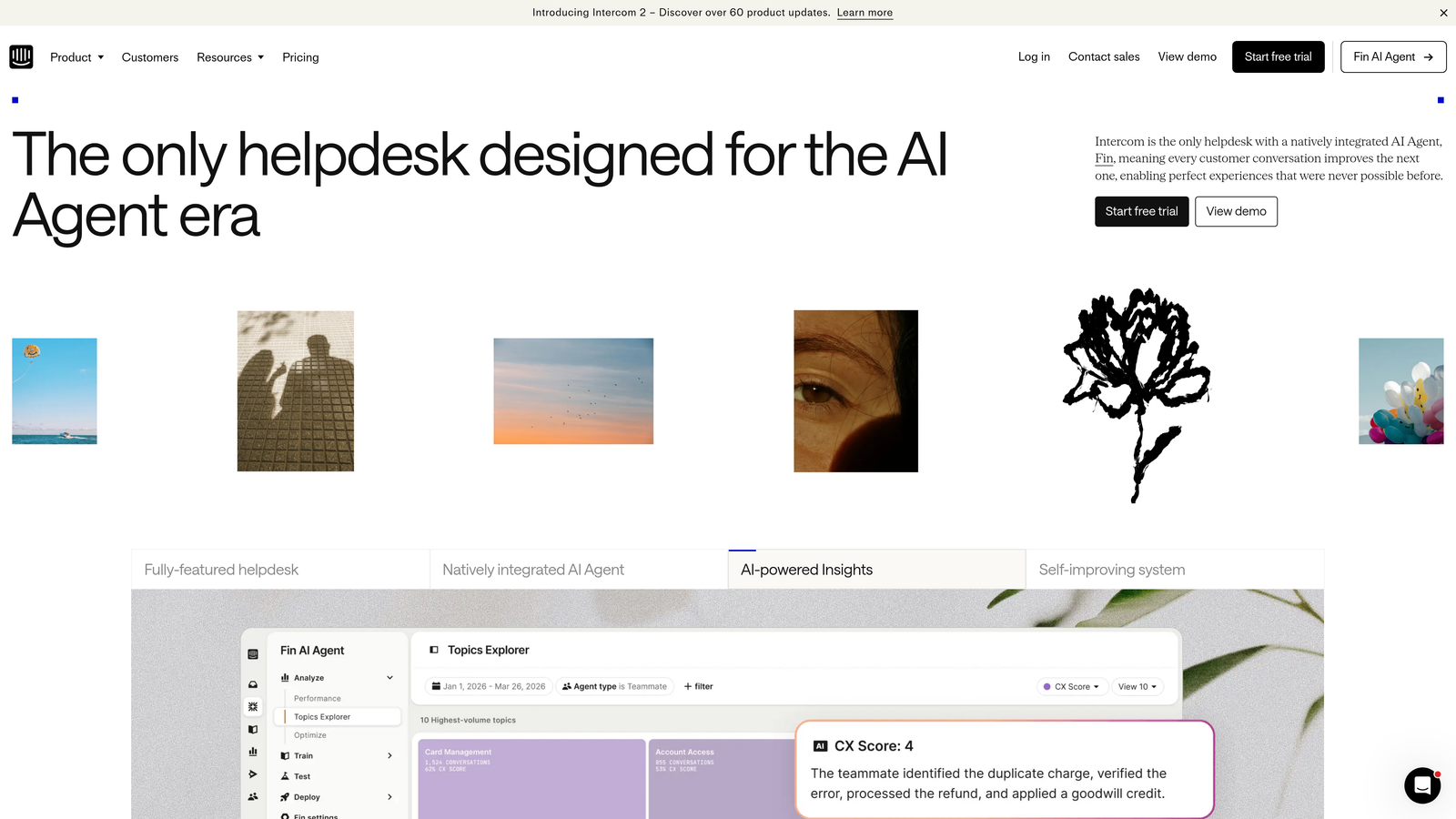
Intercom is a messenger-first customer platform whose Fin AI agent uses your existing help center content to autonomously resolve support questions before they reach a human agent.
Where This Tool Shines
Fin AI's biggest advantage is how quickly it can get to work. If you already have a populated Intercom knowledge base, Fin trains on that content and starts resolving conversations almost immediately. There's no lengthy implementation or complex workflow configuration required to see early results.
Beyond Fin, Intercom's broader platform is genuinely strong for SaaS: product tours, in-app tooltips, and proactive messaging make it a natural fit for teams that want to handle onboarding and support from a single platform. The unified messenger experience across chat, email, and in-app channels is a real operational advantage for growing teams.
Key Features
Fin AI Agent: Trained on your help center content to resolve incoming questions autonomously, with clear handoff to human agents when needed.
Unified Messenger: Manages conversations across chat, email, and in-app channels from a single interface.
Product Tours and Tooltips: Built-in in-app onboarding tools that reduce the support burden before it starts.
Custom Bots and Workflow Automation: Visual builder for creating custom conversation flows and automating routine routing tasks.
AI Resolution Reporting: Tracks resolution rates and conversation quality so you can measure Fin's actual impact over time.
Best For
SaaS companies that are already using Intercom for customer communication and want to add AI resolution without switching platforms. Also strong for teams that want onboarding and support handled in one tool.
Pricing
Essential plan starts at $39/seat/month. Fin AI is charged on a per-resolution basis, so costs scale with usage rather than being a flat add-on fee.
3. Zendesk AI
Best for: Enterprise SaaS teams with complex, multi-channel support operations and high ticket volumes
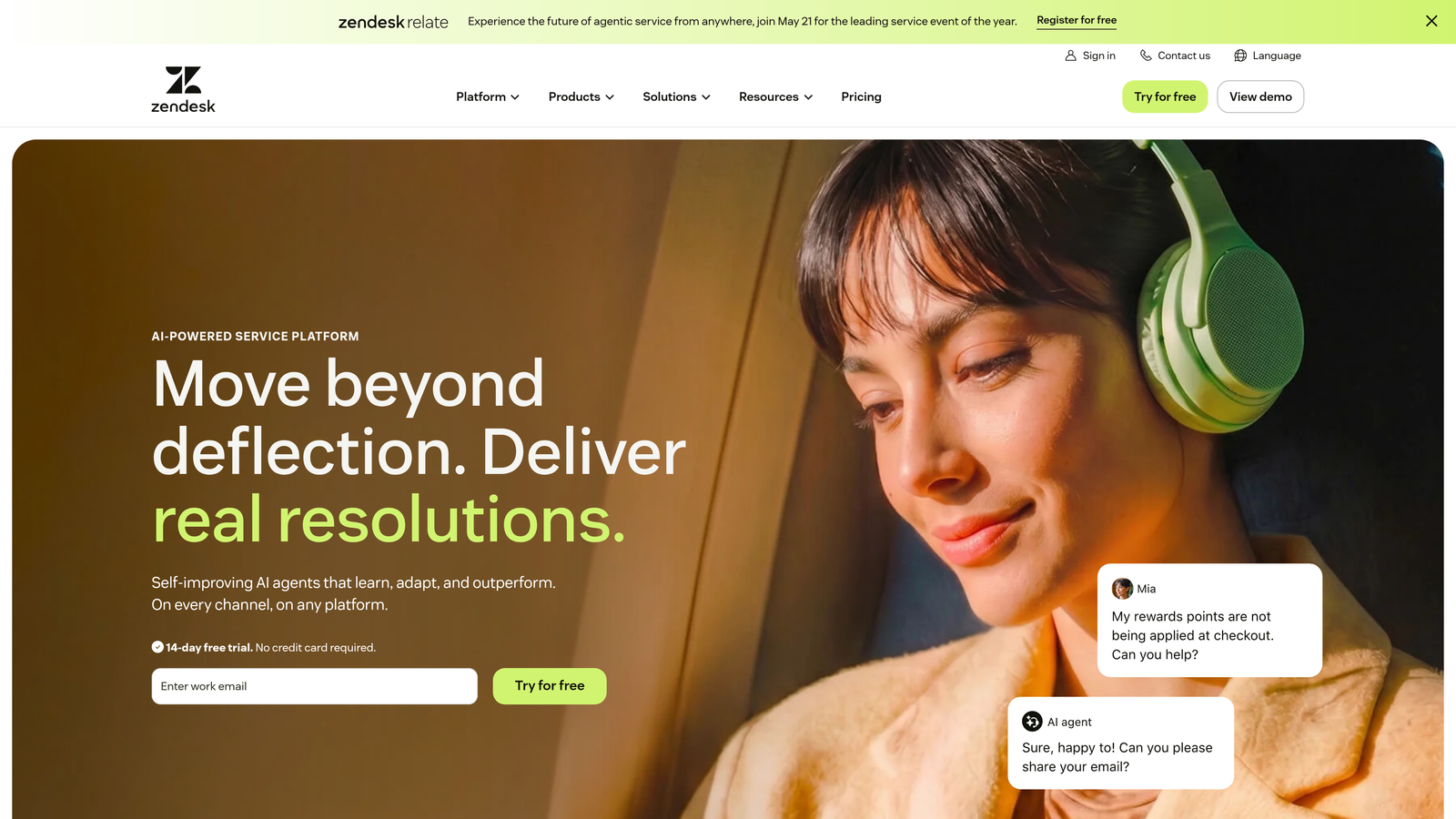
Zendesk is a mature enterprise helpdesk platform that has layered AI-powered intent detection, intelligent routing, and an agent copilot onto its already extensive multi-channel support infrastructure.
Where This Tool Shines
Zendesk's strength is breadth. If your support operation spans email, chat, phone, social, and messaging—and you need all of it managed in one place with enterprise-grade reliability—very few platforms can match it. The AI features, particularly the agent copilot with suggested replies and next-best-action recommendations, are genuinely useful for reducing handle time on complex tickets.
The integration marketplace is also a serious differentiator. With over 1,500 apps, Zendesk can connect to almost anything in your stack without custom development. For enterprise teams with complicated existing toolchains, that flexibility matters more than it might seem.
Key Features
AI Intent Detection: Automatically classifies incoming tickets by intent and routes them to the right team or workflow without manual triage.
Agent Copilot: Surfaces suggested replies and next-best-action recommendations to help human agents resolve tickets faster and more consistently.
1,500+ App Marketplace: Extensive integration ecosystem covering virtually every tool category relevant to SaaS support operations.
Multi-Channel Support: Unified management of email, chat, phone, social, and messaging from a single platform.
Advanced Analytics: Custom reporting dashboards with deep visibility into team performance, resolution metrics, and channel-level data.
Best For
Enterprise SaaS companies with large, distributed support teams and complex multi-channel operations. Less ideal for early-stage startups due to cost and configuration overhead, but hard to beat at scale.
Pricing
Suite Team starts at $55/agent/month. Advanced AI features are available on higher-tier plans, which adds to the total cost for teams that want the full AI capability set.
4. Freshdesk with Freddy AI
Best for: Startups and SMBs that need solid AI-assisted support without enterprise-level pricing
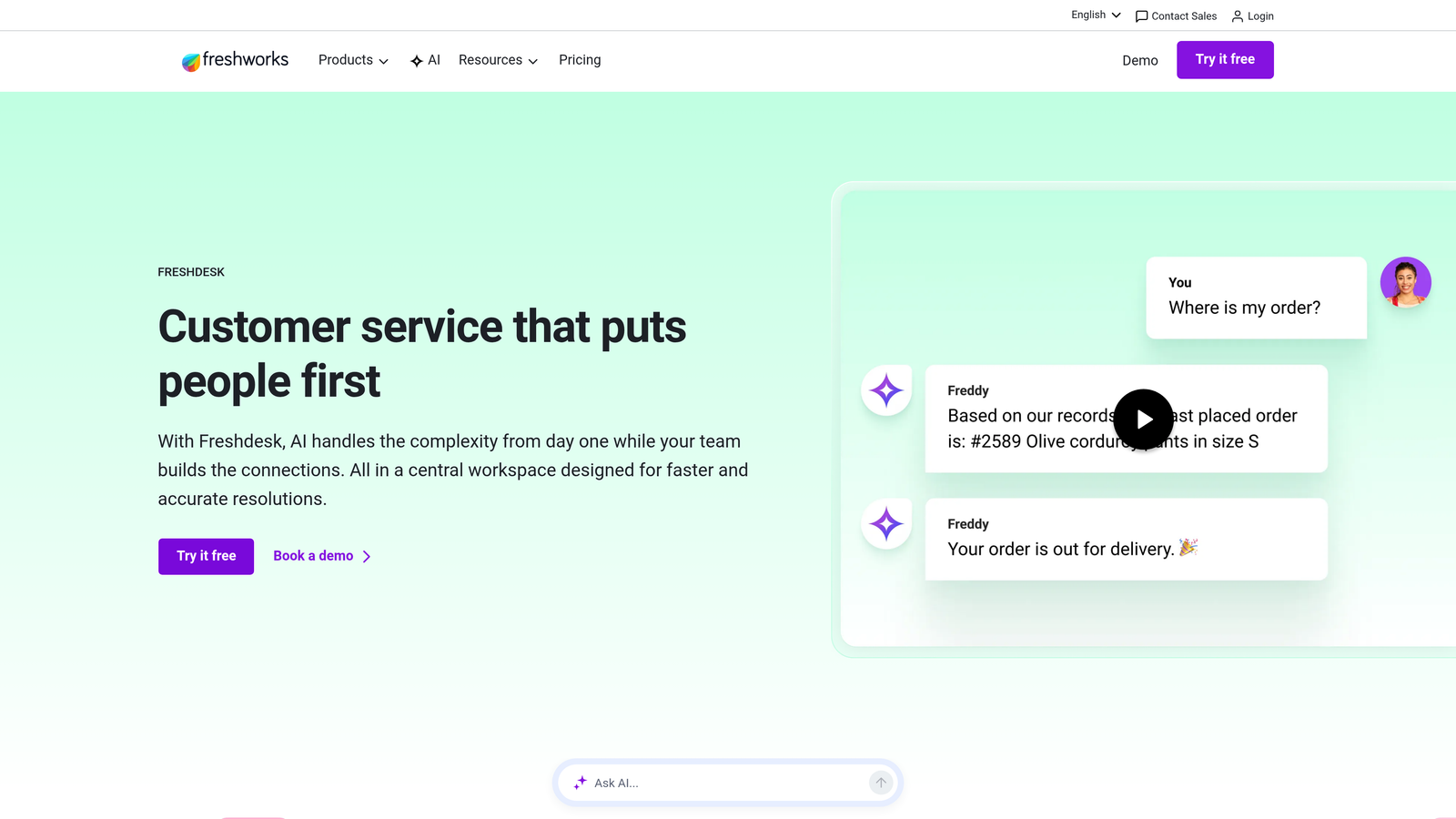
Freshdesk is a cost-effective helpdesk platform with Freddy AI handling auto-triage, suggested responses, and self-service chatbots—making it one of the most accessible AI-powered options for teams watching their budget.
Where This Tool Shines
Freshdesk's value proposition is straightforward: you get a capable helpdesk with AI features at a price point that doesn't require a procurement process. The free tier supporting up to two agents is genuinely useful for very early-stage teams, and the paid plans remain competitive even as you scale into the SMB range.
Freddy AI handles the fundamentals well—ticket classification, priority assignment, and suggested responses reduce the manual work on routine tickets without requiring heavy configuration. The no-code chatbot builder is accessible enough for non-technical team members to maintain, which matters for smaller teams without dedicated ops resources.
Key Features
Freddy AI Triage: Automatically classifies incoming tickets by type and assigns priority levels, reducing manual sorting work for agents.
AI-Suggested Responses: Surfaces relevant response suggestions to agents based on ticket content and historical resolutions.
No-Code Chatbot Builder: Visual self-service bot builder that non-technical team members can configure and update independently.
Free Tier: Supports up to two agents with core helpdesk functionality—rare in a market where most tools require paid plans from day one.
SaaS Tool Integrations: Marketplace connections to common SaaS tools cover most standard workflow needs without custom development.
Best For
Early-stage SaaS startups and SMBs that need a reliable helpdesk with AI assistance but aren't ready for enterprise pricing. Also a good fit for teams migrating off manual email-based support for the first time.
Pricing
Free tier available for up to two agents. Paid plans start at $15/agent/month, making this one of the more affordable options on this list.
5. Ada
Best for: Teams that want an AI agent focused on taking action, not just answering questions
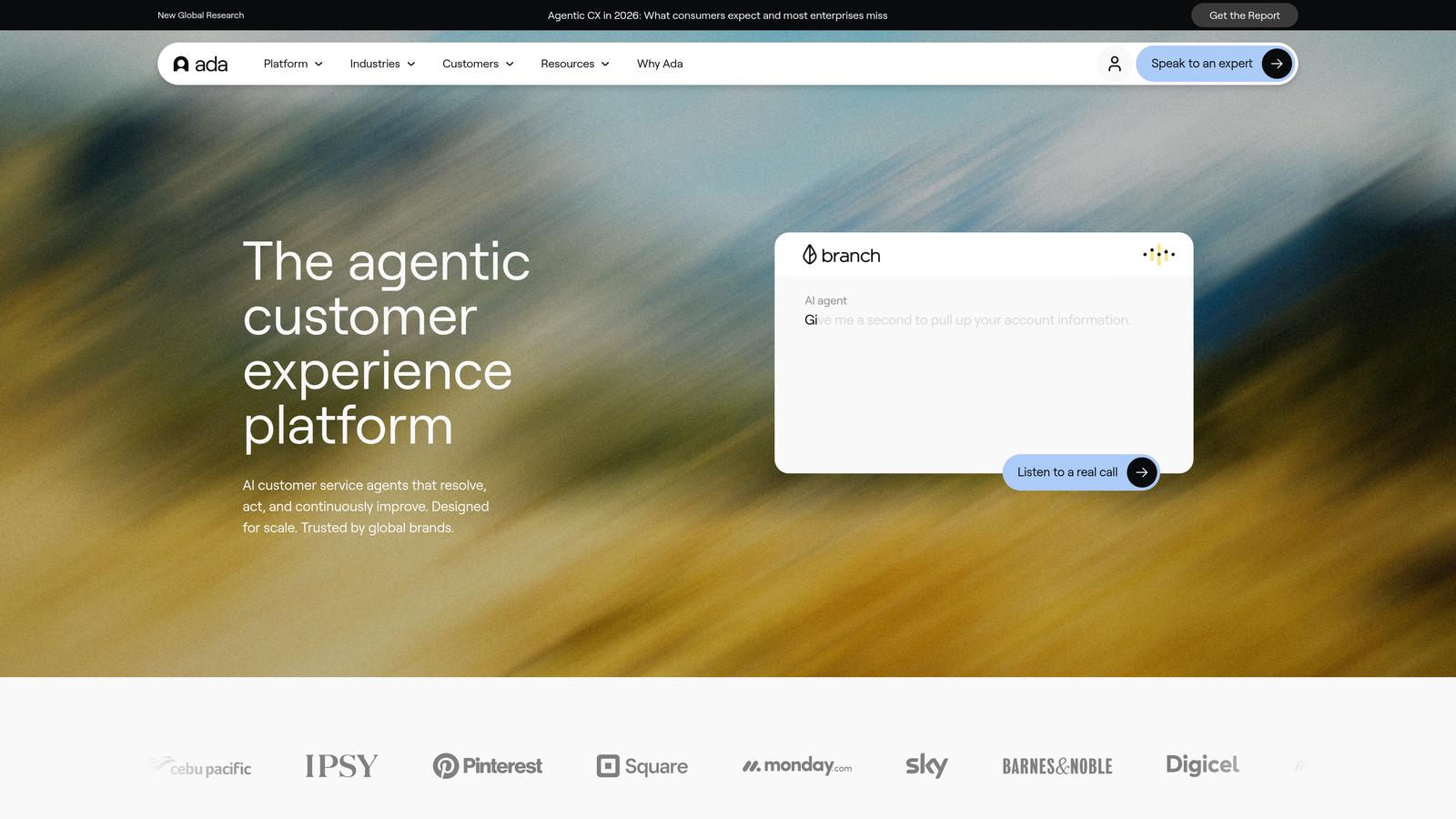
Ada is a dedicated AI agent platform built around autonomous resolution—its agents don't just surface information, they take actions like processing refunds, updating account details, and managing requests across integrated systems.
Where This Tool Shines
The distinction Ada draws between "deflection" and "resolution" is meaningful. Many AI support tools route customers to a help article and call it a win. Ada's agents are designed to complete the task: if a user needs a refund, the agent processes it. If an account needs updating, the agent updates it. That action-oriented approach changes the math on what AI support can actually accomplish.
Ada also works as an AI layer on top of existing helpdesks rather than requiring a full platform migration. If you're invested in Zendesk or Salesforce but want to add genuine AI resolution capability on top, Ada can sit in front of those systems without replacing them.
Key Features
Action-Taking AI Agent: Goes beyond answering questions to complete tasks—processing refunds, updating accounts, managing requests through integrated systems.
No-Code Conversation Builder: Visual workflow builder for creating custom conversation paths without engineering involvement.
Multilingual Support: Handles conversations in 50+ languages, making it a strong option for SaaS companies with global customer bases.
Helpdesk Integration Layer: Deploys as an AI layer on top of existing platforms like Zendesk and Salesforce, preserving your current infrastructure investment.
Resolution-Based Analytics: Measures actual resolution rates rather than just deflection metrics, giving you a clearer picture of AI performance.
Best For
Mid-market and enterprise SaaS companies that want action-capable AI agents and have global customer bases requiring multilingual support. Particularly valuable for teams that want to enhance an existing helpdesk rather than replace it.
Pricing
Custom pricing based on automated resolution volume. Expect enterprise-level investment; Ada is oriented toward teams with meaningful ticket volume where resolution automation generates clear ROI.
6. Tidio
Best for: Small SaaS teams that want fast AI chat deployment without complex setup or high costs
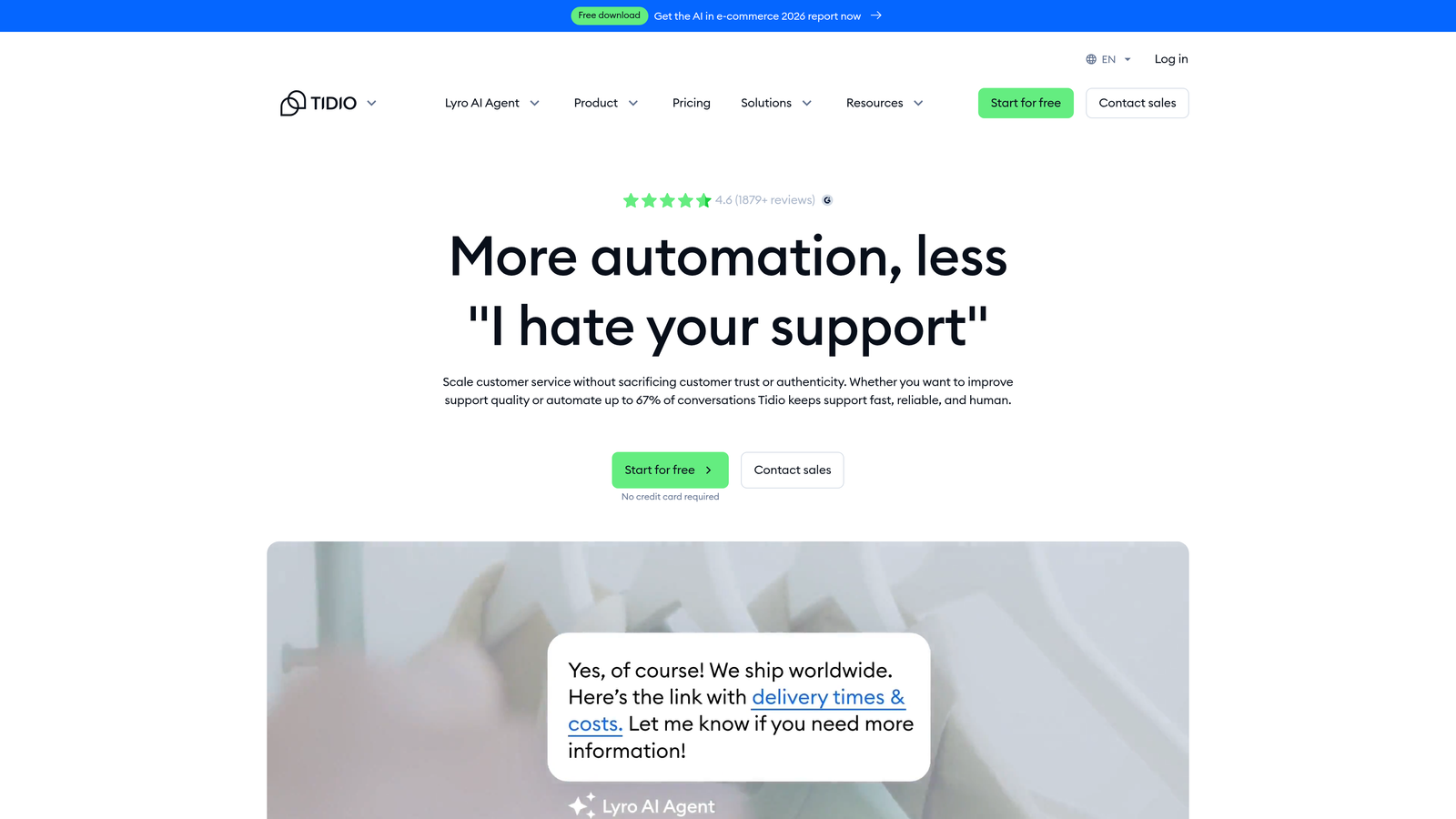
Tidio combines live chat and AI chatbot functionality in a single widget, with its Lyro AI learning from your FAQ and knowledge base content to handle common questions automatically.
Where This Tool Shines
Speed of deployment is Tidio's headline feature. For a small SaaS team that needs AI-powered chat on their site or in-app quickly—without a lengthy implementation project—Tidio can be live in minutes. Lyro AI's ability to auto-learn from existing FAQ content means you're not starting from scratch on training data.
The combined live chat and AI chatbot in one widget is a practical advantage for small teams. You're not managing two separate tools or juggling handoffs between systems—everything lives in one place, which simplifies both the agent experience and the customer experience.
Key Features
Lyro AI Chatbot: Automatically learns from your FAQ and knowledge base content to handle common questions without manual conversation design.
Visual Flow Builder: Drag-and-drop builder for creating custom conversation paths and escalation logic.
Unified Chat Widget: Combines live chat and AI chatbot in a single widget, eliminating the need to manage separate tools.
Fast Setup: Can be deployed and live in minutes, making it one of the fastest paths to AI-assisted support on this list.
Visitor Tracking and Analytics: Basic visitor tracking and conversation analytics to understand who's engaging and what they're asking about.
Best For
Small SaaS teams and early-stage startups that want AI-powered chat without heavy investment in setup, training, or ongoing maintenance. Best suited for companies with relatively straightforward support needs rather than complex technical workflows.
Pricing
Free plan available. Lyro AI starts at $39/month for 50 conversations, with higher-volume plans available as your conversation needs grow.
7. Forethought
Best for: SaaS teams that want AI across the full support lifecycle, from triage through workflow intelligence
Forethought is a modular AI platform with separate products for autonomous ticket resolution (Solve), real-time agent assistance (Assist), and workflow intelligence (Discover)—covering every stage of the support operation.
Where This Tool Shines
Forethought's modular approach is its defining characteristic. Rather than a single AI layer, you get purpose-built AI for each phase of the support workflow. Solve handles autonomous resolution. Assist surfaces real-time suggestions and knowledge for human agents mid-conversation. Discover analyzes patterns to identify workflow bottlenecks and trending issues before they become systemic problems.
The SupportGPT foundation means conversations feel natural rather than scripted, which matters for SaaS customers who have high expectations for how AI should communicate. The pre-built integrations with Zendesk and Salesforce also make it a strong enhancement layer for teams already on those platforms.
Key Features
Solve: Autonomous AI agent that handles ticket resolution end-to-end without human involvement for qualifying conversations.
Assist: Real-time AI suggestions and knowledge surfacing for human agents during live conversations, reducing research time and improving consistency.
Discover: AI-driven workflow analysis that identifies bottlenecks, trending issues, and optimization opportunities across your support operation.
SupportGPT: Generative AI foundation that enables natural, context-aware conversations rather than rigid scripted responses.
Helpdesk Integrations: Pre-built connections to Zendesk, Salesforce, and other major helpdesk platforms for straightforward deployment.
Best For
Mid-market and enterprise SaaS companies that want comprehensive AI coverage across their support operation, not just a single-point solution. Especially valuable for teams already using Zendesk or Salesforce who want to add sophisticated AI without a platform migration.
Pricing
Custom pricing based on ticket volume and which modules you select. Contact Forethought for a quote tailored to your support scale and use case.
8. Help Scout
Best for: SaaS teams that prioritize a clean, human-centric agent experience with AI as a productivity layer
Help Scout is a support platform built around a clean shared inbox and in-app Beacon widget, with AI features focused on drafting, summarizing, and translating to help agents work faster without replacing the human element.
Where This Tool Shines
Help Scout takes a deliberately different philosophy from AI-first platforms. Rather than pushing toward full autonomy, it uses AI to make human agents more effective: drafting responses, summarizing long conversation threads, and translating messages across languages. For teams where human judgment and relationship quality are central to the support experience, that approach is a feature, not a limitation.
The Beacon widget is well-designed for SaaS in-app support, offering self-service access to the Docs knowledge base alongside live chat. The overall interface is one of the cleanest in the category, which reduces agent training time and tends to improve adoption compared to more complex platforms.
Key Features
AI Draft, Summarize, and Translate: Built-in AI tools that help agents craft responses, get up to speed on conversation history, and handle multilingual tickets without leaving the inbox.
Beacon Widget: In-app widget that surfaces self-service knowledge base content and live chat in a clean, user-friendly interface.
Docs Knowledge Base: Integrated knowledge base with AI-powered search to help users find answers before they open a ticket.
Clean Shared Inbox: Intentionally simple interface that prioritizes agent experience and reduces the cognitive load of managing high conversation volumes.
CSAT Surveys and Reporting: Built-in customer satisfaction measurement and reporting to track support quality over time.
Best For
SaaS teams that value agent experience and relationship-driven support over full automation. A strong fit for companies where support quality is a differentiator and where the goal is AI-assisted humans rather than AI-replaced humans.
Pricing
Standard plan starts at $25/user/month. Straightforward per-seat pricing with no separate AI add-on fees on standard plans.
9. Drift (by Salesloft)
Best for: SaaS teams that want AI handling support and sales conversations from the same platform
Drift is a conversational AI platform that intentionally blurs the line between support and sales, deploying AI chatbots that handle support questions while simultaneously qualifying and routing leads.
Where This Tool Shines
Drift occupies a unique position on this list: it's less a pure support tool and more a revenue-focused conversational platform that also handles support. If your SaaS business has meaningful overlap between support conversations and sales opportunities—think free trial users hitting friction points, or customers asking questions that signal upgrade intent—Drift's architecture is designed to capture that value.
The CRM integrations with Salesforce and HubSpot are deep enough that sales teams can act on signals generated by support conversations without manual data transfer. For companies that see support as part of the revenue motion, that connectivity is genuinely useful.
Key Features
Dual-Purpose AI Chatbots: Handles both support questions and sales conversations within the same conversational flow, reducing the need for separate tools.
Lead Qualification and Routing: Built-in logic to qualify visitors and route high-intent leads to the right sales rep in real time.
CRM Integrations: Deep connections with Salesforce and HubSpot ensure conversation data flows directly into revenue systems.
Conversational Landing Pages: Targeted conversation experiences for specific campaigns or audience segments.
Revenue Attribution: Analytics that connect conversational interactions to pipeline and revenue outcomes, not just support metrics.
Best For
Mid-market and enterprise SaaS companies with strong alignment between support and sales functions, particularly those running product-led growth motions where trial users frequently convert to paid customers through support interactions.
Pricing
Custom pricing oriented toward mid-market and enterprise buyers. Contact Salesloft for a quote based on your team size and use case.
How to Choose the Right AI Support Tool for Your SaaS
The honest answer is that the right tool depends on where you are and what you're optimizing for. But a few patterns emerge when you look across this list.
If you're an early-stage startup with a small team and a tight budget, Freshdesk or Tidio give you a functional starting point without requiring significant investment. You'll grow out of them eventually, but they'll get you off manual email support and give you a foundation to build on.
If you're scaling and want AI that genuinely resolves tickets rather than deflecting them, the comparison narrows to platforms built around autonomous resolution. Halo AI stands out for SaaS teams specifically because of the page-aware context, the business intelligence layer, and the continuous learning architecture—it's not just resolving tickets, it's feeding insights back into your product and revenue operations. Ada is a strong alternative if you need action-taking AI on top of an existing helpdesk. Forethought is worth evaluating if you want modular AI coverage across triage, agent assist, and workflow intelligence simultaneously.
If you're an enterprise with multi-channel complexity and a large agent team, Zendesk's breadth and integration marketplace are hard to argue with, even if the AI features aren't the most cutting-edge on this list.
A few questions worth asking any vendor before you commit: What's the actual resolution rate, not the deflection rate? How does the AI improve over time, and what does that process look like? What does the integration with your specific stack look like in practice, not just on the features page?
Your support team shouldn't scale linearly with your customer base. Let AI agents handle routine tickets, guide users through your product, and surface business intelligence while your team focuses on complex issues that need a human touch. See Halo in action and discover how continuous learning transforms every interaction into smarter, faster support.